


 |
市場調查報告書
商品編碼
2121410
輻射探測、監測和安全:市場佔有率分析、行業趨勢和統計數據以及成長預測(2026-2031 年)Radiation Detection, Monitoring, And Safety - Market Share Analysis, Industry Trends & Statistics, Growth Forecasts (2026 - 2031) |
||||||

※ 本網頁內容可能與最新版本有所差異。詳細情況請與我們聯繫。
據 Mordor Intelligence 稱,輻射探測、監測和安全領域的市場規模預計在 2026 年達到 38.5 億美元,高於 2025 年的 36.2 億美元,預計到 2031 年將達到 52.3 億美元。
預計從 2026 年到 2031 年,其複合年成長率將達到 6.32%。
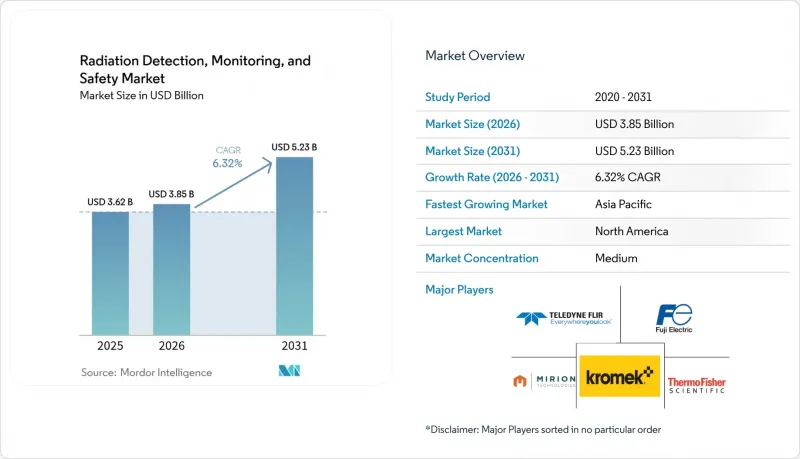
本報告按產品類型(檢測、監測和安全)、檢測技術(氣體填充、閃爍等)、終端用戶產業(醫療保健、能源電力、國防安全保障與國防、工業等)以及地區(北美、南美、歐洲等)進行細分。市場預測以美元計價。
輻射探測、監測和安全市場的全球趨勢和見解。
癌症和慢性病發生率增加
預計到2050年,全球整體癌症病例將達到3,500萬例,將擴大精密劑量測定系統的市場需求。目前,放射治療領域需要亞毫秒的束流監測精度,因此,能夠捕捉劑量率高頻波動的半導體檢測器備受青睞。自適應治療計畫平台不斷增加資料產生量,臨床醫師也擴大利用即時回饋迴路來調整分次劑量。因此,醫療機構正在為多通道劑量檢驗架、冗餘場校準器和基於雲端的劑量配準軟體等設備累計,而這項生態系統正在推動輻射探測、監測和安全市場的擴張。供應商的策略重點是模組化檢測器頭,以提高線性加速器的運作和人工智慧驅動的品質保證(QA)儀表板。
擴展核子醫學和放射治療技術
2024年,核醫檢測量較去年同期成長12%,主要得益於錒-225和鎦-177等治療診斷同位素的應用。放射性藥物中心需要配備機載α粒子監測器、用於熱室的γ射線譜儀以及可與設施實驗室資訊管理系統(LIMS)資料庫自動同步的個人劑量計。分散式迴旋加速器網路靠近患者群體,增加了屏蔽櫃、去污通道和洩漏測試套件的採購點。基於美國FDA《聯邦法規》第21篇第361部分(21 CFR Part 361)的標準化要求制定了同位素特異性校準規程,從而確保了檢測器重新校準提供服務業者的持續外包機會。這些趨勢正在推高平均售價(ASP),並擴大售後市場的收入前景。
跨多個司法管轄區嚴格合規的負擔
檢測器OEM製造商必須獲得FDA 510(k)申請批准、滿足IEC 60601-2-45性能指標並獲得CE認證,每項認證都需要進行單獨的生物相容性、電磁相容性和輻射模式測試。僅文檔工作就大幅增加了研發預算,迫使小規模創新者轉向授權許可和利基學術市場。並行認證流程阻礙了韌體的快速更新,並減緩了已部署設備在多個國家/地區的功能部署。因此,從設計到應用的週期已延長至四年以上,降低了新技術投資的淨現值(NPV),並減緩了輻射探測、監測和安全市場短期利潤成長的動能。
細分市場分析
到2025年,檢測和監測系統將佔銷售額的50.74%,並成為醫院、公共產業和國防機構採購預算的基礎,這些機構需要持續檢驗輻射劑量狀況。就輻射檢測、監測和安全市場規模而言,預計檢測平台將與預測分析模組(用於建議預防性維護週期)一起成長。安全設備(包括鉛襯防護衣服、去污室和自動隔離門)的複合年成長率 (CAGR) 為7.55%,高於歷史平均水平,這主要得益於ISO 2919防護設備標準的統一化。整合即時伽馬射線探頭和電動屏蔽簾的解決方案可縮短從警報到隔離的時間,並提高ALARA(盡可能合理減少輻射劑量)原則的遵守度。供應商正在利用交叉銷售協同效應。例如,訂購閃爍探頭的醫院通常也會同時訂購劑量計,而核子反應爐操作員則將外圍通道劑量計和就地避難通風系統作為成套設備銷售。由於監管要求提高了採購的緊迫性,價格彈性仍然不高,這確保了輻射探測、監測和安全行業高階產品的穩定銷售。
增強的雲端儀錶板功能、地理標記警報視覺化、基於角色的存取控制以及自動化合規報告生成,使檢測設備超越了普通商品的範疇。 SaaS 解決方案的毛利率遠高於硬體,從而促進了獨立於硬體的生態系統的形成。因此,通路合作夥伴越來越傾向於儲備整合 NaI(Tl)、CZT 和中子模組的多重通訊協定閘道器,這些閘道器整合到單一的監控人機介面 (HMI) 中。即時分析進一步減少了誤報,並降低了採取成本高昂的疏散措施的必要性。這些高價值解決方案鞏固了檢測解決方案在更廣泛的輻射檢測、監測和安全市場的主導地位。
區域分析
預計到2025年,北美將繼續保持其在銷售額方面的領先地位,增幅達30.05%。這反映了北美成熟的核能發電廠、完善的國防安全保障基礎設施以及快速發展的醫療保健系統。美國國家實驗室正在投入研發津貼,致力於小型化碲鋅鎘(CZT)檢測器;加拿大自然資源部(NRCan)則津貼研究核子反應爐環境監測設備的升級改造。墨西哥放射性藥物出口的不斷成長進一步推高了同位素生產用熱室監測器的需求。基於ANSI N42標準的跨境標準化正在提升儀器的互通性,從而增強該地區輻射探測、監測和安全市場的規模經濟效益。
亞太地區正處於最快的成長軌道上,年複合成長率高達8.05%,這主要得益於中國計畫在2060年運作150座核子反應爐。北京「中國製造2025」政策中強制推行的在地化生產,正在刺激碲鋅鎘(CZT)晶片製造的合資企業,降低進口關稅,並緩解供應鏈的脆弱性。在日本,福島第一核電事故事故後的管理體制正在資助建造覆蓋核子反應爐周圍20公里的伽馬射線探測網;而印度核能部則在資助二線城市癌症治療病房使用低成本輻射探測器。在韓國,18兆電子伏迴旋加速器網路的擴建進一步擴大了覆蓋醫院的數量,鞏固了亞太地區作為全球輻射探測、監測和安全市場成長引擎的地位。
在歐洲,德國、比利時和西班牙的除役計畫帶動了對機載α輻射監測器和廢棄物桶分析系統等專業設備需求的均衡成長。法國核能發電佔比高,正致力於核電廠延壽維修,這些改造必須符合法國核安局(ASN)嚴格的地震風險標準。 《歐洲核子轉移公約》(Eurotom Convention)規範了採購標準,使得利用多年預算週期簽訂大規模跨國合約成為可能。在中歐和東歐國家,蘇聯時期研究核子反應爐的現代化改造正在推進,由此產生了包含配套培訓服務的承包檢測系統的需求。
儘管非洲地區仍在發展中,但隨著戰略港口引入中子貨物掃描儀以及使用迴旋加速器的放射性藥物實驗室開始運作,新興地區的輻射探測、監測和安全市場已顯示出中期成長的跡象。
其他好處:
- Excel格式的市場預測(ME)表
- 3個月的分析師支持
目錄
第1章:引言
- 研究假設和市場定義
- 調查範圍
第2章:調查方法
第3章執行摘要
第4章 市場狀況
- 市場概覽
- 市場促進因素
- 癌症和慢性病發生率上升
- 核子醫學和放射治療程序的擴展
- 監管部門為實現即時環境監測所做的努力
- 小型化且相容物聯網的劑量計
- 利用無人機進行大面積放射線測繪
- 全球老舊核子反應爐除役
- 市場限制因素
- 跨多個司法管轄區的嚴重合規負擔
- 持證輻射負責人短缺
- 光譜級檢測器。
- 氦-3閃爍晶體的供應鏈變異性
- 產業價值鏈分析
- 宏觀經濟因素對市場的影響
- 監理情勢
- 技術展望
- 波特五力分析
第5章 市場規模與成長預測
- 依產品類型
- 檢測和監測
- 安全
- 透過檢測技術
- 充氣式(蓋革-米勒計數器、比例計數器、電離室)
- 閃爍體(NaI(Tl)、CsI、LaBr3、塑膠)
- 半導體(HPGe、CZT、SiPM)
- 個人劑量計(TLD、OSL、電子式)
- 按最終用戶行業分類
- 醫療保健
- 能源與電力(核能、常規電力)
- 國防安全保障/國防部
- 工業(石油和天然氣、採礦、製造業)
- 研究和學術機構
- 按地區
- 北美洲
- 美國
- 加拿大
- 墨西哥
- 南美洲
- 巴西
- 阿根廷
- 其他南美國家
- 歐洲
- 德國
- 英國
- 西班牙
- 俄羅斯
- 其他歐洲國家
- 亞太地區
- 中國
- 日本
- 印度
- 韓國
- 其他亞太國家
- 中東和非洲
- 中東
- 沙烏地阿拉伯
- 阿拉伯聯合大公國
- 其他中東國家
- 非洲
- 南非
- 埃及
- 其他非洲國家
- 中東
- 北美洲
第6章 競爭情勢
- 市場集中度
- 策略趨勢
- 市佔率分析
- 公司簡介
- Mirion Technologies Inc.
- Thermo Fisher Scientific Inc.
- Teledyne FLIR LLC
- Fuji Electric Co., Ltd.
- Unfors RaySafe AB
- Arktis Radiation Detectors Ltd.
- Kromek Group plc
- Berthold Technologies GmbH & Co. KG
- Alpha-Spectra, Inc.
- Radiation Detection Company
- Centronic Ltd.
- Burlington Medical LLC
- Amray Group Ltd.
- Atomtex SPE
- Polimaster Ltd.
- Smiths Detection Group Ltd.
- Ludlum Measurements, Inc.
- Hitachi-Aloka Medical, Ltd.
- General Atomics Electronic Systems
- Else Nuclear srl
- Silena Group srl
第7章 市場機會與未來展望
According to Mordor Intelligence, the radiation detection, monitoring, and safety market size in 2026 is estimated at USD 3.85 billion, growing from 2025 value of USD 3.62 billion with 2031 projections showing USD 5.23 billion, growing at 6.32% CAGR over 2026-2031.
This report is Segmented by Product Type (Detection and Monitoring and Safety), Detector Technology (Gas-Filled, Scintillation, and More), End-User Industry (Medical and Healthcare, Energy and Power, Homeland Security and Defence, Industrial, and More), and Geography (North America, South America, Europe, and More). The Market Forecasts are Provided in Terms of Value (USD).
Global Radiation Detection, Monitoring, And Safety Market Trends and Insights
Rising Incidence of Cancer and Chronic Diseases
Cancer prevalence is climbing toward 35 million global cases by 2050, enlarging the addressable base for precision dosimetry systems.Radiotherapy departments now specify sub-millisecond beam-monitoring accuracy, favoring semiconductor detectors that capture high-frequency fluctuations in dose rate. Adaptive treatment planning platforms amplify data-generation volumes, and clinicians increasingly rely on real-time feedback loops to tune fractionated doses. Health systems, therefore, budget for multi-channel dose-verification racks, redundant field calibrators, and cloud-hosted dose-registry software, an ecosystem that broadens the radiation detection, monitoring, and safety market. Vendor strategies focus on modular detector heads and AI-assisted QA dashboards that enhance linear-accelerator uptime.
Expanding Nuclear Medicine and Radiotherapy Procedures
Nuclear medicine examinations grew 12% year-over-year in 2024, propelled by theranostic isotopes such as actinium-225 and lutetium-177.Radiopharmaceutical hubs require air-borne alpha-particle monitors, hot-cell gamma spectrometers, and personal dosimeters that auto-synchronize with facility LIMS databases. Decentralized cyclotron networks, positioned closer to patient populations, multiply procurement nodes for shielding cabinets, de-contamination portals, and leak-testing kits. Standardization under U.S. FDA 21 CFR Part 361 obliges isotope-specific calibration protocols, ensuring recurring outsourcing opportunities for detector-recalibration service providers. These trends elevate ASPs (average selling prices) and extend aftermarket revenue visibility.
Stringent Multi-Jurisdictional Compliance Burden
Detector OEMs must clear FDA 510(k) dossiers, satisfy IEC 60601-2-45 performance metrics, and attain CE marking conformity, each requiring discrete biocompatibility, EMC, and radiation pattern tests. Documentation alone inflates research and development budgets, steering smaller innovators toward licensing deals or niche academic markets. Parallel certification tracks hinder agile firmware updates once fielded devices enter multi-country footprints, slowing feature rollouts. The result is elongated design-win cycles that can exceed four years, diluting NPV on new technology investments and tempering near-term revenue acceleration within the radiation detection, monitoring, and safety market.
Other drivers and restraints analyzed in the detailed report include:
- Regulatory Push for Real-Time Environmental Monitoring
- Miniaturization and IoT-Enabled Dosimeters
- Shortage of Certified Radiation Safety Officers
For complete list of drivers and restraints, kindly check the Table Of Contents.
Segment Analysis
Detection and monitoring systems generated 50.74% of 2025 revenue, anchoring procurement budgets for hospitals, utilities, and defense agencies that must continuously validate dose conditions. Within the radiation detection, monitoring, and safety market size, detection platforms are projected to grow alongside predictive analytics modules that recommend proactive maintenance intervals. Safety equipment, encompassing lead-lined apparel, decontamination booths, and automated containment doors, is outpacing historical norms with a 7.55% CAGR, buoyed by harmonized ISO 2919 protective device standards. Integrated offerings that unite real-time g-ray probes with motorized shielding curtains shorten alarm-to-containment times and improve ALARA (as low as reasonably achievable) compliance. Vendors leverage cross-selling synergies: hospitals ordering scintillation probes often append badge-dosimetry subscriptions, while reactor operators bundle perimeter portals with shelter-in-place ventilation systems. Price elasticity remains modest, as regulatory obligations heighten procurement urgency, ensuring premium SKUs maintain a steady pull-through across the radiation detection, monitoring, and safety industry.
The expanded functionality of cloud dashboards, geo-tagged alarm visualization, role-based access, and automated compliance report generation pushes detection gear beyond commodity status. SaaS overlays carry significant gross margin, outstripping hardware rates and encouraging hardware-agnostic ecosystems. Consequently, channel partners favor stocking multi-protocol gateways that integrate NaI(Tl), CZT, and neutron modules under one supervisory HMI. Real-time analytics further reduces false-positive occurrences, trimming costly evacuation incidents. Such value-added solutions reinforce the leadership of detection solutions within the broader radiation detection, monitoring, and safety market.
Complete Report Scope:
- By Product Type
- Detection and Monitoring
- Safety
- By Detector Technology
- Gas-Filled (Geiger-Muller, Proportional, Ion-Chambers)
- Scintillation (NaI(Tl), CsI, LaBr3, Plastic)
- Semiconductor (HPGe, CZT, SiPM)
- Personal Dosimeters (TLD, OSL, Electronic)
- By End-user Industry
- Medical and Healthcare
- Energy and Power (Nuclear, Conventional)
- Homeland Security and Defence
- Industrial (Oil and Gas, Mining, Manufacturing)
- Research and Academic Laboratories
- By Geography
- North America
- United States
- Canada
- Mexico
- South America
- Brazil
- Argentina
- Rest of South America
- Europe
- Germany
- United Kingdom
- Spain
- Russia
- Rest of Europe
- Asia-Pacific
- China
- Japan
- India
- South Korea
- Rest of Asia-Pacific
- Middle East and Africa
- Middle East
- Saudi Arabia
- United Arab Emirates
- Rest of Middle East
- Africa
- South Africa
- Egypt
- Rest of Africa
- Middle East
- North America
Geography Analysis
North America retained a 30.05% revenue lead in 2025, reflecting entrenched nuclear-power fleets, extensive homeland-security infrastructures, and early-adopter healthcare systems. U.S. national laboratories are funneling research and development grants into CZT detector miniaturization, while the Canadian NRCan framework is subsidizing environmental-monitoring upgrades at research reactors. Mexico's expanding radiopharmaceutical exports add incremental volume for isotope-production hot-cell monitors. Cross-border standardization under ANSI N42 enhances equipment interoperability, thereby reinforcing economies of scale within the regional radiation detection, monitoring, and safety market.
Asia-Pacific records the fastest trajectory at an 8.05% CAGR, underwritten by China's plan to commission 150 reactors before 2060. The localization mandate embedded in Beijing's Made-in-China 2025 policy promotes joint-venture fabrication plants for CZT wafers, reducing import tariffs and mitigating supply-chain fragility. Japan's post-Fukushima regulatory regime finances perimeter gamma-ray meshes extending 20 km around reactor sites, while India's Department of Atomic Energy funds low-cost survey meters for cancer-therapy wards in tier-two cities. South Korea's expanding 18-MeV cyclotron network further widens the addressable hospital count, reinforcing the Asia-Pacific region's status as the global growth engine for the radiation detection, monitoring, and safety market.
Europe exhibits balanced growth as decommissioning projects in Germany, Belgium, and Spain create specialized demand for alpha-in-air monitors and waste-drum assay systems. France, maintaining a strong nuclear-electricity share, focuses on life-extension upgrades that must meet ASN's stringent seismic-risk criteria. The Euratom treaty standardizes procurement specifications, enabling cross-border volume contracts that leverage multi-year budget cycles. Central and Eastern European nations, modernizing Soviet-era research reactors, seek turnkey detection suites bundled with training services.
The Middle East and Africa, although nascent, are deploying neutron-cargo scanners at strategic ports and commissioning cyclotron-based radiopharmacy labs, foreshadowing medium-term momentum for the radiation detection, monitoring, and safety market in emerging geographies.
- Mirion Technologies Inc.
- Thermo Fisher Scientific Inc.
- Teledyne FLIR LLC
- Fuji Electric Co., Ltd.
- Unfors RaySafe AB
- Arktis Radiation Detectors Ltd.
- Kromek Group plc
- Berthold Technologies GmbH & Co. KG
- Alpha-Spectra, Inc.
- Radiation Detection Company
- Centronic Ltd.
- Burlington Medical LLC
- Amray Group Ltd.
- Atomtex SPE
- Polimaster Ltd.
- Smiths Detection Group Ltd.
- Ludlum Measurements, Inc.
- Hitachi-Aloka Medical, Ltd.
- General Atomics Electronic Systems
- Else Nuclear s.r.l.
- Silena Group s.r.l.
Additional Benefits:
- The market estimate (ME) sheet in Excel format
- 3 months of analyst support
TABLE OF CONTENTS
1 INTRODUCTION
- 1.1 Study Assumptions and Market Definition
- 1.2 Scope of the Study
2 RESEARCH METHODOLOGY
3 EXECUTIVE SUMMARY
4 MARKET LANDSCAPE
- 4.1 Market Overview
- 4.2 Market Drivers
- 4.2.1 Rising incidence of cancer and chronic diseases
- 4.2.2 Expanding nuclear medicine and radiotherapy procedures
- 4.2.3 Regulatory push for real-time environmental monitoring
- 4.2.4 Miniaturisation and IoT-enabled dosimeters
- 4.2.5 UAV-based wide-area radiation mapping
- 4.2.6 De-commissioning of ageing nuclear reactors worldwide
- 4.3 Market Restraints
- 4.3.1 Stringent multi-jurisdictional compliance burden
- 4.3.2 Shortage of certified radiation safety officers
- 4.3.3 High capex for spectroscopic-grade detectors
- 4.3.4 Supply-chain volatility for He-3 and scintillator crystals
- 4.4 Industry Value Chain Analysis
- 4.5 Impact of Macroeconomic Factors on the Market
- 4.6 Regulatory Landscape
- 4.7 Technological Outlook
- 4.8 Porter's Five Forces Analysis
- 4.8.1 Threat of New Entrants
- 4.8.2 Bargaining Power of Suppliers
- 4.8.3 Bargaining Power of Buyers
- 4.8.4 Threat of Substitutes
- 4.8.5 Competitive Rivalry
5 MARKET SIZE AND GROWTH FORECASTS (VALUE)
- 5.1 By Product Type
- 5.1.1 Detection and Monitoring
- 5.1.2 Safety
- 5.2 By Detector Technology
- 5.2.1 Gas-Filled (Geiger-Muller, Proportional, Ion-Chambers)
- 5.2.2 Scintillation (NaI(Tl), CsI, LaBr3, Plastic)
- 5.2.3 Semiconductor (HPGe, CZT, SiPM)
- 5.2.4 Personal Dosimeters (TLD, OSL, Electronic)
- 5.3 By End-user Industry
- 5.3.1 Medical and Healthcare
- 5.3.2 Energy and Power (Nuclear, Conventional)
- 5.3.3 Homeland Security and Defence
- 5.3.4 Industrial (Oil and Gas, Mining, Manufacturing)
- 5.3.5 Research and Academic Laboratories
- 5.4 By Geography
- 5.4.1 North America
- 5.4.1.1 United States
- 5.4.1.2 Canada
- 5.4.1.3 Mexico
- 5.4.2 South America
- 5.4.2.1 Brazil
- 5.4.2.2 Argentina
- 5.4.2.3 Rest of South America
- 5.4.3 Europe
- 5.4.3.1 Germany
- 5.4.3.2 United Kingdom
- 5.4.3.3 Spain
- 5.4.3.4 Russia
- 5.4.3.5 Rest of Europe
- 5.4.4 Asia-Pacific
- 5.4.4.1 China
- 5.4.4.2 Japan
- 5.4.4.3 India
- 5.4.4.4 South Korea
- 5.4.4.5 Rest of Asia-Pacific
- 5.4.5 Middle East and Africa
- 5.4.5.1 Middle East
- 5.4.5.1.1 Saudi Arabia
- 5.4.5.1.2 United Arab Emirates
- 5.4.5.1.3 Rest of Middle East
- 5.4.5.2 Africa
- 5.4.5.2.1 South Africa
- 5.4.5.2.2 Egypt
- 5.4.5.2.3 Rest of Africa
- 5.4.5.1 Middle East
- 5.4.1 North America
6 COMPETITIVE LANDSCAPE
- 6.1 Market Concentration
- 6.2 Strategic Moves
- 6.3 Market Share Analysis
- 6.4 Company Profiles (includes Global overview, Market overview, Core Segments, Financials, Strategic Info, Market Share, Products and Services, Recent Developments)
- 6.4.1 Mirion Technologies Inc.
- 6.4.2 Thermo Fisher Scientific Inc.
- 6.4.3 Teledyne FLIR LLC
- 6.4.4 Fuji Electric Co., Ltd.
- 6.4.5 Unfors RaySafe AB
- 6.4.6 Arktis Radiation Detectors Ltd.
- 6.4.7 Kromek Group plc
- 6.4.8 Berthold Technologies GmbH & Co. KG
- 6.4.9 Alpha-Spectra, Inc.
- 6.4.10 Radiation Detection Company
- 6.4.11 Centronic Ltd.
- 6.4.12 Burlington Medical LLC
- 6.4.13 Amray Group Ltd.
- 6.4.14 Atomtex SPE
- 6.4.15 Polimaster Ltd.
- 6.4.16 Smiths Detection Group Ltd.
- 6.4.17 Ludlum Measurements, Inc.
- 6.4.18 Hitachi-Aloka Medical, Ltd.
- 6.4.19 General Atomics Electronic Systems
- 6.4.20 Else Nuclear s.r.l.
- 6.4.21 Silena Group s.r.l.
7 MARKET OPPORTUNITIES AND FUTURE OUTLOOK
- 7.1 White-space and Unmet-need Assessment

 輻射探測、監測和安全市場規模、佔有率、成長、全球產業分析、區域趨勢以及 2026 年至 2034 年的預測。
 輻射探測、監測和安全市場:2026-2032年全球市場預測(按產品類型、探測方法、技術、技術類型、配置、應用和銷售管道)
 輻射檢測器市場規模、佔有率和成長分析:按探測方法、應用和地區分類-2026-2033年產業預測
 輻射探測、監測及安全市場:依產品類型、探測方法、防護方法、應用、國家及地區分類-產業分析、市場規模、市場佔有率及2026年至2033年預測
 全球輻射偵測、監測和安全市場(到 2031 年):產品(個人劑量計、監測器、區域過程、環境、材料、軟體)、配置(蓋革計數器、閃爍體)和最終用戶(核能發電廠、醫療、國防)。
 非電離輻射/電磁場(EMF)偵測、測量和安全措施市場-按檢測器、設備類型、最終用途產業和地區分類:市場規模、佔有率、前景和機會分析(2025-2032 年)
 海水輻射探測設備市場預測至2034年—按類型、探測技術、應用、最終用戶和地區分類的全球分析
 2026年全球深空輻射監測市場報告輻射測量儀市場:依產品類型、輻射類型、技術、銷售管道、應用、全球預測(2026-2030 年)攜帶式多功能輻射檢測器市場:按檢測器類型、便攜性、銷售管道、最終用戶和應用分類——全球預測,2026-2032年