


 |
市場調查報告書
商品編碼
2121390
農業助劑:市場佔有率分析、產業趨勢與統計、成長預測(2026-2031)Agricultural Adjuvants - Market Share Analysis, Industry Trends & Statistics, Growth Forecasts (2026 - 2031) |
||||||

※ 本網頁內容可能與最新版本有所差異。詳細情況請與我們聯繫。
據 Mordor Intelligence 稱,2025 年農業助劑市場價值 43 億美元,預計將從 2026 年的 45.5 億美元成長到 2031 年的 64 億美元,預測期(2026-2031 年)的複合年成長率為 7.1%。
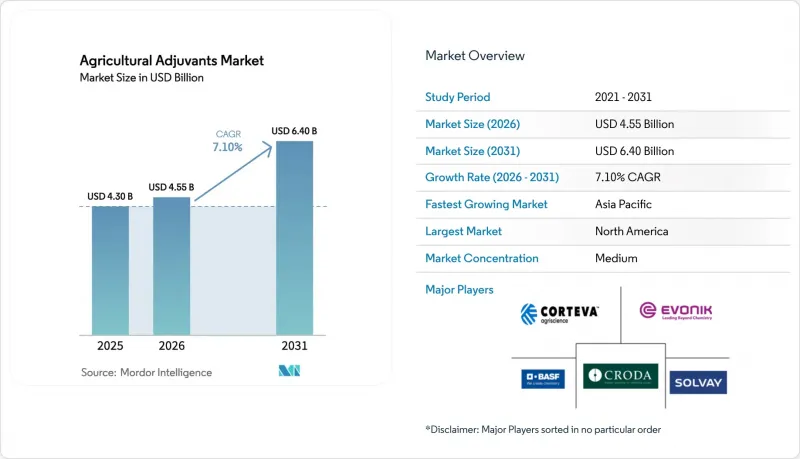
本報告按類型(活化劑和通用助劑)、應用(除草劑助劑、殺蟲劑助劑等)、作物(穀物、油籽和豆類、水果和蔬菜以及其他作物)和地區(北美、南美、歐洲、亞太地區、中東及其他地區)進行細分。市場預測以美元計價。
全球農業輔助產品市場趨勢及洞察
糧食需求不斷增加,而耕地面積卻在減少
根據聯合國預測,2050年,世界人口預計將達到97億,屆時對新增耕地的需求將達到1.65億公頃。隨著人均可耕種面積的減少,各國政府正在推廣增產計劃,鼓勵使用添加了噴灑助劑的農藥,從而減少噴灑次數,提高投入效率。糧食需求與可用耕地之間日益擴大的差距迫使生產者最大限度地提高現有面積的生產力,從而增加了他們對農作物保護產品的依賴。農業噴灑助劑透過改善農藥的附著力、擴散性和吸收性來支持這一轉變,從而在最佳化農藥使用的同時,更有效地控制病蟲害和雜草。
精密農業的引進提高了噴灑精度。
精密農業技術,例如GPS導航噴霧器、變數噴灑(VRT)技術和基於感測器的噴灑系統,正在對作物保護實踐產生重大影響。這些系統可以將噴灑量減少15%至25%,但前提是必須保持液滴均勻性。因此,抑制漂移的聚合物和低發泡表面活性劑如今已成為必不可少的添加劑。西歐也出現了類似的趨勢。 「從農場到餐桌」策略中50%的減量目標迫使農民進一步提高每公升農藥的利用效率。在中國,無人機噴灑量為每公頃5至15公升,而地面噴霧器的噴灑量可達每公頃100公升,因此有機矽超擴散劑對於維持葉面覆蓋至關重要。這些趨勢正在加速推動農業輔助產品市場所有細分領域的需求成長。
對輔料成分設定更嚴格的毒性閾值
監管機構正在加強對農藥中使用的惰性成分和輔料的審查。歐盟透過其化學品註冊、評估、授權和限制(REACH)框架,以及美國環保署(EPA),都對錶面活性劑和烷基酚聚氧乙烯醚類化合物引入了更嚴格的毒性標準。 2022年,歐盟的「從農場到餐桌」策略旨在到2030年將農藥使用量減少50%。因此,成員國正在執行比轉碼器標準更嚴格的殘留基準值。這些措施導致合規成本增加,並且由於需要重新設計配方,研發支出也隨之增加。每種化學品的合規成本都可能很高,這種負擔正迫使小規模配方生產商退出市場,並將農業農藥的市場佔有率轉移到大型垂直整合公司手中。植物油基界面活性劑在低溫環境下的表現不佳仍然是一個挑戰,這迫使企業不斷重新設計配方,從而擠壓利潤空間。
細分市場分析
到2025年,活化劑將成為最大的細分市場,佔農業助劑市場佔有率的70.5%。這是因為大多數芽後除草劑的標籤上仍然強制要求使用表面活性劑和油類。受農業化學品、經濟和監管等因素的影響,現代作物保護實踐正受到全球對農業活化劑需求的顯著成長。隨著農業系統為滿足全球日益成長的糧食、飼料和纖維需求而運轉,農民越來越重視除草劑、殺菌劑、殺蟲劑和葉面肥料等農作物保護產品的效率和效果。
農用助劑是成長最快的細分市場,預計到2031年將以8.4%的複合年成長率成長。這主要得益於抑制漂移的聚合物和水質調節劑,它們幫助農民滿足日益嚴格的噴嘴和pH需求。隨著無人機作業規程和在硬水地區應用案例的增加,農業助劑市場預計將穩定擴張。隨著精密農業的普及,通用添加劑正逐漸成為農業的核心技術。漂移抑制劑符合ISO 22866液滴標準,水質調節劑可中和礦物間的拮抗作用(此拮抗作用會使Glyphosate的藥效降低40%),而消泡劑可防止高壓幫浦溢流。隨著添加到罐混中的成分數量增加,不相容的風險也隨之增加,導致對緩衝劑和穩定乳液的聚合物的需求增加。
區域分析
北美是最大的農業助劑市場區域,預計2025年將佔據35.4%的市場。這主要歸功於高度機械化的農場和廣泛的分銷網路已將助劑產品納入常規作物保護方案。由於美國市場已趨於飽和,限制了新增耕地面積,預計北美市場的成長速度將略低於全球整體平均。在加拿大,菜籽和小麥種植計畫仍然依賴使用表面活性劑最佳化的Glyphosate,這為市場提供了一定的韌性。同時,墨西哥正在擴大滴灌蔬菜種植,從而推動了北美整體市場的快速成長。
亞太地區是成長最快的地區,預計到2031年將以8.1%的複合年成長率成長,這主要得益於中國和印度對其噴灑設備進行現代化改造並提高產量目標。中國對無人機和智慧農業機械的政策支持,推動了對「超級撒佈器」和「漂移控制器」等輔助設備的需求。印度的「數位農業計畫」為精準噴灑設備符合條件的支出津貼一半的補貼,從而促進了棉花、芥菜和豆類作物活性劑的銷售。日本和澳洲透過在老齡化農村地區引入無人機以及高度依賴漂移控制的棉花農藥項目,為該地區的成長提供了補充。
在歐洲和南美洲,穩定的政策支持和市場限制相互抵消,導致成長較為溫和。在歐洲,成長的主要驅動力是嚴格的環境法規,這些法規促使消費者轉向生物基混合產品,但這並未帶來總銷售量的成長。在南美洲,隨著巴西和阿根廷農民擴大大豆和玉米種植面積,複合年成長率顯著提高。然而,外匯波動和投入成本上升阻礙了優質肥料的普及。非洲的成長落後於其他地區,但在商業農業發展和捐助者資助的、側重於漂移控制和水質管理的培訓計畫的推動下,保持著穩定的個位數成長。
其他好處:
- Excel格式的市場預測(ME)表
- 3個月的分析師支持
目錄
第1章:引言
- 研究假設和市場定義
- 調查範圍
第2章:調查方法
第3章執行摘要
第4章 市場狀況
- 市場概覽
- 市場促進因素
- 糧食需求不斷增加,而耕地面積卻在減少
- 精密農業的引進提高了噴灑農藥的準確性。
- 轉向使用抗除草劑種子導致對除草劑促效劑的需求增加。
- 生物基界面活性劑的技術進步日新月異,毒性也隨之降低。
- 使用無人機進行超低容量噴灑需要超廣域噴灑設備。
- 將減少用藥劑量的獎勵與碳權額度掛鉤
- 市場限制因素
- 收緊複合添加劑的毒性閾值
- 石化原料價格波動
- 利用微生物的生物防治劑的相容性差距
- 人工智慧驅動的噴灑系統正在減少對廣譜輔助藥劑的需求。
- 監理情勢
- 技術展望
- 波特五力分析
第5章 市場規模與成長預測
- 按類型
- 活化劑和佐劑
- 界面活性劑
- 油基佐劑
- 通用添加劑
- 漂移抑制劑
- 水處理劑
- 消泡劑
- 酸化劑和緩衝劑
- 活化劑和佐劑
- 透過使用
- 除草劑助劑
- 殺蟲劑助劑
- 殺菌劑助劑
- 其他用途
- 按作物類型
- 穀類和穀類食品
- 油籽/豆類
- 水果和蔬菜
- 其他作物
- 按地區
- 北美洲
- 美國
- 加拿大
- 墨西哥
- 其他北美國家
- 南美洲
- 巴西
- 阿根廷
- 其他南美國家
- 歐洲
- 德國
- 法國
- 英國
- 義大利
- 俄羅斯
- 其他歐洲國家
- 亞太地區
- 中國
- 印度
- 日本
- 澳洲
- 其他亞太國家
- 中東
- 沙烏地阿拉伯
- 阿拉伯聯合大公國
- 其他中東國家
- 非洲
- 南非
- 奈及利亞
- 其他非洲國家
- 北美洲
第6章 競爭情勢
- 市場集中度
- 策略趨勢
- 市佔率分析
- 公司簡介
- BASF SE
- Corteva Agriscience
- Evonik Industries
- Solvay SA
- Croda International
- Nufarm Ltd
- Helena Agri-Enterprises
- AkzoNobel NV
- Brandt Consolidated
- Wilbur-Ellis Company
- Adjuvant Plus Inc.
- Huntsman Corporation
- Clariant AG
- Momentive Performance Materials
- Interagro Ltd
第7章 市場機會與未來展望
According to Mordor Intelligence, the agricultural adjuvants market size was valued at USD 4.30 billion in 2025 and is estimated to grow from USD 4.55 billion in 2026 to USD 6.40 billion by 2031, at a CAGR of 7.1% during the forecast period (2026-2031).
This report is Segmented by Type (Activator Adjuvants and Utility Adjuvants), by Application (Herbicide Adjuvants, Insecticide Adjuvants, and More), by Crop Type (Cereals and Grains, Oilseeds and Pulses, Fruits and Vegetables, and Other Crops) and by Geography (North America, South America, Europe, Asia-Pacific, Middle East, and More). The Market Forecasts are Provided in Terms of Value (USD).
Global Agricultural Adjuvants Market Trends and Insights
Growing Food Demand Versus Declining Arable Land
According to United Nations projections, the world's population is projected to reach 9.7 billion by 2050, and demand for additional arable land is projected to reach 165 million hectares. As cultivable land per capita declines, governments are promoting yield intensification programs that encourage the use of adjuvant-enhanced sprays to reduce repeat applications and improve input efficiency. This widening gap between food demand and available farmland compels growers to maximize productivity on existing acreage, increasing dependence on crop protection products. Agricultural adjuvants support this shift by improving spray deposition, spreading, and uptake, enabling more effective pest and weed control while optimizing agrochemical use.
Precision-Farming Adoption Boosting Spray Accuracy
Precision agriculture technologies, such as GPS-guided sprayers, variable rate technology (VRT), and sensor-based application systems, are significantly influencing crop protection practices. Such systems cut spray volumes by 15% to 25%, but only if droplets remain uniform, drift-control polymers and low-foam surfactants are now required additives. Similar trends hold in Western Europe, where the Farm-to-Fork strategy's 50% reduction target forces growers to squeeze more efficacy from each liter. China's drone fleet delivers 5-15 liters per hectare compared with 100 liters from ground rigs, making organosilicone superspreaders indispensable to maintain leaf coverage. These dynamics accelerate demand across every subsegment of the agricultural adjuvants market.
Tightening Toxicology Thresholds for Co-Formulants
Regulatory agencies are intensifying their scrutiny of inert ingredients and co-formulants used in adjuvants. The European Union, through the Registration, Evaluation, Authorisation, and Restriction of Chemicals (REACH) framework, and the Environmental Protection Agency (EPA) have implemented stricter toxicity benchmarks for surfactants and alkylphenol ethoxylates. In 2022, the European Union's Farm to Fork strategy targets a 50% reduction in pesticide use by 2030. As a result, member states are enforcing stringent maximum residue limits that surpass Codex standards. These measures have increased compliance costs and necessitated reformulations, leading to higher R&D expenditures. Compliance costs can reach high per-chemistry level, a burden that sidelines small formulators and shifts share toward vertically integrated majors in the agricultural adjuvants market. Cold-weather performance gaps still plague vegetable-oil surfactants, forcing reformulation cycles that sap margins.
Other drivers and restraints analyzed in the detailed report include:
- Shift to Herbicide-Tolerant Seeds Elevating Adjuvant Need
- Surge in Bio-Based Surfactant Innovation Lowering Toxicity
- Compatibility Gaps with Microbial Biocontrol Agents
For complete list of drivers and restraints, kindly check the Table Of Contents.
Segment Analysis
Activator adjuvants were the largest segment, led with 70.5% of the agricultural adjuvants market share in 2025, because surfactants and oils remain mandatory on most post-emergence herbicide labels. The global demand for agricultural activator adjuvants is rising significantly, driven by agronomic, economic, and regulatory factors influencing modern crop protection practices. As agricultural systems work to meet the growing global demand for food, feed, and fiber, farmers are increasingly prioritizing the efficiency and effectiveness of crop protection products, including herbicides, fungicides, insecticides, and foliar nutrients.
Utility adjuvants are fastest fastest-growing segment, forecast to post an 8.4% CAGR through 2031, fueled by drift-control polymers and water conditioners that help growers satisfy ever-tighter nozzle and pH specifications. The agricultural adjuvants market size for utility products is forecast to expand steadily as drone protocols and hard-water fields multiply use cases. Precision rules are embedding utilities into core agronomy. Drift-control agents meet ISO 22866 droplet standards, water conditioners neutralize mineral antagonism that can cut glyphosate performance by 40%, and antifoams protect high-pressure pumps from overflow. Each added tank-mix input increases the risk of incompatibility, which drives demand for buffers and polymers that stabilize emulsions.
Complete Report Scope:
- By Type
- Activator Adjuvants
- Surfactants
- Oil Adjuvants
- Utility Adjuvants
- Drift Control Agents
- Water Conditioners
- Antifoaming Agents
- Acidifiers and Buffers
- Activator Adjuvants
- By Application
- Herbicide Adjuvants
- Insecticide Adjuvants
- Fungicide Adjuvants
- Other Applications
- By Crop Type
- Cereals and Grains
- Oilseeds and Pulses
- Fruits and Vegetables
- Other Crops
- By Geography
- North America
- United States
- Canada
- Mexico
- Rest of North America
- South America
- Brazil
- Argentina
- Rest of South America
- Europe
- Germany
- France
- United Kingdom
- Italy
- Russia
- Rest of Europe
- Asia-Pacific
- China
- India
- Japan
- Australia
- Rest of Asia-Pacific
- Middle East
- Saudi Arabia
- United Arab Emirates
- Rest of Middle East
- Africa
- South Africa
- Nigeria
- Rest of Africa
- North America
Geography Analysis
North America was the largest region, holding 35.4% of the agricultural adjuvants market share in 2025, as its highly mechanized farms and extensive dealer networks already integrate adjuvant packages into routine crop-protection programs. Growth is projected to increase slightly behind the worldwide pace, because saturation in the United States caps incremental acreage. Canada adds resilience with canola and wheat programs that still depend on surfactant-optimized glyphosate passes, while Mexico, expanding drip-irrigated vegetables, brings faster growth to the continental mix.
Asia-Pacific is the fastest-growing region, on track to expand at an 8.1% CAGR to 2031, as China and India modernize their spraying equipment and push yield targets higher. China's policy backing for Unmanned Aerial Vehicles (UAVs) and smart machinery funnels adjuvant demand into superspreaders and drift-reducers. India's Digital Agriculture Mission funds half of the qualifying costs for precision-spray equipment, stoking sales of activators for cotton, mustard, and pulses. Japan and Australia round out regional growth with drone deployments in aging rural districts and cotton insecticide programs that rely heavily on drift control.
Europe and South America demonstrate moderate performance, balancing steady policy support with market limitations. In Europe, growth is primarily driven by stringent environmental regulations, which are shifting purchasing preferences toward bio-based blends rather than increasing overall volumes. In South America, a notable CAGR is observed as Brazilian and Argentine farmers expand soybean and corn cultivation. However, fluctuating currency values and input costs hinder the adoption of premium adjuvants. Africa lags behind other regions but maintains consistent single-digit growth, supported by the development of commercial farming and donor-funded training programs emphasizing drift control and water conditioning.
- BASF SE
- Corteva Agriscience
- Evonik Industries
- Solvay SA
- Croda International
- Nufarm Ltd
- Helena Agri-Enterprises
- AkzoNobel NV
- Brandt Consolidated
- Wilbur-Ellis Company
- Adjuvant Plus Inc.
- Huntsman Corporation
- Clariant AG
- Momentive Performance Materials
- Interagro Ltd
Additional Benefits:
- The market estimate (ME) sheet in Excel format
- 3 months of analyst support
TABLE OF CONTENTS
1 Introduction
- 1.1 Study Assumptions and Market Definition
- 1.2 Scope of the Study
2 Research Methodology
3 Executive Summary
4 Market Landscape
- 4.1 Market Overview
- 4.2 Market Drivers
- 4.2.1 Growing food demand versus declining arable land
- 4.2.2 Precision-farming adoption boosting spray accuracy
- 4.2.3 Shift to herbicide-tolerant seeds elevates adjuvant need
- 4.2.4 Surge in bio-based surfactant innovation, lowering toxicity
- 4.2.5 Drone-enabled ultra-low-volume spraying necessitating ultra-spreaders
- 4.2.6 Carbon-credit-linked dose-reduction incentives
- 4.3 Market Restraints
- 4.3.1 Tightening toxicology thresholds for co-formulants
- 4.3.2 Volatility in petrochemical feedstock pricing
- 4.3.3 Compatibility gaps with microbial biocontrol agents
- 4.3.4 AI-guided spray systems reducing broad-spectrum adjuvant use
- 4.4 Regulatory Landscape
- 4.5 Technological Outlook
- 4.6 Porter's Five Forces Analysis
- 4.6.1 Bargaining Power of Suppliers
- 4.6.2 Bargaining Power of Buyers
- 4.6.3 Threat of New Entrants
- 4.6.4 Threat of Substitutes
- 4.6.5 Intensity of Competitive Rivalry
5 Market Size and Growth Forecasts (Value)
- 5.1 By Type
- 5.1.1 Activator Adjuvants
- 5.1.1.1 Surfactants
- 5.1.1.2 Oil Adjuvants
- 5.1.2 Utility Adjuvants
- 5.1.2.1 Drift Control Agents
- 5.1.2.2 Water Conditioners
- 5.1.2.3 Antifoaming Agents
- 5.1.2.4 Acidifiers and Buffers
- 5.1.1 Activator Adjuvants
- 5.2 By Application
- 5.2.1 Herbicide Adjuvants
- 5.2.2 Insecticide Adjuvants
- 5.2.3 Fungicide Adjuvants
- 5.2.4 Other Applications
- 5.3 By Crop Type
- 5.3.1 Cereals and Grains
- 5.3.2 Oilseeds and Pulses
- 5.3.3 Fruits and Vegetables
- 5.3.4 Other Crops
- 5.4 By Geography
- 5.4.1 North America
- 5.4.1.1 United States
- 5.4.1.2 Canada
- 5.4.1.3 Mexico
- 5.4.1.4 Rest of North America
- 5.4.2 South America
- 5.4.2.1 Brazil
- 5.4.2.2 Argentina
- 5.4.2.3 Rest of South America
- 5.4.3 Europe
- 5.4.3.1 Germany
- 5.4.3.2 France
- 5.4.3.3 United Kingdom
- 5.4.3.4 Italy
- 5.4.3.5 Russia
- 5.4.3.6 Rest of Europe
- 5.4.4 Asia-Pacific
- 5.4.4.1 China
- 5.4.4.2 India
- 5.4.4.3 Japan
- 5.4.4.4 Australia
- 5.4.4.5 Rest of Asia-Pacific
- 5.4.5 Middle East
- 5.4.5.1 Saudi Arabia
- 5.4.5.2 United Arab Emirates
- 5.4.5.3 Rest of Middle East
- 5.4.6 Africa
- 5.4.6.1 South Africa
- 5.4.6.2 Nigeria
- 5.4.6.3 Rest of Africa
- 5.4.1 North America
6 Competitive Landscape
- 6.1 Market Concentration
- 6.2 Strategic Moves
- 6.3 Market Share Analysis
- 6.4 Company Profiles (Includes Global level Overview, Market level Overview, Core Segments, Financials as available, Strategic Information, Market Rank/Share, Products and Services, and Recent Developments)
- 6.4.1 BASF SE
- 6.4.2 Corteva Agriscience
- 6.4.3 Evonik Industries
- 6.4.4 Solvay SA
- 6.4.5 Croda International
- 6.4.6 Nufarm Ltd
- 6.4.7 Helena Agri-Enterprises
- 6.4.8 AkzoNobel NV
- 6.4.9 Brandt Consolidated
- 6.4.10 Wilbur-Ellis Company
- 6.4.11 Adjuvant Plus Inc.
- 6.4.12 Huntsman Corporation
- 6.4.13 Clariant AG
- 6.4.14 Momentive Performance Materials
- 6.4.15 Interagro Ltd
7 Market Opportunities and Future Outlook

 微生物協同劑市場:全球市場預測,2026-2032年肥料增效劑市場-2026-2032年全球預測農業助劑市場:2026-2032年全球市場預測(依產品、配方、原料、功能、應用、作物種類及最終用戶分類)
 農業援助市場規模、佔有率、趨勢和預測:按類型、作物類型、應用和地區分類,2026-2034 年
 農業助劑市場:依功能(活性成分、通用助劑)、應用(除草劑、殺蟲劑、殺菌劑)、劑型(懸浮劑和乳油)、應用階段(罐混、製劑內添加)和作物類型劃分 - 至2036年的全球預測
 2026-2034年全球農業輔助用品市場規模、佔有率、趨勢和成長分析報告
 2026年全球農業助劑市場報告吸水聚合物市場:依產品類型、形態、技術、應用和分銷管道分類,全球預測(2026-2032年)農業用高吸水性聚合物市場(依作物類型、類型、應用、通路和最終用戶分類)-2026-2032年全球預測
 農業助劑市場規模、佔有率和成長分析(按配方、應用階段、功能、應用、作物類型和地區分類)-2026-2033年產業預測