


 |
市場調查報告書
商品編碼
2121362
丙酸:市場佔有率分析、產業趨勢與統計、成長預測(2026-2031)Propionic Acid - Market Share Analysis, Industry Trends & Statistics, Growth Forecasts (2026 - 2031) |
||||||

※ 本網頁內容可能與最新版本有所差異。詳細情況請與我們聯繫。
據 Mordor Intelligence 稱,2025 年丙酸市值為 16.3 億美元,預計到 2031 年將達到 23.1 億美元,而 2026 年為 17.3 億美元,預測期(2026-2031 年)複合年成長率為 5.92%。
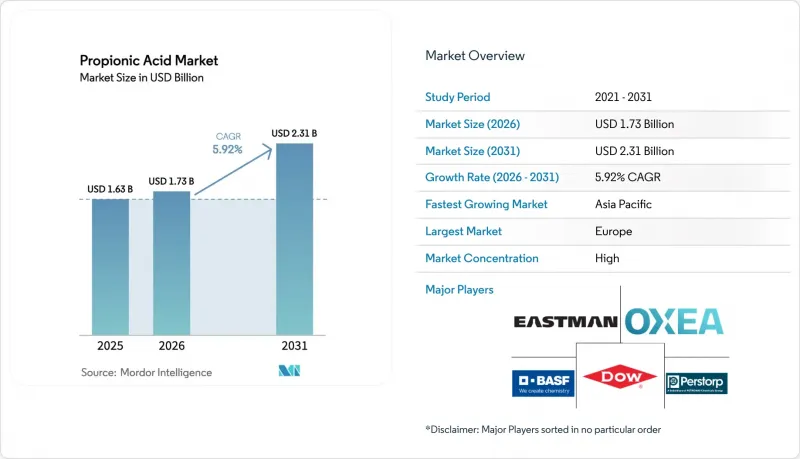
本報告按應用領域(動物飼料和防腐劑、鈣鹽、銨鹽和鈉鹽等)、終端用戶行業(農業、食品飲料、個人護理等)、生產流程(石油化工和生物基發酵)、等級(飼料、食品等)和地區(亞太地區、北美等)進行細分。市場預測以美元計價。
全球丙酸市場趨勢及洞察
穀物和青貯飼料防腐劑的需求不斷成長
當穀物水分含量超過一定閾值時,曲霉屬和青黴屬真菌的生長就會促進,導致黃麴毒素含量超過轉碼器基準值。然而,對許多合作社而言,機械乾燥成本過高,難以實際應用。丙酸能有效抑制真菌生長,確保毒素含量符合國際標準。美國食品藥物管理局(FDA) 已授予丙酸 GRAS(公認安全)認證,可直接添加到飼料中,為畜牧養殖戶提供了監管方面的保障。在青貯飼料中,丙酸鈣和丙酸銨都能防止青貯窖開啟時發生需氧腐敗,進而避免乾物質的潛在損失。在黴菌毒素威脅嚴重的濕潤熱帶地區,丙酸的應用率最高。因此,丙酸市場在提高飼料安全性和增加養殖戶盈利發揮著至關重要的作用。
將飼料酸引入無抗生素肉類生產鏈
繼歐洲禁止使用低於治療劑量的抗生素以及北美採取類似政策之後,一體化生產商正日益轉向有機酸方案。丙酸以降低腸道pH值而聞名,能夠有效抑製沙門氏菌和梭菌等有害病原體,同時保護有益的乳酸菌。肉雞生產中的田間試驗證實了其經濟效益。歐洲食品安全局 (EFSA) 2024年的評估未發現任何遺傳毒性問題,再次確認了丙酸的安全性。一個值得關注的產業趨勢是,主要供應商目前正將丙酸、甲酸和丁酸混合使用。此舉不僅拓寬了抗菌活性範圍,也標誌著業界正從單一酸策略轉向其他策略,推動了丙酸市場的成長。
石油衍生原料價格波動
2025年,由於煉油廠的計畫性維護和裂解裝置運轉率的變化,丙烯現貨價格劇烈波動。這些價格波動擠壓了尚未整合烯烴產能的生產商的利潤空間,也使得簽訂固定價格合約的烘焙商難以進行價格談判。發酵法可以提供部分對沖,因為粗甘油的原料價格與原油價格無關,但生物基生產路線仍然成本高昂,有時甚至達到石油化學合成成本的兩倍。這種成本差異阻礙了丙酸市場向完全可再生原料的即時轉型。
細分市場分析
2025年,飼料和食品防腐劑佔丙酸市場佔有率的51.92%。由於高固態汽車塗料和含有生物成分的指甲油的需求,醋酸丙酸纖維素預計將以6.49%的複合年成長率成長。該細分市場受益於支持提高丙醯基含量和生物成分添加的專利,從而推動了對特殊應用的需求。丙酸鈣、丙酸銨和丙酸鈉在麵包、乳製品和飼料中仍然必不可少,因為這些產品對pH值控制要求很高。 Perstorp公司2024年產能的提升將有助於其內部生產鹽類和塑化劑,從而增強供應穩定性。儘管除草劑和塑化劑的市場佔有率較小,但其穩定的銷售量有助於實現收入多元化和降低風險。
全球糧食供應鏈對黴菌控制的穩定需求推動了相關應用領域的優先發展。飼料添加劑用丙酸的市場規模預計將以中等個位數的複合年成長率成長,這與亞太和南美地區畜牧業規模的擴張密切相關。在特種飼料領域,為應對日益嚴格的法規,丙酸纖維素被用於降低揮發性有機化合物(VOC)含量,從而實現高利潤成長。生產商正在最佳化運轉率,並透過平衡通用飼料級丙酸的生產與小規模醫藥和特種應用丙酸的生產,廣泛滿足丙酸市場的需求。
預計到2025年,農業部門將佔丙酸消費量的56.98%,因為綜合性農業企業強制要求在無抗生素系統中實施有機酸方案。這一領域支撐著丙酸市場的基礎產量。預計到2031年,製藥業將以6.02%的複合年成長率成長,這主要得益於緩釋輔料和局部抗菌劑的日益普及。藥典對丙酸的純度標準有嚴格規定,鞏固了其相對於飼料級丙酸的溢價。
食品飲料行業的生產商正在利用丙酸鈣來延長麵包的保存期限,並在廣泛的分銷網路中保持產品品質。同時,個人護理、紡織和電子等行業作為利基市場,抵消了農業和烘焙行業需求的季節性波動。受cGMP規範約束的醫藥級丙酸鈣,由於供應商數量有限,確保了利潤率。這一趨勢不僅增強了製藥業,也拓寬了丙酸市場的範圍,使其應用不再局限於飼料防腐劑。
區域分析
2025年,歐洲佔全球市場規模的49.83%。由於抗生素生長促進劑的早期淘汰以及歐洲食品安全局(EFSA)的嚴格評估,丙酸鈣和飼料酸的需求趨於穩定。德國的工業化麵包房和家禽養殖場消耗大量丙酸鈣和飼料酸,BASF為其路德維希港工廠引入無二氧化碳蒸氣的資金投入,正是政策支持低碳化學品的例證。佩爾斯托普公司位於斯滕松德的工廠產能提升,進一步鞏固了歐洲作為生產中心的地位,使其能夠應對新的碳邊境調節措施。成熟穩定的烘焙和畜牧業確保了全部區域丙酸市場的強勁成長。
預計到2031年,亞太地區將以6.34%的複合年成長率成長,成為所有地區中成長最快的地區。中國是推動消費的主要力量,這得益於BASF與YPC的合資企業為國內飼料廠和麵包店提供原料。在印度,家禽業的有機酸計畫正在擴展,由於都市化,包裝麵包的需求也在不斷成長。日本和韓國等高附加價值市場正在尋求醫藥級原料,而出口型家禽企業則在東南亞推動市場發展。科比恩公司2024年在泰國的投資顯示了對該地區發酵衍生防腐劑的信心,並預示著丙酸市場產能未來將出現有利的轉變。
北美憑藉其大規模畜牧養殖和強大的烘焙連鎖店,約佔全球丙酸需求的四分之一。據美國環保署(EPA)稱,美國國內丙酸生產確保了穩定的本地供應。為了促進跨境貿易,墨西哥和加拿大已將飼料安全標準與美國接軌。南美市場規模龐大,但對價格高度敏感,尤其是穀物保鮮領域,巴西和阿根廷是其主要市場。同時,中東和非洲市場雖然規模較小,但正處於上升趨勢。沙烏地阿拉伯家禽業的擴張以及南非烘焙業的成長,都推動了丙酸進口量的成長。這些不同的區域趨勢共同支撐著全球丙酸市場。
其他好處:
- Excel格式的市場預測(ME)表
- 3個月的分析師支持
目錄
第1章:引言
- 研究假設和市場定義
- 調查範圍
第2章:調查方法
第3章執行摘要
第4章 市場狀況
- 市場概覽
- 市場促進因素
- 穀物和青貯飼料防腐劑的需求不斷成長
- 無抗生素肉類供應鏈中飼料酸的引入現況。
- 新興亞洲包裝烘焙產品的蓬勃發展
- 對加工食品延長保存期限的需求日益成長
- 食品品牌的範圍 3 脫碳目標正在推動低碳聚乙烯醯胺的使用。
- 市場限制因素
- 石油衍生原料價格波動
- 長期食用超加工食品引發的健康問題
- 生產能力集中所帶來的供應鏈風險
- 價值鏈分析
- 波特五力模型
第5章 市場規模與成長預測
- 透過使用
- 飼料和防腐劑
- 鈣鹽、銨鹽、鈉鹽
- 醋酸纖維素丙酸酯(CAP)
- 除草劑
- 塑化劑和溶劑
- 其他
- 按最終用戶行業分類
- 農業
- 食品/飲料
- 個人護理
- 製藥
- 其他終端用戶產業
- 透過生產路線
- 石油化工
- 生物基發酵
- 按年級
- 飼料級
- 食品級
- 醫藥級
- 工業級
- 按地區
- 亞太地區
- 中國
- 印度
- 日本
- 韓國
- 其他亞太國家
- 北美洲
- 美國
- 加拿大
- 墨西哥
- 歐洲
- 德國
- 英國
- 法國
- 義大利
- 其他歐洲國家
- 南美洲
- 巴西
- 阿根廷
- 其他南美國家
- 中東和非洲
- 沙烏地阿拉伯
- 南非
- 其他中東和非洲國家
- 亞太地區
第6章 競爭情勢
- 市場集中度
- 策略趨勢
- 市佔率和排名分析
- 公司簡介
- BASF SE
- Celanese Corporation
- Dow
- Eastman Chemical Company
- KANTO KAGAKU
- Kishida Chemical Co., Ltd
- Luxi Group
- Merck KGaA
- OXEA Gmbh
- Perstorp
- Shanghai Jianbei Organic Chemical Co., Ltd.
- Yancheng Hongtai Bioengineering Co., Ltd.
- Yancheng Huade(Dancheng)Biological Engineering Co.,Ltd.
第7章 市場機會與未來展望
According to Mordor Intelligence, the propionic acid market size was valued at USD 1.63 billion in 2025 and is estimated to grow from USD 1.73 billion in 2026 to reach USD 2.31 billion by 2031, at a CAGR of 5.92% during the forecast period (2026-2031).
This report is Segmented by Application (Animal Feed and Preservatives, Calcium Ammonium and Sodium Salts, and More), End-User Industry (Agriculture, Food and Beverage, Personal Care, and More), Production Route (Petrochemical and Bio-Based Fermentation), Grade (Feed Grade, Food Grade, and More), and Geography (Asia-Pacific, North America, and More). Market Forecasts are Provided in Terms of Value (USD).
Global Propionic Acid Market Trends and Insights
Expanding Demand for Grain and Silage Preservatives
Grain moisture levels exceeding a certain threshold foster the growth of Aspergillus and Penicillium, leading to aflatoxin levels surpassing Codex limits. However, many cooperatives find mechanical drying to be prohibitively expensive. Propionic acid effectively halts fungal growth, ensuring toxin levels remain within global standards. The U.S. Food and Drug Administration's GRAS status for direct feed inclusion provides livestock producers with regulatory assurance. In silage, both calcium and ammonium propionate prevent aerobic spoilage upon opening bunkers, safeguarding dry matter from potential loss. Adoption rates are highest in humid tropical regions, where mycotoxin pressures are pronounced. Consequently, the propionic acid market plays a pivotal role in enhancing feed safety and bolstering farmer profitability.
Uptake of Feed-Grade Acids in Antibiotic-Free Meat Chains
In response to European bans on sub-therapeutic antibiotics and similar policies in North America, integrators are increasingly turning to organic-acid programs. Propionic acid, known for lowering intestinal pH, effectively suppresses harmful pathogens like Salmonella and Clostridium, all while safeguarding beneficial lactobacilli. Field trials in broiler production have demonstrated its economic advantages. A 2024 assessment by the European Food Safety Authority, which found no genotoxic concerns, reaffirmed the safety of propionic acid. In a notable industry trend, leading suppliers are now blending propionic, formic, and butyric acids. This move not only broadens their antimicrobial coverage but also indicates a shift away from single-acid strategies, bolstering the growth trajectory of the propionic acid market.
Volatile Petro-Based Feedstock Prices
In 2025, refinery turnarounds and fluctuating cracker operating rates caused propylene spot prices to oscillate. These price swings tightened margins for producers without integrated olefin capacity and made pricing negotiations challenging for bakeries locked into fixed-price contracts. While fermentation offers a partial hedge-thanks to crude glycerol feedstock's independent trading from oil-bio routes remain costly, often reaching twice the price of petrochemical synthesis. This financial disparity moderates the immediate transition to a wholly renewable supply in the propionic acid market.
Other drivers and restraints analyzed in the detailed report include:
- Packaged-Bakery Boom in Emerging Asia
- Growing Requirement for Shelf-Life Extension in Processed Foods
- Health Concerns over Chronic Intake in Ultra-Processed Foods
For complete list of drivers and restraints, kindly check the Table Of Contents.
Segment Analysis
Animal feed and food preservatives held 51.92% of the propionic acid market share in 2025. Cellulose acetate propionate posted a 6.49% CAGR outlook thanks to high-solids automotive refinish coatings and bio-content nail lacquers. The segment benefits from patents that increase propionyl content and support bio-content claims, boosting specialty demand. Calcium, ammonium, and sodium propionates remain indispensable in bread, dairy, and feed, where pH control is critical. Perstorp's 2024 capacity addition supports captive production of salts and plasticizers, reinforcing supply stability. Herbicides and plasticizers occupy smaller shares, but their steady volumes diversify revenue and lessen risk.
Steady requirement for mold inhibition in global grain chains underpins the application hierarchy. The propionic acid market size for feed additives is projected to track livestock expansion in Asia-Pacific and South America at a mid-single-digit CAGR. Specialty coatings draw on cellulose acetate propionate to cut volatile organic compound levels in line with tightening regulations, adding high-margin growth. Producers balance commodity feed-grade manufacturing with smaller pharmaceutical and specialty runs to optimize capacity utilization, ensuring broad coverage of propionic acid market demand.
Agriculture absorbed 56.98% of consumption in 2025 as integrators mandate organic-acid programs in antibiotic-free systems. The segment anchors baseline tonnage for the propionic acid market. Pharmaceuticals are forecast to grow at a 6.02% CAGR through 2031 on the rising adoption of controlled-release excipients and topical antimicrobials. Pharmacopeial monographs set the purity of propionic acid at high levels, solidifying its price premium over feed grade.
Manufacturers in the food and beverage sector rely on calcium propionate to prolong bread's shelf life, ensuring its viability through extensive distribution networks. Meanwhile, sectors like personal care, textiles, and electronics serve as niche markets, balancing out the seasonal fluctuations in demand from agriculture and bakeries. The pharmaceutical grade, bound by cGMP regulations, faces a limited supplier base, safeguarding its margins. This dynamic not only fortifies the pharmaceutical sector but also broadens the horizons of the propionic acid market, extending its reach beyond mere bulk feed preservation.
Complete Report Scope:
- By Application
- Animal Feed and Preservatives
- Calcium, Ammonium and Sodium Salts
- Cellulose Acetate Propionate (CAP)
- Herbicides
- Plasticizers and Solvents
- Others
- By End-user Industry
- Agriculture
- Food and Beverage
- Personal Care
- Pharmaceutical
- Other End user Industries
- By Production Route
- Petrochemical
- Bio-based Fermentation
- By Grade
- Feed Grade
- Food Grade
- Pharmaceutical Grade
- Industrial Grade
- By Geography
- Asia-Pacific
- China
- India
- Japan
- South Korea
- Rest of Asia-Pacific
- North America
- United States
- Canada
- Mexico
- Europe
- Germany
- United Kingdom
- France
- Italy
- Rest of Europe
- South America
- Brazil
- Argentina
- Rest of South America
- Middle-East and Africa
- Saudi Arabia
- South Africa
- Rest of Middle-East and Africa
- Asia-Pacific
Geography Analysis
Europe controlled 49.83% of the global value in 2025. Early elimination of antibiotic growth promoters and stringent European Food Safety Authority evaluations stabilized demand for calcium propionate and feed-grade acids. Germany's industrial bakeries and poultry farms consume large volumes, while funding for CO2-free steam at BASF's Ludwigshafen complex exemplifies policy support for lower-carbon chemicals. Capacity additions at Perstorp's Stenungsund site further anchor Europe as a production base that can comply with emerging carbon-border adjustments. Mature yet stable bakery and livestock sectors keep the propionic acid market resilient across the region.
Asia-Pacific is projected to grow at a 6.34% CAGR through 2031, the fastest among regions. China leads consumption, supported by the BASF-YPC joint venture that supplies domestic feed mills and bakeries. India is ramping up organic-acid programs in poultry, and packaged-bread demand is climbing alongside urbanization. High-value markets such as Japan and South Korea require pharmaceutical-grade material, while Southeast Asia benefits from export-oriented poultry complexes. Corbion's 2024 investment in Thailand signals confidence in fermentation-based preservatives within the region, pointing to future capacity shifts favorable to the propionic acid market.
North America, bolstered by its vast livestock operations and prominent bakery chains, accounts for about a quarter of the world's propionic acid demand. The U.S. Environmental Protection Agency reports that domestic production of propionic acid ensures a steady local supply. In a bid to enhance cross-border trade, Mexico and Canada have aligned their feed-safety protocols with those of the U.S. South America, predominantly driven by Brazil and Argentina, showcases a significant yet price-sensitive market, particularly in grain preservation. Meanwhile, the Middle East and Africa, though smaller, are on an upward trajectory. In Saudi Arabia, poultry expansion and a growing bakery sector in South Africa are fueling increased imports. Together, these varied regional dynamics play a pivotal role in sustaining the global propionic acid market.
- BASF SE
- Celanese Corporation
- Dow
- Eastman Chemical Company
- KANTO KAGAKU
- Kishida Chemical Co., Ltd
- Luxi Group
- Merck KGaA
- OXEA Gmbh
- Perstorp
- Shanghai Jianbei Organic Chemical Co., Ltd.
- Yancheng Hongtai Bioengineering Co., Ltd.
- Yancheng Huade (Dancheng) Biological Engineering Co.,Ltd.
Additional Benefits:
- The market estimate (ME) sheet in Excel format
- 3 months of analyst support
TABLE OF CONTENTS
1 Introduction
- 1.1 Study Assumptions and Market Definition
- 1.2 Scope of the Study
2 Research Methodology
3 Executive Summary
4 Market Landscape
- 4.1 Market Overview
- 4.2 Market Drivers
- 4.2.1 Expanding demand for grain and silage preservatives
- 4.2.2 Uptake of feed-grade acids in antibiotic-free meat chains
- 4.2.3 Packaged-bakery boom in emerging Asia
- 4.2.4 Growing requirement for shelf-life extension in processed foods
- 4.2.5 Food-brand Scope-3 decarbonisation targets favouring low-carbon polyvinyl amide
- 4.3 Market Restraints
- 4.3.1 Volatile petro-based feedstock prices
- 4.3.2 Health concerns over chronic intake in ultra-processed foods
- 4.3.3 Capacity concentration-driven supply-chain risk
- 4.4 Value Chain Analysis
- 4.5 Porter's Five Forces
- 4.5.1 Bargaining Power of Suppliers
- 4.5.2 Bargaining Power of Buyers
- 4.5.3 Threat of New Entrants
- 4.5.4 Threat of Substitutes
- 4.5.5 Degree of Competition
5 Market Size and Growth Forecasts (Value)
- 5.1 By Application
- 5.1.1 Animal Feed and Preservatives
- 5.1.2 Calcium, Ammonium and Sodium Salts
- 5.1.3 Cellulose Acetate Propionate (CAP)
- 5.1.4 Herbicides
- 5.1.5 Plasticizers and Solvents
- 5.1.6 Others
- 5.2 By End-user Industry
- 5.2.1 Agriculture
- 5.2.2 Food and Beverage
- 5.2.3 Personal Care
- 5.2.4 Pharmaceutical
- 5.2.5 Other End user Industries
- 5.3 By Production Route
- 5.3.1 Petrochemical
- 5.3.2 Bio-based Fermentation
- 5.4 By Grade
- 5.4.1 Feed Grade
- 5.4.2 Food Grade
- 5.4.3 Pharmaceutical Grade
- 5.4.4 Industrial Grade
- 5.5 By Geography
- 5.5.1 Asia-Pacific
- 5.5.1.1 China
- 5.5.1.2 India
- 5.5.1.3 Japan
- 5.5.1.4 South Korea
- 5.5.1.5 Rest of Asia-Pacific
- 5.5.2 North America
- 5.5.2.1 United States
- 5.5.2.2 Canada
- 5.5.2.3 Mexico
- 5.5.3 Europe
- 5.5.3.1 Germany
- 5.5.3.2 United Kingdom
- 5.5.3.3 France
- 5.5.3.4 Italy
- 5.5.3.5 Rest of Europe
- 5.5.4 South America
- 5.5.4.1 Brazil
- 5.5.4.2 Argentina
- 5.5.4.3 Rest of South America
- 5.5.5 Middle-East and Africa
- 5.5.5.1 Saudi Arabia
- 5.5.5.2 South Africa
- 5.5.5.3 Rest of Middle-East and Africa
- 5.5.1 Asia-Pacific
6 Competitive Landscape
- 6.1 Market Concentration
- 6.2 Strategic Moves
- 6.3 Market Share(%)/Ranking Analysis
- 6.4 Company Profiles (includes Global level Overview, Market level overview, Core Segments, Financials as available, Strategic Information, Products and Services, and Recent Developments)
- 6.4.1 BASF SE
- 6.4.2 Celanese Corporation
- 6.4.3 Dow
- 6.4.4 Eastman Chemical Company
- 6.4.5 KANTO KAGAKU
- 6.4.6 Kishida Chemical Co., Ltd
- 6.4.7 Luxi Group
- 6.4.8 Merck KGaA
- 6.4.9 OXEA Gmbh
- 6.4.10 Perstorp
- 6.4.11 Shanghai Jianbei Organic Chemical Co., Ltd.
- 6.4.12 Yancheng Hongtai Bioengineering Co., Ltd.
- 6.4.13 Yancheng Huade (Dancheng) Biological Engineering Co.,Ltd.
7 Market Opportunities and Future Outlook
- 7.1 White-space and Unmet-need Assessment


