


 |
市場調查報告書
商品編碼
2121349
環保水泥:市場佔有率分析、產業趨勢與統計、成長預測(2026-2031)Green Cement - Market Share Analysis, Industry Trends & Statistics, Growth Forecasts (2026 - 2031) |
||||||

※ 本網頁內容可能與最新版本有所差異。詳細情況請與我們聯繫。
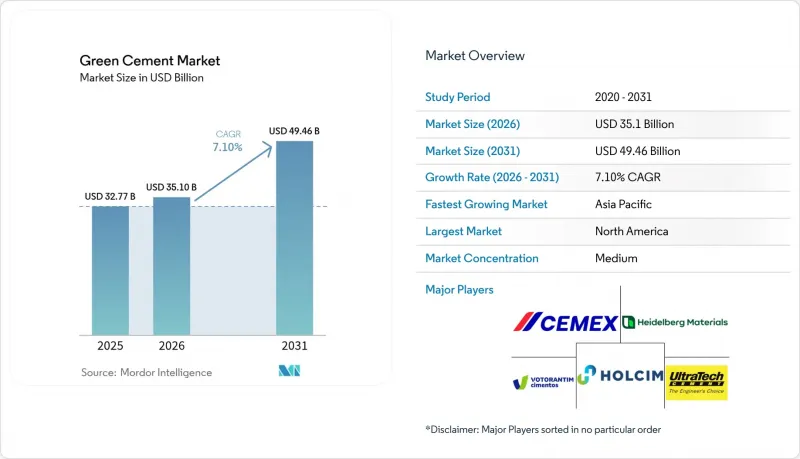
根據 Mordor Intelligence 預測,環保水泥市場規模將從 2025 年的 327.7 億美元成長到 2026 年的 351 億美元,然後在 2031 年達到 494.6 億美元,2026 年至 2031 年的複合年成長率為 7.1%。
本報告按產品類型(飛灰、礦渣、石灰石、矽灰及其他產品類型)、建築業(住宅、非住宅)和地區(亞太、北美、歐洲、南美以及中東和非洲)進行細分。市場預測以美元計價。
全球環保水泥市場趨勢與洞察
強制性全球脫碳及以環境、社會及公司治理(ESG)為重點的建築標準
強制性低碳採購政策正在加速市場需求從傳統波特蘭水泥轉向檢驗的環保水泥的轉變。加州的目標是到2035年將水泥業的排放量減少40%,並在2045年實現淨零排放,美國其他州也在推行類似的措施。歐盟修訂後的建築產品法規將從2024年起要求混凝土產品必須配備數位護照並揭露二氧化碳排放量,這將使已建立完善生命週期文件的生產商在競標名單中排名更高。法國、丹麥、愛爾蘭和紐約州均已推出先進的排放上限和「清潔採購」法規,使受監管的材料成為預設選擇而非額外選擇。隨著各個司法管轄區推出開創性法規,環保水泥市場正在建立政策主導成長的最低門檻,這使得窯爐維修和與專業供應商建立合作關係對於傳統生產商滿足市場需求至關重要。
碳價格上漲與碳排放交易機制
碳成本正在改變水泥熟料的經濟格局,二氧化碳排放變成了直接成本。歐盟的碳排放交易體係正在逐步取消免費配額,迫使水泥生產商要麼加快採用低碳替代品,要麼面臨利潤率下降的風險。中國的全國性碳交易平台也已將水泥納入其中,使得成本壓力波及全球最大的水泥生產國—中國。隨著碳定價機制的日益普及,水泥替代品的競爭力日益增強,環保水泥市場也因此受益於相對於傳統產品的結構性成本優勢。
對建築公司和承包商的履約能力持懷疑態度
由於養護期延長、寒冷天氣下硬化延遲以及輔助材料供應存在區域差異,一些承包商對規範變更持抵觸態度。標準化機構正致力於以基於性能的指南取代強制性的混合料配比限制,但知識缺口仍然存在,尤其是在中小企業中。試點計畫和針對性培訓對於推廣這項技術仍然至關重要。
細分市場分析
2025年,飛灰配方水泥在環保水泥市場仍佔43.55%的佔有率,鞏固了其在燃煤殘渣豐富的地區作為低碳水泥首選替代品的地位。製造商正利用成熟的物流系統和久經考驗的性能,滿足大規模基礎設施項目和政府競標的需求。然而,隨著燃煤發電量的下降導致未來原料來源日益減少,各公司正轉向從現有灰渣儲存中回收利用,並逐步過渡到使用石灰石和煅燒粘土混合物。 LC3技術可減少高達40%的排放,實驗室測試顯示其機械性能與普通矽酸鹽水泥相當,因此備受關注。矽灰產品佔據了高階細分市場,可提供適用於海上結構和化學品容器結構的防滲混凝土。礦渣基替代品正努力應對即將到來的供應結構變化,但在綜合鋼鐵廠附近仍保持重要地位。包括無機聚合物混凝土在內的新型接合材料的化學技術正在透過先導計畫取得進展,規模經濟效益的提高可能會使環保水泥市場多樣化。
日益多元化的生產模式降低了對單一產品線的過度依賴,使生產商免受原料價格劇烈波動的影響。雖然隨著回收灰占美國再生飛灰總量的10%,供應穩定性提高,但加工成本卻上升。因此,水泥生產商與電廠煤灰再利用業者之間的策略合作在近期的交易趨勢中日益凸顯。在企業權衡技術可行性、減排目標和原料經濟效益的過程中,爐渣破碎的合作以及黏土煅燒方面的合資企業同樣重要。
區域分析
預計到2025年,北美將佔全球銷售額的37.55%,這主要得益於聯邦和各州「清潔採購」法規、早期碳捕獲試點計畫以及承包商對混合水泥的高度了解。僅海德堡材料公司的米切爾碳捕獲與封存(CCS)項目就計劃在30年內將超過5000萬噸二氧化碳儲存在地下,這表明該地區的基礎設施足以支持長期的供應承諾。不同地區的供應情況各不相同。中西部各州利用位置靠近煤灰礦的優勢,而沿海地區則需要進口礦渣和煅燒粘土來滿足規格要求。
亞太地區預計將成為成長最快的地區,到2031年複合年成長率將達到7.94%,這主要得益於印度的多年基礎設施規劃以及東南亞地區日益嚴格的監管。在中國,大型企業集團正在升級工廠,採用低碳生產線以應對房地產行業的逆風,從而保住生產許可。全球三分之二的高鐵網路集中在該地區,這催生了對符合更嚴格排放標準的混凝土的需求。隨著軌道和車站設備升級專案的推進,環保水泥市場也蓬勃發展。
在歐洲,強而有力的氣候政策和成熟的工業能力正在融合。愛爾蘭強制要求所有國家計畫在2024年前使用低碳水泥,丹麥則設定了2025年二氧化碳當量/平方公尺/年的排放上限,這些都成為了具有影響力的標竿。儘管建築量有所波動,但碳定價機制必將擴大環保水泥市場,因為在競標評估中,二氧化碳成本有利於低水泥熟料配方。在中東和非洲,新的需求正在湧現,尤其是在計劃建造氫能中心和大規模公共工程項目的海灣國家。然而,由於標準不一和缺乏現場專業知識,在統一的指導方針訂定之前,市場滲透速度將較為緩慢。
其他好處:
- Excel格式的市場預測(ME)表
- 3個月的分析師支持
目錄
第1章:引言
- 研究假設和市場定義
- 調查範圍
第2章:調查方法
第3章執行摘要
第4章 市場狀況
- 市場概覽
- 市場促進因素
- 強制性全球脫碳和強調ESG的建築標準
- 碳價格上漲與碳排放交易機制
- 亞太地區都市化的快速發展正在推動對低碳材料的需求不斷成長。
- 利用豐富的輔助膠凝材料原料(飛灰、礦渣)降低成本
- 氫燃料爐的商業化
- 市場限制因素
- 對建築公司和承包商的履約能力持懷疑態度
- 新興市場標準差異
- 由於鋼鐵生產轉向電弧爐(EAF)/直接還原鐵(DRI),導致爐渣供應減少。
- 價值鏈分析
- 波特五力模型
第5章 市場規模與成長預測
- 依產品類型
- 飛灰型
- 渣型
- 石灰石類型
- 矽灰類型
- 其他產品類型
- 建築業
- 住宅
- 非住宅
- 按地區
- 亞太地區
- 中國
- 印度
- 日本
- 韓國
- 其他亞太國家
- 北美洲
- 美國
- 加拿大
- 墨西哥
- 歐洲
- 德國
- 英國
- 法國
- 義大利
- 其他歐洲國家
- 南美洲
- 巴西
- 阿根廷
- 其他南美國家
- 中東和非洲
- 沙烏地阿拉伯
- 南非
- 其他中東和非洲國家
- 亞太地區
第6章 競爭情勢
- 市場集中度
- 策略趨勢
- 市佔率分析
- 公司簡介
- Adani Group
- Buzzi SpA
- CarbonCure Technologies Inc.
- Cemex SAB DE CV
- Cenin
- China National Building Material Group Corporation
- Ecocem
- Heidelberg Materials
- Hoffmann Green Cement Technologies
- Holcim
- JSW Cement
- Kiran Global Chem Limited.
- TAIHEIYO CEMENT CORPORATION
- UltraTech Cement Ltd.
- Votorantim Cimentos
第7章 市場機會與未來展望
According to Mordor Intelligence, the green cement market size is expected to grow from USD 32.77 billion in 2025 to USD 35.1 billion in 2026 and is forecast to reach USD 49.46 billion by 2031 at 7.1% CAGR over 2026-2031.
This report is Segmented by Product Type (Fly-Ash-Based, Slag-Based, Limestone-Based, Silica-Fume-Based, Other Product Types), Construction Sector (Residential, Non-Residential), and Geography (Asia-Pacific, North America, Europe, South America, Middle East and Africa). The Market Forecasts are Provided in Terms of Value (USD).
Global Green Cement Market Trends and Insights
Global Decarbonization Mandates & ESG-Centric Building Codes
Mandatory low-carbon procurement policies drive immediate demand shifts from ordinary Portland cement to verified green formulations. California targets a 40% emissions cut for its cement sector by 2035 and net-zero by 2045, anchoring similar actions in other U.S. states. The EU's revised Construction Products Regulation obliges digital passports and CO2 disclosure for concrete from 2024, pushing producers already equipped with life-cycle documentation to the front of tender lists. France, Denmark, Ireland, and New York State have each introduced progressive emissions ceilings or Buy Clean rules that make compliant materials the default choice rather than a premium option. As jurisdictions replicate pioneering statutes, the green cement market gains a policy-driven growth floor that traditional producers can meet only by retrofitting kilns or partnering with specialized suppliers.
Rising Carbon Pricing & Emissions-Trading Schemes
Carbon costs alter clinker economics by turning CO2 into a direct expense. The EU Emission Trading System gradually withholds free allowances, prompting cement manufacturers to accelerate low-carbon substitutions or risk margin compression. China's national trading platform now covers cement, expanding cost pressure to the world's largest producer. As more regions price carbon, supplementary cementitious materials gain relative competitiveness, and the green cement market benefits from a structural cost advantage over legacy products.
Performance Scepticism Among Builders & Contractors
Some contractors resist specification changes, citing extended curing, cold-weather set delays, and inconsistent regional availability of supplementary materials. Standards bodies work to replace prescriptive mix limits with performance-based guidelines, yet knowledge gaps persist, especially in small and mid-size firms. Demonstration projects and targeted training remain essential for mainstream adoption.
Other drivers and restraints analyzed in the detailed report include:
- APAC Urbanization Surge Requiring Low-Carbon Materials
- Abundant SCM Feedstocks Lowering Costs
- Fragmented Standards in Emerging Markets
For complete list of drivers and restraints, kindly check the Table Of Contents.
Segment Analysis
Fly-ash-based formulations kept a 43.55% green cement market share in 2025, underscoring their status as the default low-carbon substitute where coal-combustion residues remain abundant. Producers leverage mature logistics and well-documented performance to serve large infrastructure contracts and government tenders. However, declining coal generation narrows future feedstock pools, prompting companies to harvest legacy ash ponds or shift toward limestone-calcined clay blends. LC3 technology, able to trim emissions by up to 40%, gains visibility as laboratories validate mechanical parity with ordinary Portland cement. Silica-fume-based variants occupy high-specification niches, delivering impermeable concrete suited to marine and chemical containment structures. Slag-based alternatives struggle with impending supply shifts but retain relevance near integrated steelworks. Novel binder chemistries, including geopolymer concretes, progress through pilot projects that could diversify the green cement market if scale economics improve.
Growing diversification reduces over-reliance on any single supplementary stream and insulates producers from raw-material shocks. With harvested ash constituting 10% of recycled U.S. fly ash, supply security improves, yet processing costs rise. Strategic agreements between cement makers and utility coal-ash reclamation entities therefore feature prominently in recent deal flow. Slag-grinding partnerships and clay-calcination joint ventures become equally critical as companies balance technical feasibility, emissions objectives, and raw-material economics.
Complete Report Scope:
- By Product Type
- Fly-Ash-Based
- Slag-Based
- Limestone-Based
- Silica-Fume-Based
- Other Product Types
- By Construction Sector
- Residential
- Non-Residential
- By Geography
- Asia-Pacific
- China
- India
- Japan
- South Korea
- Rest of Asia-Pacific
- North America
- United States
- Canada
- Mexico
- Europe
- Germany
- United Kingdom
- France
- Italy
- Rest of Europe
- South America
- Brazil
- Argentina
- Rest of South America
- Middle East and Africa
- Saudi Arabia
- South Africa
- Rest of Middle East and Africa
- Asia-Pacific
Geography Analysis
North America retained 37.55% of 2025 revenues, anchored by federal and state Buy Clean rules, early carbon-capture pilots, and high contractor familiarity with blended cements. Heidelberg Materials' Mitchell CCS project alone targets geological storage for more than 50 million t of CO2 over 30 years, signaling infrastructure that can underpin long-run volume commitments. Supply availability differs by region: Midwest states leverage proximity to coal-ash basins, while coastal areas import slag or calcined clay to meet specifications.
Asia-Pacific registers the fastest 7.94% CAGR to 2031, fueled by India's multi-year infrastructure pipeline and progressively stricter codes across Southeast Asia. China's consolidation efforts prompt large groups to upgrade plants with low-carbon lines to retain permits amid property-sector headwinds. Two-thirds of global high-speed rail networks reside in the region, requiring concrete that satisfies tightening emissions caps and boon the green cement market as projects replenish track and station stock.
Europe blends robust climate policy with mature industrial capabilities. Ireland's 2024 mandate for low-carbon cement in all state projects and Denmark's 2025 emissions ceiling of 7.1 kg CO2e/m2/year set influential benchmarks. Carbon pricing ensures that the green cement market size expands despite construction-volume volatility, as CO2 costs tilt bid evaluations toward low-clinker mixes. The Middle East and Africa witness emerging demand, especially in Gulf economies planning hydrogen hubs and large-scale public works, yet fragmented standards and limited on-site expertise slow penetration until harmonized guidelines mature.
- Adani Group
- Buzzi S.p.A.
- CarbonCure Technologies Inc.
- Cemex S.A.B DE C.V.
- Cenin
- China National Building Material Group Corporation
- Ecocem
- Heidelberg Materials
- Hoffmann Green Cement Technologies
- Holcim
- JSW Cement
- Kiran Global Chem Limited.
- TAIHEIYO CEMENT CORPORATION
- UltraTech Cement Ltd.
- Votorantim Cimentos
Additional Benefits:
- The market estimate (ME) sheet in Excel format
- 3 months of analyst support
TABLE OF CONTENTS
1 Introduction
- 1.1 Study Assumptions and Market Definition
- 1.2 Scope of the Study
2 Research Methodology
3 Executive Summary
4 Market Landscape
- 4.1 Market Overview
- 4.2 Market Drivers
- 4.2.1 Global decarbonisation mandates and ESG-centric building codes
- 4.2.2 Rising carbon pricing and emissions-trading schemes
- 4.2.3 APAC urbanisation surge requiring low-carbon materials
- 4.2.4 Abundant SCM feedstocks (fly-ash, slag) lowering costs
- 4.2.5 Commercialisation of hydrogen-fuelled kilns
- 4.3 Market Restraints
- 4.3.1 Performance scepticism among builders and contractors
- 4.3.2 Fragmented standards in emerging markets
- 4.3.3 Shrinking slag supply as steel shifts to EAF/DRI
- 4.4 Value Chain Analysis
- 4.5 Porter's Five Forces
- 4.5.1 Bargaining Power of Suppliers
- 4.5.2 Bargaining Power of Buyers
- 4.5.3 Threat of New Entrants
- 4.5.4 Threat of Substitutes
- 4.5.5 Competitive Rivalry
5 Market Size and Growth Forecasts (Value)
- 5.1 By Product Type
- 5.1.1 Fly-Ash-Based
- 5.1.2 Slag-Based
- 5.1.3 Limestone-Based
- 5.1.4 Silica-Fume-Based
- 5.1.5 Other Product Types
- 5.2 By Construction Sector
- 5.2.1 Residential
- 5.2.2 Non-Residential
- 5.3 By Geography
- 5.3.1 Asia-Pacific
- 5.3.1.1 China
- 5.3.1.2 India
- 5.3.1.3 Japan
- 5.3.1.4 South Korea
- 5.3.1.5 Rest of Asia-Pacific
- 5.3.2 North America
- 5.3.2.1 United States
- 5.3.2.2 Canada
- 5.3.2.3 Mexico
- 5.3.3 Europe
- 5.3.3.1 Germany
- 5.3.3.2 United Kingdom
- 5.3.3.3 France
- 5.3.3.4 Italy
- 5.3.3.5 Rest of Europe
- 5.3.4 South America
- 5.3.4.1 Brazil
- 5.3.4.2 Argentina
- 5.3.4.3 Rest of South America
- 5.3.5 Middle East and Africa
- 5.3.5.1 Saudi Arabia
- 5.3.5.2 South Africa
- 5.3.5.3 Rest of Middle East and Africa
- 5.3.1 Asia-Pacific
6 Competitive Landscape
- 6.1 Market Concentration
- 6.2 Strategic Moves
- 6.3 Market Share Analysis
- 6.4 Company Profiles (includes Global level Overview, Market level overview, Core Segments, Financials as available, Strategic Information, Market Rank/Share for key companies, Products and Services, and Recent Developments)
- 6.4.1 Adani Group
- 6.4.2 Buzzi S.p.A.
- 6.4.3 CarbonCure Technologies Inc.
- 6.4.4 Cemex S.A.B DE C.V.
- 6.4.5 Cenin
- 6.4.6 China National Building Material Group Corporation
- 6.4.7 Ecocem
- 6.4.8 Heidelberg Materials
- 6.4.9 Hoffmann Green Cement Technologies
- 6.4.10 Holcim
- 6.4.11 JSW Cement
- 6.4.12 Kiran Global Chem Limited.
- 6.4.13 TAIHEIYO CEMENT CORPORATION
- 6.4.14 UltraTech Cement Ltd.
- 6.4.15 Votorantim Cimentos
7 Market Opportunities and Future Outlook
- 7.1 White-space and Unmet-Need Assessment

 環保水泥和混凝土市場分析及預測(至2035年):按類型、產品、技術、應用、材料類型、工藝、最終用戶、功能、安裝類型和解決方案分類
 環保水泥和混凝土市場規模及預測(2021-2034年),全球及區域佔有率、趨勢和成長機會分析報告:按產品類型、最終用戶和地區分類
 環保水泥市場規模、佔有率和成長分析:按類型、最終用戶和地區分類-2026-2033年產業預測
 2026年全球石灰石基環保水泥市場報告2026年全球礦渣基環保水泥市場報告
 全球環保水泥市場規模、佔有率、趨勢和成長分析報告(2026-2034年)環保水泥市場規模、佔有率、成長及全球產業分析:按類型、應用和地區分類,並預測至2026-2034年
 環保水泥市場:按原料、製造流程、通路、應用和最終用戶分類-2026年至2032年全球預測環保水泥市場分析及預測(至2035年):依類型、產品、技術、應用、材料類型、製程、最終用戶、安裝類型、設備分類
 環保水泥市場規模、佔有率、趨勢和預測:按產品類型、最終用途行業和地區分類,2026-2034年