


 |
市場調查報告書
商品編碼
2121328
混合實境:市場佔有率分析、產業趨勢與統計、成長預測(2026-2031)Mixed Reality - Market Share Analysis, Industry Trends & Statistics, Growth Forecasts (2026 - 2031) |
||||||

※ 本網頁內容可能與最新版本有所差異。詳細情況請與我們聯繫。
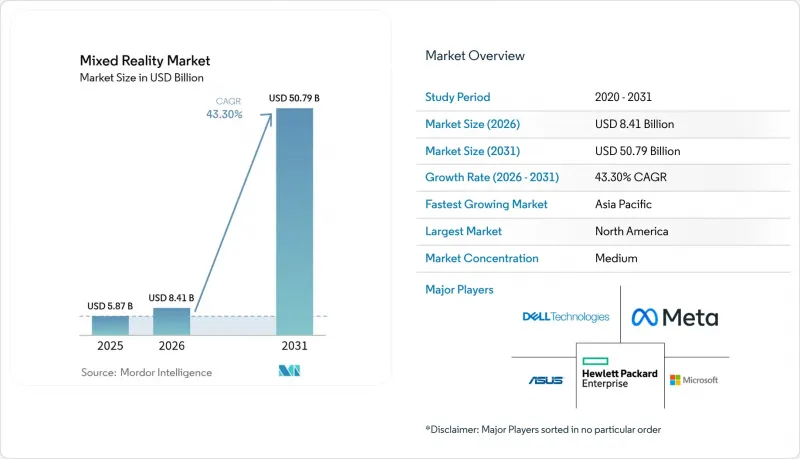
根據 Mordor Intelligence 預測,混合實境(MR) 市場將從 2025 年的 58.7 億美元成長到 2026 年的 84.1 億美元,然後在 2031 年達到 507.9 億美元,2026 年至 2031 年的複合年成長率為 43.3%。
本報告按組件(硬體、軟體及其他)、設備類型(獨立式MR頭戴設備、有線MR頭戴設備及其他)、應用(培訓模擬、產品設計與原型製作、遠端援助與協作及其他)、最終用戶行業(醫療保健、製造業及工業、教育及其他)和地區進行細分。市場預測以美元計價。
全球混合實境(MR)市場趨勢與洞察
企業培訓和協作需求激增
目前,像波音這樣的公司正在使用混合實境(MR)培訓項目,將培訓時間縮短75%,並將知識保留率提高到90%,這些實際的成本節約效果正在贏得董事會的支持。隨著混合辦公模式的持續發展,身臨其境型、多用戶數位工作空間(支援3D模型協作編輯、即時註解和空間白板功能)的價值日益凸顯。工業領域的組裝製造商正在為老工程師部署基於頭戴式設備的指導系統,在減少組裝錯誤的同時,保持組織的專業技能。這些部署透過安全的雲端連接進行,使公司能夠在全球範圍內共用專業知識,而無需擔心差旅造成的延誤。人工智慧模組會根據學員的表現動態調整任務難度,進而加快個人學習曲線,縮短掌握技能所需的時間。
5G 和邊緣運算賦能的低延遲混合實境
商用 5G 和高密度邊緣節點的部署已將往返延遲降至 20 毫秒以下,從而實現了與逼真 3D 資產的沉浸式互動。現場工程師可以將現場影像即時傳輸給遠端專家,專家隨後可以疊加空間標註,即時指導維修工作。將運算任務卸載到網路邊緣,可以減輕頭戴式設備的重量並延長電池續航時間,這對於輪班工業應用至關重要。亞太地區的營運商正在主導網路切片試點項目,即使在流量高峰時段也能確保高優先級混合實境(MR) 會話的頻寬。隨著覆蓋範圍擴展到製造地,遠端機器人操作和遠端手術指導等對延遲敏感的任務也逐漸成為技術上的可行性。
高昂的初始硬體成本
企業級頭戴式顯示器的售價在 3,299 美元到 4,999 美元之間,給 IT 預算帶來了壓力,尤其是在利潤微薄的行業。消費者市場也面臨類似的挑戰,調查顯示,65% 的潛在客戶認為價格是最大的障礙。儘管供應商正在探索租賃模式和按用戶訂閱模式以減輕財務負擔,但由於光學級波導和客製化矽晶片等組件成本居高不下,組件成本依然很高。對高品質影像和低延遲的需求使得製造商不得不依賴專門的供應鏈,從而減緩了組件的商品化進程。雖然像 XREAL Beam Pro 這樣售價低於 200 美元的配套設備表明存在低成本的入門途徑,但更廣泛的混合實境(MR) 市場仍然面臨著「高價」的障礙。
細分市場分析
服務領域預計將以 44.57% 的複合年成長率成長,這反映出隨著企業規模的擴大,對系統設計、應用開發和生命週期支援的需求日益成長。即使到了 2025 年,硬體仍將佔混合實境(MR) 市場規模的 63.84%,鞏固其作為主要收入來源的地位。供應商透過將託管服務納入多年期契約,確保了除一次性設備銷售之外的穩定收入來源。部署後支援至關重要,因為它需要韌體更新、空間地圖管理和安全補丁,以維護整個設備生態系統的合規性和效能。
專業服務團隊目前正致力於整合複雜的中間件,例如將耳機遙測資料連接到 MES、ERP 或 PACS 平台。這種增值服務使得更高的時薪合理化,並進一步加深了客戶鎖定。雖然雲端原生交付模式簡化了補丁分發和分析儀表板,但也迫使企業分配新的預算來適應計量型的定價模式。隨著平台日趨成熟,向低程式碼工具的轉變可能會在未來減緩服務成長,但預計專業顧問公司至少在未來三年內仍將保持相當大的市場佔有率。
預計到2025年,獨立式頭戴裝置將佔據混合實境(MR)市場52.10%的佔有率,並在2031年之前以44.25%的複合年成長率成長。無線外形規格在生產線和醫療環境中越來越受歡迎,因為不受限制的移動能夠提高安全性和生產效率。驍龍和蘋果晶片的整合晶片組如今能夠提供主機的圖形性能和穩定的散熱,從而無需使用背包式PC。未來的藍圖預計將加入超表面天線,這將在不增加體積的情況下改善5G接收效果。
有線系統在需要工作站級渲染功能以創建高精度多邊形原型的設計工程師中仍然保持著一定的市場需求。同時,受全球智慧型手機普及率的推動,基於智慧型手機的套件正在發展壯大其注重性價比的消費群體。基於投影的解決方案則瞄準了那些優先考慮無需佩戴頭顯即可實現房間級可視化的建築公司。設備製造商正在加速向由內而外的六自由度 (6-DoF) 追蹤技術的過渡,這項技術可以減少設定工作量,並擴展其在公共空間中的應用場景。
區域分析
北美地區持續保持領先地位,預計2025年將佔全球支出的38.05%,主要得益於早期企業先導計畫和高密度5G網路。該地區匯集了許多頂級平台供應商,加速了概念驗證(PoC)週期。同時,亞太地區預計將以44.80%的複合年成長率超越其他所有地區,這主要得益於其強大的消費電子供應鏈和雄心勃勃的政府主導的數位化計畫。 2023年,中國國內5G設備出貨量達到26.2萬台,較去年成長154.4%,顯示市場需求日益成熟。
印度對延展實境(XR)的投資從2020年的不到20億美元成長到2022年的超過65億美元,顯示企業和娛樂平台的需求都在不斷成長。在歐洲,隨著嚴格的資料隱私法規引導供應商為工業企業提供客製化、安全的本地部署方案,XR市場呈現穩定成長的態勢。拉丁美洲和中東地區的XR應用零星出現,主要集中在石油天然氣和電信業,這些產業在資本支出方面擁有柔軟性。非洲雖然發展落後,但隨著價格適中的行動裝置日益普及,行動優先解決方案有望帶來顯著成長。
其他好處
- Excel格式的市場預測(ME)表
- 3個月的分析師支持
目錄
第1章:引言
- 研究假設和市場定義
- 調查範圍
第2章:調查方法
第3章執行摘要
第4章 市場狀況
- 市場概覽
- 市場促進因素
- 企業培訓和協作需求激增
- 基於 5G 和邊緣運算的低延遲混合實境
- 大型科技公司在市場研究生態系中的投資熱潮
- 由於勞動力老化,對空間專家指導的需求增加。
- 磁振造影輔助手術的監管批准
- 利用優先傳輸型消費性設備減少網路暈動症
- 市場限制因素
- 高昂的初始硬體成本
- 對資料隱私和安全的擔憂
- 戶外工作期間電池續航力受限
- 手部和眼動追蹤標準的碎片化
- 監理情勢
- 技術展望
- 波特五力分析
- MR頭戴式顯示器組件供應商
- 比較分析(VR vs. AR vs. MR)
第5章 市場規模與成長預測
- 按組件
- 硬體
- 頭戴式顯示器
- 光學透視頭戴式顯示器
- 視訊透視頭戴式顯示器
- 感測器和追蹤系統
- 處理器記憶體
- 頭戴式顯示器
- 軟體
- SDK平台
- 視覺化軟體
- 服務
- 整合與部署
- 支援與維護
- 硬體
- 依設備類型
- 獨立式MR頭顯
- 有線MR頭戴式設備
- 相容智慧型手機的MR設備
- 基於投影的磁振造影系統
- 透過使用
- 訓練模擬
- 產品設計與原型製作
- 遠端援助協作
- 手術計劃和可視化
- 娛樂遊戲
- 教育和文化體驗
- 其他
- 按最終用戶行業分類
- 衛生保健
- 製造業和工業
- 建築、工程及施工
- 教育
- 媒體與娛樂
- 國防/航太
- 零售與電子商務
- 其他
- 按地區
- 北美洲
- 美國
- 加拿大
- 南美洲
- 巴西
- 阿根廷
- 其他南美國家
- 歐洲
- 德國
- 英國
- 法國
- 義大利
- 西班牙
- 俄羅斯
- 其他歐洲國家
- 亞太地區
- 中國
- 日本
- 印度
- 韓國
- 澳洲和紐西蘭
- 其他亞太國家
- 中東和非洲
- 中東
- 阿拉伯聯合大公國
- 沙烏地阿拉伯
- 土耳其
- 其他中東國家
- 非洲
- 南非
- 奈及利亞
- 其他非洲地區
- 中東
- 北美洲
第6章 競爭情勢
- 市場集中度
- 策略趨勢
- 市佔率分析
- 公司簡介
- Acer Incorporated
- Alphabet Inc.
- Apple Inc.
- AsusTek Computer Inc.
- Dell Technologies Inc.
- Hewlett Packard Enterprise Company
- HTC Corporation
- Lenovo Group Limited
- Magic Leap, Inc.
- Meta Platforms, Inc.
- Microsoft Corporation
- Qualcomm Technologies, Inc.
- Samsung Electronics Co., Ltd.
- Sony Group Corporation
- Vuzix Corporation
- Varjo Technologies Oy
- PTC Inc.
- Ultraleap Limited
- Unity Software Inc.
- NVIDIA Corporation
- Snap Inc.
- RealWear, Inc.
- Seiko Epson Corporation
- Valve Corporation
- XREAL Inc.
第7章 市場機會與未來展望
According to Mordor Intelligence, the mixed reality market size is expected to grow from USD 5.87 billion in 2025 to USD 8.41 billion in 2026 and is forecast to reach USD 50.79 billion by 2031 at 43.3% CAGR over 2026-2031.
This report is Segmented by Component (Hardware, Software, and More), Device Type (Standalone MR Headsets, Tethered MR Headsets, and More), Application (Training and Simulation, Product Design and Prototyping, Remote Assistance and Collaboration, and More), End-User Industry (Healthcare, Manufacturing and Industrial, Education, and More), and Geography. The Market Forecasts are Provided in Terms of Value (USD).
Global Mixed Reality Market Trends and Insights
Enterprise Training and Collaboration Demand Surge
Mixed reality training programs now slash instruction time by 75% and raise knowledge retention to 90% at firms such as Boeing, demonstrating hard savings that drive board-level sponsorship. A continued shift toward hybrid work increases the value of immersive, multi-user digital workspaces that allow 3D model co-editing, real-time annotation, and spatial whiteboarding. Industrial assemblers embed headset-based guidance for aging technicians, cutting assembly errors while preserving institutional expertise. Because these deployments operate over secure cloud links, companies can pool specialist knowledge globally without incurring travel delays. Artificial intelligence modules dynamically adapt task difficulty to a trainee's performance, fostering individualized learning curves that reduce time to competency.
5G and Edge-Computing Enabled Low-Latency MR
Commercial 5G rollouts and dense edge nodes now cut round-trip latency to below 20 ms, enabling lifelike interaction with photorealistic 3D assets. Field engineers livestream on-site video to remote experts who overlay spatial annotations that guide repairs in real time. Compute off-loading to the network edge keeps headset form factors light and extends battery cycles, a crucial benefit for shift-length industrial usage. APAC operators spearhead network slicing pilots that guarantee bandwidth for high-priority mixed reality sessions even during peak traffic windows. As coverage spreads across manufacturing corridors, latency-sensitive tasks such as robotic tele-operation and surgical tele-mentoring become technically feasible.
High Upfront Hardware Cost
Enterprise-grade head-mounted displays list from USD 3,299 to USD 4,999, straining IT budgets, especially in sectors with narrow margins. Consumer uptake mirrors the issue; surveys show 65% of prospects cite price as the primary deterrent. Vendors experiment with leasing models and per-seat subscriptions to smooth cash burdens, but optical-grade waveguides and custom silicon keep bill-of-materials high. Component commoditization is slow because demand for premium image quality and low latency locks manufacturers into specialized supply chains. Sub-USD 200 companion devices such as XREAL Beam Pro hint at a low-cost on-ramp, yet the broader mixed reality market still contends with sticker shock.
Other drivers and restraints analyzed in the detailed report include:
- Big-Tech Investment Wave in MR Ecosystem
- Aging-Workforce Push for Spatial Expert Guidance
- Limited Battery Life for Outdoor Workflows
For complete list of drivers and restraints, kindly check the Table Of Contents.
Segment Analysis
The services segment is forecast to grow at a 44.57% CAGR, reflecting rising demand for system design, application development, and lifecycle support as enterprises scale deployments. Hardware still constituted 63.84% of mixed reality market size in 2025, cementing its role as the baseline revenue driver. Vendors bundle managed services into multi-year contracts, stabilizing income streams beyond one-time device sales. Post-implementation support becomes critical as firmware updates, spatial map management, and security patches are required to keep fleets compliant and performant.
Professional services teams now tackle complex middleware integration, linking headset telemetry to MES, ERP, or PACS platforms. This added value justifies premium hourly rates and deepens customer lock-in. Cloud-native delivery models simplify patch distribution and analytics dashboards, yet they push organizations to secure new budget lines for consumption-based fees. As platforms mature, a shift toward low-code authoring tools could eventually temper services growth, but the window remains at least three years wide where expert consultancies capture sizable wallet share.
Standalone headsets represented 52.10% of the 2025 mixed reality market share and are projected for a 44.25% CAGR through 2031. Untethered form factors find favor in manufacturing lines and healthcare wards where cable-free movement boosts safety and productivity. Integrated Snapdragon and Apple silicon chipsets now deliver console-grade graphics at sustainable thermals, eliminating the need for backpack PCs. Forward-looking roadmaps add metasurface antennas to improve 5G reception without bulk.
Tethered rigs retain a niche among design engineers who require workstation-class rendering for high-polygon prototypes. Meanwhile, smartphone-enabled kits carve out a cost-sensitive consumer segment, riding on global handset penetration levels. Projection-based solutions target architecture studios that value room-scale visualization without goggles. Device makers increasingly converge on inside-out 6-DoF tracking, reducing setup friction and expanding addressable use cases across public venues.
Complete Report Scope:
- By Component
- Hardware
- Head-Mounted Displays
- Optical See-Through HMDs
- Video See-Through HMDs
- Sensors and Tracking Systems
- Processors and Memory
- Head-Mounted Displays
- Software
- SDKs and Platforms
- Visualization Software
- Services
- Integration and Deployment
- Support and Maintenance
- Hardware
- By Device Type
- Standalone MR Headsets
- Tethered MR Headsets
- Smartphone-Enabled MR Devices
- Projection-Based MR Systems
- By Application
- Training and Simulation
- Product Design and Prototyping
- Remote Assistance and Collaboration
- Surgical Planning and Visualization
- Entertainment and Gaming
- Education and Cultural Experience
- Other Applications
- By End-user Industry
- Healthcare
- Manufacturing and Industrial
- Architecture, Engineering and Construction
- Education
- Media and Entertainment
- Defense and Aerospace
- Retail and E-commerce
- Other End-user Industries
- By Geography
- North America
- United States
- Canada
- South America
- Brazil
- Argentina
- Rest of South America
- Europe
- Germany
- United Kingdom
- France
- Italy
- Spain
- Russia
- Rest of Europe
- Asia Pacific
- China
- Japan
- India
- South Korea
- Australia and New Zealand
- Rest of Asia Pacific
- Middle East and Africa
- Middle East
- United Arab Emirates
- Saudi Arabia
- Turkey
- Rest of Middle East
- Africa
- South Africa
- Nigeria
- Rest of Africa
- Middle East
- North America
Geography Analysis
North America led with 38.05% of 2025 spending, anchored by early enterprise pilots and dense 5G coverage grids. The region houses most top-tier platform vendors, facilitating faster proof-of-concept cycles. Asia Pacific, however, is set to outpace all peers at a 44.80% CAGR, catalyzed by robust consumer electronics supply chains and ambitious state-sponsored digital agendas. China's domestic shipments reached 262,000 AR units in 2023, a 154.4% annual jump that signals maturing demand.
India's extended reality outlays surged from below USD 2 billion in 2020 to beyond USD 6.5 billion by 2022, revealing an appetite for enterprise and entertainment platforms alike. Europe shows steady gains as strict data-privacy regulation nudges vendors toward secure on-premises deployments tailored to industrial firms. Latin America and the Middle East exhibit sporadic adoption, mainly in the oil & gas and telecom sectors that possess capex flexibility. Africa lags but may leapfrog via mobile-first solutions as affordable devices proliferate.
- Acer Incorporated
- Alphabet Inc.
- Apple Inc.
- AsusTek Computer Inc.
- Dell Technologies Inc.
- Hewlett Packard Enterprise Company
- HTC Corporation
- Lenovo Group Limited
- Magic Leap, Inc.
- Meta Platforms, Inc.
- Microsoft Corporation
- Qualcomm Technologies, Inc.
- Samsung Electronics Co., Ltd.
- Sony Group Corporation
- Vuzix Corporation
- Varjo Technologies Oy
- PTC Inc.
- Ultraleap Limited
- Unity Software Inc.
- NVIDIA Corporation
- Snap Inc.
- RealWear, Inc.
- Seiko Epson Corporation
- Valve Corporation
- XREAL Inc.
Additional Benefits:
- The market estimate (ME) sheet in Excel format
- 3 months of analyst support
TABLE OF CONTENTS
1 INTRODUCTION
- 1.1 Study Assumptions and Market Definition
- 1.2 Scope of the Study
2 RESEARCH METHODOLOGY
3 EXECUTIVE SUMMARY
4 MARKET LANDSCAPE
- 4.1 Market Overview
- 4.2 Market Drivers
- 4.2.1 Enterprise training and collaboration demand surge
- 4.2.2 5G and edge-computing enabled low-latency MR
- 4.2.3 Big-Tech investment wave in MR ecosystem
- 4.2.4 Aging-workforce push for spatial expert guidance
- 4.2.5 Regulatory nods for MR-assisted surgery
- 4.2.6 Passthrough-first consumer devices reduce cybersickness
- 4.3 Market Restraints
- 4.3.1 High upfront hardware cost
- 4.3.2 Data-privacy and security concerns
- 4.3.3 Limited battery life for outdoor workflows
- 4.3.4 Fragmented hand/eye-tracking standards
- 4.4 Regulatory Landscape
- 4.5 Technological Outlook
- 4.6 Porter's Five Forces Analysis
- 4.6.1 Bargaining Power of Suppliers
- 4.6.2 Bargaining Power of Buyers
- 4.6.3 Threat of New Entrants
- 4.6.4 Threat of Substitutes
- 4.6.5 Intensity of Competitive Rivalry
- 4.7 MR HMD Component Vendors
- 4.8 Comparative Analysis (VR vs AR vs MR)
5 MARKET SIZE AND GROWTH FORECASTS (VALUE)
- 5.1 By Component
- 5.1.1 Hardware
- 5.1.1.1 Head-Mounted Displays
- 5.1.1.1.1 Optical See-Through HMDs
- 5.1.1.1.2 Video See-Through HMDs
- 5.1.1.2 Sensors and Tracking Systems
- 5.1.1.3 Processors and Memory
- 5.1.1.1 Head-Mounted Displays
- 5.1.2 Software
- 5.1.2.1 SDKs and Platforms
- 5.1.2.2 Visualization Software
- 5.1.3 Services
- 5.1.3.1 Integration and Deployment
- 5.1.3.2 Support and Maintenance
- 5.1.1 Hardware
- 5.2 By Device Type
- 5.2.1 Standalone MR Headsets
- 5.2.2 Tethered MR Headsets
- 5.2.3 Smartphone-Enabled MR Devices
- 5.2.4 Projection-Based MR Systems
- 5.3 By Application
- 5.3.1 Training and Simulation
- 5.3.2 Product Design and Prototyping
- 5.3.3 Remote Assistance and Collaboration
- 5.3.4 Surgical Planning and Visualization
- 5.3.5 Entertainment and Gaming
- 5.3.6 Education and Cultural Experience
- 5.3.7 Other Applications
- 5.4 By End-user Industry
- 5.4.1 Healthcare
- 5.4.2 Manufacturing and Industrial
- 5.4.3 Architecture, Engineering and Construction
- 5.4.4 Education
- 5.4.5 Media and Entertainment
- 5.4.6 Defense and Aerospace
- 5.4.7 Retail and E-commerce
- 5.4.8 Other End-user Industries
- 5.5 By Geography
- 5.5.1 North America
- 5.5.1.1 United States
- 5.5.1.2 Canada
- 5.5.2 South America
- 5.5.2.1 Brazil
- 5.5.2.2 Argentina
- 5.5.2.3 Rest of South America
- 5.5.3 Europe
- 5.5.3.1 Germany
- 5.5.3.2 United Kingdom
- 5.5.3.3 France
- 5.5.3.4 Italy
- 5.5.3.5 Spain
- 5.5.3.6 Russia
- 5.5.3.7 Rest of Europe
- 5.5.4 Asia Pacific
- 5.5.4.1 China
- 5.5.4.2 Japan
- 5.5.4.3 India
- 5.5.4.4 South Korea
- 5.5.4.5 Australia and New Zealand
- 5.5.4.6 Rest of Asia Pacific
- 5.5.5 Middle East and Africa
- 5.5.5.1 Middle East
- 5.5.5.1.1 United Arab Emirates
- 5.5.5.1.2 Saudi Arabia
- 5.5.5.1.3 Turkey
- 5.5.5.1.4 Rest of Middle East
- 5.5.5.2 Africa
- 5.5.5.2.1 South Africa
- 5.5.5.2.2 Nigeria
- 5.5.5.2.3 Rest of Africa
- 5.5.5.1 Middle East
- 5.5.1 North America
6 COMPETITIVE LANDSCAPE
- 6.1 Market Concentration
- 6.2 Strategic Moves
- 6.3 Market Share Analysis
- 6.4 Company Profiles (includes Global level Overview, Market level overview, Core Segments, Financials as available, Strategic Information, Market Rank/Share for key companies, Products and Services, and Recent Developments)
- 6.4.1 Acer Incorporated
- 6.4.2 Alphabet Inc.
- 6.4.3 Apple Inc.
- 6.4.4 AsusTek Computer Inc.
- 6.4.5 Dell Technologies Inc.
- 6.4.6 Hewlett Packard Enterprise Company
- 6.4.7 HTC Corporation
- 6.4.8 Lenovo Group Limited
- 6.4.9 Magic Leap, Inc.
- 6.4.10 Meta Platforms, Inc.
- 6.4.11 Microsoft Corporation
- 6.4.12 Qualcomm Technologies, Inc.
- 6.4.13 Samsung Electronics Co., Ltd.
- 6.4.14 Sony Group Corporation
- 6.4.15 Vuzix Corporation
- 6.4.16 Varjo Technologies Oy
- 6.4.17 PTC Inc.
- 6.4.18 Ultraleap Limited
- 6.4.19 Unity Software Inc.
- 6.4.20 NVIDIA Corporation
- 6.4.21 Snap Inc.
- 6.4.22 RealWear, Inc.
- 6.4.23 Seiko Epson Corporation
- 6.4.24 Valve Corporation
- 6.4.25 XREAL Inc.
7 MARKET OPPORTUNITIES AND FUTURE OUTLOOK
- 7.1 White-space and Unmet-Need Assessment

 2026-2030年全球教育領域混合實境市場
 混合實境(MR)市場:按組件類型、應用和地區分類
 混合實境(MR)市場規模、佔有率、趨勢和預測:按組件、設備類型、應用和地區分類,2026-2034年
 2026年全球混合實境頭戴式顯示器市場報告2026年混合實境全球市場報告
 混合實境頭戴式裝置市場分析及預測(至2035年):依類型、產品類型、服務、技術、組件、應用、最終使用者、功能、部署類型及解決方案分類2026年全球混合實境頭戴式設備市場報告
 混合實境頭戴式裝置市場-全球產業規模、佔有率、趨勢、機會和預測,按混合實境頭戴式裝置類型、價格範圍、最終用戶產業、地區和競爭格局分類,2021-2031年預測
 混合實境市場規模、佔有率和成長分析(按設備、技術、應用、最終用戶和地區分類)-2026-2033年產業預測
 北美混合實境耳機市場規模、佔有率和趨勢分析報告:按組件、作業系統、儲存、充電技術、最終用途、行業垂直、解析度、分銷管道、國家和細分市場預測,2025 年至 2030 年