


 |
市場調查報告書
商品編碼
2121322
射頻檢測設備:市場佔有率分析、產業趨勢與統計、成長預測(2026-2031)RF Test Equipment - Market Share Analysis, Industry Trends & Statistics, Growth Forecasts (2026 - 2031) |
||||||

※ 本網頁內容可能與最新版本有所差異。詳細情況請與我們聯繫。
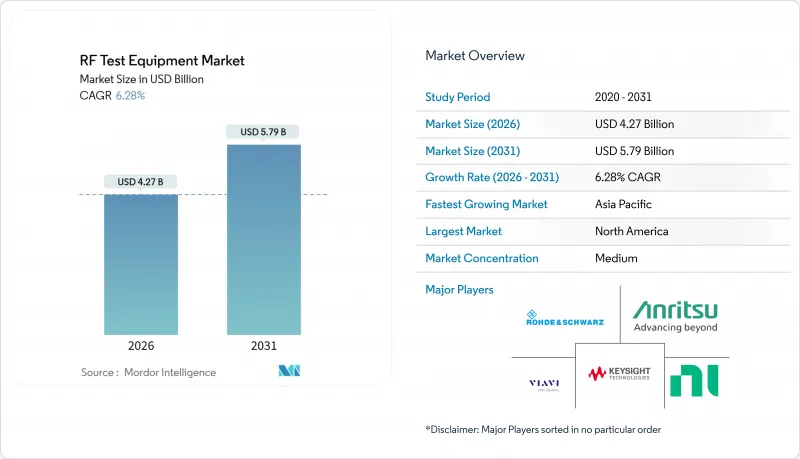
根據 Mordor Intelligence 估計,2026 年射頻檢測設備的市場規模為 42.7 億美元,預計到 2031 年將達到 57.9 億美元。
這意味著在整個預測期內,複合年成長率將達到 6.28%。
本報告按類型(模組化通用測量儀器、傳統通用測量儀器、其他)、外形規格(桌上型、可攜式、模組化)、頻段(6GHz)、組件(射頻分析儀、射頻振盪器、其他)、終端用戶產業(電訊、消費性電子、其他)和地區進行細分。市場預測以美元計價。
全球射頻檢測設備市場趨勢與洞察
毫米波 5G 的部署(需要 24GHz 以上的檢驗)正在迅速增加。
隨著全球監管機構批准24.25GHz至40GHz之間的FR2頻段,電信業者被迫從傳導測試轉向能夠模擬真實環境的無線檢查室。 SK Telecom計劃在2025年將其28GHz基地台網路規模擴大三倍,這意味著每個站點都需要進行高達50GHz的諧波測量。因此,儀器供應商正在整合氮化鎵放大器、主動冷卻和多探頭定位系統,以應對超過150W/cm²的熱密度。目前,能夠在這些頻段連續運作的儀器售價高達每台8,000至12,000美元。那些能夠在不犧牲熱穩定性的前提下最佳化便攜性的供應商預計將在高頻市場佔據主導地位。
在東亞部署大規模MIMO基地台
中國和日本正在採用64T64R和128T128R天線模組,與單輸入單輸出(SISO)配置相比,這將使檢測複雜度增加40%。全面的空間通道模擬推動了對價格在50萬至120萬美元之間的自動定位系統和多探針檢測室的需求。兩大認證檢測室供應商的壟斷地位,加上MIMO無線檢測Release 19規範的推出,已將採購前置作業時間延長至九個月。目前,各區域中心實驗室正在聯合出資購買這些設備,以抵銷成本支出。
ETSI 和 3GPP 標準的快速發展導致了過時。
2025年12月發布的第19版規範凍結以及計劃於2027年中發布的第20版規範凍結,將使折舊期從之前的四年縮短至兩年。採用模組化射頻前端且無法現場升級的設備面臨提前報廢的風險。例如,一家中國原始設備製造商(OEM)就為專用於第17版的設備提列了320萬美元的減損準備。目前,平台供應商透過更換訊號處理卡來延長設備的使用壽命,但模組化會使初始成本增加15%至20%,這對於預算敏感的測試實驗室來說並不理想。此外,頻繁的韌體檢驗週期也進一步增加了認證機構的營運成本。
細分市場分析
預計到2025年,傳統通用儀器的銷售額將佔總銷售額的32.54%。這主要得益於航太、國防和大學實驗室的需求,這些機構優先考慮可溯源至NIST的校準以及在10 kHz偏移頻率下低於-135 dBc/Hz的相位噪聲基底。是德科技的N9000B CXA和羅德與施瓦茨的FSW系列是該領域的旗艦產品,其動態範圍超過120 dB,並且在雷達面積測量和衛星轉發器特性分析方面仍然展現出無與倫比的性能。同時,隨著通訊和汽車產業的買家採用遠端可重構的軟體定義架構,預計到2031年,模組化通用儀器的複合年成長率將達到7.83%。美國國家儀器公司的 PXI底盤在 2025 年佔該公司銷售額的 28%,它允許用戶透過 PCIe 背板熱插拔射頻前端,從而將 6 GHz 以下頻段到毫米波頻段過渡期間的切換時間從幾天縮短到幾小時。
在融資緊張的地區,租賃通用測量設備正成為可行的選擇。根據巴西國家電信和電信管理局 (Anatel) 的數據,到 2025 年 8 月,72% 的新增 5G 測試部署將透過經營租賃的方式資金籌措,高於 2023 年的 48%,這使得整合商能夠在合約期間將 Release 18 硬體升級到 Release 19。這種模式給原始設備製造商 (OEM) 的利潤率帶來了壓力,因為租賃提供者要求 25% 的數量折扣,同時也要承擔設備過時的風險。半導體自動化測試設備 (ATE) 市場由愛德萬測試 (Advantest) 的 V93000 晶圓探針平台主導,該市場仍呈現週期性波動,由於消費性電子產品庫存調整,預計 2025 年晶圓廠產能擴張速度將放緩。隨著數位替代方案將多種功能整合到單一底盤中,傳統的類比訊號產生器和功率計的市場佔有率持續下降。鑑於目前的普及速度,到 2028 年,模組化解決方案可能會佔據通訊和汽車實驗室新部署的大部分,這可能會推動供應商轉向基於訂閱的收入流和支援跨多個地點共用儀器的雲端原生編配。
模組化機架式系統市場正以 8.12% 的複合年成長率 (CAGR) 成長。這是因為電信業者正在行動通訊基地台機房部署高密度測試節點,在這些環境中,遠端存取和 19 吋機架相容性比單純的處理速度更為重要。是德科技 (Keysight) 的 M9384B VXG(3 槽 PXI 發生器)將於 2025 年 4 月發布,其相位噪聲性能(1dB 以內)可與台式系統媲美,而佔用的空間僅為台式系統的五分之一,並在單個機殼內提供 12 種測量功能。到 2025 年,桌上型系統仍將佔 35.13% 的銷售額,這主要得益於國防實驗室對高達 110GHz、動態範圍達 120dB 的產品的需求。安立 (Anritsu) 的「Field Master Pro」和 RIGOL 的「DSA800E」等可攜式分析儀非常適合屋頂勘測和干擾源識別,因為 15kg 重的桌上型系統並不適合日常使用。 Release 19 無線通訊標準 TS 38.141-2 規定,當基地台投入運作時,必須使用手持參考接收器,從而在該領域建立了最低監管標準。
熱設計對總體擁有成本 (TCO) 有顯著影響。桌上型分析儀依靠強制風冷來維持在 40 GHz 以上頻段的連續運行,而手持式設備則採用被動式散熱器,並將佔空比限制在 60%,從而使汽車雷達檢測時間延長 40%。模組化機架整合式夾層液冷迴路,可實現中央站 24/7 全天候運行,並且由於符合 ETSI 機架尺寸標準,因此可在全球範圍內運作。羅德與施瓦茨已將 2025 年研發預算的 40% 用於模組化設計,這表明他們相信機架密度在 Open RAN檢驗等大規模生產領域將超越台式精度。這種市場分化迫使供應商維護平行產品線:面向航空航太和國防領域的高精度台式分析儀,以及面向通訊和汽車領域的模組化 PXI。這使得庫存管理和分銷通路獎勵的發展變得更加複雜。
區域分析
由於C頻段授權義務所導致的嚴格干擾檢驗,以及超過220億美元的聯邦頻率競標收入,北美在2025年維持了36.01%的收入佔有率。美國也資助了41億美元的聯合全區指揮與控制(JADC2)計劃,該計劃強制要求在關鍵任務網路中使用30MHz至6GHz的軟體定義分析儀。在加拿大,3.4億加元(約2.5億美元)的補貼(包括測試設備代金券)正在支持遍遠地區5G網路的擴展。
亞太地區呈現最快成長態勢,年複合成長率達7.64%,這主要得益於中國476萬個5G廣域基地台的建設以及印度私有網路牌照的快速發放。韓國的藍圖規劃在2028年前部署用於6G原型機的110GHz頻段分析儀。日本於2025年3月舉行的頻譜競標創造了4,800億日圓(約32億美元)的收入,並規定了經向量網路分析檢驗的營運商間干擾裕度。
預計到2025年,歐洲將佔22%的市場佔有率,但目前主要供應商的毫米波工程師缺口高達23%,這給歐洲市場帶來了巨大挑戰。歐盟的《晶片法案》撥款12億歐元(約13億美元)用於聯合投資測試基礎設施,而挪威電信公司Telenor已將五個實驗室合併為一個遠端接入站點,從而降低了31%的營運成本。英國26GHz頻段的競標創造了14億英鎊(約18億美元)的收入,現在的許可證發放也包含了無線傳輸的要求。
儘管本質安全型分析儀在中東和非洲的部署仍處於早期階段,但沙烏地阿拉伯油田的專用5G網路需要此類分析儀,而福祿克在該領域佔據主導地位。在南美洲,租賃模式已被廣泛接受,巴西預計到2025年,新測試設備的租賃率將達到72%。這種資金籌措模式也正在非洲推廣,南非已撥款80億蘭特(約4.4億美元)用於農村寬頻建設,其中包括租賃選項。
其他好處
- Excel格式的市場預測(ME)表
- 3個月的分析師支持
目錄
第1章:引言
- 研究假設和市場定義
- 調查範圍
第2章:調查方法
第3章執行摘要
第4章 市場狀況
- 市場概覽
- 市場促進因素
- 毫米波 5G 的部署(需要 24GHz 以上的檢驗)正在迅速增加。
- 在東亞部署大規模MIMO基地台
- 德國和日本對汽車雷達和ADAS測試的需求
- 低地球軌道(LEO)衛星星系的部署擴大了對Ka波段測試的需求。
- 採用小型化物聯網晶片組的攜帶式射頻分析儀已廣泛應用。
- 雲端連線、人工智慧增強型遠端測試實驗室的出現。
- 市場限制因素
- ETSI 和 3GPP 標準的快速發展導致了過時。
- 由於外形規格,在高於 40GHz 的頻率下散熱面臨挑戰
- 北歐國家缺乏熟練的射頻測試工程師
- 南美洲高資本投資與租賃偏好之間的衝突
- 產業價值鏈分析
- 監管和技術展望
- 波特五力分析
- 投資分析
- 宏觀經濟因素的影響
第5章 市場規模與成長預測
- 按類型
- 模組化GP測量儀器
- 傳統GP測量儀器
- 半導體自動測試設備
- 租賃GP
- 其他
- 按外形規格
- 工作檯面
- 可攜式的
- 模組化的
- 按頻段
- 小於1GHz
- 1~6GHz
- 超過 6GHz
- 按組件
- 射頻分析儀
- 射頻振盪器
- 射頻合成器
- 射頻放大器
- 射頻檢測器
- 其他
- 按最終用戶行業分類
- 電訊
- 航太/國防
- 家用電子產品
- 車
- 半導體製造
- 衛生保健
- 工業和物聯網
- 其他
- 按地區
- 北美洲
- 美國
- 加拿大
- 南美洲
- 巴西
- 阿根廷
- 其他南美國家
- 歐洲
- 英國
- 德國
- 法國
- 義大利
- 瑞典
- 挪威
- 其他歐洲國家
- 中東
- 沙烏地阿拉伯
- 阿拉伯聯合大公國
- 土耳其
- 其他中東國家
- 非洲
- 南非
- 奈及利亞
- 其他非洲國家
- 亞太地區
- 中國
- 日本
- 印度
- 韓國
- 亞太其他地區
- 北美洲
第6章 競爭情勢
- 市場集中度
- 策略趨勢
- 市佔率分析
- 公司簡介
- Keysight Technologies Inc.
- Rohde and Schwarz GmbH and Co. KG
- Anritsu Corporation
- Viavi Solutions Inc.
- National Instruments Corporation
- Yokogawa Electric Corporation
- Tektronix Inc.
- Teledyne Technologies Inc.
- Fortive Corp.(Fluke)
- Teradyne Inc.
- Chroma ATE Inc.
- EXFO Inc.
- Cobham Ltd.
- Copper Mountain Technologies
- Advantest Corporation
- LitePoint Corporation
- Spirent Communications plc
- RIGOL Technologies Inc.
- Aim-TTi(Thurlby Thandar Instruments)
- Boonton Electronics
- SIGLENT Technologies
- GW Instek
- Wireless Telecom Group
- Picotest Corp.
- B&K Precision Corporation
- TestEquity LLC
- Copper Mountain Technologies
- Giga-tronics Inc.
- Empirix Inc.
第7章 市場機會與未來展望
According to Mordor Intelligence, the RF test equipment market size is estimated at USD 4.27 billion in 2026 and is projected to reach USD 5.79 billion by 2031, reflecting a 6.28% CAGR across the forecast period.
This report is Segmented by Type (Modular GP Instrumentation, Traditional GP Instrumentation, and More), Form Factor (Benchtop, Portable, and Modular), Frequency Range (6 GHz), Component (RF Analysers, RF Oscillators, and More), End-User Industry (Telecommunication, Consumer Electronics, and More), and Geography. The Market Forecasts are Provided in Terms of Value (USD).
Global RF Test Equipment Market Trends and Insights
Surge in mmWave 5G Roll-outs Requiring >24 GHz Validation
Global regulators are clearing FR2 spectrum between 24.25 GHz and 40 GHz, which forces operators to migrate from conducted tests to over-the-air chambers that mimic field conditions. SK Telecom tripled its 28 GHz base-station footprint in 2025, and each site requires harmonic measurements up to 50 GHz. Instrument vendors therefore integrate gallium-nitride amplifiers, active cooling, and multi-probe positioning systems to cope with heat densities above 150 W/cm2. Instruments capable of continuous operation at these frequencies now command price premiums of USD 8,000-12,000 per unit. Vendors that optimize portability without sacrificing thermal stability stand to capture disproportionate share in the high-frequency tier.
Proliferation of Massive-MIMO Base-Stations in East Asia
China and Japan are adopting 64T64R and 128T128R antenna modules, increasing test complexity by 40% compared with single-input single-output setups. Comprehensive spatial-channel emulation drives demand for automated positioners and multi-probe chambers priced between USD 500,000 and 1.2 million. The duopoly of certified chamber suppliers, combined with Release 19 specifications for MIMO over-the-air tests, lengthens procurement lead times to nine months. Centralized regional labs now pool capital for these assets to offset cost overheads.
Rapidly Evolving ETSI and 3GPP Standards Creating Obsolescence
The December 2025 freeze of Release 19 and the scheduled mid-2027 freeze of Release 20 collapse the historical four-year amortization window to two years. Equipment that lacks modular, field-upgradeable RF front-ends risks premature retirement, evidenced by a Chinese OEM's USD 3.2 million write-off of Release 17-only gear. Although platform providers now swap signal-processing cards to extend service lives, modularity adds 15-20% to upfront cost, a premium budget-conscious labs resist. Frequent firmware validation cycles further inflate operating expense for accredited certification houses.
Other drivers and restraints analyzed in the detailed report include:
- Automotive RADAR and ADAS Test Demand Across Germany and Japan
- Satellite LEO Constellation Build-outs Driving Ka-Band Tests
- Form-Factor Heat-Dissipation Challenges Above 40 GHz
For complete list of drivers and restraints, kindly check the Table Of Contents.
Segment Analysis
Traditional general-purpose instrumentation accounted for 32.54% of 2025 revenue, anchored in aerospace, defense, and university labs that value NIST-traceable calibration and phase-noise floors below -135 dBc/Hz at a 10 kHz offset. Keysight's N9000B CXA and Rohde & Schwarz's FSW families exemplify this tier, offering dynamic ranges above 120 dB that remain unmatched for radar cross-section work and satellite-transponder characterization. Modular general-purpose instrumentation, however, is advancing at a 7.83% CAGR to 2031 as telecom and automotive buyers embrace software-defined architectures that can be reconfigured remotely. National Instruments' PXI chassis, which generated 28% of the company's revenue in 2025, lets users hot-swap RF front-ends over PCIe backplanes, shrinking changeover time from days to hours when migrating from sub-6 GHz to millimeter-wave cases.
Rental general-purpose instrumentation is emerging as a viable option in cash-constrained regions. Brazil's Anatel noted that 72% of new 5G test placements in August 2025 were financed through operating leases, up from 48% in 2023, allowing integrators to swap Release 18 hardware for Release 19 mid-contract. This model puts pressure on OEM margins because lessors demand 25% volume discounts while absorbing obsolescence risk. Semiconductor automated test equipment, dominated by Advantest's V93000 wafer-probe platform, remains cyclical, tied to fab-capacity additions that slowed in 2025 amid consumer-electronics inventory corrections. Legacy analog signal generators and power meters continue to decline as digital alternatives collapse multiple functions into a single chassis. Given current velocity, modular solutions could represent the majority of new placements in telecom and automotive labs by 2028, nudging vendors toward subscription revenue and cloud-native orchestration that supports multi-site instrument sharing.
Modular rack-mount systems are expanding at an 8.12% CAGR because operators deploy dense test nodes in cell-site hotels, where remote access and 19-inch rack compatibility outweigh raw speed. Keysight's M9384B VXG, a three-slot PXI generator introduced in April 2025, matches benchtop phase noise within 1 dB while occupying only one-fifth the space, enabling 12 measurement functions in a single enclosure. Benchtop boxes still accounted for 35.13% of 2025 revenue, supported by defense labs that demand a 120 dB dynamic range to 110 GHz. Portable analyzers such as Anritsu's Field Master Pro and RIGOL's DSA800E are well-suited for rooftop surveys and interference hunting, where 15 kg benchtop units are impractical. Release 19's over-the-air specification, TS 38.141-2, mandates handheld reference receivers for base-station turn-up, creating a regulatory floor for this segment.
Thermal engineering drives the cost of ownership. Benchtop analyzers rely on forced-air cooling to sustain continuous duty above 40 GHz, whereas handheld devices use passive heat sinks that cap duty cycle at 60%, extending automotive radar tests by 40%. Modular racks incorporate mezzanine liquid loops for 24/7 operation in central offices, and ETSI rack dimensions ensure global installability. Rohde & Schwarz devoted 40% of its 2025 R&D budget to modular design, signaling faith that rack density will trump benchtop precision in volume segments like Open RAN validation. The bifurcation forces suppliers to maintain parallel product lines: high-accuracy benchtops for space and defense, and modular PXI for telecom and automotive, complicating inventory management and channel incentives.
Complete Report Scope:
- By Type
- Modular GP Instrumentation
- Traditional GP Instrumentation
- Semiconductor ATE
- Rental GP
- Other Types
- By Form Factor
- Benchtop
- Portable
- Modular
- By Frequency Range
- < 1 GHz
- 1 - 6 GHz
- > 6 GHz
- By Component
- RF Analysers
- RF Oscillators
- RF Synthesizers
- RF Amplifiers
- RF Detectors
- Other Components
- By End-user Industry
- Telecommunication
- Aerospace and Defence
- Consumer Electronics
- Automotive
- Semiconductor Manufacturing
- Healthcare
- Industrial and IoT
- Other End-user Industries
- By Geography
- North America
- United States
- Canada
- South America
- Brazil
- Argentina
- Rest of South America
- Europe
- United Kingdom
- Germany
- France
- Italy
- Sweden
- Norway
- Rest of Europe
- Middle East
- Saudi Arabia
- United Arab Emirates
- Turkey
- Rest of Middle East
- Africa
- South Africa
- Nigeria
- Rest of Africa
- Asia Pacific
- China
- Japan
- India
- South Korea
- Rest of Asia Pacific
- North America
Geography Analysis
North America maintained a 36.01% revenue share in 2025 as C-band license obligations enforced stringent interference validation, and Federal auction receipts exceeded USD 22 billion. The United States also funds a USD 4.1 billion Joint All-Domain Command and Control program that mandates software-defined analyzers across 30 MHz-6 GHz for mission-critical networks. Canadian subsidies worth CAD 340 million (USD 250 million) support 5G rural coverage, including test-gear vouchers.
Asia Pacific shows the fastest trajectory, posting a 7.64% CAGR, powered by China's 4.76 million 5G macro sites and India's rapid private-network licensing. South Korea's roadmap sets a path to 110 GHz analyzers for 6G prototypes by 2028. Japan's March 2025 spectrum auction raised JPY 480 billion (USD 3.2 billion) and stipulates inter-operator interference margins verified by vector network analysis.
Europe accounted for 22% share in 2025 but grapples with a 23% vacancy rate for mmWave engineers at leading vendors. The EU Chips Act earmarks EUR 1.2 billion (USD 1.3 billion) for test-infrastructure co-investment, while Norway's Telenor consolidated five labs into a single remote-access site, cutting overhead by 31%. The United Kingdom's 26 GHz auction raised GBP 1.4 billion (USD 1.8 billion), embedding over-the-air mandates into licensing.
Middle East and Africa depict nascent uptake, yet Saudi private 5G in oil fields requires intrinsically safe analyzers, a domain Fluke dominates. South America embraces rentals, with Brazil registering 72% lease penetration for new test gear in 2025. This financing model migrates toward Africa where South Africa earmarks ZAR 8 billion (USD 440 million) for rural broadband, including rental options.
- Keysight Technologies Inc.
- Rohde and Schwarz GmbH and Co. KG
- Anritsu Corporation
- Viavi Solutions Inc.
- National Instruments Corporation
- Yokogawa Electric Corporation
- Tektronix Inc.
- Teledyne Technologies Inc.
- Fortive Corp. (Fluke)
- Teradyne Inc.
- Chroma ATE Inc.
- EXFO Inc.
- Cobham Ltd.
- Copper Mountain Technologies
- Advantest Corporation
- LitePoint Corporation
- Spirent Communications plc
- RIGOL Technologies Inc.
- Aim-TTi (Thurlby Thandar Instruments)
- Boonton Electronics
- SIGLENT Technologies
- GW Instek
- Wireless Telecom Group
- Picotest Corp.
- B&K Precision Corporation
- TestEquity LLC
- Copper Mountain Technologies
- Giga-tronics Inc.
- Empirix Inc.
Additional Benefits:
- The market estimate (ME) sheet in Excel format
- 3 months of analyst support
TABLE OF CONTENTS
1 INTRODUCTION
- 1.1 Study Assumptions and Market Definition
- 1.2 Scope of the Study
2 RESEARCH METHODOLOGY
3 EXECUTIVE SUMMARY
4 MARKET LANDSCAPE
- 4.1 Market Overview
- 4.2 Market Drivers
- 4.2.1 Surge in mmWave 5G Roll-outs Requiring >24 GHz Validation
- 4.2.2 Proliferation of Massive-MIMO Base-Stations in East Asia
- 4.2.3 Automotive RADAR and ADAS Test Demand Across Germany and Japan
- 4.2.4 Satellite LEO Constellation Build-outs Driving Ka-Band Tests
- 4.2.5 Miniaturised IoT Chipsets Boosting Hand-held RF Analysers
- 4.2.6 Emergence of Cloud-Connected, AI-Enhanced Remote Test Labs
- 4.3 Market Restraints
- 4.3.1 Rapidly Evolving ETSI and 3GPP Standards Creating Obsolescence
- 4.3.2 Form-Factor Heat-Dissipation Challenges Above 40 GHz
- 4.3.3 Skilled RF-Test Engineering Talent Shortage in Nordics
- 4.3.4 High Cap-Ex Versus Rental Preference in South America
- 4.4 Industry Value Chain Analysis
- 4.5 Regulatory or Technological Outlook
- 4.6 Porter's Five Forces Analysis
- 4.6.1 Threat of New Entrants
- 4.6.2 Bargaining Power of Buyers
- 4.6.3 Bargaining Power of Suppliers
- 4.6.4 Threat of Substitute Products
- 4.6.5 Intensity of Competitive Rivalry
- 4.7 Investment Analysis
- 4.8 Impact of Macroeconomic Factors
5 MARKET SIZE AND GROWTH FORECASTS (VALUE)
- 5.1 By Type
- 5.1.1 Modular GP Instrumentation
- 5.1.2 Traditional GP Instrumentation
- 5.1.3 Semiconductor ATE
- 5.1.4 Rental GP
- 5.1.5 Other Types
- 5.2 By Form Factor
- 5.2.1 Benchtop
- 5.2.2 Portable
- 5.2.3 Modular
- 5.3 By Frequency Range
- 5.3.1 < 1 GHz
- 5.3.2 1 - 6 GHz
- 5.3.3 > 6 GHz
- 5.4 By Component
- 5.4.1 RF Analysers
- 5.4.2 RF Oscillators
- 5.4.3 RF Synthesizers
- 5.4.4 RF Amplifiers
- 5.4.5 RF Detectors
- 5.4.6 Other Components
- 5.5 By End-user Industry
- 5.5.1 Telecommunication
- 5.5.2 Aerospace and Defence
- 5.5.3 Consumer Electronics
- 5.5.4 Automotive
- 5.5.5 Semiconductor Manufacturing
- 5.5.6 Healthcare
- 5.5.7 Industrial and IoT
- 5.5.8 Other End-user Industries
- 5.6 By Geography
- 5.6.1 North America
- 5.6.1.1 United States
- 5.6.1.2 Canada
- 5.6.2 South America
- 5.6.2.1 Brazil
- 5.6.2.2 Argentina
- 5.6.2.3 Rest of South America
- 5.6.3 Europe
- 5.6.3.1 United Kingdom
- 5.6.3.2 Germany
- 5.6.3.3 France
- 5.6.3.4 Italy
- 5.6.3.5 Sweden
- 5.6.3.6 Norway
- 5.6.3.7 Rest of Europe
- 5.6.4 Middle East
- 5.6.4.1 Saudi Arabia
- 5.6.4.2 United Arab Emirates
- 5.6.4.3 Turkey
- 5.6.4.4 Rest of Middle East
- 5.6.5 Africa
- 5.6.5.1 South Africa
- 5.6.5.2 Nigeria
- 5.6.5.3 Rest of Africa
- 5.6.6 Asia Pacific
- 5.6.6.1 China
- 5.6.6.2 Japan
- 5.6.6.3 India
- 5.6.6.4 South Korea
- 5.6.6.5 Rest of Asia Pacific
- 5.6.1 North America
6 COMPETITIVE LANDSCAPE
- 6.1 Market Concentration
- 6.2 Strategic Moves
- 6.3 Market Share Analysis
- 6.4 Company Profiles
- 6.4.1 Keysight Technologies Inc.
- 6.4.2 Rohde and Schwarz GmbH and Co. KG
- 6.4.3 Anritsu Corporation
- 6.4.4 Viavi Solutions Inc.
- 6.4.5 National Instruments Corporation
- 6.4.6 Yokogawa Electric Corporation
- 6.4.7 Tektronix Inc.
- 6.4.8 Teledyne Technologies Inc.
- 6.4.9 Fortive Corp. (Fluke)
- 6.4.10 Teradyne Inc.
- 6.4.11 Chroma ATE Inc.
- 6.4.12 EXFO Inc.
- 6.4.13 Cobham Ltd.
- 6.4.14 Copper Mountain Technologies
- 6.4.15 Advantest Corporation
- 6.4.16 LitePoint Corporation
- 6.4.17 Spirent Communications plc
- 6.4.18 RIGOL Technologies Inc.
- 6.4.19 Aim-TTi (Thurlby Thandar Instruments)
- 6.4.20 Boonton Electronics
- 6.4.21 SIGLENT Technologies
- 6.4.22 GW Instek
- 6.4.23 Wireless Telecom Group
- 6.4.24 Picotest Corp.
- 6.4.25 B&K Precision Corporation
- 6.4.26 TestEquity LLC
- 6.4.27 Copper Mountain Technologies
- 6.4.28 Giga-tronics Inc.
- 6.4.29 Empirix Inc.
7 MARKET OPPORTUNITIES AND FUTURE OUTLOOK
- 7.1 White-Space and Unmet-Need Assessment

 射頻測試設備市場:全球市場預測,2026-2032年
 美國和歐洲寬頻多通道EMSO測試系統市場:2025-2030年
 全球射頻測試系統(雷達、敵我識別、雷達警報接收機、導航輔助設備)市場:2026-2036年全球射頻測試設備市場規模、佔有率、趨勢和成長分析報告(2026-2034年)
 5G射頻組件市場分析及預測(至2035年):類型、產品、技術、組件、應用、部署、最終用戶、模組、功能、安裝配置
 2026年全球射頻測試設備市場報告雷達高度計測試設備市場按產品類型、測試類型、應用和最終用戶分類 - 全球預測 2026-2032
 射頻測試設備市場規模、佔有率和成長分析(按類型、外形規格、頻率範圍、最終用途和地區分類)-2026-2033年產業預測
 射頻測試設備市場機會、成長動力、產業趨勢分析及 2025 - 2034 年預測射頻測試夾具市場按組件、類型、頻率範圍、最終用途和最終用戶分類 - 2025 年至 2030 年全球預測