


 |
市場調查報告書
商品編碼
2121304
M2M 連結:市場佔有率分析、產業趨勢與統計、成長預測(2026-2031 年)M2M Connections - Market Share Analysis, Industry Trends & Statistics, Growth Forecasts (2026 - 2031) |
||||||

※ 本網頁內容可能與最新版本有所差異。詳細情況請與我們聯繫。
根據 Mordor Intelligence 預測,M2M 連結市場預計將在 2026 年達到 419.1 億美元,到 2031 年達到 594.4 億美元,年複合成長率為 7.24%。
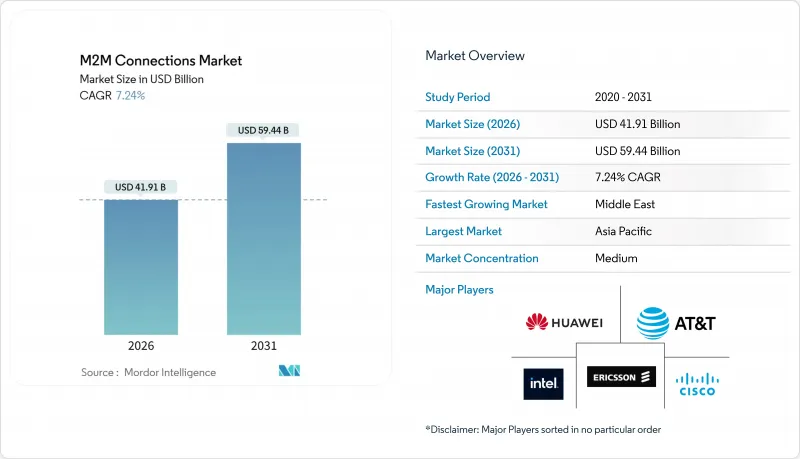
本報告按連接類型(有線、無線)、技術(蜂窩連接、低功耗廣域通訊 (LPWA)、短程通訊、都市區域網路(MAN)、廣域固定通訊、衛星通訊)、部署模式(本地部署、雲端部署、混合部署)、最終用戶產業(零售、銀行及金融機構、電信及IT、其他)和地區進行細分。市場預測以美元計價。
全球M2M連結市場趨勢及洞察
物聯網設備在各行業的普及
工業企業正透過將感測器整合到以往孤立的設備中,並收集用於預測性維護程序的遙測數據,來減少意外停機時間和能源浪費。製造商的補貼和模組價格的下降(NB-IoT晶片組的價格現已低於5美元)使得即使是低價值資產也能實現互聯互通。零售連鎖店正在部署能夠自動觸發補貨的智慧貨架,管道營運商則在數千公里的基礎設施上安裝壓力感測器,以便在幾分鐘內檢測到洩漏。這一趨勢在重工業、採礦和石化行業中尤為明顯,因為在這些行業,一小時的停機可能會造成高達六位數的損失。設備製造商現在將互聯功能作為標準配置交付,這不僅加快了部署速度,也提高了營運商和分析供應商的持續業務收益。
行動連線增加和智慧型手機普及率不斷提高
新興市場智慧型手機的快速普及使得營運商能夠重複利用現有的LTE和5G容量,從而降低了新增M2M終端的邊際成本。印度通訊部強制要求所有新建基地台相容NB-IoT和LTE-M,以擴大農業感測器在農村地區的覆蓋範圍。技術人員現在可以透過手持終端機上的藍牙和NFC功能配置閘道器,而無需使用專用筆記型電腦,從而將安裝時間從數小時縮短到數分鐘。中國移動的OneLink平台展示了基於應用程式的存取方式的可擴充性,在截至2024年9月的12個月內新增了1.8億個連線。類似的變化也出現在物流車隊中,駕駛員可以將智慧型手機與車輛單元配對,無需專用掃描器即可上傳遠端資訊處理數據,從而進一步增強營運商盈利的飛輪效應。
M2M通訊中的隱私和安全問題
薄弱的身份驗證機制和過時的韌體正在危及關鍵基礎設施的安全。 2024年,美國網路安全與基礎設施安全局 (CISA) 發布了23項關於工業控制系統的建議,重點在於硬編碼憑證和安全防護不足的引導程式。製造商在出廠設備時使用了預設密碼,揭露了設定漏洞,導致4萬台路由器被殭屍網路入侵。醫療監管機構要求胰島素幫浦和心電圖監視器採用端對端加密,這增加了合規成本並延遲了產品上市。儘管企業正在採用零信任架構,但對於低價值資產而言,為傳統感測器加裝加密硬體仍然不划算。 IEC 62443等認證系統使組件成本上漲了10%至15%,擠壓了利潤空間。
細分市場分析
到2025年,無線連接將佔M2M連接市場72.33%的佔有率,預計到2031年將以7.66%的複合年成長率成長。澳洲和智利的礦業公司正在使用LTE-M覆蓋廣闊的礦區,並連接自動駕駛卡車,而無需鋪設昂貴的光纖電纜。在智慧農業領域,無線通訊是首選,因為在分散的農田中鋪設感測器和氣象站的溝槽成本過高。衛星通訊填補了管道和海上資產通訊覆蓋的空白,銥星和環球星在地面電波無線電波無法覆蓋的地區提供窄頻服務。
儘管模組價格預計在2022年至2024年間下降40%,但由於技術純熟勞工短缺導致有線安裝成本上升,總體擁有成本(TCO)方面無線方案仍然更具優勢。有線乙太網路在建築自動化領域仍然佔據重要地位,乙太網路供電(PoE)簡化了配置並免去了電池維護。混合拓撲結構正在興起,將有線感測器叢集整合到蜂窩回程傳輸中,以平衡可靠性和成本,但無線方案在整個M2M連接市場仍然保持著強勁的發展勢頭。
到2025年,蜂窩網路連線預計將佔據M2M連線市場佔有率的47.19%,這主要得益於LTE和5G網路的普及,它們支援高頻寬影片和即時追蹤。 NB-IoT和LTE-M延長了電錶和環境監測器的電池續航時間,推動低功耗廣域網路(LPWA )年複合成長率(CAGR)實現最快成長,預計到2031年這一數字將達到8.41%。光是中國移動一家就管理超過14.7億條物聯網線路,其中大部分採用NB-IoT技術。
藍牙低功耗 (Bluetooth Low Energy) 和 Zigbee 等短距離無線技術正逐漸成為穿戴式裝置和智慧家庭叢集的主流選擇,其應用範圍可達閘道器 100 公尺以內。在城市規模的部署中,LoRaWAN 佔據中間位置,因為蜂窩資料方案會導致不永續的經常性成本。目前,阿姆斯特丹和新加坡等地的公共網路正在運行,用於連接停車場和空氣品質感測器。衛星技術在海事、航空和偏遠管道等領域仍然至關重要,它增強了多模態環境,晶片組供應商正透過整合無線功能來應對這一挑戰,從而實現動態網路選擇。
區域分析
預計到2025年,亞太地區將佔全球連結量的33.82%,主要得益於各國政府對智慧城市和公共產業的監管。同時,中國大規模部署5G設備,以及印度的「國家物聯網計畫」(旨在2027年部署5億台設備,並為模組製造商提供補貼)也推動了這一趨勢。在日本,基於5G獨立組網的V2I(車路協同)應用案例正在試點中;而在韓國,政府正為支持工廠自動化的私人5G測試平台提供資金支持。
在北美和歐洲,連線成長速度較慢,但每條線路的收入更高,因為企業專注於高價值分析和嚴格的安全認證。歐盟的無線電設備指令將於2025年1月生效,該指令要求所有設備支援安全軟體更新,提高了合規門檻,但也增強了人們對連網終端的信心。在美國,FirstNet為公共安全領域的機器對機器(M2M)通訊提供了一條優先通道,預計到2024年中期將有500萬台設備使用它。
在中東,預計到2031年,年複合成長率(CAGR)。這主要得益於沙烏地阿拉伯NEOM新城部署的100萬個感測器以及杜拜的智慧基礎設施,這些設施已使能源消耗降低了30%。在南美洲,精密農業正集中在巴西和阿根廷,並得到了巴西農業部補貼的支持。在非洲,儘管農村地區的覆蓋率仍然落後,但南非和埃及都市區NB-IoT技術的部署正在推動計量和車輛管理的發展。
其他好處
- Excel格式的市場預測(ME)表
- 3個月的分析師支持
目錄
第1章:引言
- 研究假設和市場定義
- 調查範圍
第2章:調查方法
第3章執行摘要
第4章 市場狀況
- 市場概覽
- 市場促進因素
- 物聯網設備在各行業的普及
- 行動連線增加和智慧型手機普及率不斷提高
- 擴大遠端資訊處理技術在汽車和交通運輸領域的應用
- 透過整合 eSIM 技術實現大規模M2M 可擴充性。
- 面向工業M2M應用的專用5G網路的興起
- 對能夠降低延遲的即時邊緣分析的需求日益成長
- 市場限制因素
- M2M通訊中的隱私和安全問題
- 缺乏全球通用的M2M規範與互通性
- IPv4 位址空間短缺以及向 IPv6 過渡的延遲
- 專用應用M2M晶片組的供應鏈中斷
- 產業價值鏈分析
- 宏觀經濟因素對市場的影響
- 監理情勢
- 技術展望
- 波特五力分析
- 評估新冠疫情對市場的影響
第5章 市場規模與成長預測
- 按連線類型
- 有線
- 無線的
- 透過技術
- 蜂窩網路連接
- 低功耗廣域通訊(LPWA)
- 短程通訊
- 都市區域網路(MAN)
- 廣域固定線路通訊
- 衛星通訊
- 按部署模式
- 現場
- 雲
- 混合
- 按最終用戶行業分類
- 零售
- 銀行和金融機構
- 通訊/IT
- 衛生保健
- 車
- 石油和天然氣
- 運輸
- 其他
- 按地區
- 北美洲
- 美國
- 加拿大
- 墨西哥
- 歐洲
- 德國
- 英國
- 法國
- 俄羅斯
- 其他歐洲國家
- 亞太地區
- 中國
- 日本
- 印度
- 韓國
- 澳洲
- 其他亞太國家
- 中東和非洲
- 中東
- 沙烏地阿拉伯
- 阿拉伯聯合大公國
- 其他中東國家
- 非洲
- 南非
- 埃及
- 其他非洲地區
- 中東
- 南美洲
- 巴西
- 阿根廷
- 南美洲其他地區
- 北美洲
第6章 競爭情勢
- 市場集中度
- 策略趨勢
- 市佔率分析
- 公司簡介
- AT&T Inc.
- Vodafone Group Plc
- Deutsche Telekom AG
- China Mobile Ltd.
- Verizon Communications Inc.
- Cisco Systems Inc.
- Huawei Technologies Co., Ltd.
- Intel Corporation
- Sierra Wireless Inc.
- Telefonica SA
- Telit Communications PLC
- Gemalto NV(Thales Group)
- Ericsson AB
- Orange Business Services
- Telenor Group
- China Unicom Ltd.
- VMware Inc.
- Texas Instruments Incorporated
- Quectel Wireless Solutions Co., Ltd.
- Semtech Corporation
第7章 市場機會與未來展望
According to Mordor Intelligence, the M2M connections market size stands at USD 41.91 billion in 2026 and is forecast to reach USD 59.44 billion by 2031, expanding at a 7.24% CAGR.
This report is Segmented by Connection Type (Wired, and Wireless), Technology (Cellular Connections, Low Power Wide Area (LPWA), Short Range, Metropolitan Area Network (MAN), Wide Area Fixed, Satellite), Deployment Model (On-Premise, Cloud, Hybrid), End-User Industry (Retail, Banking and Financial Institutions, Telecom and IT, and More), and Geography. Market Forecasts are Provided in Terms of Value (USD).
Global M2M Connections Market Trends and Insights
Proliferation Of IoT Devices Across Industries
Industrial firms are embedding sensors in once-isolated equipment to collect telemetry that feeds predictive maintenance programs, trimming unplanned downtime and energy waste. Manufacturer subsidies and falling module prices, now below USD 5 for NB-IoT chipsets, make connectivity viable for low-value assets. Retail chains run smart shelves that trigger restocks automatically, and pipeline operators outfit thousands of kilometers of infrastructure with pressure sensors that detect leaks within minutes. Momentum is strongest in heavy industry, mining, and petrochemicals, where every hour of outage carries six-figure losses. Equipment makers now ship connectivity-ready machines by default, accelerating the installed base and stimulating recurring service revenue for operators and analytics vendors.
Increasing Number Of Mobile Connections And Smartphone Penetration
Rapid smartphone adoption in emerging markets lowers the marginal cost of adding M2M endpoints by allowing carriers to reuse existing LTE and 5G capacity. India's Department of Telecommunications requires every new tower to support NB-IoT and LTE-M, expanding rural coverage for agriculture sensors. Technicians now provision gateways via Bluetooth and NFC on handheld devices rather than proprietary laptops, cutting installation times from hours to minutes. China Mobile's OneLink platform added 180 million connections in the 12 months ending September 2024, proving the scalability of app-based onboarding. Logistics fleets mirror this shift, as drivers pair smartphones with vehicle units to upload telematics without dedicated scanners, reinforcing the flywheel effect for operator economics.
Privacy And Security Concerns In M2M Communications
Weak authentication and outdated firmware expose critical infrastructure. CISA issued 23 industrial control advisories in 2024, citing hardcoded credentials and insecure bootloaders. A botnet hijacked 40,000 routers after manufacturers shipped devices with default passwords, underscoring provisioning lapses. Healthcare regulators demand end-to-end encryption for insulin pumps and cardiac monitors, raising compliance costs and delaying launches. Enterprises are adopting zero-trust architectures, but retrofitting cryptographic hardware onto legacy sensors remains cost-prohibitive for low-value assets. Certification regimes such as IEC 62443 add 10-15% to the bill of materials, squeezing margins.
Other drivers and restraints analyzed in the detailed report include:
- Growing Adoption Of Telematics In Automotive And Transport
- Integration of eSIM Technology Enabling Massive M2M Scalability
- Lack Of Global M2M Standards And Interoperability
For complete list of drivers and restraints, kindly check the Table Of Contents.
Segment Analysis
Wireless links accounted for 72.33% of the M2M connections market in 2025 and are on track for a 7.66% CAGR through 2031. Mining companies in Australia and Chile cover sprawling pits with LTE-M, connecting autonomous haul trucks without costly fiber runs. Smart agriculture favors wireless because sensors and weather stations spread across fragmented acreage cannot justify trenching. Satellite fills coverage gaps for pipelines and maritime assets, with Iridium and Globalstar offering narrowband service where terrestrial signals fade.
Total cost of ownership keeps tilting toward wireless as module prices drop 40% between 2022 and 2024, while skilled-labor shortages drive up wired-installation costs. Wired Ethernet still holds its ground in building automation, where power-over-Ethernet simplifies provisioning and eliminates battery maintenance. Hybrid topologies are emerging, aggregating wired sensor clusters into cellular backhaul to balance reliability and cost, but the overall momentum remains firmly behind wireless in the M2M connections market.
Cellular connections secured 47.19% of the M2M connections market share in 2025, driven by ubiquitous LTE and 5G networks that support high-bandwidth video and real-time tracking. NB-IoT and LTE-M extend battery life for meters and environmental monitors, propelling LPWA toward the fastest 8.41% CAGR to 2031. China Mobile alone manages more than 1.47 billion IoT lines, the majority of which are on NB-IoT.
Short-range radios like Bluetooth Low Energy and Zigbee dominate wearables and smart home clusters within 100 meters of a gateway. LoRaWAN occupies a middle ground for city-scale deployments where cellular data plans incur unsustainable recurring fees, with Amsterdam and Singapore running public networks that host parking and air-quality sensors. Satellite technologies remain indispensable for maritime, aviation, and remote pipelines, reinforcing a multi-modal landscape that chipset vendors now address with integrated radios capable of dynamic network selection.
Complete Report Scope:
- By Connection Type
- Wired
- Wireless
- By Technology
- Cellular Connections
- Low Power Wide Area (LPWA)
- Short Range
- Metropolitan Area Network (MAN)
- Wide Area Fixed
- Satellite
- By Deployment Model
- On-Premise
- Cloud
- Hybrid
- By End-User Industry
- Retail
- Banking and Financial Institutions
- Telecom and IT
- Healthcare
- Automotive
- Oil and Gas
- Transportation
- Other End-User Industries
- By Geography
- North America
- United States
- Canada
- Mexico
- Europe
- Germany
- United Kingdom
- France
- Russia
- Rest of Europe
- Asia-Pacific
- China
- Japan
- India
- South Korea
- Australia
- Rest of Asia-Pacific
- Middle East and Africa
- Middle East
- Saudi Arabia
- United Arab Emirates
- Rest of Middle East
- Africa
- South Africa
- Egypt
- Rest of Africa
- Middle East
- South America
- Brazil
- Argentina
- Rest of South America
- North America
Geography Analysis
Asia-Pacific accounted for 33.82% of global connections in 2025, driven by state mandates for smart cities and utilities. China's vast installed base is complemented by India's National IoT Policy, which aims to reach 500 million devices by 2027 and offers subsidies to module makers. Japan trials vehicle-to-infrastructure use cases over 5G standalone networks, while South Korea funds private 5G testbeds that anchor factory automation.
North America and Europe show slower connection growth yet richer revenue per line as enterprises focus on value-added analytics and stringent security certifications. The European Union's Radio Equipment Directive, effective January 2025, requires all devices to support secure software updates, raising compliance hurdles but boosting trust in connected endpoints. In the United States, FirstNet provides priority lanes for public-safety M2M traffic, tallying 5 million devices by mid-2024.
The Middle East projects the highest CAGR of 8.91% through 2031, fueled by Saudi Arabia's NEOM deployment of 1 million sensors and Dubai's smart infrastructure, which cut energy use by 30%. South America sees concentrated adoption of precision agriculture in Brazil and Argentina, aided by subsidies from the Brazilian Ministry of Agriculture. Africa lags in rural coverage, but urban NB-IoT rollouts in South Africa and Egypt are enabling metering and fleet management.
- AT&T Inc.
- Vodafone Group Plc
- Deutsche Telekom AG
- China Mobile Ltd.
- Verizon Communications Inc.
- Cisco Systems Inc.
- Huawei Technologies Co., Ltd.
- Intel Corporation
- Sierra Wireless Inc.
- Telefonica SA
- Telit Communications PLC
- Gemalto NV (Thales Group)
- Ericsson AB
- Orange Business Services
- Telenor Group
- China Unicom Ltd.
- VMware Inc.
- Texas Instruments Incorporated
- Quectel Wireless Solutions Co., Ltd.
- Semtech Corporation
Additional Benefits:
- The market estimate (ME) sheet in Excel format
- 3 months of analyst support
TABLE OF CONTENTS
1 INTRODUCTION
- 1.1 Study Assumptions and Market Definition
- 1.2 Scope of the Study
2 RESEARCH METHODOLOGY
3 EXECUTIVE SUMMARY
4 MARKET LANDSCAPE
- 4.1 Market Overview
- 4.2 Market Drivers
- 4.2.1 Proliferation of IoT Devices Across Industries
- 4.2.2 Increasing Number of Mobile Connections and Smartphone Penetration
- 4.2.3 Growing Adoption of Telematics in Automotive and Transport
- 4.2.4 Integration of eSIM Technology Enabling Massive M2M Scalability
- 4.2.5 Rise of Private 5G Networks for Industrial M2M Applications
- 4.2.6 Emerging Demand for Real-Time Edge Analytics Reducing Latency
- 4.3 Market Restraints
- 4.3.1 Privacy and Security Concerns in M2M Communications
- 4.3.2 Lack of Global M2M Standards and Interoperability
- 4.3.3 Scarcity of IPv4 Address Space and Delays in IPv6 Transition
- 4.3.4 Supply-Chain Disruptions for Specialized M2M Chipsets
- 4.4 Industry Value Chain Analysis
- 4.5 Impact of Macroeconomic Factors on the Market
- 4.6 Regulatory Landscape
- 4.7 Technological Outlook
- 4.8 Porter's Five Forces Analysis
- 4.8.1 Bargaining Power of Suppliers
- 4.8.2 Bargaining Power of Buyers
- 4.8.3 Threat of New Entrants
- 4.8.4 Threat of Substitute Products
- 4.8.5 Intensity of Competitive Rivalry
- 4.9 Assessment of the Impact of COVID-19 on the Market
5 MARKET SIZE AND GROWTH FORECASTS (VALUE)
- 5.1 By Connection Type
- 5.1.1 Wired
- 5.1.2 Wireless
- 5.2 By Technology
- 5.2.1 Cellular Connections
- 5.2.2 Low Power Wide Area (LPWA)
- 5.2.3 Short Range
- 5.2.4 Metropolitan Area Network (MAN)
- 5.2.5 Wide Area Fixed
- 5.2.6 Satellite
- 5.3 By Deployment Model
- 5.3.1 On-Premise
- 5.3.2 Cloud
- 5.3.3 Hybrid
- 5.4 By End-User Industry
- 5.4.1 Retail
- 5.4.2 Banking and Financial Institutions
- 5.4.3 Telecom and IT
- 5.4.4 Healthcare
- 5.4.5 Automotive
- 5.4.6 Oil and Gas
- 5.4.7 Transportation
- 5.4.8 Other End-User Industries
- 5.5 By Geography
- 5.5.1 North America
- 5.5.1.1 United States
- 5.5.1.2 Canada
- 5.5.1.3 Mexico
- 5.5.2 Europe
- 5.5.2.1 Germany
- 5.5.2.2 United Kingdom
- 5.5.2.3 France
- 5.5.2.4 Russia
- 5.5.2.5 Rest of Europe
- 5.5.3 Asia-Pacific
- 5.5.3.1 China
- 5.5.3.2 Japan
- 5.5.3.3 India
- 5.5.3.4 South Korea
- 5.5.3.5 Australia
- 5.5.3.6 Rest of Asia-Pacific
- 5.5.4 Middle East and Africa
- 5.5.4.1 Middle East
- 5.5.4.1.1 Saudi Arabia
- 5.5.4.1.2 United Arab Emirates
- 5.5.4.1.3 Rest of Middle East
- 5.5.4.2 Africa
- 5.5.4.2.1 South Africa
- 5.5.4.2.2 Egypt
- 5.5.4.2.3 Rest of Africa
- 5.5.4.1 Middle East
- 5.5.5 South America
- 5.5.5.1 Brazil
- 5.5.5.2 Argentina
- 5.5.5.3 Rest of South America
- 5.5.1 North America
6 COMPETITIVE LANDSCAPE
- 6.1 Market Concentration
- 6.2 Strategic Moves
- 6.3 Market Share Analysis
- 6.4 Company Profiles (includes global level overview, market level overview, core segments, financials as available, strategic information, market rank/share for key companies, products and services, and recent developments)
- 6.4.1 AT&T Inc.
- 6.4.2 Vodafone Group Plc
- 6.4.3 Deutsche Telekom AG
- 6.4.4 China Mobile Ltd.
- 6.4.5 Verizon Communications Inc.
- 6.4.6 Cisco Systems Inc.
- 6.4.7 Huawei Technologies Co., Ltd.
- 6.4.8 Intel Corporation
- 6.4.9 Sierra Wireless Inc.
- 6.4.10 Telefonica SA
- 6.4.11 Telit Communications PLC
- 6.4.12 Gemalto NV (Thales Group)
- 6.4.13 Ericsson AB
- 6.4.14 Orange Business Services
- 6.4.15 Telenor Group
- 6.4.16 China Unicom Ltd.
- 6.4.17 VMware Inc.
- 6.4.18 Texas Instruments Incorporated
- 6.4.19 Quectel Wireless Solutions Co., Ltd.
- 6.4.20 Semtech Corporation
7 MARKET OPPORTUNITIES AND FUTURE OUTLOOK
- 7.1 White-Space and Unmet-Need Assessment

 機器對機器(M2M)服務:市場佔有率分析、行業趨勢和統計數據以及成長預測(2026-2031 年)
 衛星M2M通訊市場:2026-2032年全球市場預測(依衛星軌道、頻段、終端類型、類型及應用分類)
 蜂窩M2M市場規模、佔有率和成長分析:按技術、應用、終端用戶產業和地區分類-2026-2033年產業預測
 機器對機器 (M2M) 連接市場:按技術、終端用戶產業和地區分類
 機器對機器 (M2M) 連接市場報告:按連接類型、技術、最終用戶行業和地區分類 (2026–2034)
 2026年全球機器對機器連接市場報告2026年全球機器對機器(M2M)服務市場報告M2M(機器對機器)連結市場:按組件、連接方式、技術、應用和最終用戶產業分類-2026-2032年全球市場預測2026年全球機器對機器(M2M)市場報告M2M服務市場:依連結類型、服務類型、合約模式、應用程式類型、產業和部署模式分類-2026-2032年全球預測