


 |
市場調查報告書
商品編碼
2121287
吸塑包裝:市場佔有率分析、產業趨勢與統計、成長預測(2026-2031)Blister Packaging - Market Share Analysis, Industry Trends & Statistics, Growth Forecasts (2026 - 2031) |
||||||

※ 本網頁內容可能與最新版本有所差異。詳細情況請與我們聯繫。
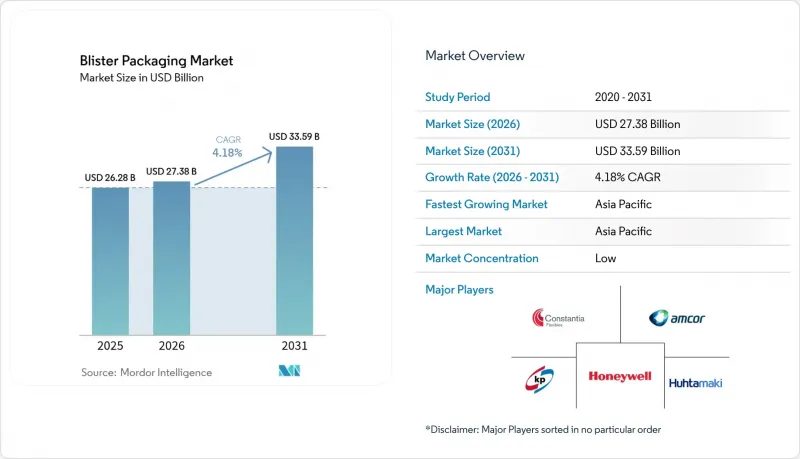
據 Mordor Intelligence 稱,2025 年泡殼包裝市場價值為 262.8 億美元,預計到 2031 年將達到 335.9 億美元,而 2026 年為 273.8 億美元,預測期(2026-2031 年)的複合年成長率為 4.18%。
本報告按製程(熱成型、冷成型)、材料(塑膠薄膜、鋁、紙和紙板)、產品類型(卡片式/面封式吸塑包裝、翻蓋式吸塑包裝、卡扣式/全卡片式吸塑包裝及其他)、終端用戶行業(製藥、營養保健品和膳食補充劑及其他)以及地區進行細分。市場預測以美元計價。
全球泡殼包裝市場趨勢及洞察
老年人口增加和慢性病盛行率上升
預計到2030年,全球60歲及以上人口將激增56%,這將增加對易於使用且具有防篡改功能的泡殼包裝的需求,同時也有助於提高遵守用藥。諸如大字體、顏色編碼和易開設計等老年人友善設計正被Drug Plastics Group等加工商推向市場。該公司的「Pop & Click」閉合設計可將所需的手部力量減少約四分之一。糖尿病和心血管疾病等慢性病進一步推動了多劑量包裝的普及,這種包裝為複雜的用藥方案提供了清晰的視覺提示,並促進了泡殼包裝專家的高價產品的銷售。
對單劑量包裝和用藥依從性支持包裝的需求
醫院、藥局和居家醫療機構正日益將報銷與用藥依從性指標掛鉤,凸顯了泡殼式單劑量包裝的重要性。 Parata 的自動化系統現已直接與電子健康記錄平台整合,在減少配藥錯誤的同時,簡化了重新包裝流程。美國食品藥物管理局 (FDA)提案強制要求非處方崩壞口腔製劑使用單劑量包裝,凸顯了監管機構對單劑量包裝安全性的認可。製藥品牌也正利用單劑量泡殼包裝來實現差異化,將增強品牌認知度與瓶裝包裝無法實現的防竄改功能結合。
PVC與鋁價格波動劇烈
中國將於2025年大幅提高PVC進口關稅,從1%增加到5.5%,這推高了下游加工商的樹脂成本,凸顯了他們對政策變化的脆弱性。印度加工商60%的PVC原料依賴進口,因此仍面臨風險,避險和後向整合是風險管理的關鍵。鋁箔價格也受能源市場波動的影響,這給規模較小、無法簽訂多年合約的中小型吸塑包裝生產商帶來了沉重負擔。
細分市場分析
預計到2025年,熱成型將佔全球銷售額的63.75%,年成長率達5.54%,主要得益於製藥公司對其低模具成本、高生產線速度以及與多種薄膜基材相容性的青睞。布朗機械公司(Brown Machines)的Quad系列熱成型機目前每小時可生產高達25萬個蓋子,同時能耗降低約四分之一,從而提高合約包裝公司的生產效率,並助力泡罩包裝市場的發展。小規模實驗室也可以透過GEA推出的模組化設備使用這項技術,從而將供應商群體擴展到大型跨國公司之外。
冷泡膜雖然市佔率較小,但對於水分和光敏分子而言至關重要。當穩定性測試要求接近零水蒸氣透過率時,製藥公司通常會指定使用鋁-鋁結構。隨著生物製藥和高活性成分的日益普及,冷泡膜的應用範圍不斷擴大,更薄的薄膜和混合複合材料的研發也在加速推進,這些材料能夠在不影響阻隔性的前提下減輕重量。這些進步,加上更廣泛的技術選擇,正在鞏固泡殼包裝市場作為多功能平台的地位,該平台既能滿足大規模生產的學名藥的需求,也能滿足小眾專科藥品的需求。
塑膠薄膜(主要為PVC、PET和PP)憑藉著成熟的供應鏈和優異的熱成型性能,在2025年佔據了吸塑包裝市場67.52%的佔有率。然而,由於對化石基材料的監管力度加大,紙基包裝解決方案的市佔率正在迅速成長,預計到2031年將維持7.02%的年複合成長率(CAGR)公司現推出透明、可回收的中等阻隔PET吸塑包裝,其中含有30%的再生材料,顯示加工商在推動循環經濟發展的同時,也確保了符合藥典規範。
像羅勒公司(Rohrer)的「EcoVolve-30」這樣的紙板泡殼包裝,結合了纖維和功能性塗層,能夠承受生產線的成型溫度,並保護防潮片劑。雖然易受潮限制了其廣泛的應用,但品牌商仍在使用紙質泡殼包裝維生素、膳食補充劑和保存期限較短的產品,以彰顯其環保理念。材料科學的進步有望推動纖維-聚合物混合複合材料在需要更高阻隔性的產品類別中的應用。這將進一步加速泡殼包裝市場的成長,並有助於滿足有關再生材料含量的監管要求。
區域分析
預計亞太地區將成為領先區域,到2025年將佔全球銷售額的40.95%,年複合成長率(CAGR)將達到7.29%,超過其他所有地區。這主要得益於中國和印度擴大了活性藥物成分(API)的生產規模,並符合西方品質標準。藥明康德新在泰興新建的API工廠以及在新加坡的擴建計劃,正是該地區製造地擴張的典型例證,直接推動了當地對符合標準的泡殼包裝生產線的需求。中國將進口PVC關稅提高至5.5%,將進一步刺激國內薄膜擠出成型製程的發展,並加強支撐東亞泡殼包裝市場的供應鏈本地化。
北美仍然是技術標竿。儘管美國食品藥物管理局 (FDA) 嚴格的序列化和防篡改法規維持了智慧包裝的溢價,但隨著生物製藥灌裝和包裝需求的成長,對機械設備的資本投資正在擴大。 PMMI 預測,到 2027 年,包裝器材的銷售額將創下歷史新高,這主要得益於製藥應用領域的成長,預計製藥應用的成長速度將超過食品飲料產業。安姆科收購貝瑞全球後,將把軟包裝和硬包裝能力整合到單一平台上,確保規模和垂直整合,這對於小規模的北美加工商來說難以匹敵。
歐洲實施了一些最嚴格的永續發展法規。歐盟2025/40號法規要求到2030年,PET包裝必須可回收且再生材料含量達到30%,從而鼓勵對循環經濟友善設計進行投資。 TekniPlex公司展示的透明、可回收、中等阻隔性的吸塑包裝,展示了一種既能滿足合規要求又能符合歐洲藥品管理局(EMA)嚴格阻隔性能規範的途徑。臨床實驗室包裝也符合歐盟536/2014號法規的要求,這促使Catalent公司在其位於日本滋賀縣的工廠安裝了一條高速吸塑生產線。該生產線滿足了跨區域的臨床實驗室需求,凸顯了合規主導需求的全球性特徵。因此,儘管材料選擇不斷變化,歐洲吸塑包裝的市場佔有率仍然保持強勁。
其他好處
- Excel格式的市場預測(ME)表
- 3個月的分析師支持
目錄
第1章:引言
- 調查假設和市場定義
- 調查範圍
第2章:調查方法
第3章執行摘要
第4章 市場狀況
- 市場概覽
- 市場促進因素
- 老年人口增加和慢性病盛行率上升
- 對單劑量包裝和用藥依從性支持包裝的需求
- 監管機構為實施防篡改規範所做的努力
- 帶有 NFC/QR碼的智慧型吸塑包裝,可用於追蹤和追溯。
- 用於個人化醫療的小批量泡殼包裝生產線
- 出於對永續性,人們對用PE取代PVC的需求日益成長。
- 市場限制因素
- PVC和鋁價波動劇烈
- 加強對聚氯乙烯(PVC)處置和回收的監管
- PVDC樹脂供應瓶頸
- 非處方條狀包裝和小袋的替代品
- 價值供應鏈分析
- 監理情勢
- 技術展望
- 波特五力分析
第5章 市場規模與成長預測
- 透過流程
- 熱成型
- 冷成型
- 材料
- 塑膠薄膜(PVC、PET、PP、PE、rPET、COP 等)
- 鋁(鋁鋁箔,PTP箔)
- 紙張和紙板
- 依產品類型
- 卡片式/面封式吸塑包裝
- 翻蓋式吸塑包裝
- 陷阱型/全卡片式吸塑包裝
- 兒童安全/老人友善包裝
- 按最終用戶行業分類
- 製藥
- 營養保健品和膳食補充劑
- 家用電器和五金
- 個人護理和化妝品
- 其他
- 按地區
- 北美洲
- 美國
- 加拿大
- 墨西哥
- 歐洲
- 德國
- 英國
- 法國
- 義大利
- 西班牙
- 俄羅斯
- 其他歐洲國家
- 亞太地區
- 中國
- 印度
- 日本
- 韓國
- 澳洲和紐西蘭
- 其他亞太國家
- 中東和非洲
- 中東
- 阿拉伯聯合大公國
- 沙烏地阿拉伯
- 土耳其
- 其他中東國家
- 非洲
- 南非
- 奈及利亞
- 埃及
- 其他非洲地區
- 中東
- 南美洲
- 巴西
- 阿根廷
- 南美洲其他地區
- 北美洲
第6章 競爭情勢
- 市場集中度
- 策略趨勢
- 市佔率分析
- 公司簡介
- Amcor plc
- WestRock Company
- Constantia Flexibles GmbH
- Klockner Pentaplast Group
- Sonoco Products Company
- DuPont de Nemours, Inc.
- Honeywell International Inc.
- Tekni-Plex, Inc.
- Dow Inc.
- Uflex Ltd.
- Huhtamaki Oyj
- Winpak Ltd.
- Bilcare Ltd.
- Bemis Company LLC(Amcor)
- Lotte Aluminium Co., Ltd.
- Toyo Aluminium KK
- Pharma Packaging Solutions
- R-Pharm Germany GmbH
- FormPaks Ltd.
- Zhejiang Hualian Pharmaceutical Co.
第7章 市場機會與未來展望
According to Mordor Intelligence, the blister packaging market size was valued at USD 26.28 billion in 2025 and estimated to grow from USD 27.38 billion in 2026 to reach USD 33.59 billion by 2031, at a CAGR of 4.18% during the forecast period (2026-2031).
This report is Segmented by Process (Thermoforming, Cold Forming), Material (Plastic Films, Aluminium, Paper and Paperboard), Product Type (Carded/Face-Seal Blisters, Clamshell Blisters, Trapped and Full-Card Blisters, and More), End-User Industry (Pharmaceuticals, Nutraceuticals and Dietary Supplements, and More), and Geography. The Market Forecasts are Provided in Terms of Value (USD).
Global Blister Packaging Market Trends and Insights
Growing Geriatric Population and Chronic-Disease Prevalence
The global cohort aged 60 and above will surge 56% by 2030, intensifying demand for user-friendly blister packs that improve medication adherence while offering tamper evidence. Senior-centric designs-larger print, color coding, and low opening force-are being commercialized by converters such as Drug Plastics Group, whose Pop & Click closure reduces required hand pressure by roughly a quarter. Chronic conditions like diabetes and cardiovascular disease further amplify multi-dose pack adoption, enabling clear visual cues for complex regimes and reinforcing premium price realization for blister specialists.
Demand for Unit-Dose and Patient-Adherence Packs
Hospitals, pharmacies, and home-health providers increasingly link reimbursement to adherence metrics, elevating the role of blister-based unit-dose packs. Automated equipment from Parata now integrates directly with electronic health-record platforms, cutting dispensing errors while simplifying repack operations. The FDA's proposal to require single-unit containers for orally disintegrating OTC forms underscores regulatory endorsement of unit-dose safety benefits. Pharmaceutical brands also leverage unit-dose blisters for differentiation, combining brand visibility with tamper-evidence that bottles cannot replicate.
Volatile PVC and Aluminium Prices
China's jump in PVC import tariffs from 1% to 5.5% in 2025 lifted resin costs for downstream converters, spotlighting vulnerability to policy shifts. Indian converters remain exposed since 60% of their PVC feedstock is sourced abroad, making hedging and backward integration central to risk management. Aluminium foil prices also swing with energy markets, straining smaller blister firms that lack the scale to lock in multi-year contracts.
Other drivers and restraints analyzed in the detailed report include:
- Regulatory Push for Tamper-Evident Formats
- Smart Blister Packs with NFC/QR for Track-and-Trace
- Tightening PVC Disposal/Recycling Legislation
For complete list of drivers and restraints, kindly check the Table Of Contents.
Segment Analysis
Thermoforming commanded 63.75% of global revenues in 2025 and will grow 5.54% a year as drug makers favor its low tooling cost, fast line speeds, and compatibility with diverse film substrates. Brown Machine's Quad-Series thermoformers now deliver up to 250,000 lids per hour while trimming energy use by roughly one-quarter, giving contract packers productivity gains that sustain the blister packaging market's momentum. Smaller laboratories gain access through modular machines introduced by GEA, broadening supplier bases beyond large multinationals.
Cold-form foil, though a minority share, is indispensable for moisture- or light-sensitive molecules. Drug makers often specify aluminium-aluminium structures when stability studies demand near-zero water vapor transmission. As biologics and high-potency actives proliferate, cold form's installed base expands, intensifying R&D into thinner foils and hybrid lamination that cut weight without compromising barrier. Together, these advances widen the technology palette, reinforcing the blister packaging market as a versatile platform for both mass-production generics and niche specialty drugs.
Plastic films, led by PVC, PET, and PP, accounted for 67.52% of blister revenues in 2025 thanks to mature supply chains and easy thermoformability. Yet heightened scrutiny of fossil-based materials is spurring rapid incremental gains for paper-based solutions, which log a 7.02% CAGR through 2031. TekniPlex now offers transparent recyclable mid-barrier PET blisters containing 30% recycled content, illustrating how converters preserve pharmacopoeial compliance while advancing circularity.
Paperboard entrants such as Rohrer's EcoVolve-30 use fiber plus functional coatings to withstand line forming temperatures and protect moisture-tolerant tablets. Although moisture sensitivity limits broad substitution, brand owners deploy paper variants in vitamins, nutraceuticals, and short shelf-life SKUs, bolstering eco-credentials. Over time, material science breakthroughs are expected to let hybrid fiber-polymer laminates secure higher-barrier categories, reinforcing the blister packaging market size trajectory and aligning with regulatory recycled-content mandates.
Complete Report Scope:
- By Process
- Thermoforming
- Cold Forming
- By Material
- Plastic Films (PVC, PET, PP, PE, rPET, COP, others)
- Aluminium (ALU-ALU, PTP foil)
- Paper and Paperboard
- By Product Type
- Carded / Face-Seal Blisters
- Clamshell Blisters
- Trapped and Full-Card Blisters
- Child-Resistant / Senior-Friendly Packs
- By End-User Industry
- Pharmaceuticals
- Nutraceuticals and Dietary Supplements
- Consumer Electronics and Hardware
- Personal Care and Cosmetics
- Other End-user Industry
- By Geography
- North America
- United States
- Canada
- Mexico
- Europe
- Germany
- United Kingdom
- France
- Italy
- Spain
- Russia
- Rest of Europe
- Asia-Pacific
- China
- India
- Japan
- South Korea
- Australia and New Zealand
- Rest of Asia-Pacific
- Middle East and Africa
- Middle East
- United Arab Emirates
- Saudi Arabia
- Turkey
- Rest of Middle East
- Africa
- South Africa
- Nigeria
- Egypt
- Rest of Africa
- Middle East
- South America
- Brazil
- Argentina
- Rest of South America
- North America
Geography Analysis
Asia-Pacific led with 40.95% of 2025 revenue and will outpace all regions at 7.29% CAGR as China and India scale active-pharmaceutical-ingredient output and align with Western quality standards. WuXi STA's new Taixing API site and proposed Singapore expansion exemplify regional manufacturing build-out, directly lifting local demand for compliant blister lines. China's tariff hike on imported PVC to 5.5% further encourages domestic film extrusion, reinforcing supply-chain localization that underpins the blister packaging market in East Asia.
North America remains a technological bellwether. Stringent FDA serialization plus tamper-evidence rules sustain premium margins for intelligent formats, while machinery capex expands in anticipation of biologic fill-finish demand. PMMI projects packaging-machinery sales will hit record highs by 2027, with pharmaceutical applications outperforming food and beverage. Amcor's Berry Global acquisition consolidates flexible and rigid capabilities inside a single platform, ensuring scale and vertical reach that smaller North American converters will find hard to match.
Europe confronts the most aggressive sustainability legislation. Regulation 2025/40 enforces recyclability and 30% recycled content in PET packs by 2030, directing investment into circular-ready designs. TekniPlex's showcase of transparent recyclable mid-barrier blisters demonstrates compliance pathways that still satisfy stringent EMA barrier specifications. Clinical-trial packs also adapt to EU 536/2014, prompting Catalent to equip its Shiga, Japan, site with high-speed blister lines that serve pan-regional studies and underscore the global nature of compliance-driven demand. Consequently, the blister packaging market share in Europe remains resilient even as material choices evolve.
- Amcor plc
- WestRock Company
- Constantia Flexibles GmbH
- Klockner Pentaplast Group
- Sonoco Products Company
- DuPont de Nemours, Inc.
- Honeywell International Inc.
- Tekni-Plex, Inc.
- Dow Inc.
- Uflex Ltd.
- Huhtamaki Oyj
- Winpak Ltd.
- Bilcare Ltd.
- Bemis Company LLC (Amcor)
- Lotte Aluminium Co., Ltd.
- Toyo Aluminium K.K.
- Pharma Packaging Solutions
- R-Pharm Germany GmbH
- FormPaks Ltd.
- Zhejiang Hualian Pharmaceutical Co.
Additional Benefits:
- The market estimate (ME) sheet in Excel format
- 3 months of analyst support
TABLE OF CONTENTS
1 INTRODUCTION
- 1.1 Study Assumptions and Market Definition
- 1.2 Scope of the Study
2 RESEARCH METHODOLOGY
3 EXECUTIVE SUMMARY
4 MARKET LANDSCAPE
- 4.1 Market Overview
- 4.2 Market Drivers
- 4.2.1 Growing geriatric population and chronic-disease prevalence
- 4.2.2 Demand for unit-dose and patient-adherence packs
- 4.2.3 Regulatory push for tamper-evident formats
- 4.2.4 Smart blister packs with NFC / QR for track-and-trace
- 4.2.5 Personalized-medicine small-batch blister lines
- 4.2.6 PVC-to-PE retrofit demand driven by sustainability
- 4.3 Market Restraints
- 4.3.1 Volatile PVC and aluminium prices
- 4.3.2 Tightening PVC disposal / recycling legislation
- 4.3.3 PVDC-resin supply bottlenecks
- 4.3.4 OTC stick-pack and sachet substitution
- 4.4 Value / Supply-Chain Analysis
- 4.5 Regulatory Landscape
- 4.6 Technological Outlook
- 4.7 Porter's Five Forces Analysis
- 4.7.1 Bargaining Power of Suppliers
- 4.7.2 Bargaining Power of Buyers
- 4.7.3 Threat of New Entrants
- 4.7.4 Threat of Substitutes
- 4.7.5 Intensity of Rivalry
5 MARKET SIZE AND GROWTH FORECASTS (VALUE)
- 5.1 By Process
- 5.1.1 Thermoforming
- 5.1.2 Cold Forming
- 5.2 By Material
- 5.2.1 Plastic Films (PVC, PET, PP, PE, rPET, COP, others)
- 5.2.2 Aluminium (ALU-ALU, PTP foil)
- 5.2.3 Paper and Paperboard
- 5.3 By Product Type
- 5.3.1 Carded / Face-Seal Blisters
- 5.3.2 Clamshell Blisters
- 5.3.3 Trapped and Full-Card Blisters
- 5.3.4 Child-Resistant / Senior-Friendly Packs
- 5.4 By End-User Industry
- 5.4.1 Pharmaceuticals
- 5.4.2 Nutraceuticals and Dietary Supplements
- 5.4.3 Consumer Electronics and Hardware
- 5.4.4 Personal Care and Cosmetics
- 5.4.5 Other End-user Industry
- 5.5 By Geography
- 5.5.1 North America
- 5.5.1.1 United States
- 5.5.1.2 Canada
- 5.5.1.3 Mexico
- 5.5.2 Europe
- 5.5.2.1 Germany
- 5.5.2.2 United Kingdom
- 5.5.2.3 France
- 5.5.2.4 Italy
- 5.5.2.5 Spain
- 5.5.2.6 Russia
- 5.5.2.7 Rest of Europe
- 5.5.3 Asia-Pacific
- 5.5.3.1 China
- 5.5.3.2 India
- 5.5.3.3 Japan
- 5.5.3.4 South Korea
- 5.5.3.5 Australia and New Zealand
- 5.5.3.6 Rest of Asia-Pacific
- 5.5.4 Middle East and Africa
- 5.5.4.1 Middle East
- 5.5.4.1.1 United Arab Emirates
- 5.5.4.1.2 Saudi Arabia
- 5.5.4.1.3 Turkey
- 5.5.4.1.4 Rest of Middle East
- 5.5.4.2 Africa
- 5.5.4.2.1 South Africa
- 5.5.4.2.2 Nigeria
- 5.5.4.2.3 Egypt
- 5.5.4.2.4 Rest of Africa
- 5.5.4.1 Middle East
- 5.5.5 South America
- 5.5.5.1 Brazil
- 5.5.5.2 Argentina
- 5.5.5.3 Rest of South America
- 5.5.1 North America
6 COMPETITIVE LANDSCAPE
- 6.1 Market Concentration
- 6.2 Strategic Moves
- 6.3 Market Share Analysis
- 6.4 Company Profiles (includes Global level Overview, Market level overview, Core Segments, Financials as available, Strategic Information, Market Rank/Share for key companies, Products and Services, and Recent Developments)
- 6.4.1 Amcor plc
- 6.4.2 WestRock Company
- 6.4.3 Constantia Flexibles GmbH
- 6.4.4 Klockner Pentaplast Group
- 6.4.5 Sonoco Products Company
- 6.4.6 DuPont de Nemours, Inc.
- 6.4.7 Honeywell International Inc.
- 6.4.8 Tekni-Plex, Inc.
- 6.4.9 Dow Inc.
- 6.4.10 Uflex Ltd.
- 6.4.11 Huhtamaki Oyj
- 6.4.12 Winpak Ltd.
- 6.4.13 Bilcare Ltd.
- 6.4.14 Bemis Company LLC (Amcor)
- 6.4.15 Lotte Aluminium Co., Ltd.
- 6.4.16 Toyo Aluminium K.K.
- 6.4.17 Pharma Packaging Solutions
- 6.4.18 R-Pharm Germany GmbH
- 6.4.19 FormPaks Ltd.
- 6.4.20 Zhejiang Hualian Pharmaceutical Co.
7 MARKET OPPORTUNITIES AND FUTURE OUTLOOK
- 7.1 White-space and Unmet-need Assessment

 吸塑包裝市場預測至2034年-按材料、產品類型、技術、應用、最終用戶和地區分類的全球分析
 吸塑包裝設備市場:依設備類型、成型材料、自動化程度、速度及最終用途產業分類-2026-2032年全球市場預測
 泡殼包裝市場規模、佔有率、趨勢和預測:按產品類型、技術、原料、最終用途和地區分類,2026-2034年
 吸塑包裝市場:按產品類型、技術、材料、應用和地區分類
 泡殼包裝市場規模、佔有率和趨勢分析報告:按材料、類型、技術、應用、地區和細分市場分類(2026-2033 年)泡殼包裝市場:2026-2032年全球市場預測(依材料、技術、劑型、應用及通路分類)
 2026-2034年全球泡殼包裝器材市場規模、佔有率、趨勢及成長分析報告泡殼包裝生產線市場按組件、包裝類型、材料、自動化程度、成型技術、應用和最終用途行業分類,全球預測,2026-2032年
 2026年全球泡殼包裝市場報告2026年全球泡殼包裝機械消費市場報告