


 |
市場調查報告書
商品編碼
2121285
證券交易即服務 (SECaaS):市場佔有率分析、產業趨勢與統計資料、成長預測(2026-2031 年)SECaaS - Market Share Analysis, Industry Trends & Statistics, Growth Forecasts (2026 - 2031) |
||||||

※ 本網頁內容可能與最新版本有所差異。詳細情況請與我們聯繫。
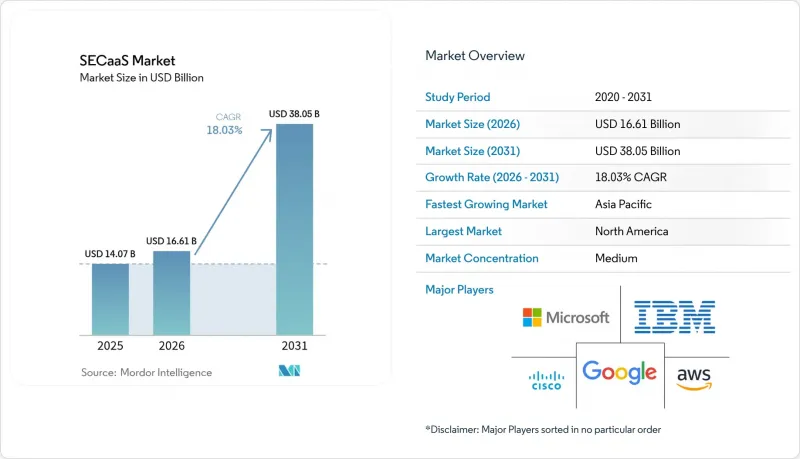
據 Mordor Intelligence 稱,2025 年安全即服務 (SECaaS) 市場價值為 140.7 億美元,預計到 2031 年將達到 380.5 億美元,而 2026 年為 166.1 億美元,預測期(2026-2031 年)的複合年成長率為 18.03%。
本報告按解決方案(識別及存取管理 (IAM)、安全郵件閘道、其他)、部署模式(公共雲端、私有雲端、混合雲端)、組織規模(大型企業、中小企業 (SME))、最終用戶產業(銀行、金融服務和保險 (BFSI)、IT 和電信、醫療保健和生命科學、其他)以及地區進行細分。市場預測以價值(美元)表示。
全球證券交易即服務 (SECaaS) 市場趨勢與洞察
中小企業和大型企業對雲端運算的採用率迅速成長。
隨著企業從以邊界為中心的技術轉向「身份驗證優先」的防禦策略,不斷成長的雲端預算正直接流入安全、通訊和即服務 (SECaaS) 市場。預計到 2028 年,印度的公共雲端服務市場規模將超過 242 億美元,其中保全服務成長最為迅猛,複合年成長率 (CAGR) 高達 19%。中小企業 (SME) 正在加速採用多租戶平台,因為他們無需投資建造專用安全營運中心 (SOC) 即可獲得企業級安全防護。金融機構尤其體現了這種轉變;98% 的金融機構已在使用至少一種雲端服務,大多數金融機構正在嚴格控制存取措施的前提下,將受監管的工作負載擴展到第三方雲端。隨著每個新工作負載遷移到雲端,SECaaS 訂閱滲透率也會自動提升,在整個供應商格局中產生協同增效效應。
網路威脅日益複雜
攻擊者現在利用人工智慧生成的網路釣魚、自主惡意軟體和大規模撞人員編制攻擊來癱瘓基於特徵碼的工具。為了應對這些攻擊,銀行正在將機器學習分析整合到其核心安全營運中心 (SOC) 工作流程中,並將多年網路安全預算中越來越大的比例分配給雲端原生威脅偵測引擎。醫療保健機構的資料外洩事件激增了 256%,他們現在強制要求所有第三方服務部署都必須符合 SOC 2 和 HIPAA 標準。安全、通訊和應用即服務 (SECaaS) 市場展現出大規模的自主性:威脅情報集中化,偵測模型持續更新,全球各地的自動化回應行動可在數秒內協調完成。
對資料儲存位置和主權的擔憂。
跨境資料流動的監管對雲端技術的統一應用構成挑戰。歐洲的《一般資料保護規範》(GDPR) 和即將實施的《數位營運彈性法案》(Digital Operational Resilience Act) 要求許多金融機構將客戶資料保留在區域邊界內,從而限制了其全球雲端部署的選擇。儘管多重雲端策略看似誘人,但主權管理的差異會導致安全架構的切割和成本的重疊。新興的主權雲端服務承諾提供本地處理,但企業仍對潛在的供應商鎖定風險保持謹慎。
細分市場分析
識別及存取管理 (IAM) 仍然是安全即服務 (SECaaS) 市場的基石。隨著雲端優先架構將身分管理定位為預設控制平面,預計到 2025 年,IAM 將佔 24.32% 的收入。此細分市場的持續重要性反映了最小權限原則要求的日益嚴格以及第三方開發者帳戶的爆炸性成長。進階 IAM 套件的功能已超越員工單一登入 (SSO),能夠管理容器編排器產生的非人工身份驗證,從而提升授權數量和每位使用者平均收入。雲端存取安全仲介(CASB) 細分市場雖然不太引人注目,但成長迅速,其複合年成長率 (CAGR) 高達 18.67%,這主要得益於對檢測未經授權的 SaaS 存取以及將資料遺失防護規則直接應用於跨 SaaS 流量的需求。這些解決方案支柱共同推動了向整合式保全服務邊緣解決方案的轉變,在這種解決方案中,線上偵測、存取控制和資料分類在全球邊緣架構上共存。安全電子郵件閘道器和安全 Web 閘道器功能正在遷移到此整合堆疊,而下一代 SIEM 透過重構資料擷取管道以利用超大規模資料中心業者存儲,顯著降低了每Terabyte 的成本並消除了部署障礙。
第二代漏洞管理工具直接整合到 CI/CD 管線中,從而閉合了程式碼、建置和執行環境之間的回饋迴路。這種轉變將安全態勢與開發人員的工作流程緊密結合,使安全即服務 (SECaaS) 市場與更廣泛的平台工程趨勢保持一致。供應商現在將預先已通過核准的基礎設施即程式碼 (IaC) 範本、策略即程式碼庫和管線插件打包在一起,使風險可見性成為系統固有的組成部分,而不是事後考慮的因素。最有效的銷售策略著重於透過將五點解決方案整合到單一合約中,實現可衡量的平均檢測和回應時間 (MTTD) 縮短、儀表板主導的合規性以及可驗證的投資回報率 (ROI)。
隨著企業利用承包全球接入點 (PoP) 和彈性可擴展性,到 2025 年,公共雲端將佔據安全、控制和即服務 (SECaaS) 市場 59.12% 的佔有率。然而,混合雲端的採用預計將以 19.52% 的複合年成長率成長,因為受監管的企業需要在資料主權要求與延遲和效能標準之間權衡取捨。目前,企業通常在公共雲端中部署身分驗證仲介和策略引擎,同時在客戶管理的基礎架構上運作內嵌解密節點,以處理高度敏感的工作負載。這種架構多樣性需要一個編配層,允許策略一次配置即可應用於所有位置,而這項功能是選擇供應商的關鍵差異化因素。
國防機構和關鍵基礎設施營運商由於無法將元資料暴露於共用環境,因此繼續在私有雲端上使用安全即服務 (SECaaS) 實例。一項新的產業藍圖實現了跨可信任域對入侵徵兆(IoC) 的受控同步,且不違反資料儲存位置規則。這種方法由工業控制供應商與國家電腦緊急應變小組 (CERT) 合作率先提出。在整個預測期內,多重雲端措施的自動化將變得至關重要,這將促進雲端平台和安全供應商之間的合作,旨在簡化身分驗證聯合、金鑰管理和遙測規範化流程。
區域分析
預計到2025年,北美將佔全球整體收入的36.72%,這反映了該地區超大規模資料中心業者、網路安全創新者和早期採用者的集中度。美國保全服務與基礎設施安全局 (CISA) 的聯邦指南呼籲逐步淘汰傳統VPN隧道,並推廣零信任、雲端原生訪問,這進一步強化了市場需求。金融機構目前在第三方實質審查調查審計中強制要求實施安全服務邊緣 (SSE) 控制,從而增強了整個供應鏈的網路效應。加拿大和墨西哥正利用這一勢頭,透過整合區域資料保護法和跨境資料流來加速平台擴張。
亞太地區預計在2031年前繼續維持19.12%的複合年成長率,主要得益於各國為實現國家數位經濟目標而製定的雲端遷移藍圖。印度的公共雲端收入已躋身全球成長最快的行列,而澳洲的IRAP框架也為認證的供應商打開了政府採購的大門。日本電信業者在5G邊緣部署方面處於主導,促使工業客戶為遠端工廠預先配置線上檢測功能。儘管各地區的資料法規有所不同,但能夠展現出一致且符合本地實際情況的加密金鑰管理方案的供應商將在競標中佔據決定性優勢。
在歐洲,受GDPR和新頒布的《數位營運彈性法案》(該法案強制要求金融機構進行即時控制檢驗)的推動,市場需求仍然強勁。德國和英國正主導著對融合平台的投資,這些平台整合了雲端存取、電子郵件安全和預防資料外泄。法國和義大利正透過國家網路彈性計畫加快採購步伐,這些計畫包括共同資助,用於支持中小企業採用相關技術。在其他地區,南美洲、中東和非洲尚處於雲端技術應用的早期階段,但網路基礎設施和法律規範正在快速發展,隨著經濟情勢的趨於穩定,安全、通訊和即服務(SECaaS)的普及應用也正在逐步奠定基礎。
其他好處
- Excel格式的市場預測(ME)表
- 3個月的分析師支持
目錄
第1章:引言
- 調查假設和市場定義
- 調查範圍
第2章:調查方法
第3章執行摘要
第4章 市場狀況
- 市場概覽
- 市場促進因素
- 中小企業和大型企業對雲端運算的採用率迅速成長。
- 網路威脅日益複雜
- 過渡到遠距辦公/自備設備辦公環境
- 全球嚴格的資料保護條例
- DevSecOps 中對 API主導的「安全即代碼」的需求
- 在邊緣快速部署零信任保全服務
- 市場限制因素
- 對資料儲存位置和主權的擔憂。
- 管理涉及多個供應商的訂閱的複雜性
- 繞過雲端安全機制,應對延遲敏感型工作負載
- 缺乏基於使用量的收費標準
- 價值鏈分析
- 監理情勢
- 技術展望
- 波特五力分析
- 投資分析
- 評估宏觀經濟趨勢對市場的影響
第5章 市場規模與成長預測
- 透過解決方案
- 識別及存取管理 (IAM)
- 安全郵件閘道器
- 安全網路閘道器
- 雲端存取安全仲介(CASB)
- 安全資訊和事件管理 (SIEM)
- 漏洞管理
- 其他解決方案
- 按部署模式
- 公共雲端
- 私有雲端
- 混合雲端
- 按組織規模
- 大公司
- 中小企業
- 按最終用戶行業分類
- BFSI
- 資訊科技/通訊
- 醫療保健和生命科學
- 政府/國防
- 零售與電子商務
- 製造業
- 其他
- 按地區
- 北美洲
- 美國
- 加拿大
- 墨西哥
- 歐洲
- 德國
- 英國
- 法國
- 義大利
- 西班牙
- 其他歐洲國家
- 亞太地區
- 中國
- 日本
- 印度
- 韓國
- 澳洲
- 其他亞太國家
- 南美洲
- 巴西
- 阿根廷
- 其他南美國家
- 中東和非洲
- 中東
- 沙烏地阿拉伯
- 阿拉伯聯合大公國
- 土耳其
- 其他中東國家
- 非洲
- 南非
- 埃及
- 奈及利亞
- 其他非洲地區
- 中東
- 北美洲
第6章 競爭情勢
- 市場集中度
- 策略趨勢
- 市佔率分析
- 公司簡介
- Cisco Systems
- Zscaler
- Palo Alto Networks
- Microsoft
- Trend Micro
- Barracuda Networks
- IBM
- Proofpoint
- Sophos
- Forcepoint
- McAfee
- Symantec(Broadcom)
- Qualys
- Check Point Software
- Fortinet
- Cloudflare
- Okta
- Akamai
- Amazon Web Services
- Google Cloud
- CrowdStrike
- Rapid7
第7章 市場機會與未來展望
According to Mordor Intelligence, the SECaaS market size was valued at USD 14.07 billion in 2025 and estimated to grow from USD 16.61 billion in 2026 to reach USD 38.05 billion by 2031, at a CAGR of 18.03% during the forecast period (2026-2031).
This report is Segmented by Solution (Identity and Access Management (IAM), Secure Email Gateway, and More), Deployment Model (Public Cloud, Private Cloud, and Hybrid Cloud), Organization Size (Large Enterprises and Small and Medium Enterprises (SMEs)), End-User Industry (BFSI, IT and Telecom, Healthcare and Life Sciences, and More), and Geography. The Market Forecasts are Provided in Terms of Value (USD).
Global SECaaS Market Trends and Insights
Surging Cloud Adoption among SMEs and Enterprises
Growing cloud budgets channel directly into the SECaaS market as firms retire perimeter-centric technologies in favor of identity-first defenses. Public-cloud services in India are forecast to exceed USD 24.2 billion by 2028, with security services advancing the quickest at a 19% CAGR. Small and mid-size businesses gain enterprise-grade protection without dedicated SOC investments, accelerating vendor pipelines for multi-tenant platforms. Financial institutions illustrate the shift: 98% already consume at least one class of cloud service, and most now extend regulated workloads to third-party clouds under tightly governed access policies. Each new workload moved to the cloud automatically expands the attach rate for SECaaS subscriptions, creating a compounding revenue effect across the vendor landscape.
Rising Sophistication of Cyber Threats
Adversaries now wield AI-generated phishing, autonomous malware, and large-scale credential-stuffing campaigns that overwhelm signature-based tools. Banks have responded by embedding machine-learning analytics inside core SOC workflows, dedicating a growing share of multi-year cyber budgets to cloud-native threat detection engines. Healthcare providers, facing a 256% spike in hacking-related breaches, now stipulate SOC 2 and HIPAA alignment as entry requirements for any third-party service. The SECaaS market offers autonomy at scale: threat-intelligence feeds are centralized, detection models are continuously retrained, and automated response actions are orchestrated across global points of presence in seconds.
Data-Residency and Sovereignty Concerns
Cross-border data-flow restrictions challenge uniform cloud adoption. Europe's GDPR and impending Digital Operational Resilience Act compel many financial institutions to maintain customer data within regional boundaries, limiting the choice of global cloud locations. Multi-cloud strategies appear attractive, yet variations in sovereignty controls create fragmented security architectures that duplicate cost. While emerging sovereign-cloud offerings promise localized processing, enterprises remain cautious about potential vendor lock-in.
Other drivers and restraints analyzed in the detailed report include:
- Shift to Remote-Work and BYOD Environments
- Stringent Global Data-Protection Regulations
- Multi-Vendor Subscription-Management Complexity
For complete list of drivers and restraints, kindly check the Table Of Contents.
Segment Analysis
Identity-and-Access Management remains the anchor of the SECaaS market, contributing 24.32% of 2025 revenue as cloud-first architectures elevate identity to the default control plane. The segment's enduring relevance reflects tighter least-privilege mandates and the explosion of third-party developer accounts. Advanced IAM suites now extend beyond workforce SSO to govern non-human identities generated by container orchestrators, elevating license counts and average revenue per user. Less visible yet faster moving, the Cloud Access Security Broker segment is growing at a 18.67% CAGR, fueled by the need to discover unsanctioned SaaS and enforce data-loss-prevention rules directly in SaaS-to-SaaS traffic. Combined, these solution pillars underpin the transition toward unified Security Service Edge offerings, where in-line inspection, access control, and data classification co-reside on a global edge fabric. Secure Email Gateway and Secure Web Gateway functions are migrating into these converged stacks, while next-generation SIEM refactors ingestion pipelines to exploit hyperscaler object-storage, thus slashing per-terabyte economics and removing deployment friction.
Second-generation vulnerability-management tools, embedded directly into CI/CD pipelines, close feedback loops between code, build, and runtime. This segue ties security posture tightly to developer workflows and allies the SECaaS market with the broader Platform Engineering movement. Vendors now package pre-approved IaC templates, policy-as-code libraries, and pipeline plugins so that risk visibility becomes intrinsic rather than bolted-on. The most effective sales narratives pivot on measurable MTTD reductions, dashboard-driven compliance, and the demonstrable ROI of consolidating five point solutions into one contract.
Public-cloud deployments represented 59.12% of the 2025 SECaaS market as organizations capitalized on turnkey global points of presence and elastic scale. Nevertheless, hybrid-cloud adoption is posting a 19.52% CAGR as regulated entities weigh data-sovereignty mandates against latency and performance criteria. Enterprises now commonly place identity brokers and policy engines in public cloud while running inline decryption nodes on customer-managed infrastructure for sensitive workloads. Such architectural pluralism requires orchestration layers that can propagate policy once and enforce everywhere-capabilities that have become a differentiator in vendor bake-offs.
Private-cloud SECaaS instances persist for defense and critical-infrastructure operators who cannot expose traffic metadata to shared environments. Emerging industry blueprints allow controlled synchronization of indicators of compromise across trust domains without violating data-residency rules, an approach pioneered by industrial-control vendors working with national CERTs. Over the forecast horizon, multi-cloud policy automation will become table stakes, catalyzing alliances between cloud platforms and security vendors aimed at streamlining identity federation, key management, and telemetry normalization.
Complete Report Scope:
- By Solution
- Identity and Access Management (IAM)
- Secure Email Gateway
- Secure Web Gateway
- Cloud Access Security Broker (CASB)
- Security Information and Event Management (SIEM)
- Vulnerability Management
- Other Solutions
- By Deployment Model
- Public Cloud
- Private Cloud
- Hybrid Cloud
- By Organization Size
- Large Enterprises
- Small and Medium Enterprises (SMEs)
- By End-User Industry
- BFSI
- IT and Telecom
- Healthcare and Life Sciences
- Government and Defense
- Retail and E-commerce
- Manufacturing
- Others
- By Geography
- North America
- United States
- Canada
- Mexico
- Europe
- Germany
- United Kingdom
- France
- Italy
- Spain
- Rest of Europe
- Asia-Pacific
- China
- Japan
- India
- South Korea
- Australia
- Rest of Asia-Pacific
- South America
- Brazil
- Argentina
- Rest of South America
- Middle East and Africa
- Middle East
- Saudi Arabia
- United Arab Emirates
- Turkey
- Rest of Middle East
- Africa
- South Africa
- Egypt
- Nigeria
- Rest of Africa
- Middle East
- North America
Geography Analysis
North America retained 36.72% of global revenue in 2025, reflecting its concentration of hyperscalers, cybersecurity innovators, and early-adopter enterprises. Federal guidance from CISA urging the sunset of legacy VPN tunnels in favor of zero-trust, cloud-native access further cements demand. Financial institutions now mandate Security Service Edge controls during third-party due-diligence reviews, reinforcing network effects across supply chains. Canada and Mexico ride this momentum, integrating regional data-protection statutes with cross-border data flows to spur platform expansion.
Asia-Pacific is advancing at a 19.12% CAGR to 2031 as cloud-migration roadmaps underpin national digital-economy targets. India's public-cloud revenues already rank among the world's fastest-growing, and Australia's IRAP framework has opened government procurement channels for certified providers. Japan's telecom operators spearhead 5G edge rollouts, prompting industrial clients to pre-provision inline inspection to remote factories. Localized data regulations are diverse, but providers that can demonstrate consistent, region-aware encryption-key management gain a decisive bidding advantage.
Europe maintains robust demand, driven by GDPR and the emerging Digital Operational Resilience Act that obliges real-time control validation for financial entities. Germany and the United Kingdom lead investments in converged platforms that unify cloud access, email security, and data-loss prevention. France and Italy accelerate procurement through national cyber-resilience plans that allocate co-funding for SME adoption. Elsewhere, South America and the Middle East and Africa are earlier in their cloud journeys yet rapidly expanding internet backbones and regulatory frameworks, setting the stage for elevated SECaaS penetration rates as economic conditions stabilize.
- Cisco Systems
- Zscaler
- Palo Alto Networks
- Microsoft
- Trend Micro
- Barracuda Networks
- IBM
- Proofpoint
- Sophos
- Forcepoint
- McAfee
- Symantec (Broadcom)
- Qualys
- Check Point Software
- Fortinet
- Cloudflare
- Okta
- Akamai
- Amazon Web Services
- Google Cloud
- CrowdStrike
- Rapid7
Additional Benefits:
- The market estimate (ME) sheet in Excel format
- 3 months of analyst support
TABLE OF CONTENTS
1 INTRODUCTION
- 1.1 Study Assumptions and Market Definition
- 1.2 Scope of the Study
2 RESEARCH METHODOLOGY
3 EXECUTIVE SUMMARY
4 MARKET LANDSCAPE
- 4.1 Market Overview
- 4.2 Market Drivers
- 4.2.1 Surging cloud adoption among SMEs and enterprises
- 4.2.2 Rising sophistication of cyber threats
- 4.2.3 Shift to remote-work and BYOD environments
- 4.2.4 Stringent global data-protection regulations
- 4.2.5 API-driven "security-as-code" demand in DevSecOps
- 4.2.6 Rapid rollout of zero-trust Security Service Edge
- 4.3 Market Restraints
- 4.3.1 Data-residency and sovereignty concerns
- 4.3.2 Multi-vendor subscription-management complexity
- 4.3.3 Latency-sensitive workloads bypassing inline cloud security
- 4.3.4 Lack of usage-based billing standards
- 4.4 Value Chain Analysis
- 4.5 Regulatory Landscape
- 4.6 Technological Outlook
- 4.7 Porter's Five Forces Analysis
- 4.7.1 Bargaining Power of Suppliers
- 4.7.2 Bargaining Power of Buyers
- 4.7.3 Threat of New Entrants
- 4.7.4 Threat of Substitutes
- 4.7.5 Intensity of Competitive Rivalry
- 4.8 Investment Analysis
- 4.9 Assessment of the Impact of Macroeconomic Trends on the Market
5 MARKET SIZE AND GROWTH FORECASTS (VALUE)
- 5.1 By Solution
- 5.1.1 Identity and Access Management (IAM)
- 5.1.2 Secure Email Gateway
- 5.1.3 Secure Web Gateway
- 5.1.4 Cloud Access Security Broker (CASB)
- 5.1.5 Security Information and Event Management (SIEM)
- 5.1.6 Vulnerability Management
- 5.1.7 Other Solutions
- 5.2 By Deployment Model
- 5.2.1 Public Cloud
- 5.2.2 Private Cloud
- 5.2.3 Hybrid Cloud
- 5.3 By Organization Size
- 5.3.1 Large Enterprises
- 5.3.2 Small and Medium Enterprises (SMEs)
- 5.4 By End-User Industry
- 5.4.1 BFSI
- 5.4.2 IT and Telecom
- 5.4.3 Healthcare and Life Sciences
- 5.4.4 Government and Defense
- 5.4.5 Retail and E-commerce
- 5.4.6 Manufacturing
- 5.4.7 Others
- 5.5 By Geography
- 5.5.1 North America
- 5.5.1.1 United States
- 5.5.1.2 Canada
- 5.5.1.3 Mexico
- 5.5.2 Europe
- 5.5.2.1 Germany
- 5.5.2.2 United Kingdom
- 5.5.2.3 France
- 5.5.2.4 Italy
- 5.5.2.5 Spain
- 5.5.2.6 Rest of Europe
- 5.5.3 Asia-Pacific
- 5.5.3.1 China
- 5.5.3.2 Japan
- 5.5.3.3 India
- 5.5.3.4 South Korea
- 5.5.3.5 Australia
- 5.5.3.6 Rest of Asia-Pacific
- 5.5.4 South America
- 5.5.4.1 Brazil
- 5.5.4.2 Argentina
- 5.5.4.3 Rest of South America
- 5.5.5 Middle East and Africa
- 5.5.5.1 Middle East
- 5.5.5.1.1 Saudi Arabia
- 5.5.5.1.2 United Arab Emirates
- 5.5.5.1.3 Turkey
- 5.5.5.1.4 Rest of Middle East
- 5.5.5.2 Africa
- 5.5.5.2.1 South Africa
- 5.5.5.2.2 Egypt
- 5.5.5.2.3 Nigeria
- 5.5.5.2.4 Rest of Africa
- 5.5.5.1 Middle East
- 5.5.1 North America
6 COMPETITIVE LANDSCAPE
- 6.1 Market Concentration
- 6.2 Strategic Moves
- 6.3 Market Share Analysis
- 6.4 Company Profiles (includes Global-level Overview, Market-level Overview, Core Segments, Financials as available, Strategic Information, Market Rank/Share, Products and Services, Recent Developments)
- 6.4.1 Cisco Systems
- 6.4.2 Zscaler
- 6.4.3 Palo Alto Networks
- 6.4.4 Microsoft
- 6.4.5 Trend Micro
- 6.4.6 Barracuda Networks
- 6.4.7 IBM
- 6.4.8 Proofpoint
- 6.4.9 Sophos
- 6.4.10 Forcepoint
- 6.4.11 McAfee
- 6.4.12 Symantec (Broadcom)
- 6.4.13 Qualys
- 6.4.14 Check Point Software
- 6.4.15 Fortinet
- 6.4.16 Cloudflare
- 6.4.17 Okta
- 6.4.18 Akamai
- 6.4.19 Amazon Web Services
- 6.4.20 Google Cloud
- 6.4.21 CrowdStrike
- 6.4.22 Rapid7
7 MARKET OPPORTUNITIES AND FUTURE OUTLOOK
- 7.1 White-space and Unmet-Need Assessment

 安全即服務市場:依服務類型、定價模式、部署模式、組織規模與產業分類-2026-2032年全球市場預測
 SaaS(安全即服務)市場:依公司規模、產業和地區分類
 安全即服務市場報告:按組件、組織規模、應用、產業和地區分類(2026-2034 年)
 2026年全球安全即服務市場報告
 安全即服務市場分析及至 2035 年預測:按類型、產品類型、服務、技術、組件、應用、部署類型、最終用戶和解決方案分類日本安防服務市場報告(按組件、組織規模、應用、垂直行業和地區分類,2026-2034 年)
 安全即服務 (SaaS) 市場規模、佔有率和成長分析(按類型、行業垂直領域、組織規模和地區分類)—2026 年至 2033 年行業預測
 安全即服務市場規模、佔有率和趨勢分析報告:按組件、部署模式、組織規模、安全類型、最終用途、地區和細分市場進行預測,2025 年至 2033 年
 安全即服務 (SECaaS) 市場 - 預測 2025-2030
 安全即服務 (SECaaS) 的全球市場:各零件,各用途,各組織規模,各終端用戶業界,各地區,機會,預測,2018年~2032年