


 |
市場調查報告書
商品編碼
2121262
奈米陶瓷粉末:市場佔有率分析、產業趨勢與統計、成長預測(2026-2031)Nanoceramic Powder - Market Share Analysis, Industry Trends & Statistics, Growth Forecasts (2026 - 2031) |
||||||

※ 本網頁內容可能與最新版本有所差異。詳細情況請與我們聯繫。
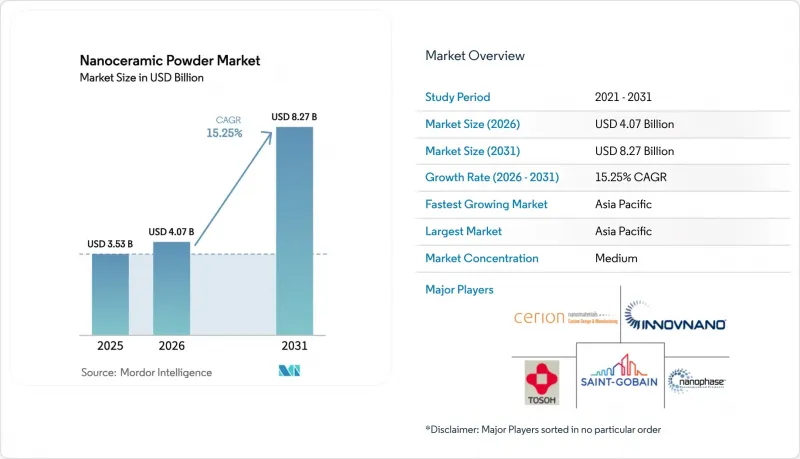
根據 Mordor Intelligence 預測,奈米陶瓷粉末市場規模預計將在 2025 年達到 35.3 億美元,2026 年達到 40.7 億美元,到 2031 年達到 82.7 億美元,2026 年至 2031 年的複合年成長率為 15.25%。
本報告按粉末類型(氧化物、碳化物、氮化物、硼及其他)、合成技術(電氣和電子設備、工業、交通運輸、醫療、化學、國防及其他)以及地區(亞太地區、北美地區、歐洲地區、南美地區以及中東和非洲地區)進行細分。市場預測以美元計價。
全球奈米陶瓷粉末市場趨勢及洞察
在電子行業中廣泛應用
微型化藍圖已將邏輯和儲存節點的目標介電層厚度降低至 5微米以下。要達到此閾值需要使用粒徑 100 奈米或更小的氧化鋁和氮化鋁分散體。展望未來,三星已在 2025 年以後的資本計畫中為封裝生產線累計了大量資金。這些生產線配備了顆粒分選光學系統,旨在去除大於 120 奈米的聚集體。台積電正在推進其 2 奈米製程中氧化鋁原子層沉積 (ALD) 前驅體的應用。在嚴格的公差控制下,台積電的目標是降低隨機缺陷密度並維持較高的背面電源良率。高通的 RF360 模組需要介電常數超過 2000 的可變鈦酸鋇濾波器。這項要求對填料供應商的粒徑分佈提出了嚴格的控制,尤其是在 5G 毫米波頻段。為此,亞太地區的供應商正在採用符合IEC 60384可追溯性標準的雷射衍射檢測法。此舉進一步鞏固了現有參與企業在過程控制方面的競爭優勢。
來自醫療領域的需求
在整形外科和牙科領域,氧化鋯增強氧化鋁股骨頭和牙冠正日益取代傳統的鈷鉻合金。 2025年,Zimmer Biomet公司公佈,瓷質對瓷質接合面(CoC)軸承已在歐洲全髖關節置換術中佔據相當大的佔有率,年損耗率低於0.05毫米。 Strathrone公司獲得FDA 510(k)批准,其「一次就診」氧化鋯修復體可顯著縮短諮詢時間,預計將加速其在門診的普及。一項於2025年發表的同行評審研究表明,與BETA-磷酸三鈣(BETA-TCP)對照組相比,骨移植塊中含有的羥磷石灰奈米粉末可加速骨整合。另一方面,ISO 13356 標準規定粉末純度必須達到 99.9% 或更高,重金屬含量限制在 10 ppm 或更低,這小規模製造商與大規模垂直整合的集團公司建立委託製造合作關係。
高昂的處理成本
奈米陶瓷的製造成本遠高於微米級陶瓷,這主要是由於溶膠-凝膠法、水熱法和氣相冷凝法等製造方法所致。在化學氣相沉積(CVD)反應器中加工碳化矽粉末會消耗大量能源,因此電費取決於電價收費系統。設備供應商透露,到2025年,高能量球磨機每年的介質更換成本將取決於加工量。矽烷處理是聚合物分散的必要步驟,但其表面功能化過程會增加成本。儘管國際能源總署(IEA)建議煅燒窯電氣化可以降低單位成本,但如果碳價格持續低於一定閾值,投資回收期將長達數年甚至更久。
細分市場分析
截至2025年,氧化物基奈米陶瓷粉末將佔奈米陶瓷粉末市場62.72%的佔有率,但碳化物粉末,尤其是碳化矽粉末,正從氧化物粉末手中奪取市場佔有率。碳化矽奈米粉末如今已成為能夠承受200 度C鍵合溫度的寬能隙晶片的必備材料。這項進步使得電動車逆變器中無需使用笨重的冷卻裝置,從而顯著減輕了重量。在汽車沖壓加工領域,碳化鎢奈米晶刀片在切割硬化鋼時能夠延長刀具壽命,並提高機器的運轉率。預計到2031年,碳化物級奈米陶瓷粉末市場將以17.07%的複合年成長率成長,這主要得益於電容器、植入和拋光應用領域的持續需求。氮化物,尤其是氮化基板,憑藉其在LED封裝領域優異的導熱性能,正在溫度控管領域開闢出一片利基市場。同時,硼基粉末在國防和核能領域佔據了穩固的地位,其優異的中子吸收性能使其成本優勢得以充分體現。在航太領域,符合ASTM F3303標準且氧化閾值超過1600 度C的二硼化鈦和碳化鉿球體正在積層製造測試中進行評估。
氧化物供應商正透過擴大產能和加深對監管環境的理解來鞏固其市場地位。氧化鋁仍然是多層陶瓷電容器的主要材料,但氧化鋯固有的韌性和生物相容性正使其在整形外科領域的應用日益廣泛。然而,採購團隊卻擔憂氧化物價格波動,尤其是在氧化釔等稀土元素穩定劑地緣政治不穩定的情況下。為此,製造商正致力於採用最佳化摻雜劑進行批次開發,在保持相穩定性的同時成功降低氧化釔含量。這種價值動態的轉變,即碳化物和氮化物粉末的興起,凸顯了市場的兩極化。具體而言,大規模生產的氧化物產品線優先考慮成本效益,而碳化物產品線則專注於提高利潤率,因為精確的粒度控制對於半導體和高超音速應用至關重要。
區域分析
預計到2025年,亞太地區將佔全球銷售額的50.73%,年複合成長率(舉措)高達16.06%,成長速度位居全球之首。中國「中國製造2025」的後續計畫旨在2028年提高電子級粉末的國產化率,並為此提供了大量補貼。日本新能源產業技術綜合開發機構(NEDO)正在支援14個聯合體,專注於研發用於6G諧振器的50奈米以下氧化鋁。韓國是陶瓷電容器的主要出口國,在釜山和世宗擁有眾多生產線,需要大量的粉末材料。印度的生產關聯激勵計畫(PLI)正在投資賈姆訥格爾的先導計畫。同時,越南和泰國的陶瓷組裝園區正迎來外國直接投資(FDI)的顯著成長,從而增強了該地區的供應韌性。
在北美這個市場佔有率龐大的地區,國防相關舉措和《陶瓷塗層工業產品法案》(CHIPS Act)正推動著市場發展,該法案提供了大量激勵措施。這些激勵措施強制要求俄亥俄州和亞利桑那州的新製造企業使用美國生產的高純度氧化鋁。雖然加拿大稀土元素精煉廠的稅額扣抵尚未真正運作,但墨西哥正受益於《美墨加協定》(USMCA)的規定,並計劃在2025年前向美國出口陶瓷塗層引擎零件。
在歐洲,我們見證了德國汽車工業的進步、法國賽峰集團對CMC熱端零件的整合,以及英國對核融合反應器瓦片的投資。儘管南美洲和中東/非洲的市場佔有率合計較小,但值得注意的是,巴西石油公司(Petrobras)正在測試含有氧化鋁奈米顆粒的鑽井液,沙烏地阿拉伯的NEOM專案正在採購陶瓷塗層太陽能熱接收器。
其他好處
- Excel格式的市場預測(ME)表
- 3個月的分析師支持
目錄
第1章:引言
- 研究假設和市場定義
- 調查範圍
第2章:調查方法
第3章執行摘要
第4章 市場狀況
- 市場概覽
- 市場促進因素
- 在電子行業中廣泛應用
- 來自醫療領域的需求
- 高性能陶瓷塗層的應用日益廣泛
- 高超音速武器對耐熱耐腐蝕粉末的需求
- 量子點與固態電池的整合
- 市場限制因素
- 高昂的處理成本
- 遵守環境和健康法規
- 稀土元素前驅供應鏈瓶頸
- 價值鏈分析
- 波特五力模型
- 專利分析
- 原料分析
第5章 市場規模與成長預測
- 按粉末類型
- 氧化物粉末
- 碳化粉末
- 氮化物粉末
- 硼粉
- 其他
- 透過合成技術
- 電氣和電子設備
- 產業
- 運輸
- 醫學領域
- 化學品
- 防禦
- 其他
- 按地區
- 亞太地區
- 中國
- 印度
- 日本
- 韓國
- ASEAN
- 其他亞太國家
- 北美洲
- 美國
- 加拿大
- 墨西哥
- 歐洲
- 德國
- 英國
- 法國
- 義大利
- 俄羅斯
- 其他歐洲國家
- 南美洲
- 巴西
- 阿根廷
- 其他南美國家
- 中東和非洲
- 沙烏地阿拉伯
- 南非
- 其他中東和非洲國家
- 亞太地區
第6章 競爭情勢
- 市場集中度
- 策略趨勢
- 市佔率(%)/排名分析
- 公司簡介
- ABM Advance Ball Mill Inc.
- American Elements
- Beijing DK Nano Technology Co. Ltd
- Cerion LLC
- Inframat Advanced Materials LLC
- Innovnano-Materiais Avancados SA
- IoLiTec Ionic Liquids Technologies GmbH
- Nanografi
- Nanophase Technologies Corporation
- Nanoshel LLC
- Nanostructured & Amorphous Materials, Inc.
- NYACOL Nano Technologies Inc.
- PlasmaChem GmbH
- Resonac Corporation
- Saint-Gobain
- Sumitomo Chemical Co., Ltd.
- Tosoh Corporation
- TRUNNANO
第7章 市場機會與未來展望
According to Mordor Intelligence, the nanoceramic powder market size is projected to be USD 3.53 billion in 2025, USD 4.07 billion in 2026, and reach USD 8.27 billion by 2031, growing at a CAGR of 15.25% from 2026 to 2031.
This report is Segmented by Powder Type (Oxide, Carbide, Nitride, Boron, and Other Types), Synthesis Technology (Electrical and Electronics, Industrial, Transportation, Medical, Chemical, Defense, and Other End-User Industries), and Geography (Asia-Pacific, North America, Europe, South America, and Middle-East and Africa). Market Forecasts are Provided in Terms of Value (USD).
Global Nanoceramic Powder Market Trends and Insights
Widespread Use in Electronics Industry
Miniaturization roadmaps have pushed dielectric-layer thickness targets below 5 µm in logic and memory nodes. Achieving this threshold now hinges on using sub-100-nm alumina and aluminum-nitride dispersions. Samsung, eyeing the future, has earmarked significant investments in its post-2025 capital plan for packaging lines. These lines come equipped with particle-classification optics, designed to reject agglomerates exceeding 120 nm. TSMC, in its 2 nm process flow, is turning to aluminum-oxide atomic-layer-deposition precursors. With tight tolerances, TSMC aims to reduce random-defect density, ensuring backside-power-delivery yields remain high. Qualcomm's RF360 module is on the hunt for barium-titanate tunable filters, demanding dielectric constants greater than 2,000. This requirement is compelling filler suppliers to ensure tight particle-size distributions, especially for the 5G millimeter-wave bands. In response, suppliers in the Asia-Pacific have adopted laser-diffraction metrology, aligning with IEC 60384 traceability standards. This move further solidifies the advantage for established players with a strong process-control background.
Demand from Healthcare Sector
Orthopedic and dental segments are increasingly favoring zirconia-toughened alumina femoral heads and crowns over traditional cobalt-chrome alloys. In 2025, Zimmer Biomet revealed that ceramic-on-ceramic bearings had already secured a significant share of hip-replacement procedures in Europe, boasting wear rates below 0.05 mm annually. Straumann, having obtained FDA 510(k) clearance, introduced single-visit zirconia restorations that reduce chair time significantly, paving the way for broader adoption in ambulatory centers. A peer-reviewed trial in 2025 highlighted that hydroxyapatite nanopowders in bone-graft blocks accelerated osseointegration speeds compared to beta-TCP controls. Meanwhile, ISO 13356 mandates powder purities greater than 99.9% and restricts heavy metals to less than 10 ppm, prompting smaller mills to forge tolling partnerships with larger, vertically integrated conglomerates.
High Processing Cost
Production costs for nanoceramics soar significantly higher than their micron-scale counterparts, primarily due to methods like sol-gel, hydrothermal, and gas-phase condensation. Silicon-carbide powders, processed in chemical-vapor-deposition reactors, consume substantial energy, leading to electricity bills that depend on tariff rates. Equipment vendors disclosed in 2025 that high-energy ball mills incur notable annual media replacement costs, based on throughput levels. Silane treatments, essential for polymer dispersion, contribute an added cost through surface-functionalization steps. While the IEA suggests that electrifying calcination kilns could reduce unit costs, the payback period stretches beyond several years if carbon prices remain below certain thresholds.
Other drivers and restraints analyzed in the detailed report include:
- Increasing Adoption of High-performance Ceramic Coatings
- Need for High-temperature, Corrosion-resistant Powders in Hypersonic Weapons
- Environmental and Health Regulatory Compliance
For complete list of drivers and restraints, kindly check the Table Of Contents.
Segment Analysis
Carbide powders, notably silicon carbide, are stealing share from oxides despite oxide grades locking in 62.72% of the nanoceramics powder market in 2025. Silicon-carbide nanopowders are now integral to wide-bandgap chips, which can withstand junction temperatures of 200 °C. This advancement allows electric-vehicle inverters to eliminate bulky cooling hardware, resulting in a significant reduction in mass. In the realm of automotive stamping, tungsten-carbide nano-grain inserts boost tool life during hardened-steel cuts, enhancing machine uptime. The nanoceramics powder market size for carbide grades is projected to grow at a 17.07% CAGR through 2031. This is largely due to their continued demand in capacitors, implants, and polishing applications. Nitrides, particularly aluminum-nitride substrates, are carving out niches in thermal management, boasting commendable conductivity for LED packages. Meanwhile, boron-based powders find their footing in defense and nuclear sectors, where their neutron-absorption capabilities overshadow cost considerations. In aerospace, additive-manufacturing trials are evaluating titanium-diboride and hafnium-carbide spheres, aiming for oxidation thresholds exceeding 1,600 °C, in line with ASTM F3303 standards.
Oxide suppliers are bolstering their market position through scaled capacities and a keen understanding of regulatory landscapes. Alumina remains the go-to for multilayer ceramic capacitors, while zirconia's inherent toughness and biocompatibility are carving out a larger presence in orthopedics. However, procurement teams are wary of the price sensitivity associated with oxides, particularly given the geopolitical volatility surrounding rare-earth stabilizers like yttria. In response, producers are innovating with dopant-optimized batches, managing to reduce yttria loadings while ensuring phase stability remains intact. This shift in value dynamics, favoring carbide and nitride powders, highlights a market divergence: while high-volume oxide lines prioritize cost efficiency, carbide lines are honing in on margins, emphasizing precise particle-size control crucial for semiconductor and hypersonic applications.
Complete Report Scope:
- By Powder Type
- Oxide Powder
- Carbide Powder
- Nitride Powder
- Boron Powder
- Other Types
- By Synthesis Technology
- Electrical and Electronics
- Industrial
- Transportation
- Medical
- Chemical
- Defense
- Other End-user Industries
- By Geography
- Asia-Pacific
- China
- India
- Japan
- South Korea
- ASEAN Countries
- Rest of Asia-Pacific
- North America
- United States
- Canada
- Mexico
- Europe
- Germany
- United Kingdom
- France
- Italy
- Russia
- Rest of Europe
- South America
- Brazil
- Argentina
- Rest of South America
- Middle-East and Africa
- Saudi Arabia
- South Africa
- Rest of Middle-East and Africa
- Asia-Pacific
Geography Analysis
Asia-Pacific accounted for 50.73% of 2025 revenue and carries the fastest 16.06% CAGR outlook. China's successor to the "Made in China 2025" initiative has allocated a substantial amount in subsidies, aiming for high domestic content in electronic-grade powders by 2028. Japan's NEDO is backing 14 consortia, focusing on sub-50 nm alumina for 6G resonators. South Korea, with significant exports in ceramic capacitors, boasts numerous powder-demanding lines in Busan and Sejong. India's PLI scheme has invested in LLZO electrolyte pilots in Jamnagar. Meanwhile, Vietnam and Thailand have seen a notable surge in FDI for ceramic assembly parks, enhancing regional supply resilience.
North America, holding a significant market share, is bolstered by defense initiatives and the CHIPS Act, which offers substantial incentives. These incentives mandate U.S.-sourced high-purity alumina for new fabs in Ohio and Arizona. While Canada's tax credit for rare-earth refineries hasn't yet led to commissioning milestones, Mexico benefited from USMCA rules, exporting ceramic-coated engine parts to the U.S. in 2025.
Europe, capturing a notable portion of the revenue, sees Germany's automotive push, France's Safran integrating CMC hot sections, and the UK investing in fusion-reactor tiles. South America and the Middle-East and Africa, together accounting for a smaller share, are highlighted by Brazil's Petrobras testing alumina-nanoparticle drilling fluids and Saudi Arabia's NEOM project procuring ceramic-coated solar-thermal receivers.
- ABM Advance Ball Mill Inc.
- American Elements
- Beijing DK Nano Technology Co. Ltd
- Cerion LLC
- Inframat Advanced Materials LLC
- Innovnano-Materiais Avancados SA
- IoLiTec Ionic Liquids Technologies GmbH
- Nanografi
- Nanophase Technologies Corporation
- Nanoshel LLC
- Nanostructured & Amorphous Materials, Inc.
- NYACOL Nano Technologies Inc.
- PlasmaChem GmbH
- Resonac Corporation
- Saint-Gobain
- Sumitomo Chemical Co., Ltd.
- Tosoh Corporation
- TRUNNANO
Additional Benefits:
- The market estimate (ME) sheet in Excel format
- 3 months of analyst support
TABLE OF CONTENTS
1 Introduction
- 1.1 Study Assumptions and Market Definition
- 1.2 Scope of the Study
2 Research Methodology
3 Executive Summary
4 Market Landscape
- 4.1 Market Overview
- 4.2 Market Drivers
- 4.2.1 Widespread Use in Electronics Industry
- 4.2.2 Demand from Healthcare Sector
- 4.2.3 Increasing Adoption of High-performance Ceramic Coatings
- 4.2.4 Need for High-temperature, Corrosion-resistant Powders in Hypersonic Weapons
- 4.2.5 Quantum-dot and Solid-state Battery Integration
- 4.3 Market Restraints
- 4.3.1 High Processing Cost
- 4.3.2 Environmental and Health Regulatory Compliance
- 4.3.3 Supply-chain Bottlenecks in Rare-earth Precursors
- 4.4 Value Chain Analysis
- 4.5 Porter's Five Forces
- 4.5.1 Bargaining Power of Suppliers
- 4.5.2 Bargaining Power of Buyers
- 4.5.3 Threat of New Entrants
- 4.5.4 Threat of Substitute Products
- 4.5.5 Degree of Competition
- 4.6 Patent Analysis
- 4.7 Raw Material Analysis
5 Market Size and Growth Forecasts (Value)
- 5.1 By Powder Type
- 5.1.1 Oxide Powder
- 5.1.2 Carbide Powder
- 5.1.3 Nitride Powder
- 5.1.4 Boron Powder
- 5.1.5 Other Types
- 5.2 By Synthesis Technology
- 5.2.1 Electrical and Electronics
- 5.2.2 Industrial
- 5.2.3 Transportation
- 5.2.4 Medical
- 5.2.5 Chemical
- 5.2.6 Defense
- 5.2.7 Other End-user Industries
- 5.3 By Geography
- 5.3.1 Asia-Pacific
- 5.3.1.1 China
- 5.3.1.2 India
- 5.3.1.3 Japan
- 5.3.1.4 South Korea
- 5.3.1.5 ASEAN Countries
- 5.3.1.6 Rest of Asia-Pacific
- 5.3.2 North America
- 5.3.2.1 United States
- 5.3.2.2 Canada
- 5.3.2.3 Mexico
- 5.3.3 Europe
- 5.3.3.1 Germany
- 5.3.3.2 United Kingdom
- 5.3.3.3 France
- 5.3.3.4 Italy
- 5.3.3.5 Russia
- 5.3.3.6 Rest of Europe
- 5.3.4 South America
- 5.3.4.1 Brazil
- 5.3.4.2 Argentina
- 5.3.4.3 Rest of South America
- 5.3.5 Middle-East and Africa
- 5.3.5.1 Saudi Arabia
- 5.3.5.2 South Africa
- 5.3.5.3 Rest of Middle-East and Africa
- 5.3.1 Asia-Pacific
6 Competitive Landscape
- 6.1 Market Concentration
- 6.2 Strategic Moves
- 6.3 Market Share(%)/ Ranking Analysis
- 6.4 Company Profiles (includes Global level Overview, Market level overview, Core Segments, Financials as available, Strategic Information, Products and Services, and Recent Developments)
- 6.4.1 ABM Advance Ball Mill Inc.
- 6.4.2 American Elements
- 6.4.3 Beijing DK Nano Technology Co. Ltd
- 6.4.4 Cerion LLC
- 6.4.5 Inframat Advanced Materials LLC
- 6.4.6 Innovnano-Materiais Avancados SA
- 6.4.7 IoLiTec Ionic Liquids Technologies GmbH
- 6.4.8 Nanografi
- 6.4.9 Nanophase Technologies Corporation
- 6.4.10 Nanoshel LLC
- 6.4.11 Nanostructured & Amorphous Materials, Inc.
- 6.4.12 NYACOL Nano Technologies Inc.
- 6.4.13 PlasmaChem GmbH
- 6.4.14 Resonac Corporation
- 6.4.15 Saint-Gobain
- 6.4.16 Sumitomo Chemical Co., Ltd.
- 6.4.17 Tosoh Corporation
- 6.4.18 TRUNNANO
7 Market Opportunities and Future Outlook
- 7.1 White-space and Unmet-need Assessment


