


 |
市場調查報告書
商品編碼
2121225
裝飾混凝土:市場佔有率分析、產業趨勢與統計、成長預測(2026-2031)Decorative Concrete - Market Share Analysis, Industry Trends & Statistics, Growth Forecasts (2026 - 2031) |
||||||

※ 本網頁內容可能與最新版本有所差異。詳細情況請與我們聯繫。
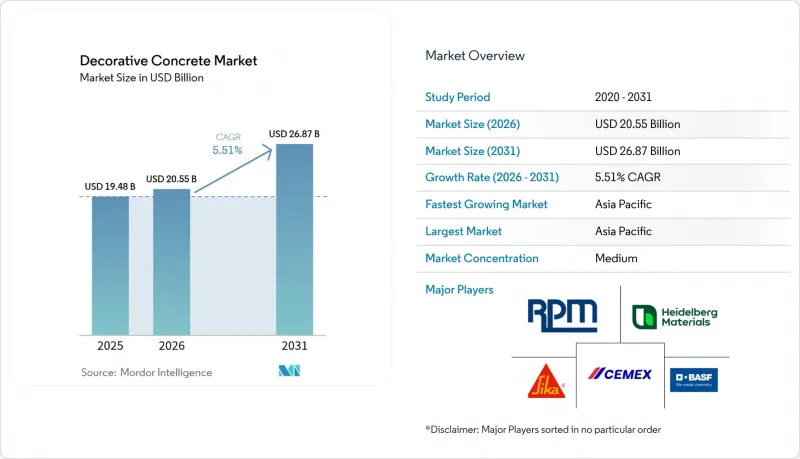
根據 Mordor Intelligence 預測,裝飾混凝土市場規模將從 2025 年的 194.8 億美元成長到 2026 年的 205.5 億美元,然後在 2031 年達到 268.7 億美元,2026 年至 2031 年的複合年成長率為 5.51%。
本報告按類型(壓印混凝土、拋光混凝土、混凝土覆蓋層、染色混凝土、彩色混凝土、混凝土染料及其他)、應用(人行道/道路、露台等)、最終用戶行業(住宅、非住宅)和地區(亞太地區、北美、歐洲等)進行細分。市場預測以美元計價。
全球裝飾混凝土市場趨勢與洞察
疫情後住宅翻新維修成本增加
隨著翻新預算的增加,項目數量有所減少,但每個項目的價值卻在上升,這表明市場對兼具美觀性和長壽命的表面維修需求日益成長。 2023年,儘管項目總數暫時下降,但住宅平均支出卻增加了12%。這反映了消費者願意為能夠提升房產價值並滿足老齡化社會居家生活需求的優質裝修買單。裝飾混凝土完美契合這些需求,其20-30年的使用壽命遠超許多其他鋪路材料,從而最大限度地減少了未來的維護週期。隨著住宅存量老化,大規模的外牆和地下室維修日益增多,壓印混凝土和拋光地板能夠帶來即時的視覺效果。預計到2025年中期,抵押房屋抵押貸款利率將降至5.5%左右,屆時獲得維修資金將更加容易,預計在整個預測期內,需求將持續成長。
新建戶外生活空間對壓印混凝土的需求
壓印墊和整合著色技術的進步打破了人們對壓印飾面的傳統認知,使得極其自然的紋理得以再現,並且經過適當的密封處理,可保持20年以上。其單位應用成本與天然石材相比仍具有競爭力,使承包商能夠拓展更廣泛的客戶群。冷色調顏料和幾何圖案符合現代景觀設計趨勢,而透水性產品則符合高密度都市區專案中雨水管理的相關法規要求。整合式LED燈槽和金屬光澤提升了飾面的高級質感,尤其是在泳池周圍,它們能夠降低表面溫度,並透過防滑性能提高安全性。
特殊顏料、模具和密封劑的初始成本較高。
裝飾性混凝土的成本為每立方碼 200 至 300 美元,而普通混合混凝土的成本為每立方碼 100 至 150 美元。這種價格差異源自於昂貴的氧化鐵顏料、矽膠模板和多層密封系統。承包商會將這些成本轉嫁給住宅和小規模開發商,從而限制了其在價格敏感地區的普及。壓印和拋光飾面由於澆築速度較慢且需要特殊的表面處理技術,因此也增加了人事費用。小規模承包商不願購買自己的壓印模具和鑽石拋光設備,限制了農村地區的服務可及性,並減緩了其在農村地區的推廣。
細分市場分析
2025年,壓印混凝土在裝飾混凝土市場中佔據39.86%的佔有率,這主要得益於其廣泛的適用性,可用於車道、露台和商業廣場等多種場所。不斷擴充的工具庫,使得壓印板岩和木紋圖案以及標誌成為可能,也讓承包商能夠將銷售拓展至酒店業和品牌零售連鎖店。拋光混凝土市場規模雖小,但預計到2031年將以6.12%的複合年成長率成長,因為設施管理人員重視無縫地板,這種地板不僅耐堆高機磨損,而且易於清潔。裝飾混凝土市場的擴張主要得益於覆蓋層和自癒膠囊的出現。覆蓋層無需拆除結構即可延長表面的使用壽命,而自癒膠囊這項新興技術則能釋放石灰來密封微裂縫,從而延長維護週期。總而言之,多樣化的產品類型有助於供應商滿足預算和性能的雙重需求,並增強了裝飾混凝土市場的韌性。
持續的研發旨在開發出耐褪色染料和快速固化密封劑,從而縮短施工週期。色彩混合採用更精細的顏料分散技術,防止條紋不均;半透明染料系統則可實現精品店和其他高階場所青睞的藝術漸變效果。纖維增強設計可減少收縮開裂,而抗紫外線面漆則可防止戶外休閒場所褪色。這些技術的進步共同推動了裝飾混凝土市場的長期成長,拓展了其應用範圍,並提高了其在高階建築元素中的滲透率。
區域分析
預計到2025年,亞太地區將佔全球水泥銷售額的37.60%,並預計在2031年之前保持行業最快增速,達到6.44%,從而鞏固其作為市場領導和主要成長引擎的雙重地位。光是中國在2011年至2013年間就消耗了66億噸水泥,遠超過美國在20世紀的消費量,目前仍佔全球水泥產量的一半以上。大規模的住宅搬遷項目和大型企劃,例如印尼耗資50億美元的工業園區,支撐了結構性需求;同時,透水裝飾板因其能夠滿足快速城市都市化地區嚴格的雨水管理法規而備受關注。為響應國家的脫碳承諾,本地生產商正在擴大低熟料水泥熟料接合材料的生產,從而豐富產品線並減少對進口的依賴。
在北美,隨著2025年起進口關稅的實施,成本波動預計將更加顯著,但成長潛力依然存在,這得益於房屋抵押貸款利率的下降和公共部門支出的持續成長。老舊住宅存量的增加推動了住宅鋪路更換需求的成長,而《兩黨基礎設施法案》則為公共廣場和交通樞紐的商業機會拓展。面對供應鏈的挑戰,綜合供應商正在擴大自有採石場和碼頭的產能,以確保原料供應並穩定裝飾混凝土市場的價格。
歐洲嚴格的碳排放法規正促使規範朝低碳材料方向發展,並推動生物基外加劑和再生骨材的應用。投資於餘熱回收窯和生物炭混燒的製造商可根據歐盟分類法規獲得購買激勵,從而增強其區域競爭優勢。同時,中東、非洲和南美洲在都市區擴張的推動下呈現穩定成長,但外匯波動和承包商產能的限制限制了其短期成長潛力。在所有地區,裝飾混凝土市場都展現出適應當地政策要求和建築業經濟週期的能力,並維持著廣泛的市場需求。
其他好處:
- Excel格式的市場預測(ME)表
- 3個月的分析師支持
目錄
第1章:引言
- 研究假設和市場定義
- 調查範圍
第2章:調查方法
第3章執行摘要
第4章 市場狀況
- 市場概覽
- 市場促進因素
- 疫情後住宅翻新維修成本增加
- 在新戶外生活空間中,壓印混凝土更受歡迎。
- 淨零排放和綠色建築認證正在推動彩色和低VOC材料的廣泛應用。
- 在快速維修工程中,裝飾混凝土覆蓋層的使用日益增多。
- 採用生物基添加劑來減少隱含碳足跡
- 市場限制因素
- 特殊顏料、模具和密封劑的初始成本很高。
- 水泥和顏料供應鏈的波動推高了價格。
- 合格的裝飾混凝土承包商短缺
- 價值鏈分析
- 波特五力模型
第5章 市場規模與成長預測
- 按類型
- 壓印混凝土
- 拋光混凝土
- 混凝土覆蓋層
- 染色混凝土
- 彩色混凝土
- 混凝土著色劑
- 其他類型
- 透過使用
- 人行道和道路
- 露臺
- 泳池平台
- 地面
- 牆
- 其他用途
- 按最終用戶行業分類
- 住宅
- 非住宅
- 按地區
- 亞太地區
- 中國
- 印度
- 日本
- 韓國
- 其他亞太國家
- 北美洲
- 美國
- 加拿大
- 墨西哥
- 歐洲
- 德國
- 英國
- 法國
- 義大利
- 其他歐洲國家
- 南美洲
- 巴西
- 阿根廷
- 其他南美國家
- 中東和非洲
- 沙烏地阿拉伯
- 南非
- 其他中東和非洲國家
- 亞太地區
第6章 競爭情勢
- 市場集中度
- 策略趨勢
- 市佔率分析
- 公司簡介
- 3M
- BASF
- Boral
- CEMEX SAB de CV
- Dex-O-Tex
- Elite Crete Systems
- Heidelberg Materials
- Holcim
- Palermo Concrete Inc
- Parchem Construction Supplies
- PPG Industries Inc
- RPM International Inc.
- Saint-Gobain
- Sika AG
- Subana Technologies Pvt. Ltd.
- Tarmac
- The Euclid Chemical Company
- The Sherwin-Williams Company
- UltraTech Cement Ltd.
第7章 市場機會與未來展望
According to Mordor Intelligence, the decorative concrete market size is expected to grow from USD 19.48 billion in 2025 to USD 20.55 billion in 2026 and is forecast to reach USD 26.87 billion by 2031 at 5.51% CAGR over 2026-2031.
This report is Segmented by Type (Stamped Concrete, Polished Concrete, Concrete Overlay, Stained Concrete, Colored Concrete, Concrete Dye, Other Types), Application (Footpath and Driveway, Patio, and More), End-User Industry (Residential, Non-Residential), and Geography (Asia-Pacific, North America, Europe, and More ). The Market Forecasts are Provided in Terms of Value (USD).
Global Decorative Concrete Market Trends and Insights
Rising Residential Remodeling and Refurbishment Spend Post-Pandemic
Elevated remodeling budgets have shifted toward fewer but higher-value projects, strengthening demand for surface upgrades that combine aesthetics with long service life. Average homeowner spend increased 12% in 2023 despite a brief dip in overall project volume, signaling a willingness to pay for premium finishes that raise property value and support aging-in-place needs. Decorative concrete aligns well because its 20-30-year life span outperforms many alternative pavements, limiting future repair cycles. An aging housing stock motivates extensive outdoor and basement renovations where stamped slabs and polished floors deliver quick visual impact. Mortgage rates trending toward 5.5% by mid-2025 should further unlock renovation funding, amplifying demand throughout the forecast window.
Preference for Stamped Concrete in New-Build Outdoor Living Spaces
Advances in stamping mats and integral coloring have dispelled dated perceptions of stamped surfaces and now enable convincingly natural textures that last beyond two decades when properly sealed. Unit installation costs retain a favorable spread versus quarried stone, enabling contractors to target broader demographic segments. Cool-tone pigments and geometric templates resonate with modern landscaping trends while permeable variants address storm-water mandates in dense urban projects. Integrated LED channels and metallic highlights differentiate premium installations, particularly around pool decks where cooler surface temperatures and slip resistance improve safety.
High Upfront Cost of Specialty Pigments, Molds and Sealers
Decorative concrete commands USD 200-300 per cubic yard against USD 100-150 for standard mixes, a gap driven by expensive iron-oxide pigments, silicone molds, and multi-layer sealing systems. Contractors pass these costs to homeowners and small developers, curbing uptake in price-sensitive regions. Labor premiums also arise because stamped or polished finishes require slower placement rates and specialized finishing skills. Smaller contractors hesitate to purchase proprietary stamp libraries or diamond-polishing equipment, limiting service availability in secondary cities and slowing rural penetration.
Other drivers and restraints analyzed in the detailed report include:
- Net-Zero and Green-Building Certification Pushing Colored/Low-VOC Mixes
- Growth of Decorative Concrete Overlays in Fast-Track Renovation Projects
- Volatility in Cement and Pigment Supply Chains Inflating Prices
For complete list of drivers and restraints, kindly check the Table Of Contents.
Segment Analysis
Stamped concrete retained a 39.86% decorative concrete market share in 2025, underpinned by its adaptability across driveways, patios, and commercial plazas. Enhanced tool libraries offer slate, timber, and even integrated logo impressions, enabling contractors to court hospitality and branded retail chains. Polished concrete, while holding a smaller base, is forecast to grow at a 6.12% CAGR to 2031 as facility managers appreciate seamless floors that resist forklift abrasion and ease cleaning protocols. Decorative concrete market size benefits from overlays that extend surface life without structural demolition, and from emerging self-healing capsules that release lime to seal microcracks and prolong service intervals. Overall, diversified type options help suppliers meet both budget and performance briefs, reinforcing the decorative concrete market's resilience.
Continued R&D targets color-fast dyes and rapid-cure sealers that shorten turnover cycles. Colored mixes leverage finer pigment dispersions to avoid streaking, whereas translucent dye systems permit artistic gradients favored in boutique venues. Fiber-reinforced designs alleviate shrinkage cracking, while UV-resistant topcoats guard against fade in open-air entertainment spaces. Collectively, these advances widen use cases and deepen penetration into high-visibility architectural elements, bolstering long-term decorative concrete market growth.
Complete Report Scope:
- By Type
- Stamped Concrete
- Polished Concrete
- Concrete Overlay
- Stained Concrete
- Colored Concrete
- Concrete Dye
- Other Types
- By Application
- Footpath and Driveway
- Patio
- Pool Deck
- Floor
- Wall
- Other Applications
- By End-user Industry
- Residential
- Non-residential
- By Geography
- Asia-Pacific
- China
- India
- Japan
- South Korea
- Rest of Asia-Pacific
- North America
- United States
- Canada
- Mexico
- Europe
- Germany
- United Kingdom
- France
- Italy
- Rest of Europe
- South America
- Brazil
- Argentina
- Rest of South America
- Middle East and Africa
- Saudi Arabia
- South Africa
- Rest of Middle East and Africa
- Asia-Pacific
Geography Analysis
Asia-Pacific held 37.60% of 2025 revenue and posts a leading 6.44% CAGR to 2031, reinforcing its dual role as market leader and primary growth driver. China alone consumed 6.6 gigatons of cement between 2011-2013, dwarfing 20th-century U.S. usage, and still accounts for more than half of global output. Massive housing-relocation schemes and megaprojects such as Indonesia's USD 5 billion industrial park underscore structural demand, while permeable decorative slabs respond to stringent storm-water ordinances in rapidly urbanizing cities. Local producers are scaling low-clinker binders to align with national decarbonization pledges, broadening the product mix and tempering import dependence.
North America faces pronounced cost volatility after 2025 import tariffs but retains growth potential supported by mortgage-rate easing and continued public-sector outlays. An aging housing stock boosts residential resurfacing, while the Bipartisan Infrastructure Law extends opportunities in public plazas and transit hubs. Supply-chain headwinds encourage integrated suppliers to expand captive quarry and terminal capacity, securing raw materials and stabilizing decorative concrete market pricing.
Europe's stringent carbon directives recalibrate specifications toward low-embodied materials, catalyzing uptake of bio-based admixtures and recycled aggregates. Producers investing in waste-heat recovery kilns and bio-char co-firing earn procurement preference under EU Taxonomy rules, reinforcing regional competitive advantages. Meanwhile, Middle East, Africa, and South America register steady gains anchored by urban population growth, though currency volatility and limited installer capacity temper immediate upside potential. Across all regions the decorative concrete market demonstrates capacity to align with local policy imperatives and construction-sector cycles, sustaining a broad demand base.
- 3M
- BASF
- Boral
- CEMEX S.A.B. de C.V.
- Dex-O-Tex
- Elite Crete Systems
- Heidelberg Materials
- Holcim
- Palermo Concrete Inc
- Parchem Construction Supplies
- PPG Industries Inc
- RPM International Inc.
- Saint-Gobain
- Sika AG
- Subana Technologies Pvt. Ltd.
- Tarmac
- The Euclid Chemical Company
- The Sherwin-Williams Company
- UltraTech Cement Ltd.
Additional Benefits:
- The market estimate (ME) sheet in Excel format
- 3 months of analyst support
TABLE OF CONTENTS
1 Introduction
- 1.1 Study Assumptions and Market Definition
- 1.2 Scope of the Study
2 Research Methodology
3 Executive Summary
4 Market Landscape
- 4.1 Market Overview
- 4.2 Market Drivers
- 4.2.1 Rising residential remodeling and refurbishment spend post-pandemic
- 4.2.2 Preference for stamped concrete in new-build outdoor living spaces
- 4.2.3 Net-zero and green-building certification pushing colored/low-VOC mixes
- 4.2.4 Growth of decorative concrete overlays in fast-track renovation projects
- 4.2.5 Adoption of bio-based admixtures to cut embodied-carbon footprint
- 4.3 Market Restraints
- 4.3.1 High upfront cost of specialty pigments, molds and sealers
- 4.3.2 Volatility in cement and pigment supply chains inflating prices
- 4.3.3 Shortage of certified decorative concrete installers
- 4.4 Value Chain Analysis
- 4.5 Porter's Five Forces
- 4.5.1 Bargaining Power of Suppliers
- 4.5.2 Bargaining Power of Buyers
- 4.5.3 Threat of New Entrants
- 4.5.4 Threat of Substitutes
- 4.5.5 Competitive Rivalry
5 Market Size and Growth Forecasts (Value)
- 5.1 By Type
- 5.1.1 Stamped Concrete
- 5.1.2 Polished Concrete
- 5.1.3 Concrete Overlay
- 5.1.4 Stained Concrete
- 5.1.5 Colored Concrete
- 5.1.6 Concrete Dye
- 5.1.7 Other Types
- 5.2 By Application
- 5.2.1 Footpath and Driveway
- 5.2.2 Patio
- 5.2.3 Pool Deck
- 5.2.4 Floor
- 5.2.5 Wall
- 5.2.6 Other Applications
- 5.3 By End-user Industry
- 5.3.1 Residential
- 5.3.2 Non-residential
- 5.4 By Geography
- 5.4.1 Asia-Pacific
- 5.4.1.1 China
- 5.4.1.2 India
- 5.4.1.3 Japan
- 5.4.1.4 South Korea
- 5.4.1.5 Rest of Asia-Pacific
- 5.4.2 North America
- 5.4.2.1 United States
- 5.4.2.2 Canada
- 5.4.2.3 Mexico
- 5.4.3 Europe
- 5.4.3.1 Germany
- 5.4.3.2 United Kingdom
- 5.4.3.3 France
- 5.4.3.4 Italy
- 5.4.3.5 Rest of Europe
- 5.4.4 South America
- 5.4.4.1 Brazil
- 5.4.4.2 Argentina
- 5.4.4.3 Rest of South America
- 5.4.5 Middle East and Africa
- 5.4.5.1 Saudi Arabia
- 5.4.5.2 South Africa
- 5.4.5.3 Rest of Middle East and Africa
- 5.4.1 Asia-Pacific
6 Competitive Landscape
- 6.1 Market Concentration
- 6.2 Strategic Moves
- 6.3 Market Share Analysis
- 6.4 Company Profiles (includes Global level Overview, Market level overview, Core Segments, Financials as available, Strategic Information, Market Rank/Share, Products and Services, Recent Developments)
- 6.4.1 3M
- 6.4.2 BASF
- 6.4.3 Boral
- 6.4.4 CEMEX S.A.B. de C.V.
- 6.4.5 Dex-O-Tex
- 6.4.6 Elite Crete Systems
- 6.4.7 Heidelberg Materials
- 6.4.8 Holcim
- 6.4.9 Palermo Concrete Inc
- 6.4.10 Parchem Construction Supplies
- 6.4.11 PPG Industries Inc
- 6.4.12 RPM International Inc.
- 6.4.13 Saint-Gobain
- 6.4.14 Sika AG
- 6.4.15 Subana Technologies Pvt. Ltd.
- 6.4.16 Tarmac
- 6.4.17 The Euclid Chemical Company
- 6.4.18 The Sherwin-Williams Company
- 6.4.19 UltraTech Cement Ltd.
7 Market Opportunities and Future Outlook
- 7.1 White-space and Unmet-Need Assessment

 裝飾性壓花砂漿市場報告:趨勢、預測及競爭分析(至2035年)
 裝飾混凝土市場-2026-2032年全球市場預測
 2026年全球裝飾混凝土市場報告
 全球裝飾混凝土市場規模、佔有率、趨勢和成長分析報告(2026-2034年)
 裝飾混凝土市場-全球產業規模、佔有率、趨勢、機會、預測:按類型、應用、最終用戶、地區和競爭格局分類,2021-2031年
 裝飾混凝土市場規模、佔有率和成長分析(按類型、應用、最終用途產業和地區分類)-2026-2033年產業預測裝飾混凝土市場按類型、應用、最終用戶產業和地區分類:未來預測(2026-2032 年)
 裝飾混凝土市場機會、成長動力、產業趨勢分析與預測 2024 - 2032