


 |
市場調查報告書
商品編碼
2121203
智慧玻璃:市場佔有率分析、產業趨勢與統計、成長預測(2026-2031)Smart Glass - Market Share Analysis, Industry Trends & Statistics, Growth Forecasts (2026 - 2031) |
||||||

※ 本網頁內容可能與最新版本有所差異。詳細情況請與我們聯繫。
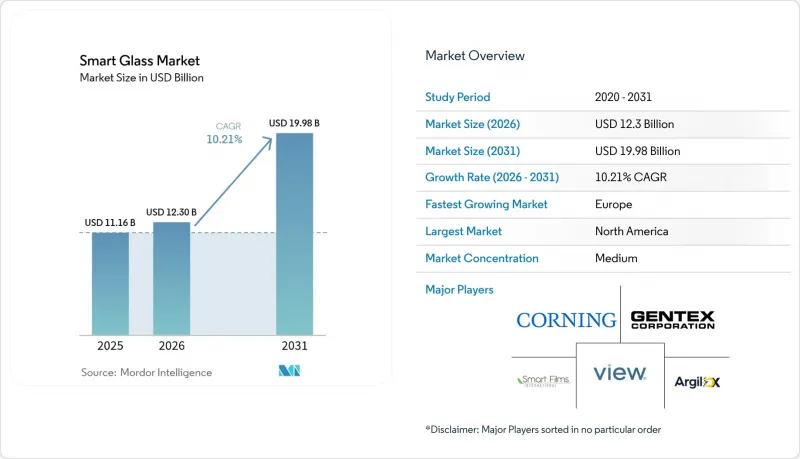
根據 Mordor Intelligence 預測,智慧眼鏡市場規模將從 2025 年的 111.6 億美元成長到 2026 年的 123 億美元,然後在 2031 年達到 199.8 億美元,2026 年至 2031 年的複合年成長率為 10.21%。
本報告按技術類型(電致變色、感溫變色、光致變色等)、最終用戶(汽車、航空電子、船舶、零售等)、控制模式(有線開關/牆板、遙控器/射頻控制器、調光面板/滑塊等)、應用(外牆和幕牆、室內隔間和隱私面板等)和地區進行分類。
全球智慧玻璃市場趨勢及洞察
嚴格的綠建築標準和維修義務
強制性的建築圍護基準值,例如加州2025年建築能源效率標準,正在催生對電致變色幕牆的強勁需求,這種幕牆在U值和太陽能熱增益係數方面均優於傳統玻璃。 2024年修訂的國際節能標準(IECC)與上一版本相比,節能效果提升了9.8%,消除了權衡取捨的漏洞,並提高了玻璃的性能標準。歐洲的類似措施,包括荷蘭的混合爐舉措,正在強化以監管合規主導的採購流程,並加速維修活動。隨著業主享受到尖峰時段冷卻負荷的降低、獲得綠色融資的資格以及房產價值的提升,智慧玻璃市場正持續受益於監管方面的利好。
高階汽車玻璃和天窗的快速應用
汽車製造商正採用具備動態光線控制功能的車頂,以區分車內空間並最佳化空調負載。雷諾的「Solarbay PDLC」天窗實現了特定細分市場的透光率,並使用了約50%的回收材料。 AGC基於SPD技術的「Wonderlight」車頂應用於梅賽德斯-奔馳S-Class小轎車,可降低空調需求並減少二氧化碳排放。現代的「奈米冷卻膜」在試點車輛中已將車內溫度降低了攝氏12.33度C,顯示該技術正朝著主流應用方向發展。 3-5年的汽車設計週期正在加速成本降低,這種趨勢也蔓延至建築領域,並擴大了智慧玻璃市場的潛在基本客群。
與傳統玻璃相比,初始成本較高
電致變色窗的成本仍高達每平方公尺180至250美元,而普通玻璃的成本僅為每平方公尺20至30美元。分析師估計,大規模更換的損益平衡點為每平方公尺215美元(每平方英尺20美元),加速了技術創新的競爭。一種無需電極的電致變色窗原型通過去除氧化銦錫層,將成本降低至平方公尺80美元。採用等離子增強化學氣相沉積(PECVD)技術,預計在年產量達140萬平方公尺的情況下,成本將降至每平方公尺近5.26美元。雖然隨著安裝人員對這項技術的日益熟悉,安裝的複雜性正在降低,但價格阻力仍然是價格敏感的智慧玻璃市場領域最大的阻礙因素。
細分市場分析
2025年,電致變色解決方案將主導智慧玻璃市場,佔42.55%的市場。其低功耗、漸層著色以及經過驗證的5萬次循環壽命,使其成為大規模建築立面和企業園區的首選。預計到2031年,電致變色智慧玻璃市場規模將從2025年的47.5億美元成長至80.9億美元,年複合成長率(CAGR)為9.37%。從線上濺鍍到全固體化學技術,一系列成本降低藍圖確保了資本支出預算的可預測性。同時,混合光伏玻璃正以17.62%的年複合成長率快速成長,其採用的透明有機太陽能電池在丹麥的CitySolar專案中已實現了12.3%的電池效率。根據 NEXT Energy Technologies 估計,這些面板可以抵消 25% 的典型辦公室用電需求,同時保持建築物的透明度,使混合產品成為對傳統電致變色產品的創新挑戰。
空氣傳播粒子裝置在需要亞秒切換的細分市場中保持領先地位,例如駕駛座、鐵路車輛車廂和豪華轎車。聚合物分散液晶(PDLC)窗作為低壓隱私隔間,在醫療機構和會議室中越來越受歡迎。感溫變色和光致變色型窗戶雖然僅限於被動式氣候條件,但其無需佈線的安裝方式符合維修預算。因此,該技術體係正呈現兩極化:電致變色技術用於滿足能源法規要求,混合光伏技術用於實現淨零能耗建築立面,而SPD和PDLC則兼顧速度和隱私需求。
在商業房地產領域,智慧玻璃在辦公大樓和零售商店的廣泛應用預計將在2025年占到銷售額的37.68%。該領域強調節能、最佳化自然採光和ESG認證,以支撐其高價。預計商業房地產智慧玻璃市場將以9.21%的複合年成長率成長,從2025年的42.1億美元成長到2031年的71.5億美元。同時,醫療保健產業預計將以16.70%的最高複合年成長率成長,這主要得益於感染控制方案中對非接觸式隱私保護的日益重視。加護病房正在使用可瞬間變不透明的PDLC面板,以減少窗簾的清洗頻率;而精神科病房則使用抗衝擊動態玻璃,以兼顧病患監護和尊嚴。
汽車玻璃仍然是收入的第三大支柱,尤其是在豪華車和電動車領域,動態天窗可以抵消暖通空調系統對電池的消耗。雖然住宅領域的普及速度緩慢,但稅收優惠和更低的模組價格正在改變高性能住宅的投資回報率前景。航太、鐵路和船舶領域正在穩步推進,儘管規模較小;家用電子電器領域則在嘗試微型電致變色螢幕和擴增實境頭戴裝置。
區域分析
預計到2025年,北美將佔全球銷售額的34.22%。這主要得益於加州《建築標準法案》提高了玻璃規格標準,以及聯邦《晶片和工業產品安全法案》(CHIPS Act)對高純度玻璃製造廠的獎勵。康寧公司在紐約投資3.15億美元擴建熔融石英生產線,體現了當地供應鏈的成熟度,縮短了前置作業時間,並提供五年服務保障。此外,全景天窗製造商(OEM)需求以及針對聯邦政府所有物業的公私合作維修項目也支撐了該地區的智慧玻璃市場。
亞太地區預計將成為成長最快的地區,到2031年複合年成長率將達到14.05%,這主要得益於中國京東方投資88億美元的OLED產業園、日本的5G幕牆示範項目以及韓國的電動汽車玻璃升級改造。中國製造商如福耀已將其車規級OLED產能提高了58億元人民幣,擴大了規模經濟效益,並降低了售價。儘管對氧化鎢前驅體的監管構成供應風險,但各地區政府正在加快本地開採和回收利用,以增強戰略自主性。
在歐洲,智慧玻璃市場正穩步擴張,這得益於日益嚴格的能源性能證書(EPC)評估標準以及維修熱潮帶來的補貼。聖戈班的低碳ORAE玻璃和AGC Interpain的多地擴張都證明了使用回收材料和區域淨零排放生產的合理性。然而,不斷上漲的電價和重疊的許可框架正在降低住宅市場的盈利,並將需求轉向商業高層建築和豪華翻新項目。這些趨勢共同支撐著地域分散的智慧玻璃市場的基礎。
其他好處:
- Excel格式的市場預測(ME)表
- 3個月的分析師支持
目錄
第1章:引言
- 研究假設和市場定義
- 調查範圍
第2章:調查方法
第3章執行摘要
第4章 市場動態
- 市場概覽
- 市場促進因素
- 嚴格的綠建築標準和維修義務
- 豪華車迅速採用玻璃和天窗
- 商業地產業者的能源成本降低
- 面向智慧建築的物聯網賦能「玻璃即感測器」平台
- 相容於 5G/毫米波的低損耗立面解決方案。
- 新冠疫情後對抗菌、非接觸式表面的需求
- 市場限制因素
- 與傳統玻璃安裝相比,初始成本較高
- 極端氣候條件下的可靠性問題
- 大型電致變色幕牆電磁干擾輻射合規標準
- 特殊EC前驅供應瓶頸
- 價值鏈分析
- 監理情勢
- 技術展望
- 技術概述
- 波特五力分析
- 投資分析
第5章 市場規模與成長預測
- 依技術類型
- 電致變色
- 懸浮顆粒探測器(SPD)
- 聚合物分散液晶(PDLC)
- 熱敏
- 光致變色
- 混合動力和太陽能
- 最終用戶
- 車
- 建築設計 -住宅
- 建築/商業
- 航空電子設備
- 海上
- 鐵路
- 家用電子電器和穿戴式裝置
- 醫療機構
- 其他最終用戶
- 控制模式
- 有線開關/牆板
- 遙控/射頻控制器
- 調光面板/滑桿
- 智慧型手機/語音助手
- 基於感測器的自動控制
- 透過使用
- 立面和帷幕牆
- 室內隔間和隱私面板
- 天窗、採光窗和屋頂玻璃
- 鏡子和展示
- 按地區
- 北美洲
- 美國
- 加拿大
- 墨西哥
- 南美洲
- 巴西
- 阿根廷
- 其他南美國家
- 歐洲
- 德國
- 英國
- 法國
- 義大利
- 西班牙
- 俄羅斯
- 其他歐洲國家
- 亞太地區
- 中國
- 印度
- 日本
- 韓國
- ASEAN
- 其他亞太國家
- 中東和非洲
- 中東
- 土耳其
- 沙烏地阿拉伯
- 阿拉伯聯合大公國
- 卡達
- 其他中東國家
- 非洲
- 南非
- 奈及利亞
- 埃及
- 其他非洲國家
- 中東
- 北美洲
第6章 競爭情勢
- 市場集中度
- 策略趨勢
- 市佔率分析
- 公司簡介
- AGC Inc.
- Compagnie de Saint-Gobain SA(SageGlass)
- Guardian Glass LLC
- View Inc.
- Halio International SA
- Gentex Corporation
- Corning Incorporated
- Nippon Sheet Glass Co. Ltd.(NSG)
- Polytronix Inc.
- Research Frontiers Inc.
- Pleotint LLC
- EControl-Glas GmbH
- BOE Technology Group Co.
- Hitachi Chemical Co.
- Merck KGaA(liquid-crystal materials)
- Smart Films International
- uniteGlass(CNBM)
- Pro Display/Intelligent Glass
- Magic Film Factory
- Argil Inc.
第7章 市場機會與未來展望
According to Mordor Intelligence, the smart glass market size is expected to grow from USD 11.16 billion in 2025 to USD 12.3 billion in 2026 and is forecast to reach USD 19.98 billion by 2031 at 10.21% CAGR over 2026-2031.
This report is Segmented by Technology Type (Electrochromic, Thermochromic, Photochromic, and More), End User (Automotive, Avionics, Marine, Retail, and More), Control Mode (Wired Switch / Wall Panel, Remote / RF Controller, Dimming Panel / Slider, and More), Application (Facades and Curtain Walls, Interior Partitions and Privacy Panels, and More), and Geography.
Global Smart Glass Market Trends and Insights
Stringent Green-Building Codes and Retrofit Mandates
Mandatory envelope performance thresholds such as California's 2025 Building Energy Efficiency Standards are creating non-discretionary demand for electrochromic facades that outperform conventional glazing on U-factor and Solar Heat Gain Coefficient criteria. The 2024 International Energy Conservation Code revision delivers 9.8% incremental savings versus the prior cycle, eliminating trade-off loopholes and elevating glass performance baselines. Similar measures in Europe, including the Netherlands' hybrid-furnace initiative, reinforce a compliance-driven procurement cycle that lifts retrofit activity. As owners witness lower peak cooling loads, green-finance eligibility, and enhanced asset values, the smart glass market gains a durable regulatory tailwind.
Rapid Adoption in Premium Automotive Glazing and Sunroofs
Automakers are deploying dynamic light-control roofs to differentiate cabins and trim HVAC loads. Renault's Solarbay PDLC sunroof supplies segmental opacification while using nearly 50% recycled content. AGC's SPD-based Wonderlite roof on the Mercedes S-Class Coupe cuts air-conditioning demand and lowers tailpipe CO2. Hyundai's Nano Cooling Film shows mainstream migration by shaving interior temperatures by 12.33 °C in pilot fleets. Automotive design cycles of 3-5 years accelerate cost degression that cascades into the building sector, expanding the smart glass market addressable base.
High Upfront Cost vs. Conventional Glazing
Electrochromic windows still price at USD 180-250 m2 against USD 20-30 m2 for standard units. Analysts peg USD 215 m2 (USD 20 ft2) as the crossover point for mass substitution, prompting an innovation race. Electrode-free electrochromic prototypes have sliced costs toward USD 80 m2 by stripping indium-tin-oxide layers. Plasma-enhanced chemical vapor deposition promises costs near USD 5.26 m2 at 1.4 million m2 annual scale. Installation complexity is receding as contractor familiarity grows, but price resistance remains the foremost limiting factor in cost-sensitive slices of the smart glass market.
Other drivers and restraints analyzed in the detailed report include:
- Energy-Cost Savings for Commercial Real-Estate Operators
- IoT-Ready Glass-as-a-Sensor Platforms for Smart Buildings
- Reliability Issues in Extreme Climates
For complete list of drivers and restraints, kindly check the Table Of Contents.
Segment Analysis
Electrochromic solutions dominated 2025 with 42.55% smart glass market share. Their low-power operation, gradual tinting, and proven 50,000 cycle life make them the default choice for large facades and corporate campuses. The smart glass market size for electrochromic products is projected to expand from USD 4.75 billion in 2025 to USD 8.09 billion by 2031 at a 9.37% CAGR. Cost-out roadmaps ranging from in-line sputtering to all-solid-state chemistries keep capex budgets predictable. Meanwhile, hybrid photovoltaic glass is scaling at an 17.62% CAGR, leveraging transparent organic photovoltaics that already hit 12.3% cell efficiency in Denmark's CitySolar project. NEXT Energy Technologies estimates these panels could offset 25% of typical office demand while retaining architectural clarity, positioning hybrids as the disruptor that challenges electrochromic incumbency.
Suspended Particle Device products maintain a niche where sub-second switching is critical-cockpits, rail cabins, and luxury sedans. Polymer-Dispersed Liquid Crystal windows are penetrating healthcare suites and conference rooms as low-voltage privacy partitions. Thermochromic and photochromic variants stay limited to passive climates, yet their wiring-free installation appeals to retrofit budgets. The technology stack is therefore bifurcating: electrochromic for energy mandates and hybrid PV for net-zero facades, with SPD and PDLC covering speed and privacy use cases.
Commercial real-estate applications captured 37.68% of 2025 revenue through broad office and retail uptake. The segment relied on energy savings, daylight optimization, and ESG credentialing to justify premium costs. Smart glass market size for commercial real estate is forecast to grow at 9.21% CAGR, moving from USD 4.21 billion in 2025 to USD 7.15 billion in 2031. Healthcare, however, secures the steepest 16.70% CAGR as infection-control protocols privilege touch-free privacy. Intensive-care wards deploy instant-opaque PDLC panels to reduce curtain laundering, while psychiatric units harness break-resistant dynamic glass to balance patient oversight with dignity.
Automotive glazing remains the third revenue pillar, particularly within luxury and electric vehicles, where dynamic skylights offset battery-draining HVAC. Residential uptake is slower, but tax incentives and lower module prices are shifting the ROI narrative for high-performance homes. Aerospace, rail, and marine progress steadily, albeit off smaller bases, and consumer electronics experiment with miniaturized electrochromic screens and AR headsets.
Complete Report Scope:
- By Technology Type
- Electrochromic
- Suspended Particle Device (SPD)
- Polymer-Dispersed Liquid Crystal (PDLC)
- Thermochromic
- Photochromic
- Hybrid and Photovoltaic
- By End User
- Automotive
- Architectural - Residential
- Architectural - Commercial
- Avionics
- Marine
- Rail
- Consumer Electronics and Wearables
- Healthcare Facilities
- Other End Users
- By Control Mode
- Wired Switch / Wall Panel
- Remote / RF Controller
- Dimming Panel / Slider
- Smartphone / Voice Assistant
- Sensor-Based Automatic Control
- By Application
- Facades and Curtain Walls
- Interior Partitions and Privacy Panels
- Sunroofs, Skylights and Roof Glazing
- Mirrors and Displays
- By Geography
- North America
- United States
- Canada
- Mexico
- South America
- Brazil
- Argentina
- Rest of South America
- Europe
- Germany
- United Kingdom
- France
- Italy
- Spain
- Russia
- Rest of Europe
- Asia Pacific
- China
- India
- Japan
- South Korea
- ASEAN
- Rest of Asia Pacific
- Middle East and Africa
- Middle East
- Turkey
- Saudi Arabia
- United Arab Emirates
- Qatar
- Rest of Middle East
- Africa
- South Africa
- Nigeria
- Egypt
- Rest of Africa
- Middle East
- North America
Geography Analysis
North America anchored 34.22% of 2025 revenue as California's building code raised glazing baselines and the federal CHIPS Act funnelled incentives to high-purity glass fabs. Corning's USD 315 million fused-silica expansion in New York exemplifies local supply-chain maturation that lowers lead times and underwrites five-year service warranties. The regional smart glass market is also buoyed by OEM demand for panoramic roofs and public-private retrofit programmes targeting federal properties.
Asia Pacific charts the fastest 14.05% CAGR through 2031, propelled by China's BOE USD 8.8 billion OLED campus, Japan's 5G facade pilots, and South Korea's EV-glass upgrades. Chinese producers such as Fuyao are adding CNY 5.8 billion of auto-grade capacity, amplifying economies of scale that compress selling prices. While tungsten-oxide precursor restrictions pose supply risk, regional governments are accelerating localised mining and recycling to fortify strategic autonomy.
Europe advances at a stable pace underpinned by stricter EPC ratings and renovation-wave subsidies. Saint-Gobain's low-carbon ORAE glass and AGC Interpane's multi-site expansion validate a regional focus on recycled content and net-zero manufacturing. However, elevated electricity prices and overlapping permitting frameworks dampen return profiles in mass-market housing, steering demand toward commercial towers and premium retrofits. Together, these dynamics sustain a geographically diversified smart glass market footprint.
- AGC Inc.
- Compagnie de Saint-Gobain S.A. (SageGlass)
- Guardian Glass LLC
- View Inc.
- Halio International SA
- Gentex Corporation
- Corning Incorporated
- Nippon Sheet Glass Co. Ltd. (NSG)
- Polytronix Inc.
- Research Frontiers Inc.
- Pleotint LLC
- EControl-Glas GmbH
- BOE Technology Group Co.
- Hitachi Chemical Co.
- Merck KGaA (liquid-crystal materials)
- Smart Films International
- uniteGlass (CNBM)
- Pro Display / Intelligent Glass
- Magic Film Factory
- Argil Inc.
Additional Benefits:
- The market estimate (ME) sheet in Excel format
- 3 months of analyst support
TABLE OF CONTENTS
1 INTRODUCTION
- 1.1 Study Assumptions and Market Definition
- 1.2 Scope of the Study
2 RESEARCH METHODOLOGY
3 EXECUTIVE SUMMARY
4 MARKET DYNAMICS
- 4.1 Market Overview
- 4.2 Market Drivers
- 4.2.1 Stringent green-building codes and retrofit mandates
- 4.2.2 Rapid adoption in premium automotive glazing and sunroofs
- 4.2.3 Energy-cost savings for commercial real-estate operators
- 4.2.4 IoT-ready glass-as-a-sensor platforms for smart-buildings
- 4.2.5 5G/mm-wave friendly, low-loss facade solutions
- 4.2.6 Post-COVID demand for antimicrobial, touch-free surfaces
- 4.3 Market Restraints
- 4.3.1 High upfront cost vs. conventional glazing
- 4.3.2 Reliability issues in extreme climates
- 4.3.3 EMI-emission compliance limits for large EC facades
- 4.3.4 Supply bottlenecks for specialty EC precursors
- 4.4 Value Chain Analysis
- 4.5 Regulatory Landscape
- 4.6 Technological Outlook
- 4.7 Technology Snapshot
- 4.8 Porter's Five Forces Analysis
- 4.8.1 Bargaining Power of Suppliers
- 4.8.2 Bargaining Power of Buyers
- 4.8.3 Threat of New Entrants
- 4.8.4 Threat of Substitutes
- 4.8.5 Competitive Rivalry
- 4.9 Investment Analysis
5 MARKET SIZE AND GROWTH FORECASTS (VALUE)
- 5.1 By Technology Type
- 5.1.1 Electrochromic
- 5.1.2 Suspended Particle Device (SPD)
- 5.1.3 Polymer-Dispersed Liquid Crystal (PDLC)
- 5.1.4 Thermochromic
- 5.1.5 Photochromic
- 5.1.6 Hybrid and Photovoltaic
- 5.2 By End User
- 5.2.1 Automotive
- 5.2.2 Architectural - Residential
- 5.2.3 Architectural - Commercial
- 5.2.4 Avionics
- 5.2.5 Marine
- 5.2.6 Rail
- 5.2.7 Consumer Electronics and Wearables
- 5.2.8 Healthcare Facilities
- 5.2.9 Other End Users
- 5.3 By Control Mode
- 5.3.1 Wired Switch / Wall Panel
- 5.3.2 Remote / RF Controller
- 5.3.3 Dimming Panel / Slider
- 5.3.4 Smartphone / Voice Assistant
- 5.3.5 Sensor-Based Automatic Control
- 5.4 By Application
- 5.4.1 Facades and Curtain Walls
- 5.4.2 Interior Partitions and Privacy Panels
- 5.4.3 Sunroofs, Skylights and Roof Glazing
- 5.4.4 Mirrors and Displays
- 5.5 By Geography
- 5.5.1 North America
- 5.5.1.1 United States
- 5.5.1.2 Canada
- 5.5.1.3 Mexico
- 5.5.2 South America
- 5.5.2.1 Brazil
- 5.5.2.2 Argentina
- 5.5.2.3 Rest of South America
- 5.5.3 Europe
- 5.5.3.1 Germany
- 5.5.3.2 United Kingdom
- 5.5.3.3 France
- 5.5.3.4 Italy
- 5.5.3.5 Spain
- 5.5.3.6 Russia
- 5.5.3.7 Rest of Europe
- 5.5.4 Asia Pacific
- 5.5.4.1 China
- 5.5.4.2 India
- 5.5.4.3 Japan
- 5.5.4.4 South Korea
- 5.5.4.5 ASEAN
- 5.5.4.6 Rest of Asia Pacific
- 5.5.5 Middle East and Africa
- 5.5.5.1 Middle East
- 5.5.5.1.1 Turkey
- 5.5.5.1.2 Saudi Arabia
- 5.5.5.1.3 United Arab Emirates
- 5.5.5.1.4 Qatar
- 5.5.5.1.5 Rest of Middle East
- 5.5.5.2 Africa
- 5.5.5.2.1 South Africa
- 5.5.5.2.2 Nigeria
- 5.5.5.2.3 Egypt
- 5.5.5.2.4 Rest of Africa
- 5.5.5.1 Middle East
- 5.5.1 North America
6 COMPETITIVE LANDSCAPE
- 6.1 Market Concentration
- 6.2 Strategic Moves
- 6.3 Market Share Analysis
- 6.4 Company Profiles (includes Global level Overview, Market level overview, Core Segments, Financials as available, Strategic Information, Market Rank/Share for key companies, Products and Services, and Recent Developments)
- 6.4.1 AGC Inc.
- 6.4.2 Compagnie de Saint-Gobain S.A. (SageGlass)
- 6.4.3 Guardian Glass LLC
- 6.4.4 View Inc.
- 6.4.5 Halio International SA
- 6.4.6 Gentex Corporation
- 6.4.7 Corning Incorporated
- 6.4.8 Nippon Sheet Glass Co. Ltd. (NSG)
- 6.4.9 Polytronix Inc.
- 6.4.10 Research Frontiers Inc.
- 6.4.11 Pleotint LLC
- 6.4.12 EControl-Glas GmbH
- 6.4.13 BOE Technology Group Co.
- 6.4.14 Hitachi Chemical Co.
- 6.4.15 Merck KGaA (liquid-crystal materials)
- 6.4.16 Smart Films International
- 6.4.17 uniteGlass (CNBM)
- 6.4.18 Pro Display / Intelligent Glass
- 6.4.19 Magic Film Factory
- 6.4.20 Argil Inc.
7 MARKET OPPORTUNITIES AND FUTURE OUTLOOK
- 7.1 White-space and Unmet-need Assessment

 全球智慧眼鏡市場規模、佔有率、趨勢和成長分析報告(2026-2034)
 智慧玻璃市場:2026-2032年全球市場預測(按玻璃類型、功能、控制方式、安裝方式、形狀、應用和分銷管道分類)
 2026-2030年全球智慧眼鏡市場
 智慧眼鏡市場規模、佔有率和趨勢分析報告:按類型、作業系統、鏡片著色技術、應用、連接方式、地區和細分市場預測(2026-2033 年)
 智慧眼鏡市場-全球產業規模、佔有率、趨勢、機會和預測:按產品類型、最終用戶、鏡框形狀、分銷管道、地區和競爭格局分類,2021-2031年
 智慧玻璃和自適應窗戶系統市場預測至2034年—按技術、應用、最終用戶和地區分類的全球分析智慧玻璃市場-全球產業規模、佔有率、趨勢、機會、預測:按技術、應用、地區和競爭格局分類,2021-2031年智慧玻璃和智慧窗戶市場預測至2034年—按技術、應用、最終用戶和地區分類的全球分析
 智慧玻璃市場報告:按技術、控制方法、應用和地區分類(2026-2034 年)
 2026年全球智慧玻璃市場報告