


 |
市場調查報告書
商品編碼
2120813
專業雲端服務:市場佔有率分析、產業趨勢與統計、成長預測(2026-2031)Professional Cloud Services - Market Share Analysis, Industry Trends & Statistics, Growth Forecasts (2026 - 2031) |
||||||

※ 本網頁內容可能與最新版本有所差異。詳細情況請與我們聯繫。
根據 Mordor Intelligence 估計,專業雲端服務市場在 2026 年的價值為 310.7 億美元,預計在預測期(2026-2031 年)內將以 8.74% 的複合年成長率成長,到 2031 年達到 472.3 億美元。
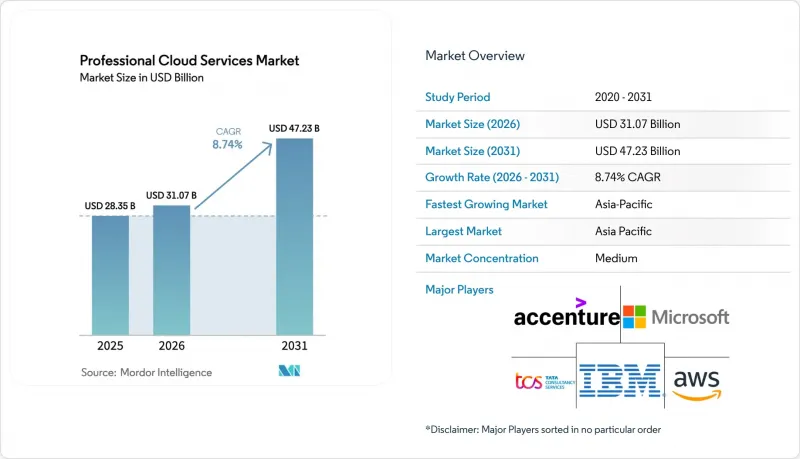
本報告按部署類型(公有雲、私有雲、混合雲)、服務模式(SaaS(軟體即服務)、PaaS(平台即服務)等)、最終用戶產業(政府/公部門、銀行/金融服務/保險等)、組織規模(大型企業、中小企業)和地區進行細分。市場預測以美元計價。
全球專業雲端服務市場趨勢與洞察
超大規模資料中心業者更高的性價比正在加速向雲端遷移。
客製化晶片將每次交易的運算成本降低了約三分之一,這促使企業將大量工作負載也遷移到公共區域。 AWS Graviton 4、Azure Maia 100 和 Google Cloud TPU v5 都計劃在 2024 年至 2025 年間發布,在提升效能的同時,還能降低每月總費用,並將遷移的投資回收期從三年縮短到不到 18 個月。價格透明度和更短的投資回收期正在擴大對成本敏感、傳統上雲端技術應用較為緩慢的行業(例如製造業和物流業)的專業雲端服務市場。
人工智慧工作負載的激增需要專業的雲端運算技術。
大規模語言模型的訓練和推理需要高頻寬網路、低延遲儲存和高彈性的叢集——而大多數企業資料中心都無法提供這些條件。 OpenAI 的 GPT-4 預計在 2024 年將消耗約 25,000 個 GPU,而 Anthropic 的 Claude 3 將於 2025 年增加多模態輸入。這加速了企業向整合向量資料庫、提示工程工具和託管模型的承包平台的遷移。能夠整合和營運這些技術堆疊的整合商會收取高額諮詢費,進一步推動了專業雲端服務市場的發展。
高階雲端運算領域熟練人才短缺
預計到 2025 年,對雲端 FinOps 工程師的需求將年增 85%,而供應量僅成長 22%,這將造成結構性技能缺口,並推高北美多重雲端架構師的薪資,使其年薪超過 20 萬美元。難以招募人才的公司嚴重依賴外部顧問,導致整個專業雲端服務市場的成本增加和專案週期延長。
細分市場分析
預計到2025年,混合部署將佔總收入的43%,這反映出企業希望在利用公共雲端擴充性的同時,維持現有的資本投資。同時,公共雲端預計將在專業雲端服務市場中以9.02%的複合年成長率成長,憑藉其成本透明度和靈活的收費系統吸引新的用戶。私有雲端在銀行和政府機構等高度監管的行業仍然很受歡迎,但由於超大規模資料中心業者大規模雲端服務商提供的獨立租戶選項,其市場佔有率正在逐漸萎縮。
Kubernetes 透過提升工作負載的可攜性,彌合了不同部署模型之間的差距。根據雲端原生運算基金會 (CNCF) 2025 年的報告,78% 的企業將在生產環境中運行 Kubernetes,從而能夠出於成本和效能方面的考慮,在私有雲端雲和公共雲端之間遷移應用程式。這種可移植性正在使基礎設施商品化,競爭對手也正轉向託管資料庫和人工智慧平台等更高價值的服務,這些服務如今已成為專業雲端服務市場的關鍵參與者。
預計到 2025 年,基礎設施即服務 (IaaS) 將佔據 35% 的市場佔有率,這主要得益於對運算密集型工作負載精細化控制的持續需求。軟體即服務、Microsoft Dynamics 和 Oracle Fusion 目前均已整合生成式人工智慧 (AI) 功能,無需客戶管理底層基礎架構即可交付成果。
人工智慧的興起正在重新定義服務模式的邊界。訓練需要IaaS等級的GPU叢集,而配置則更傾向於捆綁預訓練模型的SaaS服務。 OpenAI的「ChatGPT Enterprise」清晰地展現了這種雙重性,它提供承包的互動式人工智慧,同時將基礎設施方面的挑戰轉移給超大規模資料中心業者雲端服務供應商。隨著專業雲端服務市場的日趨成熟,擁有技術深度和垂直整合能力的供應商將更有利於實現永續成長。
區域分析
預計到2025年,亞太地區將佔據專業雲端服務市場28.3%的佔有率,並將以8.93%的複合年成長率持續成長至2031年。該地區的需求不斷成長,主要得益於印度、印尼和越南數位轉型的加速,以及中國致力於鞏固其作為國內超大規模資料中心業者的主導地位。印度的「數位印度」舉措已撥款100億美元用於公共雲端採購,為公有雲的普及應用奠定了基礎,並正逐步擴展到私人企業。
北美仍然是主要市場,但隨著企業將重心放在最佳化現有環境而非遷移新工作負載上,其成長速度正在放緩。在美國,FedRAMP計畫嚴格的認證流程限制了持牌服務提供者的數量,並減緩了聯邦領域的擴張。加拿大的《個人資料保護與電子文件法》(PIPEDA)促使企業轉向國內資料中心,但超大規模資料中心業者資料中心仍被用於跨國協作工具。
在Gaia-X和各國資料在地化政策的推動下,歐洲「主權雲」計畫正導致區域市場碎片化。儘管AWS在2025年推出了「歐洲主權雲端」以滿足本地合規要求,但法國和德國的策略優先考慮國內供應商,導致成本上升和服務範圍縮小。另一方面,英國採取了更務實的做法,允許超大規模資料中心業者在滿足安全標準的前提下進入市場。
在中東和非洲,優先發展公共部門的趨勢十分明顯。沙烏地阿拉伯的「2030願景」撥款64億美元用於數位基礎設施建設,並鼓勵超大規模資料中心業者夥伴關係在沙烏地王國建立業務。阿拉伯聯合大公國(阿拉伯聯合大公國)和南非正在製定資料保護法,引導敏感工作負載遷移到本國資料中心。在整個非洲,奈及利亞的《2024年雲端運算指南》體現了政府以身作則的決心。
南美洲的前景喜憂參半。巴西貨幣貶值和阿根廷三位數通貨膨脹推高了以美元計價的服務成本,短期內減緩了其普及速度。然而,電子商務的擴張和金融科技的創新正在推動該地區專業雲端服務市場滲透率的逐步提升。
其他好處:
- Excel格式的市場預測(ME)表
- 3個月的分析師支持
目錄
第1章:引言
- 研究假設和市場定義
- 調查範圍
第2章:調查方法
第3章執行摘要
第4章 市場狀況
- 市場概覽
- 市場促進因素
- 超大規模資料中心業者成本績效的提高正在加速雲端遷移。
- 生成式人工智慧工作負載的激增,催生了對專業雲端技術人才的需求。
- 過渡到基於績效的「軟體即服務 (SaaS)」合約
- 歐洲和亞太地區的強制性主權雲
- 面向低延遲應用的邊緣到雲端整合
- 雲端財務營運工具能夠加速提高支出透明度和普及率。
- 市場限制因素
- 高階雲端運算領域熟練人才短缺
- 出口流量和雲端間傳輸成本飆升。
- 合規框架因地區而異。
- 在通貨膨脹背景下,對中小企業營運費用進行審查。
- 宏觀經濟因素對市場的影響
- 產業價值/價值鏈分析
- 監理情勢
- 技術展望
- 波特五力分析
第5章 市場規模與成長預測
- 按實現類型
- 民眾
- 私人的
- 混合
- 按服務模式
- Software as a Service(SaaS)
- Platform as a Service(PaaS)
- Infrastructure as a Service(IaaS)
- 按最終用戶行業分類
- 政府/公共部門
- 衛生保健
- 銀行、金融、服務和保險(BFSI)
- 零售
- 資訊科技/通訊
- 媒體與娛樂
- 其他終端用戶產業
- 按組織規模
- 大公司
- 小型企業
- 按地區
- 北美洲
- 美國
- 加拿大
- 墨西哥
- 南美洲
- 巴西
- 阿根廷
- 其他南美國家
- 歐洲
- 英國
- 德國
- 法國
- 義大利
- 西班牙
- 俄羅斯
- 其他歐洲國家
- 亞太地區
- 中國
- 日本
- 印度
- 韓國
- 澳洲
- 其他亞太國家
- 中東
- 沙烏地阿拉伯
- 阿拉伯聯合大公國
- 土耳其
- 其他中東國家
- 非洲
- 南非
- 奈及利亞
- 埃及
- 其他非洲國家
- 北美洲
第6章 競爭情勢
- 市場集中度
- 策略趨勢
- 市佔率分析
- 公司簡介
- Accenture plc
- Amazon Web Services, Inc.
- Microsoft Corporation
- IBM Corporation
- Alphabet Inc.(Google Cloud)
- Deloitte Touche Tohmatsu Limited
- Tata Consultancy Services Limited
- Infosys Limited
- Capgemini SE
- Wipro Limited
- HCL Technologies Limited
- Cognizant Technology Solutions Corporation
- Rackspace Technology, Inc.
- Oracle Corporation
- Alibaba Group Holding Limited(Alibaba Cloud)
- Salesforce, Inc.
- SAP SE
- NTT DATA Corporation
- Huawei Technologies Co., Ltd.
- Google Professional Services, LLC
第7章 市場機會與未來展望
According to Mordor Intelligence, the professional cloud services market size is estimated at USD 31.07 billion in 2026, and is expected to reach USD 47.23 billion by 2031, at a CAGR of 8.74% during the forecast period (2026-2031).
This report is Segmented by Type of Deployment (Public, Private, and Hybrid), Service Model (Software As A Service, Platform As A Service, and More), End-User Industry (Government and Public Sector, Banking Finance Services and Insurance, and More), Organization Size (Large Enterprises, and Small and Medium Enterprises), and Geography. The Market Forecasts are Provided in Terms of Value (USD).
Global Professional Cloud Services Market Trends and Insights
Hyperscaler Price-Performance Gains Accelerate Cloud Migration
Custom silicon is reducing compute cost per transaction by roughly one-third, encouraging enterprises to move even batch workloads into public regions. AWS Graviton4, Azure Maia 100, and Google Cloud TPU v5 all launched in 2024-2025, improving performance while lowering total monthly bills and cutting the payback period for migrations from three years to under 18 months. Price visibility and quicker returns are expanding the professional cloud services market among cost-sensitive verticals, such as manufacturing and logistics, where cloud adoption has historically lagged.
Generative AI Workload Surge Demands Specialized Cloud Expertise
Training and inference for large language models require high-bandwidth networking, low-latency storage, and elastic clusters that most corporate data centers cannot supply. OpenAI's GPT-4 consumed about 25,000 GPUs in 2024, while Anthropic's Claude 3 added multimodal inputs in 2025, driving enterprises toward turnkey platforms that bundle vector databases, prompt-engineering tools, and managed model hosting. Integrators capable of orchestrating these stacks are commanding premium consulting rates, adding momentum to the professional cloud services market.
Talent Shortage in Advanced Cloud Specializations
While demand for cloud FinOps engineers rose 85% year-over-year in 2025, supply grew only 22%, creating a structural skills gap and inflating salaries for multi-cloud architects above USD 200,000 in North America. Enterprises struggling to recruit talent rely heavily on external consultants, adding cost and stretching project timelines across the professional cloud services market.
Other drivers and restraints analyzed in the detailed report include:
- Sovereign-Cloud Mandates Fragment Global Scale
- Edge-to-Cloud Integration Enables Low-Latency Applications
- Escalating Egress and Inter-Cloud Transfer Costs
For complete list of drivers and restraints, kindly check the Table Of Contents.
Segment Analysis
Hybrid deployments accounted for 43% of 2025 revenue, underscoring enterprises' wish to preserve existing capital investments while tapping public elasticity. Public cloud, however, is poised to advance at a 9.02% CAGR, the fastest within the professional cloud services market, as cost transparency and variable pricing attract new adopters. Private cloud retains traction in strictly regulated sectors such as banking and government, though its share is slowly eroding thanks to isolated tenancy options offered by hyperscalers.
Kubernetes is leveling the differences among deployment models by making workloads portable. In 2025 the Cloud Native Computing Foundation reported that 78% of enterprises ran Kubernetes in production, leading firms to shift applications between private and public clouds based on cost and performance considerations. This portability is commoditizing infrastructure and pushing competition into higher-value services like managed databases and AI platforms, elements now decisive in the professional cloud services market.
Infrastructure as a Service held 35% of the market share in 2025 because compute-intensive workloads still need granular control. Software as a Service is expected to grow the fastest, at a 9.31% CAGR, as vendors package industry workflows into pre-integrated suites, shortening deployment from months to weeks. Salesforce, Microsoft Dynamics, and Oracle Fusion now embed generative AI features, delivering outcomes without clients managing the underlying infrastructure.
The rise of AI is redrawing service-model boundaries. Training requires IaaS-level GPU clusters, whereas deployment favors SaaS offerings that bundle pre-trained models. OpenAI's ChatGPT Enterprise illustrates this duality by providing turnkey conversational AI while delegating infrastructure concerns to hyperscalers. As the professional cloud services market matures, vendors that combine stack depth with vertical functionality are best positioned for sustained growth.
Complete Report Scope:
- By Type of Deployment
- Public
- Private
- Hybrid
- By Service Model
- Software as a Service (SaaS)
- Platform as a Service (PaaS)
- Infrastructure as a Service (IaaS)
- By End-User Industry
- Government and Public Sector
- Healthcare
- Banking, Finance, Services and Insurance (BFSI)
- Retail
- IT and Telecommunications
- Media and Entertainment
- Other End-User Industries
- By Organization Size
- Large Enterprises
- Small and Medium Enterprises
- By Geography
- North America
- United States
- Canada
- Mexico
- South America
- Brazil
- Argentina
- Rest of South America
- Europe
- United Kingdom
- Germany
- France
- Italy
- Spain
- Russia
- Rest of Europe
- Asia-Pacific
- China
- Japan
- India
- South Korea
- Australia
- Rest of Asia-Pacific
- Middle East
- Saudi Arabia
- United Arab Emirates
- Turkey
- Rest of Middle East
- Africa
- South Africa
- Nigeria
- Egypt
- Rest of Africa
- North America
Geography Analysis
Asia-Pacific held 28.3% of the professional cloud services market share in 2025 and is projected to rise at an 8.93% CAGR through 2031. Digital-transformation mandates in India, Indonesia, and Vietnam, together with China's drive for domestic hyperscaler dominance, are widening regional demand. India's Digital India initiative earmarked USD 10 billion for public cloud procurement, anchoring adoption that spills over into private enterprise.
North America remains a major market, but growth is moderating as enterprises optimize existing estates rather than migrate new workloads. In the United States, the FedRAMP program's rigorous certification timeline limits the number of authorized providers, slowing federal-sector expansion. Canada's Personal Information Protection and Electronic Documents Act steers enterprises toward local data centers, but cross-border collaboration tools still benefit from hyperscaler footprints.
Europe's sovereign-cloud ambitions, led by Gaia-X and national data-localization policies, are fragmenting the regional market. AWS introduced its European Sovereign Cloud in 2025 to address local compliance demands, while French and German strategies privilege domestic providers, raising costs and narrowing service breadth. The United Kingdom adopted a more pragmatic stance, allowing hyperscaler participation provided security standards are met.
The Middle East and Africa are following a public-sector-first trajectory. Saudi Arabia's Vision 2030 allocated USD 6.4 billion to digital infrastructure, triggering partnerships that bring hyperscaler regions into the kingdom. The United Arab Emirates and South Africa enforce data-protection laws that steer sensitive workloads to in-country data centers. Across Africa, Nigeria's 2024 cloud guidelines signal government willingness to lead by example.
South America's outlook is mixed. Currency depreciation in Brazil and triple-digit inflation in Argentina raise the cost of dollar-denominated services, slowing near-term adoption. Nonetheless, e-commerce expansion and fintech innovation underpin a gradual increase in regional professional cloud services market penetration.
- Accenture plc
- Amazon Web Services, Inc.
- Microsoft Corporation
- IBM Corporation
- Alphabet Inc. (Google Cloud)
- Deloitte Touche Tohmatsu Limited
- Tata Consultancy Services Limited
- Infosys Limited
- Capgemini SE
- Wipro Limited
- HCL Technologies Limited
- Cognizant Technology Solutions Corporation
- Rackspace Technology, Inc.
- Oracle Corporation
- Alibaba Group Holding Limited (Alibaba Cloud)
- Salesforce, Inc.
- SAP SE
- NTT DATA Corporation
- Huawei Technologies Co., Ltd.
- Google Professional Services, LLC
Additional Benefits:
- The market estimate (ME) sheet in Excel format
- 3 months of analyst support
TABLE OF CONTENTS
1 INTRODUCTION
- 1.1 Study Assumptions and Market Definition
- 1.2 Scope of the Study
2 RESEARCH METHODOLOGY
3 EXECUTIVE SUMMARY
4 MARKET LANDSCAPE
- 4.1 Market Overview
- 4.2 Market Drivers
- 4.2.1 Hyperscaler Price-Performance Gains Accelerate Cloud Migration
- 4.2.2 Generative AI Workload Surge Demands Specialized Cloud Expertise
- 4.2.3 Shift to Outcome-Based Service-as-a-Software Contracts
- 4.2.4 Sovereign-Cloud Mandates in Europe and Asia-Pacific
- 4.2.5 Edge-to-Cloud Integration for Low-Latency Applications
- 4.2.6 Cloud FinOps Tools Drive Spend Transparency and Adoption
- 4.3 Market Restraints
- 4.3.1 Talent Shortage in Advanced Cloud Specializations
- 4.3.2 Escalating Egress and Inter-Cloud Transfer Costs
- 4.3.3 Fragmented Regional Compliance Frameworks
- 4.3.4 Inflation-Driven Opex Scrutiny in SME Segment
- 4.4 Impact of Macroeconomic Factors on the Market
- 4.5 Industry Value / Supply-Chain Analysis
- 4.6 Regulatory Landscape
- 4.7 Technological Outlook
- 4.8 Porter's Five Forces Analysis
- 4.8.1 Bargaining Power of Buyers
- 4.8.2 Bargaining Power of Suppliers
- 4.8.3 Threat of New Entrants
- 4.8.4 Threat of Substitutes
- 4.8.5 Competitive Rivalry
5 MARKET SIZE AND GROWTH FORECASTS
- 5.1 By Type of Deployment
- 5.1.1 Public
- 5.1.2 Private
- 5.1.3 Hybrid
- 5.2 By Service Model
- 5.2.1 Software as a Service (SaaS)
- 5.2.2 Platform as a Service (PaaS)
- 5.2.3 Infrastructure as a Service (IaaS)
- 5.3 By End-User Industry
- 5.3.1 Government and Public Sector
- 5.3.2 Healthcare
- 5.3.3 Banking, Finance, Services and Insurance (BFSI)
- 5.3.4 Retail
- 5.3.5 IT and Telecommunications
- 5.3.6 Media and Entertainment
- 5.3.7 Other End-User Industries
- 5.4 By Organization Size
- 5.4.1 Large Enterprises
- 5.4.2 Small and Medium Enterprises
- 5.5 By Geography
- 5.5.1 North America
- 5.5.1.1 United States
- 5.5.1.2 Canada
- 5.5.1.3 Mexico
- 5.5.2 South America
- 5.5.2.1 Brazil
- 5.5.2.2 Argentina
- 5.5.2.3 Rest of South America
- 5.5.3 Europe
- 5.5.3.1 United Kingdom
- 5.5.3.2 Germany
- 5.5.3.3 France
- 5.5.3.4 Italy
- 5.5.3.5 Spain
- 5.5.3.6 Russia
- 5.5.3.7 Rest of Europe
- 5.5.4 Asia-Pacific
- 5.5.4.1 China
- 5.5.4.2 Japan
- 5.5.4.3 India
- 5.5.4.4 South Korea
- 5.5.4.5 Australia
- 5.5.4.6 Rest of Asia-Pacific
- 5.5.5 Middle East
- 5.5.5.1 Saudi Arabia
- 5.5.5.2 United Arab Emirates
- 5.5.5.3 Turkey
- 5.5.5.4 Rest of Middle East
- 5.5.6 Africa
- 5.5.6.1 South Africa
- 5.5.6.2 Nigeria
- 5.5.6.3 Egypt
- 5.5.6.4 Rest of Africa
- 5.5.1 North America
6 COMPETITIVE LANDSCAPE
- 6.1 Market Concentration
- 6.2 Strategic Moves
- 6.3 Market Share Analysis
- 6.4 Company Profiles (includes Global Level Overview, Market Level Overview, Core Segments, Financials as available, Strategic Information, Market Rank/Share for key companies, Products and Services, and Recent Developments)
- 6.4.1 Accenture plc
- 6.4.2 Amazon Web Services, Inc.
- 6.4.3 Microsoft Corporation
- 6.4.4 IBM Corporation
- 6.4.5 Alphabet Inc. (Google Cloud)
- 6.4.6 Deloitte Touche Tohmatsu Limited
- 6.4.7 Tata Consultancy Services Limited
- 6.4.8 Infosys Limited
- 6.4.9 Capgemini SE
- 6.4.10 Wipro Limited
- 6.4.11 HCL Technologies Limited
- 6.4.12 Cognizant Technology Solutions Corporation
- 6.4.13 Rackspace Technology, Inc.
- 6.4.14 Oracle Corporation
- 6.4.15 Alibaba Group Holding Limited (Alibaba Cloud)
- 6.4.16 Salesforce, Inc.
- 6.4.17 SAP SE
- 6.4.18 NTT DATA Corporation
- 6.4.19 Huawei Technologies Co., Ltd.
- 6.4.20 Google Professional Services, LLC
7 MARKET OPPORTUNITIES AND FUTURE OUTLOOK
- 7.1 White-Space and Unmet-Need Assessment

 雲端對等互聯服務市場:依對等互聯類型、服務模式、連接方式、組織規模、最終用戶、國家及地區分類-全球產業分析、市場規模、市場佔有率及2026年至2033年預測
 2026-2030年全球應用整合服務市場
 全球雲端服務市場規模、佔有率、趨勢和成長分析報告(2026-2034)
 雲端服務市場規模、佔有率和成長分析:按服務模式、部署模式、企業規模、最終用戶產業、組織類型、應用程式和地區分類-2026-2033年產業預測
 雲端服務市場:2026-2032年全球市場預測(按服務類型、部署模式、組織規模、應用程式和最終用戶分類)
 雲端互聯服務市場預測至 2034 年—按互聯類型、服務模式、連接方式、組織規模、最終用戶和地區分類的全球分析雲端儲存庫服務市場:按服務、部署模式、交付方式、應用、國家和地區分類-產業分析、市場規模、市場佔有率和預測(2026-2033 年)
 2026年全球雲端採用支援服務市場報告
 雲端攝影機市場:按攝影機類型、產業、公司規模、電源、視野角、分析與智慧功能、應用、最終用戶、雲端服務模式、整合和區域分類SRv6 服務鏈全球市場報告 2026