


 |
市場調查報告書
商品編碼
2120791
丙烯腈:市場佔有率分析、產業趨勢與統計、成長預測(2026-2031)Acrylonitrile - Market Share Analysis, Industry Trends & Statistics, Growth Forecasts (2026 - 2031) |
||||||

※ 本網頁內容可能與最新版本有所差異。詳細情況請與我們聯繫。
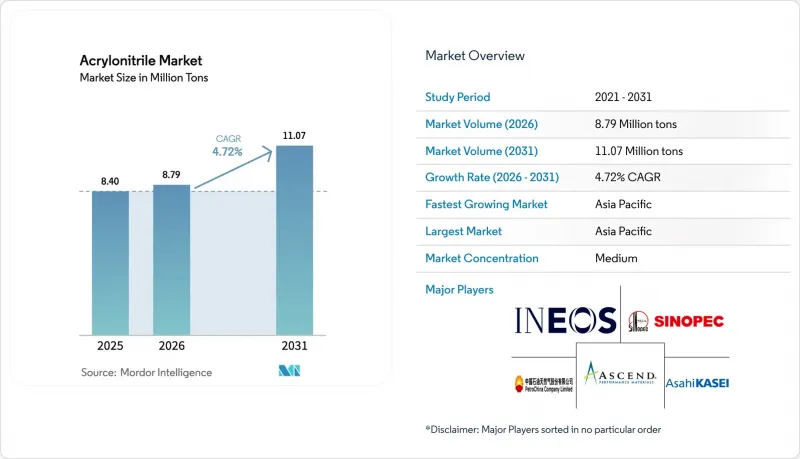
據 Mordor Intelligence 稱,2025 年丙烯腈市值為 840 萬噸,預計到 2031 年將達到 1107 萬噸,而 2026 年為 879 萬噸,預測期(2026-2031 年)的複合年成長率為 4.72%。
本報告依製程技術(氧化製程及其他製造製程)、應用領域(丙烯酸纖維、ABS/SAN樹脂、丙烯醯胺等)、終端用戶產業(汽車及交通運輸、建築及基礎設施等)以及地區(亞太、北美、歐洲、南美、中東和非洲)進行細分。市場預測以噸為單位。
全球丙烯腈市場趨勢與洞察
歐盟在生物化學領域的獎勵正在加速可再生ACN試點計畫的進展。
歐盟委員會於2025年7月發布的《化學工業行動計畫》明確列出了大規模生產中間體中可再生路徑的資金優先事項。 OCI目前正向AnQore的Econitrile生產線供應生物氨,與傳統的氨氧化法相比,其生命週期排放量減少了約60%。美國國家再生能源實驗室(NREL)的研究人員進一步證明了3-羥基丙酸的轉化率高達98%,這項突破性成果縮小了化石燃料路線和可再生路線之間的成本差距。發布範圍3儀錶板的汽車原始設備製造商(OEM)開始明確規定在ABS化合物中使用可再生丙烯腈,如果生物氨的供應量超過目前每年不足50萬噸的限制,這一轉變可能會提振對優質等級生物氨的需求。儘管目前綠色氫能計畫的進度限制了生物氨的推廣速度,但鑑於歐盟鼓勵低碳中間體的獎勵機制,中期發展勢頭依然樂觀。
市場對用於 5G 硬體機殼的電子級 SAN 的需求正在激增。
網路設備製造商需要兼具低介電損耗、阻燃性和紫外線穩定性的機殼。含有28-32%丙烯腈的電子SAN符合這些要求,並正在取代愛立信和華為提供的戶外5G無線電單元中的聚碳酸酯混合物。與通用SAN等級相比,更高的單體含量可使每個單元的丙烯腈用量直接增加約15-20%。韓國和日本的整合製造商無需添加後混煉添加劑即可調整配方以滿足UL 94 V-0標準,從而提高區域供應鏈的冗餘性。產品生命週期分析表明,在惡劣的戶外環境中,SAN機殼的使用壽命比聚烯替代品更長,從而降低了電信業者的更換成本。隨著基地台密度的增加,對丙烯腈需求的溢出效應在亞太地區人口稠密的地區將最為顯著。
丙烯價格波動與蒸汽裂解裝置的停產有關。
在標準的氨氧化製程中,丙烯原料約佔現金成本的65%。 2025年,美國墨西哥灣沿岸一家裂解裝置意外停產,導致該地區丙烯有意產量下降,現貨價格超過季度最低合約價格。同時,歐洲煉油商依賴進口美國石腦油取代受出口禁令限制的俄羅斯原料,加劇了跨大西洋丙烯供需平衡,導致價格飆升,使得中小丙烯腈生產商難以進行避險。這些事態發展削弱了下游ABS和丙烯酸纖維加工商的購買力,迫使他們要么增加庫存,要么承受波動劇烈的指數風險,從而在需求低迷時期損害盈利。在蒸汽裂解裝置運轉率提高以及區域瓶頸解決方案項目於2027年下半年竣工之前,丙烯腈市場將持續面臨成本推動壓力。
細分市場分析
截至2025年,氨氧化法將佔據丙烯腈市場83.15%的佔有率,預計到2031年將以5.12%的複合年成長率穩步成長,這主要得益於現有工廠的持續維修。傳統的Sohio製程採用鉬酸鉍催化劑,使丙烯與氨反應,單一途徑收率接近85%,此基準是新型丙烷或生物製程尚未達到的。 2024年,英力士(INEOS)完成了位於Seal Sands工廠的能源效率維修,證實分階段改進熱整合和最佳化催化劑冷卻可使工廠收率提高3%。由安科瑞(AnQore)旗下Econitrile生產線主導的可再生能源先導計畫,使用OCI提供的生物氨,已成功將生命週期排放量減少了約60%,使汽車OEM廠商能夠減少其範圍3排放。然而,生物氨的供應量仍低於每年50萬噸,而且由於需要含氧金屬材料,使用丙烷進行氨氧化物處理仍需要大量的資本投入。因此,在生物原料的物流系統得到改善之前,傳統製程在提高絕對產量方面可能仍將佔據主導地位。
同時,透過週期性改變反應器溫度來抑制催化劑燒結的「強制動態操作」技術也在同步發展。雖然實驗室研究已證實該技術能夠提高產率,但仍需進行大規模驗證。催化劑供應商也同步開發鉬碲配方以提高選擇性,但當操作溫度高於430 度C時,揮發性問題就會浮現。擁有自有丙烯生產線的綜合性生產商最有能力投資這些創新技術,這進一步鞏固了大型企業佔據供應成長主導地位的格局。
區域分析
預計到2025年,亞太地區將佔據全球丙烯腈市場佔有率的69.81%,並將在2031年之前保持5.53%的複合年成長率。光是在中國,2025年就將新增131萬噸產能,使中國名目產能超過每年570萬噸。主要運作項目包括浙江石化大上二期工廠(年產能66萬噸)和中國石油吉林工廠(年產能26萬噸),這兩家工廠均與下游ABS、壓克力纖維和碳纖維的生產區域整合。印度持續面臨結構性供不應求,目前僅有一家位於古吉拉突邦吉拉的工廠在運作,年產能為4.1萬噸。這種供需失衡,加上政府的生產連結獎勵計畫計畫(PLI),促使各方提出一系列建議,要求從2027年起每年新增至少20萬噸產能。日本和韓國在催化劑設計和特殊SAN等級方面持續保持主導地位,但由於汽車和消費性電子產業的成熟,國內需求仍然疲軟。該地區的成長取決於電動車的普及、5G基礎設施的發展以及南亞紡織品出口的成長。
北美和歐洲合計僅佔全球消費量的五分之一多一點。美國墨西哥灣沿岸丙烯價格的波動因煉油廠的計畫性維護而加劇,限制了2025年丙烯腈的運轉率。英力士(INEOS)在德克薩斯州格林湖和德國科隆分別擁有年產能45萬噸和30萬噸的生產能力,保持著戰略柔軟性,凸顯了垂直原料整合的重要性。歐洲生產商正準備迎接2026年4月即將實施的REACH法規中1.0毫克/立方公尺的職業暴露限值。遵守該法規的成本可能會迫使小規模的加工商退出市場或進行整合。同時,歐盟的化學工業行動計畫(CIAP)正在為可再生丙烯腈的試點計畫提供津貼,這項措施有利於那些無需巨額資本投資即可轉型生產生物氨的現有企業。
預計中東、非洲和南美洲三地合計將實現高於平均的成長。沙烏地基礎工業公司(SABIC)位於阿爾朱拜爾的工廠(年產能42萬噸)採用富含丙烷的低成本原料,並正在探索下游製程中碳纖維前驅物的企業發展。土耳其的Petkim公司向歐洲和中東的客戶供應產品,但運轉率易受地區政治風險的影響。在巴西,汽車生產的復甦支撐了對用於內飾的ABS的需求,當地包裝製造商正轉向使用阻燃ABS製造家用電器機殼。由於非洲市場基數仍然小規模,因此是水處理用丙烯醯胺的關鍵市場,而且目前非洲,特別是採礦業發達的經濟體,正受到更嚴格的廢水排放法規的約束。
其他好處:
- Excel格式的市場預測(ME)表
- 3個月的分析師支持
目錄
第1章:引言
- 研究假設和市場定義
- 調查範圍
第2章:調查方法
第3章執行摘要
第4章 市場狀況
- 市場概覽
- 市場促進因素
- 汽車和建築業(主流)對ABS的需求不斷成長
- 紡織業(主流)丙烯酸纖維消費量的擴張
- 工業水處理對丙烯醯胺的需求正在擴大(主流)。
- 歐盟在生物化學領域的獎勵正在加速可再生ACN的試點計畫(這一點尚未得到充分報告)。
- 5G硬體機殼用電子級SAN的需求激增(媒體通報不足)
- 鈉離子電池前驅體需求不斷成長(通報不足)
- 市場限制因素
- 與嚴格的毒性法規和 REACH 合規性相關的成本(主流)
- 由於蒸汽裂解裝置(主流)運作,丙烯價格出現波動
- 用聚烯合金取代工程塑膠(報道不足)
- 高壓氨氧化設備熟練工人短缺(報告不足)。
- 價值鏈分析
- 供應概覽
- 監理展望
- 技術展望
- 波特五力模型
- 產品概覽
- 生產成本概覽
- 定價概覽
- 價格趨勢概覽(丙烯腈)
- 原物料價格
第5章 市場規模與成長預測
- 透過工藝技術
- 氨氧化法
- 其他製造程序
- 透過使用
- 丙烯酸纖維
- 丙烯腈-丁二烯-苯乙烯共聚物 (ABS) / 苯乙烯-丙烯腈樹脂 (SAN)
- 丙烯醯胺
- 丁腈橡膠
- 其他用途
- 按最終用途行業分類
- 汽車和運輸業
- 建築和基礎設施
- 電氣和電子設備
- 紡織服裝
- 其他終端用戶產業(供水和污水處理、包裝和消費品等)
- 按地區
- 亞太地區
- 中國
- 印度
- 日本
- 韓國
- 其他亞太國家
- 北美洲
- 美國
- 加拿大
- 墨西哥
- 歐洲
- 德國
- 英國
- 法國
- 義大利
- 俄羅斯
- 其他歐洲國家
- 南美洲
- 巴西
- 阿根廷
- 其他南美國家
- 中東和非洲
- 沙烏地阿拉伯
- 南非
- 其他中東和非洲國家
- 亞太地區
第6章 競爭情勢
- 市場集中度
- 策略趨勢
- 市佔率和排名分析
- 公司簡介
- AnQore
- Asahi Kasei Corporation
- Ascend Performance Materials
- China Petrochemical Corporation
- Cornerstone Chemical
- Formosa Plastics Corporation
- INEOS
- Jiangsu Sailboat Petrochemical
- Jiangsu Shenghong Petrochemical
- LG Chem
- Mitsubishi Chemical Group Corporation.
- PetroChina
- Reliance Industries Limited.
- SABIC
- SGL Carbon
- Shanghai SECCO
- SOCAR(Petkim)
- Sumitomo Chemical Co., Ltd.
- Taekwang Industrial
- TONGSUH PETROCHEMICAL CORPORATION, LTD.
- Toray Industries
第7章 市場機會與未來展望
According to Mordor Intelligence, the acrylonitrile market size was valued at 8.40 Million tons in 2025 and is estimated to grow from 8.79 Million tons in 2026 to reach 11.07 Million tons by 2031, at a CAGR of 4.72% during the forecast period (2026-2031).
This report is Segmented by Process Technology (Ammoxidation Process and Other Production Processes), Application (Acrylic Fiber, ABS/SAN Resin, Acrylamide, and More), End-Use Industry (Automotive and Transportation, Construction and Infrastructure, and More), and Geography (Asia-Pacific, North America, Europe, South America, and Middle East and Africa). Market Forecasts are Provided in Terms of Volume (tons).
Global Acrylonitrile Market Trends and Insights
EU Bio-Chemical Incentives Accelerating Renewable ACN Pilots
The European Commission's Chemical Industry Action Plan, published in July 2025, sets explicit funding priorities for renewable pathways in high-volume intermediates. OCI now ships bio-ammonia to AnQore's Econitrile line, enabling a documented ~60% lifecycle-emissions cut compared with conventional ammoxidation. NREL researchers further validated a 98% conversion yield from 3-hydroxypropionic acid, a milestone that narrows the cost gap between fossil and renewable routes. Automotive OEMs that publish Scope 3 dashboards are beginning to specify renewable acrylonitrile in ABS compounds, a shift that could boost premium-grade demand once bio-ammonia availability scales beyond the current sub-500,000 t/y ceiling. Implementation speed is now constrained by green-hydrogen project timing, but medium-term momentum remains favorable as EU incentive structures reward low-carbon intermediates.
Surge in Electronics-Grade SAN for 5G Hardware Casings
Network-equipment manufacturers require housings that combine low dielectric loss, flame retardancy, and UV stability. Electronics-grade SAN, formulated with 28-32% acrylonitrile, meets these criteria and is displacing polycarbonate blends in outdoor 5G radio units supplied by Ericsson and Huawei. The higher monomer content directly lifts acrylonitrile uptake by roughly 15-20% per unit compared with general-purpose SAN grades. Regional supply chains gain redundancy because integrated players in South Korea and Japan can tailor recipes to meet UL 94 V-0 without post-compounding additives. Product life-cycle analyses show that SAN casings outlast polyolefin alternatives in demanding outdoor conditions, thereby lowering replacement costs for telecom operators. As base-station density rises, the associated pull-through effect on acrylonitrile market volumes will be most pronounced in Asia-Pacific's high-population corridors.
Propylene Price Volatility Linked to Steam-Cracker Outages
Propylene feedstock accounts for roughly 65% of cash costs in standard ammoxidation. Unplanned cracker shutdowns in the US Gulf Coast during 2025 cut regional on-purpose propylene output and lifted spot prices above quarterly contract floors. European refiners simultaneously leaned on U.S. naphtha imports to replace embargoed Russian feed, tightening trans-Atlantic propylene balances and creating abrupt price spikes that smaller acrylonitrile producers struggle to hedge. These dynamics weaken the purchasing power of downstream ABS and acrylic-fiber converters, which are forced to carry higher inventories or accept exposure to floating indices that erode profitability during demand troughs. Until steam-cracker reliability improves and regional de-bottlenecking projects reach mechanical completion in late 2027, the acrylonitrile market will face periodic cost-push pressure.
Other drivers and restraints analyzed in the detailed report include:
- Emerging Sodium-Ion Battery Precursor Demand
- Rising ABS Demand in Automotive and Construction
- Engineering Plastics Substitution by Polyolefin Alloys
For complete list of drivers and restraints, kindly check the Table Of Contents.
Segment Analysis
Ammoxidation accounted for 83.15% of the acrylonitrile market share in 2025, and continued brownfield upgrades place the pathway on a steady 5.12% CAGR through 2031. The legacy Sohio process converts propylene and ammonia over bismuth-molybdate catalysts at single-pass yields near 85%, a benchmark that newer propane or bio-routes have yet to match. INEOS completed an energy-efficiency revamp at its Seal Sands unit in 2024, confirming that incremental heat-integration and catalyst-cooling tweaks can lift site-specific yields by up to 3%. Renewable pilots, led by AnQore's Econitrile line using OCI-supplied bio-ammonia, achieve roughly 60% lower lifecycle emissions, an attribute that automotive OEMs can translate into Scope 3 reductions. That said, bio-ammonia availability remains under 500,000 t/y, and propane ammoxidation still requires higher capex owing to oxygenate-resistant metallurgy. As a result, the conventional process will dominate absolute volume additions until bio-feedstock logistics improve.
Parallel advances in forced dynamic operation, in which reactor temperatures cycle to mitigate catalyst sintering, show laboratory yield bumps but need field validation at scale. Catalyst suppliers are simultaneously pursuing molybdenum-tellurium formulations that boost selectivity yet introduce volatility concerns when operating above 430°C. Integrated producers with captive propylene are best positioned to fund these innovations, reinforcing the structure where top-tier players command the lion's share of incremental supply.
Complete Report Scope:
- By Process Technology
- Ammoxidation Process
- Other Production Processes
- By Application
- Acrylic Fiber
- Acrylonitrile Butadiene Styrene (ABS)/Styrene-Acrylonitrile Resin (SAN)
- Acrylamide
- Nitrile-Butadiene Rubber
- Other Applications
- By End-use Industry
- Automotive and Transportation
- Construction and Infrastructure
- Electrical and Electronics
- Textiles and Apparel
- Other End-user Industries (Water and Waste-water Treatment, Packaging and Consumer Goods, etc.)
- By Geography
- Asia-Pacific
- China
- India
- Japan
- South Korea
- Rest of Asia-Pacific
- North America
- United States
- Canada
- Mexico
- Europe
- Germany
- United Kingdom
- France
- Italy
- Russia
- Rest of Europe
- South America
- Brazil
- Argentina
- Rest of South America
- Middle East and Africa
- Saudi Arabia
- South Africa
- Rest of Middle East and Africa
- Asia-Pacific
Geography Analysis
Asia-Pacific held 69.81% acrylonitrile market share in 2025 and is projected to post a 5.53% CAGR through 2031. China alone added 1.31 million t/y of capacity during 2025, bringing national nameplate capacity above 5.7 million t/y. Major start-ups include Zhejiang Petrochemical's 660,000 t/y Daishan Plant 2 and PetroChina's 260,000 t/y Jilin unit, both integrated with downstream ABS, acrylic fiber, and carbon-fiber precincts. India remains structurally short, operating a single 41,000 t/y plant at Hazira, Gujarat; that imbalance, coupled with government Production-Linked Incentives, is spurring proposals for at least 200,000 t/y of new capacity post-2027. Japan and South Korea continue to lead in catalyst design and specialty SAN grades, though domestic demand is flat due to mature automotive and appliance sectors. Regional growth hinges on electric-vehicle penetration, 5G equipment build-out, and expanding textile exports from South Asia.
North America and Europe jointly account for just over one-fifth of global consumption. US Gulf Coast propylene volatility, aggravated by refinery turnarounds, constrained acrylonitrile operating rates in 2025. INEOS maintains strategic flexibility with 450,000 t/y at Green Lake, Texas, and 300,000 t/y in Cologne, Germany, underscoring the importance of vertical feedstock integration. European producers brace for the April 2026 occupational exposure limit of 1.0 mg/m3 under REACH, a compliance cost that could prompt smaller converters to exit or consolidate. The EU Chemical Industry Action Plan simultaneously funnels grants toward renewable acrylonitrile pilots, a dynamic that favors incumbents able to retrofit bio-ammonia inputs without massive capex.
The Middle East, Africa, and South America together are positioned for above-average growth. SABIC's 420,000 t/y Al-Jubail unit leverages low-cost propane-rich feed and is evaluating downstream carbon-fiber precursor ventures. Turkey's Petkim serves both European and Middle Eastern customers, although utilization is sensitive to regional political risk. Brazil's vehicle production rebound supports ABS demand for interior trims, and local packaging converters are shifting toward flame-retardant ABS for appliance housings. Africa's modest base makes it a focus for water-treatment acrylamide, particularly in mining-intensive economies where stricter discharge laws now apply.
- AnQore
- Asahi Kasei Corporation
- Ascend Performance Materials
- China Petrochemical Corporation
- Cornerstone Chemical
- Formosa Plastics Corporation
- INEOS
- Jiangsu Sailboat Petrochemical
- Jiangsu Shenghong Petrochemical
- LG Chem
- Mitsubishi Chemical Group Corporation.
- PetroChina
- Reliance Industries Limited.
- SABIC
- SGL Carbon
- Shanghai SECCO
- SOCAR (Petkim)
- Sumitomo Chemical Co., Ltd.
- Taekwang Industrial
- TONGSUH PETROCHEMICAL CORPORATION,LTD.
- Toray Industries
Additional Benefits:
- The market estimate (ME) sheet in Excel format
- 3 months of analyst support
TABLE OF CONTENTS
1 Introduction
- 1.1 Study Assumptions & Market Definition
- 1.2 Scope of the Study
2 Research Methodology
3 Executive Summary
4 Market Landscape
- 4.1 Market Overview
- 4.2 Market Drivers
- 4.2.1 Rising ABS demand in automotive and construction (mainstream)
- 4.2.2 Growing acrylic-fiber consumption in textiles (mainstream)
- 4.2.3 Expansion of acrylamide for industrial water treatment (mainstream)
- 4.2.4 EU bio-chemical incentives accelerating renewable ACN pilots (under-reported)
- 4.2.5 Surge in electronics-grade SAN for 5G hardware casings (under-reported)
- 4.2.6 Emerging sodium-ion battery precursor demand (under-reported)
- 4.3 Market Restraints
- 4.3.1 Stringent toxicity regulations and REACH compliance costs (mainstream)
- 4.3.2 Propylene price volatility linked to steam-cracker outages (mainstream)
- 4.3.3 Engineering plastics substitution by polyolefin alloys (under-reported)
- 4.3.4 Limited skilled workforce for high-pressure ammoxidation units (under-reported)
- 4.4 Value Chain Analysis
- 4.5 Supply Overview
- 4.6 Regulatory Outlook
- 4.7 Technological Outlook
- 4.8 Porter's Five Forces
- 4.8.1 Bargaining Power of Suppliers
- 4.8.2 Bargaining Power of Buyers
- 4.8.3 Threat of New Entrants
- 4.8.4 Threat of Substitutes
- 4.8.5 Degree of Competition
- 4.9 Production Overview
- 4.10 Production Cost Overview
- 4.11 Pricing Overview
- 4.11.1 Pricing Overview (Acrylonitrile)
- 4.11.2 Raw Material Pricing
5 Market Size & Growth Forecasts (Volume)
- 5.1 By Process Technology
- 5.1.1 Ammoxidation Process
- 5.1.2 Other Production Processes
- 5.2 By Application
- 5.2.1 Acrylic Fiber
- 5.2.2 Acrylonitrile Butadiene Styrene (ABS)/Styrene-Acrylonitrile Resin (SAN)
- 5.2.3 Acrylamide
- 5.2.4 Nitrile-Butadiene Rubber
- 5.2.5 Other Applications
- 5.3 By End-use Industry
- 5.3.1 Automotive and Transportation
- 5.3.2 Construction and Infrastructure
- 5.3.3 Electrical and Electronics
- 5.3.4 Textiles and Apparel
- 5.3.5 Other End-user Industries (Water and Waste-water Treatment, Packaging and Consumer Goods, etc.)
- 5.4 By Geography
- 5.4.1 Asia-Pacific
- 5.4.1.1 China
- 5.4.1.2 India
- 5.4.1.3 Japan
- 5.4.1.4 South Korea
- 5.4.1.5 Rest of Asia-Pacific
- 5.4.2 North America
- 5.4.2.1 United States
- 5.4.2.2 Canada
- 5.4.2.3 Mexico
- 5.4.3 Europe
- 5.4.3.1 Germany
- 5.4.3.2 United Kingdom
- 5.4.3.3 France
- 5.4.3.4 Italy
- 5.4.3.5 Russia
- 5.4.3.6 Rest of Europe
- 5.4.4 South America
- 5.4.4.1 Brazil
- 5.4.4.2 Argentina
- 5.4.4.3 Rest of South America
- 5.4.5 Middle East and Africa
- 5.4.5.1 Saudi Arabia
- 5.4.5.2 South Africa
- 5.4.5.3 Rest of Middle East and Africa
- 5.4.1 Asia-Pacific
6 Competitive Landscape
- 6.1 Market Concentration
- 6.2 Strategic Moves
- 6.3 Market Share/Ranking Analysis
- 6.4 Company Profiles (includes Global level Overview, Market level overview, Core Segments, Financials as available, Strategic Information, Products & Services, Recent Developments)
- 6.4.1 AnQore
- 6.4.2 Asahi Kasei Corporation
- 6.4.3 Ascend Performance Materials
- 6.4.4 China Petrochemical Corporation
- 6.4.5 Cornerstone Chemical
- 6.4.6 Formosa Plastics Corporation
- 6.4.7 INEOS
- 6.4.8 Jiangsu Sailboat Petrochemical
- 6.4.9 Jiangsu Shenghong Petrochemical
- 6.4.10 LG Chem
- 6.4.11 Mitsubishi Chemical Group Corporation.
- 6.4.12 PetroChina
- 6.4.13 Reliance Industries Limited.
- 6.4.14 SABIC
- 6.4.15 SGL Carbon
- 6.4.16 Shanghai SECCO
- 6.4.17 SOCAR (Petkim)
- 6.4.18 Sumitomo Chemical Co., Ltd.
- 6.4.19 Taekwang Industrial
- 6.4.20 TONGSUH PETROCHEMICAL CORPORATION,LTD.
- 6.4.21 Toray Industries
7 Market Opportunities & Future Outlook
- 7.1 White-Space & Unmet-Need Assessment
- 7.2 Development of Bio-Based Acrylonitrile

 丙烯腈市場-2026-2032年全球市場預測
 全球丙烯腈市場:市場規模、佔有率、趨勢和成長分析(2026-2034)全球生物基丙烯腈市場規模、佔有率、趨勢和成長分析報告(2026-2034)
 2026年全球丙烯腈市場報告
 丙烯腈市場規模、佔有率及成長分析(按製造流程、應用和地區分類)-產業預測(2026-2033)
 丙烯睛(ACN)的全球市場(~2035年):各做法類型,各永續性焦點類型,各製造流程類型,各用途,不同企業規模,各經營模式類型,各主要地區,產業趨勢,預測丙烯腈市場:2025-2030年預測
 丙烯腈全球市場,2025-2029
 全球丙烯腈市場:市場規模、佔有率、趨勢分析(按應用和地區)、細分市場預測(2025-2030 年)聚丙烯腈市場:預測(2025-2030)