


 |
市場調查報告書
商品編碼
2120755
高性能輪胎:市場佔有率分析、產業趨勢與統計、成長預測(2026-2031)High Performance Tires - Market Share Analysis, Industry Trends & Statistics, Growth Forecasts (2026 - 2031) |
||||||

※ 本網頁內容可能與最新版本有所差異。詳細情況請與我們聯繫。
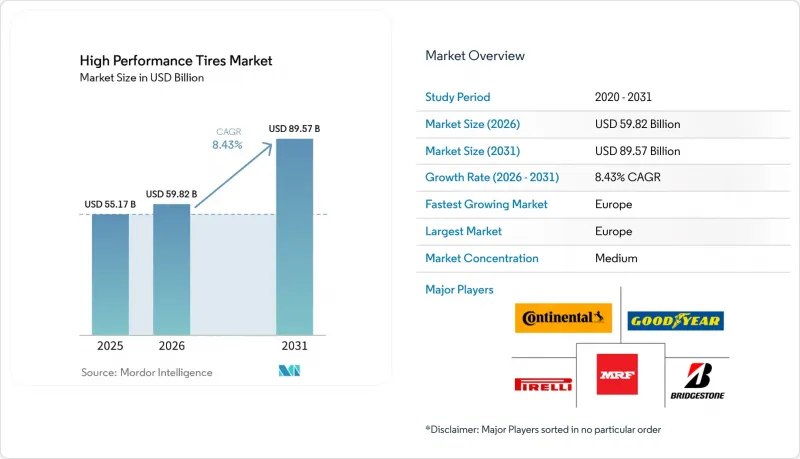
根據 Mordor Intelligence 預測,高性能輪胎市場規模預計將從 2025 年的 551.7 億美元成長到 2026 年的 598.2 億美元,然後從 2026 年到 2031 年以 8.43% 的複合年成長率成長,到 2031 年達到 895.7 億美元。
本報告按輪胎類型(光頭胎、胎紋胎及其他)、銷售管道(原廠配套和售後市場)、應用領域(賽車等)、輪胎類型(夏季胎、冬季胎、全季胎)和地區細分。市場預測以美元計價。
全球高性能輪胎市場趨勢及洞察
電動車的扭力和重量需要專門設計的高性能輪胎。
電池式電動車)比同級別的內燃機車型重250-350公斤,這增加了輪胎接地面積的負荷,並在快速加速時使胎面磨損加快高達五分之二。Bridgestone將於2024年5月推出的「Turanza EV」輪胎,結合了芳香聚醯胺束層和高矽橡膠,以增強散熱性能;韓泰的「iON evo SUV」輪胎則透過加強胎側,實現了高速公路行駛的靜謐性。輪胎輪圈協會於2024年推出了「高載重(HL)」標誌,以規範電動車的載重指數。大陸集團的「EcoContact Next」輪胎採用雙複合胎面,即使在電動車特有的扭矩驟增情況下也能保持煞車抓地力。預計到2025年,全球電動車銷量將超過2,000萬輛,電動車專用輪胎的利潤率比傳統超高性能輪胎高出四分之一。
SUV 和豪華轎車的輪圈尺寸不斷增加,推動了汽車製造商採用超高性能輪胎。
近年來,豪華車市場中相當一部分新車都配備了尺寸遠超以往的輪圈。保時捷在Taycan CrossTurismo車型上採用了更大的輪胎,進一步突破了尺寸限制;而梅賽德斯-奔馳則在EQS車型上提案了尺寸更大的輪胎選項,這進一步鞏固了市場對Low profile比超高性能輪胎的需求。更大的輪轂能夠減少胎側變形,從而提升車輛的操控響應,但同時也增加了碰撞風險。為此,倍耐力在其P Zero Elect系列輪胎中加入了降噪泡沫層。這一趨勢在中東地區尤為盛行,豪華SUV在沿岸地區的輕型車市場佔據了相當大的佔有率。
高昂的價格阻礙了其在對成本敏感地區的廣泛應用。
世界銀行指出,高性能輪胎的價格遠高於中檔輪胎,這使得它們在人均收入較低的市場更難普及。在巴西,不斷上漲的通貨膨脹和高額的高階輪胎進口關稅迫使消費者選擇更經濟實惠的輪胎。同時,假輪胎在南非和埃及佔據了相當大的市場。在東南亞,分散的流通結構限制了利潤空間,而對價格敏感的消費者更注重輪胎的耐用性而非抓地力。
細分市場分析
截至2025年,賽車光頭胎將佔據高性能輪胎市場44.72%的佔有率,預計到2031年將以8.49%的複合年成長率成長。雖然其較大的接地面積顯著提升了過彎時的抓地力,但其在濕滑路面上的牽引力不足限制了其在賽道上的應用。而採用均衡溝槽和富含二氧化矽配方的胎紋超高性能夏季胎和全季胎則能滿足日常駕駛需求。大陸集團的「UltraContact NXT」輪胎是梅賽德斯-奔馳EQE的標配,憑藉其低噪音和主要可再生材料製成的特性,已成為原廠配套輪胎的首選。
倍耐力憑藉著最新的F1輪胎,採用FSC認證橡膠和再生炭黑,引領著輪胎產業邁向更環保的未來。同時,光頭胎配方也擴大採用生物基材料。米其林Pilot Sport 5輪胎採用混合配方胎面,在保持卓越濕地抓地力的同時,圈速可與半光頭胎媲美。裝甲車輛和遙控車輛使用的缺氣保用輪胎和自密封輪胎則優先考慮耐穿刺性而非舒適性。在高性能輪胎市場,專業光面輪胎的生產仍備受青睞,其毛利率遠高於一般胎面輪胎。
預計到2025年,OEM通路將佔總銷量的78.10%,這主要得益於與汽車製造商簽訂的多年型式認證協議。倍耐力在BMWiX車型上應用的「CyberTire」感測器,展現了其技術深度整合。然而,受亞太地區「賽道日」文化和中東沙漠拉力賽的推動,預計到2031年,售後市場將以每年8.55%的更快速度成長。由於半光面輪胎的更換週期遠短於日常用車輪胎,其交易量將顯著成長。
儘管對整車製造商 (OEM) 的出貨量不斷成長,但由於汽車製造商競相爭奪契約,該公司每年都面臨著持續的價格壓力。相較之下,由於策略性經銷商合作夥伴關係和電子商務帶來的透明度,售後市場的利潤率仍然相當高。固特異的 Eagle F1 Asymmetric 6 輪胎憑藉其安全性能吸引了日常駕駛者,而百路馳的越野輪胎系列則在沙漠拉力賽領域佔據主導地位。高性能輪胎市場的這種雙重特性使該公司既能從穩定的整車製造商訂單中獲益,又能滿足盈利愛好者的需求。
區域分析
到2025年,歐洲將佔據高性能輪胎市場38.35%的佔有率,預計到2031年將以8.52%的複合年成長率成長。這一成長主要得益於歐7磨損標準的實施,該標準加速了低磨損技術的創新。德國汽車製造商越來越關注具有高滾動阻力和整合感測器的輪胎,因此倍耐力Cyber輪胎和大陸UltraContact NXT等先進產品已應用於其高階電動車。
在包括中國、日本、韓國和東南亞國家在內的亞太地區,超高性能(UHP)輪胎正迅速普及,這主要得益於電氣化進程的推進和收入水平的提高。在中國,更嚴格的輪胎標準促使輪胎製造中二氧化矽的使用量增加,進而幫助中策和玲瓏等本土品牌強化其高性能產品線。在日本,Bridgestone和Yokohama Rubber正利用其在冬季輪胎技術方面的專長擴大出口,而韓泰輪胎則透過獨家供應電動方程式賽車來提升品牌形象。在印度,阿波羅和MRF正致力於開發適用於熱帶氣候的耐熱輪胎配方。
其他好處:
- Excel格式的市場預測(ME)表
- 3個月的分析師支持
目錄
第1章:引言
- 研究假設和市場定義
- 調查範圍
第2章:調查方法
第3章執行摘要
第4章 市場狀況
- 市場概覽
- 市場促進因素
- 為了承受電動車的扭力和重量,需要專門設計的高性能輪胎。
- SUV 和豪華轎輪圈尺寸的不斷增加,促使汽車製造商採用超高性能 (UHP) 輪轂。
- 二氧化碳排放和滾動阻力法規正在加速採用富含二氧化矽的化合物。
- 歐7顆粒物排放法規正在推動低磨損胎面設計的發展。
- 賽車運動及其愛好者文化的蓬勃發展正在推動售後市場的需求。
- 一個由人工智慧驅動的智慧輪胎平台正在產生高品質的資訊服務。
- 市場限制因素
- 價格溢價阻礙了對成本敏感地區的普及。
- 天然橡膠和石油基聚合物的價格波動給利潤率帶來了壓力。
- 歐洲7號磨損測試會增加合規成本。
- 新興的無氣/3D列印技術對氣動技術構成了威脅。
- 價值供應鏈分析
- 監理情勢
- 技術展望
- 波特五力模型
第5章 市場規模與成長預測
- 按類型
- 賽車光頭胎
- 胎面輪胎
- 其他類型
- 按銷售管道
- OEM
- 售後市場
- 透過使用
- 賽車
- 越野車
- 其他車型
- 按輪胎類型
- 夏季輪胎
- 冬天
- 四季
- 按地區
- 北美洲
- 美國
- 加拿大
- 其他北美國家
- 南美洲
- 巴西
- 阿根廷
- 其他南美國家
- 歐洲
- 英國
- 德國
- 西班牙
- 義大利
- 法國
- 俄羅斯
- 其他歐洲國家
- 亞太地區
- 印度
- 中國
- 日本
- 韓國
- 其他亞太國家
- 中東和非洲
- 阿拉伯聯合大公國
- 沙烏地阿拉伯
- 土耳其
- 埃及
- 南非
- 其他中東和非洲國家
- 北美洲
第6章 競爭情勢
- 市場集中度
- 策略趨勢
- 市佔率分析
- 公司簡介
- Compagnie Generale des Etablissements Michelin
- Bridgestone Corporation
- The Goodyear Tire & Rubber Company
- Continental AG
- Pirelli & CSpA
- Hankook Tire & Technology Co., Ltd.
- Yokohama Rubber Co., Ltd.
- Sumitomo Rubber Industries, Ltd.
- Nokian Tyres plc(Nokian Renkaat Oyj)
- Toyo Tire & Rubber Co., Ltd.
- Kumho Tire Co., Inc.
- MRF Tyres
- Apollo Tyres Ltd.
- Madras Rubber Factory Limited
- Zhongce Rubber Group Co., Ltd.
- Shandong Linglong Tire Co., Ltd.
- Sailun Group Co., Ltd.
- Giti Tire(Fujian)Co., Ltd.
- Cheng Shin Rubber Ind. Co., Ltd.
- Triangle Tire Co., Ltd.
第7章 市場機會與未來展望
According to Mordor Intelligence, the high-performance tire market size is expected to grow from USD 55.17 billion in 2025 to USD 59.82 billion in 2026 and is forecast to reach USD 89.57 billion by 2031 at 8.43% CAGR over 2026-2031.
This report is Segmented by Type (Racing Slick, Tread Tire, and Other Types), Sales Channel (OEM and Aftermarket), Application (Racing Cars and More), Tire Type (Summer, Winter, and All-Season), and Geography. The Market Forecasts are Provided in Terms of Value (USD).
Global High Performance Tires Market Trends and Insights
Electrified-Vehicle Torque & Weight Require Purpose-Built HP Tires
Battery-electric vehicles weigh 250-350 kg more than comparable internal-combustion models, which increases contact-patch loads and accelerates tread wear by up to two-fifths under hard acceleration . Bridgestone's Turanza EV, launched in May 2024, combines aramid belts with high-silica rubber to dissipate heat, while Hankook's iON evo SUV reinforces sidewalls for silent highway running. The Tire and Rim Association introduced the High Load (HL) symbol in 2024 to standardize EV-specific load indices. Continental's EcoContact Next applies a dual-compound tread that maintains braking grip despite EV torque spikes. With global EV sales expected to exceed 20 million units in 2025, dedicated EV lines are earning margin premiums of one-fourth over conventional UHP tires.
SUV / Luxury Rim-Size Upsizing Drives OEM UHP Fitment
In recent years, a significant portion of new vehicles in the premium segment has been equipped with larger wheels, showcasing a notable increase compared to earlier periods. Porsche has opted for large tires on its Taycan Cross Turismo, while Mercedes-Benz is pushing the envelope with even bigger options on its EQS, solidifying the demand for low-profile UHP tires. While larger rims enhance responsiveness by reducing sidewall flex, they also heighten the risk of impact. In response, Pirelli has integrated noise-canceling foam layers into its P Zero Elect series. This trend finds strong backing in the Middle East, where luxury SUVs represent a considerable share of light-vehicle sales in the Gulf region.
Price Premium Curbs Uptake in Cost-Sensitive Regions
According to the World Bank, high-performance tires are significantly more expensive than mid-tier alternatives, making them less accessible in markets with lower per-capita income levels. In Brazil, rising inflation and high import tariffs on premium tires encourage consumers to opt for budget options. Meanwhile, counterfeit tires have captured a notable share of the market in both South Africa and Egypt. In Southeast Asia, a fragmented distribution landscape limits profit margins, as price-sensitive consumers prioritize durability over grip.
Other drivers and restraints analyzed in the detailed report include:
- CO2 / Rolling-Resistance Mandates Accelerate Silica-Rich Compounds
- Euro 7 Particulate Caps Spur Low-Wear Tread Designs
- Natural-Rubber & Petro-Polymer Volatility Squeezes Margins
For complete list of drivers and restraints, kindly check the Table Of Contents.
Segment Analysis
Racing slicks held 44.72% of the high-performance tire market share in 2025 and are projected to advance at an 8.49% CAGR to 2031. While their contact-patch advantage significantly enhances cornering grip, the lack of wet-weather traction limits their use to circuits. Treaded UHP summer and all-season tires, featuring balanced grooves and silica-rich compounds, cater to daily driving needs. Continental's UltraContact NXT, now standard on the Mercedes EQE, boasts a blend of predominantly renewable materials and low noise, securing its place in OEM fitments.
Pirelli is steering its latest F1 tires towards a greener future, using FSC-certified rubber and recycled carbon black, while slick compounds are increasingly incorporating bio-based inputs. Michelin's Pilot Sport 5, with its hybrid-compound tread, delivers lap times comparable to semi-slicks, all while maintaining superior wet grip. Catering to armored and remote-area vehicles, run-flat and self-sealing variants prioritize puncture resilience over comfort. The high-performance tire market continues to favor specialized slick production, enjoying significantly higher gross margins than their treaded counterparts.
The OEM channel accounted for 78.10% of 2025 revenue, driven by multi-year homologation contracts with automakers. Pirelli's Cyber Tyre sensors on BMW's iX show the depth of technical integration. Yet, the aftermarket is forecast to grow faster, at 8.55% through 2031, driven by the Asia Pacific's track-day culture and the Middle East's desert rallies. Semi-slick replacements are required much sooner than those for daily drivers, resulting in a significant increase in transaction values.
While OEM volumes achieve scale, they face consistent annual price pressure as automakers competitively bid contracts. In contrast, considerably higher aftermarket margins depend on strategic distributor partnerships and the transparency offered by e-commerce. Goodyear's Eagle F1 Asymmetric 6 capitalizes on safety credentials to appeal to daily drivers, whereas BFGoodrich's off-road lineup dominates the desert-rally segment. This duality in the high-performance tire market allows it to benefit from consistent OEM orders while catering to the lucrative enthusiast demand.
Complete Report Scope:
- By Type
- Racing Slick
- Tread Tire
- Other Types
- By Sales Channel
- OEM
- Aftermarket
- By Application
- Racing Cars
- Off-the-Road Vehicles
- Other Vehicle Types
- By Tire Type
- Summer
- Winter
- All-Season
- By Region
- North America
- United States
- Canada
- Rest of North America
- South America
- Brazil
- Argentina
- Rest of South America
- Europe
- United Kingdom
- Germany
- Spain
- Italy
- France
- Russia
- Rest of Europe
- Asia Pacific
- India
- China
- Japan
- South Korea
- Rest of Asia Pacific
- Middle East and Africa
- United Arab Emirates
- Saudi Arabia
- Turkey
- Egypt
- South Africa
- Rest of Middle East and Africa
- North America
Geography Analysis
Europe controlled 38.35% of the high-performance tire market in 2025 and is projected to grow at an 8.52% CAGR through 2031. This growth is largely driven by the introduction of Euro 7 abrasion limits, which are accelerating innovations in low-wear technologies. German OEMs are increasingly focusing on tires with high rolling resistance ratings and integrated sensors, leading to the adoption of advanced products like Pirelli's Cyber Tyre and Continental's UltraContact NXT in their premium electric vehicles.
Asia Pacific, including countries such as China, Japan, South Korea, and those in Southeast Asia, is experiencing rapid growth in the adoption of ultra-high-performance (UHP) tires, fueled by increasing electrification and rising income levels. China's implementation of stricter standards is encouraging greater use of silica in tire production, helping domestic brands like Zhongce and Linglong enhance their performance offerings. Japan's Bridgestone and Yokohama are leveraging their expertise in winter tire technology for exports, while Hankook's exclusive supply to Formula E is strengthening its brand image. In India, Apollo and MRF are focusing on developing heat-resistant compounds suitable for tropical climates.
- Compagnie Generale des Etablissements Michelin
- Bridgestone Corporation
- The Goodyear Tire & Rubber Company
- Continental AG
- Pirelli & C. S.p.A.
- Hankook Tire & Technology Co., Ltd.
- Yokohama Rubber Co., Ltd.
- Sumitomo Rubber Industries, Ltd.
- Nokian Tyres plc (Nokian Renkaat Oyj)
- Toyo Tire & Rubber Co., Ltd.
- Kumho Tire Co., Inc.
- MRF Tyres
- Apollo Tyres Ltd.
- Madras Rubber Factory Limited
- Zhongce Rubber Group Co., Ltd.
- Shandong Linglong Tire Co., Ltd.
- Sailun Group Co., Ltd.
- Giti Tire (Fujian) Co., Ltd.
- Cheng Shin Rubber Ind. Co., Ltd.
- Triangle Tire Co., Ltd.
Additional Benefits:
- The market estimate (ME) sheet in Excel format
- 3 months of analyst support
TABLE OF CONTENTS
1 Introduction
- 1.1 Study Assumptions & Market Definition
- 1.2 Scope of the Study
2 Research Methodology
3 Executive Summary
4 Market Landscape
- 4.1 Market Overview
- 4.2 Market Drivers
- 4.2.1 Electrified-Vehicle Torque & Weight Require Purpose-Built HP Tires
- 4.2.2 SUV / Luxury Rim-Size Upsizing Drives OEM UHP Fitment
- 4.2.3 CO2 / Rolling-Resistance Mandates Accelerate Silica-Rich Compounds
- 4.2.4 Euro 7 Particulate Caps Spur Low-Wear Tread Designs
- 4.2.5 Expanding Motorsport & Enthusiast Culture Fuels Aftermarket Demand
- 4.2.6 AI-Enabled Smart-Tire Platforms Create Premium Data Services
- 4.3 Market Restraints
- 4.3.1 Price Premium Curbs Uptake in Cost-Sensitive Regions
- 4.3.2 Natural-Rubber & Petro-Polymer Volatility Squeezes Margins
- 4.3.3 Euro 7 Abrasion Tests Add Compliance Costs
- 4.3.4 Emerging Airless / 3-D-Printed Concepts Threaten Pneumatics
- 4.4 Value / Supply-Chain Analysis
- 4.5 Regulatory Landscape
- 4.6 Technological Outlook
- 4.7 Porter's Five Forces
- 4.7.1 Threat of New Entrants
- 4.7.2 Bargaining Power of Suppliers
- 4.7.3 Bargaining Power of Buyers
- 4.7.4 Threat of Substitutes
- 4.7.5 Competitive Rivalry
5 Market Size & Growth Forecasts (Value (USD))
- 5.1 By Type
- 5.1.1 Racing Slick
- 5.1.2 Tread Tire
- 5.1.3 Other Types
- 5.2 By Sales Channel
- 5.2.1 OEM
- 5.2.2 Aftermarket
- 5.3 By Application
- 5.3.1 Racing Cars
- 5.3.2 Off-the-Road Vehicles
- 5.3.3 Other Vehicle Types
- 5.4 By Tire Type
- 5.4.1 Summer
- 5.4.2 Winter
- 5.4.3 All-Season
- 5.5 By Region
- 5.5.1 North America
- 5.5.1.1 United States
- 5.5.1.2 Canada
- 5.5.1.3 Rest of North America
- 5.5.2 South America
- 5.5.2.1 Brazil
- 5.5.2.2 Argentina
- 5.5.2.3 Rest of South America
- 5.5.3 Europe
- 5.5.3.1 United Kingdom
- 5.5.3.2 Germany
- 5.5.3.3 Spain
- 5.5.3.4 Italy
- 5.5.3.5 France
- 5.5.3.6 Russia
- 5.5.3.7 Rest of Europe
- 5.5.4 Asia Pacific
- 5.5.4.1 India
- 5.5.4.2 China
- 5.5.4.3 Japan
- 5.5.4.4 South Korea
- 5.5.4.5 Rest of Asia Pacific
- 5.5.5 Middle East and Africa
- 5.5.5.1 United Arab Emirates
- 5.5.5.2 Saudi Arabia
- 5.5.5.3 Turkey
- 5.5.5.4 Egypt
- 5.5.5.5 South Africa
- 5.5.5.6 Rest of Middle East and Africa
- 5.5.1 North America
6 Competitive Landscape
- 6.1 Market Concentration
- 6.2 Strategic Moves
- 6.3 Market Share Analysis
- 6.4 Company Profiles (includes Global Level Overview, Market Level Overview, Core Segments, Financials as Available, Strategic Information, Market Rank/Share for Key Companies, Products and Services, SWOT Analysis, and Recent Developments)
- 6.4.1 Compagnie Generale des Etablissements Michelin
- 6.4.2 Bridgestone Corporation
- 6.4.3 The Goodyear Tire & Rubber Company
- 6.4.4 Continental AG
- 6.4.5 Pirelli & C. S.p.A.
- 6.4.6 Hankook Tire & Technology Co., Ltd.
- 6.4.7 Yokohama Rubber Co., Ltd.
- 6.4.8 Sumitomo Rubber Industries, Ltd.
- 6.4.9 Nokian Tyres plc (Nokian Renkaat Oyj)
- 6.4.10 Toyo Tire & Rubber Co., Ltd.
- 6.4.11 Kumho Tire Co., Inc.
- 6.4.12 MRF Tyres
- 6.4.13 Apollo Tyres Ltd.
- 6.4.14 Madras Rubber Factory Limited
- 6.4.15 Zhongce Rubber Group Co., Ltd.
- 6.4.16 Shandong Linglong Tire Co., Ltd.
- 6.4.17 Sailun Group Co., Ltd.
- 6.4.18 Giti Tire (Fujian) Co., Ltd.
- 6.4.19 Cheng Shin Rubber Ind. Co., Ltd.
- 6.4.20 Triangle Tire Co., Ltd.
7 Market Opportunities & Future Outlook
- 7.1 White-space & Unmet-need Assessment

 汽車智慧輪胎市場-全球及區域分析:按應用、產品和地區分類-分析與預測(2026-2035年)
 2026-2030年全球高階汽車輪胎市場
 智慧輪胎市場預測至2034年—全球輪胎類型、感測器類型、車輛類型、驅動系統、技術、應用、最終用戶、銷售管道和區域分析
 汽車高階輪胎市場-2026-2032年全球市場預測
 2026年全球智慧輪胎市場報告
 超高性能(UHP)輪胎市場分析及至2035年預測:按類型、產品、技術、組件、應用、材料類型、製程、最終用戶和安裝類型分類
 智慧輪胎軟體市場機會、成長要素、產業趨勢分析及2026-2035年預測智慧輪胎技術市場預測至2034年—全球輪胎類型、感測器類型、驅動系統、分銷管道、技術、應用和區域分析2026年全球高性能車輪市場報告汽車智慧輪胎市場:按車輛類型、輪胎類型、應用和銷售管道分類-2026-2032年全球市場預測