


 |
市場調查報告書
商品編碼
2120716
防偽包裝:市場佔有率分析、產業趨勢與統計、成長預測(2026-2031 年)Anti-Counterfeit Packaging - Market Share Analysis, Industry Trends & Statistics, Growth Forecasts (2026 - 2031) |
||||||

※ 本網頁內容可能與最新版本有所差異。詳細情況請與我們聯繫。
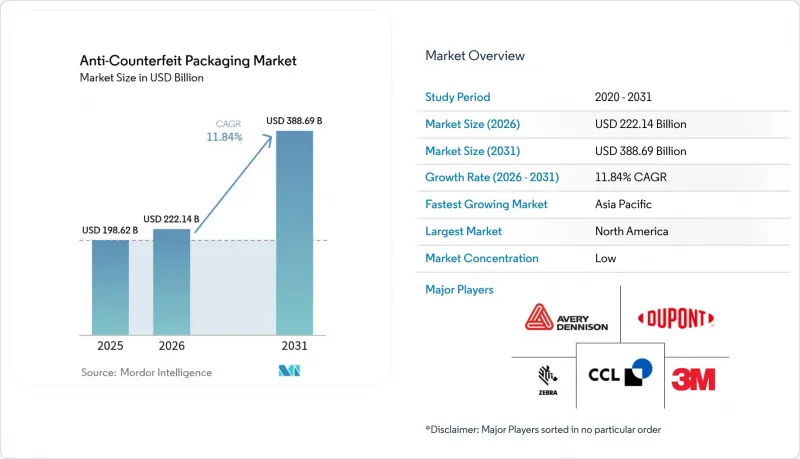
據 Mordor Intelligence 稱,防偽包裝市場預計到 2026 年價值 2,221.4 億美元,高於 2025 年的 1,986.2 億美元,預計到 2031 年將達到 3,886.9 億美元。
預計從 2026 年到 2031 年,其複合年成長率將達到 11.84%。
本報告按技術(例如,追蹤溯源)、應用(例如,序列化碼)、包裝組件(例如,標籤、安全油墨和塗層)、包裝類型(例如,吸塑包裝)、終端用戶行業(例如,食品飲料、醫療保健和製藥)以及地區進行細分。市場預測以美元價值表示。
全球防偽包裝市場趨勢及洞察
電子商務的快速發展導致序列化需求激增。
線上銷售的激增縮短了分銷鏈,並取消了實體檢驗點,迫使品牌商在每個小包裹中都加入獨立的數位識別碼。艾利丹尼森與一家美國連鎖超市合作進行的RFID前導測試表明,掃描準確率超過99%,證實了序列化資料流能夠提高存貨周轉和仿冒品。如今,雲端控制面板已整合到履約應用程式中,使零售商能夠在最後一公里配送前攔截潛在的假冒商品,從而維護消費者信心。這一趨勢正將資本投資重點從裝飾性表面處理轉向客製印刷的編碼器,提升了軟體驅動型加工商在防偽包裝市場的策略價值。
各國擴大追蹤溯源法規
繼美國於2024年底實施基於DSCSA的單元級可追溯性之後,藥品出口商已在全球各地的工廠部署了符合EPCIS標準的編碼平台,以避免重複庫存。歐盟的FMD(藥品防偽指令)引入了平行序列化和防篡改包裝的相關規定,巴西、沙烏地阿拉伯和泰國正在考慮將其作為參考模式。隨著監管的日益統一,防偽包裝市場的供應商將能夠獲得跨國服務契約,更快地攤銷研發成本,並進一步提高規模經濟效益。
將整條生產線維修為序列化生產需要大量的資金投入。
傳統的灌裝機和裝盒機通常空間有限,難以安裝視覺攝影機和瑕疵產品剔除站,迫使企業購買全新的承包線,而非僅添加附加模組。儘管 TraceLink 的無代碼 OPUS 平台簡化了資料層整合,但每條瓶裝生產線的硬體支出平均仍高達 100 萬美元。印度和越南的中小型學名藥生產商和合約包裝公司紛紛推遲升級,直到資金籌措到位,導致防偽包裝的市場佔有率不斷萎縮。
細分市場分析
到2025年,溯源解決方案將佔防偽包裝市場32.12%的佔有率,市場規模約638億美元。同時,預計到2031年,法醫標記物將以15.1%的複合年成長率實現強勁成長。序列化硬體、視覺檢測和雲端儲存構成了製藥業合規性的基礎,這是不可或缺的。隨著造假者利用人工智慧控制的印表機來模仿可見的全像圖,品牌商正在轉向使用需要實驗室級專業技術的隱形DNA墨水和法醫標記物,這進一步豐富了防偽包裝市場的解決方案。
目前,人工智慧驅動的列印工具能夠以驚人的精度複製璣鏤圖案和動態微縮文字,這削弱了僅憑視覺可驗證標記的阻礙力。麻省理工學院關於太兆赫識別標籤的研究,為將包裹與獨特的頻譜特徵關聯起來的防篡改物理指紋系統帶來了新的希望。因此,提供混合溯源和取證解決方案的供應商獲得了更高的利潤率和更長的服務合約。
至2025年,序號將佔防偽包裝市場35.95%的佔有率,成為符合《藥品供應鏈安全法案》(DSCSA)和《防偽指令》(FMD)的核心。同時,隨著智慧型手機的普及,非接觸式讀取技術日趨普及,RFID/NFC技術的複合年成長率將達到16.28%,超過其他所有功能。包裝級GS1數位連結格式現在允許將EPC條碼連結到可解析的URL,使消費者能夠在購物應用程式中檢驗產品。
全像標籤因其視覺吸引力能夠提升品牌美感,因此在酒類和高階化妝品領域仍被廣泛應用。同時,嵌入到產品影像中的數位浮水印能夠實現生產線過渡期間的無墨修改。 Digimarc 將此類浮水印整合到 C2PA 2.1 標準中,表明包裝和線上影像共用相同檢驗協議。這種融合正在拓展防偽包裝市場的訂閱收入來源。
區域分析
2025年,北美地區維持了38.64%的收入成長。這得歸功於《藥品供應鏈安全法案》(DSCSA)的全面實施,以及契約製造(CMO)緊密合作的網路,這些CMO要求提供承包編碼、檢驗和資料交換解決方案。加拿大的「塑膠協議」也鼓勵加工商在安全性和可回收性之間取得平衡,優先選擇帶有隱形水印標記的纖維基包裝,以便進行自動化分類。與美國供應鏈緊密相連的墨西哥正在加快實施醫療設備和龍舌蘭酒出口的防偽措施,以確保市場准入。
亞太地區以15.72%的複合年成長率領跑,主要得益於中國新的包裝前標籤法、印度的QR碼藥品目錄以及日本的食品接觸樹脂正面表列。廣東省和胡志明市的契約製造生產商正在試驗低成本噴墨編碼器和區塊鏈技術,以滿足跨國公司的審計要求。一家印尼軟包裝印刷商在初步投資回報率研究發現,一年內因仿冒品造成的退貨量減少了一半後,引入了奈米顏料工作站,這表明防偽包裝市場潛力遠超傳統醫藥場所。
歐洲市場依然成熟,佔據相當大的佔有率。由於《食品藥品法》(FMD)以及即將訂定的包裝和包裝廢棄物法規,永續性和安全性緊密相連。各大品牌正在探索將纖維基阻隔包裝與Digimarc水印結合,以便自動分揀機能夠穿透污垢和反射光讀取訊號。俄羅斯對PET的禁令以及歐盟對BPA的禁令正在推動樹脂技術的變革,促使試驗新型安全印刷技術。中東和非洲地區仍在發展中,但海灣國家的高階汽車零件供應商正在投資建造2D條碼庫,以增強全球買家的信心。一旦區域關稅同盟建立通用的編碼方法,防偽包裝市場有望迎來更大的成長。
其他好處:
- Excel格式的市場預測(ME)表
- 3個月的分析師支持
目錄
第1章:引言
- 研究假設和市場定義
- 調查範圍
第2章:調查方法
第3章執行摘要
第4章 市場狀況
- 市場概覽
- 市場促進因素
- 電子商務的快速發展正在推動序列化需求的成長。
- 各國擴大強制性追蹤和監控範圍
- 推廣廣泛使用QR碼/NFC功能的“互聯包裝”,以促進品牌互動
- 奈米顏料安全油墨可實現低成本的真偽驗證。
- 一項利用區塊鏈技術進行溯源追蹤的試點計畫正在走向成熟,並朝著全面部署的方向發展。
- 整合到消費者應用程式中的人工智慧圖像識別功能
- 市場限制因素
- 維修整個產品線以支援序列化,需要大量的資金投入。
- 全球編碼標準之間的互通性差距
- Cloud T&T在資料隱私和網路安全方面的法律責任
- 造假者迅速引入生成式印刷技術
- 供應鏈分析
- 監理情勢
- 技術展望
- 波特五力分析
第5章 市場規模與成長預測
- 透過技術
- Trace and Track
- 防篡改
- Covert
- Overt
- 法醫標記
- 依使用特性
- 序列化程式碼
- RFID/NFC標籤
- 全像貼紙
- 數位浮水印
- 按組件包裝
- 標籤和吊牌
- 安全油墨和塗料
- 薄膜袋
- 全像圖
- 其他包裝組件
- 按包裝類型
- 吸塑包裝
- 瓶子
- 紙盒
- 軟包裝
- 其他包裝形式
- 按最終用戶行業分類
- 食品/飲料
- 醫療和藥品
- 工業和汽車
- 家用電子產品
- 其他終端用戶產業
- 按地區
- 北美洲
- 美國
- 加拿大
- 墨西哥
- 歐洲
- 德國
- 英國
- 法國
- 義大利
- 西班牙
- 俄羅斯
- 其他歐洲國家
- 亞太地區
- 中國
- 印度
- 日本
- 韓國
- 澳洲和紐西蘭
- 其他亞太國家
- 中東和非洲
- 中東
- 阿拉伯聯合大公國
- 沙烏地阿拉伯
- 土耳其
- 其他中東國家
- 非洲
- 南非
- 奈及利亞
- 埃及
- 其他非洲國家
- 中東
- 南美洲
- 巴西
- 阿根廷
- 其他南美國家
- 北美洲
第6章 競爭情勢
- 市場集中度
- 策略趨勢
- 市佔率分析
- 公司簡介
- Avery Dennison Corporation
- CCL Industries Inc.
- 3M Company
- DuPont de Nemours Inc.
- Zebra Technologies Corporation
- SICPA Holding SA
- AlpVision SA
- Applied DNA Sciences Inc.
- Uflex Limited
- Authentix Inc.
- Ampacet Corporation
- PharmaSecure Inc.
- Sun Chemical Corporation
- Alien Technology LLC
- Honeywell International Inc.
- TraceLink Inc.
- OPTEL Group
- Prooftag SAS
- Giesecke+Devrient GmbH
- SATO Holdings Corp.
第7章 市場機會與未來展望
According to Mordor Intelligence, anti-Counterfeit packaging market size in 2026 is estimated at USD 222.14 billion, growing from 2025 value of USD 198.62 billion with 2031 projections showing USD 388.69 billion, growing at 11.84% CAGR over 2026-2031.
This report is Segmented by Technology (Trace and Track, and More), Usage Feature (Serialization Codes, and More), Packaging Component (Labels and Tags, Security Inks and Coatings, and More), Packaging Format (Blister Packs, and More), End-User Industry (Food and Beverage, Healthcare and Pharmaceuticals, and More), and Geography. The Market Forecasts are Provided in Terms of Value (USD).
Global Anti-Counterfeit Packaging Market Trends and Insights
Rapid e-commerce-driven serialization demand
Surging online sales shorten distribution chains and remove physical inspection points, forcing brands to embed unit-level digital identifiers that travel with every parcel. RFID pilots between Avery Dennison and US grocery chains show scan rates above 99% accuracy, confirming that serialized data flow improves both inventory turns and counterfeit detection. Cloud dashboards now fit into fulfilment apps, so retailers block suspected fakes before last-mile dispatch, preserving shopper trust. The trend shifts cap-ex priority toward print-on-demand coders and away from decorative embellishments, raising the strategic value of software-ready converters in the Anti-Counterfeit Packaging market.
Proliferation of national track-and-trace mandates
After the United States enforced DSCSA unit-level traceability in late-2024, pharmaceutical exporters equipped plants worldwide with EPCIS-ready coding platforms to avoid dual inventories. The European Union's FMD introduced parallel serialization and tamper-evident rules, prompting a template that Brazil, Saudi Arabia, and Thailand study for rollout. When regulations converge, vendors in the Anti-Counterfeit Packaging market win multi-country service contracts and amortize R&D faster, reinforcing scale advantages.
High capex for full-line serialization retro-fits
Legacy fillers and cartoners often lack space for vision cameras and reject stations, so firms must buy new turnkey lines rather than bolt-on modules. Although TraceLink's no-code OPUS platform eases integration of data layers, hardware outlays still average USD 1 million per bottle line. Small generics players and contract packers in India and Vietnam defer upgrades, shrinking their accessible share of the Anti-Counterfeit Packaging market until financing improves.
Other drivers and restraints analyzed in the detailed report include:
- Expansion of QR/NFC-enabled connected packaging
- Nano-pigment security inks enabling low-cost authentication
- Inter-operability gaps between global coding standards
For complete list of drivers and restraints, kindly check the Table Of Contents.
Segment Analysis
In 2025, Trace and Track solutions captured 32.12% of the Anti-Counterfeit Packaging market, equal to an Anti-Counterfeit Packaging market size of roughly USD 63.8 billion, while Forensic Markers are projected to post a brisk 15.1% CAGR to 2031. Serialization hardware, vision inspection, and cloud vaults form a compliance backbone that pharmaceutical lines cannot sidestep. As counterfeiters mimic overt holograms with AI-guided presses, brands pivot to covert DNA inks and forensic taggants that require lab-grade readers, pushing solution diversity within the Anti-Counterfeit Packaging market.
Generative-AI printing tools now replicate guilloche patterns and kinetic micro-text with startling fidelity, cutting the deterrent value of purely visible marks. Research at MIT on terahertz-wave ID tags opens hope for tamper-proof physical-fingerprint systems that link packages to a unique spectral signature. Vendors selling hybrid traceability plus forensic stacks, therefore, command higher margins and lengthier service contracts.
Serialization Codes owned 35.95% of Anti-Counterfeit Packaging market share in 2025, supplying the backbone for DSCSA and FMD compliance; RFID/NFC, at a 16.28% CAGR, outpaces all other features as smartphone adoption universalizes contactless reading. Pack-level GS1 Digital Link formats now bind EPC codes to web-resolvable URLs, so consumers verify goods inside shopping apps.
Holographic seals still appear on spirits and luxury cosmetics because visual flair complements brand aesthetics. Yet digital watermarks, embedded invisibly in artwork, allow zero-ink alterations during line changeovers. Digimarc's integration of such marks into the C2PA 2.1 standard shows how packaging and online imagery share one verification protocol. This convergence increases subscription revenue pools inside the Anti-Counterfeit Packaging market.
Complete Report Scope:
- By Technology
- Trace and Track
- Tamper-Evident
- Covert
- Overt
- Forensic Markers
- By Usage Feature
- Serialization Codes
- RFID / NFC Tags
- Holographic Seals
- Digital Watermarks
- By Packaging Component
- Labels and Tags
- Security Inks and Coatings
- Films and Pouches
- Holograms
- Other Packaging Component
- By Packaging Format
- Blister Packs
- Bottles
- Cartons
- Flexible Packs
- Other Packaging Format
- By End-User Industry
- Food and Beverage
- Healthcare and Pharmaceuticals
- Industrial and Automotive
- Consumer Electronics
- Other End-User Industry
- By Geography
- North America
- United States
- Canada
- Mexico
- Europe
- Germany
- United Kingdom
- France
- Italy
- Spain
- Russia
- Rest of Europe
- Asia-Pacific
- China
- India
- Japan
- South Korea
- Australia and New Zealand
- Rest of Asia-Pacific
- Middle East and Africa
- Middle East
- United Arab Emirates
- Saudi Arabia
- Turkey
- Rest of Middle East
- Africa
- South Africa
- Nigeria
- Egypt
- Rest of Africa
- Middle East
- South America
- Brazil
- Argentina
- Rest of South America
- North America
Geography Analysis
North America retained 38.64% revenue in 2025, buoyed by full DSCSA enforcement and a dense network of CMOs that need turnkey coding, inspection, and data-exchange stacks. Canada's Plastics Pact also nudges converters to blend security and recyclability, favoring fiber-based packs that carry invisible watermark tracers enabling automated sortation. Mexico, intertwined with US supply chains, ramps anti-counterfeit adoption in medical devices and tequila exports to safeguard market access.
Asia-Pacific registers the swiftest 15.72% CAGR, driven by China's new pre-packaged labeling law, India's QR-code drug lists, and Japan's Positive List for food-contact resins. Contract manufacturers across Guangdong and Ho Chi Minh City deploy low-cost inkjet coders and blockchain pilots to satisfy multinational audits. Flexible-pack printers in Indonesia install nano-pigment stations after early ROI studies show counterfeit returns fall by half within one year, proving the Anti-Counterfeit Packaging market's potential beyond legacy pharma hubs.
Europe holds a mature but sizable share, with FMD and the upcoming Packaging and Packaging Waste Regulation intertwining sustainability and security. Brands explore fibre-based barrier packs paired with Digimarc watermarks so automated sorters read signals through dirt and glare. Russia's PET bans and the EU's BPA prohibition push resin switchovers, which in turn invite fresh security print trials. The Middle East and Africa remain nascent, yet luxury auto-parts suppliers in the Gulf invest in 2D code vaults to reassure global buyers, hinting at a wider Anti-Counterfeit Packaging market take-off once regional customs unions finalize common coding laws.
- Avery Dennison Corporation
- CCL Industries Inc.
- 3M Company
- DuPont de Nemours Inc.
- Zebra Technologies Corporation
- SICPA Holding SA
- AlpVision SA
- Applied DNA Sciences Inc.
- Uflex Limited
- Authentix Inc.
- Ampacet Corporation
- PharmaSecure Inc.
- Sun Chemical Corporation
- Alien Technology LLC
- Honeywell International Inc.
- TraceLink Inc.
- OPTEL Group
- Prooftag SAS
- Giesecke + Devrient GmbH
- SATO Holdings Corp.
Additional Benefits:
- The market estimate (ME) sheet in Excel format
- 3 months of analyst support
TABLE OF CONTENTS
1 INTRODUCTION
- 1.1 Study Assumptions and Market Definition
- 1.2 Scope of the Study
2 RESEARCH METHODOLOGY
3 EXECUTIVE SUMMARY
4 MARKET LANDSCAPE
- 4.1 Market Overview
- 4.2 Market Drivers
- 4.2.1 Rapid e-commerce-driven serialization demand
- 4.2.2 Proliferation of national track-and-trace mandates
- 4.2.3 Expansion of QR / NFC-enabled "connected packaging" for brand engagement
- 4.2.4 Nano-pigment security inks enabling low-cost authentication
- 4.2.5 Blockchain-based provenance pilots maturing into roll-outs
- 4.2.6 AI image-forensics integrated into consumer apps
- 4.3 Market Restraints
- 4.3.1 High capex for full-line serialization retro-fits
- 4.3.2 Inter-operability gaps between global coding standards
- 4.3.3 Data-privacy and cybersecurity liabilities in cloud TandT
- 4.3.4 Counterfeiters' rapid adoption of generative printing
- 4.4 Supply-Chain Analysis
- 4.5 Regulatory Landscape
- 4.6 Technological Outlook
- 4.7 Porter's Five Forces Analysis
- 4.7.1 Bargaining Power of Suppliers
- 4.7.2 Bargaining Power of Buyers
- 4.7.3 Threat of New Entrants
- 4.7.4 Threat of Substitute Products
- 4.7.5 Intensity of Competitive Rivalry
5 MARKET SIZE AND GROWTH FORECASTS (VALUE)
- 5.1 By Technology
- 5.1.1 Trace and Track
- 5.1.2 Tamper-Evident
- 5.1.3 Covert
- 5.1.4 Overt
- 5.1.5 Forensic Markers
- 5.2 By Usage Feature
- 5.2.1 Serialization Codes
- 5.2.2 RFID / NFC Tags
- 5.2.3 Holographic Seals
- 5.2.4 Digital Watermarks
- 5.3 By Packaging Component
- 5.3.1 Labels and Tags
- 5.3.2 Security Inks and Coatings
- 5.3.3 Films and Pouches
- 5.3.4 Holograms
- 5.3.5 Other Packaging Component
- 5.4 By Packaging Format
- 5.4.1 Blister Packs
- 5.4.2 Bottles
- 5.4.3 Cartons
- 5.4.4 Flexible Packs
- 5.4.5 Other Packaging Format
- 5.5 By End-User Industry
- 5.5.1 Food and Beverage
- 5.5.2 Healthcare and Pharmaceuticals
- 5.5.3 Industrial and Automotive
- 5.5.4 Consumer Electronics
- 5.5.5 Other End-User Industry
- 5.6 By Geography
- 5.6.1 North America
- 5.6.1.1 United States
- 5.6.1.2 Canada
- 5.6.1.3 Mexico
- 5.6.2 Europe
- 5.6.2.1 Germany
- 5.6.2.2 United Kingdom
- 5.6.2.3 France
- 5.6.2.4 Italy
- 5.6.2.5 Spain
- 5.6.2.6 Russia
- 5.6.2.7 Rest of Europe
- 5.6.3 Asia-Pacific
- 5.6.3.1 China
- 5.6.3.2 India
- 5.6.3.3 Japan
- 5.6.3.4 South Korea
- 5.6.3.5 Australia and New Zealand
- 5.6.3.6 Rest of Asia-Pacific
- 5.6.4 Middle East and Africa
- 5.6.4.1 Middle East
- 5.6.4.1.1 United Arab Emirates
- 5.6.4.1.2 Saudi Arabia
- 5.6.4.1.3 Turkey
- 5.6.4.1.4 Rest of Middle East
- 5.6.4.2 Africa
- 5.6.4.2.1 South Africa
- 5.6.4.2.2 Nigeria
- 5.6.4.2.3 Egypt
- 5.6.4.2.4 Rest of Africa
- 5.6.4.1 Middle East
- 5.6.5 South America
- 5.6.5.1 Brazil
- 5.6.5.2 Argentina
- 5.6.5.3 Rest of South America
- 5.6.1 North America
6 COMPETITIVE LANDSCAPE
- 6.1 Market Concentration
- 6.2 Strategic Moves
- 6.3 Market Share Analysis
- 6.4 Company Profiles (includes Global level Overview, Market level overview, Core Segments, Financials as available, Strategic Information, Market Rank/Share for key companies, Products and Services, and Recent Developments)
- 6.4.1 Avery Dennison Corporation
- 6.4.2 CCL Industries Inc.
- 6.4.3 3M Company
- 6.4.4 DuPont de Nemours Inc.
- 6.4.5 Zebra Technologies Corporation
- 6.4.6 SICPA Holding SA
- 6.4.7 AlpVision SA
- 6.4.8 Applied DNA Sciences Inc.
- 6.4.9 Uflex Limited
- 6.4.10 Authentix Inc.
- 6.4.11 Ampacet Corporation
- 6.4.12 PharmaSecure Inc.
- 6.4.13 Sun Chemical Corporation
- 6.4.14 Alien Technology LLC
- 6.4.15 Honeywell International Inc.
- 6.4.16 TraceLink Inc.
- 6.4.17 OPTEL Group
- 6.4.18 Prooftag SAS
- 6.4.19 Giesecke + Devrient GmbH
- 6.4.20 SATO Holdings Corp.
7 MARKET OPPORTUNITIES AND FUTURE OUTLOOK
- 7.1 White-space and Unmet-Need Assessment

 區塊鏈賦能套件市場規模、佔有率和趨勢分析報告:按包裝層、解決方案類型、識別技術、最終用途、地區和細分市場預測(2026-2033 年)
 化妝品防偽包裝市場預測至2034年—按技術、包裝類型、材料、分銷管道、應用和地區分類的全球分析
 藥品和化妝品防偽包裝市場:安全架構、技術、材料、包裝形式、應用和最終用途-2026-2032年全球市場預測防偽包裝市場:按類型、包裝材料、印刷技術、終端用戶產業和分銷管道分類-2026-2032年全球市場預測浮水印包裝市場預測-全球分析(按組件、包裝形式、技術、材料、應用、最終用戶和地區分類)——2034年
 醫藥和化妝品防偽包裝市場規模、佔有率和成長分析:按技術、包裝類型、應用、材料、最終用戶、分銷管道和地區分類-2026-2033年產業預測
 全球防偽包裝市場:依技術、終端用戶產業及地區分類-預測至2031年防篡改包裝市場預測至2034年—按產品類型、材料、技術、應用、最終用戶和地區分類的全球分析全球防拆封包裝市場預測(至2034年):按類型、材料、包裝形式、最終用戶和地區分類
 全球防篡改包裝市場分析:市場規模、佔有率、應用與預測(2018-2034 年)