


 |
市場調查報告書
商品編碼
2120675
環氧乙烷:市場佔有率分析、產業趨勢與統計、成長預測(2026-2031)Ethylene Oxide - Market Share Analysis, Industry Trends & Statistics, Growth Forecasts (2026 - 2031) |
||||||

※ 本網頁內容可能與最新版本有所差異。詳細情況請與我們聯繫。
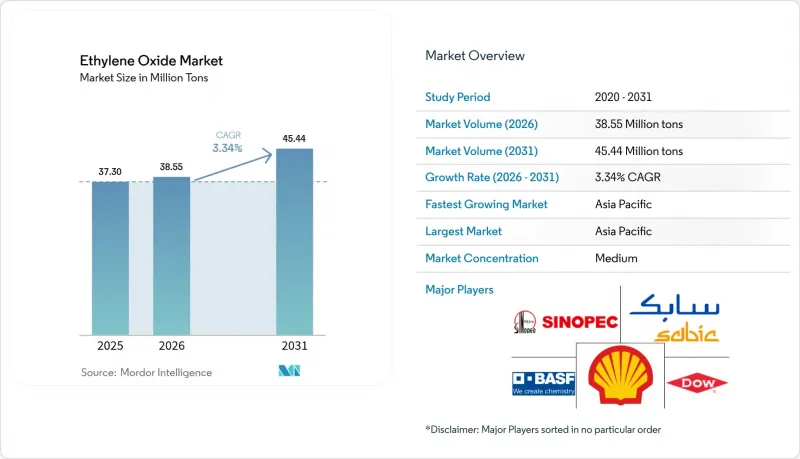
根據 Mordor Intelligence 預測,環氧乙烷市場將從 2025 年的 3,730 萬噸成長到 2026 年的 3,855 萬噸,然後在 2031 年達到 4,544 萬噸,2026 年至 2031 年的複合年成長率為 3.34%。
本報告按衍生產品(乙二醇、乙氧基化物、乙醇胺等)、應用(聚酯纖維、PET樹脂、界面活性劑、清潔劑等)、終端用戶行業(汽車、農業化學品、食品和飲料等)、原料(石油衍生乙烯和生物乙烯)以及地區(亞太地區、北美、歐洲、南美、中東和非洲)進行分類。
全球環氧乙烷市場趨勢及洞察
PET在食品和飲料行業的應用日益廣泛
隨著品牌商在維持產品品質的前提下,更傾向於選擇輕巧、可回收的解決方案,PET包裝的普及速度正在加快。乙二醇(由環氧乙烷衍生而來)約佔PET聚合反應中乙二醇總量的90%,直接推動了上游需求。領先的塑膠製造商正在支援化學回收平台,解聚合成單體,產率超過90%,從而建造循環供應鏈,並穩定環氧乙烷的供應。像陶氏化學這樣的公司正在製定相關計劃,力爭2030年每年供應數百萬噸循環和可再生塑膠。即使產品結構正向再生塑膠轉變,這些努力也正在增強PET的長期需求前景。
對家用和個人保健產品的需求增加
含有乙氧基化物和乙醇胺的界面活性劑和清潔劑具有卓越的清潔性能,尤其是在硬水地區。在消費者對環保成分偏好的推動下,像Nurion這樣的製造商正在尋求ISCC PLUS認證體系下環保環氧乙烷衍生物的認證。從烷基酚轉向Fatty alcohol ethoxylated,既能保持清潔性能,又能符合即將推出的生物分解法規。隨著自有品牌洗滌劑在零售商店貨架上的佔有率不斷擴大,歐洲和北美地區產能的提升正是為了滿足這一日益成長的需求。
高濃度暴露對健康與環境的影響
環氧乙烷被列為致癌性,為此,美國環保署 (EPA) 於 2025 年 1 月做出臨時決定,將工人接觸環氧乙烷的限值從 2028 年的 0.5 ppm 降低至 2035 年的 0.1 ppm。遵守這項規定需要昂貴的工程措施、個人監測以及升級改造方面的資本投入。一些醫療設備製造商正在加快替代滅菌方法的認證,例如伽馬射線輻照、過氧化氫蒸氣和二氧化氮滅菌。雖然這些替代方案會在某些領域降低對環氧乙烷的需求,但對於具有複雜管腔的熱敏醫療設備而言,環氧乙烷仍然至關重要。
細分市場分析
到2025年,乙二醇將成為環氧乙烷市場的基礎,佔75.02%的市場佔有率,這主要得益於亞太地區聚酯纖維和PET樹脂產量的擴張。由於上游供應中斷,價格波動再次出現,迫使亞洲買家與一體化生產商簽訂長期合約。同時,隨著品牌商尋求低碳包裝方案,生物基乙二醇的先導計畫正在加速。
儘管乙醇胺的產量相對較低,但預計到2031年,其複合年成長率將達到3.55%,成為成長最快的行業之一,這主要得益於農藥、氣體處理和個人護理行業的需求成長。BASF安特衛普工廠瓶頸的消除,使全球烷基乙醇胺的產能提高了約30%,達到每年14萬噸以上,凸顯了該細分市場的戰略價值。拉丁美洲和亞洲Glyphosate除草劑銷售量的成長持續推動對單乙醇胺的需求,而三乙醇胺則在二氧化碳回收溶劑領域找到了新的發展機會。下游產業的多元化發展使得這類衍生物不易受單一產業波動的影響。
到2025年,PET樹脂和聚酯纖維將佔環氧乙烷需求的27.86%。隨著飲料生產商從玻璃瓶和金屬瓶轉向輕質寶特瓶,PET相關的環氧乙烷市場預計將穩定成長。諸如使用碳酸二甲酯進行甲醇分解等創新解聚工藝,使得對苯二甲酸二甲酯的產率超過90%,從而獲得高純度的再生PET。在整個預測期內,已開發地區對原生材料的需求預計將保持溫和,而快速成長的經濟體(其回收基礎設施仍在發展中)的需求預計將會成長。
滅菌和燻蒸是成長最快的應用領域,複合年成長率達3.67%。約有5萬種醫療設備依賴環氧乙烷滅菌,這種滅菌方式有助於保護那些無法承受伽瑪射線或電子束輻照的熱不穩定聚合物。儘管排放法規日益嚴格,但市場需求依然旺盛,因為其他滅菌方法往往無法穿透複雜的包裝或達到所需的滅菌效果。對催化氧化系統和連續排放氣體監測的投資,確保了合規運營,從而維持了這一細分市場的成長。
區域分析
預計到2025年,亞太地區仍將是環氧乙烷市場最大的參與者,供應全球50.72%的需求,並將在2031年之前以3.68%的複合年成長率成長,為該地區最高。中國在提升產能方面處於領先地位,BASF湛江一體化生產基地計畫於2025年運作。在印度,由於政府製造業獎勵措施和國內聚酯纖維產量的擴大,產量也不斷增加。儘管各地區政府都在收緊環境法規,但配備先進減排技術的一體化生產基地仍保持競爭力。
得益於頁岩氣乙烷的經濟優勢,北美擁有全球最低的乙烯現金成本之一。醫療設備滅菌需求的成長正在推動國內消費,而英力士(INEOS)於2024年收購利安德巴塞爾(LyondellBasell)的Bayport部門,進一步鞏固了其在這個全球最大單一市場的供應鏈。遵守美國環保署(EPA)的排放法規正在加速催化洗滌器和即時監測的投資,並建立全球技術標準。
歐洲正面臨能源價格飆升和更嚴格的二氧化碳排放目標,預計在2023年至2024年間,該地區將關閉1,100萬噸化學品產能。諸如科萊恩和OMV於2024年簽署的低碳乙烯和環氧乙烷衍生物供應協議等合作,旨在保護市場佔有率免受進口衝擊。東歐憑藉著管道天然氣供應和成熟的下游聚酯資產,保持著一定的競爭優勢。
在中東,生產商正利用有利的原料資源來建造一體化生產基地,其中沙烏地阿拉伯的生產商瞄準的是亞洲出口市場。在非洲,本地生產能力有限,但清潔劑和殺蟲劑的進口量仍然強勁。在南美洲,巴西正在建造一個生物乙烯項目,預計該地區將在未來十年內成為低碳衍生品的潛在淨出口地區。
其他好處:
- Excel格式的市場預測(ME)表
- 3個月的分析師支持
目錄
第1章:引言
- 研究假設和市場定義
- 調查範圍
第2章:調查方法
第3章執行摘要
第4章 市場狀況
- 市場概覽
- 市場促進因素
- PET在食品和飲料行業的應用日益廣泛
- 對家用和個人保健產品的需求增加
- 在醫療設備消毒中應用日益廣泛
- 紡織服裝產業需求不斷成長
- 在農業領域的應用擴展
- 市場限制因素
- 高濃度暴露對健康與環境的影響
- 乙烯原料價格波動
- 高昂的生產成本
- 價值鏈分析
- 波特五力模型
第5章 市場規模與成長預測
- 導數
- 乙二醇
- 單乙二醇(MEG)
- 二伸乙甘醇(DEG)
- 三甘醇(TEG)
- 乙氧基化物
- 乙醇胺
- 乙二醇醚
- 聚乙二醇
- 其他衍生性商品
- 乙二醇
- 透過使用
- 聚酯纖維和PET樹脂
- 界面活性劑和清潔劑
- 消毒和燻蒸
- 冷卻液和防凍液
- 藥用輔料
- 其他用途
- 按最終用戶行業分類
- 車
- 農業化學品
- 食品/飲料
- 紡織品
- 個人護理
- 製藥
- 清潔劑
- 其他終端用戶產業
- 按原料
- 石油衍生乙烯
- 生物乙烯
- 按地區
- 亞太地區
- 中國
- 印度
- 日本
- 韓國
- 其他亞太國家
- 北美洲
- 美國
- 加拿大
- 墨西哥
- 歐洲
- 德國
- 英國
- 法國
- 義大利
- 其他歐洲國家
- 南美洲
- 巴西
- 阿根廷
- 其他南美國家
- 中東和非洲
- 沙烏地阿拉伯
- 南非
- 其他中東和非洲國家
- 亞太地區
第6章 競爭情勢
- 市場集中度
- 策略趨勢
- 市佔率和排名分析
- 公司簡介
- BASF SE
- China Petrochemical Corporation
- Clariant
- Dow
- Huntsman International LLC
- India Glycols Limited
- Indorama Ventures Public Company Limited
- INEOS
- LOTTE Chemical Corporation
- NIPPON SHOKUBAI CO., LTD.
- Nouryon
- PETRONAS Chemicals Group Berhad
- Reliance Industries Limited
- SABIC
- Sasol Limited
- Shell plc
第7章 市場機會與未來展望
According to Mordor Intelligence, the ethylene oxide market size is expected to grow from 37.30 Million tons in 2025 to 38.55 Million tons in 2026 and is forecast to reach 45.44 Million tons by 2031 at 3.34% CAGR over 2026-2031.
This report is Segmented by Derivative (Ethylene Glycols, Ethoxylates, Ethanolamines, and More), Application (Polyester Fiber and PET Resins, Surfactants and Detergents, and More), End-User Industry (Automotive, Agrochemicals, Food and Beverage, and More), Feedstock (Petro-Based Ethylene and Bio-Ethylene), and Geography (Asia-Pacific, North America, Europe, South America, and Middle East and Africa).
Global Ethylene Oxide Market Trends and Insights
Growing Usage of PET in the Food and Beverage Industry
PET packaging adoption is accelerating because brand owners favor lightweight, recyclable solutions that preserve product integrity. Monoethylene glycol derived from ethylene oxide constitutes nearly 90% of the ethylene glycol pool used for PET polymerization, causing direct pull-through on upstream demand. Large resin producers are backing chemical-recycling platforms that depolymerize post-consumer PET into monomers with yields above 90%, enabling circular supply chains while keeping ethylene oxide volumes steady. Companies such as Dow have earmarked multi-million-metric-ton programs to deliver circular and renewable plastics annually by 2030. These initiatives strengthen long-term demand visibility even as the product mix shifts toward recycled grades.
Increasing Demand for Household and Personal Care Products
Surfactants and detergents formulated with ethoxylates and ethanolamines deliver superior cleaning efficiency, especially in hard-water regions. Consumer preference for eco-friendly ingredients is prompting producers such as Nouryon to certify green ethylene oxide derivatives under the ISCC PLUS scheme. Switching from alkylphenol to fatty-alcohol ethoxylates aligns with forthcoming biodegradability regulations while sustaining performance. Capacity additions in Europe and North America are timed to capture this demand uptick as private-label cleaning brands gain retail shelf space.
Health and Environmental Effects over High Exposure
Ethylene oxide is classified as carcinogenic, prompting the EPA's January 2025 interim decision that cuts worker exposure limits from 0.5 ppm by 2028 down to 0.1 ppm by 2035. Compliance demands costly engineering controls, personal monitoring, and capital upgrades. Some healthcare device makers are accelerating the qualification of alternative sterilization methods, including gamma radiation, vaporized hydrogen peroxide, and nitrogen dioxide. While these substitutes will erode specific volumes, ethylene oxide remains indispensable for heat-sensitive devices with intricate lumens.
Other drivers and restraints analyzed in the detailed report include:
- Increasing Utilization in Medical Device Sterilization
- Growing Demand from Textile and Apparel Industry
- Volatility of Ethylene Feedstock Prices
For complete list of drivers and restraints, kindly check the Table Of Contents.
Segment Analysis
Ethylene glycols formed the bedrock of the ethylene oxide market in 2025, capturing 75.02% share as polyester fiber and PET resin output scaled in Asia-Pacific. Price volatility has returned following upstream supply disruptions, pushing Asia-based buyers to secure long-term contracts with integrated producers. In parallel, bio-MEG pilots are gaining traction as brand owners seek lower-carbon packaging options.
Ethanolamines contribute a smaller volume but post the highest 3.55% CAGR to 2031, driven by agrochemicals, gas treatment, and personal-care demand. BASF's Antwerp debottlenecking raised global alkyl ethanolamine capacity by nearly 30% to more than 140,000 t per year, underscoring the segment's strategic value. Rising glyphosate herbicide volumes in Latin America and Asia sustain monoethanolamine pull-through, while triethanolamine sees new opportunities in CO2 capture solvents. Strong downstream diversification shields this derivative class from single-industry cyclicality.
PET resins and polyester fibers absorbed 27.86% of ethylene oxide demand in 2025. The ethylene oxide market size linked to PET is expected to grow steadily as beverage companies transition from glass and metal to lightweight PET bottles. Innovative depolymerization pathways such as dimethyl-carbonate-aided methanolysis enable greater than 90% dimethyl terephthalate yields, opening high-purity recycled PET streams. Over the forecast horizon, virgin demand moderates in developed regions yet expands in fast-growing economies where recycling infrastructure remains nascent.
Sterilization and fumigation ranked as the fastest-growing application at 3.67% CAGR. Approximately 50,000 distinct medical devices rely on ethylene oxide sterilization, preserving thermolabile polymers that cannot withstand gamma or electron-beam radiation. Even with stringent emissions limits, demand persists because alternative modalities often fail to penetrate complex packaging or achieve required sterility assurance levels. Investment in catalytic oxidation units and continuous emissions monitoring allows compliant operations, sustaining growth in this niche.
Complete Report Scope:
- By Derivative
- Ethylene Glycols
- Monoethylene Glycol (MEG)
- Diethylene Glycol (DEG)
- Triethylene Glycol (TEG)
- Ethoxylates
- Ethanolamines
- Glycol Ethers
- Polyethylene Glycol
- Other Derivatives
- Ethylene Glycols
- By Application
- Polyester Fiber and PET Resins
- Surfactants and Detergents
- Sterilization and Fumigation
- Coolant and Antifreeze
- Pharmaceuticals Excipients
- Other Applications
- By End-user Industry
- Automotive
- Agrochemicals
- Food and Beverage
- Textile
- Personal Care
- Pharmaceuticals
- Detergents
- Others End user Industries
- By Feedstock
- Petro-based Ethylene
- Bio-ethylene
- By Geography
- Asia-Pacific
- China
- India
- Japan
- South Korea
- Rest of Asia-Pacific
- North America
- United States
- Canada
- Mexico
- Europe
- Germany
- United Kingdom
- France
- Italy
- Rest of Europe
- South America
- Brazil
- Argentina
- Rest of South America
- Middle East and Africa
- Saudi Arabia
- South Africa
- Rest of Middle East and Africa
- Asia-Pacific
Geography Analysis
Asia-Pacific remained the largest ethylene oxide market in 2025, supplying 50.72% of global demand and expanding at a region-leading 3.68% CAGR to 2031. China anchors capacity additions with BASF's Zhanjiang Verbund complex slated for start-up in 2025. India's production grows alongside local polyester fiber expansion, supported by government manufacturing incentives. Regional governments tighten environmental norms, but integrated complexes with advanced abatement maintain competitiveness.
North America benefits from shale-based ethane economics that yield some of the world's lowest ethylene cash costs. Medical device sterilization concentration elevates domestic consumption, and INEOS's 2024 acquisition of LyondellBasell's Bayport unit consolidates supply in the largest single market. Compliance with EPA emission rules accelerates investment in catalytic scrubbers and real-time monitoring, setting a global technology benchmark.
Europe confronts high energy prices and more stringent CO2 targets, prompting 11 million tons of regional chemical capacity closures during 2023-2024. Collaborations such as the 2024 Clariant-OMV agreement to supply lower-carbon ethylene and ethylene oxide derivatives aim to defend market share against imports. Eastern Europe retains selective competitiveness through access to pipeline gas and established downstream polyester assets.
The Middle East leverages advantaged feedstock at integrated complexes, with Saudi-based producers targeting export markets in Asia. Africa sees limited local production but steady imports for detergent and agrochemical formulations. South America advances bio-ethylene projects in Brazil, positioning the subcontinent as a potential net exporter of low-carbon derivatives over the next decade.
- BASF SE
- China Petrochemical Corporation
- Clariant
- Dow
- Huntsman International LLC
- India Glycols Limited
- Indorama Ventures Public Company Limited
- INEOS
- LOTTE Chemical Corporation
- NIPPON SHOKUBAI CO., LTD.
- Nouryon
- PETRONAS Chemicals Group Berhad
- Reliance Industries Limited
- SABIC
- Sasol Limited
- Shell plc
Additional Benefits:
- The market estimate (ME) sheet in Excel format
- 3 months of analyst support
TABLE OF CONTENTS
1 Introduction
- 1.1 Study Assumptions and Market Definition
- 1.2 Scope of the Study
2 Research Methodology
3 Executive Summary
4 Market Landscape
- 4.1 Market Overview
- 4.2 Market Drivers
- 4.2.1 Growing Usage of PET in the Food and Beverage Industry
- 4.2.2 Increasing Demand for Household and Personal Care Products
- 4.2.3 Increasing Utilziation in Medical Device Sterilization
- 4.2.4 Growing Demand from Textile and Apparel Industry
- 4.2.5 Increasing Utilization from the Agriculture Sector
- 4.3 Market Restraints
- 4.3.1 Health and Environmental Effects over High Exposure
- 4.3.2 Volatility of Ethylene Feedstock Prices
- 4.3.3 High Production Cost
- 4.4 Value Chain Analysis
- 4.5 Porter's Five Forces
- 4.5.1 Bargaining Power of Suppliers
- 4.5.2 Bargaining Power of Buyers
- 4.5.3 Threat of New Entrants
- 4.5.4 Threat of Substitutes
- 4.5.5 Degree of Competition
5 Market Size and Growth Forecasts (Volume)
- 5.1 By Derivative
- 5.1.1 Ethylene Glycols
- 5.1.1.1 Monoethylene Glycol (MEG)
- 5.1.1.2 Diethylene Glycol (DEG)
- 5.1.1.3 Triethylene Glycol (TEG)
- 5.1.2 Ethoxylates
- 5.1.3 Ethanolamines
- 5.1.4 Glycol Ethers
- 5.1.5 Polyethylene Glycol
- 5.1.6 Other Derivatives
- 5.1.1 Ethylene Glycols
- 5.2 By Application
- 5.2.1 Polyester Fiber and PET Resins
- 5.2.2 Surfactants and Detergents
- 5.2.3 Sterilization and Fumigation
- 5.2.4 Coolant and Antifreeze
- 5.2.5 Pharmaceuticals Excipients
- 5.2.6 Other Applications
- 5.3 By End-user Industry
- 5.3.1 Automotive
- 5.3.2 Agrochemicals
- 5.3.3 Food and Beverage
- 5.3.4 Textile
- 5.3.5 Personal Care
- 5.3.6 Pharmaceuticals
- 5.3.7 Detergents
- 5.3.8 Others End user Industries
- 5.4 By Feedstock
- 5.4.1 Petro-based Ethylene
- 5.4.2 Bio-ethylene
- 5.5 By Geography
- 5.5.1 Asia-Pacific
- 5.5.1.1 China
- 5.5.1.2 India
- 5.5.1.3 Japan
- 5.5.1.4 South Korea
- 5.5.1.5 Rest of Asia-Pacific
- 5.5.2 North America
- 5.5.2.1 United States
- 5.5.2.2 Canada
- 5.5.2.3 Mexico
- 5.5.3 Europe
- 5.5.3.1 Germany
- 5.5.3.2 United Kingdom
- 5.5.3.3 France
- 5.5.3.4 Italy
- 5.5.3.5 Rest of Europe
- 5.5.4 South America
- 5.5.4.1 Brazil
- 5.5.4.2 Argentina
- 5.5.4.3 Rest of South America
- 5.5.5 Middle East and Africa
- 5.5.5.1 Saudi Arabia
- 5.5.5.2 South Africa
- 5.5.5.3 Rest of Middle East and Africa
- 5.5.1 Asia-Pacific
6 Competitive Landscape
- 6.1 Market Concentration
- 6.2 Strategic Moves
- 6.3 Market Share(%)/Ranking Analysis
- 6.4 Company Profiles {(includes Global level Overview, Market level overview, Core Segments, Financials as available, Strategic Information, Market Rank/Share for key companies, Products and Services, and Recent Developments)}
- 6.4.1 BASF SE
- 6.4.2 China Petrochemical Corporation
- 6.4.3 Clariant
- 6.4.4 Dow
- 6.4.5 Huntsman International LLC
- 6.4.6 India Glycols Limited
- 6.4.7 Indorama Ventures Public Company Limited
- 6.4.8 INEOS
- 6.4.9 LOTTE Chemical Corporation
- 6.4.10 NIPPON SHOKUBAI CO., LTD.
- 6.4.11 Nouryon
- 6.4.12 PETRONAS Chemicals Group Berhad
- 6.4.13 Reliance Industries Limited
- 6.4.14 SABIC
- 6.4.15 Sasol Limited
- 6.4.16 Shell plc
7 Market Opportunities and Future Outlook
- 7.1 White-space and Unmet-need Assessment
- 7.2 Usage of Bio-derived Ethylene over Petro-based Ethylene for Production

 2026年全球環氧乙烷衍生物市場報告
 2026-2034年全球環氧乙烷市場規模、佔有率、趨勢和成長分析報告
 環氧乙烷市場:依生產流程、等級、應用、終端用戶產業及通路分類-2026-2032年全球市場預測
 環氧乙烷市場規模、佔有率和成長分析(按產品類型、生產方法、應用、最終用途、通路和地區分類)-2026-2033年產業預測
 日本環氧乙烷市場規模、佔有率、趨勢和預測:按衍生產品、最終用途和地區分類,2026-2034年2026年全球環氧樹脂市場報告二辛基氧化錫市場按產品形態、純度等級、終端用戶產業和分銷管道分類 - 全球預測 2026-2032
 全球環氧乙烷滅菌服務市場
 全球環氧乙烷(EO)市場需求分析:依類型、應用及預測(2034年)
 2030 年環氧乙烷市場預測:按衍生物類型、應用、最終用戶和地區進行的全球分析