


 |
市場調查報告書
商品編碼
2120669
潤滑脂:市場佔有率分析、產業趨勢與統計、成長預測(2026-2031)Grease - Market Share Analysis, Industry Trends & Statistics, Growth Forecasts (2026 - 2031) |
||||||

※ 本網頁內容可能與最新版本有所差異。詳細情況請與我們聯繫。
據 Mordor Intelligence 稱,2025 年潤滑脂市值為 26.8 億公升,預計到 2031 年將達到 32.8 億公升,而 2026 年為 27.7 億公升,預測期(2026-2031 年)的複合年成長率為 3.45%。
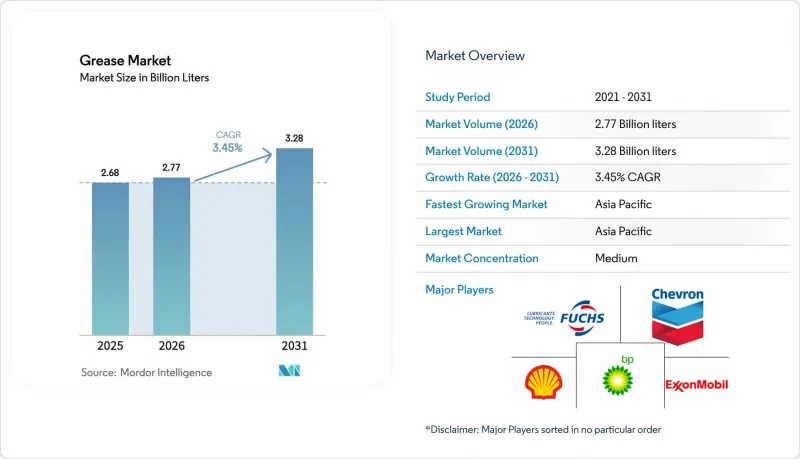
本報告按增稠劑(鋰基、鈣基等)、產品類型(礦物油、合成油等)、性能等級(高溫等)、終端用戶產業(發電、重型機械等)和地區(亞太、北美、歐洲、南美、中東和非洲)進行細分。市場預測以銷售量(公升)為單位。
全球潤滑脂市場趨勢與洞察
在加工生產線上採用衛生級食品潤滑劑。
由於監管檢查現在將潤滑劑的選擇視為一項預防性控制措施,因此對獲得 NSF H1 認證的鋁基複合潤滑脂和磺酸磺酸鹽潤滑脂的需求正在成長。加工乳製品、啤酒和調理食品食品的加工廠已將召回的潛在成本納入其總體擁有成本 (TCO) 分析,因此 15-25% 的價格溢價是可以接受的。這些等級的潤滑脂即使在 150 度C以上的溫度下也能保持氧化穩定性,並且能夠承受蒸汽清洗的殘留,從而防止金屬皂衍生的異味轉移到食品中。隨著跨國品牌在歐洲和北美採用 ISO 21469 審核來統一全球衛生標準,這些潤滑脂的採用速度正在加快。由於加工商急於通過審核,能夠提供食品級潤滑脂、技術支援和相關文件的供應商正日益受到重視。
電動車動力傳動系統總成軸承向鋰基複合材料和磺酸磺酸鹽基潤滑脂過渡
電動車馬達轉速高達 10,000 至 15,000 轉/分,由此產生的導電性和混合滾動工況是傳統鋰基潤滑脂無法應對的。添加離子液體添加劑的磺酸磺酸鹽和鋰複合潤滑脂可將摩擦損失降低高達 45%,降低轉子溫度,並延長續航里程。在中國,電池組組裝指定使用鈣基潤滑脂,以避免進一步接觸碳酸鋰。這是在 2022 年至 2024 年間原物料價格劇烈波動後採取的標準化預防措施。汽車製造商已簽訂多年契約,採購具有這些化學成分的潤滑脂,以保護材料清單(BOM) 免受原料價格波動的影響。聚脲配方可在 -40 度C至 +180 度C的溫度範圍內保持性能穩定,具有耐水蝕性,在輪轂軸承和等速萬向節等應用中越來越受歡迎。
由於電池產業的競爭,碳酸鋰的價格出現波動。
由於中國新建海水計畫的發展速度超過了電動車的普及速度,鋰皂現貨價格從2022年的每噸8萬美元跌至2024年的每噸1萬至1.2萬美元。高成本合約的潤滑脂生產商利潤率下降了200至300個基點,採購前置作業時間也從8週延長至16週。這項衝擊促使企業轉向與電池產業無關的磺酸鹽鈣和聚脲基增稠劑。採購團隊目前正尋求多家供應商以降低風險,但這次事件凸顯了鋰皂經濟結構的脆弱性。儘管價格在2024年底趨於穩定,但風險溢價仍包含在供應商合約中。
細分市場分析
鋰基潤滑脂在2025年仍維持66.89%的市場佔有率,這得益於數十年來OEM廠商的認可。然而,磺酸磺酸鹽潤滑脂的市佔率正以8.22%的複合年成長率快速成長,其滴點高於260 度C,具有卓越的耐水性和優異的四球磨損試驗結果。船舶、礦業和鋼鐵廠營運商正在採用這些潤滑脂,以避免潤滑脂在高負載下被沖刷和失效。雪佛龍公司於2024年推出的「Rykon」潤滑脂,憑藉其優於鋰基複合潤滑脂的承載能力,瞄準了這一領域,並推動了進一步的替代方案。鋁基複合潤滑脂則佔據了窯爐軸承等高溫應用領域的特定位置,其在250 度C下的穩定性足以彌補20-30%的價格溢價。聚脲基潤滑脂因其在-40 度C至+180 度C溫度循環範圍內具有優異的抗氧化性能,正逐漸成為電動車輪轂軸承和渦輪偏航驅動裝置的理想解決方案。膨潤土和矽膠等特殊增稠劑支持符合 NSF H1 標準的無塵室應用,並增強供應商的產品系列。
採用鈣基和聚脲類潤滑脂反映了籌資策略的多元化,旨在對沖碳酸鋰價格波動風險。買家正在建立鋰基複合材料和鈣基產品相結合的雙重採購模式,這將改變2031年前的市場佔有率趨勢。風力發電機中使用聚脲類潤滑脂也有助於延長維護週期,從而減少停機時間和降低生命週期成本。這些趨勢共同推動了磺酸磺酸鹽和聚脲類潤滑脂在潤滑脂市場的擴張,而鋰基產品的市佔率則穩定下降。
儘管到2025年,礦物油基潤滑脂仍將佔據75.19%的銷售量,但隨著性能要求超越傳統潤滑脂的極限,合成潤滑脂市場正以4.51%的複合年成長率快速成長。聚α烯烴和酯類潤滑脂的黏度指數超過140,且抗氧化時間超過1000小時,這使得風力發電機的潤滑週期延長至12個月成為可能。埃克森美孚在法國和荷蘭的II類和III類煉油項目將於2025年投產,屆時合成潤滑油的原料成本將降低10%至15%,從而縮小與礦物油產品之間的價格差距。雖然生物基潤滑脂目前仍屬於小眾市場,但在林業和海洋領域,由於ISO 12924標準要求其具有低水生毒性,因此必須使用生物基潤滑脂。該領域的成長勢頭表明,從總擁有成本(TCO)的角度來看,當設備停機時間至關重要時,生物基潤滑脂的優勢足以彌補其較高的單價。
在汽車底盤潤滑和一般工業應用中,礦物油仍然佔據主導地位,因為這些應用對成本非常敏感。然而,隨著合成油價格的下降和汽車製造商延長換油週期,合成油的替代方案正在逐步推進。生物基產品由於價格溢價高達50-70%且工作溫度範圍較窄,其市場接受度成長最為緩慢,但由於監管獎勵和處罰措施,其市場佔有率正在不斷擴大。總體而言,合成油領域的不斷擴張正推動其在潤滑脂市場的佔有率逐年成長。
區域分析
預計到2025年,亞太地區將佔全球總量的49.75%,年複合成長率達4.39%。中國汽車年產量超過3000萬輛,比亞迪的組裝目前在冷卻模組中使用磺酸鹽鈣潤滑脂,以減輕鋰價格波動的影響。印度的國家基礎設施建設計畫正在推動其挖土機和起重機車隊使用極壓潤滑脂,運轉率%。日本和韓國正在將其汽車出口轉向電動車平台,並採用聚脲和鋰複合材料解決方案,以降低軸承摩擦45%。殼牌在印尼的1.2萬噸工廠和產能翻倍的泰國工廠正在增強區域供應穩定性,並反映出對東協工業成長的長期信心。
在北美,近岸外包模式正受益匪淺。預計到2024年,墨西哥的汽車產量將超過400萬輛,這將加速當地潤滑脂的採購。美國在頁岩油氣開採和食品級產品應用方面處於領先地位,同時,德克薩斯州和大平原地區的陸上風電走廊對合成潤滑油的需求也在不斷成長。雪佛龍公司位於墨西哥灣的安克油田使用專為承受深海負荷而設計的船用級潤滑油。加拿大的採礦作業需要使用北極級潤滑脂來應對零下低溫環境,這些潤滑脂主要採用聚脲和合成PAO化學品。
歐洲形勢複雜。預計德國汽車產量將在2025年放緩,但北海和波羅的海離岸風力發電的建設正在加速。北歐國家正在尋求流點為-50 度C的極地潤滑脂,而土耳其由於重建工作,對極壓潤滑脂的需求激增。歐盟關於PFAS和氮化硼的REACH法規正在導致產品系列的重組和研發投入的增加,但也為符合規定的供應商帶來了競爭優勢。
在南美洲,巴西是核心市場,巴西石油公司(Petrobras)的鹽層下計畫推動了對船用潤滑脂的需求。在阿根廷的鋰礦區,破碎設備和輸送機線對極壓潤滑脂的需求正在成長。在中東和非洲,受沙烏地阿拉伯「2030願景」和南非礦業投資的推動,施工機械和發電設備的數量正在擴大。福斯公司在南非的產能成長40%,顯示對撒哈拉以南非洲地區的成長充滿信心。
其他好處:
- Excel格式的市場預測(ME)表
- 3個月的分析師支持
目錄
第1章:引言
- 研究假設和市場定義
- 調查範圍
第2章:調查方法
第3章執行摘要
第4章 市場狀況
- 市場概覽
- 市場促進因素
- 在加工生產線中引進衛生食品級潤滑劑
- 電動車電動動力傳動系統軸承的潤滑劑正在轉向鋰基和磺酸磺酸鹽基潤滑脂。
- 深海鑽探活動增加了對防水船用潤滑脂的需求。
- 施工機械的蓬勃發展帶動了對極壓潤滑脂的需求。
- 對發電業的強勁投資
- 市場限制因素
- 由於電池產業的競爭,碳酸鋰的價格出現波動。
- 加強歐盟REACH法規對PFAS和氮化硼添加劑的監管
- 自動潤滑系統滲透率低
- 價值鏈分析
- 波特五力分析
第5章 市場規模與成長預測
- 透過增稠劑
- 鋰基
- 鈣基
- 鋁基
- 聚脲
- 其他增稠劑
- 依產品類型
- 礦物油
- 合成油
- 生物基油
- 表現等級
- 高溫潤滑脂
- 低溫和極冷油脂
- 極壓和高負荷潤滑脂
- 按最終用戶行業分類
- 汽車和其他運輸設備
- 發電(風能、水力、火力)
- 重型機械
- 食品/飲料
- 冶金/金屬加工
- 化學製造
- 其他行業
- 按地區
- 亞太地區
- 中國
- 印度
- 日本
- 韓國
- 印尼
- 馬來西亞
- 泰國
- 越南
- 其他亞太國家
- 北美洲
- 美國
- 加拿大
- 墨西哥
- 歐洲
- 德國
- 英國
- 法國
- 義大利
- 西班牙
- 北歐國家
- 土耳其
- 俄羅斯
- 其他歐洲國家
- 南美洲
- 巴西
- 阿根廷
- 哥倫比亞
- 其他南美國家
- 中東和非洲
- 沙烏地阿拉伯
- 南非
- 奈及利亞
- 埃及
- 其他中東和非洲國家
- 亞太地區
第6章 競爭情勢
- 市場集中度
- 策略趨勢
- 市佔率和排名分析
- 公司簡介
- Ampol Limited
- Axel Christiernsson AB
- BECHEM Lubrication Technology LLC
- BP plc
- Chevron Corporation
- China Petrochemical Corporation
- DuPont
- ENEOS Corporation
- ETS Oil & Gas Ltd.
- Exxon Mobil Corporation
- FUCHS
- Gazprom
- Gulf Oil International Ltd
- Idemitsu Kosan Co.,Ltd.
- Kluber Lubrication SE
- LUKOIL
- Morris Lubricants
- Orlen Oil
- Penrite Oi
- Petromin
- Petronas Lubricants International
- Shell Plc
- SKF
- TotalEnergies
- Valvoline Global Operations
第7章 市場機會與未來展望
According to Mordor Intelligence, the grease market size was valued at 2.68 Billion liters in 2025 and is estimated to grow from 2.77 Billion liters in 2026 to reach 3.28 Billion liters by 2031, at a CAGR of 3.45% during the forecast period (2026-2031).
This report is Segmented by Thickener (Lithium-Based, Calcium-Based, and More), Product Type (Mineral Oil, Synthetic Oil, and More), Performance Grade (High-Temperature, and More), End-User Industry (Power Generation, Heavy Equipment, and More), and Geography (Asia-Pacific, North America, Europe, South America, and the Middle East and Africa). The Market Forecasts are Provided in Terms of Volume (liters).
Global Grease Market Trends and Insights
Hygienic Food-Grade Lubrication Uptake in Processing Lines
Demand for NSF H1-certified aluminum-complex and calcium-sulfonate greases is climbing because regulatory inspections now treat lubricant selection as a preventive control. Processing plants that handle dairy, brewing, and ready-meal products factor potential recall costs into total-cost-of-ownership analysis, making the 15-25% price premium acceptable. These grades maintain oxidation stability above 150 °C and resist steam-cleaning washout, preventing metallic-soap taste migration. ISO 21469 audits in Europe and North America accelerate adoption as multinational brands unify global hygiene standards. Vendors that offer bundled food-grade grease, technical support, and documentation gain preferred-supplier status with processors seeking audit readiness.
EV E-Powertrain Bearing Shift to Lithium-Complex & Calcium-Sulfonate Greases
Electric-vehicle motors run at 10,000-15,000 rpm and impose electrical conductivity as well as mixed-rolling conditions that legacy lithium soaps cannot handle. Calcium-sulfonate and lithium-complex greases doped with ionic-liquid additives cut friction losses by up to 45%, reducing rotor temperature and extending driving range. Battery-pack assembly lines in China specify calcium systems to avoid additional lithium-carbonate exposure, a hedge that became standard after the commodity's 2022-2024 price whiplash. Automakers are locking multi-year contracts for these chemistries, insulating bills of materials from raw-material swings. Polyurea formulations, which remain consistent from -40°C to +180°C, are gaining ground in wheel-bearing and CV-joint applications because they resist water washout.
Lithium-Carbonate Cost Volatility Due to Battery-Sector Competition
Spot prices dropped from USD 80,000/t in 2022 to USD 10,000-12,000/t in 2024 when new Chinese brine projects outpaced EV uptake. Grease blenders locked into high-cost contracts saw margins shrink by 200-300 basis points and lengthened purchasing lead times from eight to sixteen weeks. The shock fueled diversification toward calcium-sulfonate and polyurea thickeners that lack battery-sector linkage. Procurement teams now dual-source to cap exposure, but the experience underscores structural fragility in lithium-soap economics. Although prices stabilized by late 2024, risk premiums remain embedded in supplier agreements.
Other drivers and restraints analyzed in the detailed report include:
- Offshore Deep-Water Drilling Boosting Water-Resistant Marine Greases
- Construction Equipment Boom Driving Extreme-Pressure Greases
- EU REACH Tightening on PFAS & Boron-Nitride Additives
For complete list of drivers and restraints, kindly check the Table Of Contents.
Segment Analysis
Lithium-based greases maintained a 66.89% grease market share in 2025 as decades of OEM approvals anchor their position. However, calcium-sulfonate greases are advancing at an 8.22% CAGR because they deliver dropping points beyond 260°C, superior water resistance, and excellent four-ball-wear results. Marine, mining, and steel-mill operators adopt them to avoid washout and heavy-load failures. Chevron's Rykon launch in 2024 targets this space with a load-carrying capacity that surpasses lithium complexes, catalyzing further substitution. Aluminum-complex grades occupy niche high-temperature services such as kiln bearings where 250°C stability offsets a 20-30% price premium. Polyurea chemistries progress as the preferred solution for EV wheel bearings and turbine yaw drives thanks to oxidation resistance over -40°C to +180°C cycles. Specialty thickeners like bentonite and silica gel underpin NSF H1 clean-room applications, reinforcing supplier portfolios.
Calcium and polyurea adoption mirrors procurement strategies that diversify away from lithium-carbonate volatility. Buyers draw dual-sourcing frameworks that blend lithium complexes with calcium equivalents, shifting market-share trajectories through 2031. Polyurea use in wind turbines also supports extended maintenance intervals, cutting downtime and lowering lifecycle cost. Together, these trends raise the calcium-sulfonate and polyurea slices of the grease market size while lithium-based dominance erodes steadily.
Mineral-oil greases still account for 75.19% of 2025 volume, yet synthetic formulations grow at 4.51% CAGR as performance needs outstrip conventional limits. Polyalphaolefin and ester bases carry viscosity indices above 140 and resist oxidation beyond 1,000 hours, enabling 12-month turbine relubrication cycles. ExxonMobil's 2025 re-refined Group II and Group III project in France and the Netherlands lowers synthetic input cost by 10-15%, narrowing historical price gaps with mineral products. Bio-based greases, while niche, secure mandates in forestry and marine zones that enforce low aquatic toxicity under ISO 12924. This segment's momentum demonstrates that total-cost-of-ownership considerations can outweigh higher unit prices when equipment downtime is critical.
Mineral oil grades continue to dominate automotive chassis lubrication and general industrial services where cost sensitivity prevails. However, as synthetic prices fall and OEM drain intervals lengthen, substitution edges upward. Bio-based products face the steepest adoption curve due to 50-70% price premiums and narrower temperature windows, yet regulatory carrots and sticks are expanding their footprint. Overall, synthetic expansion segments lift the synthetic share of the grease market size year over year.
Complete Report Scope:
- By Thickener
- Lithium-based
- Calcium-based
- Aluminum-based
- Polyurea
- Other Thickeners
- By Product type
- Mineral Oil
- Synthetic Oil
- Bio-based Oil
- By Performance Grade
- High-Temperature Greases
- Low-Temperature & Arctic-Grade Greases
- Extreme-Pressure & Heavy-Load Greases
- By End-user Industry
- Automotive & Other Transportation
- Power Generation (Wind, Hydro, Thermal)
- Heavy Equipment
- Food & Beverage
- Metallurgy & Metalworking
- Chemical Manufacturing
- Other Industries
- By Geography
- Asia-Pacific
- China
- India
- Japan
- South Korea
- Indonesia
- Malaysia
- Thailand
- Vietnam
- Rest of Asia-Pacific
- North America
- United States
- Canada
- Mexico
- Europe
- Germany
- United Kingdom
- France
- Italy
- Spain
- NORDIC Countries
- Turkey
- Russia
- Rest of Europe
- South America
- Brazil
- Argentina
- Colombia
- Rest of South America
- Middle East and Africa
- Saudi Arabia
- South Africa
- Nigeria
- Egypt
- Rest of Middle East and Africa
- Asia-Pacific
Geography Analysis
Asia-Pacific held 49.75% of global volume in 2025 and is forecast to post a 4.39% CAGR. Chinese manufacturing exceeds 30 million vehicles a year, with BYD assembly lines now using calcium-sulfonate greases in cooling modules to reduce exposure to lithium swings. India's National Infrastructure Pipeline drives extreme-pressure consumption in excavator and crane fleets operating above 80% utilization. Japan and South Korea transition automotive exports to EV platforms, embedding polyurea and lithium-complex solutions that lower bearing friction by 45%. Shell's 12,000 t Indonesian plant and triple-capacity Thailand site reinforce regional supply security, reflecting long-term confidence in ASEAN industrial growth.
North America benefits from near-shoring that boosts Mexican vehicle production past 4 million units in 2024, encouraging local grease sourcing. The United States leads shale drilling and food-grade adoption, while onshore wind corridors in Texas and the Great Plains absorb synthetic volumes. Chevron's Anchor field in the Gulf of Mexico consumes marine grades engineered for deep-water loads. Canadian mining operations require arctic-rated greases for sub-zero environments, leaning on polyurea and synthetic PAO chemistries.
Europe presents a mixed picture. German automotive output softened in 2025, yet offshore wind build-outs in the North Sea and Baltic accelerate. Nordic nations demand arctic-grade greases with -50°C pour points, while Turkey's reconstruction surge spurs extreme-pressure uptake. EU REACH rules on PFAS and boron nitride reshape product portfolios and inflate R&D costs, but offer competitive edge to compliant suppliers.
South America is anchored by Brazil, where Petrobras pre-salt projects fuel marine grease demand. Argentina's lithium-mining belt boosts extreme-pressure consumption in crushing and conveyor lines. The Middle East and Africa expand construction equipment and power-generation fleets under Saudi Vision 2030 and South African mining investments, respectively. FUCHS's 40% capacity addition in South Africa evidences confidence in sub-Saharan growth.
- Ampol Limited
- Axel Christiernsson AB
- BECHEM Lubrication Technology LLC
- BP p.l.c.
- Chevron Corporation
- China Petrochemical Corporation
- DuPont
- ENEOS Corporation
- ETS Oil & Gas Ltd.
- Exxon Mobil Corporation
- FUCHS
- Gazprom
- Gulf Oil International Ltd
- Idemitsu Kosan Co.,Ltd.
- Kluber Lubrication SE
- LUKOIL
- Morris Lubricants
- Orlen Oil
- Penrite Oi
- Petromin
- Petronas Lubricants International
- Shell Plc
- SKF
- TotalEnergies
- Valvoline Global Operations
Additional Benefits:
- The market estimate (ME) sheet in Excel format
- 3 months of analyst support
TABLE OF CONTENTS
1 Introduction
- 1.1 Study Assumptions & Market Definition
- 1.2 Scope of the Study
2 Research Methodology
3 Executive Summary
4 Market Landscape
- 4.1 Market Overview
- 4.2 Market Drivers
- 4.2.1 Hygienic food-grade lubrication uptake in processing lines
- 4.2.2 EV e-powertrain bearing shift to lithium-complex & calcium-sulfonate greases
- 4.2.3 Offshore deep-water drilling boosting water-resistant marine greases
- 4.2.4 Construction equipment boom driving extreme-pressure greases
- 4.2.5 Robust investments in the power-generation sector
- 4.3 Market Restraints
- 4.3.1 Lithium-carbonate cost volatility due to battery-sector competition
- 4.3.2 EU REACH tightening on PFAS & boron-nitride additives
- 4.3.3 Low penetration of auto-lubrication systems
- 4.4 Value Chain Analysis
- 4.5 Porter's Five Forces Analysis
- 4.5.1 Bargaining Power of Suppliers
- 4.5.2 Bargaining Power of Buyers
- 4.5.3 Threat of New Entrants
- 4.5.4 Threat of Substitutes
- 4.5.5 Degree of Competition
5 Market Size & Growth Forecasts (Volume)
- 5.1 By Thickener
- 5.1.1 Lithium-based
- 5.1.2 Calcium-based
- 5.1.3 Aluminum-based
- 5.1.4 Polyurea
- 5.1.5 Other Thickeners
- 5.2 By Product type
- 5.2.1 Mineral Oil
- 5.2.2 Synthetic Oil
- 5.2.3 Bio-based Oil
- 5.3 By Performance Grade
- 5.3.1 High-Temperature Greases
- 5.3.2 Low-Temperature & Arctic-Grade Greases
- 5.3.3 Extreme-Pressure & Heavy-Load Greases
- 5.4 By End-user Industry
- 5.4.1 Automotive & Other Transportation
- 5.4.2 Power Generation (Wind, Hydro, Thermal)
- 5.4.3 Heavy Equipment
- 5.4.4 Food & Beverage
- 5.4.5 Metallurgy & Metalworking
- 5.4.6 Chemical Manufacturing
- 5.4.7 Other Industries
- 5.5 By Geography
- 5.5.1 Asia-Pacific
- 5.5.1.1 China
- 5.5.1.2 India
- 5.5.1.3 Japan
- 5.5.1.4 South Korea
- 5.5.1.5 Indonesia
- 5.5.1.6 Malaysia
- 5.5.1.7 Thailand
- 5.5.1.8 Vietnam
- 5.5.1.9 Rest of Asia-Pacific
- 5.5.2 North America
- 5.5.2.1 United States
- 5.5.2.2 Canada
- 5.5.2.3 Mexico
- 5.5.3 Europe
- 5.5.3.1 Germany
- 5.5.3.2 United Kingdom
- 5.5.3.3 France
- 5.5.3.4 Italy
- 5.5.3.5 Spain
- 5.5.3.6 NORDIC Countries
- 5.5.3.7 Turkey
- 5.5.3.8 Russia
- 5.5.3.9 Rest of Europe
- 5.5.4 South America
- 5.5.4.1 Brazil
- 5.5.4.2 Argentina
- 5.5.4.3 Colombia
- 5.5.4.4 Rest of South America
- 5.5.5 Middle East and Africa
- 5.5.5.1 Saudi Arabia
- 5.5.5.2 South Africa
- 5.5.5.3 Nigeria
- 5.5.5.4 Egypt
- 5.5.5.5 Rest of Middle East and Africa
- 5.5.1 Asia-Pacific
6 Competitive Landscape
- 6.1 Market Concentration
- 6.2 Strategic Moves
- 6.3 Market Share(%)/Ranking Analysis
- 6.4 Company Profiles (includes Global-level Overview, Market-level Overview, Core Segments, Financials as available, Strategic Information, Market Rank/Share, Products & Services, Recent Developments)
- 6.4.1 Ampol Limited
- 6.4.2 Axel Christiernsson AB
- 6.4.3 BECHEM Lubrication Technology LLC
- 6.4.4 BP p.l.c.
- 6.4.5 Chevron Corporation
- 6.4.6 China Petrochemical Corporation
- 6.4.7 DuPont
- 6.4.8 ENEOS Corporation
- 6.4.9 ETS Oil & Gas Ltd.
- 6.4.10 Exxon Mobil Corporation
- 6.4.11 FUCHS
- 6.4.12 Gazprom
- 6.4.13 Gulf Oil International Ltd
- 6.4.14 Idemitsu Kosan Co.,Ltd.
- 6.4.15 Kluber Lubrication SE
- 6.4.16 LUKOIL
- 6.4.17 Morris Lubricants
- 6.4.18 Orlen Oil
- 6.4.19 Penrite Oi
- 6.4.20 Petromin
- 6.4.21 Petronas Lubricants International
- 6.4.22 Shell Plc
- 6.4.23 SKF
- 6.4.24 TotalEnergies
- 6.4.25 Valvoline Global Operations
7 Market Opportunities & Future Outlook
- 7.1 White-space & Unmet-Need Assessment
- 7.2 Growing usage of polyurea greases

 全球潤滑脂市場:依基礎油、增稠劑類型、終端用戶產業及地區分類-預測至2031年
 潤滑脂市場:全球市場預測,2026-2032年
 鋰基潤滑脂市場規模、佔有率和成長分析:按潤滑脂類型、基礎油、應用、分銷管道和地區分類-2026-2033年產業預測潤滑脂市場:按類型、濃稠度、基礎油類型、增稠劑類型和應用分類-2026-2032年全球市場預測
 橡膠潤滑脂市場規模、佔有率和成長分析:按增稠劑類型、基礎油類型、應用、終端用戶產業、銷售管道和地區分類-2026年至2033年產業預測
 潤滑脂市場報告:按增稠劑類型、基礎油、最終用戶和地區分類(2026-2034 年)非鋰基潤滑脂市場:按類型、包裝、應用、終端用戶產業和銷售管道分類-2026-2032年全球市場預測
 潤滑脂市場規模、佔有率、成長及全球產業分析:按類型、應用和地區的洞察,2026-2034年的預測
 油脂分析儀市場分析及預測(至2035年):依類型、產品類型、服務、技術、應用、最終用戶、功能、安裝類型、設備分類
 2026年全球鋰基潤滑脂市場報告