


 |
市場調查報告書
商品編碼
2120656
智慧馬達控制中心(IMCC):市場佔有率分析、產業趨勢與統計、成長預測(2026-2031)Intelligent Motor Control Centers (IMCC) - Market Share Analysis, Industry Trends & Statistics, Growth Forecasts (2026 - 2031) |
||||||

※ 本網頁內容可能與最新版本有所差異。詳細情況請與我們聯繫。
智慧馬達控制中心(IMCC)市場預計將從2025年的61.6億美元成長到2026年的65.9億美元,到2031年達到92.5億美元,2026年至2031年的複合年成長率為7.02%。
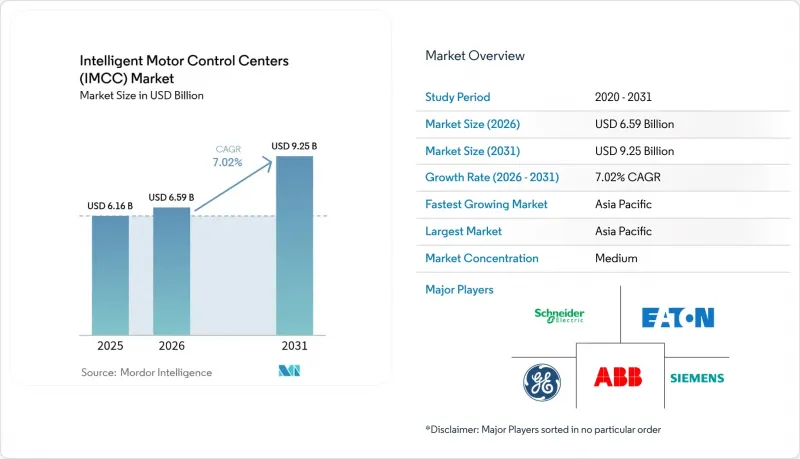
本報告按工作電壓(低壓、中壓、高壓)、組件(匯流排、斷路器、繼電器、變頻器、軟啟動器及其他)、智慧型等級(智慧型和傳統型)、最終用戶(汽車、化學、食品飲料、採礦、紙漿造紙及其他)和地區(北美、南美、歐洲及其他)進行細分。市場預測以美元計價。
全球智慧電機控制中心(IMCC)市場趨勢與洞察
擴大工業自動化和工業4.0計劃
隨著工廠車間的數位化,智慧馬達控制中心(MCC)如今已成為邊緣節點,聚合即時遙測數據,並將OPC UA資料流直接傳輸至雲端歷史資料庫,從而消除了與遠端SCADA伺服器的往返延遲。根據西門子預測,到2024年,將有超過3,200家工廠採用基於TIA Portal的MCC配置,進而減少30%的試運行工作量。 ABB已部署其Edgenius改裝模組,該模組可將傳統的低壓配電盤改造為智慧資產。此模組符合IEC 61131-3編程標準,與完全更換相比,成本可降低25%至30%。政策獎勵正在推動這一趨勢。中國的「中國製造2025」計畫已撥款450億元人民幣(約62億美元)用於國有石化聯合企業的智慧馬達升級改造。模組化、軟體定義的控制系統使操作人員能夠快速重新配置生產單元,這在產品種類日益豐富、生命週期不斷縮短的今天,是一項至關重要的優勢。為此,設備供應商正在將安全功能融入新產品線,以確保工廠能夠滿足 IEC 62443 審核要求。
能源效率法規正在推動智慧馬達控制技術的應用。
監管機構目前正透過對低效傳統啟動器課稅,從而鼓勵採用基於變頻驅動器 (VSD) 的系統。歐盟生態設計法規 2019/1781 禁止從 2023 年 7 月起對大多數功率超過 0.75 kW 的馬達使用直接驅動 (DOL) 啟動器,並鼓勵投資建造具有內建計量功能的整合馬達控制中心 (MCC)。Schneider Electric於 2024 年對歐洲 1800 家工廠進行了調查,並實施了智慧 MCC維修,最終實現了 12-18% 的節能,投資回收期不到 24 個月。 2024 年 12 月,美國能源局通過了更嚴格的低壓馬達法規,以促進軟啟動器和變頻驅動器 (VSD) 的使用。 2024年3月,印度能源效率局推出了智慧馬達系統的“五星級體系”,該體系結合了加速折舊和商品及服務稅(GST)減免。這些框架設定了傳統控制面板難以達到的最低合規標準,並鼓勵從生命週期成本的角度轉型為智慧產品。
前期投資高,且安裝成本隱性高。
儘管組件價格下降,但智慧型MCC的初始投資仍比傳統配電盤高出25%至40%,如果加上網路交換器、防火牆和軟體訂閱費用,承包的成本可能會翻倍。典型的400千瓦低壓智慧配電盤的成本為4.5萬至6萬美元,而一個基本的接觸器式配電盤的成本為1.8萬至2.5萬美元,此外還需要1.5萬至2萬美元用於乙太網路佈線和SCADA整合。每年5000至1萬美元的雲端分析成本推高了營運支出,強制性的網路安全審計每個站點可能增加1萬至1.5萬美元。因此,許多中小企業正在推遲升級,尤其是在人事費用和能源成本較低的市場。資金籌措也是一個重要因素。由於借貸成本較高且投資回收期較短,小規模企業通常選擇分階段維修而不是全面智慧化。
細分市場分析
預計到2031年,中壓智慧解決方案將以8.96%的複合年成長率成長,其成長主要得益於礦山運輸卡車充電、大規模泵站以及液化天然氣(LNG)液化項目的電氣化等應用。英美資源集團旗下的Querabeco礦場安裝了18個中壓控制面板來管理輸送機和破碎機電機,第一年就實現了12%的停機時間減少。低壓單元由於在客製化系統和商業建築中的廣泛應用,將繼續主導智慧馬達控制中心市場,即使到2025年仍將維持63.98%的市場佔有率。 11千伏特以上的高壓機種仍主要面向小眾市場,適用於抽水蓄能電站及海上平台等應用。
中壓市場的發展符合脫碳趨勢。純電動運輸卡車需要3-5兆瓦的充電器,且其負載峰值需要即時調整。智慧型馬達控制中心(MCC)能夠調整充電週期,而不會影響現場電力系統的穩定性。必和必拓表示,這項功能使其電動卡車車隊能夠全天候運作。低壓配電盤持續維持6-7%的強勁成長,這主要得益於模組化維修和分散式製造的趨勢,這些趨勢優先考慮緊湊面積。
隨著電力公司實施動態定價和需量反應計劃,預計變頻驅動器 (VSD) 將成為成長最快的產品,到 2031 年複合年成長率 (CAGR) 將達到 9.62% 。Schneider Electric的 Altivar Process 驅動器使污水處理廠運營商能夠將泵浦的運作調整到用電低谷時段,從而每年為每個設施節省高達 10 萬美元的成本。雖然匯流排市場已經成熟,但由於其在智慧型馬達控制中心 (MCC) 建設中的廣泛應用,預計到 2025 年,母線將佔據 24.05% 的市場佔有率。
通訊閘道器、電能品質濾波器和電能表的成長凸顯了硬體智慧化的趨勢。在變頻驅動器 (VSD) 性能過剩的情況下,軟啟動器正日益受到關注,其能效比高達 60-70%,成本卻僅為 VSD 的 40%,使其成為農業合作社和地方政府自來水公司的理想選擇。
區域分析
預計到2025年,亞太地區將以38.12%的市佔率引領智慧馬達控制中心(IMCC)市場,並在2031年之前維持8.21%的複合年成長率。中國國家電網公司於2024年投資5,200億元人民幣(約720億美元)用於升級其工業配電網,其中包括需量反應電機控制中心(MCC)。印度的生產連結獎勵計畫(PLI)計畫正在加速新建工廠的建設,這些工廠從一開始就將智慧面板納入其設計規範,而像拉森特博洛(Larsen & Toubro)這樣的本土供應商的交貨速度也超過了西方同行。
到2025年,北美將佔據略低於30%的市場佔有率,預計年複合成長率將達到6-7%,這主要得益於製造業回流和《通膨控制法案》推動了對自動化生產線的資本流入。美國能源局(DOE)對能源效率法規的修訂以及美國網路安全和基礎設施安全局(CISA)提出的網路安全建議,正在促進智慧啟動器的應用。到2025年,歐洲將佔據22-24%的市場佔有率,年複合成長率相對較低,為5-6%,但嚴格的能源和網路安全指令使現有設施的維修活動保持穩定。到2025年,中東和非洲合計將佔銷售額的8-10%。沙烏地阿拉伯和阿拉伯聯合大公國石化產業的大型企劃預計將以7-8%的年複合成長率擴大中壓解決方案的市場。非洲4-5%的成長率反映出其資金管道有限,且更傾向於成本較低的傳統太陽能板。在南美洲,特別是巴西和阿根廷,在WEG等當地供應商的支持下,採礦和鋰礦開採計畫預計將達到6-7%的複合年成長率。
其他好處:
- Excel格式的市場預測(ME)表
- 3個月的分析師支持
目錄
第1章:引言
- 研究假設和市場定義
- 調查範圍
第2章:調查方法
第3章執行摘要
第4章 市場狀況
- 市場概覽
- 市場促進因素
- 工業自動化和工業4.0計劃的普及
- 能源效率法規正在推動智慧馬達控制技術的應用。
- 卓越的診斷能力和預測性維護能力
- 將數位孿生技術整合到虛擬試運行和生命週期最佳化中
- 關鍵基礎設施領域對具備網路安全措施的馬達控制中心的需求日益成長。
- 針對老舊棕地工廠的模組化維修方案
- 市場限制因素
- 前期資本投入大,且有隱性安裝成本。
- 低成本替代傳統馬達控制方案的出現
- 網路安全人員短缺阻礙了互聯MCC的普及。
- 通訊標準的碎片化使互通性變得複雜。
- 宏觀經濟因素對市場的影響
- 產業價值鏈分析
- 監理情勢
- 技術展望
- 波特五力分析
第5章 市場規模與成長預測
- 透過工作電壓
- 低壓智慧MCC
- 中壓智慧MCC
- 高壓智慧MCC
- 按組件
- 匯流排
- 斷路器和保險絲
- 過載繼電器
- 變速驅動
- 軟啟動器
- 其他
- 按資訊等級
- 智慧MCC
- 傳統MCC
- 按最終用戶行業分類
- 車
- 化工/石油化工
- 食品/飲料
- 採礦和金屬
- 紙漿和造紙
- 發電
- 石油和天然氣
- 水和污水處理
- 水泥製造
- 其他
- 按地區
- 北美洲
- 美國
- 加拿大
- 墨西哥
- 南美洲
- 巴西
- 阿根廷
- 其他南美國家
- 歐洲
- 德國
- 英國
- 法國
- 義大利
- 西班牙
- 其他歐洲國家
- 亞太地區
- 中國
- 日本
- 印度
- 韓國
- 其他亞太國家
- 中東和非洲
- 中東
- 沙烏地阿拉伯
- 阿拉伯聯合大公國
- 土耳其
- 其他中東國家
- 非洲
- 南非
- 奈及利亞
- 肯亞
- 其他非洲國家
- 中東
- 北美洲
第6章 競爭情勢
- 市場集中度
- 策略趨勢
- 市佔率分析
- 公司簡介
- ABB Ltd.
- Siemens AG
- Schneider Electric SE
- Eaton Corporation plc
- General Electric Company
- Rockwell Automation Inc.
- Mitsubishi Electric Corporation
- Fuji Electric Co., Ltd.
- WEG SA
- Larsen and Toubro Limited
- Technical Control Systems Limited
- Powell Industries Inc.
- Marine Electricals(India)Limited
- Gemco Controls Limited
- Vidhyut Control India Private Limited
- Hyosung Heavy Industries Corporation
- LS Electric Co., Ltd.
- Toshiba Corporation
- Hyundai Electric and Energy Systems Co., Ltd.
- Rittal GmbH and Co. KG
- Schweitzer Engineering Laboratories Inc.
- Tesco Controls Inc.
- Sun-Tech Engineers
- Rolla Limited
- Ingeteam SA
- Emerson Electric Co.
第7章 市場機會與未來展望
According to Mordor Intelligence, the intelligent motor control centers (IMCC) market size is expected to grow from USD 6.16 billion in 2025 to USD 6.59 billion in 2026 and is forecast to reach USD 9.25 billion by 2031 at 7.02% CAGR over 2026-2031.
This report is Segmented by Operating Voltage (Low, Medium, and High), Component (Busbars, Circuit Breakers, Relays, Vfds, Soft Starters, and Others), Intelligence Level (Intelligent and Conventional), End-User (Automotive, Chemicals, Food and Beverage, Mining, Pulp and Paper, and More), and Geography (North America, South America, Europe, and More). Market Forecasts are in Value (USD).
Global Intelligent Motor Control Centers (IMCC) Market Trends and Insights
Proliferation of Industrial Automation and Industry 4.0 Initiatives
Factory-floor digitalization positions intelligent MCCs as edge nodes that aggregate real-time telemetry and publish OPC UA data streams directly to cloud historians, eliminating round-trip latency to remote SCADA servers. Siemens reported that by 2024, more than 3,200 plants had adopted TIA Portal-based MCC configurations, resulting in a 30% reduction in commissioning labor. ABB rolled out Edgenius retrofit modules that transform legacy low-voltage panels into smart assets, compatible with IEC 61131-3 programming, resulting in a 25-30% price reduction compared to full replacement. Policy incentives amplify the trend: China's Made in China 2025 program earmarked RMB 45 billion (USD 6.2 billion) for intelligent motor upgrades across state-owned petrochemical complexes. Modular, software-defined control now enables operators to quickly reconfigure production cells, a crucial advantage as product varieties and life cycles become increasingly shorter. Equipment suppliers respond by incorporating cybersecurity features into new product lines to help plants meet IEC 62443 audit requirements.
Energy Efficiency Regulations Driving Smart Motor Control Adoption
Regulators now price inefficiency, effectively taxing conventional starters in favor of VSD-based schemes. The EU Ecodesign Regulation 2019/1781 banned direct-on-line starters for most motors above 0.75 kW beginning July 2023, steering capital toward integrated MCCs with embedded metering. Schneider Electric monitored 1,800 European facilities in 2024 and achieved electricity savings of 12-18% after implementing intelligent MCC retrofits, reducing payback periods to under 24 months. In December 2024, the U.S. Department of Energy adopted tighter low-voltage motor rules that incentivize soft starters and VSDs. India's Bureau of Energy Efficiency introduced a five-star scheme in March 2024 that bundles accelerated depreciation and goods and services tax relief for intelligent motor systems. These frameworks create a compliance floor that legacy panels struggle to meet, tilting lifecycle economics toward intelligent variants.
High Upfront Capital Expenditure and Hidden Installation Costs
Even as component prices fall, intelligent MCCs still demand a 25-40% capital premium over conventional panels, and turnkey costs can double once network switches, firewalls, and software subscriptions are factored in. A typical 400 kW low-voltage smart panel costs USD 45,000-60,000, compared to USD 18,000-25,000 for a basic contactor-based unit, with an additional USD 15,000-20,000 required for Ethernet cabling and SCADA integration. Annual cloud analytics fees of USD 5,000-10,000 increase operating expenses, and mandatory cybersecurity audits can add USD 10,000-15,000 per site. Many SMEs, therefore, postpone upgrades, particularly in markets where labor is inexpensive and energy tariffs are low. Financing constraints also matter: smaller firms face higher borrowing costs and shorter payback thresholds, which favor incremental retrofits over full intelligent conversions.
Other drivers and restraints analyzed in the detailed report include:
- Superior Diagnostics and Predictive Maintenance Capability
- Integration of Digital Twins for Virtual Commissioning and Lifecycle Optimization
- Availability of Low-Cost Conventional Motor Control Alternatives
For complete list of drivers and restraints, kindly check the Table Of Contents.
Segment Analysis
Medium-voltage intelligent solutions are projected to expand at a 8.96% CAGR through 2031, driven by electrification projects in mining haul-truck charging, large-scale pumping stations, and LNG liquefaction. Anglo American's Quellaveco mine deployed 18 medium-voltage panels to manage conveyor and grinding motors, resulting in a 12% reduction in downtime in year one. Low-voltage units continue to dominate the intelligent motor control center market, retaining a 63.98% share in 2025, primarily due to their widespread use in discrete manufacturing and commercial buildings. High-voltage models above 11 kV remain a niche market, suited to applications such as pumped-storage and offshore platforms.
The medium-voltage segment also aligns with decarbonization: battery-electric haul trucks require 3-5 MW chargers, whose load spikes must be balanced in real-time. Intelligent MCCs orchestrate charging cycles without destabilizing site power systems, a capability BHP credited with enabling 24/7 electric-truck fleets. Low-voltage panels continue to post solid 6-7% growth, driven by modular retrofits and distributed manufacturing trends that favor compact footprints.
VSDs are expected to log the fastest expansion at a 9.62% CAGR to 2031, as utilities roll out dynamic tariffs and demand-response programs. Schneider Electric's Altivar Process drives let wastewater operators shift pumping to off-peak hours, saving up to USD 100,000 per plant annually. Busbars, although mature, held 24.05 of % intelligent motor control center market share in 2025 due to their universal presence in MCC construction.
Growth in communication gateways, power-quality filters, and power meters underscores the shift toward intelligence-enabling hardware. Soft starters gain traction where VSDs would be overengineered, offering 60-70% of the energy benefit at 40% of the cost, an attractive ratio for agricultural cooperatives and municipal water boards.
Complete Report Scope:
- By Operating Voltage
- Low-Voltage Intelligent MCCs
- Medium-Voltage Intelligent MCCs
- High-Voltage Intelligent MCCs
- By Component
- Busbars
- Circuit Breakers and Fuses
- Overload Relays
- Variable Speed Drives
- Soft Starters
- Others
- By Intelligence Level
- Intelligent MCCs
- Conventional MCCs
- By End-user Industry
- Automotive
- Chemicals and Petrochemicals
- Food and Beverage
- Mining and Metals
- Pulp and Paper
- Power Generation
- Oil and Gas
- Water and Wastewater
- Cement Manufacturing
- Others
- By Geography
- North America
- United States
- Canada
- Mexico
- South America
- Brazil
- Argentina
- Rest of South America
- Europe
- Germany
- United Kingdom
- France
- Italy
- Spain
- Rest of Europe
- Asia Pacific
- China
- Japan
- India
- South Korea
- Rest of Asia Pacific
- Middle East and Africa
- Middle East
- Saudi Arabia
- United Arab Emirates
- Turkey
- Rest of Middle East
- Africa
- South Africa
- Nigeria
- Kenya
- Rest of Africa
- Middle East
- North America
Geography Analysis
The Asia Pacific led the intelligent motor control centers (IMCC) market with 38.12% revenue share in 2025 and is projected to grow at an 8.21% CAGR through 2031. China's State Grid committed RMB 520 billion (USD 72 billion) in 2024 to industrial power-distribution upgrades that include demand-responsive MCCs. India's Production-Linked Incentive schemes are catalyzing the development of greenfield factories that specify intelligent panels from the outset, while local suppliers, such as Larsen & Toubro, deliver faster than their Western counterparts.
North America held a just under 30% share in 2025 and is expected to grow at a 6-7% CAGR as reshoring initiatives and the Inflation Reduction Act channel capital into automated lines. Updated DOE efficiency rules and CISA cybersecurity advisories reinforce the case for intelligent starters. Europe commands a 22-24% share in 2025 and grows more modestly at a 5-6% CAGR, but strict energy and cybersecurity directives keep retrofit activity stable. The Middle East and Africa together account for 8-10% of 2025 revenue. Petrochemical megaprojects in Saudi Arabia and the UAE are projected to drive a 7-8% CAGR for medium-voltage solutions. Africa's 4-5% growth reflects limited capital access and preference for lower-cost conventional panels. South America, led by Brazil and Argentina, is expected to register a 6-7% CAGR in mining and lithium extraction projects, supported by local vendors such as WEG.
- ABB Ltd.
- Siemens AG
- Schneider Electric SE
- Eaton Corporation plc
- General Electric Company
- Rockwell Automation Inc.
- Mitsubishi Electric Corporation
- Fuji Electric Co., Ltd.
- WEG S.A.
- Larsen and Toubro Limited
- Technical Control Systems Limited
- Powell Industries Inc.
- Marine Electricals (India) Limited
- Gemco Controls Limited
- Vidhyut Control India Private Limited
- Hyosung Heavy Industries Corporation
- LS Electric Co., Ltd.
- Toshiba Corporation
- Hyundai Electric and Energy Systems Co., Ltd.
- Rittal GmbH and Co. KG
- Schweitzer Engineering Laboratories Inc.
- Tesco Controls Inc.
- Sun-Tech Engineers
- Rolla Limited
- Ingeteam S.A.
- Emerson Electric Co.
Additional Benefits:
- The market estimate (ME) sheet in Excel format
- 3 months of analyst support
TABLE OF CONTENTS
1 INTRODUCTION
- 1.1 Study Assumptions and Market Definition
- 1.2 Scope of the Study
2 RESEARCH METHODOLOGY
3 EXECUTIVE SUMMARY
4 MARKET LANDSCAPE
- 4.1 Market Overview
- 4.2 Market Drivers
- 4.2.1 Proliferation of Industrial Automation and Industry 4.0 Initiatives
- 4.2.2 Energy Efficiency Regulations Driving Smart Motor Control Adoption
- 4.2.3 Superior Diagnostics and Predictive Maintenance Capability
- 4.2.4 Integration of Digital Twins for Virtual Commissioning and Lifecycle Optimization
- 4.2.5 Rising Demand for Cybersecure Motor Control Centers in Critical Infrastructure
- 4.2.6 Modular Retrofit Solutions Targeting Aging Brownfield Plants
- 4.3 Market Restraints
- 4.3.1 High Upfront Capital Expenditure and Hidden Installation Costs
- 4.3.2 Availability of Low-Cost Conventional Motor Control Alternatives
- 4.3.3 Cybersecurity Skill Shortage Hindering Connected MCC Deployments
- 4.3.4 Fragmented Communication Standards Complicating Interoperability
- 4.4 Impact of Macroeconomic Factors on the Market
- 4.5 Industry Value Chain Analysis
- 4.6 Regulatory Landscape
- 4.7 Technological Outlook
- 4.8 Porter's Five Forces Analysis
- 4.8.1 Threat of New Entrants
- 4.8.2 Bargaining Power of Buyers or Consumers
- 4.8.3 Bargaining Power of Suppliers
- 4.8.4 Threat of Substitute Products
- 4.8.5 Intensity of Competitive Rivalry
5 MARKET SIZE AND GROWTH FORECASTS (VALUE)
- 5.1 By Operating Voltage
- 5.1.1 Low-Voltage Intelligent MCCs
- 5.1.2 Medium-Voltage Intelligent MCCs
- 5.1.3 High-Voltage Intelligent MCCs
- 5.2 By Component
- 5.2.1 Busbars
- 5.2.2 Circuit Breakers and Fuses
- 5.2.3 Overload Relays
- 5.2.4 Variable Speed Drives
- 5.2.5 Soft Starters
- 5.2.6 Others
- 5.3 By Intelligence Level
- 5.3.1 Intelligent MCCs
- 5.3.2 Conventional MCCs
- 5.4 By End-user Industry
- 5.4.1 Automotive
- 5.4.2 Chemicals and Petrochemicals
- 5.4.3 Food and Beverage
- 5.4.4 Mining and Metals
- 5.4.5 Pulp and Paper
- 5.4.6 Power Generation
- 5.4.7 Oil and Gas
- 5.4.8 Water and Wastewater
- 5.4.9 Cement Manufacturing
- 5.4.10 Others
- 5.5 By Geography
- 5.5.1 North America
- 5.5.1.1 United States
- 5.5.1.2 Canada
- 5.5.1.3 Mexico
- 5.5.2 South America
- 5.5.2.1 Brazil
- 5.5.2.2 Argentina
- 5.5.2.3 Rest of South America
- 5.5.3 Europe
- 5.5.3.1 Germany
- 5.5.3.2 United Kingdom
- 5.5.3.3 France
- 5.5.3.4 Italy
- 5.5.3.5 Spain
- 5.5.3.6 Rest of Europe
- 5.5.4 Asia Pacific
- 5.5.4.1 China
- 5.5.4.2 Japan
- 5.5.4.3 India
- 5.5.4.4 South Korea
- 5.5.4.5 Rest of Asia Pacific
- 5.5.5 Middle East and Africa
- 5.5.5.1 Middle East
- 5.5.5.1.1 Saudi Arabia
- 5.5.5.1.2 United Arab Emirates
- 5.5.5.1.3 Turkey
- 5.5.5.1.4 Rest of Middle East
- 5.5.5.2 Africa
- 5.5.5.2.1 South Africa
- 5.5.5.2.2 Nigeria
- 5.5.5.2.3 Kenya
- 5.5.5.2.4 Rest of Africa
- 5.5.5.1 Middle East
- 5.5.1 North America
6 COMPETITIVE LANDSCAPE
- 6.1 Market Concentration
- 6.2 Strategic Moves
- 6.3 Market Share Analysis
- 6.4 Company Profiles (includes Global level Overview, Market level Overview, Core Segments, Financials as available, Strategic Information, Market Rank or Share, Products and Services, and Recent Developments)
- 6.4.1 ABB Ltd.
- 6.4.2 Siemens AG
- 6.4.3 Schneider Electric SE
- 6.4.4 Eaton Corporation plc
- 6.4.5 General Electric Company
- 6.4.6 Rockwell Automation Inc.
- 6.4.7 Mitsubishi Electric Corporation
- 6.4.8 Fuji Electric Co., Ltd.
- 6.4.9 WEG S.A.
- 6.4.10 Larsen and Toubro Limited
- 6.4.11 Technical Control Systems Limited
- 6.4.12 Powell Industries Inc.
- 6.4.13 Marine Electricals (India) Limited
- 6.4.14 Gemco Controls Limited
- 6.4.15 Vidhyut Control India Private Limited
- 6.4.16 Hyosung Heavy Industries Corporation
- 6.4.17 LS Electric Co., Ltd.
- 6.4.18 Toshiba Corporation
- 6.4.19 Hyundai Electric and Energy Systems Co., Ltd.
- 6.4.20 Rittal GmbH and Co. KG
- 6.4.21 Schweitzer Engineering Laboratories Inc.
- 6.4.22 Tesco Controls Inc.
- 6.4.23 Sun-Tech Engineers
- 6.4.24 Rolla Limited
- 6.4.25 Ingeteam S.A.
- 6.4.26 Emerson Electric Co.
7 MARKET OPPORTUNITIES AND FUTURE OUTLOOK
- 7.1 White-Space and Unmet-Need Assessment


