


 |
市場調查報告書
商品編碼
2120640
染料和顏料:市場佔有率分析、行業趨勢和統計數據、成長預測(2026-2031)Dyes And Pigments - Market Share Analysis, Industry Trends & Statistics, Growth Forecasts (2026 - 2031) |
||||||

※ 本網頁內容可能與最新版本有所差異。詳細情況請與我們聯繫。
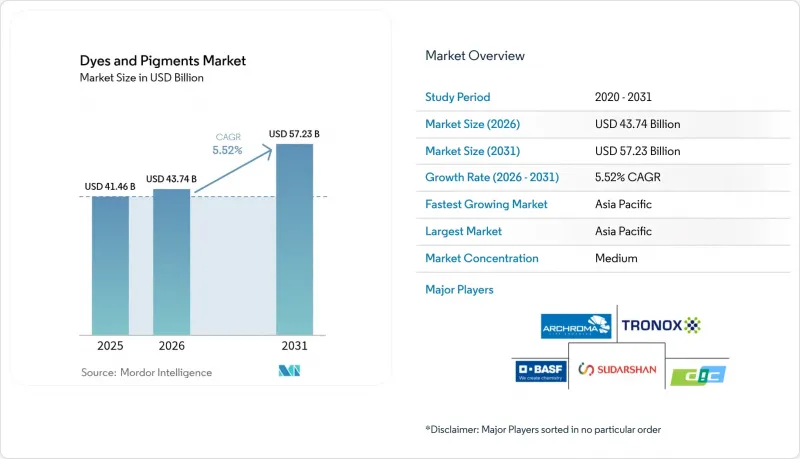
2025年染料和顏料市場價值為414.6億美元,預計到2031年將達到572.3億美元,而2026年為437.4億美元,預測期內(2026-2031年)的複合年成長率預計為5.52%。
本報告按產品類型(染料和顏料)、原料(合成和天然/生物衍生)、劑型(粉末、顆粒、液體分散體)、終端用戶行業(油漆和塗料、紡織品、印刷油墨等)以及地區(亞太地區、北美地區、歐洲地區、南美地區、中東和非洲地區)進行細分。市場預測以美元計價。
全球染料和顏料市場趨勢及洞察
亞太地區油漆和塗料行業的需求不斷成長。
亞太地區的基礎設施發展規劃正在推動建築和防護塗料對二氧化鈦和氧化鐵顏料的需求。區域政策舉措優先發展水性配方,例如中國的《低碳發展規劃2035》,正加速從溶劑型分散體轉變為水性配方的轉變。朗盛已擴大其氧化鐵產能,並發布了環境產品聲明(EPD),以幫助規範制定者滿足生態標籤要求。跨國塗料製造商正與區域配色商合作,實現色彩標準的本地化,從而加快合規性和市場准入。
紡織品生產擴張
中國、印度和越南紡織品產能的擴張正在重塑活性染料和分散染料的需求,尤其是在具有吸濕排汗和抗菌性能的功能性紡織品領域。印度已設定目標,2025年達到450億美元的紡織品出口額,並鼓勵紡紗廠採用可減少用水量並擴大色域的數位印花平台。 Archiloma收購Huntsman Textile Effects後,整合了其在42個國家的5000名員工,並打造了產品系列。隨著快時尚品牌揭露其環境足跡,染料回收系統和冷軋批量處理等循環經濟舉措正日益受到關注。苧麻和棉織物節能染色方法的研究不斷推進,以提高染色均勻性和固色率。
REACH法規和美國環保署對重金屬顏料有嚴格的規定
在塗料和塑膠產業,對鎘、六價鉻和鉛化合物的容忍度接近零,REACH法規將聚合物基質中的鎘含量限制在0.01wt%。將於2024年生效的紋身墨水法規將新增4000多種物質,包括酞菁藍15和綠7,迫使配方研發人員探索有機替代品。美國《化妝品監管現代化法案》賦予FDA權力,可以要求提供含顏料產品的安全數據並下令召回,導致合規成本增加。產品組合中包含無鉻黃色顏料和釩酸鉍替代品的公司正在擴大其在受監管市場的佔有率。隨著市場轉向更安全的化學品,重金屬顏料製造商正面臨銷售量下降和利潤率承壓的困境。
細分市場分析
到2025年,染料將佔全球染料和顏料市場的56.63%,預計到2031年將以5.76%的複合年成長率成長,這主要得益於染料在紡織、皮革和造紙等需要分子級色彩分散的工藝流程中的廣泛應用。活性染料因其強大的共用鍵,在棉和苧麻製品中佔據主導地位,並滿足了電子商務對色彩鮮豔服裝產品的需求。目前,偶氮染料在童裝的應用有限,丹麥法規將芳香胺的含量限制在0.003%(重量比)。
在染料細分領域,特種用途產品的範圍正在擴大,從螢光光學增白劑到用於雷射標記塑膠的近紅外線吸收劑,不一而足。同時,顏料在功能性塗料領域持續擴大市場佔有率,該領域對耐腐蝕性和熱控制性能有著極高的要求。隨著奈米技術驅動的混合著色劑將可溶性染料的鮮豔度與顏料的耐光性相結合,這兩大類別之間的技術界限正變得日益模糊。致力於獲得「搖籃到搖籃 (C2C)」認證的品牌正傾向於採用無金屬配方,這推動了跨學科創新。
預計到2025年,合成色素將佔總產量的84.55%,憑藉其可預測的色彩強度、寬廣的色域和成本效益,繼續保持主導地位。石油衍生中間體支持大規模生產,以滿足快時尚和包裝製造商的即時物流需求。受消費者對潔淨標示的偏好和監管獎勵的推動,天然替代品正以6.74%的複合年成長率成長。
微生物發酵技術的進步使得利用廢甘油生產甜菜鹼和類胡蘿蔔素成為可能,從而提高了供應穩定性。合成染料生產商正透過投資可再生資源型生產路線來規避風險,重點關注源自木質纖維素的生物芳香族化合物。目前,生物基靛藍和蒽醌中間體的試驗生產線正處於檢驗階段。相關人員預計歐盟將引入碳邊境調節機制,該機制可能會對高碳足跡的進口產品進行處罰,使低碳合成路線更具經濟吸引力。
區域分析
亞太地區在染料和顏料市場佔據主導地位,預計到2025年將佔據46.88%的市場佔有率,並在2031年之前以6.05%的複合年成長率持續成長。中國計劃在2025年將紡織業的自動化率提高到70%,這將推動對數位化液體染料的需求,這些染料能夠縮短生產週期並減少訂單。該地區對顏料供應的投資,例如VOXCO顏料公司投資6,000萬美元擴大鉻黃和鉬橙的生產,旨在開拓出口市場,並縮短全球客戶的前置作業時間。
儘管監管嚴格,歐洲仍保持著重要的戰略地位。對中國二氧化鈦徵收反傾銷稅促使各方重新評估其採購策略,為法國、德國和荷蘭的本土生產商創造了商機。德國仍然是氧化鐵的重要來源地,但特諾克斯公司關閉其荷蘭工廠反映出高能耗製程的成本壓力。
北美市場雖然成熟但仍充滿活力,美國環保署(EPA)的揮發性有機化合物(VOC)標準正在推動水性配方的發展。朗盛公司銷售磷酸鐵,它是磷酸鋰鐵正極材料的中間體,並且正在拓展其顏料在電池領域的應用。
南美洲依賴巴西的氧化鐵生產,以滿足國內建築需求。在中東和非洲,由於沙烏地阿拉伯NEOM等大型企劃的建設,以及對耐候性外牆塗料的需求,顏料需求不斷成長。
其他好處:
- Excel格式的市場預測(ME)表
- 3個月的分析師支持
目錄
第1章:引言
- 研究假設和市場定義
- 調查範圍
第2章:調查方法
第3章執行摘要
第4章 市場狀況
- 市場概覽
- 市場促進因素
- 亞太地區油漆和塗料行業的需求不斷成長。
- 紡織品生產擴張
- 基礎設施建設推動了建築顏料(水泥和屋頂瓦片)需求的成長。
- 過渡到低VOC、水性配方
- 積層製造中含染料長絲的應用
- 市場限制因素
- REACH 和 EPA 對重金屬顏料有嚴格的規定。
- 原油衍生原料價格波動
- 禁止在兒童服裝中使用某些偶氮染料
- 價值鏈分析
- 波特五力模型
第5章 市場規模與成長預測
- 依產品類型
- 染料
- 活性染料
- 分散染料
- 還原染料
- 硫染料
- 酸性染料
- 偶氮
- 顏料
- 有機顏料
- 無機顏料
- 染料
- 來源
- 合成
- 天然來源/生物來源
- 配方
- 粉末
- 顆粒狀
- 液體分散劑
- 按最終用戶行業分類
- 油漆和塗料
- 紡織品
- 印刷油墨
- 塑膠
- 其他終端使用者產業(建築材料、紙漿和造紙、化妝品和個人護理)
- 按地區
- 亞太地區
- 中國
- 印度
- 日本
- 韓國
- ASEAN
- 其他亞太國家
- 北美洲
- 美國
- 加拿大
- 墨西哥
- 歐洲
- 德國
- 英國
- 法國
- 義大利
- 西班牙
- 俄羅斯
- 其他歐洲國家
- 南美洲
- 巴西
- 阿根廷
- 其他南美國家
- 中東和非洲
- 沙烏地阿拉伯
- 阿拉伯聯合大公國
- 南非
- 其他中東和非洲國家
- 亞太地區
第6章 競爭情勢
- 市場集中度
- 策略趨勢
- 市佔率分析
- 公司簡介
- Altana AG
- BASF
- Archroma
- artience Co., Ltd.
- Bodal Chemicals Ltd
- Cathay Industries
- DIC Corporation
- Flint Group
- ISHIHARA SANGYO KAISHA, LTD.
- Kronos Worldwide, Inc.
- Lanxess
- Meghmani Group
- Merck KGaA
- Sudarshan Chemical Industries Limited
- Tronox Holdings plc
- Venator Materials PLC
- Vibrantz
第7章 市場機會與未來展望
According to Mordor Intelligence, the dyes and Pigments Market size was valued at USD 41.46 billion in 2025 and estimated to grow from USD 43.74 billion in 2026 to reach USD 57.23 billion by 2031, at a CAGR of 5.52% during the forecast period (2026-2031).
This report is Segmented by Product Type (Dyes and Pigments), Source (Synthetic and Natural/Bio-based), Formulation (Powder, Granular, and Liquid Dispersion), End-User Industry (Paints and Coatings, Textiles, Printing Inks, and More), and Geography (Asia-Pacific, North America, Europe, South America, and Middle-East and Africa). The Market Forecasts are Provided in Terms of Value (USD).
Global Dyes And Pigments Market Trends and Insights
Growing Demand from Paints and Coatings in APAC
Asia-Pacific infrastructure pipelines are propelling titanium dioxide and iron oxide pigment volumes in architectural and protective coatings. Regional policy initiatives that prioritize waterborne formulations, such as China's 2035 low-carbon guideline, accelerate substitutions away from solvent-borne dispersions. LANXESS expanded iron-oxide capacities and published Environmental Product Declarations that help specifiers meet ecolabel requirements. Multinational paint makers partner with regional formulators to localize color standards, ensuring regulatory alignment and faster market entry.
Expanding Textile Production
Textile capacity additions in China, India, and Vietnam are reshaping demand for reactive and disperse dyes, particularly for technical textiles with moisture-management and antimicrobial finishes. India targets USD 45 billion in textile exports by 2025, encouraging mills to adopt digital printing platforms that cut water consumption and broaden color gamut. Archroma's acquisition of Huntsman Textile Effects merged 5,000 employees across 42 countries, creating a portfolio that combines high-performance dyes with sustainability certifications. Circularity initiatives, including dye reclamation systems and Cold Pad-Batch processing, are gaining traction as fast-fashion brands disclose environmental footprints. Research into energy-saving dyeing routes for ramie and cotton fabrics continues to improve levelness and fixation rates.
Stringent REACH and EPA Restrictions on Heavy-Metal Pigments
Cadmium, chromium VI, and lead compounds face near-zero tolerance in coatings and plastics, with REACH limiting cadmium in polymer matrices to 0.01 wt%. Tattoo-ink rules effective in 2024 widened the scope to more than 4,000 substances, including phthalocyanine Blue 15 and Green 7, pushing formulators to explore organic alternatives. The US Modernization of Cosmetics Regulation Act grants the FDA the ability to request safety data and recall pigment-containing products, elevating compliance costs. Companies holding portfolios of chromium-free yellows or bismuth vanadate substitutes are gaining share in regulated markets. Heavy-metal pigment producers confront shrinking volumes and margin compression as markets pivot to safer chemistries.
Other drivers and restraints analyzed in the detailed report include:
- Infrastructure-Led Rise in Construction Pigments
- Shift Toward Low-VOC, Water-Borne Formulations
- Volatile Crude-Derived Feedstock Prices
For complete list of drivers and restraints, kindly check the Table Of Contents.
Segment Analysis
Dyes control 56.63% of the global dyes and pigments market in 2025 and will advance at 5.76% CAGR to 2031, fueled by penetrating textile, leather, and paper workflows that need molecular-level color dispersion. Reactive dyes dominate cotton and ramie applications due to strong covalent bonding, supporting e-commerce demand for vibrant apparel. Azo dye proliferation is now curbed in children's wear, with Danish rules capping aromatic amines at 0.003 wt%.
The dyes subsegment showcases a widening specialty range, from fluorescent optical brighteners to near-infrared absorbers for laser-markable plastics. Meanwhile, pigments keep gaining ground in functional coatings that demand corrosion resistance or thermal control. Technological barriers between the two categories blur as nano-engineered hybrid colorants deliver soluble-like brilliance with pigment-level lightfastness. Brands pursuing cradle-to-cradle certification gravitate toward metal-free recipes, stimulating cross-disciplinary innovation.
Synthetic colorants represented 84.55% of total volume in 2025 and continue to lead due to predictable shade strength, wide color coverage, and cost efficiency. Petroleum-based intermediates support high-scale production that meets just-in-time logistics for fast-fashion and packaging converters. Natural alternatives grow at a 6.74% CAGR, buoyed by consumer preference for clean labels and regulatory incentives.
Microbial fermentation advances enable production of betalains and carotenoids from waste glycerol, enhancing supply security. Synthetic producers are hedging with renewable routes, investing in bio-aromatics derived from lignocellulose. Pilot lines for bio-based indigo and anthraquinone intermediates are entering validation stages. Stakeholders anticipate carbon-border adjustment mechanisms in the EU that could penalize high-footprint imports, making low-carbon synthetic routes financially attractive.
Complete Report Scope:
- By Product Type
- Dyes
- Reactive
- Disperse
- Vat
- Sulfur
- Acid
- Azo
- Pigments
- Organic Pigments
- Inorganic Pigments
- Dyes
- By Source
- Synthetic
- Natural / Bio-based
- By Formulation
- Powder
- Granular
- Liquid Dispersion
- By End-user Industry
- Paints and Coatings
- Textiles
- Printing Inks
- Plastics
- Other End-user Industries (Construction Materials, Paper and Pulp, Cosmetics and Personal Care)
- By Geography
- Asia-Pacific
- China
- India
- Japan
- South Korea
- ASEAN
- Rest of Asia-Pacific
- North America
- United States
- Canada
- Mexico
- Europe
- Germany
- United Kingdom
- France
- Italy
- Spain
- Russia
- Rest of Europe
- South America
- Brazil
- Argentina
- Rest of South America
- Middle-East and Africa
- Saudi Arabia
- United Arab Emirates
- South Africa
- Rest of Middle-East and Africa
- Asia-Pacific
Geography Analysis
Asia-Pacific dominates the dyes and pigments market, holding 46.88% share in 2025 and expanding at 6.05% CAGR through 2031. China's program to reach 70% textile automation by 2025 fuels orders for digitally compatible liquid dyes that shorten batch cycles and cut water usage. Regional pigment supply investments, such as VOXCO Pigments' USD 60 million expansion in chrome yellow and molybdate orange, target export markets and reduce lead times for global customers.
Europe retains strategic significance despite stringent regulation. Anti-dumping duties on Chinese titanium dioxide recalibrate sourcing, offering openings for domestic producers in France, Germany, and the Netherlands. Germany remains a critical source of iron oxides, while Tronox's idling of a Dutch plant reflects cost pressures in energy-intensive processes.
North America is mature yet dynamic, with EPA VOC standards catalyzing waterborne formulation upgrades. LANXESS markets iron-phosphate intermediates for lithium iron phosphate cathodes, expanding pigment reach into battery applications.
South America leans on Brazil's iron oxide output, supporting domestic construction. The Middle East and Africa observe pigment demand growth from megaprojects such as Saudi Arabia's NEOM, combined with coatings demand for climate-resilient facades.
- Altana AG
- BASF
- Archroma
- artience Co., Ltd.
- Bodal Chemicals Ltd
- Cathay Industries
- DIC Corporation
- Flint Group
- ISHIHARA SANGYO KAISHA, LTD.
- Kronos Worldwide, Inc.
- Lanxess
- Meghmani Group
- Merck KGaA
- Sudarshan Chemical Industries Limited
- Tronox Holdings plc
- Venator Materials PLC
- Vibrantz
Additional Benefits:
- The market estimate (ME) sheet in Excel format
- 3 months of analyst support
TABLE OF CONTENTS
1 Introduction
- 1.1 Study Assumptions and Market Definition
- 1.2 Scope of the Study
2 Research Methodology
3 Executive Summary
4 Market Landscape
- 4.1 Market Overview
- 4.2 Market Drivers
- 4.2.1 Growing Demand from Paints and Coatings in APAC
- 4.2.2 Expanding Textile Production
- 4.2.3 Infrastructure-Led Rise in Construction Pigments (Cement and Roof Tiles)
- 4.2.4 Shift Toward Low-VOC, Water-Borne Formulations
- 4.2.5 Adoption of Dye-Infused Filaments for Additive Manufacturing
- 4.3 Market Restraints
- 4.3.1 Stringent REACH and EPA Restrictions on Heavy-Metal Pigments
- 4.3.2 Volatile Crude-Derived Feedstock Prices
- 4.3.3 Ban on Certain Azo Dyes in Children's Apparel
- 4.4 Value Chain Analysis
- 4.5 Porter's Five Forces
- 4.5.1 Bargaining Power of Suppliers
- 4.5.2 Bargaining Power of Buyers
- 4.5.3 Threat of New Entrants
- 4.5.4 Threat of Substitutes
- 4.5.5 Degree of Competition
5 Market Size and Growth Forecasts (Value)
- 5.1 By Product Type
- 5.1.1 Dyes
- 5.1.1.1 Reactive
- 5.1.1.2 Disperse
- 5.1.1.3 Vat
- 5.1.1.4 Sulfur
- 5.1.1.5 Acid
- 5.1.1.6 Azo
- 5.1.2 Pigments
- 5.1.2.1 Organic Pigments
- 5.1.2.2 Inorganic Pigments
- 5.1.1 Dyes
- 5.2 By Source
- 5.2.1 Synthetic
- 5.2.2 Natural / Bio-based
- 5.3 By Formulation
- 5.3.1 Powder
- 5.3.2 Granular
- 5.3.3 Liquid Dispersion
- 5.4 By End-user Industry
- 5.4.1 Paints and Coatings
- 5.4.2 Textiles
- 5.4.3 Printing Inks
- 5.4.4 Plastics
- 5.4.5 Other End-user Industries (Construction Materials, Paper and Pulp, Cosmetics and Personal Care)
- 5.5 By Geography
- 5.5.1 Asia-Pacific
- 5.5.1.1 China
- 5.5.1.2 India
- 5.5.1.3 Japan
- 5.5.1.4 South Korea
- 5.5.1.5 ASEAN
- 5.5.1.6 Rest of Asia-Pacific
- 5.5.2 North America
- 5.5.2.1 United States
- 5.5.2.2 Canada
- 5.5.2.3 Mexico
- 5.5.3 Europe
- 5.5.3.1 Germany
- 5.5.3.2 United Kingdom
- 5.5.3.3 France
- 5.5.3.4 Italy
- 5.5.3.5 Spain
- 5.5.3.6 Russia
- 5.5.3.7 Rest of Europe
- 5.5.4 South America
- 5.5.4.1 Brazil
- 5.5.4.2 Argentina
- 5.5.4.3 Rest of South America
- 5.5.5 Middle-East and Africa
- 5.5.5.1 Saudi Arabia
- 5.5.5.2 United Arab Emirates
- 5.5.5.3 South Africa
- 5.5.5.4 Rest of Middle-East and Africa
- 5.5.1 Asia-Pacific
6 Competitive Landscape
- 6.1 Market Concentration
- 6.2 Strategic Moves
- 6.3 Market Share Analysis
- 6.4 Company Profiles (includes Global level Overview, Market level overview, Core Segments, Financials as available, Strategic Information, Market Rank/Share, Products and Services, Recent Developments)
- 6.4.1 Altana AG
- 6.4.2 BASF
- 6.4.3 Archroma
- 6.4.4 artience Co., Ltd.
- 6.4.5 Bodal Chemicals Ltd
- 6.4.6 Cathay Industries
- 6.4.7 DIC Corporation
- 6.4.8 Flint Group
- 6.4.9 ISHIHARA SANGYO KAISHA, LTD.
- 6.4.10 Kronos Worldwide, Inc.
- 6.4.11 Lanxess
- 6.4.12 Meghmani Group
- 6.4.13 Merck KGaA
- 6.4.14 Sudarshan Chemical Industries Limited
- 6.4.15 Tronox Holdings plc
- 6.4.16 Venator Materials PLC
- 6.4.17 Vibrantz
7 Market Opportunities and Future Outlook
- 7.1 White-space and Unmet-Need Assessment

 2026年全球染料和顏料市場報告
 天然染料和顏料市場:全球市場預測(2026-2032)染料和顏料市場:按類型、形態、溶解度、著色工藝、應用和終端用戶產業分類-2026-2032年全球市場預測
 染料和顏料市場規模、佔有率和成長分析:按產品、應用和地區分類-2026-2033年產業預測
 染料和顏料市場預測至2034年—按產品類型、原料、形態、應用、最終用途產業、分銷管道和地區分類的全球分析
 染料和顏料市場報告:按產品類型、應用和地區分類(2026-2034 年)智慧顏料和染料技術市場預測至2034年—按顏料類型、染料、應用、最終用戶和地區分類的全球分析製革和染色化學品市場:按類型、形態、應用和最終用戶產業分類-2026-2032年全球預測
 染料和顏料市場規模、佔有率、成長及全球產業分析:按類型、最終用途和地區分類的洞察與預測(2026-2034 年)
 全球染料和顏料市場:市場規模、佔有率和趨勢分析(按產品、按產品和應用、按地區分類),細分市場預測(2026-2033 年)