


 |
市場調查報告書
商品編碼
2120613
量子點(QD):市場佔有率分析、產業趨勢與統計、成長預測(2026-2031)Quantum Dots (QD) - Market Share Analysis, Industry Trends & Statistics, Growth Forecasts (2026 - 2031) |
||||||

※ 本網頁內容可能與最新版本有所差異。詳細情況請與我們聯繫。
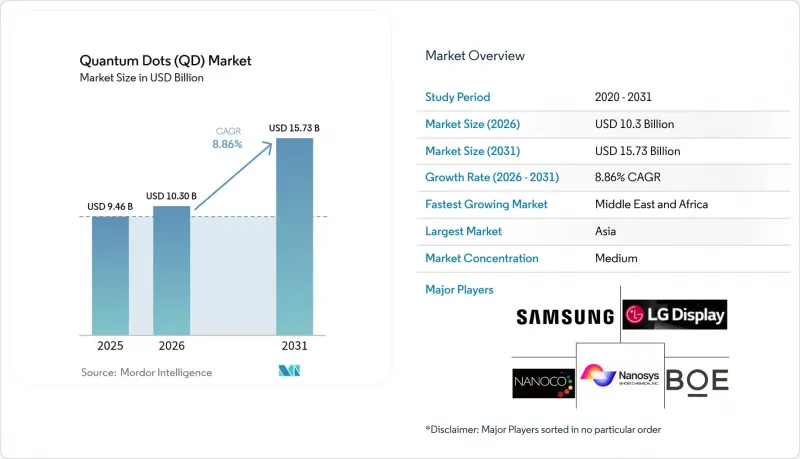
根據 Mordor Intelligence 預測,全球量子點市場規模將從 2025 年的 94.6 億美元成長到 2026 年的 103 億美元,到 2031 年將達到 157.3 億美元,2026 年至 2031 年的複合年成長率為 8.86%。
本報告材料類型(鎘基II-VI族材料(CdSe、CdS、CdTe)、無鎘III-V族材料(InP、GaAs等))、裝置形態(量子點薄膜、片上量子點等)、應用領域(顯示器、照明、太陽能電池和光伏等電子、用戶產業(家用電子電器、醫療保健和生命科學等地區進行細分。市場預測以美元計價。
全球量子點(QD)市場趨勢與洞察
中國率先在超高清電視面板中採用量子點技術。
國內面板廠商正引進高產能量子點薄膜生產線,實現超過100%的NTSC色域覆蓋率;TCL的QM6K系列憑藉其超高能量LED背光,實現了超過98%的DCI-P3色域覆蓋率和53%的亮度提升。京東方投資90億美元的第八代.6代AMOLED製造工廠計劃於2026年運作,這將進一步增強其成本優勢,並確保區域品牌的供貨。從RGB OLED向QD-OLED架構的過渡簡化了製造程序,提高了4K和8K螢幕的良率,並降低了每平方公尺的資本支出(CAPEX)。
歐盟力推針對家用電子電器。
歐盟基於RoHS指令的0.01 wt%鎘含量限制正促使一些先鋒企業轉向銅銦和磷化銦配方。 UbiQD公司獲得的2000萬美元B輪資金籌措將擴大無鎘裝置的生產規模,而應用材料公司已成功展示了在顏色轉換層中性能與鎘基元件相當的無鉛裝置。各大學正在將水相合成方法商業化,這些方法無需使用有機溶劑,並能減少製程排放,從而為採用這些方法的企業帶來成本和合規性方面的優勢。
高純度磷化銦前驅體供應鏈瓶頸
預計6G基礎設施對銦的需求將佔年產量的4%,導致磷化銦量子點供應緊張,價格上漲。蘇州大學的油墨工程合成法可將太陽能發電成本降低至0.06美元/瓦,但該方法依賴穩定的銦純度,而除少數精煉廠外,銦的供應仍然稀缺。微波輔助合成和離子液體合成法雖然減少了有害試劑的使用,但仍需要穩定的金屬原料,因此預計至少到2028年,供應風險仍將居高不下。
細分市場分析
到2025年,鎘基II-VI族化合物將佔量子點市場銷售額的47.62%,並憑藉其成熟的供應鏈和高量子產率,成為量子點市場的基礎。然而,隨著歐盟和加州政策轉向輕元素化學品,監管風險正對市場前景構成壓力。鈣鈦礦量子點正以11.28%的複合年成長率成長,從實驗室新奇事物發展成為可大規模生產的發光材料,其亮度與鎘相當,且在室溫下即可達到單光子純度,這使其在安全通訊領域的重要性日益凸顯。磷化銦平台受益於UbiQD的規模化資金籌措和應用材料公司的製程最佳化,但由於前驅體短缺,其短期市場滲透受到阻礙。矽和碳量子點正在生物醫學領域開闢新的市場,它們能夠以臨床適用劑量實現細胞毒性極低的螢光引導手術。歷史數據顯示,從 2020 年到 2024 年,鎘替代材料預計將以每年 15-20% 的速度成長,而現有鎘產品的預期成長率將低於 5%,這表明量子點市場正在發生結構性轉變。
第二代材料正在拓展終端應用範圍。石墨烯量子點與矽奈米殼融合後,已成功抑制蚜蟲數量達71%,奈米材料有望在顯示器領域以外的精密農業得到應用。鈣鈦礦發光層如今可實現140 PPI的印刷精度,使其易於整合到中型顯示器中;而矽量子點則實現了穩定的紅外光致發光,這對於穿戴式生物感測器至關重要。在供應商轉向使用毒性較低的化學品的推動下,無鎘量子點市場預計將以兩位數的速度成長。企業日益完善的ESG目標以及RoHS豁免即將到期,正在鞏固這項轉型。
預計到2025年,量子點薄膜將佔據71.35%的市場佔有率,並繼續保持主要的收入驅動力。這主要歸功於電視OEM廠商對可整合到現有LCD堆疊中的「即插即用」色彩轉換器的需求。同時,隨著半導體晶圓廠開始在晶圓代工廠平台上直接製造光子發送器,片上量子點的複合年成長率(CAGR)高達12.15%。劍橋大學開發的13000自旋量子暫存器實現了69%的保真度和130µs的相干時間,凸顯了晶片級量子節點突破的潛力。目前,利用微流體反應器生長的核殼奈米柱的尺寸變異性小於5%,這對於連貫發射至關重要。在波紋晶圓上進行電泳沉積,可以製造出無裂紋的近紅外線檢測器,為汽車雷射雷達和醫用內視鏡市場開闢了道路。隨著線寬減小達到平台期,整合光電正在實現「超越莫耳定律」的縮放,而量子點正在提供矽光電藍圖中缺少的單光子源。
擴展路徑正在分岔。採用噴墨列印技術的QD-OLED面板已在31.5吋對角線尺寸上實現了商業級良率,而動態噴射技術則正在為微型LED陣列生成微米級RGB像素。隨著量子運算效能的提升,平均售價(ASP)也隨之提高,片上量子點市場預計將會擴張。原子層沉積和原子級精度微影技術的投資將進一步提高量子點與電晶體閘極的對準精度,從而降低量子匯流排中的互連延遲。裝置OEM廠商正在整合與封裝、溫度控管和光刻對準相關的智慧財產權,以創造新的、可防禦的競爭優勢。
區域分析
亞太地區持續維持主導地位,預計2025年將佔全球銷售額的37.85%,這得益於垂直整合的面板製造商和國家層級的研發投入。三星顯示器投資109億美元轉型QD-OLED生產線,以及韓國政府4,910億美元的量子點計劃,都在強化亞太地區的生態系統。同時,中國的京東方投資90億美元建設8.6代量子點產能,以支持本地供應鏈。日本除了提升製造能力外,還專注於工藝創新,並舉辦研討會以解決毒性和耐久性等瓶頸問題。亞洲量子點市場的規模持續受到國內高階電視需求以及對北美和歐洲出口的支持。
在北美,劍橋大學(劍橋-美國聯合研究計畫)、麻省理工學院林肯實驗室和洛斯阿拉莫斯國家實驗室強大的研究資源正在推動量子安全通訊和高效太陽能發電的發展。創業投資的大力支持體現在UbiQD的2000萬美元資金籌措和IonQ的重大收購。強而有力的智慧財產權保護和聯邦政府的資助確保了商業化進程,而美國對鎘化合物更嚴格的出口限制也促使供應商開發使用磷化銦的產品。在歐洲,監管的影響力正在發揮作用。 RoHS指令的合規性推動了無鎘產品的開發,而列日大學的水溶液合成技術則減少了有害廢棄物。政府的綠色新政基金正在推廣使用量子點窗膜建造能源淨正效益建築。
中東和非洲地區以10.18%的複合年成長率位居榜首。阿拉伯聯合大公國的諾瑪中心、卡達的1000萬美元項目以及沙烏地阿拉伯的研發資金正在推動量子點計算叢集的發展,旨在實現石油經濟多元化。進口替代政策正在加速太陽能電池板和採用量子點技術的醫療設備的本地組裝。在拉丁美洲,農業技術領域的需求正在興起,採用量子點技術的溫室薄膜提高了高地農場的果樹產量,儘管市場滲透率仍低於3%。整體而言,區域收入多元化降低了集中風險。隨著中東和非洲吸收投資流入,以及西方國家開始在國內加工關鍵材料,預計2030年,亞洲的市場佔有率將略微下降至35%。
其他好處:
- Excel格式的市場預測(ME)表
- 3個月的分析師支持
目錄
第1章:引言
- 研究假設和市場定義
- 調查範圍
第2章:調查方法
第3章執行摘要
第4章 市場狀況
- 市場概覽
- 市場促進因素
- 中國在超高清電視面板中採用量子點技術方面處於領先地位。
- 歐盟為在家用電子電器中引入無鎘量子點而採取的監管措施
- 鈣鈦礦量子點在顯示器背光領域的快速商業化
- 醫學領域中利用量子點的生物成像劑的快速成長。
- 韓國政府資助的量子材料研發項目
- 市場限制因素
- 高純度磷化銦前驅體供應鏈瓶頸
- 鈣鈦礦量子點暴露於潮濕環境後性能劣化。
- 歐洲鎘排放法規的環境合規成本
- 缺乏用於量子點微型LED整合的大規模生產基礎設施
- 產業生態系分析
- 技術趨勢(生產技術)
- 波特五力分析
- 投資分析
第5章 市場規模與成長預測
- 材料類型
- 鎘基II-VI族化合物(CdSe、CdS、CdTe)
- 無鎘 III-V 族體系(InP、GaAs)
- 鈣鈦礦量子點
- 矽量子點
- 石墨烯和碳量子點
- 按設備外形規格
- 量子點薄膜
- 片上量子點
- 核心-外殼架構與殼內架構
- 透過使用
- 展示
- QD-LCD
- QD-OLED
- 微型LED整合
- 照明
- 一般照明
- 特殊照明
- 太陽能電池和光伏發電
- 醫學影像與診斷
- 藥物輸送及治療診斷學
- 感測器和測量儀器
- 量子計算與安全
- 農業和食品
- 其他
- 展示
- 按最終用途行業分類
- 家用電子產品
- 醫療保健和生命科學
- 能源與電力
- 國防與安全
- 農業
- 其他
- 按地區
- 北美洲
- 美國
- 加拿大
- 墨西哥
- 歐洲
- 德國
- 英國
- 法國
- 北歐的
- 其他歐洲國家
- 南美洲
- 巴西
- 其他南美國家
- 亞太地區
- 中國
- 日本
- 印度
- 東南亞
- 其他亞太國家
- 中東和非洲
- 中東
- 波灣合作理事會(GCC)成員國
- 土耳其
- 其他中東國家
- 非洲
- 南非
- 其他非洲國家
- 中東
- 北美洲
第6章 競爭情勢
- 市場集中度
- 策略趨勢
- 市佔率分析
- 公司簡介
- Samsung Electronics Co., Ltd.
- Nanosys Inc.
- LG Display Co., Ltd.
- BOE Technology Group Co., Ltd.
- Nanoco Group PLC
- Quantum Materials Corporation
- UbiQD, Inc.
- Ocean NanoTech LLC
- Thermo Fisher Scientific Inc.
- Merck KGaA
- Avantama AG
- Quantum Solutions Inc.
- QD Laser, Inc.
- OSRAM Licht AG
- Sony Corporation
- TCL CSOT
- Crystalplex Corporation
- Evident Technologies
- NN-Labs(NNCrystal US Corp.)
- Nanophotonica Inc.
- Quantum Science Ltd.
- Toray Industries, Inc.
第7章 市場機會與未來展望
According to Mordor Intelligence, the global quantum dots market size is expected to grow from USD 9.46 billion in 2025 to USD 10.3 billion in 2026 and is forecast to reach USD 15.73 billion by 2031 at 8.86% CAGR over 2026-2031.
This report is Segmented by Material Type (Cadmium-Based II-VI (CdSe, Cds, Cdte), Cadmium-Free III-V (InP, Gaas), and More), Device Form Factor (QD Films, On-Chip Quantum Dots, and More), Application (Displays, Lighting, Solar Cells and Photovoltaics, and More), End-Use Industry (Consumer Electronics, Healthcare and Life Sciences, and More), and Geography. The Market Forecasts are Provided in Terms of Value (USD).
Global Quantum Dots (QD) Market Trends and Insights
Quantum-dot adoption in ultra-high-definition television panels, led by China
Domestic panel makers have installed high-capacity quantum-dot film lines that deliver more than 100% NTSC color gamut, while TCL's QM6K series achieves 98%+ DCI-P3 coverage and 53% higher brightness through Super High Energy LED back-lights. BOE's USD 9 billion Gen-8.6 AMOLED facility, coming online in 2026, reinforces cost leadership and secures supply for regional brands. The shift from RGB OLED to QD-OLED architectures simplifies manufacturing, enhancing yield and lowering capex per square meter for 4K and 8K screens.
Regulatory push for cadmium-free quantum dots in EU consumer electronics
The EU's 0.01 wt% cadmium cap under RoHS is driving early movers toward copper-indium and indium-phosphide formulations. UbiQD's USD 20 million Series B round will scale cadmium-free production, while Applied Materials has proven lead-free devices matching cadmium performance in color conversion layers. Universities are commercializing aqueous synthesis routes that remove organic solvents and cut process emissions, creating cost and compliance advantages for adopters.
Supply-chain bottlenecks for high-purity indium-phosphide precursors
Indium demand from 6G infrastructure is projected to consume 4% of annual production, squeezing availability for indium-phosphide quantum dots and pushing prices higher. Soochow University's ink-engineering route lowers photovoltaic costs to USD 0.06/Wp but relies on consistent indium purity, which remains scarce outside a handful of refiners. Microwave-assisted and ionic-liquid syntheses reduce hazardous reagents yet still require secure metal feedstocks, keeping supply risk elevated through at least 2028.
Other drivers and restraints analyzed in the detailed report include:
- Rapid commercialization of perovskite quantum dots in display back-lighting
- Surge in quantum-dot bio-imaging agents in healthcare applications
- Performance degradation of perovskite quantum dots under moisture exposure
For complete list of drivers and restraints, kindly check the Table Of Contents.
Segment Analysis
Cadmium-based II-VI compounds held 47.62% of 2025 revenues, anchoring the quantum dots market through well-established supply chains and high quantum yields. Regulatory exposure, however, compresses their outlook as EU and California policies converge on lighter-element chemistries. Perovskite variants, supported by 11.28% CAGR, move from lab novelty to production-ready emitters that match cadmium brightness and achieve room-temperature single-photon purity, broadening relevance for secure communications. Indium-phosphide platforms benefit from UbiQD's scale-up funding and Applied Materials' process optimization, yet precursor shortages temper near-term penetration. Silicon and carbon quantum dots are carving biomedical niches, showing negligible cytotoxicity at clinically relevant doses and enabling fluorescence-guided surgery. Historic data reveal cadmium alternatives growing 15-20% annually versus sub-5% for cadmium incumbents from 2020-2024, signaling a structural pivot in the quantum dots market.
Second-generation materials diversify end-use reach. Graphene quantum dots fused with silicon nanoshells achieve 71% aphid-population suppression, positioning nanomaterials for precision agriculture beyond displays. Perovskite glow layers are now printable at 140 PPI, easing integration into mid-sized monitors, while silicon dots deliver stable infrared photoluminescence critical for wearable biosensors. The quantum dots market size for cadmium-free segments is projected to rise at double-digit rates, reinforcing supplier pivots toward low-toxicity chemistries. Heightened corporate ESG targets, plus upcoming RoHS exemptions sunsets, cement the transition path.
QD films remain revenue mainstays with 71.35% share in 2025, favored by television OEMs seeking plug-and-play color converters that slip into existing LCD stacks. Yet on-chip quantum dots display the highest 12.15% CAGR as semiconductor fabs capture photonic emitters directly on foundry platforms. University of Cambridge's 13,000-spin quantum register, achieving 69% fidelity at 130 µs coherence, underscores leapfrog potential for chip-scale quantum nodes. Core-shell nanopillars grown through microfluidic reactors now exhibit sub-5% size dispersion, crucial for coherent emission. Electrophoretic deposition on corrugated wafers yields crack-free near-infrared detectors, opening automotive LiDAR and medical endoscope markets. As line width reductions plateau, integrated photonics offers Moore-than-More scaling, with quantum dots supplying the single-photon sources missing from silicon photonics roadmaps.
Scaling pathways diverge. Inkjet printed QD-OLED panels already hit 31.5-inch diagonals at commercial yield, while electrohydrodynamic jetting produces micron-scale RGB pixels for microLED arrays. The quantum dots market size captured by on-chip formats is set to widen as performance gains in quantum computing justify higher ASPs. Investments in atomic-layer deposition and atomic-precision lithography will further align dot placement with transistor gateways, shrinking interconnect delays in quantum buses. Device OEMs are bundling intellectual property around packaging, thermal management, and lithographic alignment, creating new defensible moats.
Complete Report Scope:
- By Material Type
- Cadmium-based II-VI (CdSe, CdS, CdTe)
- Cadmium-Free III-V (InP, GaAs)
- Perovskite Quantum Dots
- Silicon Quantum Dots
- Graphene and Carbon Quantum Dots
- By Device Form Factor
- QD Films
- On-Chip Quantum Dots
- Core-Shell and In-Shell Architectures
- By Application
- Displays
- QD-LCD
- QD-OLED
- Micro-LED Integration
- Lighting
- General Illumination
- Specialty Lighting
- Solar Cells and Photovoltaics
- Medical Imaging and Diagnostics
- Drug Delivery and Theranostics
- Sensors and Instruments
- Quantum Computing and Security
- Agriculture and Food
- Others
- Displays
- By End-Use Industry
- Consumer Electronics
- Healthcare and Life Sciences
- Energy and Power
- Defense and Security
- Agriculture
- Others
- By Geography
- North America
- United States
- Canada
- Mexico
- Europe
- Germany
- United Kingdom
- France
- Nordics
- Rest of Europe
- South America
- Brazil
- Rest of South America
- Asia-Pacific
- China
- Japan
- India
- South-East Asia
- Rest of Asia-Pacific
- Middle East and Africa
- Middle East
- Gulf Cooperation Council Countries
- Turkey
- Rest of Middle East
- Africa
- South Africa
- Rest of Africa
- Middle East
- North America
Geography Analysis
Asia-Pacific maintains leadership with 37.85% of 2025 revenue due to vertically integrated panel makers and deliberate national R&D funding. Samsung Display's USD 10.9 billion conversion to QD-OLED lines and South Korea's KRW 491 billion quantum program cement the ecosystem, while China's BOE invests USD 9 billion in Gen-8.6 capacity that anchors local supply chains. Japan complements manufacturing heft with process innovation, hosting seminars to solve toxicity and durability bottlenecks. The quantum dots market size in Asia remains underpinned by domestic demand for premium TVs and by export flows into North America and Europe.
North America follows with deep research assets at University of Cambridge (Cambridge-US collaborations), MIT Lincoln Laboratory, and Los Alamos National Laboratory driving quantum-secure links and high-efficiency photovoltaics. Venture capital traction is robust, proven by UbiQD's USD 20 million raise and IonQ's headline acquisitions. Strong IP protection and federal funding ensure commercialization pipelines, and US export-control scrutiny over cadmium compounds nudges suppliers toward indium-phosphide builds. Europe leverages regulatory influence: RoHS compliance sparks cadmium-free adoption, while University of Liege's aqueous syntheses cut hazardous waste. Government green-deal funds deploy quantum-dot window films for energy-positive buildings.
The Middle East and Africa record the fastest 10.18% CAGR. UAE's Norma Center, Qatar's USD 10 million program, and Saudi R&D funds foster quantum-dot computing clusters, aiming to diversify oil economies. Import substitution policies encourage local assembly of QD-enhanced solar panels and medical devices. Latin America sees nascent demand in agrotechnology, where quantum-dot greenhouse sheets improve fruit yield in high-altitude farms, yet market penetration remains under 3%. Overall, geographic revenue dispersion reduces concentration risk: Asia's share inches lower toward 35% by 2030 as Middle East and Africa capture investment flows and as Western regions on-shore critical materials processing.
- Samsung Electronics Co., Ltd.
- Nanosys Inc.
- LG Display Co., Ltd.
- BOE Technology Group Co., Ltd.
- Nanoco Group PLC
- Quantum Materials Corporation
- UbiQD, Inc.
- Ocean NanoTech LLC
- Thermo Fisher Scientific Inc.
- Merck KGaA
- Avantama AG
- Quantum Solutions Inc.
- QD Laser, Inc.
- OSRAM Licht AG
- Sony Corporation
- TCL CSOT
- Crystalplex Corporation
- Evident Technologies
- NN-Labs (NNCrystal US Corp.)
- Nanophotonica Inc.
- Quantum Science Ltd.
- Toray Industries, Inc.
Additional Benefits:
- The market estimate (ME) sheet in Excel format
- 3 months of analyst support
TABLE OF CONTENTS
1 INTRODUCTION
- 1.1 Study Assumptions and Market Definition
- 1.2 Scope of the Study
2 RESEARCH METHODOLOGY
3 EXECUTIVE SUMMARY
4 MARKET LANDSCAPE
- 4.1 Market Overview
- 4.2 Market Drivers
- 4.2.1 Quantum Dot Adoption in Ultra-High-Definition Television Panels, Led by China
- 4.2.2 Regulatory Push for Cadmium-Free Quantum Dots in EU Consumer Electronics
- 4.2.3 Rapid Commercialization of Perovskite Quantum Dots in Display Back-Lighting
- 4.2.4 Surge in Quantum Dot-Based Bio-Imaging Agents in Healthcare Applications
- 4.2.5 Government-Funded Quantum-Materials R&D Programs in South Korea
- 4.3 Market Restraints
- 4.3.1 Supply-Chain Bottlenecks for High-Purity Indium-Phosphide Precursors
- 4.3.2 Performance Degradation of Perovskite QDs Under Moisture Exposure
- 4.3.3 Environmental-Compliance Costs of Cadmium Regulations in Europe
- 4.3.4 Limited Mass-Manufacturing Infrastructure for QD Micro-LED Integration
- 4.4 Industry Ecosystem Analysis
- 4.5 Technological Outlook (Production Technology)
- 4.6 Porter's Five Forces Analysis
- 4.6.1 Bargaining Power of Suppliers
- 4.6.2 Bargaining Power of Buyers
- 4.6.3 Threat of New Entrants
- 4.6.4 Threat of Substitutes
- 4.6.5 Degree of Competition
- 4.7 Investment Analysis
5 MARKET SIZE AND GROWTH FORECASTS (VALUES)
- 5.1 By Material Type
- 5.1.1 Cadmium-based II-VI (CdSe, CdS, CdTe)
- 5.1.2 Cadmium-Free III-V (InP, GaAs)
- 5.1.3 Perovskite Quantum Dots
- 5.1.4 Silicon Quantum Dots
- 5.1.5 Graphene and Carbon Quantum Dots
- 5.2 By Device Form Factor
- 5.2.1 QD Films
- 5.2.2 On-Chip Quantum Dots
- 5.2.3 Core-Shell and In-Shell Architectures
- 5.3 By Application
- 5.3.1 Displays
- 5.3.1.1 QD-LCD
- 5.3.1.2 QD-OLED
- 5.3.1.3 Micro-LED Integration
- 5.3.2 Lighting
- 5.3.2.1 General Illumination
- 5.3.2.2 Specialty Lighting
- 5.3.3 Solar Cells and Photovoltaics
- 5.3.4 Medical Imaging and Diagnostics
- 5.3.5 Drug Delivery and Theranostics
- 5.3.6 Sensors and Instruments
- 5.3.7 Quantum Computing and Security
- 5.3.8 Agriculture and Food
- 5.3.9 Others
- 5.3.1 Displays
- 5.4 By End-Use Industry
- 5.4.1 Consumer Electronics
- 5.4.2 Healthcare and Life Sciences
- 5.4.3 Energy and Power
- 5.4.4 Defense and Security
- 5.4.5 Agriculture
- 5.4.6 Others
- 5.5 By Geography
- 5.5.1 North America
- 5.5.1.1 United States
- 5.5.1.2 Canada
- 5.5.1.3 Mexico
- 5.5.2 Europe
- 5.5.2.1 Germany
- 5.5.2.2 United Kingdom
- 5.5.2.3 France
- 5.5.2.4 Nordics
- 5.5.2.5 Rest of Europe
- 5.5.3 South America
- 5.5.3.1 Brazil
- 5.5.3.2 Rest of South America
- 5.5.4 Asia-Pacific
- 5.5.4.1 China
- 5.5.4.2 Japan
- 5.5.4.3 India
- 5.5.4.4 South-East Asia
- 5.5.4.5 Rest of Asia-Pacific
- 5.5.5 Middle East and Africa
- 5.5.5.1 Middle East
- 5.5.5.1.1 Gulf Cooperation Council Countries
- 5.5.5.1.2 Turkey
- 5.5.5.1.3 Rest of Middle East
- 5.5.5.2 Africa
- 5.5.5.2.1 South Africa
- 5.5.5.2.2 Rest of Africa
- 5.5.5.1 Middle East
- 5.5.1 North America
6 COMPETITIVE LANDSCAPE
- 6.1 Market Concentration
- 6.2 Strategic Moves
- 6.3 Market Share Analysis
- 6.4 Company Profiles (includes Global level Overview, Market level overview, Core Segments, Financials as available, Strategic Information, Market Rank/Share for key companies, Products and Services, and Recent Developments)
- 6.4.1 Samsung Electronics Co., Ltd.
- 6.4.2 Nanosys Inc.
- 6.4.3 LG Display Co., Ltd.
- 6.4.4 BOE Technology Group Co., Ltd.
- 6.4.5 Nanoco Group PLC
- 6.4.6 Quantum Materials Corporation
- 6.4.7 UbiQD, Inc.
- 6.4.8 Ocean NanoTech LLC
- 6.4.9 Thermo Fisher Scientific Inc.
- 6.4.10 Merck KGaA
- 6.4.11 Avantama AG
- 6.4.12 Quantum Solutions Inc.
- 6.4.13 QD Laser, Inc.
- 6.4.14 OSRAM Licht AG
- 6.4.15 Sony Corporation
- 6.4.16 TCL CSOT
- 6.4.17 Crystalplex Corporation
- 6.4.18 Evident Technologies
- 6.4.19 NN-Labs (NNCrystal US Corp.)
- 6.4.20 Nanophotonica Inc.
- 6.4.21 Quantum Science Ltd.
- 6.4.22 Toray Industries, Inc.
7 MARKET OPPORTUNITIES AND FUTURE OUTLOOK
- 7.1 White-Space and Unmet-Need Assessment

 量子點和膠體奈米晶體市場預測至2034年-全球材料類型、成分、產品類型、合成方法、結構、應用、最終用戶和地區分析
 量子點市場:依材料、發射頻譜、溶解度和應用分類-2026-2032年全球市場預測量子點材料市場預測至2034年-按材料類型、產品類型、製造流程、應用、最終用戶和地區分類的全球分析量子點印刷材料市場預測至2034年—全球量子點材料、印刷方法、油墨配方、基材類型、應用、最終用戶和地區分析
 量子點市場報告:按製造技術、應用、材料、終端用戶產業和地區分類(2026-2034 年)
 量子點市場:按類型、應用和地區分類
 量子點市場:依產品類型、應用、國家及地區分類-全球產業分析、市場規模、市場佔有率及2025年至2032年預測
 量子點半導體油墨市場分析及預測(至2035年):依類型、產品類型、服務、技術、組件、應用、材料類型、裝置、製程、最終用戶分類量子點半導體薄膜市場分析及預測(至2035年):依類型、產品、服務、技術、組件、應用、材料類型、裝置、最終用戶及安裝類型分類量子點市場分析及預測(至2035年):依類型、產品類型、服務、技術、組件、應用、材料類型、裝置、最終用戶分類