


 |
市場調查報告書
商品編碼
2120607
智慧包裝:市場佔有率分析、產業趨勢與統計、成長預測(2026-2031)Smart Packaging - Market Share Analysis, Industry Trends & Statistics, Growth Forecasts (2026 - 2031) |
||||||

※ 本網頁內容可能與最新版本有所差異。詳細情況請與我們聯繫。
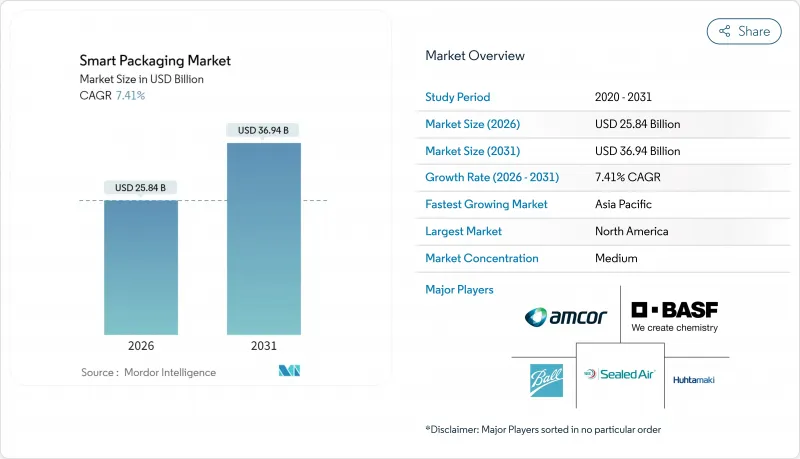
根據 Mordor Intelligence 預測,智慧包裝市場規模預計將在 2026 年達到 258.4 億美元,到 2031 年達到 369.4 億美元,預測期內複合年成長率為 7.41%。
本報告按技術(活性包裝、智慧包裝、調氣包裝)、材料(紙/紙板、塑膠、玻璃、金屬、可生物分解材料)、組件(感測器、指示器、數據載體、抗菌劑)、終端用戶產業(食品、飲料、製藥等)和地區進行細分。市場預測以美元計價。
全球智慧包裝市場趨勢及洞察
印刷電子技術的進步使得實現經濟高效的RFID和NFC標籤成為可能。
自2024年以來,採用捲對捲方式將導電油墨印刷到軟性塑膠上,已使每個標籤的成本降低了約60%,使被動式RFID的成本降至零售商認為可用於單品級追蹤的閾值美元以下。因此,服裝、化妝品甚至中等價位的消費品現在都可以被賦予唯一的標識符,從而為即時庫存儀錶板提供資訊。由於印刷電路現在可以承受標準的柔版印刷溫度,加工商可以在印刷圖形的相同印刷過程中添加天線,從而無需二次組裝步驟。智慧型手機驅動的NFC標籤正被整合到藥品泡殼包裝中,用於原產地認證和激活用藥提醒應用程式,這項舉措預計將於2025年擴展到多個歐盟市場。高階烈酒製造商也在NFC晶片中嵌入加密的批次數據,為消費者提供直接的檢驗方式,以防止盜用並提高品牌參與度。
電子商務冷鏈中對食品品質即時監控的需求日益成長。
生鮮宅配服務凸顯了「最後一公里」配送環節溫度控制的挑戰。一項2025年的研究發現,12%的冷藏商品在4°C以上停留超過30分鐘,加速了食品劣化的風險。如今,隨著基於時間和溫度的變色標籤的出現,消費者可以拒絕已變質的商品,從而降低零售商的責任風險和廢棄物。一種解決方案是將二氧化碳感測器整合到溫控托盤中,向倉庫系統發送警報,使營運商能夠將風險較高的庫存轉移到附近的門市。冷鏈營運商正擴大將這些感測器與區塊鏈帳本整合,以創建防篡改的溫度記錄,為監管機構和保險公司提供支援。這種方法已在生技藥品分銷領域得到驗證,目前正擴展到高利潤蛋白質產品和有機農產品領域。
智慧包裝生產線需要較高的初始資本投入
將感測器成型和晶片貼裝工位改造到擠出生產線上,每個工位的成本通常超過1500萬美元,這筆費用將中小型製造商拒之門外。訂單量的季節性波動會延長訂單回收期,在一些新興市場,損益平衡點甚至超過六年。科技的快速創新也帶來了設備過時的風險。即使是2024年安裝的設備,如果下一代軟性電路成為主流,也可能在完全折舊免稅額之前就被迫折舊。雖然機器製造商提供的「設備即服務」合約可以緩解初始資金需求,但在商業融資基礎設施不完善和外匯波動較大的地區,這種合約的普及程度仍然有限。
細分市場分析
到2025年,主動式智慧包裝將佔據智慧包裝市場46.54%的佔有率,其核心是氧氣吸收劑和抗菌薄膜,可有效防止肉類和烘焙食品的腐敗變質。在對低成本RFID和即時庫存追蹤的需求驅動下,智慧解決方案預計將以9.23%的複合年成長率成長。調氣包裝兼具上述功能,由於其無需數據採集功能即可延長保存期限,因此仍受到不願徹底改造設備的中型加工商的青睞。預計在2025年推出的雙功能薄膜,結合了氧氣吸收和變色成熟度指示器,象徵著技術的融合,使加工商能夠添加和銷售複雜的功能。
技術組合反映了終端用戶的需求。藥品生產商傾向於使用乾燥劑和溫度標籤來證明合規性,而消費品製造商則尋求能夠存取食譜和忠誠度計畫的NFC標籤。監管障礙也各不相同。抗菌劑需要獲得美國FDA的食品接觸許可,這會使其上市週期延長6至12個月,而RFID則無需此類許可。因此,在不受監管的類別中,RFID的普及速度超過了抗菌劑。
塑膠憑藉其靈活的加工條件和與感測器層壓材料的兼容性,預計到2025年將佔材料銷售額的42.43%。受歐洲一次性產品法規的推動,生物聚合物預計將以8.43%的複合年成長率成長,這些法規促使加工商轉向聚乳酸(PLA)和聚羥基烷酯酯(PHA)基材。這些樹脂在防潮性方面目前已與聚乙烯相當,但其較高的熔融指數需要對擠出生產線進行升級,每台生產線的成本在200萬至400萬美元之間。紙張仍然是乾貨包裝的主導材料,這得益於成熟的回收系統。一家大型紡織品製造商報告稱,到2025年,其瓦楞紙板產品的回收率將達到87%。
玻璃和金屬仍然是小眾材料,但它們正在展現出巨大的潛力。例如,採用熱致變色油墨的鋁罐試驗產品,能夠在不降低金屬廢料價值的前提下,指示飲料的理想溫度。材料策略也與供應鏈的韌性密切相關。 2024年樹脂供應中斷迫使加工商實現原料多元化,並投資於發酵衍生聚合物,儘管這會帶來20-30%的成本溢價。
區域分析
預計到2025年,北美將佔全球銷售額的39.74%。這主要得益於大型零售商早期強制採用RFID技術,以及《藥品供應鏈安全法案》(DSCSA)的全面實施,該法案強制要求所有處方藥包裝上都必須標註序號。加拿大的《加拿大食品安全條例》強制要求生鮮食品可追溯性,進一步加速了時間和溫度追蹤系統的普及。墨西哥作為近岸外包中心發揮了重要作用,隨著跨國快速消費品(FMCG)公司引入智慧標籤生產線以適應美國分銷管道,墨西哥加速了當地標籤生產能力的擴張。
預計亞太地區將呈現最高增速,到2031年複合年成長率將達9.76%。中國的「十四五」規劃已撥款5000億元人民幣用於冷鏈物流,並強制要求對疫苗進行即時溫度監控。印度製藥業佔全球學名藥產量的40%,目前正採用RFID和2D碼技術應用於出口紙箱,以符合新的國內法規。在日本,正在試行使用NFC智慧藥品管理包裝,以便在病患漏服藥物時通知看護者;在韓國,保健品的追蹤溯源範圍正在擴大。澳洲和紐西蘭已將可回收性列為強制性要求,並建議使用單基材智慧標籤,以便在分類過程中輕鬆分離。
歐洲正將永續性義務與嚴格的反仿冒措施結合。即將實施的《包裝和包裝廢棄物法規》旨在到2030年可再生或可堆肥,並推薦使用水溶性黏合劑的紙基RFID標籤。德國的《包裝法》(VerpackG)根據材料的複雜程度設定分級授權費,鼓勵品牌轉向單一材料包裝。英國的塑膠包裝稅對再生塑膠含量低於30%的產品徵收罰款,從而加速了對印刷感測器的機械回收薄膜的需求。中東和非洲地區雖然規模仍然較小,但潛力巨大。阿拉伯聯合大公國的智慧城市示範計畫和沙烏地阿拉伯的「2030願景」多元化計畫都包含用於進口生物製藥的冷鏈智慧包裝。南非目前正在強制要求抗逆轉錄病毒藥物進行序列化,這為智慧標籤的普及奠定了基礎。
其他好處:
- Excel格式的市場預測(ME)表
- 3個月的分析師支持
目錄
第1章:引言
- 研究假設和市場定義
- 調查範圍
第2章:調查方法
第3章執行摘要
第4章 市場狀況
- 市場概覽
- 市場促進因素
- 印刷電子技術的進步使得實現經濟高效的RFID和NFC標籤成為可能。
- 電子商務冷鏈中對食品品質即時監控的需求日益成長。
- 藥品供應鏈中嚴格的反仿冒法規
- 消費者偏好包含新鮮度識別的永續包裝
- 消費品品牌推出物聯網賦能的包裝,實現與消費者的直接互動。
- 智慧零售貨架的快速發展需要嵌入式智慧包裝。
- 市場限制因素
- 智慧包裝生產線的初始資本投資成本較高
- 用於多材料活性包裝的回收基礎設施有限。
- 互聯包裝收集的消費者資料引發了隱私擔憂
- 感測器整合封裝缺乏全球互通性標準
- 產業價值分析
- 監理情勢
- 技術展望
- 波特五力分析
- 投資分析
- 宏觀經濟因素對市場的影響
第5章 市場規模與成長預測
- 透過技術
- 活性包裝
- 智慧包裝
- 調氣包裝
- 材料
- 紙張和紙板
- 塑膠
- 玻璃
- 金屬
- 可生物分解聚合物
- 按組件
- 感應器
- 指數
- 資料載體
- 抗菌劑
- 按最終用戶行業分類
- 食物
- 飲料
- 製藥
- 化妝品和個人護理
- 電子設備
- 其他終端用戶產業
- 按地區
- 北美洲
- 美國
- 加拿大
- 墨西哥
- 南美洲
- 巴西
- 阿根廷
- 其他南美國家
- 歐洲
- 德國
- 英國
- 法國
- 義大利
- 西班牙
- 其他歐洲國家
- 亞太地區
- 中國
- 日本
- 印度
- 韓國
- 澳洲和紐西蘭
- 其他亞太國家
- 中東和非洲
- 中東
- 沙烏地阿拉伯
- 阿拉伯聯合大公國
- 土耳其
- 其他中東國家
- 非洲
- 南非
- 奈及利亞
- 肯亞
- 其他非洲國家
- 中東
- 北美洲
第6章 競爭情勢
- 市場集中度
- 策略趨勢
- 市佔率分析
- 公司簡介
- Sealed Air Corporation
- Amcor PLC
- Ball Corporation
- BASF SE
- Huhtamaki Oyj
- Stora Enso
- Avery Dennison Corporation
- Zebra Technologies Corporation
- 3M Company
- International Paper Company
- Smurfit WestRock
- Tetra Pak International SA
- RR Donnelley and Sons Company
- Mondi Group
- Coveris Holdings SA
- Pragmatic Semiconductor
- Thin Film Electronics ASA
- Emerson Electric Co.
第7章 市場機會與未來展望
According to Mordor Intelligence, the smart packaging market size stood at USD 25.84 billion in 2026 and is projected to reach USD 36.94 billion by 2031, reflecting a 7.41% CAGR over the forecast period.
This report is Segmented by Technology (Active Packaging, Intelligent Packaging, and Modified Atmosphere Packaging), Material (Paper and Paperboard, Plastic, Glass, Metal, and Biodegradable Materials), Component (Sensors, Indicators, Data Carriers, and Antimicrobial Agents), End-User Industry (Food, Beverage, Pharmaceuticals, and More), and Geography. The Market Forecasts are Provided in Terms of Value (USD).
Global Smart Packaging Market Trends and Insights
Advancement in Printed Electronics Enabling Cost-effective RFID and NFC Tags
Roll-to-roll printing of conductive inks on flexible plastic has reduced the per-tag cost by roughly 60% since 2024, pushing passive RFID below the USD 0.05 threshold that retailers deem viable for item-level tracking. The resulting economics allow apparel, cosmetics, and even mid-priced fast-moving goods to carry unique identifiers that feed real-time inventory dashboards. Printed circuits now survive standard flexographic temperatures, so converters add antennas during the same press pass that applies graphics, eliminating a secondary assembly stage. NFC tags, which harvest power from smartphones, are being integrated into pharmaceutical blister packs to authenticate origin and trigger dose-reminder apps, an approach that will be scaled across several EU markets in 2025. Luxury spirits producers also embed encrypted batch data in NFC chips, providing consumers with a direct verification path that deters diversion and enhances brand engagement.
Growing Demand for Real-time Food Quality Monitoring in E-commerce Cold Chains
Doorstep grocery delivery revealed gaps in last-mile temperature control. A 2025 study showed 12% of refrigerated shipments exceeded 4 °C for more than 30 minutes, accelerating spoilage risks. Color-change time-temperature labels now let shoppers reject compromised items, curbing liability for retailers and cutting waste. One solution embeds CO2 sensors in modified-atmosphere trays and transmits alerts to warehouse systems, letting operators reroute at-risk inventory to nearby stores. Cold-chain providers increasingly back these sensors with blockchain ledgers, creating immutable temperature records that assist regulators and insurers. The approach, proven in biologics distribution, is migrating to high-margin proteins and organic produce.
High Initial Capital Expenditure for Smart Packaging Production Lines
Retrofitting extrusion lines with sensor deposition and chip-placement stations often exceeds USD 15 million per site, a cost that sidelines small and mid-size converters. Payback periods lengthen when order volumes fluctuate seasonally, pushing breakeven beyond six years in some emerging markets. Rapid innovation also triggers technology-obsolescence risk; equipment installed in 2024 may face write-offs before full depreciation if next-gen flexible circuits dominate. Equipment-as-a-service contracts from machinery makers reduce upfront cash demands, yet adoption remains limited where commercial-lending ecosystems are thin and currency volatility is high.
Other drivers and restraints analyzed in the detailed report include:
- Stringent Anti-counterfeiting Regulations in Pharmaceutical Supply Chains
- Consumer Preference for Sustainable Packaging with Integrated Freshness Indicators
- Limited Recycling Infrastructure for Multi-material Active Packaging
For complete list of drivers and restraints, kindly check the Table Of Contents.
Segment Analysis
Active formats held 46.54% of smart packaging market share in 2025, anchored by oxygen scavengers and antimicrobial films that cut spoilage in meat and bakery channels. Intelligent solutions are expected to post a 9.23% CAGR, buoyed by low-cost RFID and demand for real-time inventory insight. Modified-atmosphere packaging bridges the categories, offering shelf-life gains without data capture, and remains popular with mid-tier processors hesitant to overhaul equipment. Dual-function films launched in 2025 that merge scavenging with color-changing ripeness indicators illustrate a convergence that lets converters upsell layered capabilities.
The technology mix reflects end-user priorities. Pharmaceutical shippers favor desiccants and temperature labels that document compliance, while consumer-goods producers chase NFC tags that unlock recipes or loyalty programs. Regulatory hurdles differ: antimicrobial agents require U.S. FDA food-contact clearance, adding six to twelve months to launch cycles, whereas RFID incurs no such review. As a result, RFID adoption outpaces antimicrobial roll-outs in non-regulated categories.
Plastic brought in 42.43% of material revenue in 2025 thanks to flexible processing windows and compatibility with sensor lamination. Biopolymers are set to expand at 8.43% CAGR, spurred by European single-use rules that steer converters toward polylactic acid and polyhydroxyalkanoate substrates. These resins now match polyethylene in moisture barrier, yet their higher melt index forces extrusion-line upgrades costing USD 2-4 million per unit. Paper still dominates dry-goods packs, backed by well-established recycling loops; one leading fiber company cited an 87% recovery rate for its corrugated formats in 2025.
Glass and metal remain niche but illustrate possibilities: a pilot aluminum can with thermochromic ink signals ideal drinking temperatures without compromising scrap-metal valorization. Material strategy also aligns with supply-chain resilience. Resin disruptions in 2024 pushed converters to diversify feedstocks and invest in fermentation-derived polymers despite a 20-30% cost premium.
Complete Report Scope:
- By Technology
- Active Packaging
- Intelligent Packaging
- Modified Atmosphere Packaging
- By Material
- Paper and Paperboard
- Plastic
- Glass
- Metal
- Biodegradable Polymers
- By Component
- Sensors
- Indicators
- Data Carriers
- Antimicrobial Agents
- By End-user Industry
- Food
- Beverage
- Pharmaceuticals
- Cosmetics and Personal Care
- Electronics
- Other End-user Industries
- By Geography
- North America
- United States
- Canada
- Mexico
- South America
- Brazil
- Argentina
- Rest of South America
- Europe
- Germany
- United Kingdom
- France
- Italy
- Spain
- Rest of Europe
- Asia-Pacific
- China
- Japan
- India
- South Korea
- Australia and New Zealand
- Rest of Asia-Pacific
- Middle East and Africa
- Middle East
- Saudi Arabia
- United Arab Emirates
- Turkey
- Rest of Middle East
- Africa
- South Africa
- Nigeria
- Kenya
- Rest of Africa
- Middle East
- North America
Geography Analysis
North America held a 39.74% revenue share in 2025, underpinned by early RFID mandates from big-box retailers and full DSCSA enforcement, which serialized every prescription pack. Canada's Safe Food for Canadians Regulations further spurred the adoption of time-temperature tracking by requiring traceability for fresh produce. Mexico's role as a near-shoring hub accelerated local label capacity as multinational FMCG firms installed smart-label lines to serve U.S. distribution routes.
Asia-Pacific is projected to deliver the fastest 9.76% CAGR through 2031. China's 14th Five-Year Plan earmarked CNY 500 billion for refrigerated logistics and mandated real-time temperature monitoring for vaccines. India's pharmaceutical sector, which is responsible for 40% of global generic output, now utilizes RFID and 2D codes on export cartons to comply with new domestic regulations. Japan pilots NFC-linked adherence packs that alert caregivers to missed doses, while South Korea expands track-and-trace to health supplements. Australia and New Zealand make recyclability a prerequisite, favoring mono-substrate intelligent labels that separate cleanly during sortation.
Europe combines sustainability mandates with rigorous anti-counterfeiting measures. The upcoming Packaging and Packaging Waste Regulation aims for universal recyclability or compostability by 2030, encouraging paper-based RFID labels with water-soluble adhesives. Germany's VerpackG tiers license fees by material complexity, nudging brands toward single-substrate formats. The U.K. plastic-packaging tax penalizes content with under 30% recycled resin, accelerating demand for mechanically recycled films carrying printed sensors. The Middle East and Africa remain small but show promise; United Arab Emirates smart-city pilots and Saudi Arabia's Vision 2030 diversification plan both include cold-chain smart packs for imported biologics. South Africa now requires serialization on antiretrovirals, creating a beachhead for smart labels.
- Sealed Air Corporation
- Amcor PLC
- Ball Corporation
- BASF SE
- Huhtamaki Oyj
- Stora Enso
- Avery Dennison Corporation
- Zebra Technologies Corporation
- 3M Company
- International Paper Company
- Smurfit WestRock
- Tetra Pak International SA
- R.R. Donnelley and Sons Company
- Mondi Group
- Coveris Holdings S.A.
- Pragmatic Semiconductor
- Thin Film Electronics ASA
- Emerson Electric Co.
Additional Benefits:
- The market estimate (ME) sheet in Excel format
- 3 months of analyst support
TABLE OF CONTENTS
1 INTRODUCTION
- 1.1 Study Assumptions and Market Definition
- 1.2 Scope of the Study
2 RESEARCH METHODOLOGY
3 EXECUTIVE SUMMARY
4 MARKET LANDSCAPE
- 4.1 Market Overview
- 4.2 Market Drivers
- 4.2.1 Advancement in Printed Electronics Enabling Cost-effective RFID and NFC Tags
- 4.2.2 Growing Demand for Real-time Food Quality Monitoring in E-commerce Cold Chains
- 4.2.3 Stringent Anti-counterfeiting Regulations in Pharmaceutical Supply Chains
- 4.2.4 Consumer Preference for Sustainable Packaging with Integrated Freshness Indicators
- 4.2.5 Adoption of IoT-enabled Packaging by CPG Brands for Direct-to-Consumer Engagement
- 4.2.6 Rapid Growth of Smart Retail Shelves Requiring Embedded Intelligent Packaging
- 4.3 Market Restraints
- 4.3.1 High Initial Capital Expenditure for Smart Packaging Production Lines
- 4.3.2 Limited Recycling Infrastructure for Multi-material Active Packaging
- 4.3.3 Privacy Concerns Over Consumer Data Collected via Connected Packaging
- 4.3.4 Absence of Global Interoperability Standards for Sensor-based Packaging
- 4.4 Industry Value Analysis
- 4.5 Regulatory Landscape
- 4.6 Technological Outlook
- 4.7 Porter's Five Forces Analysis
- 4.7.1 Threat of New Entrants
- 4.7.2 Bargaining Power of Buyers
- 4.7.3 Bargaining Power of Suppliers
- 4.7.4 Threat of Substitutes
- 4.7.5 Intensity of Competitive Rivalry
- 4.8 Investment Analysis
- 4.9 Impact of Macroeconomic Factors on the Market
5 MARKET SIZE AND GROWTH FORECASTS (VALUE)
- 5.1 By Technology
- 5.1.1 Active Packaging
- 5.1.2 Intelligent Packaging
- 5.1.3 Modified Atmosphere Packaging
- 5.2 By Material
- 5.2.1 Paper and Paperboard
- 5.2.2 Plastic
- 5.2.3 Glass
- 5.2.4 Metal
- 5.2.5 Biodegradable Polymers
- 5.3 By Component
- 5.3.1 Sensors
- 5.3.2 Indicators
- 5.3.3 Data Carriers
- 5.3.4 Antimicrobial Agents
- 5.4 By End-user Industry
- 5.4.1 Food
- 5.4.2 Beverage
- 5.4.3 Pharmaceuticals
- 5.4.4 Cosmetics and Personal Care
- 5.4.5 Electronics
- 5.4.6 Other End-user Industries
- 5.5 By Geography
- 5.5.1 North America
- 5.5.1.1 United States
- 5.5.1.2 Canada
- 5.5.1.3 Mexico
- 5.5.2 South America
- 5.5.2.1 Brazil
- 5.5.2.2 Argentina
- 5.5.2.3 Rest of South America
- 5.5.3 Europe
- 5.5.3.1 Germany
- 5.5.3.2 United Kingdom
- 5.5.3.3 France
- 5.5.3.4 Italy
- 5.5.3.5 Spain
- 5.5.3.6 Rest of Europe
- 5.5.4 Asia-Pacific
- 5.5.4.1 China
- 5.5.4.2 Japan
- 5.5.4.3 India
- 5.5.4.4 South Korea
- 5.5.4.5 Australia and New Zealand
- 5.5.4.6 Rest of Asia-Pacific
- 5.5.5 Middle East and Africa
- 5.5.5.1 Middle East
- 5.5.5.1.1 Saudi Arabia
- 5.5.5.1.2 United Arab Emirates
- 5.5.5.1.3 Turkey
- 5.5.5.1.4 Rest of Middle East
- 5.5.5.2 Africa
- 5.5.5.2.1 South Africa
- 5.5.5.2.2 Nigeria
- 5.5.5.2.3 Kenya
- 5.5.5.2.4 Rest of Africa
- 5.5.5.1 Middle East
- 5.5.1 North America
6 COMPETITIVE LANDSCAPE
- 6.1 Market Concentration
- 6.2 Strategic Moves
- 6.3 Market Share Analysis
- 6.4 Company Profiles (includes Global Level Overview, Market Level Overview, Core Segments, Financials as available, Strategic Information, Market Rank/Share for key companies, Products and Services, and Recent Developments)
- 6.4.1 Sealed Air Corporation
- 6.4.2 Amcor PLC
- 6.4.3 Ball Corporation
- 6.4.4 BASF SE
- 6.4.5 Huhtamaki Oyj
- 6.4.6 Stora Enso
- 6.4.7 Avery Dennison Corporation
- 6.4.8 Zebra Technologies Corporation
- 6.4.9 3M Company
- 6.4.10 International Paper Company
- 6.4.11 Smurfit WestRock
- 6.4.12 Tetra Pak International SA
- 6.4.13 R.R. Donnelley and Sons Company
- 6.4.14 Mondi Group
- 6.4.15 Coveris Holdings S.A.
- 6.4.16 Pragmatic Semiconductor
- 6.4.17 Thin Film Electronics ASA
- 6.4.18 Emerson Electric Co.
7 MARKET OPPORTUNITIES AND FUTURE OUTLOOK
- 7.1 White-space and Unmet-need Assessment

 智慧標籤、RFID 和QR碼包裝市場預測至 2034 年——按包裝類型、功能、技術、應用、最終用戶和地區分類的全球分析
 抗衝擊包裝市場規模、佔有率、成長和行業分析:按產品類型、最終用途和區域分類的預測(至2034年)互聯電商包裝市場預測至2034年-全球分析(按連接性、數位化能力、包裝形式、應用、最終用戶和地區分類)保鮮度感測型智慧包裝市場:預測至2034年-全球分析(依檢測技術、保鮮度參數、指示劑類型、食品類別、最終用戶及地區分類)
 智慧包裝市場:2026-2032年全球市場預測(按包裝類型、技術、材料、包裝層級、包裝剛性、容器類型、永續性類型、應用和最終用戶產業分類)智慧包裝市場預測(食品飲料產業,至2034年)-按包裝類型、技術類型、材料類型、應用和最終用戶分類的全球分析智慧溫度感測封裝市場預測至2034年-按組件、感測機制、技術、最終用戶、分銷管道和地區分類的全球分析氧氣監測包裝市場預測至2034年—按材料、包裝類型、功能、應用、最終用戶和地區分類的全球分析食品新鮮度監測解決方案市場預測至2034年-按技術、解決方案類型、應用、通路和最終用戶分類的全球分析互聯包裝市場預測至2034年-按類型、技術、包裝形式、功能、最終用戶和地區分類的全球分析