


 |
市場調查報告書
商品編碼
2120587
渦輪膨脹機:市場佔有率分析、產業趨勢與統計、成長預測(2026-2031)Turboexpander - Market Share Analysis, Industry Trends & Statistics, Growth Forecasts (2026 - 2031) |
||||||

※ 本網頁內容可能與最新版本有所差異。詳細情況請與我們聯繫。
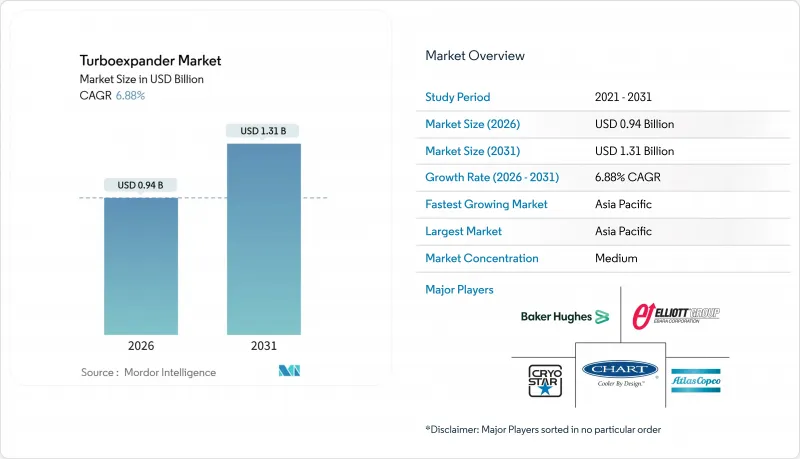
據 Mordor Intelligence 稱,2026 年渦輪膨脹機市場規模估計為 9.4 億美元,預計到 2031 年將達到 13.1 億美元,在預測期(2026-2031 年)內複合年成長率為 6.88%。
本報告按產品類型(徑向、軸向、混合配置)、負載裝置(壓縮機耦合、發電機連接、液壓/油煞車器)、功率容量(10MW 以下、40MW 以上、其他)、應用(天然氣加工/NGL 回收、氫氣/氦氣液化、其他)、天然氣用戶產業(石油和其他地區(北美、清潔能源開發商、其他地區(北美)進行。
全球渦輪膨脹機市場趨勢與洞察
由於液化天然氣設施的擴建,對渦輪膨脹機的需求增加。
卡達北田東擴建工程計畫於2026年中期運作,將安裝16套渦輪膨脹機機,每組額定功率為30-40兆瓦,以適應混合冷媒循環。阿布達比的液化天然氣產能預計到2035年將達到每年2,500萬噸,將帶來約40套新增設備的訂單。供應商佔液化設備總預算的8-10%,潛在市場規模達數十億美元。貝克休斯公司價值10億美元的里奧格蘭德液化天然氣包裝訂單,印證了渦輪膨脹機在下一代工廠佈局中的關鍵作用。 2026-2027年的緊迫工期已經為先進磁軸承(AMB)的供應鏈帶來了壓力。
管道減壓導致的能源回收項目
在美國,2024年新增了178億立方英尺/天的天然氣輸送量。超過600磅/平方英吋的壓力差使得2-5兆瓦的發電機組聯裝膨脹機能夠將先前浪費的能源轉化為效益。據能源傳輸公司(Energy Transfer)稱,每個維修項目每個站點可減少1.5萬噸二氧化碳當量排放,並且在目前的電價和碳價水平下,投資可在三年內收回。根據歐盟能源效率指令,德國和荷蘭的門站也正在進行類似的改造。
波動劇烈的石油和天然氣資本投資週期
2024年美國上游產業的現金流量較2022年的尖峰時段下降15%,採用渦輪膨脹機的天然氣處理設施擴建進度落後。 2024年海上天然氣專案的最終投資決策(FID)下降20%,訂單積壓情況持續惡化。復甦將取決於液化天然氣(LNG)銷售契約,預計到2026年底,LNG銷售合約將有所回升。
細分市場分析
受10-40兆瓦液化天然氣和空分裝置運作週期的驅動,徑向機組在2025年佔據了渦輪膨脹機市場63.1%的佔有率。預計到2031年,徑向-軸流混合式設計將以每年7.9%的速度成長,即使在部分負載條件下也能保持效率。貝克休斯收購Chart公司後,將LA Turbine的AMB徑向汽輪機與貝克休斯的壓縮機融合,實現了承包工程,縮短了現場整合時間。軸流式機組對於卡達和澳洲超過50兆瓦的大型列車仍然至關重要。
10MW以下的小型撬裝式徑向壓縮機在分散式液化天然氣和氫氣樞紐的需求量很大,工廠檢驗的包裝最大限度地減少了現場施工工作。地熱有機朗肯循環(ORC)開發人員正在採用混合架構,以在30-70%的負載波動下保持性能,這推動了25MW以下功率等級的持續需求。
到2025年,壓縮機耦合式膨脹機將佔出貨量的56.5%,這反映了它們在液化天然氣(LNG)和空分裝置(ASU)流程中的主導地位。同時,隨著管道和工業氣體運營商開始將壓力損失貨幣化並出口電力,預計到2031年,發電機耦合式膨脹機的複合年成長率將達到7.6%。德克薩斯州的一項減壓維修在2024年就節省了3,000萬美元的電力成本。
歐洲和日本的氫能發展藍圖要求引入併網發電機以降低寄生負載。整合電力電子設備的承包撬裝系統現已上市,可在40週內交付,從而降低缺乏內部電氣工程專業知識的業主的工程成本。
區域分析
到2025年,亞太地區將佔全球銷售額的36.6%,預計將維持7.3%的複合年成長率,主要得益於中國新建空氣分離裝置(ASU)的運作、印度對綠色氫能的補貼以及日本液化中心的擴建。此外,印尼和菲律賓也將新增採用15-25兆瓦膨脹機的地熱有機朗肯循環(ORC)設施。
到2025年,北美將佔全球需求的約30%,主要驅動力來自頁岩氣加工、液化天然氣訂單終端以及減壓過程中的能源回收。貝克休斯公司價值10億美元的里奧格蘭德液化天然氣訂單以及能源傳輸公司50兆瓦發電機組維修項目,都顯示了該領域的持續成長動能。
歐洲和中東合計約佔總量的30%。阿布達比國家石油公司(ADNOC)和卡達能源公司的Megatrain公司正在主導採購高功率設備,而歐盟營運商則根據能源效率義務對管道進行維修。在南美洲和非洲,海上天然氣和地熱領域的部署規模有限,但仍面臨資金籌措成本的限制。
其他福利
- Excel格式的市場預測(ME)表
- 3個月的分析師支持
目錄
第1章:引言
- 研究假設和市場定義
- 調查範圍
第2章:調查方法
第3章執行摘要
第4章 市場狀況
- 市場概覽
- 市場促進因素
- 由於液化天然氣設施的擴建,對渦輪膨脹機的需求增加。
- 由於管道減壓而能源回收項目
- 亞太地區正經歷空氣分離裝置建設的蓬勃發展。
- 氫氣液化中低溫無油膨脹機的必要性。
- 利用微型渦輪膨脹機實現礦井入口墊層設備的電氣化
- 在地熱和有機朗肯循環廢熱項目中採用膨脹式發電機
- 市場限制因素
- 波動劇烈的石油和天然氣資本投資週期
- 與JT閥門相比,初始成本更高
- AMB組件供應瓶頸
- 在氫氣濃度超過 20% 的環境中,其可靠性未經證實。
- 供應鏈分析
- 監理情勢
- 技術展望
- 波特五力模型
第5章 市場規模與成長預測
- 依產品類型
- 徑向渦輪膨脹機
- 軸流式渦輪膨脹機
- 混合配置
- 透過負載裝置
- 壓縮機耦合膨脹機
- 發電機連接擴充器
- 液壓/油煞車(發電機)單元
- 按功率容量
- 10兆瓦或以下
- 10~20MW
- 20~40MW
- 超過40兆瓦
- 透過使用
- 天然氣處理及液化天然氣回收
- 液化天然氣液化和預處理
- 空氣分離和工業氣體
- 減壓過程中的能源回收
- 用於地熱和廢熱利用的有機再生中心(ORC)
- 氫氣和氦氣的液化
- 按最終用戶行業分類
- 石油和天然氣
- 化工/石油化工
- 發電
- 工業製造
- 清潔能源開發公司
- 按地區
- 北美洲
- 美國
- 加拿大
- 墨西哥
- 歐洲
- 德國
- 法國
- 英國
- 義大利
- 西班牙
- 北歐國家
- 俄羅斯
- 其他歐洲國家
- 亞太地區
- 中國
- 印度
- 日本
- 韓國
- ASEAN
- 澳洲和紐西蘭
- 其他亞太國家
- 南美洲
- 巴西
- 阿根廷
- 智利
- 其他南美國家
- 中東和非洲
- 沙烏地阿拉伯
- 阿拉伯聯合大公國
- 南非
- 埃及
- 其他中東和非洲國家
- 北美洲
第6章 競爭情勢
- 市場集中度
- 策略趨勢(併購、聯盟、購電協議)
- 市場佔有率分析(主要公司的市場排名和佔有率)
- 公司簡介
- Atlas Copco AB
- Baker Hughes Co.
- Cryostar SAS
- Chart Industries(LA Turbine)
- Air Products & Chemicals Inc.(Rotoflow)
- EllIoTt Group
- Nikkiso ACD
- PBS Group
- Sapphire Technologies(Calnetix)
- Siemens Energy
- MAN Energy Solutions
- Barber-Nichols
- R&D Dynamics
- Simms Machinery
- Turbomachinery Solutions
- Howden Group
- Atlas Copco Rental(Expanders)
- Calnetix Technologies
- Rotoflow Aftermarket Services
- Concept NREC
第7章 市場機會與未來展望
According to Mordor Intelligence, the turboexpander market size is estimated at USD 0.94 billion in 2026, and is expected to reach USD 1.31 billion by 2031, at a CAGR of 6.88% during the forecast period (2026-2031).
This report is Segmented by Product Type (Radial, Axial, and Hybrid), Loading Device (Compressor-Coupled, Generator-Coupled, and Hydraulic/Oil-Brake), Power Capacity (Up To 10 MW, Above 40 MW, and More), Application (Natural Gas Processing and NGL Recovery, Hydrogen and Helium Liquefaction, and More), End-User (Oil and Gas, Clean Energy Developers, and More), and Geography (North America, Asia-Pacific, and More)
Global Turboexpander Market Trends and Insights
LNG Capacity Build-Out Drives Cryogenic Turboexpander Demand
Qatar's North Field East expansion, targeting mid-2026 start-up, will install 16 cryogenic turboexpander trains rated 30-40 MW each to handle mixed-refrigerant cycles. Abu Dhabi LNG capacity is slated to reach 25 mtpa by 2035, implying orders for roughly 40 additional units. Suppliers capture 8-10% of total liquefaction equipment budgets, translating into a multi-billion-dollar addressable spend. Baker Hughes' USD 1 billion Rio Grande LNG package validates turboexpanders' indispensability in next-generation layouts. Tight delivery windows in 2026-2027 are already stretching advanced magnetic-bearing (AMB) supply chains.
Pipeline Pressure-Letdown Energy-Recovery Projects
The United States added 17.8 bcf/d of takeaway capacity in 2024; pressure differentials exceeding 600 psi allow 2-5 MW generator-coupled expanders to monetize wasted energy. Energy Transfer reports each retrofit displaces 15,000 tCO2e per site and yields payback in under three years at prevailing power and carbon prices. The EU's Energy Efficiency Directive is pushing similar conversions at German and Dutch gate stations.
Volatile Oil-and-Gas CAPEX Cycles
U.S. upstream cash flow in 2024 was 15% below 2022 peaks, delaying gas-processing expansions that employ turboexpanders. FIDs on offshore gas projects declined 20% in 2024, elongating order books. Recovery depends on LNG offtake contracts expected to firm by late 2026.
Other drivers and restraints analyzed in the detailed report include:
- APAC Air-Separation Plant Construction Boom
- Hydrogen Liquefaction Needs Ultra-Cold Oil-Free Expanders
- High Upfront Cost versus J-T Valves
For complete list of drivers and restraints, kindly check the Table Of Contents.
Segment Analysis
Radial units captured 63.1% of the 2025 Turboexpander market share, driven by 10-40 MW LNG and ASU duty points. Hybrid radial-axial designs will grow 7.9% annually by 2031, preserving efficiency under part-load conditions. Baker Hughes' Chart acquisition blends L.A. Turbine AMB radials with Baker Hughes compressors, enabling turnkey trains that shorten site integration. Axial models remain indispensable above 50 MW for Qatar and Australia mega-trains.
Smaller, skid-mounted radials below 10 MW are rising in distributed LNG and hydrogen hubs, where factory-tested packages minimize site work. Geothermal ORC developers adopt hybrid architectures to maintain performance across 30-70% load swings, reinforcing sustained demand in the sub-25 MW bracket.
Compressor-coupled expanders held 56.5% of 2025 shipments, reflecting their dominance in LNG and ASU flowsheets. Generator-coupled units, however, will post a 7.6% CAGR to 2031 as pipeline and industrial-gas operators monetize pressure losses and export power. A single Texas pressure-letdown retrofit saved USD 30 million in 2024 power costs.
European and Japanese hydrogen roadmaps call for grid-synchronized generators to reduce parasitic loads. Turnkey skids integrating power electronics now ship in under 40 weeks, lowering engineering overheads for owners without in-house electrical expertise.
Complete Report Scope:
- By Product Type
- Radial Turboexpanders
- Axial Turboexpanders
- Hybrid Configurations
- By Loading Device
- Compressor-Coupled Expanders
- Generator-Coupled Expanders
- Hydraulic/Oil-Brake (Dyno) Units
- By Power Capacity
- Up to 10 MW
- 10 to 20 MW
- 20 to 40 MW
- Above 40 MW
- By Application
- Natural Gas Processing and NGL Recovery
- LNG Liquefaction and Pretreatment
- Air Separation and Industrial Gases
- Pressure-Letdown Energy Recovery
- Geothermal and Waste-Heat ORC
- Hydrogen and Helium Liquefaction
- By End-User Industry
- Oil and Gas
- Chemical and Petrochemicals
- Power Generation
- Industrial Manufacturing
- Clean Energy Developers
- By Geography
- North America
- United States
- Canada
- Mexico
- Europe
- Germany
- France
- United Kingdom
- Italy
- Spain
- NORDIC Countries
- Russia
- Rest of Europe
- Asia-Pacific
- China
- India
- Japan
- South Korea
- ASEAN Countries
- Australia and New Zealand
- Rest of Asia-Pacific
- South America
- Brazil
- Argentina
- Chile
- Rest of South America
- Middle East and Africa
- Saudi Arabia
- United Arab Emirates
- South Africa
- Egypt
- Rest of Middle East and Africa
- North America
Geography Analysis
Asia-Pacific, holding 36.6% of 2025 sales, will maintain a 7.3% CAGR as China commissions new ASUs, India subsidizes green hydrogen, and Japan scales liquefaction hubs. Indonesia and the Philippines add geothermal ORC capacity using 15-25 MW expanders.
North America delivered roughly 30% of 2025 demand, anchored by shale-gas processing, LNG export terminals, and pressure-letdown energy recovery. Baker Hughes' USD 1 billion Rio Grande LNG order and Energy Transfer's 50 MW of generator-coupled retrofits highlight enduring momentum.
Europe and the Middle East together contribute about 30% of the total. ADNOC and QatarEnergy mega-trains dominate high-power procurements, while EU operators retrofit pipelines under energy-efficiency mandates. South America and Africa register selective uptake in offshore gas and geothermal, but remain constrained by financing costs.
- Atlas Copco AB
- Baker Hughes Co.
- Cryostar SAS
- Chart Industries (L.A. Turbine)
- Air Products & Chemicals Inc. (Rotoflow)
- Elliott Group
- Nikkiso ACD
- PBS Group
- Sapphire Technologies (Calnetix)
- Siemens Energy
- MAN Energy Solutions
- Barber-Nichols
- R&D Dynamics
- Simms Machinery
- Turbomachinery Solutions
- Howden Group
- Atlas Copco Rental (Expanders)
- Calnetix Technologies
- Rotoflow Aftermarket Services
- Concept NREC
Additional Benefits:
- The market estimate (ME) sheet in Excel format
- 3 months of analyst support
TABLE OF CONTENTS
1 Introduction
- 1.1 Study Assumptions & Market Definition
- 1.2 Scope of the Study
2 Research Methodology
3 Executive Summary
4 Market Landscape
- 4.1 Market Overview
- 4.2 Market Drivers
- 4.2.1 LNG capacity build-out drives cryogenic turboexpander demand
- 4.2.2 Pipeline pressure-letdown energy-recovery projects
- 4.2.3 APAC air-separation plant construction boom
- 4.2.4 Hydrogen liquefaction needs ultra-cold oil-free expanders
- 4.2.5 Wellhead micro-turboexpanders electrify pad equipment
- 4.2.6 Geothermal & ORC waste-heat projects adopt expander-generators
- 4.3 Market Restraints
- 4.3.1 Volatile oil-&-gas CAPEX cycles
- 4.3.2 High upfront cost vs J-T valves
- 4.3.3 AMB component supply bottlenecks
- 4.3.4 Unproven reliability in >20 % H2 service
- 4.4 Supply-Chain Analysis
- 4.5 Regulatory Landscape
- 4.6 Technological Outlook
- 4.7 Porter's Five Forces
- 4.7.1 Threat of New Entrants
- 4.7.2 Bargaining Power of Suppliers
- 4.7.3 Bargaining Power of Buyers
- 4.7.4 Threat of Substitutes
- 4.7.5 Competitive Rivalry
5 Market Size & Growth Forecasts
- 5.1 By Product Type
- 5.1.1 Radial Turboexpanders
- 5.1.2 Axial Turboexpanders
- 5.1.3 Hybrid Configurations
- 5.2 By Loading Device
- 5.2.1 Compressor-Coupled Expanders
- 5.2.2 Generator-Coupled Expanders
- 5.2.3 Hydraulic/Oil-Brake (Dyno) Units
- 5.3 By Power Capacity
- 5.3.1 Up to 10 MW
- 5.3.2 10 to 20 MW
- 5.3.3 20 to 40 MW
- 5.3.4 Above 40 MW
- 5.4 By Application
- 5.4.1 Natural Gas Processing and NGL Recovery
- 5.4.2 LNG Liquefaction and Pretreatment
- 5.4.3 Air Separation and Industrial Gases
- 5.4.4 Pressure-Letdown Energy Recovery
- 5.4.5 Geothermal and Waste-Heat ORC
- 5.4.6 Hydrogen and Helium Liquefaction
- 5.5 By End-User Industry
- 5.5.1 Oil and Gas
- 5.5.2 Chemical and Petrochemicals
- 5.5.3 Power Generation
- 5.5.4 Industrial Manufacturing
- 5.5.5 Clean Energy Developers
- 5.6 By Geography
- 5.6.1 North America
- 5.6.1.1 United States
- 5.6.1.2 Canada
- 5.6.1.3 Mexico
- 5.6.2 Europe
- 5.6.2.1 Germany
- 5.6.2.2 France
- 5.6.2.3 United Kingdom
- 5.6.2.4 Italy
- 5.6.2.5 Spain
- 5.6.2.6 NORDIC Countries
- 5.6.2.7 Russia
- 5.6.2.8 Rest of Europe
- 5.6.3 Asia-Pacific
- 5.6.3.1 China
- 5.6.3.2 India
- 5.6.3.3 Japan
- 5.6.3.4 South Korea
- 5.6.3.5 ASEAN Countries
- 5.6.3.6 Australia and New Zealand
- 5.6.3.7 Rest of Asia-Pacific
- 5.6.4 South America
- 5.6.4.1 Brazil
- 5.6.4.2 Argentina
- 5.6.4.3 Chile
- 5.6.4.4 Rest of South America
- 5.6.5 Middle East and Africa
- 5.6.5.1 Saudi Arabia
- 5.6.5.2 United Arab Emirates
- 5.6.5.3 South Africa
- 5.6.5.4 Egypt
- 5.6.5.5 Rest of Middle East and Africa
- 5.6.1 North America
6 Competitive Landscape
- 6.1 Market Concentration
- 6.2 Strategic Moves (M&A, Partnerships, PPAs)
- 6.3 Market Share Analysis (Market Rank/Share for key companies)
- 6.4 Company Profiles (includes Global level Overview, Market level overview, Core Segments, Financials as available, Strategic Information, Products & Services, and Recent Developments)
- 6.4.1 Atlas Copco AB
- 6.4.2 Baker Hughes Co.
- 6.4.3 Cryostar SAS
- 6.4.4 Chart Industries (L.A. Turbine)
- 6.4.5 Air Products & Chemicals Inc. (Rotoflow)
- 6.4.6 Elliott Group
- 6.4.7 Nikkiso ACD
- 6.4.8 PBS Group
- 6.4.9 Sapphire Technologies (Calnetix)
- 6.4.10 Siemens Energy
- 6.4.11 MAN Energy Solutions
- 6.4.12 Barber-Nichols
- 6.4.13 R&D Dynamics
- 6.4.14 Simms Machinery
- 6.4.15 Turbomachinery Solutions
- 6.4.16 Howden Group
- 6.4.17 Atlas Copco Rental (Expanders)
- 6.4.18 Calnetix Technologies
- 6.4.19 Rotoflow Aftermarket Services
- 6.4.20 Concept NREC
7 Market Opportunities & Future Outlook
- 7.1 White-Space & Unmet-Need Assessment


