


 |
市場調查報告書
商品編碼
2120571
住宅太陽能:市場佔有率分析、產業趨勢與統計及成長預測(2026-2031 年)Residential Solar Energy - Market Share Analysis, Industry Trends & Statistics, Growth Forecasts (2026 - 2031) |
||||||

※ 本網頁內容可能與最新版本有所差異。詳細情況請與我們聯繫。
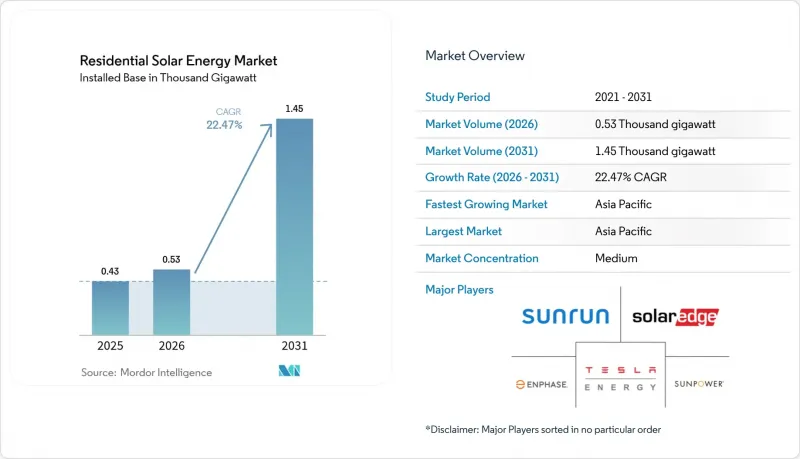
據 Mordor Intelligence 稱,2025 年住宅太陽能市場價值為 430 吉瓦,預計到 2026 年將達到 530 吉瓦,到 2031 年將達到 1450 吉瓦,在預測期(2026-2031 年)內複合年成長率為 22.47%。
本報告按技術(單晶PERC、N型TOPCon/HJT、其他)、安裝類型(屋頂光伏、整合式太陽能屋頂瓦)、併網類型(併網、離網、混合)和地區(北美、歐洲、亞太、南美、中東和非洲)進行細分。市場規模和預測均以裝置容量(GW)為基礎。
全球住宅太陽能市場趨勢及洞察
降低模組和BOS成本
預計到2024年,組件價格將降至每瓦0.20美元以下,並在2027年達到每瓦0.15美元,這得益於中國工廠持續擴張帶來的規模經濟效益。這主要歸功於N型TOPCon生產線目前26.5%的生產效率,以及高功率組件帶來的陣列面積縮小,從而降低了安裝硬體和人事費用。逆變器單價去年又下降了15%,標準化接線套件的推廣進一步降低了軟成本。這些因素共同作用,使得平準化度電成本(LCOE)低於全球超過60%家庭適用的住宅電費,使屋頂太陽能從一種奢侈品轉變為一種常見的家用電器。效率的提高也延長了屋頂的使用壽命,這對於安裝面積有限的都市區住宅至關重要。晶科能源位於山西的56GW工廠充分展現了大規模生產如何持續降低價格。
「通膨控制法」類型的獎勵浪潮正在美國以外蔓延。
美國30%的聯邦投資稅額扣抵在全球範圍內催生了類似的計劃。歐洲的REPowerEU計畫已撥款2,100億歐元用於可再生能源,而德國則恢復了上網電價補貼政策,並取消了太陽能設備的增值稅,以加速屋頂太陽能發電的普及。在日本,目前對配備電池儲能系統的太陽能發電系統提供每千瓦7萬日元的補貼;在澳洲維多利亞州,太陽能家庭補貼計畫為每個家庭提供1,400澳元的補貼。政策制定者正在建立機制,隨著設備成本的下降逐步減少這些獎勵,並借鑒了美國逐步從補貼轉向市場經濟的模式。這波全球同步的政策浪潮,既加速了當前的安裝量成長,也為未來實現成本平價後不再依賴補貼的成長創造了空間。隨著獎勵的普及,安裝商正憑藉成熟的資金籌措和供應鏈模式拓展到新的地區,從而增強規模經濟效益,並形成良性循環,最終進一步降低成本。
利率環境波動導致客戶獲取成本上升。
貨幣政策的快速緊縮導致30年期太陽能貸款利率從2022年的4.5%上升至2024年的7.8%,削弱了消費者透過融資安裝太陽能系統所獲得的提案。為因應這一局面,貸款機構提高了最低首付要求,收緊了信貸標準,並延長了銷售週期,導致客戶獲取成本增加了35%。購買計劃被推遲,尤其是在電費相對較低的地區,以及依賴長期貸款的細分市場,包括許多首次購房者。雖然大規模安裝商透過證券化獲得了低利率,但中小承包商卻缺乏類似的資金籌措,這加劇了市場競爭的多樣性。在利率波動趨於穩定之前,現金銷售和租賃將暫時再次變得具有吸引力,這將導致產品組合發生變化,並給經銷商的營運資金帶來壓力。
細分市場分析
儘管單晶PERC組件在2025年佔據了住宅太陽能市場83.32%的佔有率,但由於效率提升帶來的屋頂能量密度增加,預計到2031年,N型TOPCon組件的出貨量將以23.86%的複合年成長率成長。這種轉變將擴大住宅太陽能市場,使其更青睞價格更高的產品,這些產品無需增加安裝面積即可提高發電量。
在日益同質化的PERC市場中,製造商正轉向TOPCon以維持獲利能力。憑藉更高的加工能力和晶圓良率,TOPCon的單位成本趨於一致,定價可與PERC相近。此外,TOPCon還能額外提升1-2個百分點的效率,大幅縮短空間受限的都市區住宅的投資回收期。晶科能源在鈣鈦礦疊層結構中創下的33.24%的效率紀錄,凸顯了TOPCon未來的成長潛力,並鞏固了其作為下一代電池架構主流平台的地位。儘管薄膜和多晶材料等替代技術仍佔據著一定的市場地位,但TOPCon如今已成為高階市場的基礎,並推動組件製造商的長期研發藍圖。
區域分析
北美地區擁有完善的資金籌措管道和成熟的安裝商網路,預計到2025年將佔全球住宅太陽能市場銷售額的34.62%。去年獲得的超過30億美元的融資額度表明,機構投資者對屋頂太陽能的現金流充滿信心。隨著聯邦稅額扣抵抵免政策即將取消以及淨計量改革的推進,家庭用戶越來越迫切地需要在獎勵到期前完成安裝,儘管政策不確定性,但預計短期內安裝量仍將保持強勁成長。
亞太地區預計將以28.65%的複合年成長率實現最高成長,快速的都市化、不斷上漲的電費以及雄心勃勃的脫碳目標預計將推動該地區住宅太陽能市場的擴張。中國正利用其國內製造業優勢,在一線城市安裝高密度太陽能板;印度則透過簡化併網規定,打破了此前受繁瑣手續阻礙的住宅市場;日本則著重推廣屋頂太陽能系統與儲能系統的結合,以增強抗震能力,並為可在停電期間作為備用電源的混合系統提供補貼。
歐洲前景依然強勁,歐盟再生能源計畫(REPowerEU)的資金注入成員國項目,促成了增值稅(VAT)的取消和上網電價補貼(FIT)機制的最佳化調整。德國在政策調整後,居民用電需求正在復甦;西班牙則得益於充足的日照和穩定的監管環境,裝機量維持穩定。北歐國家面臨冬季日照減少的挑戰,正加速採用季節性儲能解決方案。在整個歐盟範圍內,強制性可追溯性使能夠證明多晶矽來源並非新疆的供應商獲得優勢,從而影響採購決策,並引領住宅太陽能產業走向供應鏈多元化。
其他福利
- Excel格式的市場預測(ME)表
- 3個月的分析師支持
目錄
第1章:引言
- 研究假設和市場定義
- 調查範圍
第2章:調查方法
第3章執行摘要
第4章 市場狀況
- 市場概覽
- 市場促進因素
- 降低模組和BOS成本
- 「通膨控制法」類型的獎勵浪潮正在美國以外蔓延。
- 零售電價飆升和對停電的擔憂
- 一個日趨成熟的住宅太陽能貸款證券化平台
- 與電動車充電器相容的家庭能源生態系統
- 利用P2P區塊鏈進行能源交易的試點項目
- 市場限制因素
- 利率環境波動導致客戶獲取成本上升。
- 突然取消淨計量政策(例如,加州的 NEM 3.0 等)
- 對多晶矽供應相關的 ESG 因素的審查正在抑制高階市場的需求。
- 大都會地區的建築公司人手不足和授權流程繁瑣的問題。
- 供應鏈分析
- 監理情勢
- 技術展望
- 波特五力模型
第5章 市場規模與成長預測
- 透過技術
- 單晶PERC
- N型TOPCon/HJT
- 多晶
- 薄膜(CdTe、CIGS)
- 新興鈣鈦礦串聯結構
- 按安裝類型
- 屋頂太陽能發電
- 建築一體化太陽能屋頂瓦
- 按網格類型
- 併網
- 離網
- 混合式(太陽能發電+儲能+電網)
- 按地區
- 北美洲
- 美國
- 加拿大
- 墨西哥
- 歐洲
- 英國
- 德國
- 法國
- 西班牙
- 北歐國家
- 俄羅斯
- 其他歐洲國家
- 亞太地區
- 中國
- 印度
- 日本
- 韓國
- 馬來西亞
- 泰國
- 印尼
- 越南
- 澳洲
- 其他亞太國家
- 南美洲
- 巴西
- 阿根廷
- 哥倫比亞
- 其他南美國家
- 中東和非洲
- 阿拉伯聯合大公國
- 沙烏地阿拉伯
- 南非
- 埃及
- 其他中東和非洲國家
- 北美洲
第6章 競爭情勢
- 市場集中度
- 策略趨勢(併購、聯盟、購電協議)
- 市場佔有率分析(主要公司的市場排名和市場佔有率)
- 公司簡介
- Sunrun Inc.
- Tesla Energy
- SunPower Corp.
- Enphase Energy
- SolarEdge Technologies
- Trina Solar
- JinkoSolar
- Canadian Solar
- LONGi Green Energy
- JA Solar
- Hanwha Q Cells
- REC Group
- First Solar
- Panasonic Energy
- SMA Solar Technology
- Fronius International
- ABB Power Conversion
- GoodWe Technologies
- Fronius International
- LG Energy Solution(ESS)
第7章 市場機會與未來展望
According to Mordor Intelligence, the residential solar energy market size was valued at 0.43 Thousand gigawatt in 2025 and estimated to grow from 0.53 Thousand gigawatt in 2026 to reach 1.45 Thousand gigawatt by 2031, at a CAGR of 22.47% during the forecast period (2026-2031).
This report is Segmented by Technology (Monocrystalline PERC, N-Type TOPCon/HJT, and More), Installation Type (Rooftop-Mounted PV and Building-Integrated Solar Roof Tiles), Grid Type (On-Grid, Off-Grid, and Hybrid), and Geography (North America, Europe, Asia-Pacific, South America, and Middle East and Africa). The Market Sizes and Forecasts are Provided in Terms of Installed Capacity (GW).
Global Residential Solar Energy Market Trends and Insights
Declining Module & BOS Costs
Module prices slid below USD 0.20 per W in 2024 and are tracking toward USD 0.15 per W by 2027, anchored by China's ongoing factory expansions that unlock economies of scale. Coupled with 26.5% production efficiencies now possible in N-type TOPCon lines, higher-power modules shrink array footprints and reduce mounting hardware and labor needs. Inverter unit costs fell another 15% last year, while standardized wiring kits trimmed soft costs. The aggregate impact lowers the levelized cost of electricity beneath residential tariffs that apply to more than 60% of global households, turning rooftop solar from a premium add-on into a mainstream household appliance. Elevated efficiency also prolongs roof-space relevance, a critical advantage for urban homes with limited surface area. JinkoSolar's 56 GW Shanxi facility underscores how large-scale manufacturing continues to compress prices.
IRA-Style Incentive Waves Spreading Beyond the US
The United States' 30% federal investment tax credit catalyzed parallel programs worldwide. Europe's REPowerEU earmarked EUR 210 billion for renewables, while Germany re-introduced feed-in tariffs and scrapped VAT on solar hardware to jump-start rooftop adoption. Japan now offers JPY 70,000 per kW for storage-paired arrays, and Australia's Victoria Solar Homes rebate provides AUD 1,400 per household. Policymakers structure these incentives to phase down in tandem with falling equipment costs, borrowing the US blueprint of gradually converting subsidies into market-based economics. The synchronized policy wave accelerates installation volumes today and creates future headroom for unsubsidized growth once parity is achieved. As incentives spread, installers enter new regions with proven finance and supply-chain models, reinforcing scale benefits that feed back into cost decline.
Volatile Interest-Rate Environment Inflating Customer Acquisition Costs
Rapid monetary tightening lifted 30-year solar-loan coupons from 4.5% in 2022 to 7.8% in 2024, eroding the consumer value proposition for financed systems. Lenders responded by raising down-payment thresholds, tightening credit filters, lengthening sales cycles, and pushing customer acquisition costs up 35%. Market segments reliant on long-tenor loans, including many first-time buyers, deferred purchases, especially in regions where electricity tariffs are moderate. Larger installers secure lower rates via securitizations, but smaller contractors lack similar funding breadth, narrowing competitive diversity. Until rate volatility subsides, cash sales and leases regain temporary attractiveness, altering product mixes and stressing dealer working capital.
Other drivers and restraints analyzed in the detailed report include:
- Spike in Retail Power Prices & Grid-Outage Anxiety
- EV-Charger-Ready Home Energy Ecosystems
- Sudden Net-Metering Policy Roll-Backs
For complete list of drivers and restraints, kindly check the Table Of Contents.
Segment Analysis
Monocrystalline PERC modules dominated the residential solar energy market share with 83.32% in 2025, but N-type TOPCon shipments are forecast to post a 23.86% CAGR through 2031 as efficiency gains translate into higher roof-level energy density. This shift broadens the residential solar energy market size for premium-priced products that add generation without expanding the array footprint.
Manufacturers pivot to TOPCon to defend margins in an increasingly commoditized PERC landscape. Unit-cost convergence-helped by higher throughput and better wafer yields-allows TOPCon to approach PERC pricing while adding 1-2 percentage points of efficiency to shorten payback periods materially in space-constrained urban dwellings. JinkoSolar's record 33.24% perovskite-tandem result underscores the pathway to future gains and solidifies TOPCon as the mainstream platform for next-generation cell architectures. While thin-film and polycrystalline alternatives persist in niche roles, TOPCon now anchors the premium tier and guides long-run R&D roadmaps for module makers.
Complete Report Scope:
- By Technology
- Monocrystalline PERC
- N-type TOPCon/HJT
- Polycrystalline
- Thin-film (CdTe, CIGS)
- Emerging Perovskite Tandems
- By Installation Type
- Rooftop-mounted PV
- Building-integrated solar roof tiles
- By Grid Type
- On-grid
- Off-grid
- Hybrid (PV + Storage + Grid)
- By Geography
- North America
- United States
- Canada
- Mexico
- Europe
- United Kingdom
- Germany
- France
- Spain
- Nordic Countries
- Russia
- Rest of Europe
- Asia-Pacific
- China
- India
- Japan
- South Korea
- Malaysia
- Thailand
- Indonesia
- Vietnam
- Australia
- Rest of Asia-Pacific
- South America
- Brazil
- Argentina
- Colombia
- Rest of South America
- Middle East and Africa
- United Arab Emirates
- Saudi Arabia
- South Africa
- Egypt
- Rest of Middle East and Africa
- North America
Geography Analysis
North America retained 34.62% of the global residential solar energy market revenue in 2025, buoyed by sophisticated financing and mature installer networks. Last year, securing loan vehicles totaling over USD 3 billion signaled institutional faith in rooftop cash-flows. Even so, the pending elimination of the federal tax credit and spreading net-metering reforms create strategic urgency for households to install before incentives lapse, sustaining near-term volume despite policy uncertainty.
Asia-Pacific is projected to deliver the fastest 28.65% CAGR, expanding the regional residential solar energy market size through rapid urbanization, rising electricity tariffs, and proactive decarbonization goals. China capitalizes on domestic manufacturing dominance to deploy high-density arrays in tier-one cities, while India's streamlined interconnection rules open residential segments previously hindered by bureaucracy. Japan emphasizes storage-paired rooftops to bolster earthquake resilience, subsidizing hybrid systems that promise backup power during grid interruptions.
Europe's outlook remains resilient as REPowerEU funds cascade into member-state programs that remove VAT and fine-tune feed-in tariffs. Germany's policy reset revived household demand, and Spain's abundant irradiation pairs with regulatory stability to sustain installations. Nordic countries, facing winter irradiance dips, are early adopters of seasonal storage solutions. Across the bloc, traceability mandates elevate suppliers able to verify non-Xinjiang polysilicon sourcing, shaping procurement decisions and nudging the residential solar energy industry toward diversified supply chains.
- Sunrun Inc.
- Tesla Energy
- SunPower Corp.
- Enphase Energy
- SolarEdge Technologies
- Trina Solar
- JinkoSolar
- Canadian Solar
- LONGi Green Energy
- JA Solar
- Hanwha Q Cells
- REC Group
- First Solar
- Panasonic Energy
- SMA Solar Technology
- Fronius International
- ABB Power Conversion
- GoodWe Technologies
- Fronius International
- LG Energy Solution (ESS)
Additional Benefits:
- The market estimate (ME) sheet in Excel format
- 3 months of analyst support
TABLE OF CONTENTS
1 Introduction
- 1.1 Study Assumptions & Market Definition
- 1.2 Scope of the Study
2 Research Methodology
3 Executive Summary
4 Market Landscape
- 4.1 Market Overview
- 4.2 Market Drivers
- 4.2.1 Declining module & BOS costs
- 4.2.2 Inflation Reduction Act-style incentive waves spreading beyond the US
- 4.2.3 Spike in retail power prices & grid-outage anxiety
- 4.2.4 Maturing residential solar loan securitization platforms
- 4.2.5 EV-charger-ready home energy ecosystems
- 4.2.6 Peer-to-peer blockchain energy trading pilots
- 4.3 Market Restraints
- 4.3.1 Volatile interest-rate environment inflating customer acquisition costs
- 4.3.2 Sudden net-metering policy roll-backs (e.g., CA NEM 3.0)
- 4.3.3 Polysilicon-supply ESG scrutiny limiting premium-segment demand
- 4.3.4 Installer labour & permitting bottlenecks in key metros
- 4.4 Supply-Chain Analysis
- 4.5 Regulatory Landscape
- 4.6 Technological Outlook
- 4.7 Porter's Five Forces
- 4.7.1 Bargaining Power of Suppliers
- 4.7.2 Bargaining Power of Buyers
- 4.7.3 Threat of New Entrants
- 4.7.4 Threat of Substitutes
- 4.7.5 Competitive Rivalry
5 Market Size & Growth Forecasts
- 5.1 By Technology
- 5.1.1 Monocrystalline PERC
- 5.1.2 N-type TOPCon/HJT
- 5.1.3 Polycrystalline
- 5.1.4 Thin-film (CdTe, CIGS)
- 5.1.5 Emerging Perovskite Tandems
- 5.2 By Installation Type
- 5.2.1 Rooftop-mounted PV
- 5.2.2 Building-integrated solar roof tiles
- 5.3 By Grid Type
- 5.3.1 On-grid
- 5.3.2 Off-grid
- 5.3.3 Hybrid (PV + Storage + Grid)
- 5.4 By Geography
- 5.4.1 North America
- 5.4.1.1 United States
- 5.4.1.2 Canada
- 5.4.1.3 Mexico
- 5.4.2 Europe
- 5.4.2.1 United Kingdom
- 5.4.2.2 Germany
- 5.4.2.3 France
- 5.4.2.4 Spain
- 5.4.2.5 Nordic Countries
- 5.4.2.6 Russia
- 5.4.2.7 Rest of Europe
- 5.4.3 Asia-Pacific
- 5.4.3.1 China
- 5.4.3.2 India
- 5.4.3.3 Japan
- 5.4.3.4 South Korea
- 5.4.3.5 Malaysia
- 5.4.3.6 Thailand
- 5.4.3.7 Indonesia
- 5.4.3.8 Vietnam
- 5.4.3.9 Australia
- 5.4.3.10 Rest of Asia-Pacific
- 5.4.4 South America
- 5.4.4.1 Brazil
- 5.4.4.2 Argentina
- 5.4.4.3 Colombia
- 5.4.4.4 Rest of South America
- 5.4.5 Middle East and Africa
- 5.4.5.1 United Arab Emirates
- 5.4.5.2 Saudi Arabia
- 5.4.5.3 South Africa
- 5.4.5.4 Egypt
- 5.4.5.5 Rest of Middle East and Africa
- 5.4.1 North America
6 Competitive Landscape
- 6.1 Market Concentration
- 6.2 Strategic Moves (M&A, Partnerships, PPAs)
- 6.3 Market Share Analysis (Market Rank/Share for key companies)
- 6.4 Company Profiles (includes Global level Overview, Market level overview, Core Segments, Financials as available, Strategic Information, Products & Services, and Recent Developments)
- 6.4.1 Sunrun Inc.
- 6.4.2 Tesla Energy
- 6.4.3 SunPower Corp.
- 6.4.4 Enphase Energy
- 6.4.5 SolarEdge Technologies
- 6.4.6 Trina Solar
- 6.4.7 JinkoSolar
- 6.4.8 Canadian Solar
- 6.4.9 LONGi Green Energy
- 6.4.10 JA Solar
- 6.4.11 Hanwha Q Cells
- 6.4.12 REC Group
- 6.4.13 First Solar
- 6.4.14 Panasonic Energy
- 6.4.15 SMA Solar Technology
- 6.4.16 Fronius International
- 6.4.17 ABB Power Conversion
- 6.4.18 GoodWe Technologies
- 6.4.19 Fronius International
- 6.4.20 LG Energy Solution (ESS)
7 Market Opportunities & Future Outlook
- 7.1 White-space & unmet-need assessment

 住宅太陽能市場預測至2034年—按系統類型、技術、安裝方式、應用、所有權方式、分銷管道和地區分類的全球分析
 住宅太陽能套件市場分析及預測(至2035年):類型、產品類型、服務、技術、組件、應用、最終用戶、安裝配置、解決方案
 2026-2034年全球住宅太陽能發電EPC市場規模、佔有率、趨勢和成長分析報告
 住宅太陽能電站市場按設備類型、系統類型、安裝類型和最終用戶分類,全球預測(2026-2032)住宅太陽能市場-2026-2031年預測
 住宅太陽能系統市場-全球產業規模、佔有率、趨勢、機會和預測,依產品類型(太陽能板、太陽能逆變器和太陽能電池)、服務、地區和競爭格局分類,2021-2031年預測
 全球住宅太陽能 EPC(工程、採購和施工)服務市場
 住宅太陽能光電市場機會、成長動力、產業趨勢分析及2025-2034年預測