


 |
市場調查報告書
商品編碼
2120540
毫米波技術:市場佔有率分析、行業趨勢和統計數據、成長預測(2026-2032)Millimeter Wave Technology - Market Share Analysis, Industry Trends & Statistics, Growth Forecasts (2026 - 2032) |
||||||

※ 本網頁內容可能與最新版本有所差異。詳細情況請與我們聯繫。
根據 Mordor Intelligence 預測,毫米波技術市場將從 2025 年的 45.2 億美元成長到 2026 年的 56.1 億美元,然後在 2032 年達到 205 億美元,2026 年至 2032 年的複合年成長率為 24.11%。
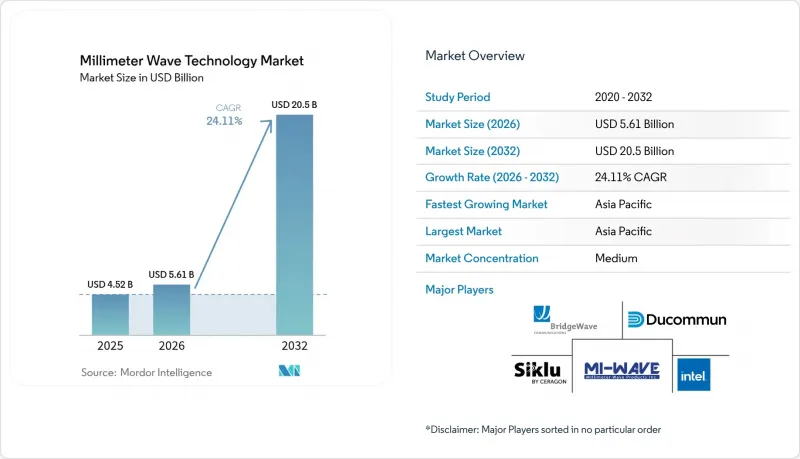
本報告按組件(天線和收發器、通訊和網路積體電路、介面和控制積體電路、頻率產生器和濾波器等)、授權模式(完全授權/部分授權和免授權)、頻段(24–57 GHz、57–95 GHz、95–300 GHz)、應用(通訊基礎設施、無線存取和消費設備、無線存取和消費設備、進行固定。
全球毫米波技術市場趨勢與洞察
5G網路密度不斷增加以及對小型基地台回程傳輸的需求
電信業者很快就意識到,當小型基地台密度超過城市規劃限制時,光纖傳輸的經濟效益就會下降。因此,他們採用了60 GHz和E波段無線鏈路,使得站點間的連接在幾週內而非幾個月內即可實現。在中國、美國和印度的現場試驗證實了多Gigabit的吞吐量,顯示毫米波回程傳輸可以取代高成本的明挖式佈線。目前,供應商正在整合軟體定義波束控制技術以縮短調整時間,而城市管理部門也在簡化屋頂安裝許可程序,以加快基地台運作。更高的資本效率和更短的上市時間使無線回程傳輸成為毫米波技術市場的基礎。
24-100 GHz 頻段的行動和固定無線資料流量增加。
固定無線用戶的資料通訊消耗量是行動用戶的五倍之多,這迫使營運商為住宅閘道分配連續的28GHz頻段。監管機構正在透過統一70/80/90GHz頻段的監管規定來應對這項挑戰,從而實現更寬的通道頻寬。晶片組製造商也紛紛發布了整合人工智慧技術的第二代CPE平台,用於鏈路最佳化。這些進展正在推動本地寬頻部署計劃,並刺激毫米波技術市場的需求。
在高於 100 GHz 的頻率下,射頻前端的溫度控管成為一項挑戰。
隨著頻率的增加,熱集中程度會異常升高,導致氮化鎵元件的結溫變得不穩定。雖然採用鑽石基板和微流體冷卻的先進封裝技術正在逐漸普及,但這些方法會增加材料成本並延長認證週期。在可擴展的溫度控管解決方案出現之前,短期部署將主要集中在100 GHz以下,將減緩毫米波技術市場高頻寬的成長。
細分市場分析
預計到2031年,影像感測器將以24.86%的複合年成長率(CAGR)實現最高成長,因為兆赫成像技術能夠實現腫瘤學和燒燙傷評估中的無標定組織診斷。相比之下,天線和收發器預計將在2025年保持37.55%的最大市場佔有率,為行動基地台提供無線前端。隨著醫院採用非電離診斷工具,毫米波成像感測器技術市場預計到2031年將超過32.5億美元。通訊和網路積體電路的互補成長得益於大型基地台的高密度部署,而介面和控制積體電路則受益於片上雷達整合技術的發展。
NTT的研發突破,例如在300GHz頻率下產生280Gbps訊號,正在改善鏈路預算並刺激對可變頻率合成器的需求。同時,隨著整合商對更高功率密度的需求,主要由先進基板和導熱界面材料組成的「其他組件」也日益增多。因此,支撐毫米波技術市場的組件堆疊正在不斷擴展。
到2025年,完全或部分授權的頻段將佔銷售額的77.20%,這反映了無干擾運行在通訊大型基地台和國防網路中的附加價值。然而,95 GHz以上的免許可頻段正以25.60%的複合年成長率快速成長,因為監管機構制定了工業場所檢測規則,最大限度地減少了文書工作。中小企業正利用這一簡化的監管框架部署工廠雷達,用於機器人和品質檢測,從而為毫米波技術市場帶來新的收入來源。
供應商目前正在部署雙模晶片組,這些晶片組能夠自動偵測法規環境並即時調整EIRP設置,從而消除了部署的一大障礙。雖然授權頻寬對於關鍵任務通訊鏈路仍然至關重要,但免執照頻段的激增正在擴大整體目標市場。
區域分析
預計到2025年,亞太地區將佔全球收入的41.60%,並在2031年之前以27.20%的複合年成長率成長,這主要得益於中國440萬個5G基站的建設以及印度FWA技術的快速部署。亞太地區各國政府都在為5G先進技術的研究投入公共資金,契約製造也正在投資建造氮化鎵晶圓生產線,以實現供應鏈的在地化。在日本的私人5G模式下,由於安裝場地的複雜性,毫米波的部署進展緩慢,但目前正在企業園區試點部署60GHz頻段的室內網路,用於擴增實境(AR)培訓。
在北美,頻率政策正與產業創新相協調,釋放出37 GHz和70/80/90 GHz頻段,同時《晶片和整合產品法案》(CHIPS Act)也為國內半導體製造企業提供獎勵。國防雷達升級和固定無線網路部署支撐著龐大的基本客群,而諾基亞和T-Mobile等夥伴關係則確保了多年的設備供應管道。在加拿大,農村寬頻示範計畫中毫米波技術的應用進一步擴大了毫米波技術市場。
歐洲已成為技術試驗場。德國正在支持6G測試平台和微電子叢集,監管機構正在製定42GHz頻段的競標條款,並優先考慮製造業創新。德國汽車製造商(OEM)對汽車雷達的需求推動了與專業晶片製造商的合作,而英國正在探索利用60GHz頻段建立交通基礎設施的通訊鏈路。中東正在投資智慧城市試點項目,南非正在進行28GHz頻段固定無線接入(FWA)的試驗,巴西則推出了毫米波CPE組裝的稅收優惠政策。儘管這些新興市場的銷售額貢獻仍處於個位數,但它們的成長速度超過了成熟市場,為毫米波技術市場注入了活力。
其他好處:
- Excel格式的市場預測(ME)表
- 3個月的分析師支持
目錄
第1章:引言
- 研究假設和市場定義
- 調查範圍
第2章:調查方法
第3章執行摘要
第4章 市場狀況
- 市場概覽
- 市場促進因素
- 5G網路密度不斷增加以及對小型基地台回程傳輸的需求
- 24-100 GHz 頻段的行動和固定無線資料流量增加。
- 放寬40GHz以上頻段的限制並進行新的頻譜競標
- 將國防雷達升級到 94 GHz,以實現低延遲目標捕獲。
- 最後50米的室內毫米波光纖替代方案
- 122 GHz頻段工業存在檢測新法規的發展趨勢
- 市場限制因素
- 100 GHz 以上頻段射頻前端溫度控管的局限性
- 大規模生產中相位陣列的高成本校準
- 市政當局高密度地塊上與「街道設施」相關的分區挑戰。
- 氮化鎵晶片供應鏈中的集中風險
- 價值供應鏈分析
- 監理情勢
- 技術展望
- 氮化鎵在毫米波應用的重要性
- 毫米波基板發展趨勢:LCP、PI 和 PTFE 對 5G 硬體的影響
- 波特五力分析
- 新冠疫情影響評估
第5章 市場規模與成長預測
- 按組件
- 天線和收發器
- 用於通訊和網路的積體電路
- 介面和控制積體電路
- 頻率發生器和濾波器
- 影像感測器
- 其他規則
- 通過許可模式
- 完整/部分許可
- 無許可證
- 按頻段
- 24~57 GHz
- 57~95 GHz
- 95~300 GHz
- 透過使用
- 通訊基礎設施(無線存取網和回程傳輸)
- 行動和消費設備
- 固定無線接入(FWA)
- 雷達和安全成像
- 汽車ADAS和V2X
- 工業自動化和工業物聯網
- 醫學和生命科學領域的診斷影像
- 航太和國防領域的通訊
- 其他用途
- 按地區
- 北美洲
- 美國
- 加拿大
- 墨西哥
- 南美洲
- 巴西
- 阿根廷
- 其他南美國家
- 歐洲
- 英國
- 德國
- 法國
- 義大利
- 俄羅斯
- 其他歐洲國家
- 亞太地區
- 中國
- 日本
- 印度
- 韓國
- 其他亞太國家
- 中東和非洲
- 中東
- 阿拉伯聯合大公國
- 沙烏地阿拉伯
- 土耳其
- 其他中東國家
- 非洲
- 奈及利亞
- 南非
- 其他非洲國家
- 中東
- 北美洲
第6章 競爭情勢
- 市場集中度
- 策略趨勢
- 市佔率分析
- 公司簡介
- Anokiwave Inc.
- Aviat Networks
- Broadcom Inc.
- BridgeWave Communications(REMEC)
- Ducommun Incorporated
- Eravant(SAGE Millimeter)
- Farran Technology
- Huawei Technologies
- Intel Corporation
- Keysight Technologies
- L3Harris Technologies
- Millimeter Wave Products Inc.
- NEC Corporation
- Nokia Corporation
- NXP Semiconductors
- Qualcomm Technologies
- Samsung Electronics
- Sivers Semiconductors
- Siklu Communication(Ceragon)
- Smiths Interconnect
- Vubiq Networks
第7章 市場機會與未來展望
According to Mordor Intelligence, the millimeter wave technology market size is expected to grow from USD 4.52 billion in 2025 to USD 5.61 billion in 2026 and is forecast to reach USD 20.5 billion by 2032 at 24.11% CAGR over 2026-2032.
This report is Segmented by Component (Antennas and Transceivers, Communications and Networking ICs, Interface and Control ICs, Frequency Generation and Filters, and More), Licensing Model (Fully/Partly Licensed and Unlicensed), Frequency Band (24-57 GHz, 57-95 GHz, and 95-300 GHz), Application (Telecom Infrastructure, Mobile and Consumer Devices, Fixed Wireless Access, and More), and Geography.
Global Millimeter Wave Technology Market Trends and Insights
5G network densification and small-cell backhaul demand
Operators quickly discover that fiber becomes uneconomical when small-cell density exceeds urban zoning caps, so 60 GHz and E-band radio links are adopted to connect sites within weeks instead of months. Field trials in China, the United States, and India deliver multi-gigabit throughput, confirming that millimeter-wave backhaul can substitute for high-cost trenching activities. Equipment vendors now integrate software-defined beam steering to reduce alignment time, while urban authorities streamline rooftop permitting to accelerate site activation. Capital efficiency and time-to-market gains make wireless backhaul a cornerstone of the millimeter wave technology market.
Rising mobile and fixed-wireless data traffic in 24-100 GHz bands
Fixed-wireless customers consume up to five times the data of mobile subscribers, forcing operators to allocate contiguous 28 GHz blocks to residential gateways. Regulatory agencies respond by harmonizing 70/80/90 GHz rules to enable wider channels, and chipset makers have announced second-generation CPE platforms with integrated AI for link optimization. These advances support rural broadband programs and stimulate demand across the millimeter wave technology market.
RF front-end thermal management limits above 100 GHz
Heat concentration rises disproportionately as frequency increases, pushing gallium-nitride devices toward junction temperatures that degrade reliability. Advanced packaging using diamond substrates and micro-fluidic cooling is under evaluation, yet these approaches add material cost and prolong qualification cycles. Until scalable thermal solutions emerge, near-term deployments will cluster below 100 GHz, tempering the millimeter wave technology market's upper-band growth.
Other drivers and restraints analyzed in the detailed report include:
- Spectrum liberalization and new auctions above 40 GHz
- Defense radar upgrades to 94 GHz
- High-cost phased-array calibration in volume production
For complete list of drivers and restraints, kindly check the Table Of Contents.
Segment Analysis
Imaging Sensors deliver the fastest 24.86% CAGR through 2031, as terahertz imaging enables label-free tissue diagnosis in oncology and burn assessment. In contrast, Antennas and Transceivers preserve the largest 37.55% share in 2025 by supplying radio front-ends for mobile base stations. The millimeter wave technology market size for Imaging Sensors is expected to cross USD 3.25 billion by 2031 as hospitals adopt non-ionizing diagnostic tools. Complementary growth in Communication and Networking ICs arises from densified macro-cell deployments, while Interface and Control ICs ride the trend toward radar-on-chip integration.
R&D breakthroughs such as NTT's 280 Gbps signal generation at 300 GHz improve link budgets and stimulate demand for frequency-agile synthesizers. Meanwhile, Other Components, chiefly advanced substrates and thermal interface materials, gain visibility as integrators seek higher power density. The result is a broadening component stack that anchors the millimeter wave technology market.
Fully or Partly Licensed spectrum delivered 77.20% of 2025 revenue, reflecting the premium attached to interference-free operations in telecom macro cells and defense networks. However, unlicensed allocations above 95 GHz advance at 25.60% CAGR as regulators create industrial presence-sensing rules that require minimal paperwork. SMEs leverage the simplified regime to deploy factory-floor radar for robotics and quality inspection, adding fresh revenue streams to the millimeter wave technology market.
Vendors now introduce dual-mode chipsets that auto-detect regulatory environments and adjust EIRP settings in real time, removing a key adoption barrier. Licensed spectrum will remain critical for mission-critical links, yet the unlicensed surge broadens the overall addressable base.
Complete Report Scope:
- By Component
- Antennas and Transceivers
- Communication and Networking ICs
- Interface and Control ICs
- Frequency Generation and Filters
- Imaging Sensors
- Other Components
- By Licensing Model
- Fully/Partly Licensed
- Unlicensed
- By Frequency Band
- 24-57 GHz
- 57-95 GHz
- 95-300 GHz
- By Application
- Telecom Infrastructure (RAN and backhaul)
- Mobile and Consumer Devices
- Fixed Wireless Access (FWA)
- Radar and Security Imaging
- Automotive ADAS and V2X
- Industrial Automation and IIoT
- Medical and Life-Sciences Imaging
- Aerospace and Defense Communications
- Other Applications
- By Geography
- North America
- United States
- Canada
- Mexico
- South America
- Brazil
- Argentina
- Rest of South America
- Europe
- United Kingdom
- Germany
- France
- Italy
- Russia
- Rest of Europe
- Asia-Pacific
- China
- Japan
- India
- South Korea
- Rest of Asia-Pacific
- Middle East and Africa
- Middle East
- United Arab Emirates
- Saudi Arabia
- Turkey
- Rest of Middle East
- Africa
- Nigeria
- South Africa
- Rest of Africa
- Middle East
- North America
Geography Analysis
Asia Pacific commands 41.60% of 2025 revenue and is forecast to grow at 27.20% CAGR through 2031, propelled by China's 4.4 million 5G base stations and India's rapid FWA penetration. Regional governments allocate public funds to 5G-Advanced research, and contract manufacturers invest in gallium-nitride wafer lines to localize supply. Japan's private 5G model shows slower mmWave uptake due to site-acquisition complexity, but corporate campuses are piloting 60 GHz indoor networks for AR training.
North America aligns spectrum policy with industrial innovation, releasing 37 GHz and 70/80/90 GHz bands while channeling CHIPS-Act incentives toward domestic fabs. Defense radar upgrades and fixed-wireless deployments underpin a resilient customer base, and partnerships such as Nokia-T-Mobile secure multi-year equipment pipelines. Canada adopts mmWave for rural broadband pilots, further expanding the millimeter wave technology market.
Europe positions itself as a technology laboratory. Germany supports 6G testbeds and micro-electronics clusters, and regulators craft 42 GHz auction terms that prioritize manufacturing innovation. Automotive radar demand from German OEMs drives collaboration with specialist chipmakers, while the UK explores 60 GHz transport-infrastructure links. The Middle East invests in smart-city proof-of-concepts, South Africa pilots 28 GHz FWA, and Brazil introduces targeted tax breaks for mmWave CPE assembly. Although revenue contributions from these emerging markets remain single-digit, growth rates surpass mature regions, adding dynamism to the millimeter wave technology market.
- Anokiwave Inc.
- Aviat Networks
- Broadcom Inc.
- BridgeWave Communications (REMEC)
- Ducommun Incorporated
- Eravant (SAGE Millimeter)
- Farran Technology
- Huawei Technologies
- Intel Corporation
- Keysight Technologies
- L3Harris Technologies
- Millimeter Wave Products Inc.
- NEC Corporation
- Nokia Corporation
- NXP Semiconductors
- Qualcomm Technologies
- Samsung Electronics
- Sivers Semiconductors
- Siklu Communication (Ceragon)
- Smiths Interconnect
- Vubiq Networks
Additional Benefits:
- The market estimate (ME) sheet in Excel format
- 3 months of analyst support
TABLE OF CONTENTS
1 INTRODUCTION
- 1.1 Study Assumptions and Market Definition
- 1.2 Scope of the Study
2 RESEARCH METHODOLOGY
3 EXECUTIVE SUMMARY
4 MARKET LANDSCAPE
- 4.1 Market Overview
- 4.2 Market Drivers
- 4.2.1 5G network densification and small-cell backhaul demand
- 4.2.2 Rising mobile and fixed-wireless data traffic in 24-100 GHz bands
- 4.2.3 Spectrum liberalisation and new auctions above 40 GHz
- 4.2.4 Defense radar upgrades to 94 GHz for low-latency targeting
- 4.2.5 Indoor millimetre-wave FWA for last-50-metre fibre substitution
- 4.2.6 Emerging 122 GHz industrial presence-sensing regulations
- 4.3 Market Restraints
- 4.3.1 RF front-end thermal management limits above 100 GHz
- 4.3.2 High-cost phased-array calibration in volume production
- 4.3.3 Municipal "street-furniture" zoning hurdles for dense sites
- 4.3.4 Gallium-nitride wafer supply chain concentration risk
- 4.4 Value/Supply-Chain Analysis
- 4.5 Regulatory Landscape
- 4.6 Technological Outlook
- 4.6.1 Significance of GaN across mmWave applications
- 4.6.2 mmWave substrate landscape: LCP, PI, PTFE impact on 5G HW
- 4.7 Porter's Five Forces Analysis
- 4.7.1 Bargaining Power of Suppliers
- 4.7.2 Bargaining Power of Buyers
- 4.7.3 Threat of New Entrants
- 4.7.4 Intensity of Competitive Rivalry
- 4.7.5 Threat of Substitutes
- 4.8 COVID-19 Impact Assessment
5 MARKET SIZE AND GROWTH FORECASTS (VALUE)
- 5.1 By Component
- 5.1.1 Antennas and Transceivers
- 5.1.2 Communication and Networking ICs
- 5.1.3 Interface and Control ICs
- 5.1.4 Frequency Generation and Filters
- 5.1.5 Imaging Sensors
- 5.1.6 Other Components
- 5.2 By Licensing Model
- 5.2.1 Fully/Partly Licensed
- 5.2.2 Unlicensed
- 5.3 By Frequency Band
- 5.3.1 24-57 GHz
- 5.3.2 57-95 GHz
- 5.3.3 95-300 GHz
- 5.4 By Application
- 5.4.1 Telecom Infrastructure (RAN and backhaul)
- 5.4.2 Mobile and Consumer Devices
- 5.4.3 Fixed Wireless Access (FWA)
- 5.4.4 Radar and Security Imaging
- 5.4.5 Automotive ADAS and V2X
- 5.4.6 Industrial Automation and IIoT
- 5.4.7 Medical and Life-Sciences Imaging
- 5.4.8 Aerospace and Defense Communications
- 5.4.9 Other Applications
- 5.5 By Geography
- 5.5.1 North America
- 5.5.1.1 United States
- 5.5.1.2 Canada
- 5.5.1.3 Mexico
- 5.5.2 South America
- 5.5.2.1 Brazil
- 5.5.2.2 Argentina
- 5.5.2.3 Rest of South America
- 5.5.3 Europe
- 5.5.3.1 United Kingdom
- 5.5.3.2 Germany
- 5.5.3.3 France
- 5.5.3.4 Italy
- 5.5.3.5 Russia
- 5.5.3.6 Rest of Europe
- 5.5.4 Asia-Pacific
- 5.5.4.1 China
- 5.5.4.2 Japan
- 5.5.4.3 India
- 5.5.4.4 South Korea
- 5.5.4.5 Rest of Asia-Pacific
- 5.5.5 Middle East and Africa
- 5.5.5.1 Middle East
- 5.5.5.1.1 United Arab Emirates
- 5.5.5.1.2 Saudi Arabia
- 5.5.5.1.3 Turkey
- 5.5.5.1.4 Rest of Middle East
- 5.5.5.2 Africa
- 5.5.5.2.1 Nigeria
- 5.5.5.2.2 South Africa
- 5.5.5.2.3 Rest of Africa
- 5.5.5.1 Middle East
- 5.5.1 North America
6 COMPETITIVE LANDSCAPE
- 6.1 Market Concentration
- 6.2 Strategic Moves
- 6.3 Market Share Analysis
- 6.4 Company Profiles (includes Global level Overview, Market level overview, Core Segments, Financials, Strategic Information, Market Rank/Share, Products and Services, Recent Developments)
- 6.4.1 Anokiwave Inc.
- 6.4.2 Aviat Networks
- 6.4.3 Broadcom Inc.
- 6.4.4 BridgeWave Communications (REMEC)
- 6.4.5 Ducommun Incorporated
- 6.4.6 Eravant (SAGE Millimeter)
- 6.4.7 Farran Technology
- 6.4.8 Huawei Technologies
- 6.4.9 Intel Corporation
- 6.4.10 Keysight Technologies
- 6.4.11 L3Harris Technologies
- 6.4.12 Millimeter Wave Products Inc.
- 6.4.13 NEC Corporation
- 6.4.14 Nokia Corporation
- 6.4.15 NXP Semiconductors
- 6.4.16 Qualcomm Technologies
- 6.4.17 Samsung Electronics
- 6.4.18 Sivers Semiconductors
- 6.4.19 Siklu Communication (Ceragon)
- 6.4.20 Smiths Interconnect
- 6.4.21 Vubiq Networks
7 MARKET OPPORTUNITIES AND FUTURE OUTLOOK
- 7.1 White-space and Unmet-Need Assessment


