


 |
市場調查報告書
商品編碼
2120535
雲端加密軟體:市場佔有率分析、產業趨勢與統計、成長預測(2026-2031)Cloud Encryption Software - Market Share Analysis, Industry Trends & Statistics, Growth Forecasts (2026 - 2031) |
||||||

※ 本網頁內容可能與最新版本有所差異。詳細情況請與我們聯繫。
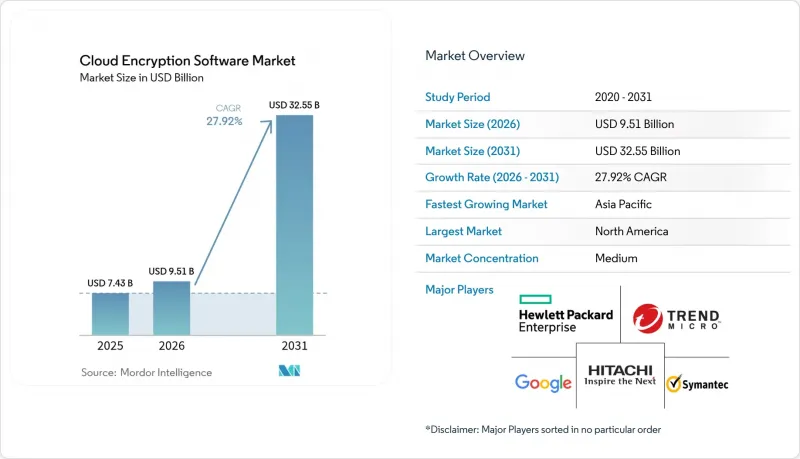
據 Mordor Intelligence 稱,雲端加密軟體市場預計到 2026 年價值 95.1 億美元,高於 2025 年的 74.3 億美元,預計到 2031 年將達到 325.5 億美元。
預計從 2026 年到 2031 年,其複合年成長率將達到 27.92%。
本報告按加密類型(對稱加密、非對稱加密/PKI 及其他)、應用領域(靜態資料、傳輸資料及其他)、組織規模(大型企業、中小企業)、產業(銀行、金融服務和保險 (BFSI)、醫療保健和生命科學、教育、零售和電子商務及其他)以及地區進行細分。市場預測以美元 (USD) 為單位。
全球雲端加密軟體市場趨勢與洞察
加強資料保護條例
世界各國都在通過法規提高安全標準。將於2025年3月生效的PCI DSS 4.0將強制要求所有擁有者環境進行年度加密審查和多因素身份驗證。歐洲的《數位營運彈性法案》和NIS 2指令要求銀行和關鍵基礎設施在2030年前實施抗量子加密。在美國,《量子計算和網路安全準備法案》要求聯邦機構過渡到NIST批准的後量子演算法,私營部門也正在效仿。 FedRAMP已經強制要求所有聯邦政府雲端服務使用FIPS 140-2認證的模組,這使得合規性成為進入市場的實際要求。由於2002年的《家庭教育權利和隱私法案》(FERPA)並未預料到學生資料儲存在雲端,因此即使是大學也在加強其管理系統,並實施高於法定最低標準的加密措施。
針對雲端的複雜網路攻擊激增。
2024年,雲端工作負載佔所有網路安全事件的31%,金融服務業勒索軟體攻擊的平均成本達537萬美元。進階持續性威脅(APT)攻擊者正在收集大量加密數據,以期未來能夠進行量子解密。因此,即時加密監控和結合傳統方法與後量子密碼技術的混合金鑰交換正日益受到關注。由於公共雲端中44%的資料外洩事件是由配置錯誤造成的,因此,無需管理員技能即可對所有物件套用加密的自動化策略引擎變得至關重要。攻擊者擴大將目標轉向控制平面身分而非終端,這進一步凸顯了對以資料為中心的保護措施的需求,這些措施即使在邊界控制失效的情況下也能保持有效。
效能開銷和延遲
資料加密會增加計算週期和 I/O 延遲。傳統的靜態資料加密在大資料庫中會使 SQL查詢延遲數百毫秒。從隱私角度來看,完全同構加密具有突破性意義,但如果沒有硬體加速,處理時間可能會增加 1000 倍。最近發表在《電腦、材料與連續體》(Computers, Materials and Continua)上的一項基準測試研究表明,GPU 驅動的框架可以將這種開銷降低約 12%。在邊緣運算場景中,加密延遲的影響在與現有網路延遲疊加時特別顯著,迫使設計人員仔細權衡即時回應性和機密性。此外,由於密鑰長度較大,後量子演算法會增加計算負載,使得低功耗設備的效能預算難以控制。
細分市場分析
預計2025年,對稱加密將主導雲端加密軟體市場,佔35.02%的佔有率。這主要歸功於其處理速度快、CPU佔用率低的優勢。全同構加密雖然仍在開發中,但已成為成長最快的技術,預計隨著敏感運算應用場景的擴展,其複合年成長率將達到28.57%。 FIPS 203、FIPS 204和FIPS 205將於2024年8月發布,它們為後量子金鑰封裝、數位簽章和無狀態雜湊簽章制定了標準,並敦促供應商將這些演算法納入其產品藍圖。
企業正在採用混合密碼技術,將傳統的橢圓曲線方案與後量子晶格技術結合,以應對演算法故障。格式保留加密技術也在不斷擴展,因為它允許舊有應用程式在不重新設計架構的情況下儲存受保護的資料。隨著美國國家標準與技術研究院 (NIST) 於 2025 年 3 月將 HQC 演算法選為第五種用於進一步豐富加密演算法多樣性的演算法,靈活的加密工具已成為經營團隊的優先事項。因此,儘管對稱工作負載的雲端加密軟體市場預計將穩定成長,但量子安全解決方案預計將在新用戶中佔據更大的佔有率。
預計到2025年,雲端加密軟體市場中,靜態資料加密仍將佔據主導地位,市場佔有率將達到36.10%。這反映了備份和儲存實踐的成熟。然而,使用中資料加密正日益受到關注,隨著可信任執行環境(TEE)消除了長期以來以明文處理資料的障礙,其複合年成長率(CAGR)將達到29.11%,呈現快速成長態勢。因此,敏感運算工作負載的雲端加密軟體市場預計將比其他任何細分市場都更快成長。
儘管傳輸層保護對於雲間連接仍然至關重要,但性能最佳化正轉向後量子握手演算法。 SaaS 協作工具擴大採用客戶端加密,以使組織能夠掌控加密金鑰。在巨量資料環境中,對於高價值查詢,延遲開銷可以接受,因此搜尋對稱加密也開始被採用。這些變化共同推動了在整個資料生命週期中實現持久、狀態無關保護的願景。
區域分析
到2025年,北美將佔據雲端加密軟體市場38.52%的佔有率。這主要得益於FedRAMP的要求、美國國防部的指令以及企業積極向後量子控制轉型。多重雲端部署普及率很高,供應商正透過託管金鑰服務和加密敏捷編配來創造收入。大規模醫療和金融客戶也在大規模試點安全運算框架,加速了創新週期。
亞太地區是成長最快的地區,預計到2031年複合年成長率將達到28.96%。澳洲、日本、韓國和印度的自主雲端藍圖要求在國內持有加密金鑰,這推動了外部金鑰管理閘道和支援國家演算法的硬體安全模組的銷售。亞洲開發銀行(亞銀)估計,改進的雲端政策預計在2024年至2028年間將該地區GDP提升至多0.7%,而加密技術被認為是關鍵促進因素。中國和東南亞的超大規模資料中心業者正與國內晶片製造商合作,以實現抗量子攻擊的網路加密,以跟上西方競爭對手的步伐。
在歐洲,受《一般資料保護規範》(GDPR) 和《數位營運韌性法案》(Digital Operational Resilience Act) 的推動,該領域的穩定擴張仍在繼續。金融機構被要求提交韌性計劃,概述向抗量子演算法的過渡,這一趨勢正使歐洲成為跨境金鑰存款互通性的試驗場。隱私保護分析,尤其是在醫療保健和行動旅行領域,正在刺激對完全同構加密的需求。南美、中東和非洲等規模小規模的市場發展滯後,但尚未開發的商機正在湧現,尤其是在那些隨著 5G 部署而引入需要輕量級、低延遲加密的邊緣雲端架構的地區。
其他好處:
- Excel格式的市場預測(ME)表
- 3個月的分析師支持
目錄
第1章:引言
- 研究假設和市場定義
- 調查範圍
第2章:調查方法
第3章執行摘要
第4章 市場狀況
- 市場概覽
- 市場促進因素
- 加強資料保護條例
- 針對雲端的複雜網路攻擊激增。
- 企業多重雲端部署
- 保密計算的需求
- 後量子密碼學的迫切性
- “加密即代碼”DevSecOps工具
- 市場限制因素
- 效能開銷和延遲
- 關鍵管理的複雜性
- 可信任執行環境中的互通性不足
- 邊緣雲端中的資料主權正在抑制需求。
- 價值鏈分析
- 監理情勢
- 技術展望
- 波特五力分析
- 價格分析
- 投資分析
- 評估宏觀經濟趨勢對市場的影響
第5章 市場規模與成長預測
- 透過加密方法
- 對稱
- 非對稱/PKI
- 格式保留類型
- 完全同構
- 抗量子演算法
- 透過使用
- 儲存資料(儲存、備份)
- 傳輸中的資料(TLS/VPN)
- 使用中的數據/機密計算
- SaaS 檔案加密與協作
- 資料庫/巨量資料加密
- 按組織規模
- 大公司
- 中小企業
- 按行業分類
- BFSI
- 醫療保健和生命科學
- 教育
- 零售與電子商務
- 資訊科技/通訊
- 政府/國防
- 其他工業部門
- 按地區
- 北美洲
- 美國
- 加拿大
- 墨西哥
- 歐洲
- 德國
- 英國
- 法國
- 義大利
- 西班牙
- 其他歐洲國家
- 亞太地區
- 中國
- 日本
- 印度
- 韓國
- 澳洲
- 其他亞太國家
- 南美洲
- 巴西
- 阿根廷
- 其他南美國家
- 中東和非洲
- 中東
- 沙烏地阿拉伯
- 阿拉伯聯合大公國
- 土耳其
- 其他中東國家
- 非洲
- 南非
- 埃及
- 奈及利亞
- 其他非洲國家
- 中東
- 北美洲
第6章 競爭情勢
- 市場集中度
- 策略趨勢
- 市佔率分析
- 公司簡介
- Trend Micro
- CipherCloud/Lookout CASB
- Broadcom(Symantec)
- Hewlett Packard Enterprise
- Google LLC
- Sophos
- Micro Focus(Voltage)
- CyberArk
- Thales(SafeNet)
- Hitachi Vantara
- Boxcryptor
- Microsoft Corporation
- Amazon Web Services
- IBM Corporation
- Check Point Software
- Palo Alto Networks
- Netskope
- Fortanix
- Zscaler
- Akeyless Security
第7章 市場機會與未來展望
According to Mordor Intelligence, the cloud encryption software market size in 2026 is estimated at USD 9.51 billion, growing from 2025 value of USD 7.43 billion with 2031 projections showing USD 32.55 billion, growing at 27.92% CAGR over 2026-2031.
This report is Segmented by Encryption Type (Symmetric, Asymmetric / PKI, and More), Application (Data-At-Rest, Data-In-Transit, and More), Organization Size (Large Enterprises and Small and Medium Enterprises (SMEs)), Industry Vertical (BFSI, Healthcare and Life Sciences, Education, Retail and E-Commerce, and More), and Geography. The Market Forecasts are Provided in Terms of Value (USD).
Global Cloud Encryption Software Market Trends and Insights
Tightening Data-Protection Regulations
Worldwide statutes are raising the security baseline. PCI DSS 4.0, effective March 2025, forces annual cryptographic reviews and multi-factor authentication across all card-holder environments. Europe's Digital Operational Resilience Act and NIS 2 directive require quantum-resistant encryption by 2030 for banking and critical infrastructure. In the United States, the Quantum Computing Cybersecurity Preparedness Act compels federal agencies to pivot to NIST-approved post-quantum algorithms, setting a template the private sector is following. FedRAMP has already mandated FIPS 140-2 validated modules for all federal cloud services, turning compliance into a de facto market entry ticket. Even universities are hardening controls because the 2002 FERPA framework never anticipated cloud-stored student data, prompting encryption measures that exceed legal minima.
Surge in Sophisticated Cyber-Attacks on Cloud
Cloud workloads absorbed 31% of recorded cyber incidents in 2024, with ransomware costs in financial services averaging USD 5.37 million. Advanced persistent-threat actors now harvest encrypted troves, betting on future quantum decryption. Real-time encryption monitoring and hybrid classical-plus-post-quantum key exchange are therefore gaining traction. Misconfigurations cause 44% of public-cloud breaches, so automated policy engines that wrap encryption around every object-independent of administrator skill-are becoming mandatory. Attackers increasingly target control-plane identities rather than endpoints, reinforcing the need for data-centric protection that stays effective even when perimeter controls fail.
Performance Overhead and Latency
Encrypting data adds compute cycles and I/O waits. Classical encryption-at-rest slows SQL queries by several hundred milliseconds in high-volume databases. Fully homomorphic encryption, while revolutionary for privacy, can inflate processing time by 1 000X unless hardware acceleration is employed. GPU-assisted frameworks cut that overhead by roughly 12% according to recent benchmark studies published in Computers, Materials and Continua. Edge-computing scenarios feel the penalty most because encryption delay compounds existing network latency, forcing architects to weigh real-time responsiveness against confidentiality. Post-quantum algorithms also raise computational tax because of larger key sizes, challenging performance budgeting in low-power devices.
Other drivers and restraints analyzed in the detailed report include:
- Enterprise Multi-Cloud Adoption
- Confidential-Computing Demand
- Key-Management Complexity
For complete list of drivers and restraints, kindly check the Table Of Contents.
Segment Analysis
Symmetric methods dominate the cloud encryption software market with 35.02% share in 2025, favored for their speed and low CPU overhead. Fully homomorphic encryption, despite its infancy, is the fastest-rising technique, forecast to grow at 28.57% CAGR as confidential-computing use cases blossom. The August 2024 release of FIPS 203, FIPS 204, and FIPS 205 set the baseline for post-quantum key encapsulation, digital signatures, and stateless hash-based signatures, prompting vendors to embed these algorithms into product road maps.
Enterprises are deploying hybrid cryptography that blends classical elliptic-curve methods with post-quantum lattices, hedging against algorithmic failure. Format-preserving encryption is also expanding because it lets legacy applications store protected data without schema redesign. With NIST's March 2025 selection of HQC as a fifth algorithm for additional diversity, crypto-agile tooling has become a board-level priority. As a result, the cloud encryption software market size for symmetric workloads is projected to climb steadily, while quantum-safe options capture a larger slice of new deployments.
Data-at-rest still tops the application stack with 36.10% share of the cloud encryption software market in 2025, reflecting mature backup and storage practices. Yet it is data-in-use encryption that makes headlines, surging at a 29.11% CAGR as TEEs remove the longstanding barrier of processing on plaintext. The cloud encryption software market size for confidential-computing workloads will therefore expand faster than any other segment.
Transport-layer protection remains indispensable for inter-cloud links, but performance tuning has shifted toward post-quantum handshake algorithms. SaaS collaboration tools are seeing wider client-side encryption rollouts so organizations retain control over cryptographic keys. Searchable symmetric encryption now appears in big-data environments, where latency overhead can be tolerated for high-value queries. Together these shifts advance the vision of persistent, state-agnostic protection across the entire data life cycle.
Complete Report Scope:
- By Encryption Type
- Symmetric
- Asymmetric / PKI
- Format-Preserving
- Fully Homomorphic
- Quantum-resistant Algorithms
- By Application
- Data-at-Rest (storage, backup)
- Data-in-Transit (TLS/VPN)
- Data-in-Use / Confidential Computing
- SaaS File and Collaboration Encryption
- Database / Big-data Encryption
- By Organization Size
- Large Enterprises
- Small and Medium Enterprises (SMEs)
- By Industry Vertical
- BFSI
- Healthcare and Life Sciences
- Education
- Retail and e-Commerce
- IT and Telecom
- Government and Defense
- Other Industry Verticals
- By Geography
- North America
- United States
- Canada
- Mexico
- Europe
- Germany
- United Kingdom
- France
- Italy
- Spain
- Rest of Europe
- Asia-Pacific
- China
- Japan
- India
- South Korea
- Australia
- Rest of Asia-Pacific
- South America
- Brazil
- Argentina
- Rest of South America
- Middle East and Africa
- Middle East
- Saudi Arabia
- United Arab Emirates
- Turkey
- Rest of Middle East
- Africa
- South Africa
- Egypt
- Nigeria
- Rest of Africa
- Middle East
- North America
Geography Analysis
North America held 38.52% of the cloud encryption software market in 2025, underpinned by FedRAMP mandates, Department of Defense directives and aggressive enterprise migration to post-quantum controls. Multi-cloud penetration is high, and vendors secure revenue through managed key services and crypto-agile orchestration. Large healthcare and finance clients also test confidential-computing frameworks at scale, accelerating innovation cycles.
Asia-Pacific is the fastest-growing region with a 28.96% CAGR through 2031. Sovereign-cloud blueprints in Australia, Japan, South Korea and India demand that encryption keys remain on domestic soil, spurring sales of external key-management gateways and hardware security modules that support national algorithms where required. The Asian Development Bank estimates improved cloud policy could lift regional GDP by up to 0.7% during 2024-2028, and encryption is cited as a pivotal enabler. Chinese and Southeast Asian hyperscalers are forming in-country alliances with chipmakers to deliver quantum-safe network encryption, keeping pace with Western rivals.
Europe maintains steady expansion driven by GDPR enforcement and the Digital Operational Resilience Act. Financial institutions must file resilience plans outlining migration to quantum-resistant algorithms, a move that is turning Europe into a laboratory for cross-border key-escrow interoperability. Privacy-preserving analytics-especially in health and mobility-stimulate demand for fully homomorphic encryption. Smaller markets in South America and the Middle East and Africa trail but present greenfield opportunities, particularly where 5G rollouts introduce edge-cloud architectures that require lightweight, low-latency encryption.
- Trend Micro
- CipherCloud / Lookout CASB
- Broadcom (Symantec)
- Hewlett Packard Enterprise
- Google LLC
- Sophos
- Micro Focus (Voltage)
- CyberArk
- Thales (SafeNet)
- Hitachi Vantara
- Boxcryptor
- Microsoft Corporation
- Amazon Web Services
- IBM Corporation
- Check Point Software
- Palo Alto Networks
- Netskope
- Fortanix
- Zscaler
- Akeyless Security
Additional Benefits:
- The market estimate (ME) sheet in Excel format
- 3 months of analyst support
TABLE OF CONTENTS
1 INTRODUCTION
- 1.1 Study Assumptions and Market Definition
- 1.2 Scope of the Study
2 RESEARCH METHODOLOGY
3 EXECUTIVE SUMMARY
4 MARKET LANDSCAPE
- 4.1 Market Overview
- 4.2 Market Drivers
- 4.2.1 Tightening data-protection regulations
- 4.2.2 Surge in sophisticated cyber-attacks on cloud
- 4.2.3 Enterprise multi-cloud adoption
- 4.2.4 Confidential-computing demand
- 4.2.5 Post-quantum encryption urgency
- 4.2.6 "Encryption-as-code" DevSecOps tools
- 4.3 Market Restraints
- 4.3.1 Performance overhead and latency
- 4.3.2 Key-management complexity
- 4.3.3 Lack of interoperability in trusted-execution
- 4.3.4 Edge-cloud data-sovereignty dampening demand
- 4.4 Value Chain Analysis
- 4.5 Regulatory Landscape
- 4.6 Technological Outlook
- 4.7 Porter's Five Forces Analysis
- 4.7.1 Bargaining Power of Suppliers
- 4.7.2 Bargaining Power of Buyers
- 4.7.3 Threat of New Entrants
- 4.7.4 Threat of Substitutes
- 4.7.5 Intensity of Competitive Rivalry
- 4.8 Pricing Analysis
- 4.9 Investment Analysis
- 4.10 Assessment of the Impact of Macroeconomic Trends on the Market
5 MARKET SIZE AND GROWTH FORECASTS (VALUE)
- 5.1 By Encryption Type
- 5.1.1 Symmetric
- 5.1.2 Asymmetric / PKI
- 5.1.3 Format-Preserving
- 5.1.4 Fully Homomorphic
- 5.1.5 Quantum-resistant Algorithms
- 5.2 By Application
- 5.2.1 Data-at-Rest (storage, backup)
- 5.2.2 Data-in-Transit (TLS/VPN)
- 5.2.3 Data-in-Use / Confidential Computing
- 5.2.4 SaaS File and Collaboration Encryption
- 5.2.5 Database / Big-data Encryption
- 5.3 By Organization Size
- 5.3.1 Large Enterprises
- 5.3.2 Small and Medium Enterprises (SMEs)
- 5.4 By Industry Vertical
- 5.4.1 BFSI
- 5.4.2 Healthcare and Life Sciences
- 5.4.3 Education
- 5.4.4 Retail and e-Commerce
- 5.4.5 IT and Telecom
- 5.4.6 Government and Defense
- 5.4.7 Other Industry Verticals
- 5.5 By Geography
- 5.5.1 North America
- 5.5.1.1 United States
- 5.5.1.2 Canada
- 5.5.1.3 Mexico
- 5.5.2 Europe
- 5.5.2.1 Germany
- 5.5.2.2 United Kingdom
- 5.5.2.3 France
- 5.5.2.4 Italy
- 5.5.2.5 Spain
- 5.5.2.6 Rest of Europe
- 5.5.3 Asia-Pacific
- 5.5.3.1 China
- 5.5.3.2 Japan
- 5.5.3.3 India
- 5.5.3.4 South Korea
- 5.5.3.5 Australia
- 5.5.3.6 Rest of Asia-Pacific
- 5.5.4 South America
- 5.5.4.1 Brazil
- 5.5.4.2 Argentina
- 5.5.4.3 Rest of South America
- 5.5.5 Middle East and Africa
- 5.5.5.1 Middle East
- 5.5.5.1.1 Saudi Arabia
- 5.5.5.1.2 United Arab Emirates
- 5.5.5.1.3 Turkey
- 5.5.5.1.4 Rest of Middle East
- 5.5.5.2 Africa
- 5.5.5.2.1 South Africa
- 5.5.5.2.2 Egypt
- 5.5.5.2.3 Nigeria
- 5.5.5.2.4 Rest of Africa
- 5.5.5.1 Middle East
- 5.5.1 North America
6 COMPETITIVE LANDSCAPE
- 6.1 Market Concentration
- 6.2 Strategic Moves
- 6.3 Market Share Analysis
- 6.4 Company Profiles (includes Global level Overview, Market level overview, Core Segments, Financials as available, Strategic Information, Market Rank/Share for key companies, Products and Services, and Recent Developments)
- 6.4.1 Trend Micro
- 6.4.2 CipherCloud / Lookout CASB
- 6.4.3 Broadcom (Symantec)
- 6.4.4 Hewlett Packard Enterprise
- 6.4.5 Google LLC
- 6.4.6 Sophos
- 6.4.7 Micro Focus (Voltage)
- 6.4.8 CyberArk
- 6.4.9 Thales (SafeNet)
- 6.4.10 Hitachi Vantara
- 6.4.11 Boxcryptor
- 6.4.12 Microsoft Corporation
- 6.4.13 Amazon Web Services
- 6.4.14 IBM Corporation
- 6.4.15 Check Point Software
- 6.4.16 Palo Alto Networks
- 6.4.17 Netskope
- 6.4.18 Fortanix
- 6.4.19 Zscaler
- 6.4.20 Akeyless Security
7 MARKET OPPORTUNITIES AND FUTURE OUTLOOK
- 7.1 White-space and Unmet-Need Assessment

 雲端加密服務市場:2026-2032年全球市場預測(依服務類型、外形規格、所有權模式、產業、組織規模和部署模式分類)
 雲端加密市場預測至 2034 年—按加密方法、組件、部署模型、服務模型、組織規模、最終用戶和地區分類的全球分析雲端加密軟體市場:按元件、組織規模、部署類型、加密方法、應用程式和最終用戶產業分類-2026-2032年全球市場預測
 2026年全球自管理密鑰(HYOK)平台市場報告2026年全球雲端加密軟體市場報告
 雲端加密市場分析及預測(至 2035 年):按類型、產品類型、服務、技術、元件、應用、部署類型、最終用戶和解決方案分類
 雲端加密市場 - 全球產業規模、佔有率、趨勢、機會及預測(按組件、服務模式、組織規模、最終用途、地區和競爭格局分類,2021-2031 年)
 雲端加密市場規模、佔有率、成長及全球產業分析:依類型、應用和地區劃分的洞察與預測(2026-2034 年)
 雲端加密市場規模、佔有率、趨勢分析報告:按元件、服務模式、公司規模、應用程式、產業垂直、地區、細分預測,2025 年至 2030 年
 雲端加密軟體市場規模、佔有率、成長分析,按組件、按服務模式、按公司規模、按行業、按地區 - 行業預測,2024-2031 年