


 |
市場調查報告書
商品編碼
2120505
結構保溫板:市場佔有率分析、產業趨勢與統計、成長預測(2026-2031)Structural Insulated Panels - Market Share Analysis, Industry Trends & Statistics, Growth Forecasts (2026 - 2031) |
||||||

※ 本網頁內容可能與最新版本有所差異。詳細情況請與我們聯繫。
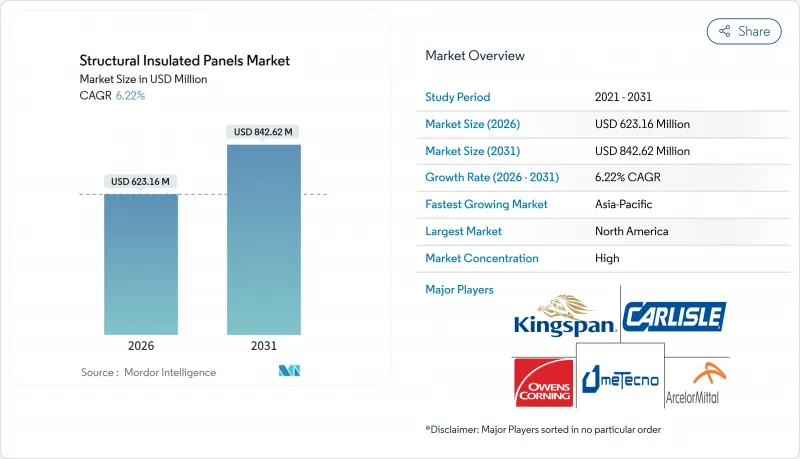
據 Mordor Intelligence 稱,結構保溫板 (SIP) 市場預計在 2026 年達到 6.2316 億美元,預計在預測期(2026-2031 年)內將以 6.22% 的複合年成長率成長,到 2031 年達到 8.4262 億美元。
本報告按產品(EPS板、玻璃絨板及其他)、覆材(定向纖維板(OSB)、膠合板及其他)、應用(建築牆壁材料、建築屋頂材料及其他)、終端用戶行業(住宅、商業、工業/公共)和地區(亞太地區、北美及其他)進行細分。市場預測以美元計價。
全球結構保溫板市場趨勢及洞察
由於能源效率法規,加速了採用
許多地區正在收緊熱傳導係數限制,引導建築商採用R值較高的建築圍護結構。歐盟《建築能源性能指令》2024年修訂版將於2028年前逐步淘汰新建住宅中的石化燃料供暖,實際上強制要求超高保溫性能。美國能源局將於2025年將氣候區4-7的牆體保溫要求提高20%,使傳統方法(框架結構)的保溫性能達到極限。加州修訂後的第24號法規規定,工廠生產的保溫板在50帕壓力下測試熱交換率(ACH)低於1.5次/小時即可達到標準,可獲得合規積分。閾值通常適用於結構保溫板,但現場組裝的牆體卻很少能達到。這些法規共同鼓勵早期保溫投資,將建築商的獎勵與居住者的能源成本掛鉤,從而促進結構保溫板市場的發展。
全球冷鏈基礎設施的擴展
在藥品分銷和生鮮食品物流領域,溫控空間持續以兩位數的速度成長。根據國際航空運輸協會(IATA)的數據,到2025年,冷鏈運輸能力將年增11%,其中亞太地區將佔新增面積的43%。沃爾瑪等大型零售食品零售商表示,其在2025年新建的14座倉庫中採用了保溫板外牆,這是其成長的主要原因。與磚牆或噴塗泡沫牆相比,保溫板外牆可降低22%的冷卻負荷。能源成本佔倉庫營運成本的40%之多,因此高性能保溫板的投資回報迅速,這也支撐了結構保溫板市場中真空絕熱芯材的高價。
與傳統模板施工方法相比,初始成本較高。
結構保溫板比採用對接隔熱材料的龍骨牆貴15%至25%,這給利潤微薄的建築商帶來了一定的阻礙。全美住宅建築商協會(NAHB)估計,到2025年,這將使每平方英尺面積的成本增加8至12美元,在沒有公用事業收費補貼計劃的情況下,投資回收期將長達12至15年。此外,一些金融機構在評估貸款時只關注前期成本而非生命週期節省,這進一步加重了建築商的負擔,並加劇了結構保溫板市場的短期限制。
細分市場分析
到2025年,發泡聚苯乙烯(EPS)板材將以79.94%的市場佔有率佔據主導地位,預計到2031年將以6.36%的複合年成長率成長。 EPS的隔熱性能為每英吋R值3.6至4.2,價格比聚氨酯便宜30%至40%,這是其廣泛採用的關鍵因素。據金斯潘公司(Kingspan)稱,到2025年,EPS將佔其保溫板材銷售額的62%,表明其在住宅市場的滲透率顯著提高。儘管由於消防法規的變化和空間限制,對高R值聚氨酯和聚異氰酸酯的需求仍然存在,但這些化學品在一般住宅應用中仍然處於次要地位。玻璃絨芯材用於需要防火和隔音的項目,而真空絕熱板的產量仍然很低,主要應用於醫藥冷鍊和航太領域。
EPS(聚苯乙烯發泡板)在監管方面已具有優勢,因為它使用戊烷這種發泡劑,符合氣候變遷法規。相較之下,聚氨酯供應商仍在升級其生產設施以取代氫氟碳化合物(HFCs),而HFCs將於2024年被美國環保署(EPA)禁用。這種轉變將導致產量不確定性和廢料風險,暫時擴大EPS的成本優勢,並進一步鞏固其在結構保溫板市場的主導地位。
定向纖維板(OSB)憑藉其優異的重量強度比和與傳統緊固方式的兼容性,預計到2025年將佔據該細分市場57.36%的佔有率。然而,結構保溫板市場正經歷著向不可燃覆材的顯著轉變。隨著都市區消防法規日益嚴格,預計2031年,其他覆材的複合年成長率將達到7.19%。根據塔塔鋼鐵公司的報告,在冷藏倉庫和製藥業的需求推動下,預計到2025年,鋼製覆層板將佔據印度商業建築市場14%的佔有率。
定向塑合板(OSB)供應的波動也推動了材料多樣化。由於甲蟲災害導致原木供不應求,一些製造商被迫轉向膠合板和混合鋼層壓板。雖然這兩種材料都需要根據當地建築規範進行重新認證,但它們可以降低原料風險。數位化設計工作流程正在加速這項變革。建築師現在可以在BIM模型中指定耐火等級、抗衝擊性和表面處理,使企劃團隊能夠在專案早期評估多種覆材方案。這縮短了競標週期,並促使結構保溫板市場更多地採用非常規覆材。
區域分析
2025年,北美地區佔全球銷售額的37.27%,主要得益於美國和加拿大的住宅需求。加拿大省級政府制定的熱損失上限政策也促進了這一成長,該政策建議牆體隔熱值達到R-30,且在50Pa壓力下氣密性不超過2ACH。然而,由於甲蟲侵襲導致定向塑合板(OSB)價格波動,以及人們對交錯層壓木材(CLT)日益成長的興趣,正在抑制北美市場的擴張。墨西哥市場仍處於低度開發狀態,由於能源成本低且熟練勞動力充足,傳統磚石結構仍盛行。但近岸外包驅動的工業建築為快速安裝的保溫建築圍護結構提供了利基市場機會。
亞太地區預計將以7.41%的複合年成長率成長,成為全球成長最快的地區。中國的預製房屋市場持續成長,其中18%的預製住宅開工工程使用了保溫板。這一趨勢在北方省份尤為顯著,這些省份在供暖季實施了嚴格的能源消耗限制。印度市場正從小規模的基數開始擴張,受益於政府資助的經濟適用住宅供應計劃以及與藥品出口相關的冷鏈建設的蓬勃發展。在從越南到印尼的東南亞國家,保溫板正被應用於溫控倉庫,以支援快速成長的電子商務食品配送。中國、印度和跨國公司在當地的製造業投資正在縮短前置作業時間,減輕外匯波動和運輸成本對結構保溫板市場的影響。
歐洲的需求主要由德國、英國和法國推動。德國嚴格的「近零能耗」指令以及德國復興信貸銀行(KfW)提供的優惠融資,正在推動被動式房屋性能所需材料的普及。英國正在推廣異地建造以解決住宅短缺問題,並已明確將保溫板納入其政策藍圖。在歐盟結構基金的資助下,東歐正快速崛起,成為一個優先對社會主義時期多用戶住宅進行大規模節能維修的次區域。南歐相對落後,因為其氣候變暖削弱了節能帶來的經濟效益,但日益嚴重的野火風險正在推動人們對防火、不燃外牆覆層的興趣。
南美洲、中東和非洲雖然規模較小,但都是具有重要戰略意義的市場。在巴西,根據巴西國家衛生監督局 (ANVISA) 的規定,疫苗儲存設施必須使用板材護套。在沙烏地阿拉伯,資料中心的外牆正在使用板材,以降低沙漠氣候(氣溫超過 50 度C)下的冷卻負荷。在南非,一些社會住宅試點計畫正在引入板材維修的檢查,旨在改善非正式居住。儘管本地生產能力不足、進口關稅和外匯波動限制了業務擴張,但也為那些尋求抓住結構保溫板市場新需求的早期參與企業提供了投資機會。
其他福利
- Excel格式的市場預測(ME)表
- 3個月的分析師支持
目錄
第1章:引言
- 研究假設和市場定義
- 調查範圍
第2章:調查方法
第3章執行摘要
第4章 市場狀況
- 市場概覽
- 市場促進因素
- 由於能源效率法規,加速了採用
- 全球冷鏈基礎設施的擴展
- 經濟適用住宅及住宅翻新工程增加
- 人們越來越傾向於快速異地建造
- 將木質結構保溫板的碳權額貨幣化
- 市場限制因素
- 與傳統模板施工方法相比,初始成本較高。
- 先進預製牆體系統所帶來的替代方案威脅
- 定向塑合板供應波動(天牛造成的損害和鋸木廠關閉)
- 價值鏈分析
- 波特五力模型
第5章 市場規模與成長預測
- 依產品
- EPS(發泡聚苯乙烯)板
- 硬質聚氨酯(PUR)/硬質聚異氰酸酯(PIR)板材
- 玻璃絨板
- 其他產品(例如,真空絕緣型等)
- 覆材類型
- 定向纖維板(OSB)
- 合板
- 其他覆材(纖維水泥板、鍍鋅鋼板等)
- 透過使用
- 建築牆壁材料
- 建築屋頂材料
- 冷藏倉庫
- 其他用途(例如,資料中心、地板鋪設等)
- 按最終用戶行業分類
- 住宅
- 商業的
- 工業和公共機構
- 按地區
- 亞太地區
- 中國
- 印度
- 日本
- 韓國
- ASEAN
- 其他亞太國家
- 北美洲
- 美國
- 加拿大
- 墨西哥
- 歐洲
- 德國
- 英國
- 法國
- 義大利
- 其他歐洲國家
- 南美洲
- 巴西
- 阿根廷
- 其他南美國家
- 中東和非洲
- 沙烏地阿拉伯
- 南非
- 其他中東和非洲國家
- 亞太地區
第6章 競爭情勢
- 市場集中度
- 策略趨勢
- 市佔率和排名分析
- 公司簡介
- All Weather Insulated Panels
- Alubel SpA
- ArcelorMittal
- Balex-Metal
- Carlisle Companies Inc.
- Cornerstone Building Brands, Inc.
- DANA Group of Companies
- Italpannelli SRL
- Jiangsu Jingxue Energy Saving Technology Co., Ltd.
- Kingspan Group
- Manni Group
- METECNO GROUP
- Multicolor Steels (India) Pvt. Ltd.
- Nucor Building Systems
- Owens Corning
- PFB Corporation
- Premium Building Systems
- Rautaruukki Corporation(Ruukki Construction)
- Structall Building Systems
- Tata Steel
- Thermocore Structural Insulated Panel Systems
- Zamil Steel Buildings India Private Limited
第7章 市場機會與未來展望
According to Mordor Intelligence, the structural insulated panels market size is estimated at USD 623.16 million in 2026, and is expected to reach USD 842.62 million by 2031, at a CAGR of 6.22% during the forecast period (2026-2031).
This report is Segmented by Product (EPS Panels, Glass-Wool Panels, and More), Skin Material (Oriented Strand Board, Plywood, and More), Application (Building Wall, Building Roof, and More), End-User Industry (Residential, Commercial, and Industrial and Institutional), and Geography (Asia-Pacific, North America, and More). The Market Forecasts are Provided in Terms of Value (USD).
Global Structural Insulated Panels Market Trends and Insights
Energy Efficiency Regulations Accelerating Adoption
Multiple jurisdictions are tightening thermal-transmittance limits, driving builders toward high-R-value envelopes. The 2024 revision of the European Union's Energy Performance of Buildings Directive phases out fossil-fuel heating in new dwellings by 2028, essentially mandating super-insulated exterior walls. The U.S. Department of Energy raised wall insulation requirements by 20% for climate zones 4-7 in 2025, pushing conventional stick framing to its practical limits. California's updated Title 24 grants compliance credits for factory-built panels that test below 1.5 ACH at 50 Pa, a threshold routinely met by structural insulated panels but seldom achieved by site-built walls. Collectively, these rules reward upfront thermal investment, synchronize builder incentives with occupant energy costs, and add momentum to the structural insulated panels market.
Expansion of Global Cold-Chain Infrastructure
Pharmaceutical distribution and perishable-food logistics continue to add temperature-controlled space at a double-digit clip. The International Air Transport Association logged an 11% year-over-year rise in cold-chain capacity in 2025, with Asia-Pacific capturing 43% of new square footage. Hyperscale grocers such as Walmart adopted insulated-panel envelopes for 14 new facilities in 2025, citing a 22% refrigeration-load cut versus masonry and spray-foam walls. Because energy expenses account for up to 40% of warehouse operating costs, the payback on higher-performance panels is swift, supporting premium pricing for vacuum-insulated cores in the structural insulated panels market.
Higher Upfront Costs Versus Conventional Framing
Structural insulated panels carry a 15-25% material premium over stud walls with batt insulation, a hurdle for builders working on tight gross margins. A 2025 cost study by the National Association of Home Builders pegged the incremental outlay at USD 8-12 per square foot of wall area, stretching the payback period to 12-15 years in markets lacking utility rebates. Financial institutions that underwrite loans on first cost rather than lifecycle savings compound the burden, amplifying the near-term restraint on the structural insulated panels market.
Other drivers and restraints analyzed in the detailed report include:
- Rising Affordable-Housing and Residential Remodeling
- Growing Preference for Rapid, Off-Site Construction
- Substitution Threat from Advanced Prefab Wall Systems
For complete list of drivers and restraints, kindly check the Table Of Contents.
Segment Analysis
Expanded polystyrene panels dominated with 79.94% share in 2025 and are projected to climb at a 6.36% CAGR through 2031. EPS delivers R-3.6-4.2 per inch at 30-40% lower material cost than polyurethane, a differential central to volume adoption. Kingspan noted that EPS accounted for 62% of its insulated-panel revenue in 2025, a testament to deep residential penetration. Fire-code shifts and space constraints sustain niche demand for higher-R-value polyurethane and polyisocyanurate, but those chemistries remain secondary for commodity housing. Glass-wool cores serve fire-rated and acoustic-sensitive projects, while vacuum-insulated panels still sit at lower unit volume, confined to pharma cold chains and aerospace.
A regulatory edge also accrues to EPS because it already relies on pentane, a climate-compliant blowing agent. By contrast, polyurethane suppliers are still retooling to replace HFCs banned by the U.S. Environmental Protection Agency in 2024. That conversion introduces yield uncertainty and scrap risk, temporarily widening the cost gap in favor of EPS and further consolidating leadership in the structural insulated panels market.
Oriented strand board commanded 57.36% segment share in 2025, underpinned by its favorable weight-to-strength profile and compatibility with conventional fastening methods. Yet the structural insulated panels market is recording a notable pivot toward noncombustible skins. Other skin materials are forecast to rise at a 7.19% CAGR to 2031 as urban fire codes stiffen. Tata Steel reported that steel-faced panels captured 14% share in Indian commercial construction by 2025, driven by cold-storage and pharmaceutical demands.
OSB's supply swings also nurture diversification. Beetle-driven log shortages pushed some manufacturers to plywood or hybrid steel laminates, each of which demands requalification under local codes but buffers raw-material risk. Digital design workflows accelerate change; architects now specify fire rating, impact resilience, and surface finish within BIM models, empowering project teams to evaluate multiple skin options early, compressing bid windows, and widening acceptance of nontraditional facings in the structural insulated panels market.
Complete Report Scope:
- By Product
- EPS (Expanded Polystyrene) Panels
- Rigid Polyurethane (PUR) and Rigid Polyisocyanurate (PIR) Panels
- Glass-wool Panels
- Other Products (e.g., Vacuum-insulated, etc.)
- By Skin Material
- Oriented Strand Board (OSB)
- Plywood
- Other Skin Materials (Fibre-cement Board, Galvanised Steel Sheet, etc.)
- By Application
- Building Wall
- Building Roof
- Cold Storage
- Other Applications (e.g., Data Centres, Floor and Deck, etc.)
- By End-user Industry
- Residential
- Commercial
- Industrial and Institutional
- Geography
- Asia-Pacific
- China
- India
- Japan
- South Korea
- ASEAN Countries
- Rest of Asia-Pacific
- North America
- United States
- Canada
- Mexico
- Europe
- Germany
- United Kingdom
- France
- Italy
- Rest of Europe
- South America
- Brazil
- Argentina
- Rest of South America
- Middle-East and Africa
- Saudi Arabia
- South Africa
- Rest of Middle-East and Africa
- Asia-Pacific
Geography Analysis
North America controlled 37.27% of global revenue in 2025, buoyed by U.S. and Canadian housing demand. Canada benefits further from provincial heat-loss caps that favor R-30 walls and airtightness below 2 ACH at 50 Pa. Nevertheless, beetle-induced OSB volatility and growing cross-laminated timber appeal temper North American expansion. Mexico remains an untapped frontier, where low energy costs and abundant skilled labor preserve conventional masonry, although nearshoring-driven industrial builds provide a niche opening for fast-tracked insulated envelopes.
Asia-Pacific is forecast to advance at a 7.41% CAGR, the quickest worldwide. China's prefabricated-construction is growing with insulated panels surfacing in 18% of prefab housing starts, especially in northern provinces that enforce stringent heating-season energy caps. India's market lifts off from a modest base but benefits from state-funded affordable-housing schemes and explosive cold-chain construction linked to pharmaceutical exports. Southeast Asian economies-from Vietnam to Indonesia-deploy panels in temperature-controlled warehouses that support rapidly expanding e-commerce grocery deliveries. Local manufacturing investments by Chinese, Indian, and multinational firms shorten lead times and buffer the structural insulated panels market against currency swings and freight costs.
Europe's demand is anchored by Germany, the United Kingdom, and France. Strict near-zero-energy directives and incentive loans from Germany's KfW bank push adoption toward Passive House-level performance. The United Kingdom targets off-site delivery to shrink its housing shortfall, explicitly including insulated panels in policy roadmaps. Eastern Europe, funded by EU structural packages, emerges as a fast-growing sub-region prioritizing deep-energy retrofits of socialist-era multifamily blocks. Southern Europe remains a relative laggard because milder climates dilute energy-savings economics, yet wildfire risk accelerates interest in fire-rated, noncombustible skins.
South America and the Middle East and Africa collectively form a small but strategic slice. Brazil mandates panel envelopes in vaccine storage under ANVISA regulations. Saudi Arabia integrates panels into data-center shells to lower cooling loads under 50 °C desert temperatures. South Africa's social-housing pilots trial panelized retrofits to upgrade informal settlements. Limited local fabrication capacity, import duties, and volatile currencies restrict scale but also open investment windows for early entrants aiming to capture nascent demand in the structural insulated panels market.
- All Weather Insulated Panels
- Alubel SpA
- ArcelorMittal
- Balex-Metal
- Carlisle Companies Inc.
- Cornerstone Building Brands, Inc.
- DANA Group of Companies
- Italpannelli SRL
- Jiangsu Jingxue Energy Saving Technology Co., Ltd.
- Kingspan Group
- Manni Group
- METECNO GROUP
- Multicolor Steels (India) Pvt. Ltd.
- Nucor Building Systems
- Owens Corning
- PFB Corporation
- Premium Building Systems
- Rautaruukki Corporation (Ruukki Construction)
- Structall Building Systems
- Tata Steel
- Thermocore Structural Insulated Panel Systems
- Zamil Steel Buildings India Private Limited
Additional Benefits:
- The market estimate (ME) sheet in Excel format
- 3 months of analyst support
TABLE OF CONTENTS
1 Introduction
- 1.1 Study Assumptions and Market Definition
- 1.2 Scope of the Study
2 Research Methodology
3 Executive Summary
4 Market Landscape
- 4.1 Market Overview
- 4.2 Market Drivers
- 4.2.1 Energy Efficiency Regulations Accelerating Adoption
- 4.2.2 Expansion of Global Cold-Chain Infrastructure
- 4.2.3 Rising Affordable-Housing and Residential Remodelling
- 4.2.4 Growing Preference for Rapid, Off-Site Construction
- 4.2.5 Carbon-Credit Monetisation for Timber-Based Structural Insulated Panels
- 4.3 Market Restraints
- 4.3.1 Higher Upfront Costs Vs. Conventional Framing
- 4.3.2 Substitution Threat from Advanced Prefab Wall Systems
- 4.3.3 OSB Supply Volatility (Beetle Infestation and Mill Outages)
- 4.4 Value Chain Analysis
- 4.5 Porter's Five Forces
- 4.5.1 Bargaining Power of Suppliers
- 4.5.2 Bargaining Power of Buyers
- 4.5.3 Threat of New Entrants
- 4.5.4 Threat of Substitute Products and Services
- 4.5.5 Degree of Competition
5 Market Size and Growth Forecasts (Value)
- 5.1 By Product
- 5.1.1 EPS (Expanded Polystyrene) Panels
- 5.1.2 Rigid Polyurethane (PUR) and Rigid Polyisocyanurate (PIR) Panels
- 5.1.3 Glass-wool Panels
- 5.1.4 Other Products (e.g., Vacuum-insulated, etc.)
- 5.2 By Skin Material
- 5.2.1 Oriented Strand Board (OSB)
- 5.2.2 Plywood
- 5.2.3 Other Skin Materials (Fibre-cement Board, Galvanised Steel Sheet, etc.)
- 5.3 By Application
- 5.3.1 Building Wall
- 5.3.2 Building Roof
- 5.3.3 Cold Storage
- 5.3.4 Other Applications (e.g., Data Centres, Floor and Deck, etc.)
- 5.4 By End-user Industry
- 5.4.1 Residential
- 5.4.2 Commercial
- 5.4.3 Industrial and Institutional
- 5.5 Geography
- 5.5.1 Asia-Pacific
- 5.5.1.1 China
- 5.5.1.2 India
- 5.5.1.3 Japan
- 5.5.1.4 South Korea
- 5.5.1.5 ASEAN Countries
- 5.5.1.6 Rest of Asia-Pacific
- 5.5.2 North America
- 5.5.2.1 United States
- 5.5.2.2 Canada
- 5.5.2.3 Mexico
- 5.5.3 Europe
- 5.5.3.1 Germany
- 5.5.3.2 United Kingdom
- 5.5.3.3 France
- 5.5.3.4 Italy
- 5.5.3.5 Rest of Europe
- 5.5.4 South America
- 5.5.4.1 Brazil
- 5.5.4.2 Argentina
- 5.5.4.3 Rest of South America
- 5.5.5 Middle-East and Africa
- 5.5.5.1 Saudi Arabia
- 5.5.5.2 South Africa
- 5.5.5.3 Rest of Middle-East and Africa
- 5.5.1 Asia-Pacific
6 Competitive Landscape
- 6.1 Market Concentration
- 6.2 Strategic Moves
- 6.3 Market Share(%)/Ranking Analysis
- 6.4 Company Profiles (includes Global level Overview, Market level overview, Core Segments, Financials as available, Strategic Information, Products and Services, and Recent Developments)
- 6.4.1 All Weather Insulated Panels
- 6.4.2 Alubel SpA
- 6.4.3 ArcelorMittal
- 6.4.4 Balex-Metal
- 6.4.5 Carlisle Companies Inc.
- 6.4.6 Cornerstone Building Brands, Inc.
- 6.4.7 DANA Group of Companies
- 6.4.8 Italpannelli SRL
- 6.4.9 Jiangsu Jingxue Energy Saving Technology Co., Ltd.
- 6.4.10 Kingspan Group
- 6.4.11 Manni Group
- 6.4.12 METECNO GROUP
- 6.4.13 Multicolor Steels (India) Pvt. Ltd.
- 6.4.14 Nucor Building Systems
- 6.4.15 Owens Corning
- 6.4.16 PFB Corporation
- 6.4.17 Premium Building Systems
- 6.4.18 Rautaruukki Corporation (Ruukki Construction)
- 6.4.19 Structall Building Systems
- 6.4.20 Tata Steel
- 6.4.21 Thermocore Structural Insulated Panel Systems
- 6.4.22 Zamil Steel Buildings India Private Limited
7 Market Opportunities and Future Outlook
- 7.1 White-space and Unmet-need Assessment
- 7.2 BIM-driven modular design integration

 結構保溫板市場:核心材料、表面材料、板材厚度、製造流程、應用、最終用戶和通路分類-2026-2032年全球市場預測
 結構保溫板市場規模、佔有率和趨勢分析報告:按產品、應用、地區和細分市場預測(2026-2033 年)
 2026年全球結構保溫板市場報告
 結構保溫板市場規模、佔有率、趨勢和預測:按產品、應用和地區分類,2026-2034年
 承重斷熱板市場-全球產業規模、佔有率、趨勢、機會及預測(依產品、表面材質、應用、地區及競爭格局分類,2021-2031年)
 2026-2030年全球結構保溫板市場
 承重斷熱板市場規模、佔有率及成長分析(按類型、應用、最終用戶和地區分類)-2026-2033年產業預測
 結構絕緣板市場分析及預測(至 2034 年):類型、產品、應用、材料類型、技術、最終用戶、安裝類型、功能、組件
 到 2030 年結構隔熱板市場預測:按產品、表皮材料、應用和地區進行全球分析