


 |
市場調查報告書
商品編碼
2120490
X光設備製造:市場佔有率分析、產業趨勢與統計、成長預測(2026-2031年)X-ray Machine Manufacturing - Market Share Analysis, Industry Trends & Statistics, Growth Forecasts (2026 - 2031) |
||||||

※ 本網頁內容可能與最新版本有所差異。詳細情況請與我們聯繫。
據 Mordor Intelligence 稱,2025 年X光設備製造市場價值為 187.1 億美元,預計到 2031 年將達到 256.7 億美元,而 2026 年為 197.2 億美元,預測期(2026-2031 年)的複合成長率為 5.41%。
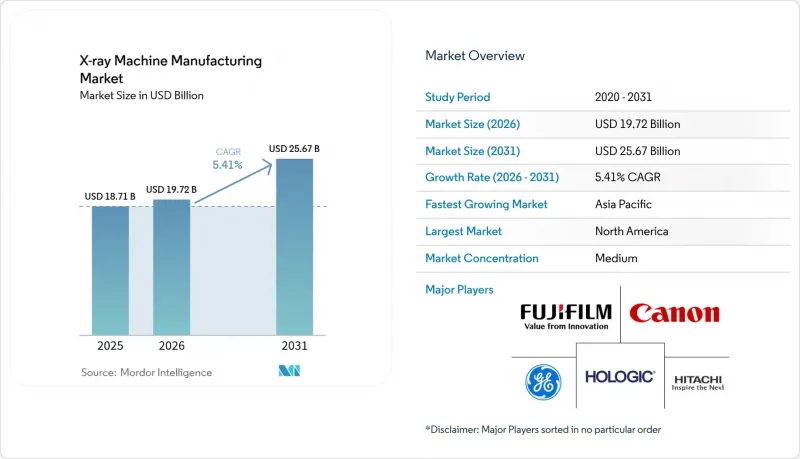
本報告按產品類型(固定式、攜帶式)、技術(類比、數位)、最終用戶(醫療機構、交通運輸與物流、其他)、應用(醫學影像、無損檢測與檢驗、篩檢、牙科影像)和地區進行細分。市場預測以美元計價。
全球X光設備製造市場趨勢及洞察
數位X光系統的應用範圍擴大
目前,醫院和門診診所優先採用數位X光成像技術,並非主要出於影像清晰度的考慮,而是為了與臨床人工智慧平台互通性。 2025年3月,GE醫療和NVIDIA共同推出了一項計劃,該計劃利用檢測器級別的資料直接訓練演算法,以檢測成像過程中的異常情況。這縮短了放射科醫生解讀影像的等待時間,並提高了診斷的一致性。整合的分析功能還能自動追蹤輻射暴露量,滿足歐洲和北美地區新出現的合規要求。該軟體支援遠端升級,使醫療機構能夠在延長設備使用壽命的同時,增加新的臨床功能,將固定資產轉變為不斷發展的決策中心。即使在類比系統尚未達到使用壽命的市場,這些網路效應也加速向數位化轉型。
需要影像檢查的慢性疾病盛行率增加
隨著老齡化社會中糖尿病、心臟衰竭和癌症發生率的上升,常規X光檢查的數量不斷增加,診斷成像的收入結構也從單次收費轉向訂閱模式。預防性醫療保健路徑要求按預定時間間隔對胸部、四肢和血管進行隨訪檢查,保險公司也擴大報銷在症狀出現前即可檢測到病變的低劑量成像方式。將可攜式產生器與平板檢測器結合,使診所能夠在基層醫療機構附近進行診斷,從而減輕患者的出行負擔,並支持在就診當天制定治療方案。早期發現可以降低住院率,並釋放醫療保健系統的資源。這些成果證明了加拿大、日本和一些歐盟成員國的公共保險公司持續投資於即時診斷設備是合理的。
X光設備的初始成本很高
包括購置價格、場地維修、屏蔽、員工培訓和多年服務合約在內的總生命週期成本,可能達到買方最初累計標價的兩倍。因此,拉丁美洲和非洲的小規模診所有時會協商租賃協議或收益分成協議,根據檢測次數支付不同的費用。為了應對這種情況,供應商透過提供模組化主機來降低初始部署成本,同時又不影響未來的擴充性,這些控制台允許後續添加檢測器陣列和軟體。基於雲端的分析進一步降低了現場 IT 成本,但對訂閱費的依賴導致投資回報期延長,使得在資源受限的環境中部署的吸引力降低。
細分市場分析
即使到了2025年,固定式X光機仍將佔據X光設備製造市場60.40%的佔有率,這反映了三級醫院的既有投資。然而,隨著醫療網路向分散式模式轉型,可攜式光機的複合年成長率預計將達到5.62%。在急診科,引入可與電子健康記錄無縫整合的電池驅動推車,已使患者從入院到確診的時間縮短了30分鐘。預計到2031年,該細分市場的成長將進一步擴大其在X光設備機的差距。
高階可攜式設備與中階固定系統之間的效能差距正在不斷縮小。西門子醫療插入公司的 Luminos Q.namix 提供行動數位減影血管造影術功能,支援在導管室外進行血管介入治療。營運行動影像設備的服務供應商正在利用遠端維護控制面板預測何時需要更換導管,從而延長設備的使用壽命。在印度農村地區,官民合作關係正在資助車載式 X 光機,這些設備每天巡迴多個村莊,提高了農村地區的篩檢率,並方便患者轉診至當地醫院。
數位影像技術目前已佔據77.20%的市場佔有率,但由於軟體的迭代改進可在無需更換硬體的情況下提升臨床價值,預計這一佔有率還將進一步成長。用於氣胸和新冠肺炎病灶分診的人工智慧模組已直接整合到影像存檔系統中,而付費使用制的授權模式也使醫療機構更容易控制營運成本。同時,預算有限的基層診所仍在使用模擬系統,但由於備件供應日益減少,其淘汰速度正在加快。
製造商正在將分析功能與產品捆綁在一起,這些功能可以將檢測器元資料轉換為輻射暴露儀錶板,從而滿足加州和歐盟更嚴格的暴露報告要求。雲端整合能夠聚合來自多個位置的影像,促進跨學科遠距醫療,而這在使用膠片或電腦斷層掃描 (CR) 時是難以實現的。隨著資料集呈指數級成長,供應商正透過網路安全和 DICOM 壓縮演算法來凸顯自身優勢,這迫使醫院在採購週期中優先考慮平台的連續性。
區域分析
到2025年,北美將佔全球收入的51.40%,這主要得益於高人均醫療保健支出以及綜合醫療網路早期強制採用人工智慧。紐約市健康與醫院管理局投資2.24億美元升級了230間放射科診室,凸顯了該地區大規模、定期升級市場的重要性。美國基於雲端的遠端放射中心正在加速對遠端可解讀檢測器格式的需求,從而導致供應商鎖定和合約延期。
亞太地區以6.03%的複合年成長率領先,主要得益於中國的本土化獎勵,包括降低國產組裝檢測器的進口關稅。印度的國家衛生任務署正在津貼在二線城市部署行動診所,擴大醫療服務覆蓋範圍,並為建立長期的設備和服務合作關係奠定基礎。在日本,面對老年人對診斷影像日益成長的需求,當地醫院正在加快投資,將輻射暴露監測軟體整合到新型DR主機中。
在歐洲,歐盟的復甦與韌性基金已投資26億歐元用於義大利的診斷設備現代化改造,加速了設備的升級換代。該地區嚴格的劑量法規提高了自動曝光控制技術的普及率,這對高階檢測器供應商來說無疑是一大利好。在中東和非洲,整合診斷影像和腫瘤中心的醫院叢集計畫正在啟動,為中端OEM製造商創造了新的市場。海灣國家對醫療旅遊的濃厚興趣也推動了符合歐美認證標準的AI賦能平台的發展。
其他好處:
- Excel格式的市場預測(ME)表
- 3個月的分析師支持
目錄
第1章:引言
- 研究假設和市場定義
- 調查範圍
第2章:調查方法
第3章執行摘要
第4章 市場狀況
- 市場概覽
- 市場促進因素
- 數位X光系統的應用範圍擴大
- 需要影像診斷的慢性疾病盛行率正在增加。
- 政府為放射診斷基礎建設提供資金
- 對即時檢測和可攜式成像設備的需求不斷成長。
- 人工智慧驅動的影像最佳化和分流整合
- 微焦點X光技術在電子領域的品管中已廣泛應用。
- 市場限制因素
- X光設備高額的購置成本
- 輻射暴露水平安全法規
- 熟練放射技師短缺
- 閃爍體和FPD材料供應鏈中的瓶頸
- 價值供應鏈分析
- 監理情勢
- 技術展望
- 波特五力分析
第5章 市場規模與成長預測
- 依產品類型
- 固定式
- 可攜式的
- 透過技術
- 模擬
- 數位的
- 按最終用戶行業分類
- 醫院
- 診斷影像中心
- 牙醫診所
- 整形外科與創傷治療中心
- 飛機維修設施
- 野戰醫院
- 安全篩檢設備
- 工業和製造業
- 政府與安全
- 獸醫學和動物護理
- 其他終端用戶產業
- 透過使用
- 醫學影像診斷
- 無損檢測與檢驗
- 安全篩檢
- 牙科影像診斷
- 地區
- 北美洲
- 美國
- 加拿大
- 歐洲
- 德國
- 英國
- 法國
- 俄羅斯
- 其他歐洲國家
- 亞太地區
- 中國
- 日本
- 印度
- 韓國
- 其他亞太國家
- 南美洲
- 巴西
- 阿根廷
- 其他南美國家
- 中東和非洲
- 波灣合作理事會(GCC)
- 南非
- 其他中東和非洲國家
- 北美洲
第6章 競爭情勢
- 市場集中度
- 策略趨勢
- 市佔率分析
- 公司簡介
- Canon Inc.
- Fujifilm Holdings Corporation
- GE HealthCare Technologies Inc.
- Hitachi Ltd.(Hitachi Healthcare)
- Hologic, Inc.
- Koninklijke Philips NV
- Shimadzu Corporation
- Siemens Healthineers AG
- Vision Medicaid Equipments Pvt. Ltd.
- Hindrays(Hind High Vacuum Company Pvt. Ltd.)
- Carestream Health, Inc.
- Agfa-Gevaert NV
- Varex Imaging Corporation
- Konica Minolta, Inc.
- Samsung Electronics Co., Ltd.(Samsung Medison)
- Shenzhen Mindray Bio-Medical Electronics Co., Ltd.
- DENTSPLY SIRONA Inc.
- Comet Group AG(Yxlon International GmbH)
- Rigaku Corporation
- Teledyne Technologies Incorporated(Teledyne DALSA)
- Spellman High Voltage Electronics Corporation
- Varian Medical Systems, Inc.
第7章 市場機會與未來展望
According to Mordor Intelligence, the x-Ray machine manufacturing market size was valued at USD 18.71 billion in 2025 and estimated to grow from USD 19.72 billion in 2026 to reach USD 25.67 billion by 2031, at a CAGR of 5.41% during the forecast period (2026-2031).
This report is Segmented by Product Type (Stationary, and Portable), Technology (Analog, and Digital), End-User (Healthcare Facilities, Transportation and Logistics, and More), Application (Medical Imaging, Non-Destructive Testing and Inspection, Security Screening, Dental Imaging), and Geography. The Market Forecasts are Provided in Terms of Value (USD).
Global X-ray Machine Manufacturing Market Trends and Insights
Rise in Adoption of Digital X-ray Systems
Hospitals and ambulatory centers now value digital radiography less for image clarity and more for its interoperability with clinical AI platforms. GE HealthCare and NVIDIA launched a program in March 2025 that trains algorithms directly on detector-level data to flag abnormalities during acquisition, trimming radiologist reading queues, and elevating diagnostic consistency. Integrated analytics also automate radiation-dose tracking, a feature that meets emerging compliance mandates in Europe and North America. Because software can be upgraded remotely, facilities extend equipment life while layering new clinical functions, turning capital assets into evolving decision-support hubs. Those network effects accelerate digital replacement even in markets where analog systems have not yet reached end-of-life.
Growing Prevalence of Chronic Diseases Requiring Diagnostic Imaging
Incidence of diabetes, heart failure, and oncology cases in aging populations lifts routine radiography volumes, shifting imaging economics from episodic to subscription-like revenue. Preventive-care pathways require chest, extremity, and vascular follow-ups at predefined intervals, and payors increasingly reimburse for low-dose modalities that detect pathologies before symptom onset. Portable generators paired with flat-panel detectors let clinics move diagnostics closer to primary-care sites, cutting patient travel and supporting same-visit treatment planning. Early findings lower hospitalization rates, freeing system resources-outcomes that justify ongoing investment in point-of-care devices by public insurers across Canada, Japan, and several EU states.
High Capital Cost of X-ray Machines
Comprehensive lifetime expenses-purchase price, site retrofits, shielding, staff training, and multiyear service contracts-can double the sticker cost that buyers initially budget. Smaller clinics in Latin America and Africa therefore negotiate leasing or revenue-share arrangements where payments align with scan volumes. Vendors answer with modular consoles whose detector arrays and software can be added over time, lowering day-one outlays without sacrificing future scalability. Cloud-based analytics further reduce on-site IT spend, yet reliance on subscription fees lengthens ROI horizons, tempering uptake in resource-constrained settings.
Other drivers and restraints analyzed in the detailed report include:
- Government Funding to Upgrade Radiology Infrastructure
- Rising Demand for Point-of-Care and Portable Imaging
- Radiation-Dose Safety Regulations
For complete list of drivers and restraints, kindly check the Table Of Contents.
Segment Analysis
Stationary rooms still commanded 60.40% of the X-Ray Machine Manufacturing market in 2025, reflecting entrenched investments in tertiary hospitals. Yet portable units are forecast to post a 5.62% CAGR as health networks pivot to decentralized models. Emergency departments cite 30-minute reductions in door-to-diagnosis times after deploying battery-powered carts that interface seamlessly with electronic health records. The segment's uplift raises its portion of the X-Ray Machine Manufacturing market size by 2031, narrowing the gap with traditional installations.
Performance parity between high-end portables and mid-tier fixed systems continues to improve. Siemens Healthineers' Luminos Q.namix delivers digital subtraction angiography on wheels, supporting vascular interventions outside cath labs. Service providers running mobile imaging fleets leverage telemaintenance dashboards to predict tube replacements, extending asset life. In rural India, public-private partnerships finance truck-mounted radiography vans that cover multiple villages daily, boosting rural screening rates and feeding referral pipelines for district hospitals.
Digital modalities already hold 77.20% share yet are still anticipated to climb thanks to iterative software enhancements that add clinical value without hardware swaps. AI modules that triage pneumothorax or COVID-19 pathology splice directly into picture-archiving systems, and pay-per-use licensing helps facilities control operating costs. Conversely, analog systems linger in budget-restricted community clinics, but shrinking spare-part availability accelerates their retirement trajectory.
Manufacturers bundle analytics that convert detector metadata into radiation-dose dashboards, satisfying stricter exposure reporting mandates in California and the EU. Cloud integration enables multi-site image pooling, facilitating subspecialty teleconsults that were difficult with film or computed radiography. Because datasets grow exponentially, vendors differentiate on cybersecurity and DICOM-compression algorithms, compelling hospitals to favor platform continuity during procurement cycles.
Complete Report Scope:
- By Product Type
- Stationary
- Portable
- By Technology
- Analog
- Digital
- By End-user Industry
- Hospitals
- Diagnostic Imaging Centers
- Dental Clinics
- Orthopedic and Trauma Care Facilities
- Aircraft Maintenance Facilities
- Military Field Hospitals
- Security Screening Units
- Industrial and Manufacturing
- Government and Security
- Veterinary and Animal Care
- Other End-user Industries
- By Application
- Medical Imaging
- Non-destructive Testing and Inspection
- Security Screening
- Dental Imaging
- Geography
- North America
- United States
- Canada
- Europe
- Germany
- United Kingdom
- France
- Russia
- Rest of Europe
- Asia Pacific
- China
- Japan
- India
- South Korea
- Rest of Asia Pacific
- South America
- Brazil
- Argentina
- Rest of South America
- Middle East and Africa
- Gulf Cooperation Council (GCC)
- South Africa
- Rest of Middle East and Africa
- North America
Geography Analysis
North America retained 51.40% of global revenue in 2025, buoyed by high per-capita healthcare spend and early AI adoption mandates from integrated delivery networks. NYC Health and Hospitals committed USD 224 million to replace 230 radiography suites, underscoring the region's sizable recurring-upgrade market. Cloud teleradiology hubs in the United States accelerate demand for detector formats compatible with remote reads, reinforcing vendor lock-in and extension contracts.
Asia-Pacific records the fastest 6.03% CAGR, propelled by China's localization incentives that reduce import tariffs for domestically assembled detectors. India's National Health Mission subsidizes mobile vans in tier-2 cities, widening access and seeding long-term equipment-service relationships. Japan confronts rising geriatric imaging loads, spurring community hospitals to invest in radiation-dose audit software embedded within new DR consoles.
Europe shows steady equipment turnover as the EU Recovery and Resilience Facility channels EUR 2.6 billion into Italy's diagnostic modernizations. Dose-regulation rigor here inspires high adoption of automatic exposure control, benefiting premium detector suppliers. The Middle East and Africa begin hospital-cluster programs that bundle imaging with oncology centers, offering fresh territory to mid-price OEMs. Gulf states' medical-tourism aspirations likewise favor AI-ready platforms that align with Western accreditation standards.
- Canon Inc.
- Fujifilm Holdings Corporation
- GE HealthCare Technologies Inc.
- Hitachi Ltd. (Hitachi Healthcare)
- Hologic, Inc.
- Koninklijke Philips N.V.
- Shimadzu Corporation
- Siemens Healthineers AG
- Vision Medicaid Equipments Pvt. Ltd.
- Hindrays (Hind High Vacuum Company Pvt. Ltd.)
- Carestream Health, Inc.
- Agfa-Gevaert N.V.
- Varex Imaging Corporation
- Konica Minolta, Inc.
- Samsung Electronics Co., Ltd. (Samsung Medison)
- Shenzhen Mindray Bio-Medical Electronics Co., Ltd.
- DENTSPLY SIRONA Inc.
- Comet Group AG (Yxlon International GmbH)
- Rigaku Corporation
- Teledyne Technologies Incorporated (Teledyne DALSA)
- Spellman High Voltage Electronics Corporation
- Varian Medical Systems, Inc.
Additional Benefits:
- The market estimate (ME) sheet in Excel format
- 3 months of analyst support
TABLE OF CONTENTS
1 INTRODUCTION
- 1.1 Study Assumptions and Market Definition
- 1.2 Scope of the Study
2 RESEARCH METHODOLOGY
3 EXECUTIVE SUMMARY
4 MARKET LANDSCAPE
- 4.1 Market Overview
- 4.2 Market Drivers
- 4.2.1 Rise in adoption of digital X-ray systems
- 4.2.2 Growing prevalence of chronic diseases requiring diagnostic imaging
- 4.2.3 Government funding to upgrade radiology infrastructure
- 4.2.4 Rising demand for point-of-care and portable imaging
- 4.2.5 Integration of AI-enabled image optimisation and triage (under-the-radar)
- 4.2.6 Expansion of micro-focus X-ray in electronics QC (under-the-radar)
- 4.3 Market Restraints
- 4.3.1 High capital cost of X-ray machines
- 4.3.2 Radiation-dose safety regulations
- 4.3.3 Shortage of skilled radiologic technologists
- 4.3.4 Supply-chain bottlenecks in scintillator and FPD materials (under-the-radar)
- 4.4 Value / Supply-Chain Analysis
- 4.5 Regulatory Landscape
- 4.6 Technological Outlook
- 4.7 Porter's Five Forces Analysis
- 4.7.1 Threat of New Entrants
- 4.7.2 Bargaining Power of Buyers
- 4.7.3 Bargaining Power of Suppliers
- 4.7.4 Threat of Substitutes
- 4.7.5 Intensity of Competitive Rivalry
5 MARKET SIZE AND GROWTH FORECASTS (VALUE)
- 5.1 By Product Type
- 5.1.1 Stationary
- 5.1.2 Portable
- 5.2 By Technology
- 5.2.1 Analog
- 5.2.2 Digital
- 5.3 By End-user Industry
- 5.3.1 Hospitals
- 5.3.2 Diagnostic Imaging Centers
- 5.3.3 Dental Clinics
- 5.3.4 Orthopedic and Trauma Care Facilities
- 5.3.5 Aircraft Maintenance Facilities
- 5.3.6 Military Field Hospitals
- 5.3.7 Security Screening Units
- 5.3.8 Industrial and Manufacturing
- 5.3.9 Government and Security
- 5.3.10 Veterinary and Animal Care
- 5.3.11 Other End-user Industries
- 5.4 By Application
- 5.4.1 Medical Imaging
- 5.4.2 Non-destructive Testing and Inspection
- 5.4.3 Security Screening
- 5.4.4 Dental Imaging
- 5.5 Geography
- 5.5.1 North America
- 5.5.1.1 United States
- 5.5.1.2 Canada
- 5.5.2 Europe
- 5.5.2.1 Germany
- 5.5.2.2 United Kingdom
- 5.5.2.3 France
- 5.5.2.4 Russia
- 5.5.2.5 Rest of Europe
- 5.5.3 Asia Pacific
- 5.5.3.1 China
- 5.5.3.2 Japan
- 5.5.3.3 India
- 5.5.3.4 South Korea
- 5.5.3.5 Rest of Asia Pacific
- 5.5.4 South America
- 5.5.4.1 Brazil
- 5.5.4.2 Argentina
- 5.5.4.3 Rest of South America
- 5.5.5 Middle East and Africa
- 5.5.5.1 Gulf Cooperation Council (GCC)
- 5.5.5.2 South Africa
- 5.5.5.3 Rest of Middle East and Africa
- 5.5.1 North America
6 COMPETITIVE LANDSCAPE
- 6.1 Market Concentration
- 6.2 Strategic Moves
- 6.3 Market Share Analysis
- 6.4 Company Profiles (includes Global level Overview, Market level overview, Core Segments, Financials as available, Strategic Information, Market Rank/Share for key companies, Products and Services, and Recent Developments)
- 6.4.1 Canon Inc.
- 6.4.2 Fujifilm Holdings Corporation
- 6.4.3 GE HealthCare Technologies Inc.
- 6.4.4 Hitachi Ltd. (Hitachi Healthcare)
- 6.4.5 Hologic, Inc.
- 6.4.6 Koninklijke Philips N.V.
- 6.4.7 Shimadzu Corporation
- 6.4.8 Siemens Healthineers AG
- 6.4.9 Vision Medicaid Equipments Pvt. Ltd.
- 6.4.10 Hindrays (Hind High Vacuum Company Pvt. Ltd.)
- 6.4.11 Carestream Health, Inc.
- 6.4.12 Agfa-Gevaert N.V.
- 6.4.13 Varex Imaging Corporation
- 6.4.14 Konica Minolta, Inc.
- 6.4.15 Samsung Electronics Co., Ltd. (Samsung Medison)
- 6.4.16 Shenzhen Mindray Bio-Medical Electronics Co., Ltd.
- 6.4.17 DENTSPLY SIRONA Inc.
- 6.4.18 Comet Group AG (Yxlon International GmbH)
- 6.4.19 Rigaku Corporation
- 6.4.20 Teledyne Technologies Incorporated (Teledyne DALSA)
- 6.4.21 Spellman High Voltage Electronics Corporation
- 6.4.22 Varian Medical Systems, Inc.
7 MARKET OPPORTUNITIES AND FUTURE OUTLOOK
- 7.1 White-space and Unmet-need Assessment

 X光成像市場:按成像方法、產品類型、系統和應用分類的全球市場預測,2026-2032年
 類比 X 光市場-全球及區域分析:依產品類型、應用、最終使用者及地區分類-分析與預測,2026-2036年工業射線照相設備市場:2026-2032年全球市場預測(依產品類型、影像技術、輻射源類型、便攜性、應用和最終用途產業分類)
 X光設備製造市場:依產品類型、技術、最終用戶和地區分類
 X光設備製造市場規模、佔有率、趨勢和預測:按產品類型、技術、最終用戶和地區分類,2026-2034年工業數位放射線市場:按技術、設備類型、檢測類型、最終用戶和應用分類-2026-2032年全球市場預測工業X光膠片市場:依底片類型、底片規格、材料成分及終端用戶產業分類-2026-2032年全球預測
 全球X光反射鏡市場規模、佔有率、趨勢和成長分析報告(2026-2034年)
 2026年全球工業X光市場報告2026年全球工業射線照相市場報告