


 |
市場調查報告書
商品編碼
2120463
汽車機器人:市場佔有率分析、產業趨勢與統計及成長預測(2026-2031)Automotive Robotics - Market Share Analysis, Industry Trends & Statistics, Growth Forecasts (2026 - 2031) |
||||||

※ 本網頁內容可能與最新版本有所差異。詳細情況請與我們聯繫。
據 Mordor Intelligence 稱,2025 年汽車機器人市場價值為 163.2 億美元,預計到 2031 年將達到 358.2 億美元,而 2026 年為 186.1 億美元,預測期(2026-2031 年)的複合年成長率為 14.01%。
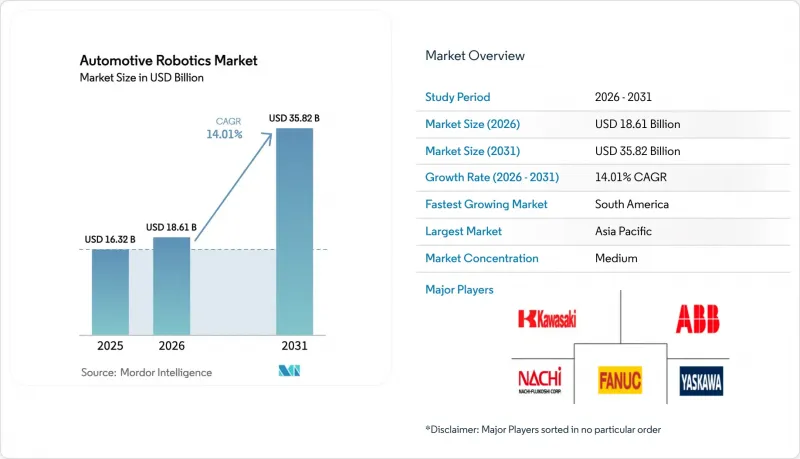
本報告按最終用戶類型(汽車製造商(OEM)、零件製造商(一級和二級供應商)、其他)、組件類型(控制器、機械臂等)、產品類型(笛卡爾機器人、 SCARA機器人等)、功能類型(噴塗機器人、焊接機器人等)和地區(北美、南美等)進行細分。市場預測以美元(USD)計價。
全球汽車機器人市場趨勢與洞察
自動化可提高產量和品質
製造商認為自動化是消除生產瓶頸最快捷的方式,65.3%的製造商計劃投資新型機器人以提高生產線效率。國際機器人聯合會(IFR)的統計數據顯示,到2024年,工業機器人的運作中數量將成長14%,這是自2018年以來最大的年度成長率。先進的檢測單元的零件檢測速度比坐標測量機快10倍,為在不延長生產週期的情況下實現100%檢測鋪平了道路。人工智慧視覺系統能夠檢測出小於0.05毫米的缺陷,為車身本體焊接和最終修整製程樹立了新的品質標準。隨著硬體價格的下降,許多工廠能夠在1-3年內收回投資,這進一步增強了擴大機器人部署的商業價值。
電動汽車電池和電動動力傳動系統的製造要求
電動車的組裝過程涉及數量較少但重量較重的子組件,每個子組件都需要獨特的搬運、密封和焊接技術。 ABB 估計,即使建成計畫中的 80 座超級工廠,電池供應也無法滿足需求,凸顯了高產能機器人生產的必要性。將電池生產線和組裝線設在同一廠址可以提高永續性並降低物流成本,但這只有在機器人能夠交替進行電池和車身組裝工作的情況下才能實現。專用的鋁焊接單元和用於拆解報廢車輛的機器人,例如 Thoth 公司的“DisMantleBot”,象徵著隨著電動車轉型而湧現的新興細分市場。
高昂的資本投資和安裝成本
儘管價格不斷下降,中小型供應商仍認為六位價位的機器人單元風險很高。像Rapid Robotics這樣的機器人即服務(RaaS)供應商透過捆綁硬體、服務和軟體的月度訂閱模式,減輕了高昂的前期成本負擔。整合相關的前期成本通常會翻倍,因為生產線需要重新配置以安裝防護裝置、校準視覺系統和進行操作員培訓。 FANUC斥資1.1億美元擴建其位於奧本山的園區,顯示了其對生態系統的投入,而這些投入對於實現承包部署至關重要。總擁有成本還取決於維護、軟體更新和網路安全補丁,而這些成本在商業案例中往往被低估。
細分市場分析
到2025年,汽車製造商將佔據汽車機器人市場60.75%的佔有率,這反映出它們有能力承擔資本成本,並將關節式焊接機、噴漆機和密封機整合到所有主要生產線中。目前,該領域優先考慮將人工智慧視覺應用於內裝和最終檢驗,並尋求能夠處理以往由人工完成的人體工學任務的協作機器人。服務中心是成長最快的領域,隨著電動車診斷和ADAS校準等售後服務環節引入機械化流程,其複合年成長率(CAGR)達到14.12%。
技能提升仍然至關重要。梅賽德斯-奔馳等汽車製造商正在部署人形機器人,以將員工從重複性操作中解放出來;而獨立維修店則投資機器人四輪定位系統,以縮短預約時間。隨著複雜的維修工作不斷從經銷商轉移到多品牌服務中心,汽車機器人市場預計將在未來十年迎來蓬勃發展。
儘管預計到2025年,機械臂將佔銷售額的35.96%,但其價值正迅速轉移到配備分析、視覺和網路安全措施的控制器。軟體和服務正以14.38%的複合年成長率成長,使其成為策略競爭的主要領域。雲端託管的儀錶板可追蹤運作狀態並產生預測性警報,從而將一次性資本支出(CAPEX)轉化為經常性收入(ANOUY)。
車隊級編配平台將數百個單元整合到一個虛擬實體中,使生產計畫負責人能夠在幾分鐘內(而非幾天)重新分配任務。隨著硬體利潤率的下降,供應商正透過持續的軟體更新和應用商店生態系統來實現差異化,從而推動汽車機器人市場轉向基於結果的合約模式。
區域分析
預計到2025年,亞太地區將佔據全球汽車機器人市場46.10%的佔有率,主要得益於中國42.95萬台的產量以及每萬名工人470台的機器人密度。中國本土供應商如新松(Siasun)和易斯頓(Estun)受益於政府獎勵,有效降低了實施成本;同時,日本系統整合商也在不斷改進精益機器人單元,以適應多品種、小批量生產的需求。東南亞各國政府正在擴大與績效掛鉤的獎勵,鼓勵汽車製造商(OEM)實現電動車生產線的本地化,並配備全自動電池組生產站。
隨著跨國公司大量湧入,南美洲的複合年成長率(CAGR)高達14.55%,位居全球之首。 Stellantis已撥款56億歐元建造靈活的電動車生產能力,通用汽車也在巴西投資14億美元興建機器人車身製造廠。這些協議中包含的技術轉移條款允許當地系統整合商獲得先進焊接軟體的許可,從而加速本土技術累積。不斷上漲的薪資通膨正在推動機器人化進程,尤其是在巴西的底盤和動力傳動系統工廠。
在北美,為了降低地緣政治風險,生產正在回流。美墨加協定(USMCA)的原產地規則鼓勵供應商推動自動化,以在人手不足的情況下保持成本競爭力。聯邦政府對電池生產的稅額扣抵正在推動新的超級工廠項目,這些項目將承重能力機器人整合到電池堆疊和模組組裝中。歐洲目前情況穩定,但對功能安全標準的嚴格遵守促使高價值的機器人解決方案更受青睞。德國繼續發揮研發中心的作用,但利潤率的壓力正促使汽車製造商將大規模生產轉移到成本更低的地區。
其他好處:
- Excel格式的市場預測(ME)表
- 3個月的分析師支持
目錄
第1章:引言
- 研究假設和市場定義
- 調查範圍
第2章:調查方法
第3章執行摘要
第4章 市場狀況
- 市場概覽
- 市場促進因素
- 自動化可提高處理能力和品質
- 電動汽車電池和電動動力傳動系統的製造需求
- 汽車業工地人手不足和工資上漲
- 原始設備製造商對品質一致性提出了更嚴格的要求
- 協作機器人能夠實現靈活的混合型生產線。
- 新興市場的生產連結獎勵計畫
- 市場限制因素
- 高昂的資本投資和安裝成本
- 熟練機器人程式設計師短缺
- 互聯電池中的網路安全風險
- 伺服馬達/晶片供電波動
- 價值供應鏈分析
- 監理情勢
- 技術展望
- 波特五力模型
第5章 市場規模與成長預測
- 按最終用戶類型分類
- 汽車製造商(OEM)
- 零件製造商(一級和二級供應商)
- 售後市場及服務中心
- 依組件類型
- 控制器
- 機械臂
- 末端執行器
- 驅動器和感測器
- 軟體服務
- 依產品類型
- 笛卡兒坐標機器人
- SCARA機器人
- 關節機器人
- 協作機器人(cobots)
- 其他類型(平行型、圓柱型)
- 依功能類型
- 焊接機器人
- 繪畫機器人
- 組裝和拆卸機器人
- 切割和銑削機器人
- 物料輸送機器人
- 用於檢測和品質測試的機器人
- 按地區
- 北美洲
- 美國
- 加拿大
- 墨西哥
- 南美洲
- 巴西
- 阿根廷
- 其他南美國家
- 歐洲
- 德國
- 英國
- 法國
- 義大利
- 西班牙
- 俄羅斯
- 其他歐洲國家
- 亞太地區
- 中國
- 印度
- 日本
- 韓國
- 東南亞
- 其他亞太國家
- 中東和非洲
- 土耳其
- 沙烏地阿拉伯
- 阿拉伯聯合大公國
- 南非
- 其他中東和非洲國家
- 北美洲
第6章 競爭情勢
- 市場集中度
- 策略趨勢
- 市佔率分析
- 公司簡介
- ABB Ltd
- FANUC Corporation
- KUKA AG
- Yaskawa Electric Corporation
- Kawasaki Heavy Industries(Robotics)
- Omron Adept Technologies
- Honda Motor Co(Robotics)
- Nachi-Fujikoshi Corp
- Harmonic Drive Systems
- RobCo SWAT Ltd
- Denso Wave Inc
- Comau SpA
- Staubli Robotics
- Universal Robots A/S
- Hyundai Robotics
- Epson Robots
- OTC Daihen
- Siasun Robot & Automation
- Estun Automation
- Techman Robot
第7章 市場機會與未來展望
According to Mordor Intelligence, the automotive robotics market size was valued at USD 16.32 billion in 2025 and estimated to grow from USD 18.61 billion in 2026 to reach USD 35.82 billion by 2031, at a CAGR of 14.01% during the forecast period (2026-2031).
This report is Segmented by End-User Type (Vehicle Manufacturers (OEMs), Component Manufacturers (Tier-1 and 2), and More), Component Type (Controllers, Robotic Arms, and More), Product Type (Cartesian Robots, SCARA Robots, and More), Function Type (Painting Robots, Welding Robots, and More), and Geography (North America, South America, and More). The Market Forecasts are Provided in Terms of Value (USD).
Global Automotive Robotics Market Trends and Insights
Automation to Boost Throughput & Quality
Manufacturers cite automation as the quickest route to alleviate production bottlenecks; 65.3% plan new robot investments to raise line throughput. The International Federation of Robotics logged a 14% rise in operational industrial robots during 2024, marking the steepest annual jump since 2018. Advanced inspection cells now test parts 10 times faster than coordinate-measuring machines, opening the door to 100% inspection without extending cycle time. AI-enabled vision detects defects smaller than 0.05 mm, creating a new quality baseline for body-in-white welding and final trim. As hardware prices drop, many plants recover capital outlays in one to three years, reinforcing the business case for expanded fleets.
EV-Battery & E-Powertrain Manufacturing Needs
Electric-vehicle assembly introduces heavier yet fewer sub-assemblies that require distinct handling, sealing, and welding methods. ABB estimates that 80 planned gigafactories will still leave battery supply short of demand, underscoring the need for high-throughput robotic production . Co-locating battery lines with final assembly promotes sustainability and reduces logistics, but only if robots can alternate between battery and body tasks. Specialized aluminum welding cells and end-of-life disassembly robots such as Thoth's DisMantleBot illustrate new niches emerging from the EV shift.
High Capex & Installation Costs
Small and medium suppliers still view six-figure robot cells as risky despite falling price points. Robotics-as-a-service vendors such as Rapid Robotics offset sticker shock through monthly contracts that bundle hardware, service, and software. Integration often doubles upfront spend because lines must be re-rigged for guarding, vision calibration, and operator training. FANUC's USD 110 million Auburn Hills campus expansion shows the ecosystem investment needed to make turnkey deployment viable. Total cost of ownership also hinges on maintenance, software refreshes, and cyber-patching, often underestimated in business cases.
Other drivers and restraints analyzed in the detailed report include:
- Labor Shortages & Wage Inflation in Auto Hubs
- Tighter OEM Quality-Consistency Mandates
- Scarcity of Skilled Robot Programmers
For complete list of drivers and restraints, kindly check the Table Of Contents.
Segment Analysis
Vehicle makers held 60.75% of the automotive robotics market in 2025, reflecting their ability to absorb capital costs and embed articulated welders, painters, and sealers across every major line. This cohort now prioritizes AI vision for trim-and-final inspection and seeks cobots that can tackle ergonomic tasks once left to humans. Service centers form the fastest-growing slice, riding a 14.12% CAGR as EV diagnostics and ADAS calibration push mechanized processes into aftermarket bays.
Upskilling remains critical. OEMs such as Mercedes-Benz integrate humanoid robots to relieve staff from repetitive fetching tasks, while independent garages invest in robotic wheel alignment systems to shorten appointment times. Continued migration of complex repairs from dealerships to multi-brand centers will buoy the automotive robotics market into the next decade.
Robotic arms represented 35.96% of revenue in 2025, yet value is quickly shifting toward analytics, vision, and cyber-secure controllers. Software and services are advancing at a 14.38% CAGR, making this the prime strategic battleground. Cloud-hosted dashboards track utilization and issue predictive alerts, converting one-time capex into annuity streams.
Fleet-level orchestration platforms unify hundreds of cells into one virtual entity, enabling production planners to redeploy tasks in minutes rather than days. As hardware margins compress, vendors differentiate through continuous software updates and app-store ecosystems, reinforcing the automotive robotics market's move toward outcome-based contracting.
Complete Report Scope:
- By End-User Type
- Vehicle Manufacturers (OEMs)
- Component Manufacturers (Tier-1 and 2)
- After-market and Service Centers
- By Component Type
- Controllers
- Robotic Arms
- End Effectors
- Drives and Sensors
- Software and Services
- By Product Type
- Cartesian Robots
- SCARA Robots
- Articulated Robots
- Collaborative Robots (Cobots)
- Other Types (Parallel, Cylindrical)
- By Function Type
- Welding Robots
- Painting Robots
- Assembly and Disassembly Robots
- Cutting and Milling Robots
- Material-Handling Robots
- Inspection and Quality-Testing Robots
- By Geography
- North America
- United States
- Canada
- Mexico
- South America
- Brazil
- Argentina
- Rest of South America
- Europe
- Germany
- United Kingdom
- France
- Italy
- Spain
- Russia
- Rest of Europe
- Asia Pacific
- China
- India
- Japan
- South Korea
- South-East Asia
- Rest of Asia Pacific
- Middle East and Africa
- Turkey
- Saudi Arabia
- United Arab Emirates
- South Africa
- Rest of Middle East and Africa
- North America
Geography Analysis
Asia-Pacific retained 46.10% of the automotive robotics market in 2025, anchored by China's 429,500 unit output and a robot density of 470 per 10,000 workers. Domestic vendors such as Siasun and Estun benefit from state incentives that keep acquisition costs low, while Japanese integrators continue to refine lean robotic cells for high-mix assembly. Southeast Asian governments extend production-linked incentives, inviting OEMs to localize EV lines with fully automated battery pack stations.
South America logs the highest 14.55% CAGR as multinationals commit fresh capital: Stellantis has earmarked EUR 5.6 billion for flexible EV capacity, and General Motors is spending USD 1.4 billion on robotic body shops in Brazil. Technology-transfer clauses in these deals allow local integrators to license advanced welding software, accelerating domestic expertise. Rising wage inflation reinforces the shift to robotics, particularly in Brazil's chassis and powertrain plants.
North America pursues reshoring to mitigate geopolitical risk. USMCA rules of origin encourage suppliers to automate to maintain cost competitiveness despite labor shortages. Federal credits targeting battery production spark new gigafactory projects that integrate high-payload robots for cell stacking and module assembly. Europe holds steady yet demands high functional-safety compliance that favors premium robotic solutions. Germany continues to act as an R&D hub, even as margin pressure spurs automakers to transfer volume production to lower-cost regions.
- ABB Ltd
- FANUC Corporation
- KUKA AG
- Yaskawa Electric Corporation
- Kawasaki Heavy Industries (Robotics)
- Omron Adept Technologies
- Honda Motor Co (Robotics)
- Nachi-Fujikoshi Corp
- Harmonic Drive Systems
- RobCo SWAT Ltd
- Denso Wave Inc
- Comau SpA
- Staubli Robotics
- Universal Robots A/S
- Hyundai Robotics
- Epson Robots
- OTC Daihen
- Siasun Robot & Automation
- Estun Automation
- Techman Robot
Additional Benefits:
- The market estimate (ME) sheet in Excel format
- 3 months of analyst support
TABLE OF CONTENTS
1 Introduction
- 1.1 Study Assumptions & Market Definition
- 1.2 Scope of the Study
2 Research Methodology
3 Executive Summary
4 Market Landscape
- 4.1 Market Overview
- 4.2 Market Drivers
- 4.2.1 Automation to boost throughput and quality
- 4.2.2 EV-battery and e-powertrain manufacturing needs
- 4.2.3 Labor shortages and wage inflation in auto hubs
- 4.2.4 Tighter OEM quality-consistency mandates
- 4.2.5 Cobots enabling flexible mixed-model lines
- 4.2.6 Emerging-market production-linked incentives
- 4.3 Market Restraints
- 4.3.1 High capex and installation costs
- 4.3.2 Scarcity of skilled robot programmers
- 4.3.3 Cyber-security risks in connected cells
- 4.3.4 Servo-motor / chip supply volatility
- 4.4 Value / Supply-Chain Analysis
- 4.5 Regulatory Landscape
- 4.6 Technological Outlook
- 4.7 Porter's Five Forces
- 4.7.1 Threat of New Entrants
- 4.7.2 Bargaining Power of Buyers
- 4.7.3 Bargaining Power of Suppliers
- 4.7.4 Threat of Substitutes
- 4.7.5 Competitive Rivalry
5 Market Size & Growth Forecasts (Value (USD))
- 5.1 By End-User Type
- 5.1.1 Vehicle Manufacturers (OEMs)
- 5.1.2 Component Manufacturers (Tier-1 and 2)
- 5.1.3 After-market and Service Centers
- 5.2 By Component Type
- 5.2.1 Controllers
- 5.2.2 Robotic Arms
- 5.2.3 End Effectors
- 5.2.4 Drives and Sensors
- 5.2.5 Software and Services
- 5.3 By Product Type
- 5.3.1 Cartesian Robots
- 5.3.2 SCARA Robots
- 5.3.3 Articulated Robots
- 5.3.4 Collaborative Robots (Cobots)
- 5.3.5 Other Types (Parallel, Cylindrical)
- 5.4 By Function Type
- 5.4.1 Welding Robots
- 5.4.2 Painting Robots
- 5.4.3 Assembly and Disassembly Robots
- 5.4.4 Cutting and Milling Robots
- 5.4.5 Material-Handling Robots
- 5.4.6 Inspection and Quality-Testing Robots
- 5.5 By Geography
- 5.5.1 North America
- 5.5.1.1 United States
- 5.5.1.2 Canada
- 5.5.1.3 Mexico
- 5.5.2 South America
- 5.5.2.1 Brazil
- 5.5.2.2 Argentina
- 5.5.2.3 Rest of South America
- 5.5.3 Europe
- 5.5.3.1 Germany
- 5.5.3.2 United Kingdom
- 5.5.3.3 France
- 5.5.3.4 Italy
- 5.5.3.5 Spain
- 5.5.3.6 Russia
- 5.5.3.7 Rest of Europe
- 5.5.4 Asia Pacific
- 5.5.4.1 China
- 5.5.4.2 India
- 5.5.4.3 Japan
- 5.5.4.4 South Korea
- 5.5.4.5 South-East Asia
- 5.5.4.6 Rest of Asia Pacific
- 5.5.5 Middle East and Africa
- 5.5.5.1 Turkey
- 5.5.5.2 Saudi Arabia
- 5.5.5.3 United Arab Emirates
- 5.5.5.4 South Africa
- 5.5.5.5 Rest of Middle East and Africa
- 5.5.1 North America
6 Competitive Landscape
- 6.1 Market Concentration
- 6.2 Strategic Moves
- 6.3 Market Share Analysis
- 6.4 Company Profiles (Includes Global Level Overview, Market Level Overview, Core Segments, Financials as Available, Strategic Information, Market Rank/Share, Products & Services, and Recent Developments)
- 6.4.1 ABB Ltd
- 6.4.2 FANUC Corporation
- 6.4.3 KUKA AG
- 6.4.4 Yaskawa Electric Corporation
- 6.4.5 Kawasaki Heavy Industries (Robotics)
- 6.4.6 Omron Adept Technologies
- 6.4.7 Honda Motor Co (Robotics)
- 6.4.8 Nachi-Fujikoshi Corp
- 6.4.9 Harmonic Drive Systems
- 6.4.10 RobCo SWAT Ltd
- 6.4.11 Denso Wave Inc
- 6.4.12 Comau SpA
- 6.4.13 Staubli Robotics
- 6.4.14 Universal Robots A/S
- 6.4.15 Hyundai Robotics
- 6.4.16 Epson Robots
- 6.4.17 OTC Daihen
- 6.4.18 Siasun Robot & Automation
- 6.4.19 Estun Automation
- 6.4.20 Techman Robot
7 Market Opportunities & Future Outlook
- 7.1 White-space & Unmet-Need Assessment

 2026年汽車與機器人領域大型VLA模型應用調查報告
 汽車製造業下一代機器人市場—全球及區域分析:按應用、機器人類型和國家分類-分析與預測(2026-2035年)
 汽車機器人市場分析及預測(至2035年):類型、產品、服務、技術、組件、應用、部署模式、最終用戶、功能、安裝類型汽車機器人駕駛市場分析與預測(至2035年):按類型、產品、服務、技術、組件、應用、流程、部署方式、最終用戶和功能分類
 汽車機器人市場報告:按產品類型、組件類型、應用、最終用戶和地區分類(2026-2034 年)
 2026年全球自主充電機器人市場報告
 汽車機器人市場:2026-2032年全球市場預測(按機器人類型、組件、有效載荷能力、自主等級、應用和部署狀態分類)
 汽車機器人市場-策略洞察與預測(2026-2031年)汽車機器人市場規模、佔有率、成長率和全球產業分析:按類型、應用和地區分類的洞察,2026-2034 年預測
 汽車機器人市場:按類型、應用、組件、技術、最終用戶、國家和地區分類-全球產業分析、市場規模、市場佔有率及2025年至2032年預測