


 |
市場調查報告書
商品編碼
2120384
歐洲汽電共生(CHP):市場佔有率分析、行業趨勢和統計數據以及成長預測(2026-2031 年)Europe Combined Heat And Power (CHP) - Market Share Analysis, Industry Trends & Statistics, Growth Forecasts (2026 - 2031) |
||||||

※ 本網頁內容可能與最新版本有所差異。詳細情況請與我們聯繫。
據 Mordor Intelligence 稱,歐洲熱電聯產 (CHP) 市場預計在 2026 年達到 140.9 億美元,預計在預測期(2026-2031 年)內將以 5.43% 的複合年成長率成長,到 2031 年達到 183.5 億美元。
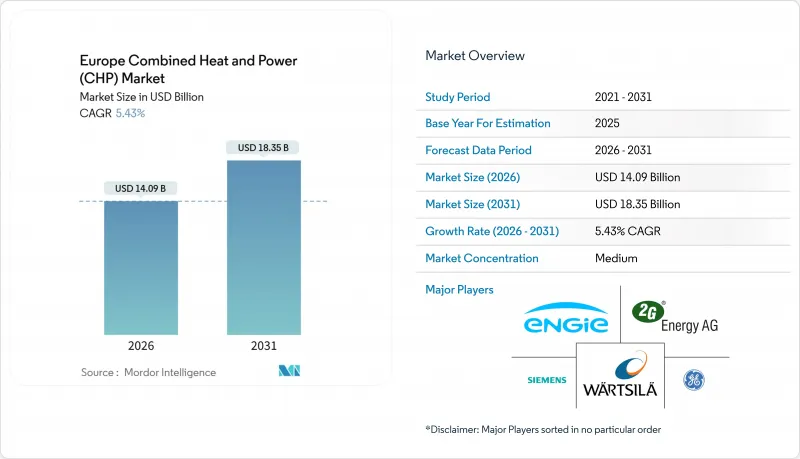
本報告按燃料(天然氣、煤炭、生質能/沼氣、柴油、核能和新興燃料)、原動機(聯合循環、燃氣住宅燃氣渦輪機、蒸氣渦輪、燃料電池等)、輸出功率(10 MW 以下、10-150 MW、150-300 公共產業和 300 MW 以下)、最終英國用戶(北歐工業分類)。
歐洲熱電聯產(CHP)市場趨勢與洞察
與歐盟綠色新政相關的能源效率和熱電聯產補貼
REPowerEU一攬子計畫將在2027年前投資3000億歐元,其中約15%將用於高效汽電共生和區域供熱維修,這將在短期內催生多個吉瓦級競標項目。德國的BEG計畫為沼氣或氫能相容機組提供高達40%的合格成本補貼,預計到2025年,5兆瓦以下往復式引擎的訂單將年增22%。荷蘭的SDE++計畫為生物甲烷燃料熱電聯產提供15年固定價格,每兆瓦時95歐元,進而刺激酪農產業新增產能(RVO.NL)。比利時FLANDERS地區已將汽電共生證書的最低價格提高至每兆瓦時28歐元,提高了製藥廠採用微型熱電聯產的可行性。 《能源效率指令》第 14 條規定,必須對廢熱進行成本效益研究,這促使市政預算用於化工、紙漿和造紙以及食品加工行業的 CHP維修。
對可再生天然氣的獎勵正在推動熱電聯產的轉型。
許多成員國推出了慷慨的上網電價補貼、投資津貼和碳排放強度獎勵,直接津貼能夠使用沼氣、生物甲烷和氫氣的汽電共生設施。德國的BEG計畫為可再生燃氣引擎的投資提供高達40%的報銷,而荷蘭的SDE++計畫則保證生物甲烷熱電聯產機組在15年內獲得每兆瓦時95歐元的溢價。這些獎勵將5兆瓦以下電廠的投資回收期縮短至不到五年,從而帶動往復式引擎製造商的訂單實現兩位數成長。電力公司也在將現有的燃氣渦輪機改造為氫氣混合氣體相容系統,以維持在容量市場的獲利能力並避免不斷上漲的排放交易體系(ETS)成本。這些政策的確定性有助於厭氧消化開發商和工業熱用戶之間簽訂長期供應契約,從而確保燃料供應穩定並降低資金籌措風險。因此,預計到 2031 年,可再生天然氣將在新增熱電聯產項目中發揮越來越大的作用。
分階段減少化石天然氣消費以及碳價格壓力
歐盟排放交易體系(ETS)2025年的平均二氧化碳價格為每噸82歐元,將使燃氣熱電聯產機組的變動成本增加每兆瓦時35歐元,並縮小電價差。德國在完成煤炭淘汰後,並未對天然氣資產實施相應的支持措施,這使得營運商面臨資產擱淺的風險。在英國,碳定價支持(CPS)在ETS課稅的基礎上增加,使總合負擔超過每噸二氧化碳40英鎊,削弱了市場交易的盈利。法國的國家低碳戰略旨在2030年將工業天然氣使用量減少40%,這將迫使玻璃和鋼鐵製造商轉向電氣化供暖。西班牙提出的氣候計畫包括在2027年前逐步取消熱電聯產機組的容量補貼,並將資金重新分配到綠氫能。
細分市場分析
2025年,天然氣在歐洲熱電聯產(CPC)市場中仍佔58.8%的佔有率,這主要得益於現有的燃氣渦輪機設施和區域供熱系統。由於斯堪地那維亞擁有豐富的林業殘餘物,中歐地區擁有大量的農業廢棄物,生質能和沼氣合計佔總發電量的18%。煤炭的佔有率為9%,但由於歐盟分類法規定的熱電聯產淘汰期限,其佔有率正在下降;而柴油和一些特殊用途的液體燃料由於缺乏實質的成長要素,佔有率仍低於4%。氫氣混合燃料、生物甲烷和先進生質燃料等新興燃料正以13.5%的複合年成長率快速成長,預計2031年將逐步削弱天然氣的主導地位。這些趨勢表明原料結構正在多元化,並可能導致整個歐洲熱電聯產市場的資本配置重新調整。
這項轉型是由政策獎勵推動的。德國耗資90億歐元的「國家氫能戰略」、義大利強制推廣生物甲烷以及荷蘭為期15年的SDE++電價補貼計劃,都在直接津貼燃料轉型。營運商正在改造現有引擎,使其氫氣相容性提升高達30%(按體積計),同時,新型往復式引擎組件也經過工廠認證,並以100%可再生氣體兼容的形式交付。因此,預計到2031年,與新興燃料相關的歐洲熱電聯產市場成長將超過其他任何類別,為地方政府和工業設施營運商提供更廣泛的技術選擇。
2025年,聯合循環發電裝置將佔總裝置容量的30.3%,為大規模區域供熱營運商和石化聯合企業提供熱能。其次是往復式引擎,其在10兆瓦以下功率等級中將佔據主導地位,主要面向醫院、資料中心和中型製造商,佔26%。燃料電池雖然目前絕對數量仍然小規模,但其複合年成長率將達到14.8%,這主要得益於政府對住宅微型熱電聯產系統的補貼以及電力公司優先考慮近零排放的訂單。
目前,原始設備製造商 (OEM) 的藍圖專注於氫能相容認證、負荷追蹤能力以及與電池的混合動力,旨在透過容量市場和輔助服務為原動機創造收入。德國的 KfW 433 等補貼計畫為每個燃料電池裝置提供高達 11,200 歐元的補貼,而固體氧化物電堆在英國容量市場被公認為可靠的備用電源。這些機制使得聯合循環發電廠能夠在供熱需求高的城市保持規模經濟效益,同時燃料電池和先進的引擎解決方案正在擴大其在歐洲熱電聯產市場的佔有率。
其他好處:
- Excel格式的市場預測(ME)表
- 3個月的分析師支持
目錄
第1章:引言
- 研究假設和市場定義
- 調查範圍
第2章:調查方法
第3章執行摘要
第4章 市場狀況
- 市場概覽
- 市場促進因素
- 與歐盟綠色交易相關的能源效率和汽電共生(CHP)補貼
- 中歐、東歐和北歐地區供熱網路的快速擴張
- 透過自我生成實現價格和波動性對沖/抵禦
- 擴大沼氣/生物甲烷的生產規模將使利用可再生氣體進行熱電聯產 (CHP) 成為可能。
- 在能源密集產業中引入混合式熱電聯產和高溫熱泵
- 用於電網平衡調節和「低谷期」應對的氫能相容型峰值汽電共生系統。
- 市場限制因素
- 分階段減少化石天然氣消費以及碳價格壓力
- 與熱泵和電氣化等替代方案相比,資本投入更高。
- 以大規模熱泵取代低溫和中溫熱源
- 負價格的出現以及由於強制性運作限制而導致的運作減少。
- 供應鏈分析
- 監理情勢
- 技術展望
- 波特五力模型
第5章 市場規模與成長預測
- 按燃料
- 天然氣
- 煤炭
- 生質能/沼氣
- 柴油和其他液體燃料
- 核能
- 新興燃料
- 搬家公司
- 複合循環
- 燃氣渦輪機
- 蒸氣渦輪
- 往復式引擎
- 燃料電池
- 微型渦輪機和其他
- 按產能
- 10兆瓦或以下
- 10~150 MW
- 150~300 MW
- 300兆瓦或以上
- 按最終用戶類別
- 公用事業
- 商業
- 產業
- 住宅
- 按地區
- 德國
- 英國
- 法國
- 義大利
- 西班牙
- 北歐國家
- 俄羅斯
- 其他歐洲國家
第6章 競爭情勢
- 市場集中度
- 策略趨勢(併購、聯盟、購電協議)
- 市場佔有率分析(主要公司的市場排名和佔有率)
- 公司簡介
- Engie SA
- General Electric Company
- Siemens AG
- Mitsubishi Power Europe
- UPM
- 2G Energy AG
- Wartsila Corp.
- Fleetsolve
- Vattenfall AB
- E.ON SE
- Veolia Environnement
- Capstone Green Energy
- Bosch Thermotechnology
- Caterpillar Energy Solutions
- MAN Energy Solutions
- Rolls-Royce(MTU)
- INNIO(Jenbacher)
- Clarke Energy
- Viessmann Group
- FuelCell Energy
- Ballard Power Systems
- Bloom Energy
- Dantherm Power
第7章 市場機會與未來展望
According to Mordor Intelligence, the Europe combined heat and power market size is estimated at USD 14.09 billion in 2026, and is expected to reach USD 18.35 billion by 2031, at a CAGR of 5.43% during the forecast period (2026-2031).
This report is Segmented by Fuel (Natural Gas, Coal, Biomass/Biogas, Diesel, Nuclear, and Emerging Fuels), Prime Mover (Combined Cycle, Gas Turbine, Steam Turbine, Fuel Cells, and More), Capacity (Up To 10 MW, 10-150 MW, 150-300 MW, and Above 300 MW), End-User (Utilities, Commercial, Industrial, and Residential), and Geography (Germany, United Kingdom, France, NORDIC Countries, and More).
Europe Combined Heat And Power (CHP) Market Trends and Insights
EU Green Deal-Linked Energy-Efficiency & CHP Subsidies
The REPowerEU package channels EUR 300 billion through 2027, with roughly 15% reserved for high-efficiency cogeneration and district-heating upgrades, translating into a multi-GW near-term tender pipeline. Germany's BEG program reimburses up to 40% of eligible costs for biogas or hydrogen-ready units, lifting sub-5 MW reciprocating-engine orders by 22% year-on-year in 2025. The Netherlands' SDE++ scheme guarantees a 15-year tariff of EUR 95 per MWh for biomethane-fueled CHP, stimulating new dairy-sector capacity RVO.NL. Belgium's Flanders raised its cogeneration certificate floor to EUR 28, boosting micro-CHP viability in pharmaceutical campuses. Article 14 of the Energy Efficiency Directive mandates waste-heat cost-benefit studies, sending municipal budgets toward CHP retrofits in chemicals, pulp and paper, and food processing.
Renewable-Gas Incentives Fueling CHP Conversions
Multiple member states deploy generous feed-in tariffs, investment grants, and carbon-intensity bonuses that directly subsidize biogas, biomethane, and hydrogen-ready cogeneration units. Germany's BEG program reimburses up to 40% of capital outlays for engines firing renewable gases, while the Netherlands' SDE++ scheme locks in a 15-year premium of EUR 95 per MWh for biomethane-based CHP. These incentives shorten payback to fewer than five years for sub-5 MW plants and underpin a double-digit order surge among reciprocating-engine manufacturers. Utilities also pivot legacy gas turbines toward hydrogen blends to retain capacity-market revenues and avoid rising ETS costs. The policy certainty encourages long-term offtake contracts between anaerobic-digestion developers and industrial heat users, anchoring fuel supply and de-risking financing. As a result, renewable gases are positioned to claim a growing share of incremental CHP additions through 2031.
Fossil-Gas Phase-Down & Carbon-Pricing Squeeze
EU ETS prices averaged EUR 82 per tCO2 in 2025, adding EUR 35 per MWh to variable costs for gas-fired CHP and tightening spark spreads. Germany finalized its coal exit without parallel support for gas assets, leaving operators exposed to stranded-asset risk. The UK stacked its Carbon Price Support atop ETS levies, driving combined charges above GBP 40 per tCO2 and eroding merchant economics. France's national low-carbon strategy aims to cut industrial gas use by 40% by 2030, pushing glass and steel producers toward electrified heat. Spain's draft climate plan phases out CHP capacity payments by 2027, redirecting funds to green hydrogen.
Other drivers and restraints analyzed in the detailed report include:
- District-Heating Decarbonization Mandates in Nordics and CEE
- Industrial Resilience and Energy-Price Volatility Hedge
- Capital-Cost Competitiveness of High-Temperature Heat Pumps
For complete list of drivers and restraints, kindly check the Table Of Contents.
Segment Analysis
Natural gas retained 58.8% of the European combined heat and power market share in 2025, anchored in legacy turbine fleets and district-heating loops. Biomass and biogas together supplied 18% of output, thanks to abundant forestry residues in Scandinavia and agricultural waste in Central Europe. Coal's 9% footprint is shrinking under EU Taxonomy retirement deadlines, and diesel plus niche liquids remained below 4% without material growth levers. Emerging fuels, hydrogen blends, biomethane, and advanced biofuels expanded at a brisk 13.5% CAGR and are set to erode natural-gas dominance through 2031. These dynamics indicate a diversifying feedstock mix that will recalibrate capital allocation across the European combined heat and power market.
Policy incentives underpin the pivot. Germany's EUR 9 billion National Hydrogen Strategy, Italy's biomethane mandates, and the Netherlands' 15-year SDE++ tariff directly subsidize fuel switching. Operators retrofit existing engines for up to 30% hydrogen by volume, while new reciprocating packages arrive factory-certified for 100% renewable gas. As a result, the Europe combined heat and power market size attached to emerging fuels is projected to outpace every other category to 2031, widening technology choice for municipal utilities and industrial hosts.
Combined-cycle units delivered 30.3% of installed capacity in 2025, safeguarding heat supply for large district-heating operators and petrochemical complexes. Reciprocating engines followed at 26%, dominating the sub-10 MW class that addresses hospitals, data centers, and mid-sized manufacturers. Fuel cells, while still small in absolute numbers, posted a 14.8% CAGR on the back of residential micro-CHP subsidies and utility-scale orders that value near-zero criteria emissions.
OEM roadmaps now emphasize hydrogen-ready certificates, load-following capability, and hybridization with batteries, positioning prime movers for capacity-market and ancillary-service revenue. Subsidy programs such as Germany's KfW 433 grant up to EUR 11,200 per fuel-cell installation, while the UK's capacity market recognizes solid-oxide stacks as a reliable reserve. These mechanisms channel a rising share of the European combined heat and power market toward fuel-cell and advanced engine solutions, even as combined-cycle plants preserve scale advantages in cities with high heat demand.
Complete Report Scope:
- By Fuel
- Natural Gas
- Coal
- Biomass/Biogas
- Diesel and Other Liquid Fuels
- Nuclear
- Emerging fuels
- By Prime Mover
- Combined Cycle
- Gas Turbine
- Steam Turbine
- Reciprocating Engine
- Fuel Cells
- Microturbines and Others
- By Capacity
- Up to 10 MW
- 10 to 150 MW
- 150 to 300 MW
- Above 300 MW
- By End-User Sector
- Utilities
- Commercial
- Industrial
- Residential
- By Geography
- Germany
- United Kingdom
- France
- Italy
- Spain
- NORDIC Countries
- Russia
- Rest of Europe
List of Companies Covered in this Report:
- Engie SA
- General Electric Company
- Siemens AG
- Mitsubishi Power Europe
- UPM
- 2G Energy AG
- Wartsila Corp.
- Fleetsolve
- Vattenfall AB
- E.ON SE
- Veolia Environnement
- Capstone Green Energy
- Bosch Thermotechnology
- Caterpillar Energy Solutions
- MAN Energy Solutions
- Rolls-Royce (MTU)
- INNIO (Jenbacher)
- Clarke Energy
- Viessmann Group
- FuelCell Energy
- Ballard Power Systems
- Bloom Energy
- Dantherm Power
Additional Benefits:
- The market estimate (ME) sheet in Excel format
- 3 months of analyst support
TABLE OF CONTENTS
1 Introduction
- 1.1 Study Assumptions & Market Definition
- 1.2 Scope of the Study
2 Research Methodology
3 Executive Summary
4 Market Landscape
- 4.1 Market Overview
- 4.2 Market Drivers
- 4.2.1 EU Green Deal-linked energy-efficiency & CHP subsidies
- 4.2.2 Rapid district-heating network expansions in CEE & Nordics
- 4.2.3 Price-volatility hedging via on-site generation/resilience
- 4.2.4 Biogas/biomethane scale-up unlocking renewable-gas CHP
- 4.2.5 Hybrid CHP + high-temp heat-pump retrofits in energy-intensive industry
- 4.2.6 Hydrogen-ready peaking CHP for grid-balancing & "dark doldrums"
- 4.3 Market Restraints
- 4.3.1 Fossil-gas phase-down & carbon-pricing squeeze
- 4.3.2 High CAPEX vs heat-pumps & electrification alternatives
- 4.3.3 Large-scale heat-pump substitution of low-/mid-temp heat
- 4.3.4 Shrinking run-hours from negative-price events & must-run limits
- 4.4 Supply-Chain Analysis
- 4.5 Regulatory Landscape
- 4.6 Technological Outlook
- 4.7 Porter's Five Forces
- 4.7.1 Bargaining Power of Suppliers
- 4.7.2 Bargaining Power of Consumers
- 4.7.3 Threat of New Entrants
- 4.7.4 Threat of Substitute Products & Services
- 4.7.5 Degree of Competition
5 Market Size & Growth Forecasts
- 5.1 By Fuel
- 5.1.1 Natural Gas
- 5.1.2 Coal
- 5.1.3 Biomass/Biogas
- 5.1.4 Diesel and Other Liquid Fuels
- 5.1.5 Nuclear
- 5.1.6 Emerging fuels
- 5.2 By Prime Mover
- 5.2.1 Combined Cycle
- 5.2.2 Gas Turbine
- 5.2.3 Steam Turbine
- 5.2.4 Reciprocating Engine
- 5.2.5 Fuel Cells
- 5.2.6 Microturbines and Others
- 5.3 By Capacity
- 5.3.1 Up to 10 MW
- 5.3.2 10 to 150 MW
- 5.3.3 150 to 300 MW
- 5.3.4 Above 300 MW
- 5.4 By End-User Sector
- 5.4.1 Utilities
- 5.4.2 Commercial
- 5.4.3 Industrial
- 5.4.4 Residential
- 5.5 By Geography
- 5.5.1 Germany
- 5.5.2 United Kingdom
- 5.5.3 France
- 5.5.4 Italy
- 5.5.5 Spain
- 5.5.6 NORDIC Countries
- 5.5.7 Russia
- 5.5.8 Rest of Europe
6 Competitive Landscape
- 6.1 Market Concentration
- 6.2 Strategic Moves (M&A, Partnerships, PPAs)
- 6.3 Market Share Analysis (Market Rank/Share for key companies)
- 6.4 Company Profiles (includes Global level Overview, Market level overview, Core Segments, Financials as available, Strategic Information, Products & Services, and Recent Developments)
- 6.4.1 Engie SA
- 6.4.2 General Electric Company
- 6.4.3 Siemens AG
- 6.4.4 Mitsubishi Power Europe
- 6.4.5 UPM
- 6.4.6 2G Energy AG
- 6.4.7 Wartsila Corp.
- 6.4.8 Fleetsolve
- 6.4.9 Vattenfall AB
- 6.4.10 E.ON SE
- 6.4.11 Veolia Environnement
- 6.4.12 Capstone Green Energy
- 6.4.13 Bosch Thermotechnology
- 6.4.14 Caterpillar Energy Solutions
- 6.4.15 MAN Energy Solutions
- 6.4.16 Rolls-Royce (MTU)
- 6.4.17 INNIO (Jenbacher)
- 6.4.18 Clarke Energy
- 6.4.19 Viessmann Group
- 6.4.20 FuelCell Energy
- 6.4.21 Ballard Power Systems
- 6.4.22 Bloom Energy
- 6.4.23 Dantherm Power
7 Market Opportunities & Future Outlook
- 7.1 White-space & Unmet-Need Assessment

 汽電共生市場:2026-2032年全球市場預測(依技術、燃料類型、發電容量、安裝類型、併網方式及最終用途分類)
 全球一氧化碳和煙霧偵測器組合安全報警器市場報告:競爭分析和區域商機(2026-2032)
 熱電聯產(CHP)市場:按燃料類型、容量、技術、應用和地區分類
 2026年全球併網汽電共生市場報告2026年全球熱電聯產(CHP)市場報告
 全球資料中心熱回收系統市場:預測(至 2034 年)—按組件、系統類型、資料中心類型、冷卻基礎設施、熱回收應用、最終用戶和地區進行分析
 全球熱電聯產市場:市場規模、佔有率、成長率、產業分析、依類型、應用和地區劃分的考量因素以及未來預測(2026-2034)
 日本熱電聯產市場報告(按燃料類型(天然氣、煤炭、石油及其他)、應用(住宅、工業和公用事業、商業)及地區分類,2026-2034年)
 熱電聯產(CHP)市場規模、佔有率和成長分析(按燃料類型、技術、容量、應用和地區分類)-2026-2033年產業預測
 2025-2029年全球熱電聯產(CHP)市場