


 |
市場調查報告書
商品編碼
2120363
高壓釜養護加氣混凝土(AAC):市場佔有率分析、產業趨勢與統計數據以及成長預測(2026-2031 年)Autoclaved Aerated Concrete (AAC) - Market Share Analysis, Industry Trends & Statistics, Growth Forecasts (2026 - 2031) |
||||||

※ 本網頁內容可能與最新版本有所差異。詳細情況請與我們聯繫。
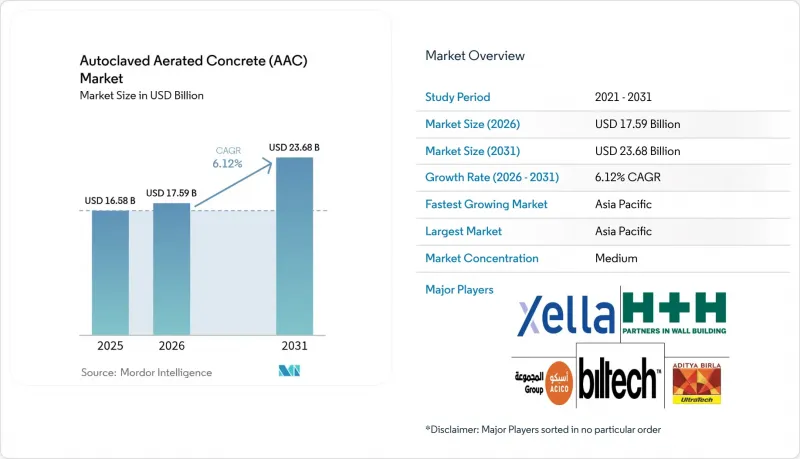
根據 Mordor Intelligence 預測,到 2025 年,高壓釜養護加氣混凝土市場規模將達到 165.8 億美元,到 2026 年將達到 175.9 億美元,到 2031 年將達到 236.8 億美元,2026 年至 2031 年的複合年成長率為 20316.2%。
本報告按產品類型(砌塊、板材、過樑等)、施工方法(現場組裝和預製/模組化施工)、應用領域(住宅、商業、工業及其他應用)和地區(亞太地區、北美、歐洲、南美以及中東和非洲)進行細分。市場預測以美元計價。
全球高壓釜養護加氣混凝土(AAC)市場趨勢與洞察
對新建和維修項目的需求不斷成長。
都市區住宅短缺和強制性節能維修同時推動了新建項目和維修預算的成長。印度計畫在2031年提供2,500萬套經濟適用住宅,而中國已為2024年的建築累計撥款1.4兆美元。歐洲的「改造浪潮」計畫在2030年維修3500萬棟建築,將帶動保溫加氣混凝土(AAC)圍護競標的訂單。基於ISO 16745標準的生命週期碳排放評估正逐漸成為投標的標配,除了初始成本外,揭露碳排放量在競標中也變得越來越重要。能夠在數天內交付尺寸精確的構件的大規模板材生產線,在需要縮短工期的維修項目中更具優勢。因此,加高壓釜混凝土(AAC)市場的資金正轉向具有高產能的自動化工廠。
嚴格的綠建築標準和 LEED 認證。
美國《通貨膨脹控制法案》、加拿大《綠建築戰略》和歐盟《建築能源性能指令》中的低碳條款都要求公共工程項目提交環境產品聲明(EPD)。 LEED v4.1 和印度綠建築委員會的類似標準也傾向於採用檢驗的排放標準材料。無法提供第三方 EPD 的供應商可能會被排除在高價值的公共和商業競標之外。因此,獲得認證的製造商可以享受 5% 至 8% 的價格溢價,這加劇了高壓高壓釜養護加氣混凝土市場的兩極分化,而未經認證的砌塊主要在價格敏感的住宅市場競爭。
與粘土磚或混凝土磚相比,初始成本較高
與傳統砌築方法相比,蒸壓加氣混凝土 (AAC) 的價格高出 20-30%,這給預算有限的住宅帶來了一定的障礙。儘管由於砂漿用量減少和施工速度加快,全生命週期成本有所降低,但這並不足以說服那些優先考慮短期現金流的開發商。公共部門補貼,例如美國環保署的 C-MORE 計劃,僅適用於公共工程項目,因此私人住宅建築商往往更傾向於選擇價格較低的磚塊。在獎勵擴大之前,成本敏感性可能會限制高壓釜加氣混凝土在住宅領域的市場滲透。
細分市場分析
2025年,砌塊佔銷售額的54.10%,而預製板預計到2031年將以每年7.55%的速度成長,成為高壓釜加氣混凝土市場中成長最快的細分市場。 Aircrete Europe和元竹公司年產能50萬立方米的工廠實現了預製工廠所需的自動化水平,能夠達到±2毫米的精度要求。在人事費用成長速度超過材料價格的市場環境下,建築商更傾向於選擇預製板,因為預製板可以將每層樓的牆體施工時間縮短兩天。砌塊市場繼續為本地化和低預算項目提供支持,因為砌塊施工依賴低技能勞動力和易於獲取的小批量砂漿。過樑和特種構件正在滿足一些細分市場的需求,例如無熱橋開口和耐火樓板,但它們的銷售量尚未達到足以推動整個高壓釜加氣混凝土市場成長的規模。
這些成長路徑的差異意味著,除非砌塊生產商在其工廠安裝傾斜式混凝土切割機和鋼筋籠,否則他們將面臨停滯的風險。此類設備升級可能使每條生產線的資本密集度增加 800 萬至 1,000 萬美元,使中小型區域性企業難以獲得資金籌措。同時,預製板生產商已與模組化建築商簽訂了多年期外購契約,使工廠運轉率穩定在 85% 至 90%。隨著公共競標擴大規定整面牆的 U 值而非每個部分的 R 值,集結構、保溫和飾面於一體的整合預製板在高壓釜加氣混凝土市場中正獲得競爭優勢。
區域分析
預計到2025年,亞太地區將佔全球銷售額的46.40%,並以7.11%的複合年成長率成長,進一步鞏固其作為高壓釜加氣混凝土市場主要成長引擎的地位。印度60%的都市化目標以及中國計畫在2024年投入1.4兆美元的建設支出,都促使人們優先考慮輕質牆壁材料,以減輕地基荷載。東南亞國協採用限制牆體品質的抗震標準也進一步推動了該地區的需求。像Infra.Market這樣的領先本地企業目前經營著九家蒸壓加氣混凝地工廠,年總合達300萬立方公尺。這些工廠主要向二線城市供應產品,由於粘土磚短缺和人事費用上漲,這些城市對蒸壓加氣混凝土塊的需求不斷成長。
歐洲的需求主要受「歐盟翻新浪潮」的推動,該浪潮要求到2030年維修3500萬棟建築。在德國、法國和荷蘭,老舊的磚石建築正採用加氣混凝土(AAC)板材進行維修,以達到能源性能證書(EPC)C級標準。同時,羅馬尼亞的直接積層製造(DVI)設施正在推動中歐地區預製構件的普及。英國的鋼筋混凝土(RAAC)危機造成了相互矛盾的趨勢。雖然非鋼筋混凝土塊的佔有率正在擴大,但鋼筋混凝土板材卻受到更嚴格的審查,迫使供應商必須獲得符合BS EN 12602標準的認證。
北美市場持續成長,儘管成長放緩,這主要得益於各州制定的模組化建築標準和採購政策,這些政策充分考慮了建築材料的碳含量。加州、華盛頓州和紐約州在工廠化住宅領域處於主導,而AAC East公司進軍南卡羅來納州的目標市場是颶風頻繁的沿海縣,因為在這些地區,AAC材料的抗衝擊性和防白蟻性能具有很高的價值。在加拿大,2030年將建築材料的碳含量降低30%的目標提振了市場前景,但現有黏土磚產業的積極遊說正在減緩這一進程。南美洲和中東市場仍在發展中,但它們是重要的戰略選擇。在巴西聖保羅的工業區,AAC在倉庫外觀方面的投資正在穩步推進。同時,沙烏地阿拉伯的大型企劃,例如NEOM新城,需要耐火防白蟻的牆壁材料來適應沙漠氣候。在這些新興的高壓釜加氣混凝土市場領域,提高當地建築商的認知度仍是最大的挑戰。
其他好處:
- Excel格式的市場預測(ME)表
- 3個月的分析師支持
目錄
第1章:引言
- 研究假設和市場定義
- 調查範圍
第2章:調查方法
第3章執行摘要
第4章 市場狀況
- 市場概覽
- 市場促進因素
- 新建和維修工程帶動了需求成長。
- 嚴格的綠建築標準和 LEED 認證的實施
- 政府對低碳材料的獎勵
- 模組化異地建造的採用現狀
- 對具有優異抗震性能的輕質砌塊的需求
- 市場限制因素
- 與粘土磚和混凝土磚相比,初始成本較高
- 承重應用中的結構約束
- 鋁粉發泡的供應和價格波動
- 價值鏈分析
- 波特五力模型
第5章 市場規模與成長預測
- 依產品類型
- 堵塞
- 控制板
- 楣
- 瓦
- 其他產品類型(U型塊、地板和屋頂構件)
- 透過施工方法
- 現場砌體施工
- 預製/模組化
- 透過使用
- 住宅
- 商業
- 產業
- 其他用途(道路、公用設施圍護結構、隔音屏障)
- 按地區
- 亞太地區
- 中國
- 印度
- 日本
- 韓國
- 東南亞國協
- 其他亞太國家
- 北美洲
- 美國
- 加拿大
- 墨西哥
- 歐洲
- 德國
- 英國
- 法國
- 義大利
- 西班牙
- 北歐國家
- 波蘭
- 荷蘭
- 羅馬尼亞
- 捷克共和國
- 其他歐洲國家
- 南美洲
- 巴西
- 阿根廷
- 哥倫比亞
- 其他南美國家
- 中東和非洲
- 沙烏地阿拉伯
- 以色列
- 卡達
- 南非
- 其他中東和非洲國家
- 亞太地區
第6章 競爭情勢
- 市場集中度
- 策略趨勢
- 市佔率和排名分析
- 公司簡介
- ACICO Group
- AERCON AAC
- Asahi Kasei Corporation
- Bauroc AS
- Biltech Building Elements Ltd.
- BirlaNu Limited
- DVI Production
- Eastland Building Materials Co., Ltd
- Eco Green
- Ecostone AAC
- H+H UK Limited
- JK Lakshmi Cement Ltd.
- Renacon
- SOLBET
- Starken AAC Sdn Bhd
- STT Turk Gazbeton
- Thomas Armstrong(Concrete Blocks)Ltd
- UAL Industries Limited
- UltraTech Cement Ltd.
- Xella International
第7章 市場機會與未來展望
According to Mordor Intelligence, the autoclaved aerated concrete market size is projected to be USD 16.58 billion in 2025, USD 17.59 billion in 2026, and reach USD 23.68 billion by 2031, growing at a CAGR of 6.12% from 2026 to 2031.
This report is Segmented by Product Type (Block, Panel, Lintel, and More), Construction Method (On-Site Masonry and Prefabricated/Modular), Application (Residential, Commercial, Industrial, and Other Applications), and Geography (Asia-Pacific, North America, Europe, South America, and Middle-East and Africa). The Market Forecasts are Provided in Terms of Value (USD).
Global Autoclaved Aerated Concrete (AAC) Market Trends and Insights
Growing Demand from New-Build and Renovation Construction
Urban housing shortages and mandatory energy-efficiency retrofits are simultaneously expanding new-build pipelines and refurbishment budgets. India targets 25 million affordable units by 2031, while China funded USD 1.4 trillion in 2024 construction outlays. The European Renovation Wave aims to upgrade 35 million buildings by 2030, channeling orders toward insulating AAC envelopes. ISO 16745 whole-life-carbon assessment is becoming a default tender requirement, meaning bids increasingly weigh embodied-carbon disclosures alongside first cost. Large panel-fabrication lines able to deliver cut-to-size elements in days are best positioned to win renovation work that demands schedule compression. Consequently, the Autoclaved aerated concrete market is shifting capital toward automated plants with higher panel output.
Stringent Green-Building Codes and LEED Adoption
Low-carbon clauses in the U.S. Inflation Reduction Act, Canada's Green Buildings Strategy, and the EU's Energy Performance of Buildings Directive require Environmental Product Declarations for public works. LEED v4.1 and analogous Indian Green Building Council criteria reward materials with verified emissions profiles. Suppliers that cannot furnish third-party EPDs risk exclusion from high-value public and commercial bids. Certified producers therefore command price premiums of 5%-8%, reinforcing a two-tier Autoclaved aerated concrete market in which uncertified blocks compete mainly in price-sensitive housing.
High Upfront Cost Versus Clay and Concrete Blocks
AAC commands a 20%-30% price premium over conventional masonry, a hurdle for budget-constrained housing. Lifecycle savings from reduced mortar and quicker erection rarely sway developers targeting immediate cash flow. Public-sector subsidies like EPA C-MORE offset only institutional projects, leaving private residential builders to favor cheaper brick. Until incentives expand, cost sensitivity will cap residential penetration in the Autoclaved aerated concrete market.
Other drivers and restraints analyzed in the detailed report include:
- Government Incentives for Low-Carbon Materials
- Modular Off-Site Construction Uptake
- Structural Limitations in Load-Bearing Applications
For complete list of drivers and restraints, kindly check the Table Of Contents.
Segment Analysis
Blocks generated 54.10% of 2025 revenue, yet panels are forecast to grow at 7.55% through 2031, representing the fastest rising slice of the Autoclaved aerated concrete market size. Aircrete Europe and Yuanzhu's 500,000 m3 annual plant embodies the automation required to hit +-2 mm tolerances demanded by prefab yards. In markets where labor costs outstrip material premiums, contractors prefer ready-to-install panels that shorten wall cycles by two days per floor. The block segment still underpins rural and low-budget projects because it relies on low-skill labor and readily available small-batch mortar. Lintels and specialty elements capture niche demand for thermal-bridge-free openings and fire-rated floor plates, but they lack the volume to move the overall Autoclaved aerated concrete market.
The differential growth path means block-only producers risk stagnation unless they retrofit factories with tilt-cake cutters and reinforcement cages. Such upgrades can lift capital intensity by USD 8-10 million per line, which smaller regional players struggle to finance. Panel producers meanwhile lock in multiyear offtake contracts with modular builders, stabilizing factory utilization at 85%-90%. As more public tenders specify whole-wall U-values rather than R-values per course, integrated panels that combine structure, insulation, and finish gain competitive traction inside the Autoclaved aerated concrete market.
Complete Report Scope:
- By Product Type
- Block
- Panel
- Lintel
- Tile
- Other Product Types (U-blocks, floor/roof elements)
- By Construction Method
- On-site masonry
- Prefabricated/Modular
- By Application
- Residential
- Commercial
- Industrial
- Other Applications (roads, utility enclosures, noise-barrier walls)
- By Geography
- Asia-Pacific
- China
- India
- Japan
- South Korea
- ASEAN Countries
- Rest of Asia-Pacific
- North America
- United States
- Canada
- Mexico
- Europe
- Germany
- United Kingdom
- France
- Italy
- Spain
- NORDIC Countries
- Poland
- Netherlands
- Romania
- Czech Republic
- Rest of Europe
- South America
- Brazil
- Argentina
- Colombia
- Rest of South America
- Middle-East and Africa
- Saudi Arabia
- Israel
- Qatar
- South Africa
- Rest of Middle-East and Africa
- Asia-Pacific
Geography Analysis
Asia-Pacific generated 46.40% of 2025 revenue and is forecast to expand at 7.11% CAGR, reinforcing its role as the core growth engine of the Autoclaved aerated concrete market. India's 60% urbanization target and China's USD 1.4 trillion 2024 construction outlay prioritize lightweight walls that cut foundation loads. ASEAN's adoption of seismic codes that limit wall mass further strengthens regional demand. Local giants such as Infra.Market now run nine AAC factories totaling 3 million m3 per year to serve tier-2 cities where clay brick shortages and rising labor costs make AAC blocks attractive.
Europe demand is fueled by the EU Renovation Wave that mandates upgrades for 35 million buildings by 2030. Germany, France, and the Netherlands retrofit aging masonry with AAC panels to hit EPC C ratings, while Romania's DVI facility positions Central Europe for prefab uptake. The United Kingdom's RAAC crisis creates mixed signals: unreinforced blocks gain share, but reinforced planks undergo heavier scrutiny, pressing suppliers to certify products under BS EN 12602.
North America contributes a smaller yet growing slice, hinging on state modular codes and embodied-carbon procurement. California, Washington, and New York lead in factory-built housing, while AAC East's South Carolina expansion targets hurricane-prone coastal counties where the material's impact and termite resistance add value. Canada's 30% embodied-carbon reduction by 2030 boosts prospects, but clay-brick incumbents lobby aggressively, slowing momentum. South America and the Middle-East present nascent yet strategic options. Brazil's Sao Paulo industrial corridor is investing in AAC for warehouse envelopes, whereas Saudi mega-projects like NEOM need fire-resistant, termite-proof walls for desert climates. Education of local contractors remains the gating factor in these emerging slices of the Autoclaved aerated concrete market.
- ACICO Group
- AERCON AAC
- Asahi Kasei Corporation
- Bauroc AS
- Biltech Building Elements Ltd.
- BirlaNu Limited
- DVI Production
- Eastland Building Materials Co., Ltd
- Eco Green
- Ecostone AAC
- H+H UK Limited
- JK Lakshmi Cement Ltd.
- Renacon
- SOLBET
- Starken AAC Sdn Bhd
- STT Turk Gazbeton
- Thomas Armstrong (Concrete Blocks) Ltd
- UAL Industries Limited
- UltraTech Cement Ltd.
- Xella International
Additional Benefits:
- The market estimate (ME) sheet in Excel format
- 3 months of analyst support
TABLE OF CONTENTS
1 Introduction
- 1.1 Study Assumptions and Market Definition
- 1.2 Scope of the Study
2 Research Methodology
3 Executive Summary
4 Market Landscape
- 4.1 Market Overview
- 4.2 Market Drivers
- 4.2.1 Growing Demand from New-Build and Renovation Construction
- 4.2.2 Stringent Green-Building Codes and LEED Adoption
- 4.2.3 Government Incentives for Low-Carbon Materials
- 4.2.4 Modular Off-Site Construction Uptake
- 4.2.5 Demand for Seismic-Resilient Lightweight Blocks
- 4.3 Market Restraints
- 4.3.1 High Upfront Cost Vs. Clay and Concrete Blocks
- 4.3.2 Structural Limitations in Load-Bearing Applications
- 4.3.3 Volatile Supply and Price of Aluminum Powder Foaming Agent
- 4.4 Value Chain Analysis
- 4.5 Porter's Five Forces
- 4.5.1 Bargaining Power of Suppliers
- 4.5.2 Bargaining Power of Buyers
- 4.5.3 Threat of New Entrants
- 4.5.4 Threat of Substitutes
- 4.5.5 Degree of Competition
5 Market Size and Growth Forecasts (Value)
- 5.1 By Product Type
- 5.1.1 Block
- 5.1.2 Panel
- 5.1.3 Lintel
- 5.1.4 Tile
- 5.1.5 Other Product Types (U-blocks, floor/roof elements)
- 5.2 By Construction Method
- 5.2.1 On-site masonry
- 5.2.2 Prefabricated/Modular
- 5.3 By Application
- 5.3.1 Residential
- 5.3.2 Commercial
- 5.3.3 Industrial
- 5.3.4 Other Applications (roads, utility enclosures, noise-barrier walls)
- 5.4 By Geography
- 5.4.1 Asia-Pacific
- 5.4.1.1 China
- 5.4.1.2 India
- 5.4.1.3 Japan
- 5.4.1.4 South Korea
- 5.4.1.5 ASEAN Countries
- 5.4.1.6 Rest of Asia-Pacific
- 5.4.2 North America
- 5.4.2.1 United States
- 5.4.2.2 Canada
- 5.4.2.3 Mexico
- 5.4.3 Europe
- 5.4.3.1 Germany
- 5.4.3.2 United Kingdom
- 5.4.3.3 France
- 5.4.3.4 Italy
- 5.4.3.5 Spain
- 5.4.3.6 NORDIC Countries
- 5.4.3.7 Poland
- 5.4.3.8 Netherlands
- 5.4.3.9 Romania
- 5.4.3.10 Czech Republic
- 5.4.3.11 Rest of Europe
- 5.4.4 South America
- 5.4.4.1 Brazil
- 5.4.4.2 Argentina
- 5.4.4.3 Colombia
- 5.4.4.4 Rest of South America
- 5.4.5 Middle-East and Africa
- 5.4.5.1 Saudi Arabia
- 5.4.5.2 Israel
- 5.4.5.3 Qatar
- 5.4.5.4 South Africa
- 5.4.5.5 Rest of Middle-East and Africa
- 5.4.1 Asia-Pacific
6 Competitive Landscape
- 6.1 Market Concentration
- 6.2 Strategic Moves
- 6.3 Market Share(%)/Ranking Analysis
- 6.4 Company Profiles (includes Global Overview, Market Overview, Core Segments, Financials, Strategic Information, Products and Services, Recent Developments)
- 6.4.1 ACICO Group
- 6.4.2 AERCON AAC
- 6.4.3 Asahi Kasei Corporation
- 6.4.4 Bauroc AS
- 6.4.5 Biltech Building Elements Ltd.
- 6.4.6 BirlaNu Limited
- 6.4.7 DVI Production
- 6.4.8 Eastland Building Materials Co., Ltd
- 6.4.9 Eco Green
- 6.4.10 Ecostone AAC
- 6.4.11 H+H UK Limited
- 6.4.12 JK Lakshmi Cement Ltd.
- 6.4.13 Renacon
- 6.4.14 SOLBET
- 6.4.15 Starken AAC Sdn Bhd
- 6.4.16 STT Turk Gazbeton
- 6.4.17 Thomas Armstrong (Concrete Blocks) Ltd
- 6.4.18 UAL Industries Limited
- 6.4.19 UltraTech Cement Ltd.
- 6.4.20 Xella International
7 Market Opportunities and Future Outlook
- 7.1 White-space and unmet-need assessment

 高壓釜養護加氣混凝土市場:2026-2032年全球市場預測(依產品類型、強度等級、應用、最終用途及通路分類)
 高壓釜發泡混凝土市場-全球產業規模、佔有率、趨勢、機會、預測:按產品類型、最終用戶、應用、地區和競爭格局分類,2021-2031年
 高壓釜養護加氣混凝土市場報告:按類型、應用、最終用戶和地區分類(2026-2034 年)
 2026年全球發泡混凝土市場報告2026年全球高壓釜養護輕質混凝土(ALC)市場報告
 蒸壓加氣混凝土市場(至 2035 年):依產品類型、應用、公司規模和地區劃分的產業趨勢和全球預測
 高壓釜輕質混凝土市場分析及預測(至2035年):類型、產品、服務、技術、應用、形式、材質類型、製造流程、最終用戶、安裝類型2026年全球高壓釜氣混凝土市場報告
 2025-2029年全球高壓釜加氣混凝土(AAC)市場AAC生產線市場按產品類型、原料、產能、自動化程度、設備類型和最終用戶分類 - 全球預測 2026-2032