


 |
市場調查報告書
商品編碼
2120357
抗菌塗層:市場佔有率分析、行業趨勢和統計數據、成長預測(2026-2031 年)Anti-microbial Coatings - Market Share Analysis, Industry Trends & Statistics, Growth Forecasts (2026 - 2031) |
||||||

※ 本網頁內容可能與最新版本有所差異。詳細情況請與我們聯繫。
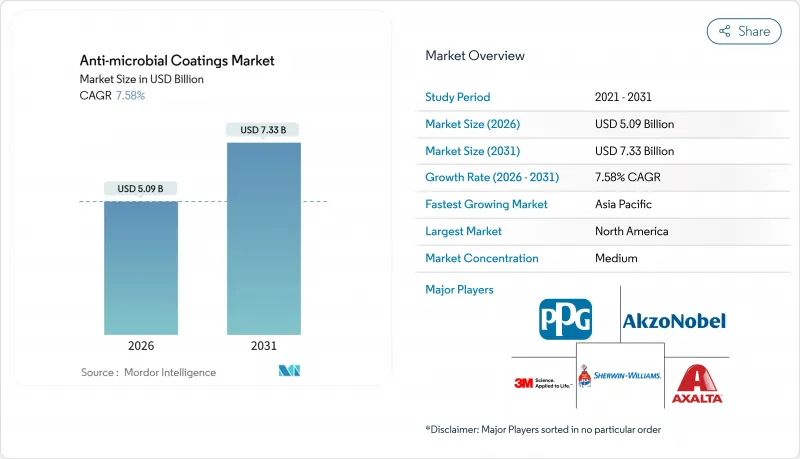
據 Mordor Intelligence 稱,抗菌塗料市場預計在 2026 年達到 50.9 億美元,預計在預測期(2026-2031 年)內將以 7.58% 的複合年成長率成長,到 2031 年達到 73.3 億美元。
本報告按材料(銀、銅、聚合物等)、塗層形態(粉末、液體、其他)、應用領域(建築、食品加工、紡織、家電、醫療、船舶及其他應用)和地區(亞太、北美、歐洲、南美、中東和非洲)進行細分。市場預測以美元計價。
全球抗菌塗料市場趨勢及洞察
醫院感染 (HAI) 減少計畫正在加速北美地區醫院表面塗層的採用。
美國疾病管制與預防中心 (CDC) 在 2025 年報告稱,高達 40% 的急性護理機構病原體傳播將源於環境表面。 CDC 最新指南建議將經美國環保署 (EPA) 註冊的抗菌塗層應用於床欄、輸液架和呼叫按鈕,作為「二級」干預措施,強調在保持手部衛生的同時進行永久性表面改性。聯合委員會 (The Joint Commission) 已將塗層審核納入其 2025 年認證調查,以鼓勵落後的醫療機構進行維修。院內感染 (HAI) 中位數超過 3% 的醫院將面臨高達 3% 的報銷減少,這為投資耐用抗菌基礎設施提供了直接的經濟獎勵。為此,供應商正在提供銀離子和銅合金塗層,這些塗層可保持長達五年的有效性,將抗菌塗層重新定義為固定資產而非消耗品。
印度和東協冷鏈的擴張正在推動對抗菌粉末的需求。
印度國家冷鏈任務署已撥款400億印度盧比(約4.8億美元)用於2024年,強制要求冷藏倉庫和運輸貨櫃採用抗菌粉末塗料。修訂後的良好分銷規範(GDP)指南將於2025年1月生效,該指南強制要求疫苗儲存設施使用通過ISO 21702認證的抗病毒塗料,以應對新冠疫情期間冷鏈中斷的宣傳活動。東協監管機構也正在採取類似措施。印尼食品藥物管理局(BPOM)第12/2025號法規強制要求對藥品配送中心進行抗菌處理,越南已撥款1.2億美元用於改善歐盟客戶水產品的冷鏈。靜電粉末塗料還能確保均勻塗覆在波紋金屬表面,並最大限度地減少揮發性有機化合物(VOC)的排放,從而滿足職業健康和安全要求。
開發中國家和低度開發國家缺乏技術意識
根據世界衛生組織(世衛組織)的數據,低收入國家僅有15%的公立醫院在其感染控制規程中明確規定了持久性表面處理,而高所得國家的比例高達78%。由於對ISO 22196和ISO 21702標準的了解有限,採購負責人缺乏評估塗層有效性的標準。培訓不足加劇了這個問題;撒哈拉以南非洲地區僅22%的設施管理人員接受過抗菌塗層的正規培訓,而北美地區的比例為61%。此外,抗菌塗層的成本比傳統塗料高出30%至50%,價格敏感度也阻礙了其廣泛應用。供應商正與多邊金融機構合作進行試點項目,以證明其有效性並建立當地信任。
細分市場分析
銀基塗層憑藉其廣泛的功效和簡化產品核可的良好監管記錄,在2025年仍保持領先地位,市佔率高達49.45%。醫院更傾向於選擇性能穩定、經實踐驗證的銀基塗層,因為這些塗層有助於降低整個生命週期的成本。有機活性材料、季銨化合物、幾丁聚醣和精油衍生物預計到2031年將以每年9.72%的速度成長,在那些優先考慮減少金屬浸出的應用領域擴大市場佔有率。由於智利供應中斷,銅基配方面臨原料成本波動的問題,這促使生產商轉向使用聚合物基質以減少金屬用量。氧化石墨烯、光催化二氧化鈦和其他新興材料目前仍處於小眾市場,但正吸引尋求高性能、低成本或低毒性產品的供應商持續投入研發。
日益嚴格的生態毒性監測迫使製劑研發人員將功效與金屬含量脫鉤。聚合物包覆的除生物劑可延長釋放動力學,進而減少30%至40%的活性成分用量。諸如石墨烯-銀複合材料之類的混合方法,在實現相當的抗菌活性降低效果的同時,還能將銀含量降低高達60%,因此對於預算有限或面臨綠色建築標準的終端用戶而言,它們是一個極具吸引力的選擇。隨著生物基產品的不斷湧現,價格競爭力可望降低傳統上與銀離子塗層相關的溢價。
區域分析
預計到2025年,北美將佔全球銷售額的45.27%。這項預測得到了美國疾病管制與預防中心(CDC)指南的支持,該指南提高了抗菌塗層在感染控制規程中的重要性;同時,美國環保署(EPA)的揮發性有機化合物(VOC)法規也加速了水性塗料的普及。加拿大也採取了類似的措施,允許在可重複使用設備的表面標註抗菌效果。同時,墨西哥正在對食品加工廠進行維修,以維持對美國的出口地位。零VOC配方正迅速成為醫療和教育行業競標的標準,這使得擁有先進水性產品系列的供應商更具優勢。
亞太地區以9.08%的複合年成長率保持最高增速,這主要得益於印度的「國家冷鏈計畫」、中國雄心勃勃的醫院建設計畫以及韓國在電子產品OEM領域的整合。印度計劃在2028年透過在冷藏物流中強制使用抗菌塗層,將疫苗劣化降低50%。中國的「十四五」規劃包括新建1400家醫院,這些醫院必須符合感染控制規範,包括在高接觸表面塗覆抗菌塗層。在韓國,電子元件供應商的行為準則中強制要求ISO 22196認證,加速了整個價值鏈的標準化進程。
歐洲市場受嚴格的除生物劑法規和揮發性有機化合物 (VOC) 限量標準的影響,這些法規和限量標準促進了生物基和水溶液解決方案的發展。在德國,抗菌塗層被推薦用於交通運輸和教育基礎設施,而英國國家醫療服務體系 (NHS) 則強制要求每 18 個月進行一次 ISO 22196 複檢。法國食品加工產業的應用以及義大利海事產業的應用,反映了歐盟各國對環境的重視。南美洲、中東和非洲地區仍處於應用初期,但局部已成長,這與巴西和沙烏地阿拉伯的醫院建設計畫密切相關。
其他好處:
- Excel格式的市場預測(ME)表
- 3個月的分析師支持
目錄
第1章:引言
- 研究假設和市場定義
- 調查範圍
第2章:調查方法
第3章執行摘要
第4章 市場狀況
- 市場概覽
- 市場促進因素
- 北美地區的醫院感染減少計畫正在加速採用醫院表面塗層。
- 印度和東協冷鏈的擴張正在推動對抗菌粉末的需求。
- 觸控介面的衛生要求正在推動電子產品OEM製造商將塗層整合到產品中。
- 遵守 VOC 法規正在改變北美和歐洲對水性和奈米配方產品的需求。
- 公共交通工具上的接觸面配備了智慧自消毒功能,這與微型交通工具的普及相結合。
- 市場限制因素
- 開發中國家和低度開發國家缺乏技術意識
- 對活性成分的釋放和毒性的擔憂
- 智利銅礦石供應罷工推高了原料成本。
- 價值鏈分析
- 波特五力模型
第5章 市場規模與成長預測
- 材料
- 銀
- 銅
- 聚合物基
- 有機的
- 其他材料
- 按塗層類型
- 粉末
- 液體(溶劑型和水溶液型)
- 其他(採用奈米技術的噴塗及薄膜、表面改質處理)
- 透過使用
- 建築/施工
- 食品加工
- 紡織品
- 家用電器
- 衛生保健
- 海上
- 其他用途
- 按地區
- 亞太地區
- 中國
- 印度
- 日本
- 韓國
- 其他亞太國家
- 北美洲
- 美國
- 加拿大
- 墨西哥
- 歐洲
- 德國
- 英國
- 法國
- 義大利
- 其他歐洲國家
- 南美洲
- 巴西
- 阿根廷
- 其他南美國家
- 中東和非洲
- 沙烏地阿拉伯
- 南非
- 其他中東和非洲國家
- 亞太地區
第6章 競爭情勢
- 市場集中度
- 策略性舉措(併購、合資、資金籌措)
- 市佔率和排名分析
- 公司簡介
- 3M
- Advanced Nanotech Lab
- AGC Inc.
- Akzo Nobel NV
- AST Products, Inc.
- Axalta Coating Systems, LLC
- BASF
- BioCote Limited
- Bio-Fence
- Covalon Technologies Ltd.
- Diamond Vogel
- dsm-firmenich
- DuPont
- Henkel AG & Co. KGaA
- Hydromer
- Jotun
- Lonza
- Microban International
- NEI Corporation
- Novapura AG
- PPG Industries, Inc.
- Sciessent LLC
- Sono-Tek Corporation
- Specialty Coating Systems Inc.
- The Sherwin-Williams Company
第7章 市場機會與未來展望
According to Mordor Intelligence, the anti-microbial coatings market size is estimated at USD 5.09 billion in 2026, and is expected to reach USD 7.33 billion by 2031, at a CAGR of 7.58% during the forecast period (2026-2031).
This report is Segmented by Material (Silver, Copper, Polymeric, and More), Coating Form (Powder, Liquid, and Others), Application (Building and Construction, Food Processing, Textiles, Home Appliances, Healthcare, Marine, and Other Applications), and Geography (Asia-Pacific, North America, Europe, South America, and Middle East and Africa). Market Forecasts are Provided in Terms of Value (USD).
Global Anti-microbial Coatings Market Trends and Insights
HAI-Reduction Programs Accelerating Hospital Surface Coating Uptake in North America
The Centers for Disease Control and Prevention reported in 2025 that environmental surfaces contribute up to 40% of pathogen transmission in acute-care settings. Updated CDC guidance now recommends EPA-registered antimicrobial coatings on bed rails, IV poles, and nurse call buttons as a Tier 2 intervention, elevating permanent surface engineering alongside hand hygiene. The Joint Commission incorporated coating audits into its 2025 accreditation surveys, pushing lagging facilities toward retrofits. Reimbursement penalties of up to 3% for hospitals with above-median HAI rates create a direct financial incentive to invest in durable antimicrobial infrastructure. Suppliers have responded with silver-ion and copper-alloy coatings that maintain efficacy for up to five years, repositioning antimicrobial coatings as a capital asset instead of a consumable expense.
Cold-Chain Expansion in India & ASEAN Propelling Antimicrobial Powder Demand
India's National Cold Chain Mission earmarked INR 40 billion (USD 480 million) in 2024 and mandates antimicrobial powder coatings on refrigerated warehouses and transport containers. Revised Good Distribution Practice guidelines, effective January 2025, require ISO 21702-certified antiviral coatings in vaccine storage, following cold-chain failures during the COVID-19 campaign. ASEAN regulators mirror the move: Indonesia's BPOM Regulation No. 12/2025 stipulates antimicrobial treatment in pharmaceutical hubs, and Vietnam allocated USD 120 million to upgrade seafood cold chains that serve EU customers. Electrostatic powder application ensures uniform coverage on corrugated metal and minimizes VOC emissions, aligning with occupational-safety requirements.
Lack of Technological Awareness in Developing & Under-Developed Nations
World Health Organization data show that only 15% of public hospitals in low-income countries reference durable surface treatments in infection-control protocols, compared with 78% in high-income economies. Limited familiarity with ISO 22196 and ISO 21702 standards leaves procurement officials without benchmarks to assess coating claims. Training gaps compound the issue; only 22% of facility managers in sub-Saharan Africa had formal education on antimicrobial coatings, versus 61% in North America. Price sensitivity also restrains uptake, as antimicrobial coatings can command a 30-50% premium over conventional paints. Suppliers are piloting demonstration projects with multilateral lenders to showcase efficacy and build local credibility.
Other drivers and restraints analyzed in the detailed report include:
- Touch-Interface Hygiene Requirements Driving Electronics OEM Coating Integration
- VOC-Cap Compliance Shifting Demand Toward Water-Borne & Nano Formulations
- Emission-Toxicity Concerns for Active Ingredients
For complete list of drivers and restraints, kindly check the Table Of Contents.
Segment Analysis
Silver retained the leading 49.45% revenue share in 2025, underpinned by broad-spectrum efficacy and a regulatory track record that simplifies product approval. Hospitals prefer silver-based coatings that demonstrate multi-year performance, which helps reduce total lifecycle costs. Organic actives, quaternary ammonium, chitosan, and essential-oil derivatives are growing at 9.72% annually through 2031, capturing share in applications that prioritize minimal metal leaching. Copper formulations face input-cost volatility linked to Chilean supply disruptions, driving producers toward polymeric matrices that cut metal usage. Graphene oxide, photocatalytic titanium dioxide, and other emerging materials remain niche but attract sustained R&D investment from suppliers seeking performance at lower cost or toxicity.
Rising ecotoxicity scrutiny has pushed formulators to decouple efficacy from metal loading. Polymer-encapsulated biocides extend release kinetics, allowing a 30-40% reduction in active-ingredient use. Hybrid approaches such as graphene-silver composites target the same antimicrobial log-reduction while cutting silver content by up to 60%, making them attractive where end-users face budget constraints or green-building criteria. As bio-based options scale, competitive pricing is likely to narrow the historical premium of silver-ion coatings.
Complete Report Scope:
- By Material
- Silver
- Copper
- Polymeric
- Organic
- Other Materials
- By Coating Form
- Powder
- Liquid (Solvent- and Water-borne)
- Others (Nano-Engineered Sprays and Films, Surface Modification Treatments)
- By Application
- Building and Construction
- Food Processing
- Textiles
- Home Appliances
- Healthcare
- Marine
- Other Applications
- By Geography
- Asia-Pacific
- China
- India
- Japan
- South Korea
- Rest of Asia-Pacific
- North America
- United States
- Canada
- Mexico
- Europe
- Germany
- United Kingdom
- France
- Italy
- Rest of Europe
- South America
- Brazil
- Argentina
- Rest of South America
- Middle East and Africa
- Saudi Arabia
- South Africa
- Rest of Middle East and Africa
- Asia-Pacific
Geography Analysis
North America captured 45.27% of 2025 revenue, supported by CDC guidance that elevated antimicrobial coatings in infection-control protocols and by EPA VOC regulations that accelerate water-borne adoption. Canada follows a similar path, permitting antimicrobial claims on reusable equipment surfaces, while Mexico retrofits food-processing plants to preserve US export eligibility. Zero-VOC formulations are quickly becoming the standard in healthcare and education tenders, favoring suppliers with advanced water-borne portfolios.
Asia-Pacific is the highest-growth region at a 9.08% CAGR, driven by India's National Cold Chain Mission, China's aggressive hospital-construction pipeline, and Korea's electronics OEM integration. India targets a 50% vaccine spoilage reduction by 2028 through mandatory antimicrobial coatings in refrigerated logistics. China's 14th Five-Year Plan schedules 1,400 new hospitals that must meet infection-control specifications, including coated high-touch surfaces. South Korea's supplier code of conduct for electronics components now mandates ISO 22196 certification, accelerating standardization across the value chain.
Europe's market is shaped by strict Biocidal Products Regulation oversight and VOC caps that encourage bio-based and water-borne solutions. Germany recommends antimicrobial coatings in transit and education infrastructure, while the United Kingdom's National Health Service mandates ISO 22196 retesting every 18 months. Food-processing adoption in France and marine transitions in Italy reflect broader EU environmental priorities. South America and Middle East-Africa remain nascent but show isolated growth pockets tied to hospital construction programs in Brazil and Saudi Arabia.
- 3M
- Advanced Nanotech Lab
- AGC Inc.
- Akzo Nobel N.V.
- AST Products, Inc.
- Axalta Coating Systems, LLC
- BASF
- BioCote Limited
- Bio-Fence
- Covalon Technologies Ltd.
- Diamond Vogel
- dsm-firmenich
- DuPont
- Henkel AG & Co. KGaA
- Hydromer
- Jotun
- Lonza
- Microban International
- NEI Corporation
- Novapura AG
- PPG Industries, Inc.
- Sciessent LLC
- Sono-Tek Corporation
- Specialty Coating Systems Inc.
- The Sherwin-Williams Company
Additional Benefits:
- The market estimate (ME) sheet in Excel format
- 3 months of analyst support
TABLE OF CONTENTS
1 Introduction
- 1.1 Study Assumptions & Market Definition
- 1.2 Scope of the Study
2 Research Methodology
3 Executive Summary
4 Market Landscape
- 4.1 Market Overview
- 4.2 Market Drivers
- 4.2.1 HAI-reduction programs accelerating hospital surface coating uptake in North America
- 4.2.2 Cold-chain expansion in India & ASEAN propelling antimicrobial powder demand
- 4.2.3 Touch-interface hygiene requirements driving electronics OEM coating integration
- 4.2.4 VOC-cap compliance shifting demand toward water-borne & nano formulations in North America & Europe
- 4.2.5 Smart self-sanitising public-transit surfaces linked to micro-mobility adoption
- 4.3 Market Restraints
- 4.3.1 Lack of technological awareness in developing & under-developed nations
- 4.3.2 Emission-toxicity concerns for active ingredients
- 4.3.3 Chilean copper-ore supply strikes inflating raw-material costs
- 4.4 Value Chain Analysis
- 4.5 Porter's Five Forces
- 4.5.1 Bargaining Power of Suppliers
- 4.5.2 Bargaining Power of Buyers
- 4.5.3 Threat of New Entrants
- 4.5.4 Threat of Substitutes
- 4.5.5 Industry Rivalry
5 Market Size and Growth Forecasts (Value)
- 5.1 By Material
- 5.1.1 Silver
- 5.1.2 Copper
- 5.1.3 Polymeric
- 5.1.4 Organic
- 5.1.5 Other Materials
- 5.2 By Coating Form
- 5.2.1 Powder
- 5.2.2 Liquid (Solvent- and Water-borne)
- 5.2.3 Others (Nano-Engineered Sprays and Films, Surface Modification Treatments)
- 5.3 By Application
- 5.3.1 Building and Construction
- 5.3.2 Food Processing
- 5.3.3 Textiles
- 5.3.4 Home Appliances
- 5.3.5 Healthcare
- 5.3.6 Marine
- 5.3.7 Other Applications
- 5.4 By Geography
- 5.4.1 Asia-Pacific
- 5.4.1.1 China
- 5.4.1.2 India
- 5.4.1.3 Japan
- 5.4.1.4 South Korea
- 5.4.1.5 Rest of Asia-Pacific
- 5.4.2 North America
- 5.4.2.1 United States
- 5.4.2.2 Canada
- 5.4.2.3 Mexico
- 5.4.3 Europe
- 5.4.3.1 Germany
- 5.4.3.2 United Kingdom
- 5.4.3.3 France
- 5.4.3.4 Italy
- 5.4.3.5 Rest of Europe
- 5.4.4 South America
- 5.4.4.1 Brazil
- 5.4.4.2 Argentina
- 5.4.4.3 Rest of South America
- 5.4.5 Middle East and Africa
- 5.4.5.1 Saudi Arabia
- 5.4.5.2 South Africa
- 5.4.5.3 Rest of Middle East and Africa
- 5.4.1 Asia-Pacific
6 Competitive Landscape
- 6.1 Market Concentration
- 6.2 Strategic Moves (Mergers and Acquisitions, JV, Funding)
- 6.3 Market Share(%)/Ranking Analysis
- 6.4 Company Profiles {(includes Global level Overview, Market level overview, Core Segments, Financials as available, Strategic Information, Products and Services, and Recent Developments)}
- 6.4.1 3M
- 6.4.2 Advanced Nanotech Lab
- 6.4.3 AGC Inc.
- 6.4.4 Akzo Nobel N.V.
- 6.4.5 AST Products, Inc.
- 6.4.6 Axalta Coating Systems, LLC
- 6.4.7 BASF
- 6.4.8 BioCote Limited
- 6.4.9 Bio-Fence
- 6.4.10 Covalon Technologies Ltd.
- 6.4.11 Diamond Vogel
- 6.4.12 dsm-firmenich
- 6.4.13 DuPont
- 6.4.14 Henkel AG & Co. KGaA
- 6.4.15 Hydromer
- 6.4.16 Jotun
- 6.4.17 Lonza
- 6.4.18 Microban International
- 6.4.19 NEI Corporation
- 6.4.20 Novapura AG
- 6.4.21 PPG Industries, Inc.
- 6.4.22 Sciessent LLC
- 6.4.23 Sono-Tek Corporation
- 6.4.24 Specialty Coating Systems Inc.
- 6.4.25 The Sherwin-Williams Company
7 Market Opportunities and Future Outlook
- 7.1 White-Space and Unmet-Need Assessment
- 7.2 Development of Multi-functional Coatings
- 7.3 Growing Demand for HVAC Applications

 全球抗菌塗料市場(2026-2030 年)
 先進塗層和表面處理市場預測至2034年-全球分析(按塗層類型、塗層形成技術、表面處理、功能、基材、應用、最終用戶和地區分類)全球抗菌醫用塗層市場預測至2034年:依抗菌劑、基材、醫療設備類型、塗層技術、抗菌機制、最終用戶和地區分類
 抗菌塗層市場報告:趨勢、預測及競爭分析(至2035年)
 抗菌塗料市場:按類型、技術、基材、形式、最終用途產業和分銷管道分類-2026-2032年全球市場預測先進塗層和表面材料市場預測至2034年——按塗層類型、表面材料、技術、化學性質、功能、最終用戶和地區分類的全球分析
 全球抗菌薄膜市場:市場規模、佔有率、成長和行業分析:按材料類型、薄膜類型、應用和地區預測(至2034年)
 抗菌塗料市場報告:按產品類型、應用和地區分類(2026-2034 年)抗病毒塗層市場:依技術、應用、終端用戶產業、劑型及通路分類-2026-2032年全球市場預測
 全球抗菌塗料市場規模、佔有率、趨勢和成長分析報告(2026-2034年)