


 |
市場調查報告書
商品編碼
2120351
乙酸乙酯:市場佔有率分析、產業趨勢與統計、成長預測(2026-2031)Ethyl Acetate - Market Share Analysis, Industry Trends & Statistics, Growth Forecasts (2026 - 2031) |
||||||

※ 本網頁內容可能與最新版本有所差異。詳細情況請與我們聯繫。
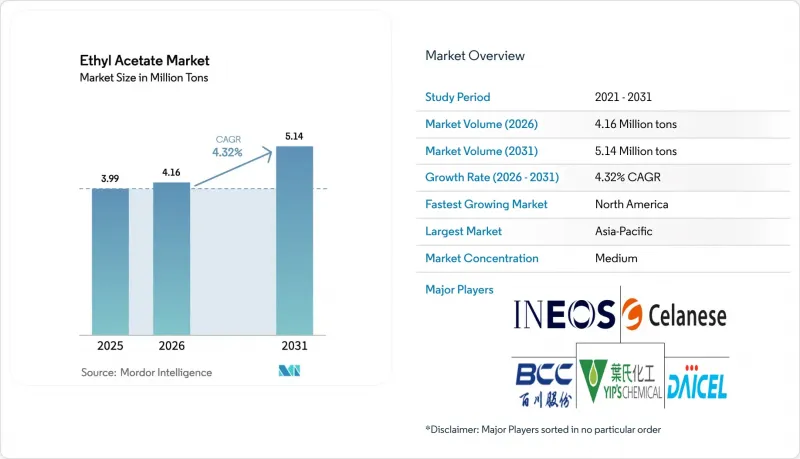
根據 Mordor Intelligence 預測,乙酸乙酯市場規模將從 2025 年的 399 萬噸和 2026 年的 416 萬噸成長到 2031 年的 514 萬噸,2026 年至 2031 年的年複合成長率(CAGR)為 4.32%。
本報告按原料(石油基和生物基)、純度等級(工業/塗料級、食品級、醫藥/GMP級)、應用領域(油漆和塗料、軟包裝油墨等)、終端用戶行業(汽車、人造皮革等)以及地區(亞太地區、北美地區、歐洲地區等)進行細分。市場預測以噸為單位。
全球乙酸乙酯市場趨勢及洞察
對溶劑應用的需求增加
乙酸乙酯作為工業溶劑,在油漆、塗料、黏合劑和一般製程應用中被大量使用,是乙酸乙酯市場成長的基礎。北美建築塗料市場的復甦以及印度和東南亞的基礎設施投資正在推動強勁的需求。伊士曼化學中間體部門報告稱,2024年第三季銷售額較上一季成長15%。這主要歸功於維護工作後乙醯基化合物供應量的增加以及強勁的銷售價格,表明一體化生產商正在收緊供需平衡。電子商務包裝的擴張增加了聚氨酯和丙烯酸層壓板黏合劑的需求,而乙酸乙酯是多層薄膜的主要溶劑。隨著汽車老化,重新噴漆的數量趨於正常化,這支撐了北美和歐洲對溶劑的額外需求。由於毒性較低且獲得監管部門批准,某些塗料配方中逐漸從丁酮轉向乙酸乙酯,這也促進了需求的成長。
製藥業的成長
在製藥生產中,乙酸乙酯可用作萃取介質、反應溶劑和層析法洗脫劑。 GMP 級規範要求單一生產場所生產、批次隔離和檢驗的雜質譜,這提高了准入門檻並支撐了高價。 2024 年,印度學名藥出口額超過 500 億美元,推動了抗生素純化、類固醇萃取和片劑包衣製程中對藥用級乙酸乙酯的需求。美國食品藥物管理局 (FDA) 法規 21 CFR 182.60 將該溶劑指定為 GRAS(公認安全物質),允許其在 cGMP 系統下用作賦形劑和掩味劑。 ICH Q3C 殘留溶劑測試設定了嚴格的去除標準,支援高純度等級的銷售。塞拉尼斯位於田納西州金斯波特的垂直整合生產基地為製藥生產客戶提供可追溯的、符合 cGMP 標準的溶劑,展現了原料管理如何確保永續的競爭優勢。
歐洲向水性黏合劑過渡
為了符合嚴格的VOC排放限制,歐洲包裝製造商正逐步採用水性系統。德國和法國正在實施優先考慮減少溶劑使用的永續發展框架,這促使黏合劑生產商嘗試水性或高固態配方。雖然溶劑型複合材料在軟包裝領域仍佔據主導地位,尤其是在對黏合強度和固化速度要求較高的應用領域,但在標籤紙組裝和某些瓦楞紙板封口生產線等終端應用領域,向水性技術的轉變正在逐步進行。這種轉變需要適應更長的乾燥時間和因去除水分的應用。北美加工商正密切關注歐洲的發展動態,如果監管壓力加大,他們可能會採用類似的規範。
細分市場分析
預計到2025年,石油衍生產品將佔全球產量的90.23%。這主要得益於成熟的費歇爾酯化裝置享受規模經濟效益和較低的原料成本。然而,在品牌所有者強制性淨零排放要求的推動下,生物基產品預計將在2031年之前以6.37%的複合年成長率成長,這促使他們對獲得ISCC PLUS和美國農業部認證的溶劑型產品的需求增加。 SEKAB新近獲得認證的生物乙酸生產線正在為歐洲塗料製造商提供物料平衡文件,而Viridis Chemical則向北美買家供應100%生物基產品。 Godavari Biorefineries透過將每噸溶劑的蒸氣用量減少到2.5噸,並提高了其永續性績效,從而改善了其可再生原料供應的成本曲線。
Selene公司推出了「ECO-B」系列產品,其生物基含量高達43%,進一步拓展了現有石油基供應鏈的部分替代選擇。儘管亞太地區以價格為導向的採購文化依然盛行,並傾向於選擇石油基產品,但歐洲和北美的政策正在培育差異化的細分市場,如果認證溢價保持在歷史水平,這些市場預計將在2031年佔據兩位數的市場佔有率。
到2025年,工業級和塗料級乙酸乙酯將佔全球需求的60.14%,仍將是大規模生產的塗料、油墨和黏合劑的主要成分。同時,受印度和中國原料藥生產成長的推動,醫藥級和GMP級乙酸乙酯的市場規模正以每年5.36%的速度成長。醫藥級和GMP級乙酸乙酯純度標準超過99%,雜質限度嚴格,且批次可追溯,因此其價格比工業級高出20%以上。伊士曼公司位於朗維尤的工廠遵循最佳實踐,滿足監管檢驗的所有必要要求,包括經過驗證的測試方法、殘留溶劑分析和符合ISO標準的文件。
食品級溶劑佔據著一個規模雖小但戰略意義重大的細分市場,其應用範圍涵蓋了美國食品藥物管理局 (FDA) 21 CFR 173.228 法規規定的咖啡和茶的脫咖啡因過程。其 GRAS(公認安全)認證進一步提升了其在風味萃取領域的應用。歐盟指令 2009/32/EC 也體現了這項認證。未來食品級溶劑的需求成長取決於亞太地區無咖啡因咖啡消費量的成長,以及植物來源蛋白風味萃取中,溶劑效率和回收率至關重要。
區域分析
到2025年,亞太地區將佔全球塗料總處理量的73.15%,主要得益於中國430萬噸的龐大裝置容量以及印度蓬勃發展的原料藥藥(API)出口產業。儘管長期供應過剩,但該地區的塗料消費量仍以超過4%的速度成長,基礎設施建設支撐了塗料需求。從北美地區到2031年將保持最高的區域複合年成長率(CAGR),達到5.91%,這主要得益於汽車供應鏈回流以及諸如Viridis Chemical位於內布拉斯加州的工廠等新型生物基項目,該工廠已獲得ISCC PLUS認證。
在歐洲,水性黏合劑的廣泛使用以及高昂的環保法規合規成本擠壓了利潤空間,但由於平版印刷油墨配方的改進和製藥業的需求,溶劑的需求仍然穩定。中東地區的生產商面臨更嚴峻的經濟狀況,Sipchem決定暫停其沙烏地阿拉伯工廠的運營,凸顯了亞洲價格下跌時,出口導向工廠所面臨的困境。南美和非洲的成長穩定但較為溫和,投資主要集中在服務該地區食品加工業的軟包裝加工企業。
其他好處:
- Excel格式的市場預測(ME)表
- 3個月的分析師支持
目錄
第1章:引言
- 研究假設和市場定義
- 調查範圍
第2章:調查方法
第3章執行摘要
第4章 市場狀況
- 市場概覽
- 市場促進因素
- 對溶劑應用的需求增加
- 製藥業的成長
- 歐盟轉向使用低VOC溶劑正在提振對平版印刷油墨的需求。
- 對個人保健產品的需求不斷成長
- 實現淨零排放的途徑是加快購買生物基乙酸乙酯。
- 市場限制因素
- 歐洲向水性黏合劑過渡
- 北美醋酸原料價格波動
- 中國近期產能的提升導致全球供應過剩。
- 價值鏈分析
- 波特五力模型
第5章 市場規模與成長預測
- 按原料
- 石油衍生的
- 生物基
- 按純度等級
- 工業/塗料級
- 食品級
- 藥品/GMP級
- 透過使用
- 油漆和塗料
- 用於軟包裝的油墨
- 黏合劑和密封劑
- 顏料和染料
- 製程溶劑
- 其他用途(增味劑、墨水)
- 按最終用戶行業分類
- 車
- 人造皮革
- 食品/飲料
- 製藥
- 其他終端用戶產業(包裝)
- 按地區
- 亞太地區
- 中國
- 印度
- 日本
- 韓國
- 東南亞國協
- 其他亞太國家
- 北美洲
- 美國
- 加拿大
- 墨西哥
- 歐洲
- 德國
- 英國
- 法國
- 義大利
- 北歐國家
- 其他歐洲國家
- 南美洲
- 巴西
- 阿根廷
- 其他南美國家
- 中東和非洲
- 沙烏地阿拉伯
- 阿拉伯聯合大公國
- 南非
- 奈及利亞
- 其他中東和非洲國家
- 亞太地區
第6章 競爭情勢
- 市場集中度
- 策略趨勢
- 市佔率和排名分析
- 公司簡介
- Celanese Corporation
- Daicel Corporation
- Eastman Chemical Company
- Godavari Biorefineries Ltd
- Greenfield Global Inc.
- INEOS
- Jiangsu Baichuan High-Tech New Materials Co., Ltd.
- Jiangsu SOPO(Group)Co. Ltd
- Jubilant Pharmova Ltd
- Laxmi Organic Industries Ltd.
- PetroChina Company Limited
- PT Pertamina(Persero)
- Resonac Holdings Corporation
- Sasol Ltd
- SEKAB
- Solvay
- Tokuyama Corporation
- Viridis Chemical, LLC
- Yip's Chemical Holdings Limited
第7章 市場機會與未來展望
According to Mordor Intelligence, the ethyl acetate market size is projected to expand from 3.99 million tons in 2025 and 4.16 million tons in 2026 to 5.14 million tons by 2031, registering a CAGR of 4.32% between 2026 to 2031.
This report is Segmented by Source (Petro-Based and Bio-Based), Purity Grade (Industrial/Coatings Grade, Food Grade, and Pharmaceutical/GMP Grade), Application (Paints and Coatings, Flexible-Packaging Inks, and More), End-User Industry (Automotive, Artificial Leather, and More), and Geography (Asia-Pacific, North America, Europe, and More). The Market Forecasts are Provided in Terms of Volume (Tons).
Global Ethyl Acetate Market Trends and Insights
Rising Demand in Solvent Applications
Industrial solvent usage sets the baseline for ethyl acetate market growth as paints, coatings, adhesives, and general process applications consume large volumes. Architectural-coating recovery in North America and infrastructure spending in India and Southeast Asia keep bulk demand resilient. Eastman's Chemical Intermediates division reported a 15% sequential revenue jump in Q3 2024, citing higher acetyls availability after maintenance work and firmer selling prices, a signal that integrated producers are tightening supply-demand balances. E-commerce packaging expansion amplifies consumption of polyurethane and acrylic laminating adhesives, where ethyl acetate provides the primary solvent in multilayer films. Automotive refinish volumes are normalizing as vehicle fleets age, supporting additional solvent offtake in both North America and Europe. The progressive shift away from methyl ethyl ketone to ethyl acetate in certain coating formulations, driven by lower toxicity and regulatory acceptance, is adding incremental demand.
Growth of the Pharmaceutical Sector
Pharmaceutical manufacturing absorbs ethyl acetate as an extraction medium, reaction solvent, and chromatography eluent. GMP-grade specifications mandate single-site production, batch quarantine, and validated impurity profiling, which raise entry barriers and support premium pricing. India's generic-drug exports surpassed USD 50 billion in 2024, boosting demand for pharmaceutical-grade ethyl acetate in antibiotic purification, steroid extraction, and tablet-coating processes. FDA regulation 21 CFR 182.60 lists the solvent as GRAS, validating its use in excipients and taste-masking formulations under cGMP regimes. ICH Q3C residual-solvent testing keeps removal thresholds tight, sustaining sales of high-purity grades. Celanese's vertically integrated Kingsport, Tennessee complex supplies pharmaceutical customers with traceable, cGMP-compliant solvent, illustrating how feedstock control can secure a durable competitive edge.
Conversion to Water-Borne Adhesives in Europe
European packaging converters have steadily introduced water-borne systems to comply with stringent VOC ceilings. Germany and France have rolled out corporate sustainability frameworks that rank solvent reduction as a top priority, persuading adhesive formulators to trial water-borne or high-solids chemistries. Although solvent-borne lamination still dominates flexible packaging, especially where high bond strength and fast cure speed are critical, a gradual migration to water-borne technologies is under way in end-use cases such as label-stock assembly and certain carton-sealing lines. The learning curve involves adapting to longer drying times and higher energy consumption for water removal, which presently caps penetration rates. North American converters are monitoring European developments and could adopt similar specifications once regulatory pressure converges.
Other drivers and restraints analyzed in the detailed report include:
- EU Shift to Low-VOC Solvents Boosting Offset-Printing Inks
- Increasing Demand for Personal-Care Products
- Volatile Acetic-Acid Feedstock Prices in North America
For complete list of drivers and restraints, kindly check the Table Of Contents.
Segment Analysis
Petro-based maintained 90.23% of worldwide output in 2025 because entrenched Fischer-esterification assets enjoy scale and feedstock cost advantages. Nonetheless, bio-based is expanding at a 6.37% CAGR through 2031 as brand-owner net-zero mandates translate into purchase orders for ISCC PLUS and USDA-certified solvent grades. SEKAB's newly certified bio-acetic acid stream gives European coatings customers mass-balance documentation, while Viridis Chemical services North American buyers with 100% bio-based product. Godavari Biorefineries trimmed steam use to 2.5 tons per ton of solvent and upgraded sustainability credentials, which sharpens the cost curve for renewable supply.
Celanese launched its ECO-B line with up to 43% bio-content, expanding options for partial drop-in replacement in established petro-based chains. Although Asia-Pacific retains a price-centric procurement culture that favors petro-routes, European and North American policies are nurturing a differentiated niche that could account for double-digit percentage shares by 2031 if certification premiums stay inside historical bounds.
Industrial/coatings grade supplied 60.14% of global demand in 2025 and remains the workhorse for high-volume coatings, inks, and adhesives. The ethyl acetate market size attributable to pharmaceutical/GMP grade is however enlarging at a 5.36% clip thanks to API manufacturing growth in India and China. USP and Ph.Eur. assays above 99% purity, strict impurity limits, and batch traceability justify price uplifts that exceed 20% over industrial grades. Eastman's Longview operations illustrate best-practice with validated test methods, residual-solvent assays, and ISO-compliant documentation, all prerequisites for regulatory inspections.
Food-grade solvent fills a smaller but strategically important niche, covering coffee and tea decaffeination under FDA 21 CFR 173.228, with GRAS status reinforcing acceptability for flavor extraction. European rules under Directive 2009/32/EC echo this clearance. Future growth in food-grade demand rides on rising decaf coffee consumption in Asia-Pacific and the scaling of flavor extraction for plant-based proteins where solvent efficiency and recoverability matter.
Complete Report Scope:
- By Source
- Petro-based
- Bio-based
- By Purity Grade
- Industrial/Coatings Grade
- Food Grade
- Pharmaceutical/GMP Grade
- By Application
- Paints and Coatings
- Flexible-Packaging Inks
- Adhesives and Sealants
- Pigments and Dyes
- Process Solvents
- Other Applications (Flavor and Fragrance Enhancers, Inks)
- By End-user Industry
- Automotive
- Artificial Leather
- Food and Beverage
- Pharmaceuticals
- Other End-user Industries (Packaging)
- By Geography
- Asia-Pacific
- China
- India
- Japan
- South Korea
- ASEAN Countries
- Rest of Asia-Pacific
- North America
- United States
- Canada
- Mexico
- Europe
- Germany
- United Kingdom
- France
- Italy
- NORDIC Countries
- Rest of Europe
- South America
- Brazil
- Argentina
- Rest of South America
- Middle-East and Africa
- Saudi Arabia
- United Arab Emirates
- South Africa
- Nigeria
- Rest of Middle-East and Africa
- Asia-Pacific
Geography Analysis
Asia-Pacific accounted for 73.15% of 2025 tonnage thanks to China's gigantic 4.30 million-ton installed base and India's thriving API export industry. Despite chronic oversupply, regional consumption growth stays above 4% as infrastructure build-outs support coatings demand. North America records the fastest regional CAGR at 5.91% through 2031, a function of automotive supply-chain reshoring and new bio-based projects such as Viridis Chemical's Nebraska plant, which benefits from ISCC PLUS certification.
Europe grapples with margin pressure from water-borne adhesive uptake and heavy environmental compliance costs, yet offset-printing ink reformulation and pharmaceutical demand stabilize solvent pull. Middle-East producers face harsher economics; Sipchem's decision to idle its Saudi unit highlights how export-oriented plants struggle when Asian prices dip. South America and Africa post steady but modest gains, with investment concentrated in flexible-packaging converters serving regional food-processing industries.
- Celanese Corporation
- Daicel Corporation
- Eastman Chemical Company
- Godavari Biorefineries Ltd
- Greenfield Global Inc.
- INEOS
- Jiangsu Baichuan High-Tech New Materials Co., Ltd.
- Jiangsu SOPO (Group) Co. Ltd
- Jubilant Pharmova Ltd
- Laxmi Organic Industries Ltd.
- PetroChina Company Limited
- PT Pertamina (Persero)
- Resonac Holdings Corporation
- Sasol Ltd
- SEKAB
- Solvay
- Tokuyama Corporation
- Viridis Chemical, LLC
- Yip's Chemical Holdings Limited
Additional Benefits:
- The market estimate (ME) sheet in Excel format
- 3 months of analyst support
TABLE OF CONTENTS
1 Introduction
- 1.1 Study Assumptions and Market Definition
- 1.2 Scope of the Study
2 Research Methodology
3 Executive Summary
4 Market Landscape
- 4.1 Market Overview
- 4.2 Market Drivers
- 4.2.1 Rising Demand in Solvent Applications
- 4.2.2 Growth of the Pharmaceutical Sector
- 4.2.3 EU Shift to Low-VOC Solvents Boosting Offset-Printing Inks
- 4.2.4 Increasing Demand for Personal-Care Products
- 4.2.5 Net-Zero Roadmaps Accelerating Bio-Based Ethyl-Acetate Purchases
- 4.3 Market Restraints
- 4.3.1 Conversion To Water-Borne Adhesives in Europe
- 4.3.2 Volatile Acetic-Acid Feedstock Prices in North America
- 4.3.3 Global Oversupply from Recent Chinese Capacity Additions
- 4.4 Value Chain Analysis
- 4.5 Porter's Five Forces
- 4.5.1 Bargaining Power of Suppliers
- 4.5.2 Bargaining Power of Buyers
- 4.5.3 Threat of New Entrants
- 4.5.4 Threat of Substitutes
- 4.5.5 Degree of Competition
5 Market Size and Growth Forecasts (Volume)
- 5.1 By Source
- 5.1.1 Petro-based
- 5.1.2 Bio-based
- 5.2 By Purity Grade
- 5.2.1 Industrial/Coatings Grade
- 5.2.2 Food Grade
- 5.2.3 Pharmaceutical/GMP Grade
- 5.3 By Application
- 5.3.1 Paints and Coatings
- 5.3.2 Flexible-Packaging Inks
- 5.3.3 Adhesives and Sealants
- 5.3.4 Pigments and Dyes
- 5.3.5 Process Solvents
- 5.3.6 Other Applications (Flavor and Fragrance Enhancers, Inks)
- 5.4 By End-user Industry
- 5.4.1 Automotive
- 5.4.2 Artificial Leather
- 5.4.3 Food and Beverage
- 5.4.4 Pharmaceuticals
- 5.4.5 Other End-user Industries (Packaging)
- 5.5 By Geography
- 5.5.1 Asia-Pacific
- 5.5.1.1 China
- 5.5.1.2 India
- 5.5.1.3 Japan
- 5.5.1.4 South Korea
- 5.5.1.5 ASEAN Countries
- 5.5.1.6 Rest of Asia-Pacific
- 5.5.2 North America
- 5.5.2.1 United States
- 5.5.2.2 Canada
- 5.5.2.3 Mexico
- 5.5.3 Europe
- 5.5.3.1 Germany
- 5.5.3.2 United Kingdom
- 5.5.3.3 France
- 5.5.3.4 Italy
- 5.5.3.5 NORDIC Countries
- 5.5.3.6 Rest of Europe
- 5.5.4 South America
- 5.5.4.1 Brazil
- 5.5.4.2 Argentina
- 5.5.4.3 Rest of South America
- 5.5.5 Middle-East and Africa
- 5.5.5.1 Saudi Arabia
- 5.5.5.2 United Arab Emirates
- 5.5.5.3 South Africa
- 5.5.5.4 Nigeria
- 5.5.5.5 Rest of Middle-East and Africa
- 5.5.1 Asia-Pacific
6 Competitive Landscape
- 6.1 Market Concentration
- 6.2 Strategic Moves
- 6.3 Market Share (%)/Ranking Analysis
- 6.4 Company Profiles (includes Global level Overview, Market level overview, Core Segments, Financials as available, Strategic Information, Products and Services, and Recent Developments)
- 6.4.1 Celanese Corporation
- 6.4.2 Daicel Corporation
- 6.4.3 Eastman Chemical Company
- 6.4.4 Godavari Biorefineries Ltd
- 6.4.5 Greenfield Global Inc.
- 6.4.6 INEOS
- 6.4.7 Jiangsu Baichuan High-Tech New Materials Co., Ltd.
- 6.4.8 Jiangsu SOPO (Group) Co. Ltd
- 6.4.9 Jubilant Pharmova Ltd
- 6.4.10 Laxmi Organic Industries Ltd.
- 6.4.11 PetroChina Company Limited
- 6.4.12 PT Pertamina (Persero)
- 6.4.13 Resonac Holdings Corporation
- 6.4.14 Sasol Ltd
- 6.4.15 SEKAB
- 6.4.16 Solvay
- 6.4.17 Tokuyama Corporation
- 6.4.18 Viridis Chemical, LLC
- 6.4.19 Yip's Chemical Holdings Limited
7 Market Opportunities and Future Outlook
- 7.1 White-space and Unmet-need Assessment

 乙酸乙酯市場-2026-2032年全球市場預測
 乙酸乙酯全球市場規模、佔有率、趨勢和成長分析報告(2026-2034)丙酸乙酯市場:依等級、應用、通路和最終用戶分類-2026-2032年全球市場預測乙酸乙酯市場:市場規模、佔有率、成長率、全球產業分析、按類型、應用和地區分類的分析以及未來預測(2026-2034 年)
 2026年全球乙酸乙酯市場報告
 2026-2030年全球乙酸乙酯市場
 甲氧基丙酯市場 - 全球產業規模、佔有率、趨勢、機會、預測:按應用、銷售管道、地區和競爭格局分類,2021-2031年乙酯L-乳酸酯市場按等級、來源和應用分類,全球預測(2026-2032年)
 乙酸乙酯市場-全球產業分析、規模、佔有率、成長、趨勢及預測(2025-2035)
 乙酸乙酯市場按應用、最終用途行業、分銷管道和地區分類