


 |
市場調查報告書
商品編碼
2120347
先進陶瓷:市場佔有率分析、產業趨勢與統計、成長預測(2026-2031)Advanced Ceramics - Market Share Analysis, Industry Trends & Statistics, Growth Forecasts (2026 - 2031) |
||||||

※ 本網頁內容可能與最新版本有所差異。詳細情況請與我們聯繫。
據 Mordor Intelligence 稱,2026 年先進陶瓷市場規模估計為 1051.2 億美元,預計在預測期(2026-2031 年)內將以 6.81% 的複合年成長率成長,到 2031 年達到 1461.3 億美元。
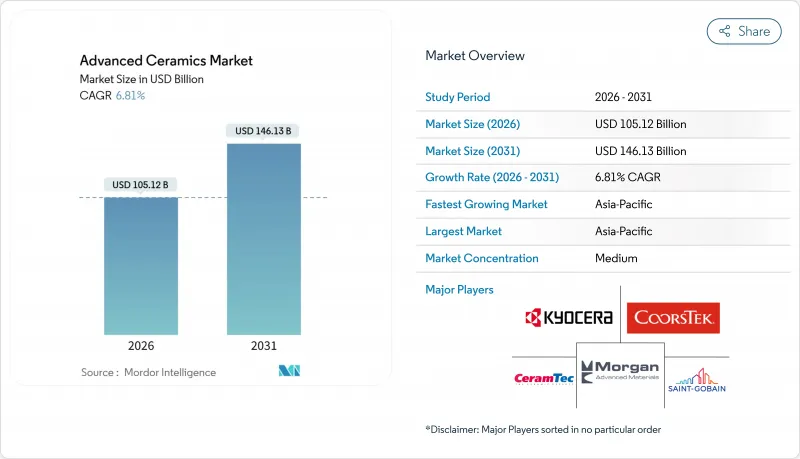
本報告按材料類型(氧化鋁、氧化鋯等)、類型(單片陶瓷、陶瓷基質複合材料、陶瓷塗層等)、應用(結構陶瓷、生物陶瓷等)、終端用戶行業(電氣電子、交通運輸等)和地區(亞太地區、北美地區、歐洲地區等)進行細分。市場預測以美元計價。
全球先進陶瓷市場趨勢及洞察
金屬和高性能塑膠的遷移
汽車和航太領域的輕量化法規正在加速從鋼和鋁轉變為氮化矽和碳化矽的轉變。現代Transys公司在2024年的測試中證明,陶瓷軸承與鋼軸承相比,可降低12%的寄生損耗。美國太空總署(NASA)2025年的研究證實,氮化矽渦輪葉片能夠承受高達1400 度C的溫度,比鎳基高溫合金高出200 度C,同時重量減輕40%。然而,NSK公司2024年提交的文件顯示,由於每個陶瓷球的成本超過15美元,一些供應商仍然選擇混合設計。總體而言,儘管存在成本差異,原始設備製造商(OEM)仍在繼續為電動車變速箱和高超音速推進系統認證全陶瓷零件。
在醫療植入和醫療設備不斷拓展的應用
由於氧化鋯增強氧化鋁和釔安定氧化鋯具有更低的離子發射和更高的耐磨性,它們正在關節重建手術中取代鈷鉻合金。 2025年3月,Zimmer Biomet公司的Persona IQ股骨假體組件獲得了FDA 510(k)認證,該組件採用二氧化鋯頭。該產品可在15年內將聚乙烯磨損減少60%。根據Stryker公司2025年的投資人資料,其採用陶瓷內襯的Mako平台10年再手術率低於2%。雖然更嚴格的歐洲醫療設備法規將產品上市時間延長了18至24個月,但這進一步鞏固了通過ISO 13485認證工廠的市場佔有率。
高昂的製造成本
超過1600 度C的爐溫以及後續加工製程使得陶瓷價格比成型聚合物高出3到5倍。根據CoorsTek 2024年的報告,氧化鋁基板的生產需要每噸12兆瓦時的電力,而歐洲天然氣價格的波動會使每公斤成本增加0.80至1.20美元。 CeramTec 2025年的永續發展報告預計,爐子電氣化改造的成本將達到1800萬歐元(1940萬美元),並預測在電價穩定之前,單位成本將增加6%。小批量生產的特色產品,例如透過熱解生產的氮化硼,每公斤成本超過500美元,這阻礙了其更廣泛的應用。
細分市場分析
預計到2025年,氧化鋁將佔據先進陶瓷市場41.26%的佔有率。這反映了其作為多層陶瓷電容器(MLCC)介質的成熟應用,而MLCC的年出貨量高達數兆個。這一主導地位意味著,在基準年,氧化鋁在先進陶瓷市場規模中所佔最大。以鈦酸鋇和鋯鈦酸鉛主導的鈦酸鹽陶瓷預計到2031年將維持7.82%的複合年成長率,是所有材料類別中成長率最高的。因此,氧化鋁和鈦酸鹽將是影響電子元件和感測技術領域先進陶瓷市場未來發展的關鍵因素。村田製作所將其雲端工廠產能擴大20%,以滿足人工智慧伺服器基板的需求(每塊板最多需要2000個電容器),此後,對氧化鋁MLCC介質的需求進一步成長。
除了多層陶瓷電容器(MLCC)之外,氧化鋯在牙冠和股骨頭領域也佔據著重要的市場佔有率。這主要歸功於其氧化釔穩定化等級,此等級的斷裂韌性超過10 MPa√m,是氧化鋁的兩倍。碳化矽(SiC)和氮化矽(SiN)仍然是高溫硬體的主要材料,其中SiC基板已應用於800伏特電動汽車逆變器中。氮化鋁的熱導率為170 W/m·K,能夠確保氮化鎵(GaN)高頻放大器在安全的工作範圍內運行,因此其售價高達每平方厘米8-12美元。隨著先進陶瓷市場向石油化工重整和半導體晶體生長等領域多元化發展,矽酸鎂觸媒撐體和熱解坩堝佔據了規模較小但盈利的細分市場。總而言之,這些材料定義了整個先進陶瓷市場功能專業化的下一個階段。
到2025年,整體式陶瓷產品將佔銷售額的78.24%,佔據先進陶瓷市場最大佔有率。這一壓倒性優勢將最大程度地推動先進陶瓷市場規模的成長。同時,陶瓷基質複合材料(CMC)預計將以8.17%的複合年成長率成長,比市場平均高出約2個百分點。這主要得益於各大航太公司正在推進CMC渦輪零件的認證工作,這些零件的運作溫度比鎳合金高出100 度C 。京瓷、CoorsTek和TDK等公司「粉末到零件」的垂直整合將使整體式基板能夠滿足人工智慧伺服器嚴格的電阻差要求,從而增強其短期產量優勢。
然而,情況正在轉變。賽峰集團報告稱,配備LEAP引擎的飛機採用CMC(陶瓷基複合材料)整流罩,燃油消耗量降低了1.2%。普拉奎爾表面技術公司證明,氧化釔釔安定氧化鋯塗層可以將引擎大修間隔從15,000飛行小時延長至22,000飛行小時,每台引擎可帶來320萬美元的利潤。這些成果表明,塗層和複合材料正在削弱傳統整體材料的主導地位。因此,先進陶瓷市場正處於十字路口,整體材料的產量仍居高不下,但附加價值正轉向工程化CMC和塗層結構,這些結構能夠在嚴苛的熱環境下延長使用壽命。
區域分析
到2025年,亞太地區將佔全球銷售額的54.22%,成為先進陶瓷市場最大的區域佔有率。預計到2031年,亞太地區的複合年成長率將達到7.11%,遠超北美和歐洲,其領先優勢也將進一步擴大。根據日本經濟產業省統計,2024年日本國內出貨收益達到1.2兆日圓(約81億美元),儘管地緣政治局勢緊張,出口額仍成長了18%。京瓷、村田製作所和TDK三家公司從粉末合成到電化學測試的垂直整合,透過縮短生產週期和保護專有技術,鞏固了亞太地區在先進陶瓷市場的主導地位。
韓國正透過三星馬達和LG Innotek加速擴大產能,兩家公司2024年的總投資額將超過8,000億韓元(約6.1億美元),用於新建多層陶瓷電容器(MLCC)和基板生產線。中國「中國製造2025」政策的獎勵措施正在津貼中陶瓷宜興工廠氧化鋁粉產能的擴張,該工廠目前年產量為1.5萬噸。印度目前仍有70%的需求依賴進口,但一項針對電子產品的「生產掛鉤激勵計畫」預計將在2028年前實現基板的本地組裝,這有望為該地區的先進陶瓷市場注入新的活力。
北美對先進陶瓷的需求主要受航太和國防項目的驅動,這些項目優先選擇美國供應商,例如 CoorsTek、3M 和 Corning。根據《通貨膨脹控制法案》的國內採購條款,通用汽車決定從 2026 年開始在其 Ultium 電池組中使用美國製造的氮化基板。普惠加拿大公司在其 PW800 引擎中使用陶瓷基質複合材料渦輪零件,以提高灣流公務機的燃油效率,這表明該技術在北美地區的應用日益廣泛。位於墨西哥克雷塔羅汽車工業園區的基板組裝採用美墨加協定 (USMCA) 下的區域加值標準,為美國電動車工廠供應產品。
預計到2025年,歐洲將佔據顯著的市場佔有率,其中德國、法國和英國在生產和消費方面均處於領先地位。 CeramTec和Morgan Advanced Materials營運著通過ISO 13485認證的工廠,生產二氧化鋯股骨頭和氧化鋁髀臼臼襯墊。雖然歐盟醫療設備法規(MDR)延長了核准週期,但也淘汰了不符合標準的進口商,使市場需求集中在知名品牌上。德國弗勞恩霍夫IKTS研究所與西門子能源公司合作,目標是在2027年之前實現氫燃料固體氧化物燃料電池(SOFC)電堆65%的電力效率。歐盟「地平線歐洲」津貼已投資1.2億歐元用於高超音速飛機用超高溫陶瓷的研發,這有助於該地區保持其在先進陶瓷市場的重要地位。
南美洲、中東和非洲對先進陶瓷的需求正在成長。巴西航空工業公司(Embraer)正在測試氮化矽襟翼導軌滾輪,以降低飛機維修成本;沙烏地阿美公司則在其半導體試驗生產線上資助熱解坩堝的研發。然而,這兩個地區都依賴粉末進口,這限制了它們在先進陶瓷市場獲得附加價值的能力。長期成長潛力取決於技術轉移和本地陶瓷工程課程的發展。
其他好處:
- Excel格式的市場預測(ME)表
- 3個月的分析師支持
目錄
第1章:引言
- 研究假設和市場定義
- 調查範圍
第2章:調查方法
第3章執行摘要
第4章 市場狀況
- 市場概覽
- 市場促進因素
- 金屬和高性能塑膠的遷移
- 在醫療植入和醫療設備的應用範圍擴大
- 高頻電力電子領域的需求
- 航太和國防領域日益成長的熱能需求
- 全固態電池和固態氧化物燃料電池的普及
- 市場限制因素
- 高昂的生產成本
- 複雜且資本密集型製造業
- 廢舊產品回收基礎設施有限。
- 價值鏈分析
- 波特五力模型
- 專利分析
- 價格分析
第5章 市場規模與成長預測
- 依材料類型
- 氧化鋁
- 氧化鋯
- 鈦酸鹽
- 碳化矽
- 氮化矽
- 氮化鋁
- 矽酸鎂
- 熱解法製得的氮化硼
- 其他
- 按類型
- 單片陶瓷
- 陶瓷基質複合材料
- 陶瓷塗層
- 透過使用
- 結構陶瓷
- 生物陶瓷
- 電陶瓷
- 磨損和腐蝕部件
- 隔熱層和超高溫陶瓷(UHTC)組件
- 觸媒撐體和過濾器
- 其他(環境與能源系統)
- 按最終用戶行業分類
- 電氣和電子設備
- 運輸
- 醫學領域
- 產業
- 國防與安全
- 化學品
- 其他終端用戶產業(能源和環境)
- 按地區
- 亞太地區
- 中國
- 印度
- 日本
- 韓國
- 其他亞太國家
- 北美洲
- 美國
- 加拿大
- 墨西哥
- 歐洲
- 德國
- 英國
- 法國
- 義大利
- 其他歐洲國家
- 南美洲
- 巴西
- 阿根廷
- 其他南美國家
- 中東和非洲
- 沙烏地阿拉伯
- 南非
- 其他中東和非洲國家
- 亞太地區
第6章 競爭情勢
- 市場集中度
- 策略趨勢
- 市佔率和排名分析
- 公司簡介
- 3M
- AGC Inc.
- Blasch Precision Ceramics, Inc.
- CeramTec GmbH
- CoorsTek Inc.
- Corning Incorporated
- Elan Technology
- International Syalons(Newcastle)Limited
- KYOCERA Corporation
- MARUWA Co., Ltd.
- Materion Corporation
- McDanel Advanced Material Technologies LLC
- Morgan Advanced Materials
- Murata Manufacturing Co., Ltd.
- Rauschert Heinersdorf-Pressig GmbH
- Saint-Gobain
- SPT-Group
- Vesuvius
- Wonik QnC Corporation
第7章 市場機會與未來展望
According to Mordor Intelligence, the advanced ceramics market size is estimated at USD 105.12 billion in 2026, and is expected to reach USD 146.13 billion by 2031, at a CAGR of 6.81% during the forecast period (2026-2031).
This report is Segmented by Material Type (Alumina, Zirconia, and More), Class Type (Monolithic Ceramics, Ceramic Matrix Composites, and Ceramic Coatings), Application (Structural Ceramics, Bioceramics, and More), End-User Industry (Electrical and Electronics, Transportation, and More), and Geography (Asia-Pacific, North America, Europe, and More). Market Forecasts are Provided in Terms of Value (USD).
Global Advanced Ceramics Market Trends and Insights
Shift From Metals And High-Performance Plastics
Automotive and aerospace weight-reduction rules accelerate the swap from steel and aluminum to silicon nitride and silicon carbide. Hyundai-Transys showed ceramic bearings cut parasitic losses by 12% versus steel in 2024 tests. NASA's 2025 work proved silicon-nitride turbine blades endure 1,400 °C, 200 °C hotter than nickel superalloys, while lowering mass by 40%. Yet NSK's 2024 filing revealed that ceramic-ball costs above USD 15 each keep some suppliers on hybrid designs. Overall, OEMs continue to qualify all-ceramic parts for EV gearboxes and hypersonic propulsion despite cost gaps.
Expanding Use In Medical Implants And Devices
Zirconia-toughened alumina and yttria-stabilized zirconia are replacing cobalt-chromium in joint arthroplasty because of low ion release and high wear resistance. Zimmer Biomet won FDA 510(k) clearance in March 2025 for its Persona IQ femoral component featuring a zirconia head that lowers polyethylene wear by 60% over 15 years. Stryker's 2025 investor deck said its Mako platform with ceramic liners cut revision surgeries below 2% at 10 years. Although Europe's stricter Medical Device Regulation extends launch timelines 18-24 months, the added rigor consolidates share for ISO 13485-certified plants.
High Production Costs
Kiln temperatures above 1,600 °C and post-machining inflate ceramic prices 3-5X molded polymers. CoorsTek's 2024 deck showed alumina substrates need 12 MWh per ton, with volatile European gas adding USD 0.80-1.20/kg. CeramTec's 2025 sustainability report projected EUR 18 million (USD 19.4 million) to electrify kilns, raising unit cost by 6% until power prices stabilize. Small-batch niches like pyrolytic boron nitride exceed USD 500/kg, deterring wider uptake.
Other drivers and restraints analyzed in the detailed report include:
- Demand In High-Frequency Power Electronics
- Rising Aerospace And Defense Thermal Needs
- Complex, Capital-Intensive Manufacturing
For complete list of drivers and restraints, kindly check the Table Of Contents.
Segment Analysis
Alumina captured 41.26% of the advanced ceramics market share in 2025, reflecting its entrenched use as the dielectric in multilayer ceramic capacitors that ship in the trillions every year. That dominance equated to the largest slice of the advanced ceramics market size for any individual material during the base year. Titanate ceramics, led by barium titanate and lead zirconate titanate, are projected to clock a 7.82% CAGR through 2031, the fastest rate among material categories. Together, alumina and titanate therefore set the tone for how the advanced ceramics market will evolve in electronic components and sensing technologies. Demand for alumina MLCC dielectrics intensified after Murata expanded Izumo capacity by 20% to satisfy AI-server boards that need up to 2,000 capacitors each.
Beyond MLCCs, zirconia commands a share in dental crowns and femoral heads because yttria-stabilized grades deliver fracture toughness above 10 MPa√m, double alumina. Silicon carbide and silicon nitride remain staples for high-temperature hardware, with SiC substrates already embedded in 800-volt electric-vehicle inverters. Aluminum nitride sells at premium prices-USD 8-12 per cm2-because 170 W/m-K thermal conductivity keeps gallium-nitride radio-frequency amplifiers within safe operating limits. Magnesium silicate catalyst supports and pyrolytic boron nitride crucibles fill smaller but profitable niches as the advanced ceramics market diversifies into petrochemical reforming and semiconductor crystal growth. Collectively, these materials define the next phase of functional specialization across the advanced ceramics market.
Monolithic products generated 78.24% of revenue in 2025, giving them the largest position in the overall advanced ceramics market. That commanding presence translated into the single biggest contribution to the advanced ceramics market size for any class type. Yet ceramic matrix composites are forecast to expand at an 8.17% CAGR, almost two percentage points above the market average, as aerospace primes qualify CMC turbine components capable of running 100 °C hotter than nickel alloys. Powder-to-part vertical integration at Kyocera, CoorsTek, and TDK allows monolithic substrates to meet tight AI-server impedance tolerances, thereby reinforcing short-term volume advantages.
Momentum nonetheless is shifting. Safran reported that CMC shrouds trim fuel burn by 1.2% on LEAP-equipped aircraft. Praxair Surface Technologies documented yttria-stabilized zirconia coatings that stretch overhaul intervals from 15,000 to 22,000 flight hours, a USD 3.2 million benefit per engine. These gains illustrate how coatings and composites erode the incumbent lead of monolithics. The advanced ceramics market, therefore, stands at a crossroads where volume remains in monolithic formats while value migrates to engineered CMC and coating architectures that lengthen service life in demanding thermal profiles.
Complete Report Scope:
- By Material Type
- Alumina
- Zirconia
- Titanate
- Silicon Carbide
- Silicon Nitride
- Aluminum Nitride
- Magnesium Silicate
- Pyrolytic Boron Nitride
- Others
- By Class Type
- Monolithic Ceramics
- Ceramic Matrix Composites
- Ceramic Coatings
- By Application
- Structural Ceramics
- Bioceramics
- Electroceramics
- Wear and Corrosion Components
- Thermal Barrier and UHTC Components
- Catalyst Supports and Filters
- Others (Environmental and Energy Systems)
- By End-user Industry
- Electrical and Electronics
- Transportation
- Medical
- Industrial
- Defense and Security
- Chemical
- Other End-user Industries (Energy and Environmental)
- By Geography
- Asia-Pacific
- China
- India
- Japan
- South Korea
- Rest of Asia-Pacific
- North America
- United States
- Canada
- Mexico
- Europe
- Germany
- United Kingdom
- France
- Italy
- Rest of Europe
- South America
- Brazil
- Argentina
- Rest of South America
- Middle East and Africa
- Saudi Arabia
- South Africa
- Rest of Middle East and Africa
- Asia-Pacific
Geography Analysis
Asia-Pacific generated 54.22% of revenue in 2025, making it the largest regional slice of the advanced ceramics market. That lead is projected to widen as the region posts a 7.11% CAGR through 2031, well ahead of North America and Europe. Japan's Ministry of Economy, Trade and Industry indicated domestic shipments hit JPY 1.2 trillion in 2024 (USD 8.1 billion) and still grew exports 18% despite geopolitical frictions. Vertical integration at Kyocera, Murata, and TDK-spanning powder synthesis to electrical testing-compresses cycle times and safeguards proprietary know-how, cementing Asia-Pacific's dominance in the advanced ceramics market.
South Korea accelerates capacity via Samsung Electro-Mechanics and LG Innotek, whose combined 2024 capital outlays topped KRW 800 billion (USD 610 million) for new MLCC and substrate lines. China's Made in China 2025 incentives subsidize alumina-powder expansion at Sinocera's Yixing plant, now producing 15,000 metric tons per year. India remains import-dependent for 70% of its needs, yet its Production-Linked Incentive scheme for electronics foresees localized substrate assembly by 2028, potentially adding fresh momentum to the regional advanced ceramics market.
The advanced ceramics demand in North America is anchored by aerospace and defense programs that favor U.S. suppliers such as CoorsTek, 3M, and Corning. The Inflation Reduction Act's domestic-content clauses prompted General Motors to commit to U.S. aluminum-nitride substrates in Ultium battery packs from 2026 onward. Pratt & Whitney Canada is deploying ceramic-matrix-composite turbine components in PW800 engines to improve fuel economy for Gulfstream business jets, demonstrating the technology's northward diffusion. Mexico's Queretaro automotive hub hosts substrate assembly lines that supply U.S. EV plants, capitalizing on regional-value-content rules under USMCA.
Europe represented a considerable market share in 2025, with Germany, France, and the United Kingdom leading production and consumption. CeramTec and Morgan Advanced Materials operate ISO 13485-certified plants producing zirconia femoral heads and alumina acetabular liners. While the European Medical Device Regulation lengthens approval cycles, it also filters out non-compliant importers, funneling demand toward established brands. Germany's Fraunhofer IKTS collaborates with Siemens Energy to achieve 65% electrical efficiency in hydrogen-fueled SOFC stacks by 2027. EU Horizon Europe grants are channeling EUR 120 million into ultra-high-temperature ceramics for hypersonic vehicles, ensuring the region remains relevant in the advanced ceramics market.
South America and the Middle East and Africa are witnessing rising demand for advanced ceramics. Brazil's EMBRAER is testing silicon-nitride flap-track rollers to shave aircraft maintenance costs, while Saudi Aramco finances pyrolytic boron nitride crucibles for in-house semiconductor pilot lines. Both regions, however, depend on imported powders, limiting value capture within the advanced ceramics market. Long-term upside hinges on knowledge transfer and the maturation of local ceramic-engineering curricula.
- 3M
- AGC Inc.
- Blasch Precision Ceramics, Inc.
- CeramTec GmbH
- CoorsTek Inc.
- Corning Incorporated
- Elan Technology
- International Syalons (Newcastle) Limited
- KYOCERA Corporation
- MARUWA Co., Ltd.
- Materion Corporation
- McDanel Advanced Material Technologies LLC
- Morgan Advanced Materials
- Murata Manufacturing Co., Ltd.
- Rauschert Heinersdorf-Pressig GmbH
- Saint-Gobain
- SPT-Group
- Vesuvius
- Wonik QnC Corporation
Additional Benefits:
- The market estimate (ME) sheet in Excel format
- 3 months of analyst support
TABLE OF CONTENTS
1 Introduction
- 1.1 Study Assumptions and Market Definition
- 1.2 Scope of the Study
2 Research Methodology
3 Executive Summary
4 Market Landscape
- 4.1 Market Overview
- 4.2 Market Drivers
- 4.2.1 Shift from Metals and High-Performance Plastics
- 4.2.2 Expanding Use in Medical Implants and Devices
- 4.2.3 Demand in High-Frequency Power Electronics
- 4.2.4 Rising Aerospace and Defence Thermal Needs
- 4.2.5 Solid-State Batteries and SOFC Adoption
- 4.3 Market Restraints
- 4.3.1 High Production Costs
- 4.3.2 Complex, Capital-Intensive Manufacturing
- 4.3.3 Limited End-of-Life Recycling Infrastructure
- 4.4 Value Chain Analysis
- 4.5 Porter's Five Forces
- 4.5.1 Bargaining Power of Suppliers
- 4.5.2 Bargaining Power of Buyers
- 4.5.3 Threat of New Entrants
- 4.5.4 Threat of Substitutes
- 4.5.5 Competitive Rivalry
- 4.6 Patent Analysis
- 4.7 Price Analysis
5 Market Size and Growth Forecasts (Value)
- 5.1 By Material Type
- 5.1.1 Alumina
- 5.1.2 Zirconia
- 5.1.3 Titanate
- 5.1.4 Silicon Carbide
- 5.1.5 Silicon Nitride
- 5.1.6 Aluminum Nitride
- 5.1.7 Magnesium Silicate
- 5.1.8 Pyrolytic Boron Nitride
- 5.1.9 Others
- 5.2 By Class Type
- 5.2.1 Monolithic Ceramics
- 5.2.2 Ceramic Matrix Composites
- 5.2.3 Ceramic Coatings
- 5.3 By Application
- 5.3.1 Structural Ceramics
- 5.3.2 Bioceramics
- 5.3.3 Electroceramics
- 5.3.4 Wear and Corrosion Components
- 5.3.5 Thermal Barrier and UHTC Components
- 5.3.6 Catalyst Supports and Filters
- 5.3.7 Others (Environmental and Energy Systems)
- 5.4 By End-user Industry
- 5.4.1 Electrical and Electronics
- 5.4.2 Transportation
- 5.4.3 Medical
- 5.4.4 Industrial
- 5.4.5 Defense and Security
- 5.4.6 Chemical
- 5.4.7 Other End-user Industries (Energy and Environmental)
- 5.5 By Geography
- 5.5.1 Asia-Pacific
- 5.5.1.1 China
- 5.5.1.2 India
- 5.5.1.3 Japan
- 5.5.1.4 South Korea
- 5.5.1.5 Rest of Asia-Pacific
- 5.5.2 North America
- 5.5.2.1 United States
- 5.5.2.2 Canada
- 5.5.2.3 Mexico
- 5.5.3 Europe
- 5.5.3.1 Germany
- 5.5.3.2 United Kingdom
- 5.5.3.3 France
- 5.5.3.4 Italy
- 5.5.3.5 Rest of Europe
- 5.5.4 South America
- 5.5.4.1 Brazil
- 5.5.4.2 Argentina
- 5.5.4.3 Rest of South America
- 5.5.5 Middle East and Africa
- 5.5.5.1 Saudi Arabia
- 5.5.5.2 South Africa
- 5.5.5.3 Rest of Middle East and Africa
- 5.5.1 Asia-Pacific
6 Competitive Landscape
- 6.1 Market Concentration
- 6.2 Strategic Moves
- 6.3 Market Share/Ranking Analysis
- 6.4 Company Profiles (includes Global overview, Market overview, Core Segments, Financials, Strategic Information, Products and Services, Recent Developments)
- 6.4.1 3M
- 6.4.2 AGC Inc.
- 6.4.3 Blasch Precision Ceramics, Inc.
- 6.4.4 CeramTec GmbH
- 6.4.5 CoorsTek Inc.
- 6.4.6 Corning Incorporated
- 6.4.7 Elan Technology
- 6.4.8 International Syalons (Newcastle) Limited
- 6.4.9 KYOCERA Corporation
- 6.4.10 MARUWA Co., Ltd.
- 6.4.11 Materion Corporation
- 6.4.12 McDanel Advanced Material Technologies LLC
- 6.4.13 Morgan Advanced Materials
- 6.4.14 Murata Manufacturing Co., Ltd.
- 6.4.15 Rauschert Heinersdorf-Pressig GmbH
- 6.4.16 Saint-Gobain
- 6.4.17 SPT-Group
- 6.4.18 Vesuvius
- 6.4.19 Wonik QnC Corporation
7 Market Opportunities and Future Outlook
- 7.1 White-space and Unmet-Need Assessment

 航太板材市場報告:趨勢、預測及競爭分析(至2035年)
 先進陶瓷市場預測至2034年-全球材料、產品類型、分類、製造流程、應用、最終用戶、形態、功能、分銷管道和區域分析電子特種陶瓷市場預測至2034年-按產品形式、材料類型、應用、最終用戶和地區分類的全球分析先進功能陶瓷市場預測至2034年:按材料類型、性能、製造流程、應用、產業和地區分類的全球分析全球耐磨材料市場預測(至2034年):依材料類型、產品、防護類型、應用、產業及地區分類氧化物陶瓷市場預測(2034 年)-按材料類型、形狀、性能、應用、產業和地區分類的全球分析結構陶瓷市場預測至2034年-按材料類型、形狀、性能、應用、產業和地區分類的全球分析能源陶瓷市場預測至2034年-按產品類型、材料類型、性能、應用、產業和地區分類的全球分析陶瓷粉末市場預測至2034年—按材料類型、純度、製造方法、應用、產業和地區分類的全球分析非氧化物陶瓷市場預測至2034年-按材料類型、形狀、性能、應用、產業和地區分類的全球分析