


 |
市場調查報告書
商品編碼
2120345
Memlista:市場佔有率分析、產業趨勢與統計、成長預測(2026-2031)Memristor - Market Share Analysis, Industry Trends & Statistics, Growth Forecasts (2026 - 2031) |
||||||

※ 本網頁內容可能與最新版本有所差異。詳細情況請與我們聯繫。
根據 Mordor Intelligence 預測,Memlista 市場規模預計將在 2026 年達到 286 億美元,到 2031 年將擴大到 1550.9 億美元,在此期間的複合年成長率為 28.6%。
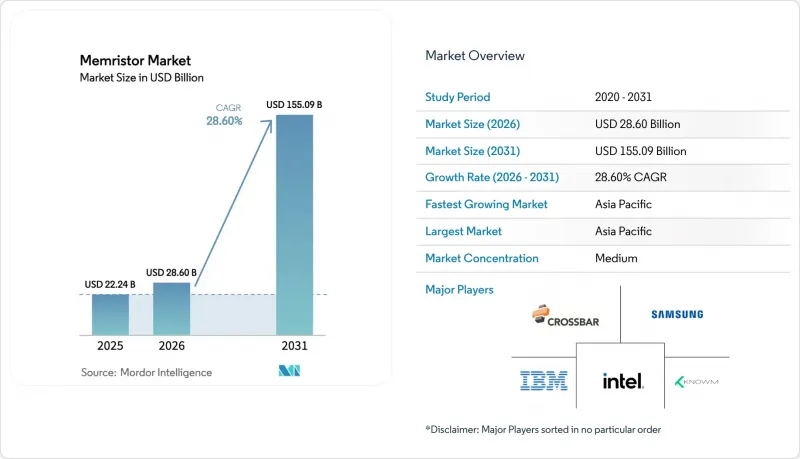
本報告按應用領域(非揮發性記憶體、神經形態和生物系統、可程式邏輯和訊號處理等)、終端用戶產業(家用電子電器、IT和通訊、汽車、醫療保健等)、技術(分子和離子薄膜等)、材料(金屬氧化物、硫族化物等)以及地區進行細分。市場預測以美元(USD)為單位。
全球Memlista市場趨勢與洞察
對物聯網、雲端運算和巨量資料日益成長的需求
超大規模資料中心業者正在採用 Memlist 型「記憶體運算」陣列,以降低馮諾依曼核心中資料傳輸帶來的 80% 的能耗開銷。清華大學開發的一款全整合晶片功耗僅為 ASIC基準值的 3%,可實現穿戴式裝置和自動駕駛汽車的即時學習。 2025 年 6 月,Softbank Corporation、英特爾和東京大學共同成立了 SAIMEMORY 公司,獲得 30 億日圓(約 2,220 萬美元)的種子輪融資,旨在將高容量、低功耗記憶體商業化。邊緣設備在待機模式下可實現零漏電流,亞太地區的消費性電子產品廠商正迅速採用這些陣列。北美地區的超大規模資料中心業者正在試驗用於建議引擎的神經形態加速器,從而推動了 Memlist 市場的發展。
自主機器人的應用正在迅速增加。
倉庫和工廠機器人需要確定性的延遲,而傳統的DRAM-GPU堆疊無法滿足這項要求。韓國科學技術院(KAIST)展示了一種仿昆蟲運動檢測器,與現有設計相比,該偵測器在提高預測精度的同時,能耗降低了92.9%。 BrainChip的「Akida」處理器整合了憶阻器突觸,正吸引那些需要毫秒響應時間的原始裝置製造商(OEM)的注意。東亞工廠的協作機器人是首批大量客戶,歐洲工業自動化產業也將在中期採購週期內跟進。這些應用推動了對具有高耐久性和低溫漂移的穩健憶阻器單元的需求。
技術應用的複雜性
系統晶片)設計人員需要整合並最佳化材料、類比電路和網路演算法,但具備這些多學科技能的人才卻十分短缺。東京大學的多層 TaOx 測試晶片採用了一種標準框架中未曾提及的新型激活函數,實現了 10 年保持性能和高密度之間的平衡。這種人才缺口導致需要客製化工具鏈,延長了產品上市時間,並增加了非重複性工程 (NRE) 成本。生態系仍在發展中的地區受到的影響最大,但隨著 2026 年以後產品通用參考設計的出現,預計這些障礙將逐步減少。
細分市場分析
到2025年,非揮發性記憶體將佔銷售額的45.22%,主要用於取代微控制器中的嵌入式快閃記憶體。與神經形態和生物系統相關的memlista市場預計將以36.22%的複合年成長率成長,因為研究機構正從模擬轉向量產晶片。韓國科學技術院(KAIST)開發的無選擇器陣列展示了用於保全攝影機的即時學習功能,顯示其商業性可行性。可程式邏輯領域的應用,例如5G無線電中的自適應濾波器,也不斷增加。隨著以運算為中心的架構超越純存儲,memlista市場的價值將轉向針對乘法和積分精度最佳化的裝置。
清華大學研發的整合式「記憶體運算」晶片是這項轉變的基礎,該晶片的能耗僅為專用積體電路(ASIC)的3%。利用超大規模資料中心業者進行的儲存級記憶體先導計畫進一步模糊了記憶體和邏輯之間的界限。隨機數產生和物理不可複製函數(PUF)等輔助功能正逐步推動憶阻器市場的需求成長,並使其市場更加多元化。
2025年,利用設備內人工智慧進行語音和攝影機處理的家用電子電器將佔總銷售額的31.55%。隨著需要亞毫秒推理的高階駕駛輔助系統被整合到電動車中,汽車產業的需求正以27.53%的複合年成長率加速成長。 BrainChip的「Akida」處理器已被應用於行人偵測模組。邊緣通訊和IT產業的買家正在5G基地台中部署Memlista加速器以降低回程傳輸延遲,這正在擴大Memlista在營運商基礎設施中的市場佔有率。
在醫療設備,零漏電流可實現長壽命電池;在工業自動化領域,憶阻器被應用於自適應機器人控制器。國防相關契約,例如入選美國國防高級研究計劃局 (DARPA) 的 REMIND 項目,為耐輻射憶阻器產品提供了穩定的收入來源。感測器節點的演示實驗也在新興領域(包括農業和零售業)穩步推進,這表明憶阻器市場擁有不斷擴大的潛在商機。
區域分析
亞太地區是記憶記憶體市場的主要驅動力,預計2025年將佔全球銷售額的53.33%,並有望在2031年之前以21.90%的複合年成長率成長。日本已撥款10兆日圓(約670億美元)用於半導體產業發展,扶持SAIMEMORY等新創公司。中國清華大學研發出一種「記憶體運算」晶片,其功耗僅為基準值的3%。韓國科學技術院(KAIST)宣布,在2024年至2025年間,相變記憶體和神經形態技術將取得突破性成果。台灣台積電(TSMC)與他人合作,在《自然》雜誌上發表了多篇關於記憶記憶體整合的論文,顯示其晶圓代工業務正在擴大規模。儘管印度和東南亞國家正在努力改善設計教育,但記憶記憶體生態系統仍處於起步階段。
受國防需求和超大規模資料中心業者投資的推動,北美預計將在2025年位居第二。美國國防高級研究計畫局(DARPA)提供的1,160萬美元REMIND津貼正用於開發航太阻變隨機存取記憶體(ReRAM),而憶阻器材料也被列入修訂後的美國微電子戰略中的國家優先事項。 IBM和英特爾正在持續進行相變和神經形態架構的研究,而加拿大和墨西哥則在封裝和設計領域貢獻人才。
在歐洲,德國、法國和英國正在推動高級駕駛輔助系統和預測性維護加速器的先導計畫。歐洲太空總署(ESA)正在評估Memlista材料在深空探勘中的抗輻射性能。在南美洲、中東和非洲,人們對Memlista的興趣日益濃厚,儘管仍處於早期階段,尤其是在智慧城市應用領域。然而,供應鏈的限制限制了其快速擴張。因此,預計亞太地區和北美將在2031年之前保持其在Memlista市場的主導地位。
其他好處:
- Excel格式的市場預測(ME)表
- 3個月的分析師支持
目錄
第1章:引言
- 研究假設和市場定義
- 調查範圍
第2章:調查方法
第3章執行摘要
第4章 市場狀況
- 市場概覽
- 市場促進因素
- 對物聯網、雲端運算和巨量資料日益成長的需求
- 自主機器人的應用正在迅速增加。
- 邊緣人工智慧加速器(需要記憶體內運算。
- 半導體小型化的極限正在推動CMOS記憶體設計的邊界。
- 用於抗輻射空間記憶體的國防預算
- 人們對碳中和資料中心越來越感興趣。
- 市場限制因素
- 技術應用的複雜性
- 開關性能極不穩定,且有耐用性問題。
- 未成熟的設計自動化工具鏈
- 對稀土元素材料供應鏈的依賴
- 產業價值/供應鏈分析
- 監理情勢
- 技術展望
- 宏觀經濟因素對市場和產業的影響
- 波特五力分析
第5章 市場規模與成長預測
- 透過使用
- 非揮發性記憶體
- 神經形態系統和生物系統
- 可程式邏輯和訊號處理
- 新興資料存儲
- 其他用途
- 按最終用戶行業分類
- 家用電子產品
- 資訊科技/通訊
- 車
- 衛生保健
- 工業自動化
- 國防/航太
- 其他終端用戶產業
- 透過技術
- 分子和離子薄膜
- 自旋憶阻器與磁性憶阻器
- 混合CMOS-Memlist
- 3D交叉點
- 其他技術
- 材料
- 金屬氧化物
- 硫族化物
- 自旋電子學
- 有機聚合物
- 鐵電
- 其他材料
- 按地區
- 北美洲
- 美國
- 加拿大
- 墨西哥
- 其他北美國家
- 歐洲
- 德國
- 法國
- 英國
- 義大利
- 西班牙
- 俄羅斯
- 其他歐洲國家
- 亞太地區
- 中國
- 日本
- 印度
- 韓國
- 澳洲
- 其他亞太國家
- 南美洲
- 巴西
- 阿根廷
- 其他南美國家
- 中東
- 沙烏地阿拉伯
- 阿拉伯聯合大公國
- 土耳其
- 其他中東國家
- 非洲
- 南非
- 奈及利亞
- 其他非洲國家
- 北美洲
第6章 競爭情勢
- 市場集中度
- 策略趨勢
- 市佔率分析
- 公司簡介
- Crossbar Inc.
- Panasonic Corporation
- 4DS Memory Limited
- Adesto Technology Inc.
- Micron Technology Inc.
- Samsung Electronics Co. Ltd.
- Sony Group Corporation
- Western Digital Corporation
- Knowm Inc.
- Intel Corporation
- IBM Corporation
- SK hynix Inc.
- Weebit Nano Ltd.
- Fujitsu Limited
- Toshiba Corporation
- Honeywell International Inc.
- Everspin Technologies Inc.
- STMicroelectronics NV
- Avalanche Technology Inc.
- HP Inc.
- Taiwan Semiconductor Manufacturing Company Limited
第7章 市場機會與未來展望
According to Mordor Intelligence, the memristor market size reached USD 28.6 billion in 2026 and is forecast to climb to USD 155.09 billion by 2031, advancing at a 28.6% CAGR over the period.
This report is Segmented by Application (Non-Volatile Memory, Neuromorphic and Biological System, Programmable Logic and Signal Processing, and More), End-User Industry (Consumer Electronics, IT and Telecom, Automotive, Healthcare, and More), Technology (Molecular and Ionic Thin Film, and More), Material (Metal Oxide, Chalcogenide, and More), and Geography. The Market Forecasts are Provided in Terms of Value (USD).
Global Memristor Market Trends and Insights
Increasing Demand for IoT, Cloud Computing, and Big Data
Hyperscalers are deploying memristive compute-in-memory arrays to curb the 80% energy overhead linked to data movement in von Neumann cores. A fully integrated chip from Tsinghua consumes 3% of ASIC baselines, enabling real-time learning on wearables and autonomous vehicles. In June 2025, SoftBank, Intel, and the University of Tokyo formed SAIMEMORY with JPY 3 billion (USD 22.2 million) seed capital to commercialize high-capacity low-power memory. Edge devices profit from zero standby leakage, and Asia-Pacific consumer-electronics vendors are quick to integrate such arrays. North American hyperscalers are piloting neuromorphic accelerators for recommendation engines, expanding the immediate addressable memristor market.
Surging Adoption of Autonomous Robots
Warehouse and factory robots demand deterministic latency that legacy DRAM-GPU stacks cannot meet. KAIST demonstrated an insect-mimicking motion detector consuming 92.9% less energy than existing designs while raising prediction accuracy. BrainChip's Akida processor, embedding memristive synapses, has attracted OEMs that require millisecond responses. Collaborative robots across East Asian factories have become early volume customers, and Europe's industrial automation sector is following in medium-term procurement cycles. These deployments push up unit demand for ruggedized memristors with high endurance and low-temperature drift.
Complexity in Technological Application
System-on-chip designers must co-optimize materials, analog circuits, and network algorithms, yet such multidisciplinary talent is scarce. The University of Tokyo's multilevel TaOx test chip balanced 10-year retention with higher density using new activation functions unrecognized by standard frameworks. This gap forces bespoke toolchains, extends time-to-market, and raises non-recurring engineering cost. Regions with nascent ecosystems feel the pinch most, but shared reference designs expected from 2026 products should gradually reduce barriers.
Other drivers and restraints analyzed in the detailed report include:
- Rising Adoption of Edge AI Accelerators Requiring In-Memory Computing
- Semiconductor Scaling Limits Pushing Beyond CMOS Memory Designs
- High Switching Variability and Endurance Issues
For complete list of drivers and restraints, kindly check the Table Of Contents.
Segment Analysis
In 2025, non-volatile memory represented 45.22% revenue, anchored by embedded flash replacements in microcontrollers. The memristor market size tied to neuromorphic and biological systems is set to grow at 36.22% CAGR as laboratories transition from simulation to production silicon. KAIST's selector-less array demonstrated real-time learning for security cameras, proving commercial viability. Programmable logic uses, such as adaptive filters in 5G radio, are also increasing. As compute-centric architectures outpace pure storage, the memristor market will witness value shifting toward devices optimized for multiply-accumulate precision.
The pivot is underscored by Tsinghua's integrated compute-in-memory chip, which operates at 3% of ASIC energy. Storage-class memory pilots by hyperscalers further blend the boundary between memory and logic. Secondary roles like random-number generation and physically unclonable functions add incremental demand, reinforcing the memristor market's diversification.
Consumer electronics held 31.55% revenue in 2025, leveraging on-device AI for voice and camera tasks. Automotive demand is accelerating at a 27.53% CAGR as electric vehicles embed advanced driver assistance requiring sub-millisecond inference. BrainChip's Akida processor is already integrated into pedestrian-detection modules. Edge telecom and IT buyers deploy memristive accelerators in 5G base stations to trim backhaul latency, boosting the memristor market share inside carrier infrastructure.
Healthcare devices enjoy long battery life thanks to zero leakage, while industrial automation uses memristors for adaptive robot controllers. Defense contracts, such as DARPA's REMIND award, secure revenue streams for radiation-hardened variants. Emerging sectors, agriculture and retail among them, experiment with sensor nodes, signaling broadening addressable opportunities for the memristor market.
Complete Report Scope:
- By Application
- Non-volatile Memory
- Neuromorphic and Biological System
- Programmable Logic and Signal Processing
- Emerging Data Storage
- Other Applications
- By End-user Industry
- Consumer Electronics
- IT and Telecom
- Automotive
- Healthcare
- Industrial Automation
- Defense and Aerospace
- Other End-user Industries
- By Technology
- Molecular and Ionic Thin Film
- Spin-based and Magnetic Memristor
- Hybrid CMOS-Memristor
- 3D Crosspoint
- Other Technologies
- By Material
- Metal Oxide
- Chalcogenide
- Spintronic
- Organic Polymer
- Ferroelectric
- Other Materials
- By Geography
- North America
- United States
- Canada
- Mexico
- Rest of North America
- Europe
- Germany
- France
- United Kingdom
- Italy
- Spain
- Russia
- Rest of Europe
- Asia-Pacific
- China
- Japan
- India
- South Korea
- Australia
- Rest of Asia-Pacific
- South America
- Brazil
- Argentina
- Rest of South America
- Middle East
- Saudi Arabia
- United Arab Emirates
- Turkey
- Rest of Middle East
- Africa
- South Africa
- Nigeria
- Rest of Africa
- North America
Geography Analysis
Asia-Pacific led the memristor market with 53.33% revenue in 2025 and is projected to grow at 21.90% CAGR through 2031. Japan earmarked JPY 10 trillion (USD 67 billion) for semiconductor programs, underpinning ventures like SAIMEMORY. China's Tsinghua University delivered a compute-in-memory chip consuming 3% of ASIC baselines, while South Korea's KAIST unveiled phase-change and neuromorphic breakthroughs during 2024-2025. Taiwan's TSMC co-authored multiple Nature papers on memristive integration, signaling foundry scale-up. India and Southeast Asian states are enhancing design education, yet their memristor ecosystems remain early-stage.
North America ranked second in 2025, propelled by defense needs and hyperscaler AI investment. DARPA's USD 11.6 million REMIND grant funds space-grade ReRAM, and amended U.S. microelectronics strategy lists memristive materials as national priorities. IBM and Intel continue research on phase-change and neuromorphic architectures, while Canada and Mexico contribute packaging and design talent.
Europe followed, with Germany, France, and the United Kingdom piloting advanced driver assistance and predictive-maintenance accelerators. The European Space Agency evaluates memristor radiation tolerance for deep-space probes. South America, the Middle East, and Africa show nascent but rising interest, especially in smart-city deployments, yet supply-chain constraints limit rapid scaling. Asia-Pacific and North America are therefore set to maintain dominant memristor market positions through 2031.
- Crossbar Inc.
- Panasonic Corporation
- 4DS Memory Limited
- Adesto Technology Inc.
- Micron Technology Inc.
- Samsung Electronics Co. Ltd.
- Sony Group Corporation
- Western Digital Corporation
- Knowm Inc.
- Intel Corporation
- IBM Corporation
- SK hynix Inc.
- Weebit Nano Ltd.
- Fujitsu Limited
- Toshiba Corporation
- Honeywell International Inc.
- Everspin Technologies Inc.
- STMicroelectronics N.V.
- Avalanche Technology Inc.
- HP Inc.
- Taiwan Semiconductor Manufacturing Company Limited
Additional Benefits:
- The market estimate (ME) sheet in Excel format
- 3 months of analyst support
TABLE OF CONTENTS
1 INTRODUCTION
- 1.1 Study Assumptions and Market Definition
- 1.2 Scope of the Study
2 RESEARCH METHODOLOGY
3 EXECUTIVE SUMMARY
4 MARKET LANDSCAPE
- 4.1 Market Overview
- 4.2 Market Drivers
- 4.2.1 Increasing Demand for IoT, Cloud Computing, and Big Data
- 4.2.2 Surging Adoption of Autonomous Robots
- 4.2.3 Rising Adoption of Edge AI Accelerators Requiring In-Memory Computing
- 4.2.4 Semiconductor Scaling Limits Pushing Beyond CMOS Memory Designs
- 4.2.5 Defense Funding for Radiation-Hardened Space Memory
- 4.2.6 Growing Focus on Carbon-Neutral Data Centers
- 4.3 Market Restraints
- 4.3.1 Complexity in Technological Application
- 4.3.2 High Switching Variability and Endurance Issues
- 4.3.3 Immature Design Automation Toolchains
- 4.3.4 Supply-Chain Dependence on Rare-Earth Materials
- 4.4 Industry Value / Supply-Chain Analysis
- 4.5 Regulatory Landscape
- 4.6 Technological Outlook
- 4.7 Industry Impact of Macroeconomic Factors on the Market
- 4.8 Porter's Five Forces Analysis
- 4.8.1 Threat of New Entrants
- 4.8.2 Bargaining Power of Buyers
- 4.8.3 Bargaining Power of Suppliers
- 4.8.4 Threat of Substitute Products
- 4.8.5 Intensity of Competitive Rivalry
5 MARKET SIZE AND GROWTH FORECASTS (VALUES)
- 5.1 By Application
- 5.1.1 Non-volatile Memory
- 5.1.2 Neuromorphic and Biological System
- 5.1.3 Programmable Logic and Signal Processing
- 5.1.4 Emerging Data Storage
- 5.1.5 Other Applications
- 5.2 By End-user Industry
- 5.2.1 Consumer Electronics
- 5.2.2 IT and Telecom
- 5.2.3 Automotive
- 5.2.4 Healthcare
- 5.2.5 Industrial Automation
- 5.2.6 Defense and Aerospace
- 5.2.7 Other End-user Industries
- 5.3 By Technology
- 5.3.1 Molecular and Ionic Thin Film
- 5.3.2 Spin-based and Magnetic Memristor
- 5.3.3 Hybrid CMOS-Memristor
- 5.3.4 3D Crosspoint
- 5.3.5 Other Technologies
- 5.4 By Material
- 5.4.1 Metal Oxide
- 5.4.2 Chalcogenide
- 5.4.3 Spintronic
- 5.4.4 Organic Polymer
- 5.4.5 Ferroelectric
- 5.4.6 Other Materials
- 5.5 By Geography
- 5.5.1 North America
- 5.5.1.1 United States
- 5.5.1.2 Canada
- 5.5.1.3 Mexico
- 5.5.1.4 Rest of North America
- 5.5.2 Europe
- 5.5.2.1 Germany
- 5.5.2.2 France
- 5.5.2.3 United Kingdom
- 5.5.2.4 Italy
- 5.5.2.5 Spain
- 5.5.2.6 Russia
- 5.5.2.7 Rest of Europe
- 5.5.3 Asia-Pacific
- 5.5.3.1 China
- 5.5.3.2 Japan
- 5.5.3.3 India
- 5.5.3.4 South Korea
- 5.5.3.5 Australia
- 5.5.3.6 Rest of Asia-Pacific
- 5.5.4 South America
- 5.5.4.1 Brazil
- 5.5.4.2 Argentina
- 5.5.4.3 Rest of South America
- 5.5.5 Middle East
- 5.5.5.1 Saudi Arabia
- 5.5.5.2 United Arab Emirates
- 5.5.5.3 Turkey
- 5.5.5.4 Rest of Middle East
- 5.5.6 Africa
- 5.5.6.1 South Africa
- 5.5.6.2 Nigeria
- 5.5.6.3 Rest of Africa
- 5.5.1 North America
6 COMPETITIVE LANDSCAPE
- 6.1 Market Concentration
- 6.2 Strategic Moves
- 6.3 Market Share Analysis
- 6.4 Company Profiles (includes Global Level Overview, Market Level Overview, Core Segments, Financials as Available, Strategic Information, Market Rank/Share for Key Companies, Products and Services, and Recent Developments)
- 6.4.1 Crossbar Inc.
- 6.4.2 Panasonic Corporation
- 6.4.3 4DS Memory Limited
- 6.4.4 Adesto Technology Inc.
- 6.4.5 Micron Technology Inc.
- 6.4.6 Samsung Electronics Co. Ltd.
- 6.4.7 Sony Group Corporation
- 6.4.8 Western Digital Corporation
- 6.4.9 Knowm Inc.
- 6.4.10 Intel Corporation
- 6.4.11 IBM Corporation
- 6.4.12 SK hynix Inc.
- 6.4.13 Weebit Nano Ltd.
- 6.4.14 Fujitsu Limited
- 6.4.15 Toshiba Corporation
- 6.4.16 Honeywell International Inc.
- 6.4.17 Everspin Technologies Inc.
- 6.4.18 STMicroelectronics N.V.
- 6.4.19 Avalanche Technology Inc.
- 6.4.20 HP Inc.
- 6.4.21 Taiwan Semiconductor Manufacturing Company Limited
7 MARKET OPPORTUNITIES AND FUTURE OUTLOOK
- 7.1 White-space and Unmet-need Assessment

 憶阻器市場機會、成長促進因素、產業趨勢分析及2026-2035年預測
 憶阻器市場:按類型、最終用戶和地區分類
 Memlista全球市場規模、佔有率、趨勢和成長分析報告(2026-2034年)
 2026年全球記憶元件計算市場報告
 Memlista市場規模、佔有率、趨勢和預測:按類型、行業和地區分類,2026-2034年憶阻器市場規模、佔有率、成長及全球產業分析:按類型、應用和地區分類的洞察,2026-2034 年預測
 憶阻器市場分析及預測(至2035年):依類型、產品類型、技術、組件、應用、材料類型、裝置、最終使用者、功能、安裝類型分類
 憶阻器市場-全球產業規模、佔有率、趨勢、機會和預測,按類型、應用、產業垂直領域、地區和競爭格局分類,2021-2031年預測
 憶阻器:2025-2031年全球市佔率及排名、總營收及需求預測離子膜憶阻器市場-2025年至2030年預測