


 |
市場調查報告書
商品編碼
2120296
汽車燃料電池:市場佔有率分析、產業趨勢與統計及成長預測(2026-2031)Automotive Fuel Cell - Market Share Analysis, Industry Trends & Statistics, Growth Forecasts (2026 - 2031) |
||||||

※ 本網頁內容可能與最新版本有所差異。詳細情況請與我們聯繫。
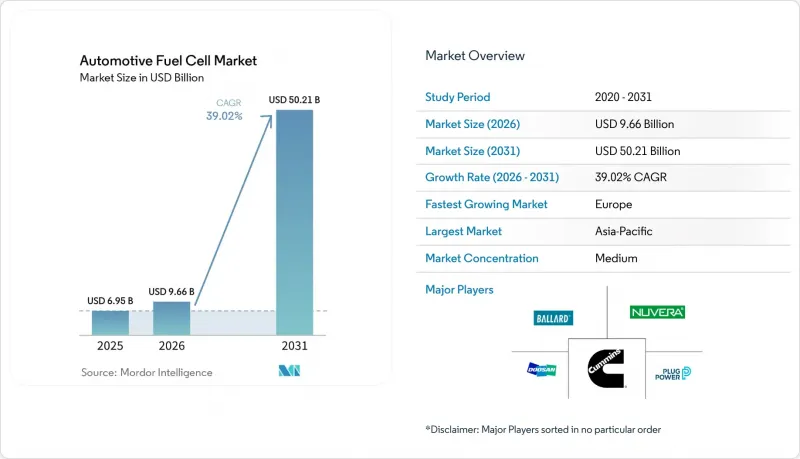
據 Mordor Intelligence 稱,2025 年汽車燃料電池市值為 69.5 億美元,預計到 2031 年將達到 502.1 億美元,而 2026 年為 96.6 億美元,預測期內(2026-2031 年)的複合年成長率為 39.02%。
本報告按車輛類型(乘用車、輕型商用車、中重型商用車、巴士和長途客車)、驅動方式(前輪驅動、後輪驅動、全輪驅動)、功率輸出(100千瓦以下、100-200千瓦、200千瓦以上)、推進系統(燃料電池電動車、混合動力燃料電池)和地區進行測量。市場預測以美元計價。
全球汽車燃料電池市場趨勢及洞察
更嚴格的二氧化碳排放和零排放車輛法規正在加速燃料電池在商用車隊中的應用。
加州先進清潔車隊法規和歐盟重型車輛二氧化碳排放標準要求製造商和車隊營運商在2030年代中期之前過渡到零排放卡車,這推動了對燃料電池驅動系統的需求。車隊管理人員優先考慮氫能密度,因為每增加一公斤電池重量都會降低負載容量收入。監管政策的確定性正在加快採購週期,尤其是在港口貨運和長途運輸領域。原始設備製造商(OEM)現在正與燃料電池供應商簽訂多年供應契約,並將滿足法規要求所需的車輛數量視為基本需求。用於基礎設施建設的額外津貼正在進一步縮小燃料電池與柴油車的總擁有成本(TCO)差距。
燃料電池堆成本的降低將加速商業化的可行性。
豐田最新的第二代燃料電池堆自2020年以來成本降低了65%,降至每千瓦45美元,這得益於鉑金用量的減少和膜電極組裝的自動化。年產量超過5萬台,推動了技術進步,目標是在2027年將成本降至每千瓦30美元。目前,燃料電池堆的續航時間已超過2.5萬小時,緩解了租賃公司對殘值的擔憂。隨著成本接近市場平均水平,汽車燃料電池市場在重型車輛領域實現兩位數滲透率的前景更加清晰。
氫氣生產成本高昂,阻礙了市場擴張。
綠色氫氣的平均價格為每公斤4-6美元,是長途卡車運輸中實現與柴油成本持平目標的兩倍。藍氫的經濟可行性仍取決於地理上有限的碳捕獲能力。在沒有管道的市場,運輸成本會使氫氣交付價格增加每公斤1-2美元。工業買家的競爭加劇了價格波動,並使車隊預算更加複雜。在再生能源價格下降或電解規模擴大之前,汽車燃料電池市場將不得不依靠政策工具來彌補這一差距。
細分市場分析
預計到2025年,乘用車市佔率將達到45.78%,而中型和重型商用車的複合年成長率(CAGR)則高達39.60%。商業業者看重氫燃料在固定路線上的快速加氫和長續航里程優勢。總擁有成本(TCO)模型分析表明,假設氫氣交付價格為每公斤3美元,那麼在加州的港口運輸中,氫燃料汽車最早可能在2027年就能與柴油汽車實現成本持平。在指定地點進行加氫可以避免零售基礎設施的缺口,並最大限度地提高卡車的運作。亞馬遜、DHL和UPS等全球物流公司已訂購數百輛燃料電池廂型車,這清楚地表明了供應商的規模需求。
從品牌定位的角度來看,將燃料電池技術引入乘用車仍然具有戰略意義,但就銷量而言,它仍處於次要地位。豐田和現代正在使用限量生產的轎車來檢驗其耐久性並讓技師熟悉這項技術,但投資重點目前正轉向商用平台。地方政府交通部門透過在高流量路線上引進燃料電池公車,進一步擴大了汽車燃料電池市場。在整個預測期內,商用車隊預計將成為燃料電池堆銷售的主要驅動力,推動供應鏈成熟,並最終惠及乘用車車型。
到2025年,由於結構更簡單,成本更低,前輪驅動車型將佔據56.30%的市場。汽車製造商正在利用現有平台,將氫氣堆置於引擎室內,燃料箱置於車尾。同時,隨著高階品牌推出雙馬達SUV,並承諾提供媲美運動型多用途車(SUV)的駕駛體驗,全輪驅動(AWD)車型預計將以26.40%的年成長率成長。 BMW的氫燃料電池X5原型車展現出優於純電動車的低溫性能,進一步提升了人們對全輪驅動的興趣。後輪驅動卡車則利用車底空間容納較大的氫氣瓶,同時又不影響載貨能力。
驅動系統的多樣化顯示市場已趨於成熟。早期採用者主要關注的是符合監管規定的細分市場,而下一代產品線則將氫燃料電池定位為「高性能」提案。多馬達扭力向量控制技術能夠實現諸如山地拖曳和越野操控等行銷訊息,而這些目標在高負載下使用電池組難以實現。隨著整車製造商將燃料電池模組整合到類似滑板式電動車的架構中,動力系統的柔軟性將不再是問題,汽車燃料電池市場也將進一步擴張。
區域分析
預計到2025年,亞太地區將佔全球整體電池汽車銷量的53.70%,這主要得益於中國的“國家氫能發展規劃”,該規劃的目標是到2030年實現100萬輛燃料電池汽車的保有量。省級政府提供的補貼(補貼額佔汽車價格的40%)吸引了汽車製造商之間的合資企業,而國有能源企業也迅速建造了1200座公共加氫站。日本的「綠色成長策略」正在推廣「Mirai」轎車作為計程車,並計畫在2030年建成900座加氫站,以滿足國內對燃料電池堆的需求。韓國正透過結合自身的氫氣生產藍圖和現代汽車的供應鏈叢集,將自身打造成為10,000磅/平方英吋(psi)儲氫罐的出口中心。
在歐洲,預計年複合成長率將達到28.10%,這主要得益於布魯塞爾的「替代燃料基礎設施法規」。該法規要求成員國在泛歐交通網路(TEN-T)核心網沿線每隔200公里建設一座加氫站。德國的「國家創新計畫」正在為巴士和長途卡車提供資金支持,而法國則將加氫站與可再生能源電解能結合。在北歐國家,氫燃料渡輪和重型卡車的試點計畫正在進行中,旨在整合貨運、航運和能源領域的脫碳進程。隨著企業環境、社會和治理(ESG)目標與雄心勃勃的二氧化碳減排路徑一致,商用車氫燃料的普及速度超過了乘用車。
北美地區的加氫站密度雖然落後於其他國家,但得益於聯邦和州政府的協調獎勵,發展勢頭正迅速增強。光是加州就擁有全美60%的公共加氫站,並利用其低碳燃料標準(LCFS)對加油站的可再生氫氣進行補貼。根據《通膨控制法案》,每生產一公斤氫氣可獲得3美元的稅額扣抵,這正在推動德克薩斯州和中西部地區新的電解計畫。加拿大正利用其豐富的水力資源,規劃一條通往美國太平洋西北地區的出口走廊,目標是連接從溫哥華到洛杉磯的卡車運輸路線。所有這些發展都表明,支持汽車燃料電池市場長期成長的政策框架正在逐步改善。
其他好處:
- Excel格式的市場預測(ME)表
- 3個月的分析師支持
目錄
第1章:引言
- 研究的先決條件
- 調查範圍
第2章:調查方法
第3章執行摘要
第4章 市場動態
- 市場促進因素
- 政府支持市場成長的舉措
- 市場限制因素
- 基礎設施不足是市場成長面臨的一大挑戰。
- 產業吸引力—五力分析
- 新進入者的威脅
- 買方/消費者議價能力
- 供應商的議價能力
- 替代品的威脅
- 競爭公司之間的競爭
第5章 市場區隔
- 按電解類型
- 聚合物電解質膜燃料電池
- 直接甲醇燃料電池
- 鹼性電解質燃料電池
- 磷酸鹽型燃料電池
- 車輛類型
- 搭乘用車
- 商用車輛
- 按燃料類型
- 氫
- 甲醇
- 依輸出類型
- 小於100千瓦
- 100~200 kW
- 200度或以上
- 按地區
- 北美洲
- 美國
- 加拿大
- 其他北美國家
- 歐洲
- 德國
- 英國
- 法國
- 俄羅斯
- 西班牙
- 其他歐洲國家
- 亞太地區
- 印度
- 中國
- 日本
- 韓國
- 其他亞太國家
- 南美洲
- 巴西
- 阿根廷
- 其他南美國家
- 中東和非洲
- 阿拉伯聯合大公國
- 沙烏地阿拉伯
- 其他中東和非洲國家
- 北美洲
第6章 競爭情勢
- 供應商市佔率
- 公司簡介
- BorgWarner Inc.
- Nuvera Fuel Cells LLC
- Ballard Power Systems Inc.
- Hydrogenics(Cummins Inc.)
- Nedstack Fuel Cell Technology BV
- Oorja Corporation
- Plug Power Inc.
- SFC Energy AG
- Watt Fuel Cell Corporation
- Doosan Fuel Cell Co. Ltd
第7章 市場機會與未來趨勢
- 擴大可再生能源的引入
According to Mordor Intelligence, the automotive fuel cell market size was valued at USD 6.95 billion in 2025 and estimated to grow from USD 9.66 billion in 2026 to reach USD 50.21 billion by 2031, at a CAGR of 39.02% during the forecast period (2026-2031).
This report is Segmented by Vehicle Type (Passenger Cars, Light Commercial Vehicles, Medium and Heavy Commercial Vehicles, Buses and Coaches), Drive Type (Front-Wheel Drive, Rear-Wheel Drive, All-Wheel Drive), Power Output (Below 100 KW, 100 To 200 KW, Above 200 KW), Propulsion (FCEV, Hybrid FC), and Geography. The Market Forecasts are Provided in Terms of Value (USD).
Global Automotive Fuel Cell Market Trends and Insights
Stricter CO2 and ZEV Mandates Drive Commercial Fleet Adoption
California's Advanced Clean Fleets rule and the EU's heavy-duty CO2 standards oblige manufacturers and fleets to shift toward zero-emission trucks by the mid-2030s, anchoring demand for fuel-cell drivetrains. Fleet managers value hydrogen's energy density because every kilogram of battery mass erodes payload revenue. Regulatory certainty accelerates procurement cycles, especially in port drayage and long-haul corridors. OEMs now treat compliance volumes as base demand, unlocking multi-year supply agreements with fuel-cell suppliers. Follow-on infrastructure grants further narrow the total-cost-of-ownership gap versus diesel.
Fuel-Cell Stack Cost Reduction Accelerates Commercial Viability
Toyota's latest Gen 2 stack lands at USD 45 per kW after a 65% cost slide since 2020, thanks to lower platinum loading and automated membrane-electrode assembly. Volumes above 50,000 units per year support learning-curve effects that target USD 30 per kW by 2027. Durability now exceeds 25,000 hours, easing residual-value concerns for leasing companies. As cost parity approaches, the automotive fuel cell market gains a clearer path to double-digit adoption in heavy-duty segments.
High Hydrogen Production Costs Constrain Market Expansion
Green hydrogen averages USD 4-6 per kg, double the cost target for diesel parity in long-haul trucking. Blue hydrogen's economics hinge on carbon-capture capacity that remains geographically limited. Transportation adds USD 1-2 per kg for delivered hydrogen in markets without pipeline access. Competing industrial offtakers raise price volatility, complicating fleet budgeting. Until renewable electricity prices fall or electrolysis scale improves, the automotive fuel cell market must rely on policy instruments to bridge the gap.
Other drivers and restraints analyzed in the detailed report include:
- Hydrogen Infrastructure Deployment Creates Network Effects
- Fleet Purchase Incentives Offset Initial Cost Premiums
- Infrastructure Gaps Limit Geographic Development
For complete list of drivers and restraints, kindly check the Table Of Contents.
Segment Analysis
Passenger cars held a 45.78% 2025 market share, while medium-and heavy-commercial vehicles are pacing at a 39.60% CAGR. Commercial operators prize the quick refueling and long range that hydrogen offers on fixed routes. Total-cost-of-ownership modeling shows break-even against diesel as early as 2027 in California drayage, assuming a delivered hydrogen price of USD 3 per kg. Depot refueling avoids retail infrastructure voids and maximizes truck uptime. Global logistics firms like Amazon, DHL, and UPS have ordered hundreds of fuel-cell box trucks, creating visible scale signals for suppliers.
Passenger-car adoption remains strategic for brand positioning but secondary in volume. Toyota and Hyundai use limited-production sedans to validate durability and familiarize technicians, yet investment focus now tilts to commercial platforms. Municipal transit agencies are rolling out fuel-cell buses on densely trafficked routes, further growing the automotive fuel cell market. Over the forecast window, commercial fleets are set to anchor stack volumes, driving supply-chain maturity that eventually benefits passenger models.
Front-wheel-drive models captured 56.30% share in 2025 because packaging simplicity keeps costs low. Automakers mount stacks under the hood and gas tanks aft, leveraging legacy platforms. All-wheel-drive, however, should grow 26.40% annually as premium brands unveil dual-motor SUVs that promise sports-utility dynamics. BMW's hydrogen X5 prototype demonstrates superior low-temperature performance versus battery peers, underpinning AWD interest. Rear-wheel-drive trucks exploit under-frame space to house larger hydrogen cylinders without compromising payload.
Drive-type diversity signals maturity: early adopters targeted compliance niches while next-generation line-ups position hydrogen as a performance proposition. Multi-motor torque vectoring enables marketing messages around mountain towing and off-road agility that battery packs struggle to match under high loads. As OEMs migrate fuel-cell modules into skateboard EV architectures, drivetrain flexibility will become a non-issue, further expanding the automotive fuel cell market.
Complete Report Scope:
- Electrolyte Type
- Polymer Electronic Membrane Fuel Cell
- Direct Methanol Fuel Cell
- Alkaline Fuel Cell
- Phosphoric Acid Fuel Cell
- Vehicle Type
- Passenger Cars
- Commercial Vehicles
- Fuel Type
- Hydrogen
- Methanol
- Power Output
- Below 100 KW
- 100 to 200 KW
- Above 200 KW
- Geography
- North America
- United States
- Canada
- Rest of North America
- Europe
- Germany
- United Kingdom
- France
- Russia
- Spain
- Rest of Europe
- Asia-Pacific
- India
- China
- Japan
- South Korea
- Rest of Asia-Pacific
- South America
- Brazil
- Argentina
- Rest of South America
- Middle-East and Africa
- United Arab Emirates
- Saudi Arabia
- Rest of Middle-East and Africa
- North America
Geography Analysis
Asia-Pacific generated 53.70% of global revenues in 2025 on the back of China's National Hydrogen Plan that targets 1 million fuel-cell vehicles by 2030. Provincial subsidies covering 40% of vehicle cost have pulled in OEM joint ventures, while state-owned energy firms fast-tracked 1,200 public stations. Japan's Green Growth Strategy keeps Mirai sedans in taxi fleets and aims for 900 stations by 2030, sustaining domestic stack demand. South Korea couples a hydrogen production roadmap with Hyundai's supply-chain cluster, positioning the country as an export hub for 10,000-psi tanks.
Europe is poised for a 28.10% CAGR as Brussels' Alternative Fuels Infrastructure Regulation obliges member states to build hydrogen stations every 200 km along the TEN-T core network. Germany's National Innovation Program funds both buses and long-haul trucks, while France links hydrogen refueling sites with renewable electrolysis capacity. Nordic countries pilot hydrogen ferries and heavy trucks that integrate freight, marine, and energy decarbonization. Commercial-vehicle uptake outruns passenger-car rollouts because corporate ESG targets align with ambitious CO2 reduction pathways.
North America lags in station density but gains momentum from synchronized federal and state incentives. California alone hosts 60% of U.S. public stations and uses the Low Carbon Fuel Standard to subsidize renewable hydrogen at the pump. The Inflation Reduction Act's USD 3 per kg hydrogen production credit is catalyzing new electrolysis projects in Texas and the Midwest. Canada leverages abundant hydropower to plan export corridors into the U.S. Pacific Northwest, targeting trucking lanes that stretch from Vancouver to Los Angeles. Collectively, these developments indicate converging policy frameworks that underwrite long-term growth for the automotive fuel cell market.
- BorgWarner Inc.
- Nuvera Fuel Cells LLC
- Ballard Power Systems Inc.
- Hydrogenics (Cummins Inc.)
- Nedstack Fuel Cell Technology BV
- Oorja Corporation
- Plug Power Inc.
- SFC Energy AG
- Watt Fuel Cell Corporation
- Doosan Fuel Cell Co. Ltd
Additional Benefits:
- The market estimate (ME) sheet in Excel format
- 3 months of analyst support
TABLE OF CONTENTS
1 INTRODUCTION
- 1.1 Study Assumptions
- 1.2 Scope of the Study
2 RESEARCH METHODOLOGY
3 EXECUTIVE SUMMARY
4 MARKET DYNAMICS
- 4.1 Market Drivers
- 4.1.1 Government Initiatives to Support The Market Growth
- 4.2 Market Restraints
- 4.2.1 Lack of Infrastructure poses a Challenge For The Growth of The Market
- 4.3 Industry Attractiveness - Porter's Five Forces Analysis
- 4.3.1 Threat of New Entrants
- 4.3.2 Bargaining Power of Buyers/Consumers
- 4.3.3 Bargaining Power of Suppliers
- 4.3.4 Threat of Substitute Products
- 4.3.5 Intensity of Competitive Rivalry
5 MARKET SEGMENTATION
- 5.1 Electrolyte Type
- 5.1.1 Polymer Electronic Membrane Fuel Cell
- 5.1.2 Direct Methanol Fuel Cell
- 5.1.3 Alkaline Fuel Cell
- 5.1.4 Phosphoric Acid Fuel Cell
- 5.2 Vehicle Type
- 5.2.1 Passenger Cars
- 5.2.2 Commercial Vehicles
- 5.3 Fuel Type
- 5.3.1 Hydrogen
- 5.3.2 Methanol
- 5.4 Power Output
- 5.4.1 Below 100 KW
- 5.4.2 100 to 200 KW
- 5.4.3 Above 200 KW
- 5.5 Geography
- 5.5.1 North America
- 5.5.1.1 United States
- 5.5.1.2 Canada
- 5.5.1.3 Rest of North America
- 5.5.2 Europe
- 5.5.2.1 Germany
- 5.5.2.2 United Kingdom
- 5.5.2.3 France
- 5.5.2.4 Russia
- 5.5.2.5 Spain
- 5.5.2.6 Rest of Europe
- 5.5.3 Asia-Pacific
- 5.5.3.1 India
- 5.5.3.2 China
- 5.5.3.3 Japan
- 5.5.3.4 South Korea
- 5.5.3.5 Rest of Asia-Pacific
- 5.5.4 South America
- 5.5.4.1 Brazil
- 5.5.4.2 Argentina
- 5.5.4.3 Rest of South America
- 5.5.5 Middle-East and Africa
- 5.5.5.1 United Arab Emirates
- 5.5.5.2 Saudi Arabia
- 5.5.5.3 Rest of Middle-East and Africa
- 5.5.1 North America
6 COMPETITIVE LANDSCAPE
- 6.1 Vendor Market Share
- 6.2 Company Profiles
- 6.2.1 BorgWarner Inc.
- 6.2.2 Nuvera Fuel Cells LLC
- 6.2.3 Ballard Power Systems Inc.
- 6.2.4 Hydrogenics (Cummins Inc.)
- 6.2.5 Nedstack Fuel Cell Technology BV
- 6.2.6 Oorja Corporation
- 6.2.7 Plug Power Inc.
- 6.2.8 SFC Energy AG
- 6.2.9 Watt Fuel Cell Corporation
- 6.2.10 Doosan Fuel Cell Co. Ltd
7 MARKET OPPORTUNITIES AND FUTURE TRENDS
- 7.1 Increasing Renewable Energy Integration

 汽車燃料電池市場規模、佔有率、成長、全球產業分析、區域趨勢及2026年至2034年預測。
 汽車燃料電池市場預測至2034年—全球燃料電池類型、組件、車輛類型、推進系統、應用、最終用戶和區域分析
 汽車燃料電池市場:2026-2032年全球市場預測(依燃料電池類型、電力輸出、驅動系統、最終用途及銷售管道)
 汽車燃料電池市場分析及至2035年的預測:按類型、產品、技術、組件、應用、材料類型、最終用戶、安裝類型和解決方案
 全球汽車燃料電池市場:按車輛類型、類型、功率輸出和地區分類-市場規模、產業動態、機會分析和預測(2026-2035 年)
 汽車燃料電池市場規模、佔有率和成長分析:按類型、燃料、功率、車輛類型和地區分類-2026-2033年產業預測
 2026年全球汽車燃料電池市場報告全球汽車燃料電池市場規模、佔有率、趨勢和成長分析報告(2026-2034年)
 汽車燃料電池市場規模、佔有率和趨勢分析報告:按類型、應用、地區和細分市場預測(2026-2033 年)
 汽車燃料電池市場-全球產業規模、佔有率、趨勢、機會及預測(按電解液類型、車輛類型、燃料類型、功率輸出、地區及競爭格局分類,2021-2031年)