


 |
市場調查報告書
商品編碼
2119900
支付編配平台:市場佔有率分析、產業趨勢與統計、成長預測(2026-2031)Payment Orchestration Platform - Market Share Analysis, Industry Trends & Statistics, Growth Forecasts (2026 - 2031) |
||||||

※ 本網頁內容可能與最新版本有所差異。詳細情況請與我們聯繫。
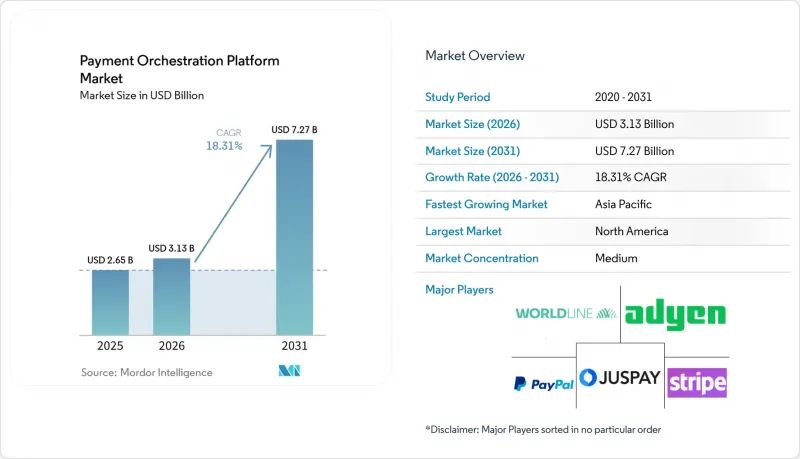
根據 Mordor Intelligence 預測,支付編配平台的市場規模預計將從 2025 年的 26.5 億美元成長到 2026 年的 31.3 億美元,然後在 2031 年達到 72.7 億美元,2026 年至 2031 年的複合年成長率為 18.31%。
本報告按類型(B2B、B2C、C2C)、部署模式(雲端、本地/私有雲端)、組織規模(大型企業、中小企業)、最終用戶行業(銀行、金融服務和保險、零售/電子商務等)以及地區進行細分。市場預測以美元計價。
全球支付編配平台市場趨勢與洞察
B2B在跨境電子商務支付的優勢
預計到2028年,跨境B2B支付交易量將成長40%,這將推動能夠同時處理多幣種支付、本地合規和基於區塊鏈的支付路徑的編配層技術的應用。穩定幣預計在2024年交易量將達到32兆美元,佔全球跨國資本流動的20%,為整合代幣化流動性的平台創造了60兆美元的潛在市場機會。萬事達卡和摩根大通等領先的金融機構正在針對B2B用例開展可互通區塊鏈通道的概念驗證實驗,這表明編配邏輯需要同時考慮法定貨幣和鏈上支付路徑。隨著交易量的成長,企業正在尋求一個集中化的控制點,以最佳化跨卡、帳戶和加密貨幣管道的路由,同時實施一致的KYC(了解你的客戶)和製裁篩檢。
亞洲快速發展的金融科技商家對智慧路由的需求激增
亞洲各地的商家報告稱,在部署人工智慧驅動的路由引擎後,交易核准率至少提高了20%,這一指標與收入成長直接相關。預計到2032年,光是日本的電子商務市場規模就將從2,300億美元成長到6,500億美元,這將推動對能夠在毫秒級內切換本地支付方案、全球銀行卡和替代支付方式的編配合作夥伴的需求。 Nuvei收購Paywiser Japan,為其提供了與主要支付網路的直接收單連接,並展示了服務提供者如何透過在地化連接來抓住亞洲快速成長的交易量。預計到2026年,日本的線上購物者數量將超過1億,因此,能夠從交易級數據中學習並即時重新路由支付路徑已成為經營團隊提高轉換率的首要任務。
額外費用和交換費的上限給編排者的處理利潤帶來了壓力。
歐盟的MIF法規將信用卡交換費上限設定為0.3%,簽帳金融卡上限設定為0.2%,將使發卡機構每年減少50億至60億歐元(55億至66億美元)的收入。隨著支付處理商降低費用以保持競爭力,那些依靠浮動基點差獲利的編配平台正面臨利潤壓力。隨著美國國會推動《信用卡競爭法案》,北美也可能出現類似的費用壓力。面對更低的費率,支付協調平台正轉向基於績效的定價模式,例如更高的核准率、更低的詐欺損失或更節省的營運資金。但這些模式需要對高階分析技術進行投資,進而導致固定成本增加。
細分市場分析
到2025年,B2B交易將佔支付編配平台市場佔有率的54.40%,反映出企業需要簡化其與多種收購方的交易關係。 B2B非現金支付年增14%,推動了許可證的持續續期和功能的廣泛應用,確保支付編配平台市場在企業領域保持強勁的地位。萬事達卡和摩根大通開展的區塊鏈互通性先導計畫表明,各大金融機構現在期望支付編排平台能夠將傳統支付基礎設施與代幣化流動性相融合。
相較之下,B2C領域的採用率正以21.63%的複合年成長率加速成長,主要得益於數位電商企業追求更流暢的支付流程和更高的支付成功率。在消費者端,生物識別、一鍵式代幣錢包以及購物車分期付款選項的需求日益成長,所有這些都增加了路由邏輯的複雜性。儘管C2C交易量仍然較小,但零工經濟支付和社交電商團購的興起正促使支付協調器提供更多樣化的API集。能夠將企業和消費者流程整合到單一分析層下的供應商,更有利於交叉銷售其他模組並提高客戶留存率。
預計到2025年,雲端服務將佔據支付編配平台市場77.20%的佔有率,並持續以19.68%的複合年成長率成長。商家青睞Akurateco的“單一整合模型”,該模型提供超過450個連接器,並持續更新,而不會增加其內部IT負擔。模組化微服務可讓商家啟用或停用各項功能,因此無需重寫整個平台即可測試和檢驗AI路由和網路令牌化的有效性。
儘管在政府支付和大型銀行等高度監管的行業中,本地部署和私有雲端部署仍然普遍存在,但趨勢正在轉向混合架構,即將關鍵加密模組保留在公司防火牆內,同時將路由智慧外包給雲端叢集。目前,各大超超大規模資料中心業者提供的雲端硬體安全模組 (HSM) 可以緩解審計人員的擔憂,並加速這項轉型。因此,採用雲端優先策略進入市場的新業務可以享受更快的上市速度優勢,而傳統的支付處理商則被迫適應容器化組件以保持競爭力。
區域分析
預計北美將在2025年繼續保持領先地位,佔據支付編配平台37.70%的市場。這主要得益於高度成熟的電子商務、廣泛的代幣應用以及FedNow等需要自適應路由邏輯的即時支付系統。諸如《信用卡競爭法案》之類的立法可能會重塑交換費的動態,迫使商家更加依賴編配來控制網路成本。 Stripe、PayPal和區域性新興企業正將研發重點放在基於人工智慧的決策引擎上。例如,PayPal預計在2024年將處理1.68兆美元的交易總額,這清楚地表明,即使交易批准率略有提高,也能轉化為可觀的收入。
預計亞太地區在2026年至2031年間將達到19.95%的最高複合年成長率,並有望在本十年末與北美交易量相媲美。印度的統一支付介面(UPI)正在建立即時小額支付系統,預計到2028年,跨境即時匯款將佔支付總額的42%。該地區超過97%的企業為微企業(MSME),而將區域最佳化支付受理能力與嵌入式融資相結合的支付服務商正為這一群體提供日益成長的服務。像Nuvei這樣的服務提供者正在東協和日本拓展業務,專注於直接收單和符合當地消費習慣的替代支付方式。
在歐洲,遵守PSD3和支付服務法規是一項挑戰。這兩項法規都旨在促進開放金融,同時也擴大了責任範圍。近期收購方的併購導致商家對備用路由的需求激增,進一步推動了中型零售商對支付編配平台的市場滲透。開放銀行主導的帳戶間結算預計將取代部分卡片付款,迫使支付編排平台協調銀行卡片付款和銀行支付的風險模型。在拉丁美洲,巴西PIX的成功推動了對能夠將即時支付指令轉化為無縫跨境結算的支付編排平台的需求。最後,中東和非洲地區雖然仍在發展中,但隨著監管機構建立金融科技沙盒和國內即時結算機制,該地區正呈現兩位數的成長。
其他好處:
- Excel格式的市場預測(ME)表
- 3個月的分析師支持
目錄
第1章:引言
- 研究假設和市場定義
- 調查範圍
第2章:調查方法
第3章執行摘要
第4章 市場狀況
- 市場概覽
- 市場促進因素
- 跨境電子商務匯款市場中B2B的主導地位。
- 亞洲快速發展的金融科技公司對智慧路由的需求激增
- 歐洲被收購公司的重組正在推進,供應商格局正在發生變化,對供應商中立的編配的需求也在增加。
- 憑證式的網路擴充(網路令牌、SRC)正在推動多支付服務提供者整合。
- 實作需要動態路由邏輯的即時支付網路(FedNow、UPI、PIX)
- 市場合規性(DAC-7,消費者資訊提供法案)正在推動分期付款工作流程的加速發展。
- 市場限制因素
- 對額外費用和交換費的限制給編排器的處理器利潤率帶來了壓力。
- 歐盟PSD3/PSR草案:加強技術服務提供者的責任
- 由於 3-DS 的豁免範圍有限,高風險地區的批准率成長受到抑制。
- 拉丁美洲認證雲端 HSM 容量短缺
- 產業價值鏈分析
- 監理展望
- 波特五力分析
第5章 市場規模與成長預測
- 按類型
- B2B
- B2C
- C2C
- 部署模式
- 基於雲端的
- 本地部署/私有雲端
- 按組織規模
- 大公司
- 小型企業
- 按最終用戶行業分類
- BFSI
- 零售與電子商務
- 旅遊與飯店
- 衛生保健
- 其他終端用戶產業
- 按地區
- 北美洲
- 美國
- 加拿大
- 墨西哥
- 歐洲
- 英國
- 德國
- 法國
- 義大利
- 其他歐洲國家
- 亞太地區
- 中國
- 日本
- 印度
- 韓國
- 其他亞太國家
- 南美洲
- 巴西
- 阿根廷
- 其他南美國家
- 中東
- 阿拉伯聯合大公國
- 沙烏地阿拉伯
- 其他中東國家
- 非洲
- 南非
- 其他非洲國家
- 北美洲
第6章 競爭情勢
- 市場集中度
- 策略趨勢
- 市佔率分析
- 公司簡介
- Adyen NV
- PayPal Holdings Inc.
- Stripe Inc.
- Worldline SA
- Juspay Technologies Private Limited
- Nuvei Corporation
- CellPoint Digital Ltd.
- IXOPAY GmbH(IXOLIT Group)
- Spreedly Inc.
- Checkout.com Group
- Rapyd Financial Network Ltd.
- Primer API Ltd.
- BlueSnap Inc.
- Corefy Limited
- Akurateco BV
- Modo Payments LLC
- Worldpay LLC(FIS)
- PayU Payments Pvt Ltd.
- PPRO Financial Ltd.
- AEVI International GmbH
- Payoneer Global Inc.
第7章 市場機會與未來展望
According to Mordor Intelligence, the payment orchestration platform market size is expected to grow from USD 2.65 billion in 2025 to USD 3.13 billion in 2026, and is forecast to reach USD 7.27 billion by 2031, at an 18.31% CAGR over 2026-2031.
This report is Segmented by Type (B2B, B2C, C2C), Deployment Mode (Cloud-Based, On-Premise / Private Cloud), Organization Size (Large Enterprises, Smes), End-User Industry (BFSI, Retail and E-Commerce, and More), and Geography. The Market Forecasts are Provided in Terms of Value (USD).
Global Payment Orchestration Platform Market Trends and Insights
B2B Dominance in Cross-border E-commerce Remittances
Cross-border B2B payment value is set to climb 40% by 2028, fueling adoption of orchestration layers that can juggle multi-currency settlement, local compliance and blockchain-enabled rails. Stablecoins moved USD 32 trillion in 2024 and are on track to reach 20% of global cross-border flows, creating a USD 60 trillion addressable opportunity for platforms that embed tokenised liquidity. Major institutions such as Mastercard and J.P. Morgan are piloting interoperable blockchain corridors aimed at B2B use cases, signalling that orchestration logic must now account for both fiat and on-chain rails. As transaction values rise, enterprises seek centralised control points that can optimise routing across card, account-to-account and crypto channels while enforcing consistent KYC and sanction screening.
Surge in Smart-Routing Demand Among High-Growth Fin-Tech Merchants in Asia
Asian merchants report at least a 20% uplift in approval rates after deploying AI-driven routing engines, a metric that directly converts into revenue gains. Japan's e-commerce market alone is forecast to grow from USD 230 billion to USD 650 billion by 2032, driving demand for orchestration partners that can switch between local schemes, global cards and alternative payment methods in milliseconds. Nuvei's acquisition of Paywiser Japan delivers direct acquiring links to major schemes, illustrating how providers are localising connectivity to capture escalating Asian volumes. With online buyers in Japan set to surpass 100 million by 2026, the capacity to learn from transaction-level data and re-route payments in real time becomes a board-level priority for merchants targeting conversion gains.
Surcharging and Interchange-Fee Caps Diluting Processor Margins for Orchestrators
The EU's MIF Regulation caps credit-card interchange at 0.3% and debit at 0.2%, stripping EUR 5-6 billion (USD 5.5-6.6 billion) in issuer revenue each year. As processors compress fees to stay competitive, orchestration platforms that earn variable basis-point spreads face margin squeeze. Parallel moves by the US Congress to advance the Credit Card Competition Act could replicate fee pressure in North America. Faced with diminished take rates, orchestrators are pivoting to outcome-based pricing anchored on approval-rate improvement, fraud loss reduction or working-capital savings, yet such models demand sophisticated analytics investments that raise fixed costs.
Other drivers and restraints analyzed in the detailed report include:
- Consolidation of Acquirer Landscape in Europe Driving Need for Vendor-Neutral Orchestration
- Token-Based Network Expansion Boosting Multi-PSP Integration
- EU PSD3/PSR Draft Heightening Liability for Technical Service Providers
For complete list of drivers and restraints, kindly check the Table Of Contents.
Segment Analysis
B2B flows accounted for 54.40% of payment orchestration platform market share in 2025, reflecting enterprises' need to rationalise multi-currency, multi-acquirer relationships. Elevated B2B non-cash growth at 14% year-on-year is translating into sustained license renewals and broader feature uptake, ensuring the payment orchestration platform market retains a strong corporate footprint. Blockchain interoperability pilots by Mastercard and J.P. Morgan signal that large treasuries now expect orchestrators to harmonise traditional rails with tokenised liquidity.
B2C implementations, in contrast, accelerate at 21.63% CAGR as digital merchants chase frictionless checkout and higher authorisation rates. Consumer endpoints increasingly demand biometric authentication, one-click token wallets and split-payment options at cart, all of which intensify routing logic. While C2C volumes remain niche, the rise of gig-economy payouts and social-commerce group purchases nudges orchestrators toward more versatile API sets. Providers that can contextualise both business and consumer flows under one analytics layer are best positioned to cross-sell additional modules and cement client stickiness.
Cloud delivery secured 77.20% of the payment orchestration platform market size in 2025 and is forecast to rise further on a 19.68% CAGR. Merchants value the single-integration model where 450-plus connectors, as offered by Akurateco, are perpetually updated without internal IT lift. Modular microservices enable feature toggling, letting merchants test-and-learn AI routing or network tokenisation without full platform re-writes.
On-premise and private-cloud instances persist in regulated verticals such as government payments and top-tier banking, yet the trend line favours hybrid architectures that retain key encryption modules behind the corporate firewall while outsourcing routing intelligence to cloud clusters. Cloud-based Hardware Security Modules, now available across the major hyperscalers, soften auditor concerns and accelerate migration. Consequently, cloud-first newcomers enjoy time-to-market advantages, while legacy processors must retrofit containerised components to sustain relevance.
Complete Report Scope:
- By Type
- B2B
- B2C
- C2C
- By Deployment Mode
- Cloud-Based
- On-Premise / Private Cloud
- By Organization Size
- Large Enterprises
- SMEs
- By End-user Industry
- BFSI
- Retail and E-commerce
- Travel and Hospitality
- Healthcare
- Other End-user Industries
- By Geography
- North America
- United States
- Canada
- Mexico
- Europe
- United Kingdom
- Germany
- France
- Italy
- Rest of Europe
- Asia Pacific
- China
- Japan
- India
- South Korea
- Rest of Asia Pacific
- South America
- Brazil
- Argentina
- Rest of South America
- Middle East
- United Arab Emirates
- Saudi Arabia
- Rest of Middle East
- Africa
- South Africa
- Rest of Africa
- North America
Geography Analysis
North America leads with 37.70% of payment orchestration platform market share in 2025, driven by advanced e-commerce maturity, widespread token adoption and real-time rails such as FedNow that necessitate adaptive routing logic. Legislative proposals like the Credit Card Competition Act could reshape interchange dynamics, compelling merchants to lean harder on orchestration to arbitrate network costs. Stripe, PayPal and regional upstarts funnel R&D into AI-based decision engines; PayPal, for instance, processed USD 1.68 trillion in total payment volume during 2024, underscoring the scale on which incremental approval gains translate into sizeable revenue.
Asia-Pacific posts the fastest CAGR at 19.95% for 2026-2031 and is on track to rival North American volume by decade-end. India's UPI has normalised instant micro-payments, with cross-border instant transfers tipped to reach 42% of flows by 2028. Over 97% of enterprises in the region are MSMEs, a segment increasingly serviced by orchestrators that bundle localised acceptance and embedded financing. Providers expanding across ASEAN and Japan, such as Nuvei, emphasise direct acquiring and alternative payments that resonate with domestic buyer behaviour.
Europe wrestles with PSD3 and the Payment Services Regulation, both of which broaden liability while promoting open finance. Merchant appetite for fallback routing soared after recent acquirer mergers, furthering the payment orchestration platform market's penetration among mid-tier retailers. Open-banking-driven account-to-account checkouts are projected to displace a share of card volume, pushing orchestrators to harmonise risk modelling across card and bank rails. Latin America, powered by Brazil's PIX success, witnesses rising demand for orchestrators that can translate real-time mandates into frictionless cross-border settlement. Finally, the Middle East and Africa, although nascent, exhibit double-digit growth as regulators lay out fintech sandboxes and domestic instant-payment schemes.
- Adyen N.V.
- PayPal Holdings Inc.
- Stripe Inc.
- Worldline S.A.
- Juspay Technologies Private Limited
- Nuvei Corporation
- CellPoint Digital Ltd.
- IXOPAY GmbH (IXOLIT Group)
- Spreedly Inc.
- Checkout.com Group
- Rapyd Financial Network Ltd.
- Primer API Ltd.
- BlueSnap Inc.
- Corefy Limited
- Akurateco BV
- Modo Payments LLC
- Worldpay LLC (FIS)
- PayU Payments Pvt Ltd.
- PPRO Financial Ltd.
- AEVI International GmbH
- Payoneer Global Inc.
Additional Benefits:
- The market estimate (ME) sheet in Excel format
- 3 months of analyst support
TABLE OF CONTENTS
1 INTRODUCTION
- 1.1 Study Assumptions and Market Definition
- 1.2 Scope of the Study
2 RESEARCH METHODOLOGY
3 EXECUTIVE SUMMARY
4 MARKET LANDSCAPE
- 4.1 Market Overview
- 4.2 Market Drivers
- 4.2.1 B2B Dominance in Cross-border E-commerce Remittances
- 4.2.2 Surge in Smart-Routing Demand Among High-Growth Fin-Tech Merchants in Asia
- 4.2.3 Consolidation of Acquirer Landscape in Europe Driving Need for Vendor-Neutral Orchestration
- 4.2.4 Token-Based Network Expansion (Network Tokens, SRC) Boosting Multi-PSP Integration
- 4.2.5 Real-time-Payment Rails Adoption (FedNow, UPI, PIX) Requiring Dynamic Routing Logic
- 4.2.6 Marketplace Compliance (DAC-7, Inform Consumers Act) Accelerating Split-Payment Workflows
- 4.3 Market Restraints
- 4.3.1 Surcharging and Interchange-Fee Caps Diluting Processor Margins for Orchestrators
- 4.3.2 EU PSD3/PSR Draft Heightening Liability for Technical Service Providers
- 4.3.3 Limited 3-DS Exemptions Curbing Approval-Rate Uplift in High-Risk Sectors
- 4.3.4 Scarcity of Certified Cloud HSM Capacity in LATAM
- 4.4 Industry Value Chain Analysis
- 4.5 Regulatory Outlook
- 4.6 Porter's Five Forces Analysis
- 4.6.1 Bargaining Power of Suppliers
- 4.6.2 Bargaining Power of Buyers
- 4.6.3 Threat of New Entrants
- 4.6.4 Threat of Substitutes
- 4.6.5 Intensity of Competitive Rivalry
5 MARKET SIZE AND GROWTH FORECASTS (VALUES)
- 5.1 By Type
- 5.1.1 B2B
- 5.1.2 B2C
- 5.1.3 C2C
- 5.2 By Deployment Mode
- 5.2.1 Cloud-Based
- 5.2.2 On-Premise / Private Cloud
- 5.3 By Organization Size
- 5.3.1 Large Enterprises
- 5.3.2 SMEs
- 5.4 By End-user Industry
- 5.4.1 BFSI
- 5.4.2 Retail and E-commerce
- 5.4.3 Travel and Hospitality
- 5.4.4 Healthcare
- 5.4.5 Other End-user Industries
- 5.5 By Geography
- 5.5.1 North America
- 5.5.1.1 United States
- 5.5.1.2 Canada
- 5.5.1.3 Mexico
- 5.5.2 Europe
- 5.5.2.1 United Kingdom
- 5.5.2.2 Germany
- 5.5.2.3 France
- 5.5.2.4 Italy
- 5.5.2.5 Rest of Europe
- 5.5.3 Asia Pacific
- 5.5.3.1 China
- 5.5.3.2 Japan
- 5.5.3.3 India
- 5.5.3.4 South Korea
- 5.5.3.5 Rest of Asia Pacific
- 5.5.4 South America
- 5.5.4.1 Brazil
- 5.5.4.2 Argentina
- 5.5.4.3 Rest of South America
- 5.5.5 Middle East
- 5.5.5.1 United Arab Emirates
- 5.5.5.2 Saudi Arabia
- 5.5.5.3 Rest of Middle East
- 5.5.6 Africa
- 5.5.6.1 South Africa
- 5.5.6.2 Rest of Africa
- 5.5.1 North America
6 COMPETITIVE LANDSCAPE
- 6.1 Market Concentration
- 6.2 Strategic Moves
- 6.3 Market Share Analysis
- 6.4 Company Profiles (includes Global level Overview, Market level overview, Core Segments, Financials as available, Strategic Information, Market Rank/Share, Products and Services, Recent Developments)
- 6.4.1 Adyen N.V.
- 6.4.2 PayPal Holdings Inc.
- 6.4.3 Stripe Inc.
- 6.4.4 Worldline S.A.
- 6.4.5 Juspay Technologies Private Limited
- 6.4.6 Nuvei Corporation
- 6.4.7 CellPoint Digital Ltd.
- 6.4.8 IXOPAY GmbH (IXOLIT Group)
- 6.4.9 Spreedly Inc.
- 6.4.10 Checkout.com Group
- 6.4.11 Rapyd Financial Network Ltd.
- 6.4.12 Primer API Ltd.
- 6.4.13 BlueSnap Inc.
- 6.4.14 Corefy Limited
- 6.4.15 Akurateco BV
- 6.4.16 Modo Payments LLC
- 6.4.17 Worldpay LLC (FIS)
- 6.4.18 PayU Payments Pvt Ltd.
- 6.4.19 PPRO Financial Ltd.
- 6.4.20 AEVI International GmbH
- 6.4.21 Payoneer Global Inc.
7 MARKET OPPORTUNITIES AND FUTURE OUTLOOK
- 7.1 White-space and Unmet-Need Assessment

 全球支付編配平台市場規模、佔有率、趨勢和成長分析報告(2026-2034)
 支付編配平台市場:按元件、部署類型、應用程式和區域分類
 支付編配平台市場-2026-2032年全球市場預測
 支付編配平台市場分析及預測(至2035年):類型、產品類型、服務、技術、組件、應用、部署模式、最終用戶、功能
 支付編配平台市場:預測(至 2034 年)-按組件、部署方式、功能、應用、最終用戶和地區分類的全球分析
 2026-2030年全球支付編配平台市場
 支付編排平台市場 - 全球產業規模、佔有率、趨勢、機會和預測,按部署類型、組件、最終用戶產業、地區和競爭格局分類,2021-2031 年預測
 支付編配平台市場規模、佔有率和成長分析(按類型、功能、公司規模、最終用途和地區分類)-2026-2033年產業預測
 2025年全球支付編配平台市場報告
 全球支付編配平台市場