


 |
市場調查報告書
商品編碼
2119882
歐洲工業廢棄物管理:市場佔有率分析、行業趨勢和統計數據、成長預測(2026-2031 年)Europe Industrial Waste Management - Market Share Analysis, Industry Trends & Statistics, Growth Forecasts (2026 - 2031) |
||||||

※ 本網頁內容可能與最新版本有所差異。詳細情況請與我們聯繫。
據 Mordor Intelligence 稱,歐洲工業廢棄物管理市場預計到 2026 年價值 566.5 億美元,高於 2025 年的 536.5 億美元,預計到 2031 年將達到 743.6 億美元。
預計 2026 年至 2031 年的複合年成長率為 5.59%。
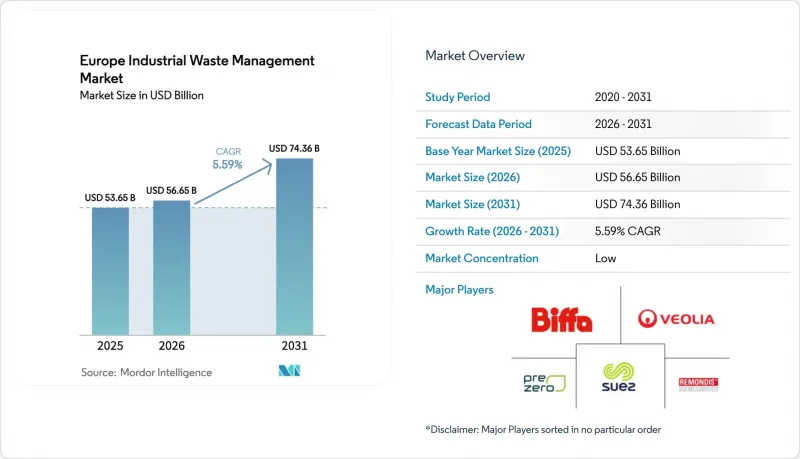
本報告按服務(收集、運輸和物流、其他)、處置方法(掩埋、回收、焚燒和能源回收)、廢棄物類型(非危險廢棄物、危險廢棄物)、產業(化學品和石化、石油和天然氣、其他)以及地區(英國、德國、其他)進行細分。市場預測以美元計價。
歐洲工業廢棄物管理市場的趨勢與洞察
歐盟嚴格的廢棄物管理指令
歐盟新規正大力推動提高回收率和實現完全可追溯性。將於2025年2月生效的《包裝及包裝廢棄物條例》規定,2030年所有包裝必須可回收,2040年再利用率達15%。修訂後的《廢棄物框架指令》強化了生產者延伸責任制,並統一了分類代碼,以促進跨境流動。同時,《廢棄物運輸條例》將於2026年11月起禁止向非經合組織國家出口塑膠廢棄物,並強制要求透過DIWASS系統進行數位追蹤。這些法規迫使工業廢棄物與能夠達到嚴格目標的認證供應商合作,從而直接促進了高附加價值領域的發展,例如回收、能源回收和危險廢棄物解毒。儘管各成員國的實施情況仍有差異,但這些法規的累積進展正推動歐洲工業廢棄物管理市場的預期複合年成長率提高1.8個百分點。
工業廢棄物產生量增加
在歐洲的工廠、化工園區和建築工地,由於產量增加和產品生命週期縮短,廢棄物產生量持續成長。預計2010年至2024年間,危險廢棄物將以每年2.25%的速度成長,其中大部分需要特殊處理的複雜、特定產品廢棄物產生於德國萊茵-魯爾區和荷蘭的化學及石化中心。僅建築材料每年就產生近4億噸主要為非危險性建築垃圾,這推動了對先進分類和收集服務的需求。電子產品製造商透過發布富含稀土元素和貴金屬的微型化元件,進一步加劇了這一趨勢,因為這些元件難以處理。儘管《工業排放指令》要求工廠採用最佳可用技術來最大限度地減少廢棄物,但電池和可再生能源供應鏈的擴張正在抵消這些減排成果。總體而言,工業生產的成長直接推動了歐洲工業廢棄物管理市場的擴張,要求營運商提高處理能力、升級技術並最佳化物流網路。
先進的加工設施需要大量的資金投入。
建造先進的回收和垃圾焚化發電設施需要大量的資本投資。雖然一座典型工廠的建造成本為每兆瓦400萬至1000萬美元,但先進的回收設施的成本可能高達5400萬至2.18億美元(5000萬至2億歐元),具體取決於其規模。德國里昂巴塞爾公司的化學回收項目獲得了歐盟4360萬美元(4000萬歐元)的資助,而CIRCTEC公司則籌集了1.635億美元(1.5億歐元)用於建設歐洲最大的輪胎熱解工廠。維修二氧化碳捕集(CCS)設施的成本為每噸二氧化碳處理能力109至164美元。在東歐,由於當地金融機構將與廢棄物相關的資產視為高風險,因此取得此類資金十分困難,這減緩了科技的普及速度。結果,歐洲工業廢棄物管理市場的成長率下降了0.8個百分點。
細分市場分析
到2025年,「處理和處置」產業將佔據歐洲工業廢棄物管理市場佔有率的53.78%,鞏固其在危險廢棄物解毒和支持現有基礎設施方面的核心地位。這一主導地位源自於德國、荷蘭和比利時運作焚化爐、物理化學處理廠和安全掩埋的巨額投資。大規模化學產業叢集依賴這些設施來遵守歐盟禁止排放未經處理的危險廢棄物的指令。持續的升級改造,例如廢氣淨化系統和碳捕集系統,確保了合規性並提供穩定的現金流。規模較小的收集和物流服務也受益於處理量的成長和對有毒廢棄物日益成長的特殊運輸需求。數位化路線最佳化和即將推出的DIWASS平台正在簡化跨國文件流程,並為整個歐洲工業廢棄物管理市場的服務增值。
回收和資源再生是成長最快的服務業,預計到2031年複合年成長率將達到6.72%,這反映了向循環經濟模式的轉變。例如,德國里昂巴塞爾的化學回收工廠和CIRCTEC的輪胎熱解設備等項目,都展現了從聚合物和橡膠中提取價值所需的資本密集度和創新深度。產業共生網路正在顯著增加原料供應,尤其是在化工園區,透過將一家公司的廢棄物轉化為另一家公司的原料。歐盟基於PPWR(生產者責任延伸制度)的生產者責任延伸制度(EPR)規定了包裝材料中再生材料的最低含量,從而推動了持續的需求。這些趨勢正在提高該領域在歐洲整體工業廢棄物管理市場的佔有率,儘管面臨許多技術挑戰,但仍吸引了股權資本的關注。
2025年,掩埋處理仍佔歐洲工業廢棄物管理市場的44.32%,這得益於其現有的處理能力、簡化的授權程序以及東歐部分地區較低的接收費用。然而,由於掩埋稅的上漲、污染標準的日益嚴格以及公眾的反對,其長期優勢正在逐漸喪失。業者承擔的甲烷回收和滲濾液監測等義務日益繁重,導致營運成本增加。儘管一些營運商正透過縮減規模或將閒置的掩埋場改建為太陽能發電廠來實現收入來源多元化,但歐洲工業廢棄物管理市場中掩埋處理的淨量仍在下降。
焚燒和能源回收產業正經歷最快成長,年複合成長率達7.31%,這主要得益於歐洲各地每年超過21.8億美元(20億歐元)的新建垃圾焚化發電設施投資。蘇伊士集團位於圖盧茲的工廠耗資15.3億美元(14億歐元),並採用了碳捕獲技術,體現了不斷演進的排放標準以及再生能源認證帶來的額外收入潛力。廢棄物衍生燃料(RDF)計畫正逐漸成為水泥窯的能源來源,可望取代高達85%的石化燃料供熱需求。火力發電廠效率的提高以及與區域供熱網路的整合,增強了其吸引力,逐步減少了送往掩埋的廢棄物量,並提升了能源回收途徑在歐洲工業廢棄物管理市場的地位。
其他好處:
- Excel格式的市場預測(ME)表
- 3個月的分析師支持
目錄
第1章:引言
- 研究假設和市場定義
- 調查範圍
第2章:調查方法
第3章執行摘要
第4章 市場狀況
- 市場概覽
- 市場促進因素
- 工業廢棄物產生量增加
- 歐盟嚴格的廢棄物管理指令
- 企業面臨越來越大的壓力,需要更重視永續發展和環境、社會及公司治理(ESG)。
- 用於廢棄物溯源的數位化追蹤和區塊鏈
- 利用廢棄物作為資源的工業共存園區
- 電動車電池供應鏈中對再生原料的需求
- 市場限制因素
- 先進加工設施的資本支出(CAPEX)很高。
- 歐盟各國監管執法力道有差異
- 東歐熟練勞動力短缺
- 回收工業材料的價格波動劇烈。
- 價值供應鏈分析
- 監管情勢與政府應對措施
- 技術展望
- 產業吸引力—五力分析
- 新進入者的威脅
- 供應商的議價能力
- 買方的議價能力
- 替代品的威脅
- 競爭公司之間的競爭
- 工業廢棄物產生分析
第5章 市場規模與成長預測
- 按服務
- 收藏
- 運輸/物流
- 加工和處置
- 回收和資源回收
- 處置方法
- 掩埋處置
- 回收利用
- 焚燒和能源回收(RDF、SRF、WtE)
- 廢棄物類型
- 無害廢棄物
- 危險廢棄物
- 按行業
- 化工/石油化工
- 石油和天然氣
- 發電
- 金屬和採礦
- 食品/飲料加工
- 製藥
- 電氣和電子設備
- 建築材料
- 按地區
- 英國
- 德國
- 法國
- 義大利
- 西班牙
- 比荷盧經濟聯盟(比利時、荷蘭、盧森堡)
- 北歐國家(丹麥、芬蘭、冰島、挪威、瑞典)
- 其他歐洲國家
第6章 競爭情勢
- 市場集中度
- 策略趨勢
- 市佔率分析
- 公司簡介
- Veolia
- Suez
- Remondis
- PreZero International
- Biffa PLC
- Urbaser
- FCC Environment
- AVR
- Renewi
- Indaver
- ALBA Group
- Viridor
- Saubermacher Dienstleistungs AG
- Ragn-Sells
- Norsk Gjenvinning
- Paprec Group
- SARP Industries
- Derichebourg Environnement
- Tradebe
第7章 市場機會與未來展望
According to Mordor Intelligence, the European industrial waste management market size in 2026 is estimated at USD 56.65 billion, growing from 2025 value of USD 53.65 billion with 2031 projections showing USD 74.36 billion, growing at 5.59% CAGR over 2026-2031.
This report is Segmented by Service (Collection, Transportation & Logistics, and More), by Disposal Method (Landfill, Recycling and Incineration & Energy Recovery), by Waste Type (Non-Hazardous and Hazardous), by Industry (Chemicals & Petrochemicals, Oil & Gas, and More), and by Geography (United Kingdom, Germany, and More). The Market Forecasts are Provided in Terms of Value (USD).
Europe Industrial Waste Management Market Trends and Insights
Stringent EU Waste Management Directives
New EU rules create a decisive pull toward higher recovery rates and full traceability. The Packaging and Packaging Waste Regulation, effective February 2025, requires all packaging to be recyclable by 2030 and sets a 15% reuse mandate by 2040. The updated Waste Framework Directive tightens extended-producer-responsibility schemes and standardizes classification codes to ease cross-border movements. Meanwhile, the Waste Shipments Regulation bans exports of plastic waste to non-OECD states from November 2026 and enforces digital tracking via the DIWASS system. These laws push industrial generators to partner with certified providers capable of meeting stringent targets, which directly expands high-value segments such as recycling, energy recovery, and hazardous-waste neutralization. Although enforcement still varies across member states, the cumulative regulatory push adds 1.8 percentage points to the forecast CAGR of the European industrial waste management market.
Increasing Industrial Waste Generation Volumes
Europe's factories, chemical parks, and construction sites continue to produce larger waste streams as output grows and product cycles shorten. Hazardous waste climbed 2.25% per year between 2010 and 2024, with chemical and petrochemical hubs in Germany's Rhine-Ruhr region and the Netherlands generating the bulk of complex by-products requiring specialized treatment. Construction-material manufacturing alone discharges close to 400 million tonnes of largely non-hazardous debris annually, reinforcing demand for advanced sorting and recovery services. Electronics producers amplify the trend by releasing difficult-to-process miniaturized components rich in rare earth elements and precious metals. Although the Industrial Emissions Directive obliges plants to adopt best available techniques for waste minimization, the build-out of battery and renewable-energy supply chains offsets reduction gains. Overall, greater industrial output directly fuels volume growth in the European industrial waste management market, prompting operators to expand capacity, upgrade technology, and refine logistics networks.
High CAPEX for Advanced Treatment Facilities
Building state-of-the-art recycling or waste-to-energy assets is capital-intensive. A typical plant costs USD 4-10 million per MW, while advanced recycling installations run USD 54-218 million (EUR 50-200 million) depending on scale. LyondellBasell's German chemical-recycling project secured USD 43.6 million (EUR 40 million) in EU funding, and CIRCTEC raised USD 163.5 million (EUR 150 million) for Europe's largest tire-pyrolysis unit. Carbon-capture retrofits add USD 109-164 per tonne of CO2 capacity. Eastern Europe struggles to mobilize such funding because local financiers view waste assets as higher-risk, slowing deployment, and shaving 0.8 percentage points off the European industrial waste management market growth rate.
Other drivers and restraints analyzed in the detailed report include:
- Demand for Secondary Raw Materials in EV Battery Supply Chains
- Growing Corporate Sustainability & ESG Pressure
- Skilled-Labor Shortage in Eastern Europe
For complete list of drivers and restraints, kindly check the Table Of Contents.
Segment Analysis
Treatment & Disposal accounted for 53.78% of the European industrial waste management market share in 2025, cementing its role as the backbone of hazardous-waste neutralization and legacy infrastructure. This dominance stems from significant sunk investment in incinerators, physicochemical plants, and secure landfills that serve Germany, the Netherlands, and Belgium. Large chemical clusters rely on these facilities to comply with EU directives that forbid untreated hazardous output. Steady upgrades such as flue-gas cleaning and carbon-capture units maintain regulatory conformity and underpin stable cash flows. Collection and logistics services, though smaller, benefit from rising volume and specialized transport mandates for toxic streams. Digital route optimization and the impending DIWASS platform streamline cross-border documentation and elevate service value across the European industrial waste management market.
Recycling & Material Recovery is the fastest-growing service at a 6.72% CAGR through 2031, reflecting the pivot to circular models. Projects like LyondellBasell's German chemical-recycling plant and CIRCTEC's tire-pyrolysis unit illustrate capital intensity and innovation depth needed to unlock polymer and rubber value. Industrial symbiosis networks multiply feedstock availability by turning one firm's waste into another's input, especially in chemical parks. EU extended-producer-responsibility schemes under the PPWR mandate minimum recycled content in packaging, driving sustained demand. These dynamics propel the segment's share upward across the European industrial waste management market and attract equity capital despite high technical hurdles.
Landfill maintained a 44.32% slice of the European industrial waste management market size in 2025, anchored in historical capacity, simple permitting, and lower gate fees in parts of Eastern Europe. Yet escalating landfill taxes, stricter contamination thresholds, and public opposition have begun to erode its long-held lead. Operators face mounting obligations to capture methane and monitor leachate, inflating operational expenditures. Some choose to downsize or retrofit inactive cells into solar farms, diversifying revenue but shrinking pure landfill tonnage within the European industrial waste management market.
Incineration & Energy Recovery displays the quickest expansion at 7.31% CAGR, buoyed by more than USD 2.18 billion (EUR 2 billion) invested annually in new waste-to-energy units across the continent. SUEZ's USD 1.53 billion (EUR 1.4 billion) Toulouse facility, which integrates carbon capture, showcases evolving emission standards and added revenue through renewable-electricity certificates. Refuse-derived-fuel programs supply cement kilns, potentially displacing up to 85% of fossil heat needs. Enhanced thermal-plant efficiencies and co-location with district-heating networks boost attractiveness, progressively drawing volumes away from landfill and raising the profile of energy-recovery routes within the European industrial waste management market.
Complete Report Scope:
- By Service
- Collection
- Transportation & Logistics
- Treatment & Disposal
- Recycling & Material Recovery
- By Disposal Method
- Landfill
- Recycling
- Incineration & Energy Recovery (RDF, SRF, WtE)
- By Waste Type
- Non-hazardous
- Hazardous
- By Industry
- Chemicals & Petrochemicals
- Oil & Gas
- Power Generation
- Metal & Mining
- Food & Beverage Processing
- Pharmaceuticals
- Electrical & Electronics
- Construction Materials
- By Geography
- United Kingdom
- Germany
- France
- Italy
- Spain
- BENELUX (Belgium, Netherlands, and Luxembourg)
- NORDICS (Denmark, Finland, Iceland, Norway, and Sweden)
- Rest of Europe
List of Companies Covered in this Report:
- Veolia
- Suez
- Remondis
- PreZero International
- Biffa PLC
- Urbaser
- FCC Environment
- AVR
- Renewi
- Indaver
- ALBA Group
- Viridor
- Saubermacher Dienstleistungs AG
- Ragn-Sells
- Norsk Gjenvinning
- Paprec Group
- SARP Industries
- Derichebourg Environnement
- Tradebe
Additional Benefits:
- The market estimate (ME) sheet in Excel format
- 3 months of analyst support
TABLE OF CONTENTS
1 Introduction
- 1.1 Study Assumptions & Market Definition
- 1.2 Scope of the Study
2 Research Methodology
3 Executive Summary
4 Market Landscape
- 4.1 Market Overview
- 4.2 Market Drivers
- 4.2.1 Increasing industrial waste generation volumes
- 4.2.2 Stringent EU waste-management directives
- 4.2.3 Growing corporate sustainability & ESG pressure
- 4.2.4 Digital tracking & blockchain for waste traceability
- 4.2.5 Industrial symbiosis parks for waste-to-input exchange
- 4.2.6 Demand for secondary raw materials in EV battery supply chains
- 4.3 Market Restraints
- 4.3.1 High CAPEX for advanced treatment facilities
- 4.3.2 Fragmented regulatory enforcement across EU
- 4.3.3 Skilled-labour shortage in Eastern Europe
- 4.3.4 Volatile prices for recycled industrial materials
- 4.4 Value / Supply-Chain Analysis
- 4.5 Regulatory Landscape & Government Initiatives
- 4.6 Technological Outlook
- 4.7 Industry Attractiveness - Porter's Five Force Analysis
- 4.7.1 Threat of New Entrants
- 4.7.2 Bargaining Power of Suppliers
- 4.7.3 Bargaining Power of Buyers
- 4.7.4 Threat of Substitutes
- 4.7.5 Intensity of Competitive Rivalry
- 4.8 Insights on Industrial Waste Production
5 Market Size & Growth Forecasts (Values, In USD Billion)
- 5.1 By Service
- 5.1.1 Collection
- 5.1.2 Transportation & Logistics
- 5.1.3 Treatment & Disposal
- 5.1.4 Recycling & Material Recovery
- 5.2 By Disposal Method
- 5.2.1 Landfill
- 5.2.2 Recycling
- 5.2.3 Incineration & Energy Recovery (RDF, SRF, WtE)
- 5.3 By Waste Type
- 5.3.1 Non-hazardous
- 5.3.2 Hazardous
- 5.4 By Industry
- 5.4.1 Chemicals & Petrochemicals
- 5.4.2 Oil & Gas
- 5.4.3 Power Generation
- 5.4.4 Metal & Mining
- 5.4.5 Food & Beverage Processing
- 5.4.6 Pharmaceuticals
- 5.4.7 Electrical & Electronics
- 5.4.8 Construction Materials
- 5.5 By Geography
- 5.5.1 United Kingdom
- 5.5.2 Germany
- 5.5.3 France
- 5.5.4 Italy
- 5.5.5 Spain
- 5.5.6 BENELUX (Belgium, Netherlands, and Luxembourg)
- 5.5.7 NORDICS (Denmark, Finland, Iceland, Norway, and Sweden)
- 5.5.8 Rest of Europe
6 Competitive Landscape
- 6.1 Market Concentration
- 6.2 Strategic Moves
- 6.3 Market Share Analysis
- 6.4 Company Profiles (includes Global level Overview, Market level overview, Core Segments, Financials as available, Strategic Information, Products & Services, and Recent Developments)
- 6.4.1 Veolia
- 6.4.2 Suez
- 6.4.3 Remondis
- 6.4.4 PreZero International
- 6.4.5 Biffa PLC
- 6.4.6 Urbaser
- 6.4.7 FCC Environment
- 6.4.8 AVR
- 6.4.9 Renewi
- 6.4.10 Indaver
- 6.4.11 ALBA Group
- 6.4.12 Viridor
- 6.4.13 Saubermacher Dienstleistungs AG
- 6.4.14 Ragn-Sells
- 6.4.15 Norsk Gjenvinning
- 6.4.16 Paprec Group
- 6.4.17 SARP Industries
- 6.4.18 Derichebourg Environnement
- 6.4.19 Tradebe
7 Market Opportunities & Future Outlook
- 7.1 White-space & Unmet-need Assessment

 農業廢棄物管理市場報告:趨勢、預測與競爭分析(至2035年)
 永續工業廢棄物分析市場預測至2034年-按解決方案類型、部署模式、技術、應用、最終用戶和地區分類的全球分析
 工業廢棄物管理市場:2026-2032年全球市場預測(廢棄物類型、處理技術、服務類型、處理方法、廢棄物形態和產業分類)農業廢棄物管理市場:按類型、廢棄物類型、管理階段、應用和最終用戶分類-全球預測,2026-2032年
 工業廢棄物管理市場:依廢棄物類型(都市廢棄物、危險廢棄物)、服務(收集、回收、處理和處置)和產業(製造業、能源業、建築業、化工業)劃分 - 至2036年的全球預測
 面向廢棄物管理的AI市場分析及預測(至2035年):按類型、產品類型、服務、技術、組件、應用、部署、最終用戶、解決方案和階段分類
 傾卸料斗市場規模、佔有率、成長分析(按產品、產能、應用、最終用戶和地區分類)-2026-2033年產業預測
 工業廢棄物管理市場規模、佔有率和成長分析(按廢棄物類型、處理方法、服務和地區分類)-產業預測(2026-2033 年)2032年農業廢棄物回收市場預測:按廢棄物類型、管理服務、處理方法、應用和地區分類的全球分析
 工業廢棄物管理市場規模、佔有率和趨勢分析報告:按服務類型、最終用途、地區和細分市場預測(2026-2033 年)