


 |
市場調查報告書
商品編碼
2119880
丙烯酸樹脂:市場佔有率分析、產業趨勢與統計、成長預測(2026-2031)Acrylic Resin - Market Share Analysis, Industry Trends & Statistics, Growth Forecasts (2026 - 2031) |
||||||

※ 本網頁內容可能與最新版本有所差異。詳細情況請與我們聯繫。
根據 Mordor Intelligence 預測,丙烯酸樹脂市場將從 2025 年的 686 萬噸成長到 2026 年的 713 萬噸,到 2031 年將達到 867 萬噸,2026 年至 2031 年的複合年成長率為 3.99%。
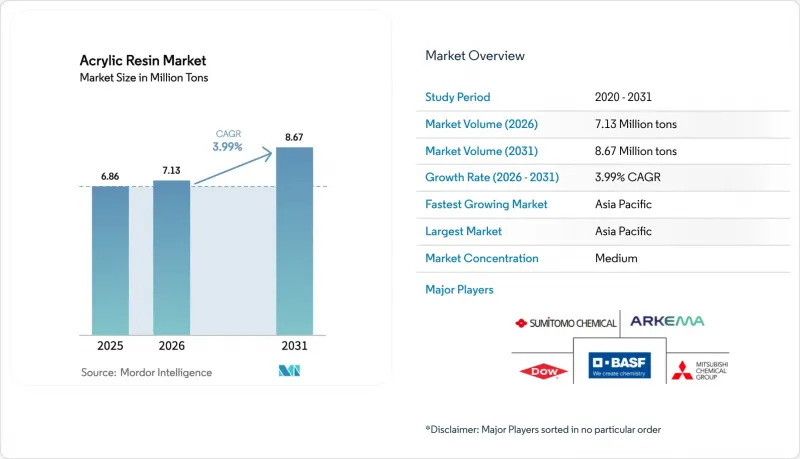
本報告按產品類型(丙烯酸酯、甲基丙烯酸酯、混合型)、應用(油漆和塗料、黏合劑和密封劑、其他應用)、最終用戶產業(建築和施工、汽車、電氣和電子設備、塑膠、紡織品和紡織品、其他)以及地區(亞太地區、北美、歐洲、南美、中東和非洲)進行分類。
全球丙烯酸樹脂市場趨勢及洞察
建築和基礎設施業務的擴張
全球建設業的復甦正支撐著丙烯酸樹脂市場的穩定成長。中國、印度和美國等國的多年期基礎設施建設項目推動了塗料和板材需求的成長。專案開發商擴大指定使用水性丙烯酸樹脂以滿足綠色建築標準,這促進了其在內外牆應用中的消耗。無甲醛黏合劑技術,例如BASF的Acrodur系統,透過滿足室內空氣品質標準,進一步提升了市場需求。總體而言,基礎設施投資確保了丙烯酸樹脂市場在週期性終端用途趨勢波動下的穩固需求基礎。
對輕量化汽車零件的需求不斷成長
隨著電氣化進程的推進,輕量化需求日益迫切,而丙烯酸樹脂正助力玻璃、車身面板、電池機殼及其他部件實現輕量化。例如,本田與三菱化學共同開發的彩色PMMA零件,無需噴漆工藝,即可在整個生命週期中減少50%的二氧化碳排放。歐美法規對燃油效率的要求,確保了高強度、低密度聚合物的長期需求。此外,電動車電池外殼需要具備熱穩定性和尺寸精度,而甲基丙烯酸酯樹脂在這些方面表現出色。再加上自動駕駛汽車感測器所需的光學透明性,這些因素共同推動了丙烯酸樹脂市場對高級產品的需求。
丙烯酸酯的環境與健康風險
監管機構正持續評估暴露風險,並收緊生產流程和消費品中單體允許濃度的限制。加強通風、監測以及引入個人防護設備,都增加了丙烯酸樹脂產業的合規成本。消費者對揮發性有機化合物(VOC)及其氣味特徵的認知正在影響他們的購買選擇,尤其是在住宅塗料領域。因此,強調安全性的品牌差異化勢在必行,但這會為生產商帶來成本。持續進行的毒理學研究旨在確定安全使用閾值,但在存在替代樹脂的領域,揮之不去的形象風險仍然限制著產品的普及。
細分市場分析
由於其光學透明度和耐候性,甲基丙烯酸酯在2025年仍佔據丙烯酸樹脂市場51.62%的佔有率。隨著生物基化學技術的應用範圍不斷擴大,預計到2031年,丙烯酸酯的複合年成長率將達到5.18%。從銷售來看,甲基丙烯酸酯廣泛應用於玻璃、標誌和高檔塗料等領域,支撐著丙烯酸樹脂市場的高階市場。受黏合劑和軟性塗料需求的推動,以及丙烯酸酯聚合物成本低、易於加工等優勢,其在新興應用領域的市場佔有率正在擴大。 LG化學推出的全植物來源丙烯酸產品表明,永續性正在吸引消費者關注丙烯酸酯類產品。
圍繞化學回收的行業努力正在縮小原生甲基丙烯酸酯和再生甲基丙烯酸酯之間的性能差距。三菱化學的技術利用微波將廢棄舊聚甲基丙烯酸甲酯(PMMA)分解為甲基丙烯酸甲酯(MMA)單體,在不影響材料品質的前提下,實現了與循環經濟的兼容性。催化劑結構和反應器設計的進步進一步提高了兩類產品的加工能力和物理性能控制,使其在競爭中脫穎而出。
區域分析
預計到2025年,亞太地區將佔全球產量的50.96%,並在2031年之前以5.57%的複合年成長率成長,這反映了該地區作為製造地和新興消費中心的雙重角色。中國持續優先投資大型基礎設施項目,刺激了交通運輸、能源和住宅項目整體油漆和密封劑的需求。日本先進的汽車和電子產業叢集也催生了對具有嚴格光學和機械公差的優質甲基丙烯酸酯的需求。
北美和歐洲在技術和法規方面發揮著引領作用。儘管美國環保署 (EPA) 修訂的針對氣霧劑塗料的揮發性有機化合物 (VOC) 法規給予了寬限期至 2027 年,但向低排放量丙烯酸類化學品的轉型勢頭依然強勁。歐洲工業界正在投資化學品回收試點計畫和 ISCC+ 認證的供應鏈,推動了對可追溯、低 PCF 樹脂的需求。這兩個地區都高度依賴汽車輕量化項目,這擴大了特種產品的高利潤市場。
南美洲、中東和非洲是發展中地區,但發展勢頭強勁。沿岸地區的工業化、物流走廊和石化合資企業正在推動該地區丙烯酸樹脂產能的擴張。儘管外匯波動和監管差異仍然是限制因素,但接近性當地市場降低了運輸成本和進口關稅,從而改善了服務交付成本指標。
其他好處
- Excel格式的市場預測(ME)表
- 3個月的分析師支持
目錄
第1章:引言
- 研究假設和市場定義
- 調查範圍
第2章:調查方法
第3章執行摘要
第4章 市場狀況
- 市場概覽
- 市場促進因素
- 建築和基礎設施業務的擴張
- 對輕量化汽車零件的需求不斷成長
- 低VOC水性塗料消費量增加
- 光固化樹脂在3D列印領域的快速普及
- 智慧自修復塗層技術的發展
- 市場限制因素
- 丙烯酸酯的環境與健康風險
- 丙烯和甲基丙烯酸甲酯(MMA)原料價格的波動
- 來自生物基聚合物替代品的競爭
- 價值鏈分析
- 波特五力模型
第5章 市場規模與成長預測
- 依產品類型
- 丙烯酸酯
- 甲基丙烯酸酯
- 混合
- 透過使用
- 油漆和塗料
- 黏合劑和密封劑
- 其他應用(顏料分散體、彈性體等)
- 按最終用戶行業分類
- 建築/施工
- 車
- 電氣和電子設備
- 塑膠
- 紡織品及紡織產品
- 紙張和紙板
- 其他用途(包裝和消費品)
- 按地區
- 亞太地區
- 中國
- 印度
- 日本
- 韓國
- 馬來西亞
- 泰國
- 印尼
- 越南
- 其他亞太國家
- 北美洲
- 美國
- 加拿大
- 墨西哥
- 歐洲
- 德國
- 英國
- 法國
- 義大利
- 西班牙
- 北歐國家
- 土耳其
- 俄羅斯
- 其他歐洲國家
- 南美洲
- 巴西
- 阿根廷
- 哥倫比亞
- 其他南美國家
- 中東和非洲
- 沙烏地阿拉伯
- 阿拉伯聯合大公國
- 卡達
- 南非
- 奈及利亞
- 埃及
- 其他中東和非洲國家
- 亞太地區
第6章 競爭情勢
- 市場集中度
- 策略趨勢
- 市佔率分析
- 公司簡介
- Allnex GMBH
- Arkema
- BASF
- Covestro AG
- DIC Corporation
- Dow
- Evonik Industries AG
- Henkel AG & Co. KGaA
- Mitsubishi Chemical Group Corporation
- Nippon Shokubai Co., Ltd.
- Resonac Holdings Corporation
- Rohm GmbH
- Sumitomo Chemical Co., Ltd.
第7章 市場機會與未來展望
According to Mordor Intelligence, the acrylic resin market size is expected to grow from 6.86 million tons in 2025 to 7.13 million tons in 2026 and is forecast to reach 8.67 million tons by 2031 at 3.99% CAGR over 2026-2031.
This report is Segmented by Product Type (Acrylates, Methacrylates, and Hybrids), Application (Paints and Coatings, Adhesives and Sealants, and Other Applications), End-User Industry (Building and Construction, Automotive, Electrical and Electronics, Plastics, Textile and Fibers, and More), and Geography (Asia-Pacific, North America, Europe, South America, and Middle-East and Africa).
Global Acrylic Resin Market Trends and Insights
Expansion in Construction and Infrastructure Activities
Global construction recovery underpins consistent acrylic resin market growth, with multi-year infrastructure programs in China, India, and the United States translating into rising coatings and panel demand. Project developers increasingly specify waterborne acrylics to meet green-building criteria, elevating consumption across exterior and interior applications. Formaldehyde-free binder technologies such as BASF's Acrodur systems further strengthen market pull by aligning with indoor-air-quality standards. Overall, infrastructure spending assures a visible demand pipeline that anchors the acrylic resin market amid cyclical end-uses.
Rising Demand for Lightweight Automotive Components
Electrification accelerates lightweighting imperatives, and acrylic resins enable mass reduction across glazing, body panels, and battery enclosures. Collaborative product development, for example, Honda and Mitsubishi Chemical's pre-colored PMMA parts, removes paint steps while lowering lifecycle CO2 emissions by 50%. Regulatory fuel-economy targets in Europe and the United States guarantee long-run demand for high-strength, low-density polymers. Electric-vehicle battery housings further require thermal stability and dimensional accuracy, properties well served by methacrylate grades. Coupled with autonomous-vehicle sensor needs for optical clarity, these factors sustain premium volumes within the acrylic resin market.
Environmental and Health Hazards of Acrylates
Regulators continue to evaluate exposure risks, tightening permissible monomer concentrations in manufacturing and consumer products. Enhanced ventilation, monitoring, and personal protective equipment raise compliance costs across the acrylic resin industry. Consumer awareness of VOC and odor profiles influences purchasing choices, particularly in residential coatings. Safety-driven brand differentiation is, therefore, necessary but costly for producers. Ongoing toxicology studies aim to substantiate safe-use thresholds, yet lingering perception risks cap adoption where substitute resins exist.
Other drivers and restraints analyzed in the detailed report include:
- Increasing Consumption of Low-VOC Water-Borne Coatings
- Rapid Adoption of 3D-Printing Photopolymer Resins
- Volatile Propylene and MMA Feed-Stock Prices
For complete list of drivers and restraints, kindly check the Table Of Contents.
Segment Analysis
Methacrylates retained a 51.62% acrylic resin market share in 2025 thanks to their optical clarity and weatherability, but acrylates are on track for a 5.18% CAGR through 2031 as bio-based chemistries broaden their usage window. In volume terms, methacrylate grades serve glazing, signage, and premium coatings, anchoring the upper tier of the acrylic resin market. Acrylate polymers, propelled by adhesive and flexible-coating demand, capitalize on lower cost and easier processability, gaining ground in emerging applications. LG Chem's roll-out of fully plant-derived acrylic acid illustrates how sustainability attributes are pulling customers toward acrylate variants.
Industry initiatives around chemical recycling are narrowing the performance gap between virgin and recovered methacrylates. Mitsubishi Chemical's microwave-assisted depolymerization of post-consumer PMMA back to MMA monomer promises circular-economy compliance without sacrificing material quality. Advancements in catalyst architectures and reactor design further enhance throughput and property control across both product families, sharpening competitive differentiation.
Complete Report Scope:
- By Product Type
- Acrylates
- Methacrylates
- Hybrids
- By Application
- Paints and Coatings
- Adhesives and Sealants
- Other Applications (Pigment Dispersion, Elastomers, etc.)
- By End-User Industry
- Building and Construction
- Automotive
- Electrical and Electronics
- Plastics
- Textile and Fibers
- Paper and Paperboard
- Other Applications (Packaging and Consumer Goods)
- By Geography
- Asia-Pacific
- China
- India
- Japan
- South Korea
- Malaysia
- Thailand
- Indonesia
- Vietnam
- Rest of Asia-Pacific
- North America
- United States
- Canada
- Mexico
- Europe
- Germany
- United Kingdom
- France
- Italy
- Spain
- Nordic Countries
- Turkey
- Russia
- Rest of Europe
- South America
- Brazil
- Argentina
- Colombia
- Rest of South America
- Middle-East and Africa
- Saudi Arabia
- United Arab Emirates
- Qatar
- South Africa
- Nigeria
- Egypt
- Rest of Middle-East and Africa
- Asia-Pacific
Geography Analysis
Asia-Pacific held 50.96% of global volume in 2025 and is positioned for a 5.57% CAGR through 2031, reflecting the region's dual role as a manufacturing hub and rising consumption center. China continues to prioritize megainfrastructure investment, stimulating coatings and sealants uptake across transport, energy, and residential projects. Japan's advanced automotive and electronics clusters carve out demand for premium methacrylate grades with tight optical and mechanical tolerances.
North America and Europe operate as technology and regulation leaders. The EPA's revised aerosol-coating VOC rule grants a compliance grace period to 2027, yet still locks in a trajectory toward low-emission acrylic chemistries. European industry is channeling capital into chemical-recycling pilots and ISCC+ certified supply chains, reinforcing a premium on traceable low-PCF resins. Both regions lean heavily on lightweight automotive programs, adding high-margin outlets for specialty grades.
South America, the Middle East, and Africa are nascent but gathering pace. Industrialization, logistics corridors, and petrochemical joint ventures in the Gulf are fostering regional acrylic resin capacity additions. Although currency swings and regulatory heterogeneity pose hurdles, local market proximity cuts freight and import tariffs, improving cost-to-serve metrics.
- Allnex GMBH
- Arkema
- BASF
- Covestro AG
- DIC Corporation
- Dow
- Evonik Industries AG
- Henkel AG & Co. KGaA
- Mitsubishi Chemical Group Corporation
- Nippon Shokubai Co., Ltd.
- Resonac Holdings Corporation
- Rohm GmbH
- Sumitomo Chemical Co., Ltd.
Additional Benefits:
- The market estimate (ME) sheet in Excel format
- 3 months of analyst support
TABLE OF CONTENTS
1 Introduction
- 1.1 Study Assumptions and Market Definition
- 1.2 Scope of the Study
2 Research Methodology
3 Executive Summary
4 Market Landscape
- 4.1 Market Overview
- 4.2 Market Drivers
- 4.2.1 Expansion in Construction and Infrastructure Activities
- 4.2.2 Rising Demand for Lightweight Automotive Components
- 4.2.3 Increasing Consumption of Low-VOC Water-Borne Coatings
- 4.2.4 Rapid Adoption of 3-D-Printing Photopolymer Resins
- 4.2.5 Growth of Smart/Self-Healing Coating Technologies
- 4.3 Market Restraints
- 4.3.1 Environmental and Health Hazards of Acrylates
- 4.3.2 Volatile Propylene and MMA Feed-Stock Prices
- 4.3.3 Competition From Bio-Based Polymer Alternatives
- 4.4 Value Chain Analysis
- 4.5 Porter's Five Forces
- 4.5.1 Bargaining Power of Suppliers
- 4.5.2 Bargaining Power of Buyers
- 4.5.3 Threat of New Entrants
- 4.5.4 Threat of Substitutes
- 4.5.5 Degree of Competition
5 Market Size and Growth Forecasts (Volume)
- 5.1 By Product Type
- 5.1.1 Acrylates
- 5.1.2 Methacrylates
- 5.1.3 Hybrids
- 5.2 By Application
- 5.2.1 Paints and Coatings
- 5.2.2 Adhesives and Sealants
- 5.2.3 Other Applications (Pigment Dispersion, Elastomers, etc.)
- 5.3 By End-User Industry
- 5.3.1 Building and Construction
- 5.3.2 Automotive
- 5.3.3 Electrical and Electronics
- 5.3.4 Plastics
- 5.3.5 Textile and Fibers
- 5.3.6 Paper and Paperboard
- 5.3.7 Other Applications (Packaging and Consumer Goods)
- 5.4 By Geography
- 5.4.1 Asia-Pacific
- 5.4.1.1 China
- 5.4.1.2 India
- 5.4.1.3 Japan
- 5.4.1.4 South Korea
- 5.4.1.5 Malaysia
- 5.4.1.6 Thailand
- 5.4.1.7 Indonesia
- 5.4.1.8 Vietnam
- 5.4.1.9 Rest of Asia-Pacific
- 5.4.2 North America
- 5.4.2.1 United States
- 5.4.2.2 Canada
- 5.4.2.3 Mexico
- 5.4.3 Europe
- 5.4.3.1 Germany
- 5.4.3.2 United Kingdom
- 5.4.3.3 France
- 5.4.3.4 Italy
- 5.4.3.5 Spain
- 5.4.3.6 Nordic Countries
- 5.4.3.7 Turkey
- 5.4.3.8 Russia
- 5.4.3.9 Rest of Europe
- 5.4.4 South America
- 5.4.4.1 Brazil
- 5.4.4.2 Argentina
- 5.4.4.3 Colombia
- 5.4.4.4 Rest of South America
- 5.4.5 Middle-East and Africa
- 5.4.5.1 Saudi Arabia
- 5.4.5.2 United Arab Emirates
- 5.4.5.3 Qatar
- 5.4.5.4 South Africa
- 5.4.5.5 Nigeria
- 5.4.5.6 Egypt
- 5.4.5.7 Rest of Middle-East and Africa
- 5.4.1 Asia-Pacific
6 Competitive Landscape
- 6.1 Market Concentration
- 6.2 Strategic Moves
- 6.3 Market Share Analysis
- 6.4 Company Profiles (includes Global level Overview, Market level overview, Core Segments, Financials as available, Strategic Information, Market Rank/Share for key companies, Products and Services, and Recent Developments)
- 6.4.1 Allnex GMBH
- 6.4.2 Arkema
- 6.4.3 BASF
- 6.4.4 Covestro AG
- 6.4.5 DIC Corporation
- 6.4.6 Dow
- 6.4.7 Evonik Industries AG
- 6.4.8 Henkel AG & Co. KGaA
- 6.4.9 Mitsubishi Chemical Group Corporation
- 6.4.10 Nippon Shokubai Co., Ltd.
- 6.4.11 Resonac Holdings Corporation
- 6.4.12 Rohm GmbH
- 6.4.13 Sumitomo Chemical Co., Ltd.
7 Market Opportunities and Future Outlook
- 7.1 White-space and Unmet-Need Assessment

 固體塑膠閃爍體市場:全球市場預測,2026-2032年
 水性丙烯酸樹脂市場機會、成長促進因素、產業趨勢分析及2026-2035年預測。丙烯酸樹脂市場-2026-2032年全球市場預測
 實心熱塑性丙烯酸(珠狀)樹脂:市場佔有率分析、產業趨勢與統計、成長預測(2026-2031)銦環市場按類型、純度、包裝、製程、厚度、應用和最終用途產業分類 - 全球預測(2026-2032 年)
 丙烯酸樹脂市場規模、佔有率和成長分析(按化學成分、溶劑強度、應用、最終用戶和地區分類)—產業預測,2026-2033年
 固態環氧樹脂:全球市佔率及排名、總收入及需求預測(2025-2031年)