

 |
市場調查報告書
商品編碼
2119857
另類資金籌措:市場佔有率分析、產業趨勢與統計、成長預測(2026-2031)Alternative Financing - Market Share Analysis, Industry Trends & Statistics, Growth Forecasts (2026 - 2031) |
||||||

※ 本網頁內容可能與最新版本有所差異。詳細情況請與我們聯繫。
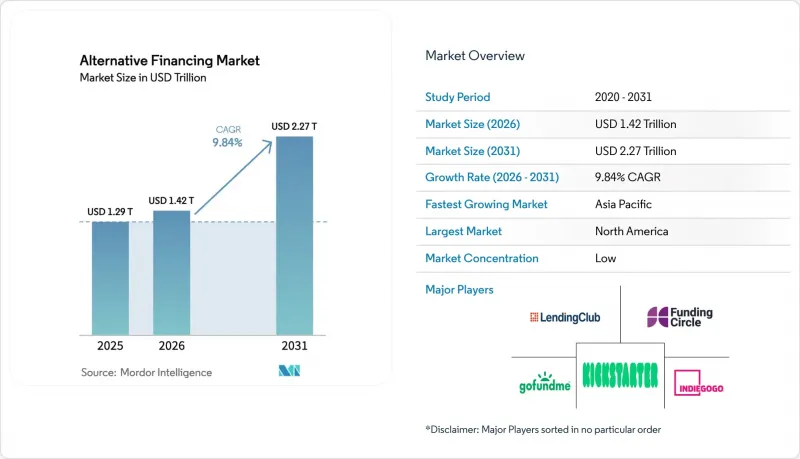
據 Mordor Intelligence 稱,2025 年另類資金籌措市場價值 1.29 兆美元,預計到 2031 年將達到 2.27 兆美元,而 2026 年為 1.42 兆美元,預測期(2026-2031 年)的複合年成長率為 9.84%。
本報告按資金籌措方式(P2P借貸、群眾集資(股權眾籌、獎勵眾籌和捐贈眾籌))、最終用戶(個人消費者、中小企業、大型企業及其他)和地區(北美、南美、歐洲及其他)進行分類。市場預測以美元計價。
全球另類資金籌措市場趨勢與洞察
採用數位化優先策略的中小企業信貸缺口日益擴大。
中小企業佔經合組織國家企業總數的99%。然而,中小企業面臨著巨大的全球資金籌措缺口,而傳統銀行由於嚴格的抵押要求和人工審核流程的高成本,難以彌補這一缺口。金融科技貸款機構正在利用基於雲端的貸款管理系統和人工智慧評分技術,實現大部分申請流程的自動化,將核准時間縮短至幾分鐘,同時降低每美元貸款的邊際成本。嵌入式金融服務提供者透過將貸款功能直接整合到會計、電子商務和薪資核算平台中,建立持續的資料循環,從而提高信貸透明度和客戶留存率。數位化貸款執行也允許貸款機構透過在市場上出售資產支持證券(ABS)或整筆貸款,快速企業聯合組織銀團貸款。這使得營運資金貸款轉化為可交易資產,滿足了尋求更高收益的機構投資者的需求。預計這些因素將擴大合格借款人的範圍,並提高平台處理能力,從而推動整體複合年成長率達到2.8%。
個人投資者「尋求回報」的勢頭
在多年低利率政策之後,個人投資者和合格投資者正轉向收益更高的私募信貸產品,預計到2025年,全球私募信貸資產規模將達到1.7兆美元。股權眾籌和獎勵型群眾集資宣傳活動都實現了兩位數的淨回報率,凸顯了個人投資者對創業家直接投資創投的需求。各平台正在將短期消費債務打包成受監管的證券,提供與投資合格債券相當的可預測贖回計劃,同時也能獲得更高的利差。機構投資者也採取類似的行動,透過購買市場貸款資產支持證券(ABS)和擔保基金債務(CFO),擴大二次性市場的流動性,並吸引更多追求收益的投資者。預計到2027年,這一趨勢將推動該產業的複合年成長率(CAGR)成長近2個百分點。
世界各國管理體制和許可證發放限制各不相同
各國不同的貸款牌照、各州不同的資訊揭露法律以及巴塞爾協議IV的實施時間表,都增加了合規預算,尤其對於那些正在跨境擴張業務的公司而言更是如此。在美國,超過一半的州現在要求商業貸款揭露年利率(APR)成本,這導致流程客製化,小規模平台難以管理。歐洲銀行管理局(EBA)關於「重大風險轉移」的指導方針,要求銀行在從金融科技公司購買資產組合時,必須逐筆核准,從而延緩了資金籌措週期。同時,新興市場對資金轉移的法規通常要求在當地註冊公司並繳納最低資本金,這阻礙了區域擴張。監管缺乏協調預計將在未來十年內使整體經濟成長率下降1.8個百分點。
細分市場分析
儘管到2025年,基於收入的融資在貸款總額中所佔比例不高,但其複合年成長率高達27.26%,超過了所有其他類別。這是因為SaaS(軟體即服務)供應商和消費品牌更傾向於與每月收入掛鉤的還款方式,而非固定還款計畫。這一趨勢已獲得認可,並表明機構投資者也開始接受這種模式。例如,創業投資公司General Catalyst已投入持續資金,為其客戶高達80%的行銷預算提供擔保。到2025年,P2P借貸仍將佔據最大佔有率,達到貸款額總額的44.12%,但這一類別正在向由機構投資者提供資金的市場化借貸轉型。光是LendingClub一家公司在2025年第一季就處理了20億美元的貸款,其中大部分被尋求成熟消費信貸的資產管理公司購買。證券化使P2P平台能夠在45天內進行資本再投資,從而幫助它們在新經營模式湧現的同時保持市場佔有率。
各細分市場的差異化因素在於營運效率。在Upstart,92%的個人貸款核准流程透過人工智慧驅動的決策來自動化。 「先買後付」(BNPL)交易量持續飆升。 Affirm近期設立的40億美元信貸額度使其三年內承銷貸款的能力超過200億美元,顯示私人信貸市場流動性極高。應收帳款融資和供應鏈金融平台正在應用區塊鏈技術,以確保審計追蹤的防篡改性,將支付週期從數週縮短至數天,並減少詐欺行為。同時,在被指控濫用判決確認後,商家現金預支(MCA)提供者正面臨更嚴格的州級上限,該領域正轉向更透明、利潤共享的還款條款。環境、社會和管治(ESG)標準正日益影響產品設計,貸款機構透過向獲得永續發展認證的借款人提供利率折扣,在信用評估中增加了定性因素。
區域分析
北美地區2025年34.20%的銷售額主要得益於開放資料監理和證券化帶來的高流動性。聯邦政府在某些州優先實施利率限制,有助於統一全國高收益分期貸款市場;而加州和密蘇裡州等州頒布的新商業財務揭露法則給小規模平台帶來了合規負擔。加拿大將於2026年生效的聯邦零售支付監管框架將把許可義務擴展至非銀行支付服務供應商(PSP),並鼓勵跨境平台進行統一的風險管理。墨西哥的金融科技法持續吸引尋求在拉丁美洲第二大經濟體建立監管框架的支付和貸款新創企業,進一步擴大了其在該地區的影響力。
亞太地區預計將成為成長最快的地區,2026年至2031年的複合年成長率將達到14.23%,這主要得益於數位支付交易量的爆炸式成長以及政府主導的開放銀行計劃。金融科技收入預計將從2021年的2,450億美元成長到2030年的1.5兆美元,其中印度和印尼預計將成為成長最快的國家。新加坡金融管理局(MAS)的《支付服務法》承認其他國家有效的電子貨幣牌照,從而促進區域金融機構的跨市場擴張。為符合國內審慎監管要求,中國當地的螞蟻集團正在拆分為多個獨立業務單元,同時利用支付寶+將57個國家的15億消費者錢包與8800萬商戶連接起來,從而促進跨境借貸。在已開發的亞洲國家(澳洲、紐西蘭、日本),私人信貸基金正在填補銀行縮減規模造成的中端市場資金籌措缺口。在澳大利亞,預計到 2024 年底將獲得 600 億美元的已承諾私人信貸資金。
在歐洲,支付服務指示第三版(PSD3)、即時結算指示、歐洲銀行管理局(EBA)以及大力推廣的重大風險轉移證券化(允許銀行與機構投資者分擔貸款風險)為平衡的機會提供了支持。英國《消費者信貸法》的修訂旨在簡化小額分期付款計劃的監管,並可能加速「先買後付」(BNPL)模式的普及。歐洲大陸企業面臨英國脫歐後許可「通行證制度」的不確定性,一些平台正在都柏林和阿姆斯特丹設立平行營業單位,以維持其在歐盟的業務准入。在中東和非洲,阿拉伯聯合大公國和沙烏地阿拉伯的自由區監管機構目前正在向數位銀行發放90天內即可營運的許可證,這促進了專注於支付的貸款機構的跨境業務擴張。創業投資在拉丁美洲依然活躍。儘管 2024 年景氣衰退,但預計金融科技公司將獲得該地區 40% 以上的創業投資投資,巴西和哥倫比亞嵌入式信貸的激增抵消了資金籌措週期的波動。
其他好處
- Excel格式的市場預測(ME)表
- 3個月的分析師支持
目錄
第1章:引言
- 研究假設和市場定義
- 調查範圍
第2章:調查方法
第3章執行摘要
第4章 市場狀況
- 市場概覽
- 市場促進因素
- 採用數位化優先策略的中小企業信貸缺口日益擴大。
- 個人投資者「尋求回報」的勢頭
- 開放銀行與類似《創業企業融資法案》(JOBS Act)的監理措施
- 面向機構投資者的市場貸款證券化
- 真實資產代幣化(共享所有權)
- 收緊銀行股本監管規定將導致大量借款人湧入金融科技貸款機構。
- 市場限制因素
- 世界各國管理體制和許可證發放限制各不相同
- 經濟放緩導致債務違約和詐欺風險增加
- 與透過存款籌集資金的銀行相比,資本成本更高。
- 非銀行貸款機構資產擔保證券倉庫流動性短缺
- 價值供應鏈分析
- 監理情勢
- 技術展望
- 波特五力模型
第5章 市場規模與成長預測
- 按資金籌措類型分類
- P2P借貸
- 群眾集資(股權眾籌、獎勵眾籌和捐贈眾籌)
- 基於收入的融資
- 商家現金預支
- 發票、供應鏈、財務
- 其他(先買後付、小額貸款、設備融資)
- 最終用戶
- 個人消費者
- 中小企業
- 大公司
- 非營利組織和社會影響組織
- 按地區
- 北美洲
- 加拿大
- 美國
- 墨西哥
- 南美洲
- 巴西
- 秘魯
- 智利
- 阿根廷
- 其他南美國家
- 歐洲
- 英國
- 德國
- 法國
- 西班牙
- 義大利
- 比荷盧經濟聯盟(比利時、荷蘭、盧森堡)
- 北歐國家(丹麥、芬蘭、冰島、挪威、瑞典)
- 其他歐洲國家
- 亞太地區
- 印度
- 中國
- 日本
- 澳洲
- 韓國
- 東南亞
- 其他亞太國家
- 中東和非洲
- 阿拉伯聯合大公國
- 沙烏地阿拉伯
- 南非
- 奈及利亞
- 其他中東和非洲國家
- 北美洲
第6章 競爭情勢
- 市場集中度
- 策略趨勢
- 市佔率分析
- 公司簡介
- LendingClub
- Funding Circle
- GoFundMe
- Kickstarter
- Indiegogo
- Prosper
- Kiva
- OnDeck
- CAN Capital
- LendingTree
- Fundbox
- Avant
- Upstart
- Lendio
- Mercado Credito(MercadoLibre)
- Ant Group
- WeBank
- Auxmoney
- RateSetter
- Zopa
- Klarna
第7章 市場機會與未來展望
According to Mordor Intelligence, the alternative financing market size was valued at USD 1.29 trillion in 2025 and estimated to grow from USD 1.42 trillion in 2026 to reach USD 2.27 trillion by 2031, at a CAGR of 9.84% during the forecast period (2026-2031).
This report is Segmented by Financing Type (Peer-To-Peer Lending, Crowdfunding (Equity, Reward/Donation)), by End User (Individual Consumers, Small & Medium Enterprises (SMEs), Large Enterprises, and More), and by Geography (North America, South America, Europe, and More). The Market Forecasts are Provided in Terms of Value (USD).
Global Alternative Financing Market Trends and Insights
Digital-first SME credit-gap expansion
SMEs constitute 99% of enterprises across OECD economies. However, they face a significant global financing gap, which traditional banks struggle to bridge due to restrictive collateral requirements and the high costs associated with manual onboarding processes. Fintech lenders use cloud-based loan-management systems and AI scoring to automate most of the applications, shrinking approval times to minutes while lowering the marginal cost per dollar originated. Embedded-finance providers integrate lending directly into accounting, e-commerce, and payroll platforms, creating a continuous data loop that enhances credit visibility and customer stickiness. Digital origination also allows lenders to syndicate exposures rapidly through marketplace ABS or whole-loan sales, turning working-capital loans into tradable assets that satisfy yield-hungry institutions. Collectively, these forces enlarge the addressable borrower base and raise platform throughput, contributing a forecast +2.8% uplift to the overall CAGR.
Retail-investor 'search-for-yield' momentum
After successive years of low policy rates, retail and accredited investors migrated toward higher-yielding private-credit instruments, fuelling a global private-credit asset pool of USD 1.7 trillion in 2025. Equity and reward-based crowdfunding campaigns have reported double-digit net returns, validating retail demand for direct exposure to entrepreneurial ventures. Platforms package short-duration consumer receivables into regulated notes, providing predictable amortization schedules that rival investment-grade bonds yet generate superior spreads. Institutional allocators mirror that behavior, purchasing marketplace-loan ABS and collateralized fund obligations, enlarging secondary-market liquidity that further attracts yield seekers. Momentum is expected to add almost two percentage points to the sector's CAGR through 2027.
Patch-work global regulatory regimes & licensing caps
Country-specific lending licenses, state-by-state disclosure laws, and diverging Basel IV adoption timelines increase compliance budgets, especially for cross-border scale-ups. In the U.S., more than half the states now require APR-style cost disclosures for commercial loans, creating customized workflows that smaller platforms find difficult to handle. The European Banking Authority's guidelines on significant risk transfer add deal-by-deal approval layers for banks purchasing fintech-originated portfolios, delaying funding cycles. Meanwhile, money transmission statutes in emerging markets often oblige local entity formation and minimum capital deposits, slowing geographic rollouts. Lack of regulatory harmonization is projected to shave 1.8 percentage points off headline growth over the decade.
Other drivers and restraints analyzed in the detailed report include:
- Open-banking legislation & JOBS Act provisions
- Institutional securitization of marketplace loans
- Rising default and fraud risk amid economic slowdown
For complete list of drivers and restraints, kindly check the Table Of Contents.
Segment Analysis
Revenue-based finance, though holding a modest slice of 2025 originations, is outpacing every peer class with a 27.26% CAGR as sellers of software-as-a-service and consumer brands prefer repayment linked to monthly sales rather than fixed amortisation schedules. The movement gained credibility when venture firm General Catalyst allocated recurring capital to underwrite up to 80% of clients' marketing budgets, signalling institutional acceptance. Peer-to-peer lending still commands the largest 44.12% slice of overall volumes in 2025, but the category has morphed into institutionally funded marketplace origination; LendingClub alone handled USD 2 billion in Q1 2025 loans, most purchased by asset managers seeking seasoned consumer credit. Securitisation now allows P2P platforms to recycle capital within 45 days, maintaining shares even as newer models arise.
Operational efficiency differentiates segments: AI-powered decision-making at Upstart automates 92% of personal-loan approvals. Buy-now-pay-later volumes continue to surge; Affirm's latest USD 4 billion warehouse expands its lending headroom to underwrite more than USD 20 billion in three years, evidencing deep private-credit liquidity. Invoice-finance and supply-chain-finance platforms incorporate blockchain for immutable audit trails, shortening pay-out cycles from weeks to days and cutting fraud. Merchant cash-advance providers, on the other hand, face stricter state-level caps after allegations of confessions-of-judgment abuse, nudging the segment toward transparent, revenue-share repayment terms. Environmental, social and governance (ESG) filters increasingly influence product design, with lenders offering rate discounts for certified sustainable-practice borrowers, adding a qualitative layer to credit scoring.
Complete Report Scope:
- By Financing Type
- Peer-to-Peer Lending
- Crowdfunding (Equity, Reward/Donation)
- Revenue-Based Financing
- Merchant Cash Advance
- Invoice & Supply-Chain Finance
- Others (BNPL,Micro-Lending,Equipment Finance)
- By End User
- Individual Consumers
- Small & Medium Enterprises (SMEs)
- Large Enterprises
- Non-profit & Social-impact Organizations
- By Geography
- North America
- Canada
- United States
- Mexico
- South America
- Brazil
- Peru
- Chile
- Argentina
- Rest of South America
- Europe
- United Kingdom
- Germany
- France
- Spain
- Italy
- BENELUX (Belgium, Netherlands, Luxembourg)
- NORDICS (Denmark, Finland, Iceland, Norway, Sweden)
- Rest of Europe
- Asia-Pacific
- India
- China
- Japan
- Australia
- South Korea
- South East Asia
- Rest of Asia-Pacific
- Middle East and Africa
- United Arab Emirates
- Saudi Arabia
- South Africa
- Nigeria
- Rest of Middle East and Africa
- North America
Geography Analysis
North America's 34.20% revenue in 2025 stems from a confluence of open-data regulation and deep securitisation liquidity. Federal pre-emption of certain state usury limits has fostered a uniform national market for high-yield instalment loans, though new commercial-finance disclosure statutes in states like California and Missouri create compliance overhead for smaller platforms. Canada's federal retail-payment supervision framework, coming into force in 2026, will extend licence obligations to non-bank PSPs, nudging cross-border platforms to unify risk controls. Mexico's fintech law continues to attract payments and lending start-ups seeking a regulated foothold in Latin America's second-largest economy, further enlarging the region's footprint.
Asia-Pacific is the fastest-growing block at 14.23% CAGR between 2026 and 2031, driven by an explosion in digital-payment volume and government-backed open-banking agendas. Fintech revenue is projected to rise from USD 245 billion in 2021 to USD 1.5 trillion by 2030, with India and Indonesia delivering the largest incremental volumes. Singapore's MAS Payment Services Act offers passportable e-money licences, simplifying multi-market expansion for regional lenders. Mainland China's Ant Group has split into independent units to align with domestic prudential requirements while using Alipay+ to export technology-connecting 1.5 billion consumer wallets to 88 million merchants across 57 countries-thereby funnelling cross-border lending flows. Developed Asia (Australia, New Zealand, Japan) is seeing private-credit funds fill middle-market funding gaps left by bank retrenchment, with Australia hosting USD 60 billion in committed private-credit dry powder by end-2024.
Europe offers a balanced opportunity, underpinned by PSD3, the instant-payment directive and the European Banking Authority's push for significant risk-transfer securitisations that allow banks to share loan risk with institutional investors. The UK's Consumer Credit Act overhaul aims to streamline rules for small-sum instalment plans, potentially accelerating BNPL penetration. Continental players face licence 'passporting' uncertainty post-Brexit, causing some platforms to establish parallel entities in Dublin and Amsterdam to retain EU access. In the Middle East and Africa, UAE and Saudi Arabia free-zone regulators now grant digital-bank charters within 90 days, spurring cross-border expansion among payments-first lenders. Latin America remains venture-capital heavy: fintechs received over 40% of regional VC dollars despite a 2024 downturn, with embedded-credit adoption in Brazil and Colombia offsetting funding-cycle volatility.
- LendingClub
- Funding Circle
- GoFundMe
- Kickstarter
- Indiegogo
- Prosper
- Kiva
- OnDeck
- CAN Capital
- LendingTree
- Fundbox
- Avant
- Upstart
- Lendio
- Mercado Credito (MercadoLibre)
- Ant Group
- WeBank
- Auxmoney
- RateSetter
- Zopa
- Klarna
Additional Benefits:
- The market estimate (ME) sheet in Excel format
- 3 months of analyst support
TABLE OF CONTENTS
1 Introduction
- 1.1 Study Assumptions & Market Definition
- 1.2 Scope of the Study
2 Research Methodology
3 Executive Summary
4 Market Landscape
- 4.1 Market Overview
- 4.2 Market Drivers
- 4.2.1 Digital-first SME credit-gap expansion
- 4.2.2 Retail-investor "search-for-yield" momentum
- 4.2.3 Open-banking & JOBS-Act-style regulations
- 4.2.4 Institutional securitization of marketplace loans
- 4.2.5 Tokenization of real-world assets (fractional funding)
- 4.2.6 Bank capital-rule tightening pushing borrowers to fintech lenders
- 4.3 Market Restraints
- 4.3.1 Patch-work global regulatory regimes & licensing caps
- 4.3.2 Rising default / fraud risk amid economic slowdown
- 4.3.3 High cost of capital versus deposit-funded banks
- 4.3.4 ABS warehouse liquidity crunch for non-bank lenders
- 4.4 Value / Supply-Chain Analysis
- 4.5 Regulatory Landscape
- 4.6 Technological Outlook
- 4.7 Porter's Five Forces
- 4.7.1 Threat of New Entrants
- 4.7.2 Bargaining Power of Buyers
- 4.7.3 Bargaining Power of Suppliers
- 4.7.4 Threat of Substitutes
- 4.7.5 Competitive Rivalry
5 Market Size & Growth Forecasts
- 5.1 By Financing Type
- 5.1.1 Peer-to-Peer Lending
- 5.1.2 Crowdfunding (Equity, Reward/Donation)
- 5.1.3 Revenue-Based Financing
- 5.1.4 Merchant Cash Advance
- 5.1.5 Invoice & Supply-Chain Finance
- 5.1.6 Others (BNPL,Micro-Lending,Equipment Finance)
- 5.2 By End User
- 5.2.1 Individual Consumers
- 5.2.2 Small & Medium Enterprises (SMEs)
- 5.2.3 Large Enterprises
- 5.2.4 Non-profit & Social-impact Organizations
- 5.3 By Geography
- 5.3.1 North America
- 5.3.1.1 Canada
- 5.3.1.2 United States
- 5.3.1.3 Mexico
- 5.3.2 South America
- 5.3.2.1 Brazil
- 5.3.2.2 Peru
- 5.3.2.3 Chile
- 5.3.2.4 Argentina
- 5.3.2.5 Rest of South America
- 5.3.3 Europe
- 5.3.3.1 United Kingdom
- 5.3.3.2 Germany
- 5.3.3.3 France
- 5.3.3.4 Spain
- 5.3.3.5 Italy
- 5.3.3.6 BENELUX (Belgium, Netherlands, Luxembourg)
- 5.3.3.7 NORDICS (Denmark, Finland, Iceland, Norway, Sweden)
- 5.3.3.8 Rest of Europe
- 5.3.4 Asia-Pacific
- 5.3.4.1 India
- 5.3.4.2 China
- 5.3.4.3 Japan
- 5.3.4.4 Australia
- 5.3.4.5 South Korea
- 5.3.4.6 South East Asia
- 5.3.4.7 Rest of Asia-Pacific
- 5.3.5 Middle East and Africa
- 5.3.5.1 United Arab Emirates
- 5.3.5.2 Saudi Arabia
- 5.3.5.3 South Africa
- 5.3.5.4 Nigeria
- 5.3.5.5 Rest of Middle East and Africa
- 5.3.1 North America
6 Competitive Landscape
- 6.1 Market Concentration
- 6.2 Strategic Moves
- 6.3 Market Share Analysis
- 6.4 Company Profiles (includes Global-level Overview, Market-level overview, Core Segments, Financials as available, Strategic Information, Market Rank/Share for key companies, Products & Services, Recent Developments)
- 6.4.1 LendingClub
- 6.4.2 Funding Circle
- 6.4.3 GoFundMe
- 6.4.4 Kickstarter
- 6.4.5 Indiegogo
- 6.4.6 Prosper
- 6.4.7 Kiva
- 6.4.8 OnDeck
- 6.4.9 CAN Capital
- 6.4.10 LendingTree
- 6.4.11 Fundbox
- 6.4.12 Avant
- 6.4.13 Upstart
- 6.4.14 Lendio
- 6.4.15 Mercado Credito (MercadoLibre)
- 6.4.16 Ant Group
- 6.4.17 WeBank
- 6.4.18 Auxmoney
- 6.4.19 RateSetter
- 6.4.20 Zopa
- 6.4.21 Klarna
7 Market Opportunities & Future Outlook
- 7.1 White-space & Unmet-need Assessment

 全球群眾集資市場規模、佔有率、趨勢和成長分析報告(2026-2034年)
 群眾集資:市場佔有率分析、產業趨勢與統計、成長預測(2026-2031)
 商家現金預支市場:依還款方式、最終用戶及地區分類
 另類資金籌措市場規模、佔有率和成長分析:按提供者類型、部署模式、企業規模、最終用戶產業和地區分類-2026-2033年產業預測
 群眾集資平台市場預測至2034年:按資金籌措模式、宣傳活動類型、平台功能、部署模式和最終用戶分類的全球分析
 2026-2030年全球群眾集資市場醫療群眾集資市場:按群眾集資類型、應用、適應症、最終用戶和地區分類。另類資金籌措市場規模、佔有率、成長及全球產業分析:按類型、應用和地區分類,並預測至2026-2034年
 2026年全球群眾集資市場報告群眾集資市場規模、佔有率、成長率及全球產業分析:按類型、應用和地區分類的洞察,以及2026-2034年的預測