


 |
市場調查報告書
商品編碼
2119849
北美固態廢棄物管理:市場佔有率分析、行業趨勢和統計數據以及成長預測(2026-2031 年)North America Solid Waste Management - Market Share Analysis, Industry Trends & Statistics, Growth Forecasts (2026 - 2031) |
||||||

※ 本網頁內容可能與最新版本有所差異。詳細情況請與我們聯繫。
據 Mordor Intelligence 稱,2025 年北美固態廢棄物管理市場價值為 762.8 億美元,預計到 2031 年將達到 908.6 億美元,而 2026 年為 785.5 億美元,預測期內(2026-2031 年)的複合成長率預計為 2.98%。
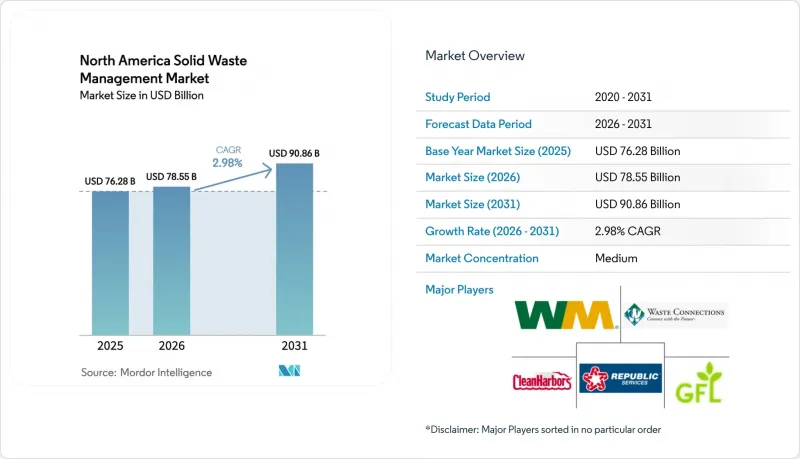
本報告廢棄物產品類型(廢棄物處理設備和廢棄物回收/分類設備)、廢棄物類型(危險廢棄物和非危險廢棄物)、收集方式(例如路邊收集)、最終用戶(例如市政廢棄物管理、醫療保健)和地區(美國、加拿大、墨西哥)進行細分。市場預測以貨幣價值(美元)表示。
北美固態廢棄物管理市場趨勢與洞察
循環經濟和強制回收將加速基礎設施投資。
生產者責任延伸(EPR)法規,例如加州的SB 54法案和加拿大對一次性塑膠的禁令,強制生產者承擔升級分類和處理設施的成本,為北美固態廢棄物管理市場的營運商帶來可預測的費用收入。共和服務公司(Republic Services)已累計2億美元用於2024年對其光學分類設施的維修,以滿足各州規定的污染閾值。這種合規強制機制已將回收從一項可選支出轉變為一項綜合營運成本,使得合約能夠保證最低處理量,而不受樹脂價格波動的影響。因此,流入機器人分類機、化學回收和先進資源回收設施的資金正在加速成長,北美固態廢棄物管理市場正進入永續基礎設施發展階段。
企業ESG目標正在推動對閉合迴路服務的需求。
如今,財富500強企業的採購計畫要求提供檢驗的廢棄物再利用指標,迫使供應商投資於收集、回收和報告於一體的綜合解決方案。廢棄物管理公司(Waste Management)收購Sterecycle後,合併後的公司擁有了一個端到端的醫療廢棄物平台,支援藥品回收、包裝收集和數位追蹤。以廢棄物再利用率和碳減排量為核心的績效契約,能夠實現溢價定價和長期合約續簽,進一步加速了北美固態廢棄物管理市場從「數量導向」向「價值導向」的轉變。
再生資源價格波動會破壞收入的穩定性。
2024年,混合紙張價格的暴跌以及再生聚合物價格每季40%的波動,使得分類機的投資回報模型變得複雜。營運商目前在與市政當局的合約中加入了價格調整條款,將風險轉移給了那些缺乏對沖機制的市政當局。這種不確定性正在減緩對下一代回收技術的投資,並抑制北美固態廢棄物管理市場的短期收入成長。
細分市場分析
到2025年,廢棄物管理設施仍將佔據北美固態廢棄物管理市場59.85%的主導佔有率,這反映了該全部區域的掩埋和轉運站基礎設施。然而,在強制性生產者責任延伸制度(EPR)和人工分類無法滿足的純度標準的推動下,收入成長正轉向高科技回收和分類系統,預計到2031年,其複合年成長率將達到3.47%。人工智慧驅動的光學掃描儀目前可回收95%的目標塑膠和金屬,從而提高回購價格並降低雜質罰款。
由於設備更新換代週期,廢棄物處理資產和資源回收資產之間的界線正變得模糊不清。鳳凰城廢棄物管理公司試運行的一款自動側裝式垃圾車,在無需額外人力的情況下,降低了12%的油耗,並提高了收集路線的處理能力。配備物聯網感測器的智慧壓實機能夠產生即時填充數據,並根據這些數據自動設定動態收集計劃,從而顯著減少空載行駛里程,延長容器的使用壽命。製造商正擴大將預測性維護分析融入硬體銷售中,這不僅提高了業務收益的穩定性,也重振了北美固態廢棄物管理的售後市場生態系統。
儘管到2025年,非危險廢棄物將佔總處理廢棄物量的77.65%,但隨著對全氟烷基和多氟烷基物質(PFAS)、藥品和半導體廢水的監管日益嚴格,危險廢棄物處理的收入正以3.22%的複合年成長率成長。在北美固態廢棄物管理市場,儘管危險廢棄物處理總量仍然不高,但其市場仍在持續成長,這主要得益於專業運輸、處理和責任險的成本,這些成本最高可達標準處置費用的八倍。醫療產業和電子產品製造商目前正與跨州處理網路簽訂契約,以確保跨轄區合規,這進一步提升了綜合運營商在北美固態廢棄物管理市場的價值提案。
儘管被歸類為非危險廢棄物,但有機廢棄物正日益受到關注,因為它是可再生天然氣 (RNG) 設施的理想原料,而這些設施與美國各州的低碳燃料標準 (LCFS) 相銜接。位於掩埋和酪農的厭氧消化池可以將食物廢棄物轉化為管道級天然氣,從而實現收入來源多元化。隨著 RNG 產量的提高,非危險廢棄物合約正在修訂,以分享能源信用收入,這為北美固態廢棄物管理行業的廢棄物減量政策提供了經濟獎勵。
其他好處:
- Excel格式的市場預測(ME)表
- 3個月的分析師支持
目錄
第1章:引言
- 研究假設和市場定義
- 調查範圍
第2章:調查方法
第3章執行摘要
第4章 市場狀況
- 市場概覽
- 市場促進因素
- 有關循環經濟和回收的法規正在加速基礎設施投資。
- 企業ESG目標正在推動對閉合迴路服務的需求。
- RFS、LCFS 和 IRA 的獎勵正在推動利用垃圾掩埋沼氣生產 RNG 的計畫激增。
- 安大略省掩埋容量不足以及美國出口關稅正在推動該地區的擴張。
- 智慧數據收集和人工智慧驅動的排序顯著降低了營運成本,並實現了基於使用量的收費系統。
- 市場限制因素
- 再生材料價格波動會破壞收入的穩定性。
- 長期人手不足和營運中斷正在擾亂收款業務。
- 將 PFAS 指定為 CERCLA(經認證的民事法規)會增加與掩埋處置相關的法律責任風險。
- 價值鏈分析
- 監理情勢
- 波特五力模型
第5章 市場規模與成長預測
- 依產品類型
- 廢棄物處理設施
- 廢棄物回收分類設施
- 廢棄物類型
- 危險廢棄物
- 無害廢棄物
- 依收藏類型
- 路邊取貨
- 上門收集
- 當地回收計劃
- 最終用戶
- 城市垃圾管理
- 衛生保健
- 化學品
- 礦業
- 按地區
- 美國
- 加拿大
- 墨西哥
第6章 競爭情勢
- 市場集中度
- 策略趨勢
- 市佔率和排名分析
- 公司簡介
- Casella Waste Systems
- Clean Harbors
- Covanta Holdings Corporation
- Darling Ingredients.
- GFL Environmental Inc.
- Kinder Morgan
- Montauk Renewables, Inc
- Recology
- Republic Services
- Rubicon Technologies, Inc.
- Stericycle
- US Ecology
- Veolia
- Waste Connections
- Waste Management Inc.
- Waste Pro USA
- WM Intellectual Property Holdings, LLC
第7章 市場機會與未來展望
According to Mordor Intelligence, the North America solid waste management market size was valued at USD 76.28 billion in 2025 and estimated to grow from USD 78.55 billion in 2026 to reach USD 90.86 billion by 2031, at a CAGR of 2.98% during the forecast period (2026-2031).
This report is Segmented by Product Type (Waste Disposal Equipment and Waste Recycling and Sorting Equipment), Waste Type (Hazardous Waste and Non-Hazardous Waste), Collection Type (Curbside Pickup, and More), End User (Municipal Waste Management, Healthcare, and More), and Geography (United States, Canada, and Mexico). The Market Forecasts are Provided in Terms of Value (USD).
North America Solid Waste Management Market Trends and Insights
Circular-Economy and Recycling Mandates Accelerate Infrastructure Investment
EPR statutes, such as California's SB 54 and Canada's federal single-use plastic ban, obligate producers to finance sorting and processing upgrades, creating predictable fee income for operators in the North American solid waste management market. Republic Services has earmarked USD 200 million for optical-sorting retrofits in 2024 that meet contamination thresholds under state rules. Mandatory compliance structures convert recycling from a discretionary expense into an embedded cost of doing business, allowing contracts that guarantee minimum tonnage regardless of resin price cycles. As a result, capital flows toward robotic sorters, chemical recycling, and advanced material recovery facilities are accelerating, positioning the North American solid waste management market for sustained infrastructure build-out.
Corporate ESG Targets Boost Demand for Closed-Loop Services
Fortune 500 procurement programs now require verifiable waste diversion metrics, prompting suppliers to invest in integrated collection, recycling, and reporting solutions. Waste Management's acquisition of Stericycle gives the combined entity an end-to-end healthcare waste platform that supports pharmaceutical take-back, packaging recovery, and digital tracking. Outcome-based contracts, anchored in diversion and carbon reduction, enable premium pricing and long-term renewals, reinforcing the value-over-volume shift inside the North America solid waste management market.
Recycled-Commodity Price Volatility Undermines Revenue Stability
Mixed-paper prices plunged in 2024, while recycled-polymer values swung 40% quarter-to-quarter, complicating payback models for robotic sorters. Operators now write price-adjustment clauses into municipal contracts, shifting risk to cities that lack hedging tools. This uncertainty delays investment in next-generation recovery technology, tempering near-term revenue growth inside the North America solid waste management market.
Other drivers and restraints analyzed in the detailed report include:
- Landfill-Gas-to-RNG Projects Surge Under RFS, LCFS and IRA Incentives
- Ontario Landfill-Capacity Crisis and U.S. Export Fees Trigger Regional Build-Outs
- Chronic Labor Shortages and Work Stoppages Disrupt Collection
For complete list of drivers and restraints, kindly check the Table Of Contents.
Segment Analysis
Waste disposal equipment retained a commanding 59.85% share of the North America solid waste management market size in 2025, reflecting entrenched landfill and transfer-station infrastructure across the region. However, revenue growth is shifting toward high-tech recycling and sorting systems, which are projected to post a 3.47% CAGR through 2031, underpinned by EPR mandates and purity standards that manual sorting cannot meet. AI-guided optical scanners now recover 95% of target plastics and metals, unlocking premium offtake pricing and reducing contamination penalties.
The equipment refresh cycle is blurring boundaries between disposal and recovery assets. Autonomous side-loading trucks piloted by Waste Management in Phoenix reduced fuel use by 12% and increased route capacity without requiring additional labor. Smart compactors equipped with Internet-of-Things sensors generate real-time fullness data, triggering dynamic collection schedules that slash empty-run miles and extend container life. Manufacturers increasingly bundle predictive-maintenance analytics with hardware sales, creating sticky service revenues that enrich the North America solid waste management industry's aftermarket ecosystem.
Non-hazardous streams account for 77.65% of 2025 volume, but hazardous waste revenue is expanding at a 3.22% CAGR as PFAS, pharmaceutical, and semiconductor effluent regulations tighten. The North American solid waste management market size for hazardous materials continues to rise, even as overall tonnage remains modest, due to specialized transport, treatment, and liability-coverage fees that can reach eight times the standard tipping rates. Healthcare and electronics manufacturers now contract with multi-state treatment networks to ensure compliance across jurisdictions, reinforcing the value proposition of integrated players in the North America solid waste management market.
Organic waste, while classified as non-hazardous, is emerging as the feedstock of choice for RNG facilities tied to state Low-Carbon Fuel Standards. Anaerobic digestion units co-located at landfills or dairy farms convert food waste into pipeline-quality gas, diversifying revenue streams. As RNG yields increase, non-hazardous waste contracts are being rewritten to share energy credit proceeds, adding a financial incentive that counterbalances waste-reduction policies within the broader North America solid waste management industry.
Complete Report Scope:
- By Product Type
- Waste Disposal Equipment
- Waste Recycling and Sorting Equipment
- By Waste Type
- Hazardous Waste
- Non-hazardous Waste
- By Collection Type
- Curbside Pickup
- Door-to-Door Collection
- Community Recycling Programs
- By End User
- Municipal Waste Management
- Healthcare
- Chemical
- Mining
- By Geography
- United States
- Canada
- Mexico
List of Companies Covered in this Report:
- Casella Waste Systems
- Clean Harbors
- Covanta Holdings Corporation
- Darling Ingredients.
- GFL Environmental Inc.
- Kinder Morgan
- Montauk Renewables, Inc
- Recology
- Republic Services
- Rubicon Technologies, Inc.
- Stericycle
- US Ecology
- Veolia
- Waste Connections
- Waste Management Inc.
- Waste Pro USA
- WM Intellectual Property Holdings, L.L.C.
Additional Benefits:
- The market estimate (ME) sheet in Excel format
- 3 months of analyst support
TABLE OF CONTENTS
1 Introduction
- 1.1 Study Assumptions and Market Definition
- 1.2 Scope of the Study
2 Research Methodology
3 Executive Summary
4 Market Landscape
- 4.1 Market Overview
- 4.2 Market Drivers
- 4.2.1 Circular-economy and recycling mandates accelerate infrastructure investment
- 4.2.2 Corporate ESG targets boost demand for closed-loop services
- 4.2.3 Landfill-gas-to-RNG projects surge under RFS, LCFS and IRA incentives
- 4.2.4 Ontario landfill-capacity crisis and U.S. export fees trigger regional build-outs
- 4.2.5 Smart collection and AI sorting slash OPEX, enable PAYT pricing
- 4.3 Market Restraints
- 4.3.1 Recycled-commodity price volatility undermines revenue stability
- 4.3.2 Chronic labor shortages and work stoppages disrupt collection
- 4.3.3 CERCLA listing of PFAS heightens landfill liability exposure
- 4.4 Value Chain Analysis
- 4.5 Regulatory Landscape
- 4.6 Porter's Five Forces
- 4.6.1 Bargaining Power of Suppliers
- 4.6.2 Bargaining Power of Buyers
- 4.6.3 Threat of New Entrants
- 4.6.4 Threat of Substitutes
- 4.6.5 Intensity of Competitive Rivalry
5 Market Size and Growth Forecasts (Value)
- 5.1 By Product Type
- 5.1.1 Waste Disposal Equipment
- 5.1.2 Waste Recycling and Sorting Equipment
- 5.2 By Waste Type
- 5.2.1 Hazardous Waste
- 5.2.2 Non-hazardous Waste
- 5.3 By Collection Type
- 5.3.1 Curbside Pickup
- 5.3.2 Door-to-Door Collection
- 5.3.3 Community Recycling Programs
- 5.4 By End User
- 5.4.1 Municipal Waste Management
- 5.4.2 Healthcare
- 5.4.3 Chemical
- 5.4.4 Mining
- 5.5 By Geography
- 5.5.1 United States
- 5.5.2 Canada
- 5.5.3 Mexico
6 Competitive Landscape
- 6.1 Market Concentration
- 6.2 Strategic Moves
- 6.3 Market Share(%)/Ranking Analysis
- 6.4 Company Profiles {(includes Global level Overview, Market level overview, Core Segments, Financials as available, Strategic Information, Market Rank/Share for key companies, Products and Services, and Recent Developments)}
- 6.4.1 Casella Waste Systems
- 6.4.2 Clean Harbors
- 6.4.3 Covanta Holdings Corporation
- 6.4.4 Darling Ingredients.
- 6.4.5 GFL Environmental Inc.
- 6.4.6 Kinder Morgan
- 6.4.7 Montauk Renewables, Inc
- 6.4.8 Recology
- 6.4.9 Republic Services
- 6.4.10 Rubicon Technologies, Inc.
- 6.4.11 Stericycle
- 6.4.12 US Ecology
- 6.4.13 Veolia
- 6.4.14 Waste Connections
- 6.4.15 Waste Management Inc.
- 6.4.16 Waste Pro USA
- 6.4.17 WM Intellectual Property Holdings, L.L.C.
7 Market Opportunities and Future Outlook
- 7.1 White-space and Unmet-Need Assessment


