


 |
市場調查報告書
商品編碼
2119820
印度鑄造業:市場佔有率分析、產業趨勢與統計及成長預測(2026-2031)India Foundry - Market Share Analysis, Industry Trends & Statistics, Growth Forecasts (2026 - 2031) |
||||||

※ 本網頁內容可能與最新版本有所差異。詳細情況請與我們聯繫。
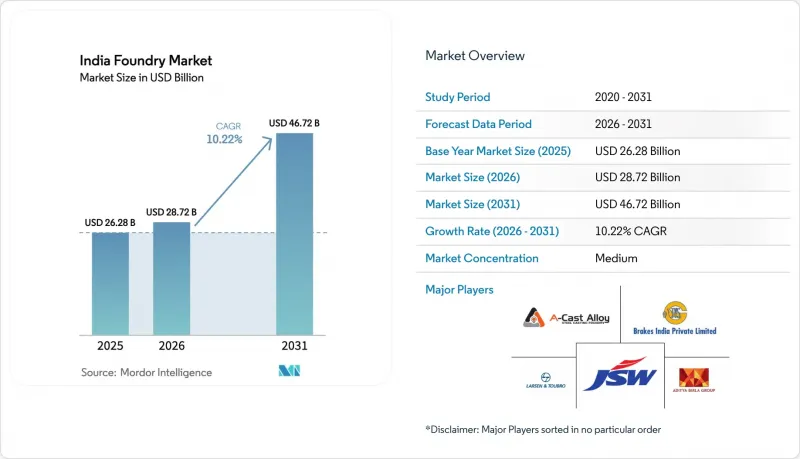
根據 Mordor Intelligence 預測,印度鑄造市場規模預計將在 2025 年達到 262.8 億美元,2026 年達到 287.2 億美元,到 2031 年達到 467.2 億美元,2026 年至 2031 年的複合年成長率為 10.22%。
本報告按鑄造類型(砂型鑄造、壓鑄及其他)、材料(黑色金屬、有色金屬)、最終用戶(汽車、航太、建築、機械及其他)和地區(印度北部、印度西部、印度南部、印度東部和東北部、印度中部)進行細分。市場預測以美元計價。
印度鑄造市場趨勢與洞察
預計到 2026 會計年度,國內電動車產量將超過 100 萬輛,這將提振對鋁製高壓壓鑄件的需求。
隨著電動車動力傳動系統總成的本地化,高壓壓鑄(HPDC)生產線正從生產引擎零件轉向生產電池外殼、馬達外殼和結構框架,這些產品對公差要求更高,導熱性要求也更高。印度鋁業(Hindalco)位於查坎(Chakan)的工廠投資5,900萬美元,截至2024年12月已向馬恆達電動車(Mahindra Electric)交付了1萬個電池外殼,並計劃到2027年將年產量擴大到16萬個。 Uno Minda公司正在馬哈拉斯特拉邦投資2,500萬美元建造一座年產能3,629噸的高壓壓鑄廠,為塔塔汽車(Tata)的Nexon電動車和馬恆達的XUV400平台運作。印度針對先進化學電池的生產連結獎勵計畫計畫要求在2027年實現60%的國內增值率,這將進一步鞏固浦那(Pune)、查坎(Chakan)和霍蘇爾(Hosul)等叢集的高壓壓鑄訂單。雖然阻燃塗層會使加工成本增加 8-12%,但這使得與 Ola Electric 和 Ather Energy 等公司簽訂高價值合約成為可能,從而推高機殼的平均售價。
中國對鑄鐵產品徵收 40% 的關稅,正在加速進口替代。
40%的基本關稅於2025年1月生效,將訂單週期從90-120天縮短至30-45天。馬恆達集團和塔塔汽車已將1.2萬噸住房從中國運往基洛斯卡·費拉斯公司和電鋼公司。巴拉特鍛造公司位於巴拉馬蒂的電動車零件工廠引入了人工智慧驅動的模具填充工具,將缺陷率降低至1%以下,並實現了當週交貨。在未來生產獎勵的推動下,施工機械原始設備製造商正在增加油壓缸筒和動臂鑄件的在地化生產。除非工廠在2028年關稅到期前達到中國的生產力水平,否則進口風險將再次出現,但透過「SAMARTH Udyog Bharat 4.0」計畫引入的數位孿生技術正在縮小這一差距。
歐盟的《共同生化修正案》(CBAM) 提高了高碳排放鑄件的到岸成本。
根據《碳排放交易法》(CBAM),自2026年1月起,每噸鑄件二氧化碳排放量超過1.5噸將加收38.8%的附加稅。科爾哈普爾的出口商,如果每噸鑄件二氧化碳排放量在1.8至2.2噸之間,將立即面臨利潤率下降。雖然大型企業能夠承擔合規成本,但70%的工廠是資金有限的微型、中型和微企業(MSME)。自2025年中期以來,每季至少有8至12家微型鑄造廠倒閉,隨著買方轉向符合CBAM標準的供應商,產業結構調整正在加速進行。
細分市場分析
預計到2025年,精密鑄造的航太產能將達到600噸,複合年成長率(CAGR)為12.05%,在印度鑄造市場中超越所有其他鑄造方法。同時,砂型鑄造仍將保持其最大佔有率,在2025年佔總產量的58.82%。印度斯坦航空有限公司(HAL)訂購的201架「光輝」Mk 2噴射機(總訂單價值214億美元)帶動了PTC工業公司、Dynamatic Technologies公司和AQUS公司渦輪葉片訂單的成長。用於精密鑄造的超合金,例如Inconel 718,具有950-1200兆帕的抗張強度,並能承受1050攝氏度的氣流通道溫度。這些性能是砂型鑄造無法實現的。儘管模具製造和蠟模製作流程會使零件成本增加到每公斤10美元,但原始設備製造商(OEM)接受這一更高的價格,因為它可以確保嚴格的公差和疲勞壽命。
在汽車汽缸體、鐵路車鉤和泵殼等領域,砂型鑄造仍是印度鑄造市場規模的基礎。光是科爾哈普爾和普納每年就出貨約60萬噸砂型鑄鐵件。壓鑄正將重心轉向電動車馬達外殼和電池框架的生產,其生產週期僅45秒,而Uno Minda計劃在馬哈拉斯特拉邦新建的工廠正是這一趨勢的先鋒。永久模鑄造、蒸發鑄造和離心鑄造則用於生產活塞、曲軸和球墨鑄鐵管,但市佔率較小。儘管精密鑄造發展迅速,但預計到2031年,砂型鑄造仍將佔據印度鑄造市場佔有率的一半以上,因為大型柴油引擎和鐵路轉向架仍然大量使用鑄鐵。
其他好處
- Excel格式的市場預測(ME)表
- 3個月的分析師支持
目錄
第1章:引言
- 研究假設和市場定義
- 調查範圍
第2章:調查方法
第3章執行摘要
第4章 市場狀況
- 市場概覽
- 市場促進因素
- 預計到 2026 會計年度,國內電動車 (EV) 產量將超過 100 萬輛,對鋁製高壓壓鑄 (HPDC) 的需求將激增。
- 強制車輛報廢政策(自 2025 年 4 月起生效)將擴大低成本廢鐵和有色金屬廢料的供應。
- 中國對鑄鐵產品徵收 40% 的基本關稅(2025 年保障措施),導致進口替代訂單增加。
- 「國家綠色氫能計畫」下的補助將使特定叢集的穹頂式反應器能夠改造為氫氣反應器。
- ONDC 的 B2B 金屬市場降低了中小鑄造製造商的原料採購成本。
- 全球 OEM 範圍 3 關於「低碳鑄件」的規定正在推動對電弧爐 (EAF) 和感應加熱製程的投資。
- 市場限制因素
- 歐盟的碳邊境調節機制(將於 2025 年 10 月起逐步實施)將增加印度製造鑄件的實際進口成本。
- 對石油焦和高硫煤進口的限制增加了焦炭沖天爐熔煉燃料的成本。
- 半導體製造業的人才流失導致鑄造廠冶金工程師嚴重短缺。
- 微型移動驅動系統中玻璃纖維增強塑膠的快速普及,導致小型鑄件產量下降。
- 價值供應鏈分析
- 監理情勢
- 技術展望
- 產業吸引力—五力分析
- 供應商的議價能力
- 買方的議價能力
- 新進入者的威脅
- 替代品的威脅
- 競爭公司之間的競爭
- 印度製造業市場洞察
- 地緣政治事件對供應鏈的影響
第5章 市場規模與成長預測
- 鑄造型
- 砂型鑄造
- 壓鑄
- 熔模鑄造
- 其他鑄造方法(永久模鑄造、蒸發鑄造、高壓壓鑄、離心鑄造)
- 材料
- 鐵
- 有色金屬
- 最終用戶
- 車
- 航太
- 建造
- 機器
- 鐵路
- 發電
- 泵浦和閥門
- 電氣元件
- 其他(通用工程等)
- 按地區
- 印度北部
- 西印度群島
- 南印度
- 印度東部和東北部
- 印度中部
第6章 競爭情勢
- 市場集中度
- 策略舉措
- 市佔率分析
- 公司簡介
- A-Cast Foundry
- Aditya Birla Management Corp.
- Brakes India
- Larsen & Toubro
- JSW Steel
- CALMET
- Ashok Iron Works
- Gujarat Metal Cast Industries
- Electrosteel Castings
- Menon & Menon
- Kirloskar Ferrous Industries
- Tata Steel(Foundry Division)
- Mahindra CIE Automotive
- Sundaram Clayton
- Endurance Technologies
- Nelcast
- DCM Engineering
- Bharat Forge(Casting Ops)
- Hinduja Foundries
- Tata AutoComp Systems
第7章 市場機會與未來展望
According to Mordor Intelligence, the India foundry market size is projected to be USD 26.28 billion in 2025, USD 28.72 billion in 2026, and reach USD 46.72 billion by 2031, growing at a CAGR of 10.22% from 2026 to 2031.
This report is Segmented by Casting Type (Sand Casting, Die Casting, and More), by Material (Ferrous, Non-Ferrous), by End-User (Automotive, Aerospace, Construction, Machinery, and More), and by Geography (North India, West India, South India, East & North-East India, Central India). Market Forecasts are Provided in Terms of Value (USD).
India Foundry Market Trends and Insights
Domestic EV Output Passing 1 Million Units in FY-26 Boosts Aluminum HPDC Demand
EV power-train localization is diverting HPDC lines from engine ancillaries to battery enclosures, motor housings, and structural frames that demand tighter tolerances and higher thermal conductivity. Hindalco's USD 59 million Chakan plant shipped 10,000 battery enclosures to Mahindra Electric by December 2024 and is scaling to 160,000 units a year by FY-2027. Uno Minda is commissioning a USD 25 million HPDC facility in Maharashtra with 3,629 t annual capacity aimed at Tata's Nexon EV and Mahindra's XUV400 platforms. India's production-linked incentive for advanced-chemistry cells compels 60% domestic value-addition by 2027, further anchoring HPDC orders in Pune, Chakan, and Hosur clusters. Although flame-retardant coatings add 8-12% processing cost, they unlock premium contracts with Ola Electric and Ather Energy, lifting average selling prices on enclosure castings.
40% Duty on Chinese Iron Castings Accelerates Import Substitution
A 40% basic customs duty, effective January 2025, has slashed ordering cycles from 90-120 days to 30-45 days. Mahindra & Mahindra and Tata Motors have shifted 12,000 t of housing from China to Kirloskar Ferrous and Electrosteel. Bharat Forge's Baramati EV-component plant uses AI mold-fill tools to keep rejections below 1%, enabling same-week deliveries. Construction-equipment OEMs, buoyed by a future production incentive, are localizing hydraulic-cylinder barrels and boom castings. Unless plants reach Chinese productivity by the duty's scheduled 2028 expiry, import risk will resurface, but digital-twin roll-outs under the SAMARTH Udyog Bharat 4.0 program are closing the gap.
EU CBAM Raises Landed Cost of High-Carbon Castings
The CBAM applies a 38.8% levy on castings above 1.5 t CO2 per t from January 2026. Kolhapur's exporters, emitting 1.8-2.2 t CO2 per t, face immediate margin compression. Larger players absorb compliance costs, yet 70% of shops are MSMEs with limited capital. At least 8-12 micro-foundries have shut each quarter since mid-2025, accelerating consolidation as buyers shift to CBAM-compliant suppliers.
Other drivers and restraints analyzed in the detailed report include:
- Vehicle Scrappage Policy Delivers Cheaper Ferrous and Non-Ferrous Scrap
- Green-Hydrogen Subsidies Support Furnace Conversion in Select Clusters
- Import Curbs on Petcoke and High-Sulfur Coal Inflate Melt-Fuel Costs
For complete list of drivers and restraints, kindly check the Table Of Contents.
Segment Analysis
Investment casting captured 600 t of aerospace-grade capacity in 2025 and is set for a 12.05% CAGR, outperforming every other route in the India foundry market. Sand casting, however, remained the largest at 58.82% of 2025 volume. HAL's USD 21.4 billion order book for 201 Tejas Mk 2 jets is driving turbine-blade contracts for PTC Industries, Dynamatic Technologies, and Aequs. Investment-cast superalloys such as Inconel 718 deliver 950-1,200 MPa tensile strength and can tolerate 1,050 °C gas-path temperatures, attributes that are impossible via sand molds. Although tools and waxing stages inflate part costs to USD 10 per kg, OEMs accept premiums for tight tolerance and fatigue life.
Sand casting still underpins the India foundry market size for automotive cylinder blocks, railway couplers, and pump housings. Kolhapur and Pune alone ship about 600,000 t of sand-cast iron parts annually. Die casting, led by Uno Minda's upcoming Maharashtra unit, is pivoting to EV motor housings and battery frames at cycle times of 45 seconds. Permanent-mold, evaporative-pattern, and centrifugal casting form a small share, serving pistons, crankshafts, and ductile-iron pipes. Even with investment casting's fast growth, sand casting will likely keep more than half of India's foundry market share through 2031 because large diesel engines and rail bogies will stay iron-intensive.
Complete Report Scope:
- By Casting Type
- Sand Casting
- Die Casting
- Investment Casting
- Other Types - Permanent-Mold Casting, Evaporative casting, High-Pressure Die Casting, and Centrifugal
- By Material
- Ferrous
- Non-Ferrous
- By End-User
- Automotive
- Aerospace
- Construction
- Machinery
- Railways
- Power Generation
- Pumps & Valves
- Electrical Components
- Others - General Engineering, etc.
- By Geography
- North India
- West India
- South India
- East & North-East India
- Central India
List of Companies Covered in this Report:
- A-Cast Foundry
- Aditya Birla Management Corp.
- Brakes India
- Larsen & Toubro
- JSW Steel
- CALMET
- Ashok Iron Works
- Gujarat Metal Cast Industries
- Electrosteel Castings
- Menon & Menon
- Kirloskar Ferrous Industries
- Tata Steel (Foundry Division)
- Mahindra CIE Automotive
- Sundaram Clayton
- Endurance Technologies
- Nelcast
- DCM Engineering
- Bharat Forge (Casting Ops)
- Hinduja Foundries
- Tata AutoComp Systems
Additional Benefits:
- The market estimate (ME) sheet in Excel format
- 3 months of analyst support
TABLE OF CONTENTS
1 Introduction
- 1.1 Study Assumptions & Market Definition
- 1.2 Scope of the Study
2 Research Methodology
3 Executive Summary
4 Market Landscape
- 4.1 Market Overview
- 4.2 Market Drivers
- 4.2.1 Domestic EV four-wheeler output crossing 1 million units in FY-26, triggering a surge in aluminium HPDC demand
- 4.2.2 Mandatory Vehicle Scrappage Policy (April 2025) unlocking low-cost ferrous & non-ferrous scrap supply
- 4.2.3 40% basic customs duty on Chinese iron castings (2025 safeguard) boosting import substitution orders
- 4.2.4 National Green-Hydrogen Mission subsidies enabling cupola-to-hydrogen furnace conversions in select clusters
- 4.2.5 ONDC B2B metals marketplace lowering raw-material procurement costs for SME foundries
- 4.2.6 Global OEM Scope-3 mandates for "low-carbon castings" pushing investments in EAF/induction routes
- 4.3 Market Restraints
- 4.3.1 EU Carbon Border Adjustment Mechanism (phase-in from Oct 2025) raising effective landed cost of Indian castings
- 4.3.2 Import curbs on petcoke & high-sulphur coal inflating melting-fuel costs for coke-fired cupolas
- 4.3.3 Semiconductor-fab talent pull creating acute metallurgical-engineer shortages in foundry hubs
- 4.3.4 Rapid switch to glass-reinforced plastics in micro-mobility drivetrains eroding small-cast-part volumes
- 4.4 Value / Supply-Chain Analysis
- 4.5 Regulatory Landscape
- 4.6 Technological Outlook
- 4.7 Industry Attractiveness - Porter's Five Forces Analysis
- 4.7.1 Bargaining Power of Suppliers
- 4.7.2 Bargaining Power of Buyers
- 4.7.3 Threat of New Entrants
- 4.7.4 Threat of Substitutes
- 4.7.5 Intensity of Competitive Rivalry
- 4.8 Insights into Indian Manufacturing Market
- 4.9 Impact of Geopolitical Events on Supply Chains
5 Market Size & Growth Forecasts(Value, In USD Billion)
- 5.1 By Casting Type
- 5.1.1 Sand Casting
- 5.1.2 Die Casting
- 5.1.3 Investment Casting
- 5.1.4 Other Types - Permanent-Mold Casting, Evaporative casting, High-Pressure Die Casting, and Centrifugal
- 5.2 By Material
- 5.2.1 Ferrous
- 5.2.2 Non-Ferrous
- 5.3 By End-User
- 5.3.1 Automotive
- 5.3.2 Aerospace
- 5.3.3 Construction
- 5.3.4 Machinery
- 5.3.5 Railways
- 5.3.6 Power Generation
- 5.3.7 Pumps & Valves
- 5.3.8 Electrical Components
- 5.3.9 Others - General Engineering, etc.
- 5.4 By Geography
- 5.4.1 North India
- 5.4.2 West India
- 5.4.3 South India
- 5.4.4 East & North-East India
- 5.4.5 Central India
6 Competitive Landscape
- 6.1 Market Concentration
- 6.2 Strategic Initiatives
- 6.3 Market Share Analysis
- 6.4 Company Profiles (includes Global level Overview, Market level overview, Core Segments, Financials as available, Strategic Information, Products & Services, and Recent Developments)
- 6.4.1 A-Cast Foundry
- 6.4.2 Aditya Birla Management Corp.
- 6.4.3 Brakes India
- 6.4.4 Larsen & Toubro
- 6.4.5 JSW Steel
- 6.4.6 CALMET
- 6.4.7 Ashok Iron Works
- 6.4.8 Gujarat Metal Cast Industries
- 6.4.9 Electrosteel Castings
- 6.4.10 Menon & Menon
- 6.4.11 Kirloskar Ferrous Industries
- 6.4.12 Tata Steel (Foundry Division)
- 6.4.13 Mahindra CIE Automotive
- 6.4.14 Sundaram Clayton
- 6.4.15 Endurance Technologies
- 6.4.16 Nelcast
- 6.4.17 DCM Engineering
- 6.4.18 Bharat Forge (Casting Ops)
- 6.4.19 Hinduja Foundries
- 6.4.20 Tata AutoComp Systems
7 Market Opportunities & Future Outlook
- 7.1 White-space & Unmet-Need Assessment


