


 |
市場調查報告書
商品編碼
2119778
美國IT外包:市佔率分析、產業趨勢與統計及成長預測(2026-2031年)United States IT Outsourcing - Market Share Analysis, Industry Trends & Statistics, Growth Forecasts (2026 - 2031) |
||||||

※ 本網頁內容可能與最新版本有所差異。詳細情況請與我們聯繫。
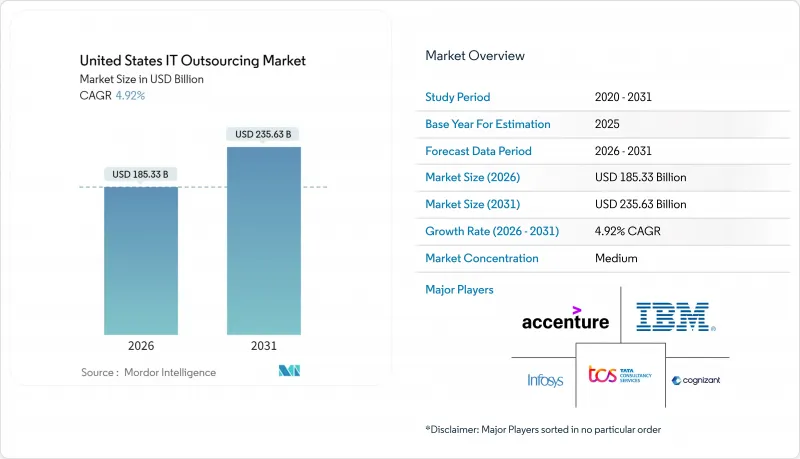
據 Mordor Intelligence 稱,美國 IT 外包市場預計在 2026 年達到 1853.3 億美元,預計在預測期(2026-2031 年)內將以 4.92% 的複合年成長率成長,到 2031 年達到 2356.3 億美元。
本報告按服務類型(應用外包、基礎設施外包等)、公司規模(中小企業、大型企業)、最終用戶行業(銀行、金融服務和保險、IT和電信、政府和公共部門、零售和電子商務等)、合約類型(固定價格等)以及地區進行細分。市場預測以美元計價。
美國IT外包市場的趨勢與洞察
面對國內IT人才短缺,如何進行成本最佳化?
預計到2025年,美國軟體工程師的年薪中位數將達到13萬美元,而電腦相關工作的失業率仍維持在2.1%左右,凸顯了持續存在的技能缺口。因此,企業正依賴全球交付模式,將美國架構師與海外開發人員結合,以降低約40%的綜合成本。這種壓力在奧斯汀、羅利和丹佛等二線科技中心尤為突出,這些城市的新創公司和成熟公司都在爭奪同一批人才。供應商將混合團隊定位為能夠應對區域人才短缺並實現全天候開發週期的團隊。這種模式既能節省成本,又能縮短發布週期,使得美國IT外包市場對尋求快速現代化的買家越來越有吸引力。
數位化優先轉型和雲端遷移的勢頭
到2025年,美國企業雲端支出將超過2,000億美元,這主要得益於基礎設施即服務(IaaS)和平台即服務(PaaS)工作負載對容器化和可觀測性專業知識的需求。外包供應商透過統籌切換和遷移後調優來承擔遷移風險,而這種能力正在加速公共部門採用雲端技術,這主要得益於美國國防部的「雲端優先」政策。獲得FedRAMP認證的供應商佔據了市場主導地位,這為那些沒有美國資料中心且僅在海外營運的競爭對手設定了很高的進入門檻。因此,雲端運算的強勁發展勢頭正在推動美國IT外包市場的持續成長。
日益成長的資料安全和合規責任
修訂後的SP條例強制要求金融機構在發生影響超過500名消費者的資料外洩事件後30天內通知監理機構,這增加了處理銀行、金融和保險(BFSI)業務的供應商的法律風險。由於核保人要求提供零信任架構的證明,到2025年,服務供應商的網路保險保費將飆升18%。無法滿足這些義務的中小型企業已退出這個監管嚴格的行業,導致市場佔有率集中在頂級企業手中。對於醫療保健和州政府客戶而言,分散的資料外洩通知法律加重了合規負擔,並減緩了美國IT外包市場的成長。
細分市場分析
預計到2025年,應用程式外包支出將佔總支出的45.11%,因為企業紛紛趕在供應商停止支援前將舊有系統遷移到新平台。生成式人工智慧驅動的編碼助理和自動化回歸測試減少了支援工單數量並降低了維護成本,但也增加了對系統現代化改造的需求。雲端遷移獎勵,例如高達50萬美元的AWS .NET現代化改造抵扣額,進一步推動了這一趨勢。由託管Kubernetes、SD-WAN和符合FedRAMP標準的SASE服務支援的基礎設施外包,預計到2031年將以5.08%的年均成長率成長。用於人工智慧訓練的高密度GPU託管價格居高不下,抵銷了傳統資料中心機櫃價格的下降。因此,預計美國IT外包市場的基礎設施外包市場成長率將高於整體市場成長率。
供應商的策略正轉向以平台主導的產品。託管式 Kubernetes叢集、資料庫即服務 (DBaaS) 和自動化可觀測性工具正在降低勞動密集度。供應商正將這些服務與零信任安全諮詢服務結合,打造能夠保障利潤率的整合提案。隨著客戶優先考慮以營運支出 (OpEx) 取代資本支出 (CapEx) 的計量收費模式,供應商正在引入靈活的服務等級協定 (SLA),將定價與資源利用率掛鉤。因此,應用外包維持了規模,而基礎設施外包則推動了美國 IT 外包市場最強勁的成長。
大型企業利用主服務協議來確保折扣和付款條件,預計到2025年,這部分收入將佔其總收入的58.83%。他們正在尋求模組化契約,將特定服務領域細分,從而確保自身擁有更換服務提供者的選擇權。同時,預計到2031年,中小企業(SME)的複合年成長率將達到5.64%。這主要得益於捆綁式SaaS套餐的出現,例如微軟面向中小企業的Azure雲端服務,每月起價僅2,500美元,無需企業進行資本投資。谷歌雲端則進一步降低了採用門檻,免除了前Terabyte的資料傳輸費用。
美國中小企業的IT外包市場雖然規模仍小於大型企業,但成長迅速。從醫療保健行業的雲端電子健康記錄(EHR)到零售業的承包電子商務套件,行業特定的SaaS服務實際上發揮著外包的作用。這些平台整合了託管、安全和技術支持,即使是員工人數不足500人的公司也能獲得企業級功能。同時,大型企業也正在拓展選擇性外包,例如將基礎設施監控外包,同時保留內部的客戶體驗平台。這種兩極化的趨勢確保了兩個細分市場的成長,並增強了美國IT外包市場的韌性。
其他好處:
- Excel格式的市場預測(ME)表
- 三個月的分析師支持
目錄
第1章:引言
- 研究假設和市場定義
- 調查範圍
第2章:調查方法
第3章執行摘要
第4章 市場狀況
- 市場概覽
- 市場促進因素
- 日本面臨技術人員短缺,如何進行成本最佳化?
- 向數位化優先轉型以及雲端遷移的勢頭
- 透過選擇性採購專注於核心能力的公司
- 在IT預算限制下,基於績效的定價面臨壓力。
- 聯邦《CHIPS法案》的獎勵正在重塑本土化和近岸化生產的構成比。
- 由生成式人工智慧驅動的編碼正在提高供應商的生產力。
- 市場限制因素
- 加強對資料安全和合規性的責任
- 在分散的供應商生態系統中,整合的複雜性不容忽視
- 海外工資上漲正在削弱勞動力套利的優勢。
- 各州的資料居住法規正在推高管治成本。
- 產業價值鏈分析
- 監理情勢
- 技術展望
- 波特五力分析
第5章 市場規模與成長預測
- 按服務類型
- 應用外包
- 發展
- 維護和支援
- 測試
- 現代化
- 基礎建設外包
- 資料中心
- 網路
- 最終用戶/設備
- 雲端基礎設施
- 業務流程和其他IT服務
- 應用外包
- 按公司規模
- 小型企業
- 大公司
- 按最終用戶行業分類
- BFSI
- IT/通訊
- 政府/公共部門
- 零售與電子商務
- 製造業
- 能源、公共產業、採礦
- 醫療保健和生命科學
- 媒體與娛樂
- 按合約類型
- 定價
- 工時/材料成本法
- 結果導向
第6章 競爭情勢
- 市場集中度
- 策略趨勢
- 市佔率分析
- 公司簡介
- Accenture plc
- International Business Machines Corporation
- Cognizant Technology Solutions Corporation
- Tata Consultancy Services Limited
- Infosys Limited
- Wipro Limited
- HCL Technologies Limited
- Hewlett Packard Enterprise Company
- DXC Technology Company
- Microsoft Corporation
- Amazon.com, Inc.(AWS Professional Services)
- Google LLC
- NTT DATA Corporation
- Kyndryl Holdings, Inc.
- CGI Inc.
- Capgemini SE
- CDW Corporation
- Rackspace Technology, Inc.
- Salesforce, Inc.
- Deloitte Consulting LLP
- Atos SE
- EPAM Systems, Inc.
- Tech Mahindra Limited
第7章 市場機會與未來展望
According to Mordor Intelligence, the United States IT outsourcing market size is estimated at USD 185.33 billion in 2026, and is expected to reach USD 235.63 billion by 2031, at a CAGR of 4.92% during the forecast period (2026-2031).
This report is Segmented by Service Type (Application Outsourcing, Infrastructure Outsourcing, and More), Enterprise Size (Small and Medium Enterprises, and Large Enterprises), End-User Industry (BFSI, IT and Telecom, Government and Public Sector, Retail and E-Commerce, and More), Contract Type (Fixed-Price, and More), and Geography. The Market Forecasts are Provided in Terms of Value (USD).
United States IT Outsourcing Market Trends and Insights
Cost-Optimization Amid Domestic Tech-Talent Shortage
Median U.S. software-engineer salaries climbed to USD 130,000 in 2025 while unemployment in computer occupations hovered near 2.1%, underscoring a persistent skills gap. Enterprises, therefore, lean on global delivery, pairing U.S. architects with offshore developers to save roughly 40% on blended rates. Second-tier tech hubs such as Austin, Raleigh, and Denver feel this pressure acutely, as startups and incumbents compete for the same talent pools. Vendors position hybrid teams as resilient to localized shortages and capable of 24-hour development cycles. The practice both cuts costs and compresses release timelines, reinforcing the appeal of the United States IT Outsourcing Market to buyers seeking rapid modernization.
Digital-First Transformation and Cloud-Migration Momentum
U.S. enterprise cloud spend exceeded USD 200 billion in 2025, led by infrastructure- and platform-as-a-service workloads that require containerization and observability expertise. Outsourcing vendors absorb migration risk by orchestrating cutovers and post-migration tuning, a capability that accelerates public-sector adoption following the Department of Defense cloud-first mandate. FedRAMP-authorized providers enjoy a captive market, raising entry barriers for offshore-only rivals lacking U.S. data-center footprints. Cloud momentum, therefore, fuels sustained growth in the United States IT Outsourcing Market.
Escalating Data-Security and Compliance Liabilities
Amended Regulation S-P requires financial institutions to notify regulators within 30 days of breaches affecting 500 or more consumers, raising legal exposure for vendors handling BFSI workloads. Cyber-insurance premiums for service providers jumped 18% in 2025, as underwriters demanded proof of zero-trust architectures. Smaller firms unable to meet these obligations exited highly regulated verticals, concentrating share among Tier-1 players. Across healthcare and state-government accounts, a patchwork of breach-notification laws amplifies compliance overhead, tempering growth in the United States IT Outsourcing Market.
Other drivers and restraints analyzed in the detailed report include:
- Enterprises Focusing on Core Competencies via Selective Sourcing
- Outcome-Based Pricing Pressure Under Constrained IT Budgets
- Integration Complexity in a Fragmented Provider Ecosystem
For complete list of drivers and restraints, kindly check the Table Of Contents.
Segment Analysis
Application Outsourcing accounted for 45.11% of 2025 spend, as firms rushed to re-platform legacy estates before vendor support sunsets. Generative-AI coding assistants and automated regression testing trimmed ticket volumes, reducing maintenance cost yet boosting modernization demand. Cloud migration incentives, such as AWS .NET Modernization credits of up to USD 500,000, supported this push. Infrastructure Outsourcing is forecast to grow at 5.08% through 2031, supported by managed Kubernetes, SD-WAN, and FedRAMP-compliant SASE offerings. High-density GPU colocation for AI training commands premium rates, offsetting price erosion in traditional data-center racks. The United States IT Outsourcing market size for Infrastructure Outsourcing is therefore poised to expand faster than the overall market.
Vendor strategy now pivots to platform-led delivery. Managed Kubernetes clusters, database-as-a-service, and automated observability tools reduce labor intensity. Vendors bundle these with advisory services around zero-trust security, creating integrated propositions that defend margin. Clients value consumption-based models that replace capex with opex, so providers embed flexible SLAs that align fees with resource utilization. As a result, Application Outsourcing retains scale while Infrastructure Outsourcing delivers the strongest incremental lift to the United States IT Outsourcing Market.
Large Enterprises captured 58.83% of 2025 revenue, leveraging master service agreements to lock in discounts and payment terms. They pursue modular contracts that carve out specific towers, preserving optionality to pivot providers. Conversely, Small and Medium Enterprises are projected to post a 5.64% CAGR to 2031 as bundled SaaS packages like Microsoft's Azure for SMB, priced from USD 2,500 per month, eliminate capital outlays. Google Cloud waives egress fees for the first 10 terabytes, further lowering adoption barriers.
The United States IT Outsourcing market for SMEs is still smaller than that for Large Enterprises, yet growth is rapid. Vertical SaaS, from cloud EHRs in healthcare to turnkey e-commerce suites in retail, effectively functions as outsourcing. These platforms bundle hosting, security, and help-desk support, allowing firms with fewer than 500 employees to access enterprise-grade capabilities. Large Enterprises, meanwhile, increase selective sourcing, retaining customer-experience platforms in-house while offloading infrastructure monitoring. This bifurcated pattern ensures expansion across both segments, reinforcing resilience in the United States IT Outsourcing Market.
Complete Report Scope:
- By Service Type
- Application Outsourcing
- Development
- Maintenance and Support
- Testing
- Modernisation
- Infrastructure Outsourcing
- Data-center
- Network
- End-user/Device
- Cloud Infrastructure
- Business Process and Other IT Services
- Application Outsourcing
- By Enterprise Size
- Small and Medium Enterprises
- Large Enterprises
- By End-user Industry
- BFSI
- IT and Telecom
- Government and Public Sector
- Retail and E-commerce
- Manufacturing
- Energy, Utilities and Mining
- Healthcare and Life Sciences
- Media and Entertainment
- By Contract Type
- Fixed-price
- Time-and-materials
- Outcome-based
List of Companies Covered in this Report:
- Accenture plc
- International Business Machines Corporation
- Cognizant Technology Solutions Corporation
- Tata Consultancy Services Limited
- Infosys Limited
- Wipro Limited
- HCL Technologies Limited
- Hewlett Packard Enterprise Company
- DXC Technology Company
- Microsoft Corporation
- Amazon.com, Inc. (AWS Professional Services)
- Google LLC
- NTT DATA Corporation
- Kyndryl Holdings, Inc.
- CGI Inc.
- Capgemini SE
- CDW Corporation
- Rackspace Technology, Inc.
- Salesforce, Inc.
- Deloitte Consulting LLP
- Atos SE
- EPAM Systems, Inc.
- Tech Mahindra Limited
Additional Benefits:
- The market estimate (ME) sheet in Excel format
- 3 months of analyst support
TABLE OF CONTENTS
1 INTRODUCTION
- 1.1 Study Assumptions and Market Definition
- 1.2 Scope of the Study
2 RESEARCH METHODOLOGY
3 EXECUTIVE SUMMARY
4 MARKET LANDSCAPE
- 4.1 Market Overview
- 4.2 Market Drivers
- 4.2.1 Cost-Optimisation Amid Domestic Tech-Talent Shortage
- 4.2.2 Digital-First Transformation And Cloud-Migration Momentum
- 4.2.3 Enterprises Focusing On Core Competencies Via Selective Sourcing
- 4.2.4 Outcome-Based Pricing Pressure Under Constrained IT Budgets
- 4.2.5 Federal CHIPS Act Incentives Reshaping On/Near-Shoring Mix
- 4.2.6 Generative-AI-Assisted Coding Boosting Vendor Productivity
- 4.3 Market Restraints
- 4.3.1 Escalating Data-Security And Compliance Liabilities
- 4.3.2 Integration Complexity In A Fragmented Provider Ecosystem
- 4.3.3 Offshore Wage Inflation Eroding Labour-Arbitrage Advantage
- 4.3.4 State-Level Data-Residency Statutes Raising Governance Costs
- 4.4 Industry Value Chain Analysis
- 4.5 Regulatory Landscape
- 4.6 Technological Outlook
- 4.7 Porter's Five Forces Analysis
- 4.7.1 Bargaining Power of Suppliers
- 4.7.2 Bargaining Power of Buyers
- 4.7.3 Threat of New Entrants
- 4.7.4 Threat of Substitutes
- 4.7.5 Intensity of Competitive Rivalry
5 MARKET SIZE AND GROWTH FORECASTS (VALUE)
- 5.1 By Service Type
- 5.1.1 Application Outsourcing
- 5.1.1.1 Development
- 5.1.1.2 Maintenance and Support
- 5.1.1.3 Testing
- 5.1.1.4 Modernisation
- 5.1.2 Infrastructure Outsourcing
- 5.1.2.1 Data-center
- 5.1.2.2 Network
- 5.1.2.3 End-user/Device
- 5.1.2.4 Cloud Infrastructure
- 5.1.3 Business Process and Other IT Services
- 5.1.1 Application Outsourcing
- 5.2 By Enterprise Size
- 5.2.1 Small and Medium Enterprises
- 5.2.2 Large Enterprises
- 5.3 By End-user Industry
- 5.3.1 BFSI
- 5.3.2 IT and Telecom
- 5.3.3 Government and Public Sector
- 5.3.4 Retail and E-commerce
- 5.3.5 Manufacturing
- 5.3.6 Energy, Utilities and Mining
- 5.3.7 Healthcare and Life Sciences
- 5.3.8 Media and Entertainment
- 5.4 By Contract Type
- 5.4.1 Fixed-price
- 5.4.2 Time-and-materials
- 5.4.3 Outcome-based
6 COMPETITIVE LANDSCAPE
- 6.1 Market Concentration
- 6.2 Strategic Moves
- 6.3 Market Share Analysis
- 6.4 Company Profiles (includes Global level Overview, Market Level Overview, Core Segments, Financials as Available, Strategic Information, Market Rank/Share for Key Companies, Products and Services, and Recent Developments)
- 6.4.1 Accenture plc
- 6.4.2 International Business Machines Corporation
- 6.4.3 Cognizant Technology Solutions Corporation
- 6.4.4 Tata Consultancy Services Limited
- 6.4.5 Infosys Limited
- 6.4.6 Wipro Limited
- 6.4.7 HCL Technologies Limited
- 6.4.8 Hewlett Packard Enterprise Company
- 6.4.9 DXC Technology Company
- 6.4.10 Microsoft Corporation
- 6.4.11 Amazon.com, Inc. (AWS Professional Services)
- 6.4.12 Google LLC
- 6.4.13 NTT DATA Corporation
- 6.4.14 Kyndryl Holdings, Inc.
- 6.4.15 CGI Inc.
- 6.4.16 Capgemini SE
- 6.4.17 CDW Corporation
- 6.4.18 Rackspace Technology, Inc.
- 6.4.19 Salesforce, Inc.
- 6.4.20 Deloitte Consulting LLP
- 6.4.21 Atos SE
- 6.4.22 EPAM Systems, Inc.
- 6.4.23 Tech Mahindra Limited
7 MARKET OPPORTUNITIES AND FUTURE OUTLOOK
- 7.1 White-space and Unmet-Need Assessment

 IT外包(ITO):市場佔有率分析、產業趨勢與統計數據、成長預測(2026-2031年)
 IT外包市場:2026-2032年全球市場預測(依服務類型、外包模式、合約模式、部署方式、最終用戶產業和組織規模分類)
 全球IT外包市場規模、佔有率、趨勢和成長分析報告(2026-2034年)
 IT外包市場-全球產業規模、佔有率、趨勢、機會和預測:按服務類型、按類型、按行業、按地區和競爭對手分類,2021-2031年
 IT外包市場規模、佔有率、趨勢和預測:按服務模式、組織規模、最終用戶和地區分類,2026-2034年
 全球IT外包市場,2026-2030年
 2026年全球IT外包市場報告
 軟體外包市場規模、佔有率和成長分析:按服務類型、交付模式、客戶規模、應用、產業和地區分類-2026年至2033年產業預測