


 |
市場調查報告書
商品編碼
2119760
電子輪班管理解決方案:市場佔有率分析、產業趨勢與統計、成長預測(2026-2031)Electronic Shift Operations Management Solutions - Market Share Analysis, Industry Trends & Statistics, Growth Forecasts (2026 - 2031) |
||||||

※ 本網頁內容可能與最新版本有所差異。詳細情況請與我們聯繫。
根據 Mordor Intelligence 預測,電子輪班管理解決方案的市場規模預計將從 2025 年的 62.9 億美元成長到 2026 年的 68.3 億美元,到 2031 年將達到 103.3 億美元,2026 年至 2031 年的複合成長率為 8.62%。
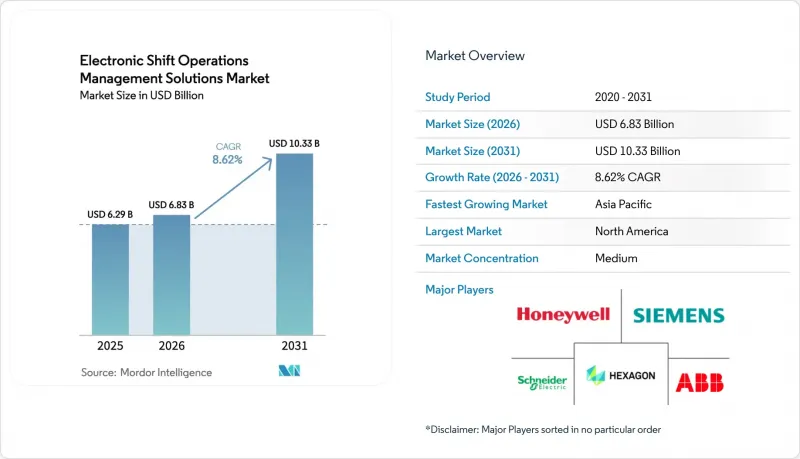
本報告按應用(例如,追蹤、管理和遵守有限運作條件 (LCO))、最終用戶行業(例如,石油和天然氣、化學和石化)、部署類型(基於雲端、本地、混合)、組織規模(大型企業和中小企業)和地區進行分類。
全球電子換班操作管理解決方案市場趨勢及洞察
能源和公共產業領域的需求不斷成長
能源營運商的目標是最大限度地降低停電風險並減少維護成本。根據阿貢國家實驗室估計,人工智慧驅動的電網維護軟體可以將現場工作人員的訪問次數減少高達 66%。因此,公共產業正在優先考慮能夠整合人員調度和資產洞察的平台,以在可再生能源波動的情況下維持電網可靠性。 Shiftboard 的能源專用解決方案套件展示如何將合規性追蹤和緊急工作安排管理整合在一起,以滿足產業需求。隨著公共產業逐漸擺脫電子表格,採用基於規則的即時調度,這些因素正在推動電子輪班營運管理解決方案市場的發展。
關鍵任務運營的自動化和整合
工業4.0計劃正在模糊工廠車間控制系統和企業軟體之間的界限,推動整合式交接班系統的發展。 PPG的數位塗裝生產線透過實施GE Vernova的iFIX系統,生產效率提高了30%。博世互聯工業的「班次簿」透過自動化操作員資料收集也取得了類似的成果。這些案例清晰地表明,為何整合解決方案正在成為「電子交接班管理解決方案」市場的標準。
高昂的初始實施成本和轉換成本
對於預算緊張的企業而言,許可、整合和培訓成本都是一大障礙。 FHI Works 估計,倉庫中隱性人事費用可能導致生產力下降 40%。雖然 SaaS 模式可以減少資本投入,但對營運中斷的擔憂卻延緩了決策過程,阻礙了中小企業即時採用電子輪班管理解決方案。
細分市場分析
到2025年,「人員資格和排班」領域將佔據電子輪班管理解決方案市場20.6億美元的佔有率,並繼續保持市場基石地位,因為操作員資格直接影響安全。公共產業、煉油廠和製藥廠利用能力矩陣來確保員工滿足不斷變化的監管要求。 Kahuna的軟體將資格與輪班安排相匹配,防止安排不合格的員工。結合自動提醒即將到期的許可證,這些工具可以降低稽核風險和停機時間。
儘管預測性輪班分析目前規模仍較小,但預計將以 11.05% 的複合年成長率成長。人工智慧模型可根據天氣、需求和資產狀態等訊號調整排班,從而降低加班成本並提高員工滿意度。採礦業的先驅正在將分析技術與數位孿生技術結合,以根據運輸卡車的運作狀態預測勞動力需求。隨著分析技術融入日常輪班計劃,這種協同效應正在推動電子輪班營運管理解決方案市場的擴張。
管理和合規模組正透過數位化日誌簿和程序清單,並以帶有時間戳的電子記錄取代紙本文件,穩步發展。追蹤和控制面板將警報、KPI圖表和員工位置資訊整合到單一介面中,從而增強了主管人員的情境察覺。在核能發電廠和化工廠中至關重要的「有限運行條件」追蹤,隨著監管機構要求持續記錄參數,變得日益重要。提供整合應用堆疊的供應商正在利用交叉銷售協同效應來提高市場滲透率。
預計到2025年,石油和天然氣產業將佔據電子輪班作業管理解決方案市場16.8億美元的佔有率,這反映了該行業複雜的工作許可規定和危險的工作環境。 Skedulo在上游作業中的應用提高了安全指標,同時縮短了排程時間。煉油廠正在將數位化輪班日誌整合到控制室主機中,並將事故數據和維護記錄關聯起來,以簡化向監管機構的報告流程。
預計金屬、採礦和材料行業將以每年10.55%的速度成長,因為自動駕駛卡車和遠端地下作業需要同步的人工監管。巴里克黃金公司的綠松石嶺礦場透過應用先進的調度技術提高礦石處理量,證明了分析主導工作計畫的投資回報。化學、公共產業和汽車產業也在大力推廣這項技術,這主要受各自合規要求和精實生產需求的驅動。
製藥和生命科學企業正投資整合數位化日誌和電子批記錄,以應對即將到來的GMP變更。軍工企業優先考慮冗餘和安全的離線模式,這推動了穩健系統的普及。各產業在安全文化和可追溯性方面的通用,為橫向平台供應商創造了商機,並擴大了電子輪班操作管理解決方案的市場滲透率。
區域分析
預計到2025年,北美電子輪班營運管理解決方案市場規模將達到22.8億美元,佔36.25%的市場。這主要得益於美國職業安全與健康管理局(OSHA)、美國食品藥物管理局(FDA)和聯邦能源監管委員會(FERC)的嚴格監管要求。美國煉油廠正在將數位化日誌整合到分散式控制系統中,而加拿大公共產業則透過人工智慧驅動的員工調度系統實現停電管理的現代化。Honeywell計劃在2026年前拆分為三個營業單位,這反映了其專注於區域專業化策略,旨在與客戶建立更緊密的聯繫。
亞太地區成長最快,複合年成長率達11.05%,預計到2031年,電子輪班營運管理解決方案市場規模將達15.6億美元。在中國工廠,雲端排班正被廣泛採用,92%的決策者已將工作負載託管在雲端。在印度化學產業,混合模式正在被實施以頻寬限制,而日本企業則正根據其「社會5.0」目標推進相關部署。然而,據IBM稱,該地區71%的企業在將數位化專案轉化為價值方面面臨挑戰,這推動了對整合商的需求。
在德國「工業4.0」藍圖和英國製藥業現代化進程的推動下,歐洲經濟持續穩定成長。歐盟GMP附件1合規計畫正在加速無菌生產車間採用數位化日誌。法國核能發電廠正在尋求高容錯性的本地部署架構,而義大利製造商則將輪班儀錶板整合到其製造執行系統(MES)套件中。在南美、中東和非洲,隨著採礦和石化產業升級其控制室,電子輪班操作管理解決方案的市場版圖正不斷拓展至新的領域,新的發展勢頭正在湧現。
其他好處:
- Excel格式的市場預測(ME)表
- 3個月的分析師支持
目錄
第1章:引言
- 研究假設和市場定義
- 調查範圍
第2章:調查方法
第3章執行摘要
第4章 市場狀況
- 市場概覽
- 市場促進因素
- 能源和公共產業領域的需求增加
- 關鍵任務運營的自動化和整合
- 引進雲端原生遷移平台
- 監管機構正努力推動數位化日誌記錄和安全標準的遵守。
- AI驅動的預測性調度和LLM副駕駛
- 整合數位孿生技術進行即時輪班分析
- 市場限制因素
- 初始設定成本和轉換成本都很高。
- 熟練技術人員短缺
- 關鍵基礎設施網路風險的日益增加。
- 傳統OT/IT系統中資料孤島整合面臨的挑戰。
- 產業價值鏈分析
- 監理情勢
- 技術展望
- 產業吸引力—五力分析
- 買方的議價能力
- 供應商的議價能力
- 新進入者的威脅
- 替代品的威脅
- 競爭公司之間的競爭
- 宏觀經濟因素對市場的影響
第5章 市場規模與成長預測
- 透過使用
- 追蹤有限運作條件 (LCO)
- 管理與合規
- 追蹤和控制儀錶板
- 人員資格和日程安排
- 預測性輪換分析
- 按最終用戶行業分類
- 石油和天然氣
- 化工/石油化工
- 能源公用事業
- 汽車和運輸業
- 軍事/國防
- 製藥和生命科學
- 金屬、採礦和材料
- 其他終端用戶產業
- 部署模式
- 基於雲端的
- 現場
- 混合
- 按組織規模
- 大公司
- 中小企業
- 按地區
- 北美洲
- 美國
- 加拿大
- 墨西哥
- 南美洲
- 巴西
- 阿根廷
- 智利
- 其他南美國家
- 歐洲
- 德國
- 英國
- 法國
- 義大利
- 西班牙
- 俄羅斯
- 其他歐洲國家
- 亞太地區
- 中國
- 印度
- 日本
- 韓國
- 新加坡
- 馬來西亞
- 澳洲
- 其他亞太國家
- 中東和非洲
- 中東
- 阿拉伯聯合大公國
- 沙烏地阿拉伯
- 土耳其
- 其他中東國家
- 非洲
- 南非
- 奈及利亞
- 其他非洲國家
- 中東
- 北美洲
第6章 競爭情勢
- 市場集中度
- 策略趨勢
- 市佔率分析
- 公司簡介
- ABB Ltd.
- Hexagon AB(HxGN Shift Operations)
- Honeywell International Inc.
- Siemens AG(Siemens Xcelerator)
- Schneider Electric SE
- Emerson Electric Co.
- General Electric Co.(GE Digital)
- IBM Corporation
- AVEVA Group plc
- Aspen Technology Inc.
- Yokogawa Electric Corporation
- PTC Inc.
- Dassault Systemes SE
- Oracle Corporation
- SAP SE
- ServiceNow Inc.
- UKG Inc.(Kronos)
- WorkForce Software LLC
- Fluke Reliability(eMaint)
- Rockwell Automation Inc.
- NICE Ltd.(CXone Workforce Engagement)
- Infor Inc.
- Aptean Industrial Manufacturing ERP
- Conmitto Inc.
- Trinoor LLC
- Globorise Technologies LLC
第7章 市場機會與未來趨勢
- 評估閒置頻段和未滿足的需求
According to Mordor Intelligence, the electronic shift operations management solutions market size is expected to grow from USD 6.29 billion in 2025 to USD 6.83 billion in 2026 and is forecast to reach USD 10.33 billion by 2031 at 8.62% CAGR over 2026-2031.
This report is Segmented by Application (Limited Condition of Operation (LCO) Tracking, Administration and Compliance, and More), End-User Industry (Oil and Gas, Chemicals and Petrochemicals, and More), Deployment Mode (Cloud-Based, On-Premise, and Hybrid), Organization Size (Large Enterprises and Small and Mid-Sized Enterprises), and Geography.
Global Electronic Shift Operations Management Solutions Market Trends and Insights
Rising Demand Across Energy and Utilities
Energy operators seek to minimize outage risk and reduce maintenance costs. Argonne National Laboratory estimates that AI-enabled grid maintenance software can cut crew visits by up to 66%. Utilities, therefore, prioritize platforms that merge workforce scheduling with asset insights to keep grids reliable amid renewable variability. Shiftboard's energy-focused suite showcases how compliance tracking and emergency roster management are packaged for sector needs. These factors buoy the Electronic Shift Operations Management Solutions market as utilities retire spreadsheets in favor of real-time, rule-based scheduling.
Automation and Integration of Mission-Critical Operations
Industry 4.0 initiatives dissolve the divide between plant-floor controls and enterprise software, fueling unified shift-handover systems. PPG's digital paint lines achieved 30% productivity gains via GE Vernova's iFIX deployment. Bosch Connected Industry's Shift Book demonstrates similar gains by automating data capture for operators. These examples illustrate why integrated solutions become standard in the Electronic Shift Operations Management Solutions market.
High Initial Installation and Switching Costs
Licensing, integration, and training outlays deter budget-constrained firms. FHI Works estimates hidden warehouse labor costs can erode productivity by 40%. While SaaS models defray capital expenses, fear of disruption slows decisions, restraining immediate Electronic Shift Operations Management Solutions market uptake among smaller operators.
Other drivers and restraints analyzed in the detailed report include:
- Adoption of Cloud-Native Shift Platforms
- Regulatory Push for Digital Logbooks and Safety Compliance
- Shortage of Skilled Technical Workforce
For complete list of drivers and restraints, kindly check the Table Of Contents.
Segment Analysis
Personnel Qualification and Scheduling contributed USD 2.06 billion to the Electronic Shift Operations Management Solutions market size in 2025 and remained the cornerstone because operator credentials directly influence safety. Utilities, refineries, and pharmaceutical plants leverage competency matrices to ensure staff meet evolving regulatory mandates. Kahuna's software aligns certifications with shift rosters, preventing unqualified assignments. Coupled with automated reminders for expiring licenses, such tools reduce audit risk and downtime.
Predictive Shift Analytics, though smaller, is poised for an 11.05% CAGR. AI models adapt schedules to weather, demand, and asset-health signals, trimming overtime costs and elevating employee satisfaction. Early adopters in mining pair analytics with digital twins to forecast labor needs against haul-truck availability. This synergy enlarges the Electronic Shift Operations Management Solutions market as analysis becomes embedded within day-to-day shift planning.
Administrative and Compliance modules grow steadily by digitizing logbooks and procedure checklists, replacing binders with timestamped e-records. Tracking and Control Dashboards broaden situational awareness for supervisors, integrating alarms, KPI charts, and crew locations in one interface. Limited Condition of Operation tracking, vital in nuclear and chemical plants, gains ground as regulators demand continuous parameter logging. Vendors that deliver a unified application stack tap cross-selling synergies, reinforcing market stickiness.
The oil and gas sector held USD 1.68 billion of the Electronic Shift Operations Management Solutions market size in 2025, reflecting complex permit-to-work rules and hazardous conditions. Skedulo's use in upstream operations improved safety metrics while shrinking dispatch times. Refiners embed digital shift logs into control-room consoles, linking incident data and maintenance notes to facilitate regulatory reporting.
Metals, mining, and materials are set to expand 10.55% annually as autonomous trucks and remote underground operations demand synchronized human oversight. Barrick's Turquoise Ridge mine applied advanced scheduling to raise ore throughput, showcasing ROI for analytics-driven rosters. Chemicals, utilities, and automotive industries sustain significant adoption, each propelled by distinct compliance or lean-manufacturing imperatives.
Pharmaceutical and life-science plants invest ahead of looming GMP changes, integrating digital logbooks with electronic batch records. Military and defense users emphasize redundancy and secure offline modes, prompting ruggedized deployments. Cross-industry parallels in safety culture and traceability create avenues for horizontal platform vendors, broadening the Electronic Shift Operations Management Solutions market penetration.
Complete Report Scope:
- By Application
- Limited Condition of Operation (LCO) Tracking
- Administration and Compliance
- Tracking and Control Dashboards
- Personnel Qualification and Scheduling
- Predictive Shift Analytics
- By End-user Industry
- Oil and Gas
- Chemicals and Petrochemicals
- Energy and Utilities
- Automotive and Transportation
- Military and Defense
- Pharmaceuticals and Life Sciences
- Metals, Mining and Materials
- Other End-user Industries
- By Deployment Mode
- Cloud-Based
- On-Premise
- Hybrid
- By Organization Size
- Large Enterprises
- Small and Mid-sized Enterprises (SMEs)
- By Geography
- North America
- United States
- Canada
- Mexico
- South America
- Brazil
- Argentina
- Chile
- Rest of South America
- Europe
- Germany
- United Kingdom
- France
- Italy
- Spain
- Russia
- Rest of Europe
- Asia-Pacific
- China
- India
- Japan
- South Korea
- Singapore
- Malaysia
- Australia
- Rest of Asia-Pacific
- Middle East and Africa
- Middle East
- United Arab Emirates
- Saudi Arabia
- Turkey
- Rest of Middle East
- Africa
- South Africa
- Nigeria
- Rest of Africa
- Middle East
- North America
Geography Analysis
North America generated USD 2.28 billion from the Electronic Shift Operations Management Solutions market size in 2025 and maintained a 36.25% share, underpinned by rigorous OSHA, FDA, and FERC mandates. US refineries integrate digital logbooks into distributed control systems, while Canadian utilities modernize outage management with AI-assisted crew dispatch. Honeywell's plan to split into three entities by 2026 illustrates regional specialization aimed at higher customer intimacy.
Asia-Pacific posts the steepest climb at an 11.05% CAGR, adding USD 1.56 billion to the Electronic Shift Operations Management Solutions market by 2031. Chinese factories adopt cloud scheduling as 92% of decision-makers already host workloads in the cloud. India's chemicals sector implements hybrid models to overcome bandwidth gaps, while Japanese firms align implementations with Society 5.0 objectives. Nonetheless, IBM notes 71% of regional firms struggle to translate digital projects into value, fueling demand for integrators.
Europe follows with consistent growth, driven by Germany's Industry 4.0 roadmaps and the United Kingdom's pharmaceutical modernization. EU GMP Annex 1 compliance timelines hasten digital logbook rollouts in sterile plants. France's nuclear fleet pursues resilient on-premise architectures, and Italy's manufacturers embed shift dashboards within MES suites. South America and the Middle East and Africa show emerging momentum as mining and petrochemicals upgrade control rooms, expanding the Electronic Shift Operations Management Solutions market footprint to new frontiers.
- ABB Ltd.
- Hexagon AB (HxGN Shift Operations)
- Honeywell International Inc.
- Siemens AG (Siemens Xcelerator)
- Schneider Electric SE
- Emerson Electric Co.
- General Electric Co. (GE Digital)
- IBM Corporation
- AVEVA Group plc
- Aspen Technology Inc.
- Yokogawa Electric Corporation
- PTC Inc.
- Dassault Systemes SE
- Oracle Corporation
- SAP SE
- ServiceNow Inc.
- UKG Inc. (Kronos)
- WorkForce Software LLC
- Fluke Reliability (eMaint)
- Rockwell Automation Inc.
- NICE Ltd. (CXone Workforce Engagement)
- Infor Inc.
- Aptean Industrial Manufacturing ERP
- Conmitto Inc.
- Trinoor LLC
- Globorise Technologies LLC
Additional Benefits:
- The market estimate (ME) sheet in Excel format
- 3 months of analyst support
TABLE OF CONTENTS
1 INTRODUCTION
- 1.1 Study Assumptions and Market Definition
- 1.2 Scope of the Study
2 RESEARCH METHODOLOGY
3 EXECUTIVE SUMMARY
4 MARKET LANDSCAPE
- 4.1 Market Overview
- 4.2 Market Drivers
- 4.2.1 Rising demand across energy and utilities
- 4.2.2 Automation and integration of mission-critical operations
- 4.2.3 Adoption of cloud-native shift platforms
- 4.2.4 Regulatory push for digital logbooks and safety compliance
- 4.2.5 AI-driven predictive scheduling and LLM copilots
- 4.2.6 Digital-twin convergence for real-time shift analytics
- 4.3 Market Restraints
- 4.3.1 High initial installation and switching costs
- 4.3.2 Shortage of skilled technical workforce
- 4.3.3 Heightened cyber-risk in critical infrastructure
- 4.3.4 Legacy OT/IT data-silo integration hurdles
- 4.4 Industry Value Chain Analysis
- 4.5 Regulatory Landscape
- 4.6 Technological Outlook
- 4.7 Industry Attractiveness - Porter's Five Forces Analysis
- 4.7.1 Bargaining Power of Buyers
- 4.7.2 Bargaining Power of Suppliers
- 4.7.3 Threat of New Entrants
- 4.7.4 Threat of Substitutes
- 4.7.5 Intensity of Competitive Rivalry
- 4.8 Impact of Macroeconomic Factors on the Market
5 MARKET SIZE AND GROWTH FORECASTS (VALUES)
- 5.1 By Application
- 5.1.1 Limited Condition of Operation (LCO) Tracking
- 5.1.2 Administration and Compliance
- 5.1.3 Tracking and Control Dashboards
- 5.1.4 Personnel Qualification and Scheduling
- 5.1.5 Predictive Shift Analytics
- 5.2 By End-user Industry
- 5.2.1 Oil and Gas
- 5.2.2 Chemicals and Petrochemicals
- 5.2.3 Energy and Utilities
- 5.2.4 Automotive and Transportation
- 5.2.5 Military and Defense
- 5.2.6 Pharmaceuticals and Life Sciences
- 5.2.7 Metals, Mining and Materials
- 5.2.8 Other End-user Industries
- 5.3 By Deployment Mode
- 5.3.1 Cloud-Based
- 5.3.2 On-Premise
- 5.3.3 Hybrid
- 5.4 By Organization Size
- 5.4.1 Large Enterprises
- 5.4.2 Small and Mid-sized Enterprises (SMEs)
- 5.5 By Geography
- 5.5.1 North America
- 5.5.1.1 United States
- 5.5.1.2 Canada
- 5.5.1.3 Mexico
- 5.5.2 South America
- 5.5.2.1 Brazil
- 5.5.2.2 Argentina
- 5.5.2.3 Chile
- 5.5.2.4 Rest of South America
- 5.5.3 Europe
- 5.5.3.1 Germany
- 5.5.3.2 United Kingdom
- 5.5.3.3 France
- 5.5.3.4 Italy
- 5.5.3.5 Spain
- 5.5.3.6 Russia
- 5.5.3.7 Rest of Europe
- 5.5.4 Asia-Pacific
- 5.5.4.1 China
- 5.5.4.2 India
- 5.5.4.3 Japan
- 5.5.4.4 South Korea
- 5.5.4.5 Singapore
- 5.5.4.6 Malaysia
- 5.5.4.7 Australia
- 5.5.4.8 Rest of Asia-Pacific
- 5.5.5 Middle East and Africa
- 5.5.5.1 Middle East
- 5.5.5.1.1 United Arab Emirates
- 5.5.5.1.2 Saudi Arabia
- 5.5.5.1.3 Turkey
- 5.5.5.1.4 Rest of Middle East
- 5.5.5.2 Africa
- 5.5.5.2.1 South Africa
- 5.5.5.2.2 Nigeria
- 5.5.5.2.3 Rest of Africa
- 5.5.5.1 Middle East
- 5.5.1 North America
6 COMPETITIVE LANDSCAPE
- 6.1 Market Concentration
- 6.2 Strategic Moves
- 6.3 Market Share Analysis
- 6.4 Company Profiles (includes Global level Overview, Market level overview, Core Segments, Financials as available, Strategic Information, Market Rank/Share for key companies, Products and Services, and Recent Developments)
- 6.4.1 ABB Ltd.
- 6.4.2 Hexagon AB (HxGN Shift Operations)
- 6.4.3 Honeywell International Inc.
- 6.4.4 Siemens AG (Siemens Xcelerator)
- 6.4.5 Schneider Electric SE
- 6.4.6 Emerson Electric Co.
- 6.4.7 General Electric Co. (GE Digital)
- 6.4.8 IBM Corporation
- 6.4.9 AVEVA Group plc
- 6.4.10 Aspen Technology Inc.
- 6.4.11 Yokogawa Electric Corporation
- 6.4.12 PTC Inc.
- 6.4.13 Dassault Systemes SE
- 6.4.14 Oracle Corporation
- 6.4.15 SAP SE
- 6.4.16 ServiceNow Inc.
- 6.4.17 UKG Inc. (Kronos)
- 6.4.18 WorkForce Software LLC
- 6.4.19 Fluke Reliability (eMaint)
- 6.4.20 Rockwell Automation Inc.
- 6.4.21 NICE Ltd. (CXone Workforce Engagement)
- 6.4.22 Infor Inc.
- 6.4.23 Aptean Industrial Manufacturing ERP
- 6.4.24 Conmitto Inc.
- 6.4.25 Trinoor LLC
- 6.4.26 Globorise Technologies LLC
7 MARKET OPPORTUNITIES AND FUTURE TRENDS
- 7.1 White-Space and Unmet-Need Assessment

 IT基礎設施:研究訂閱
 2026年全球IT基礎設施服務市場報告
 全球IT基礎設施監控軟體市場規模、佔有率、趨勢和成長分析報告(2026-2034年)2026年全球電子輪班操作管理解決方案(eSOMS)市場報告
 IT基礎設施遷移市場:依部署模式、遷移類型、服務類型、元件、垂直產業和組織規模分類 - 2026-2032年全球預測電子輪班營運管理解決方案市場:按組件、組織規模、部署類型、垂直行業、應用和最終用戶類型分類 - 2026-2032 年全球預測
 電子輪班操作管理解決方案 (eSOMS) 市場規模、佔有率和成長分析(按組件、部署方法、功能、整合類型、最終用戶和地區分類)- 產業預測(2026-2033 年)
 IT基礎設施市場預測至2032年:按組件、部署模式、企業規模、最終用戶和地區分類的全球分析
 IT基礎設施市場:按組件、部署和地區分類