


 |
市場調查報告書
商品編碼
2119758
Wi-Fi 7:市場佔有率分析、產業趨勢與統計、成長預測(2026-2031 年)Wi-fi 7 - Market Share Analysis, Industry Trends & Statistics, Growth Forecasts (2026 - 2031) |
||||||

※ 本網頁內容可能與最新版本有所差異。詳細情況請與我們聯繫。
據 Mordor Intelligence 稱,2025 年 Wi-Fi 7 市值為 65 億美元,預計到 2031 年將從 2026 年的 86.3 億美元成長至 356.6 億美元,預測期(2026-2031 年)的複合年成長率為 32.8%。
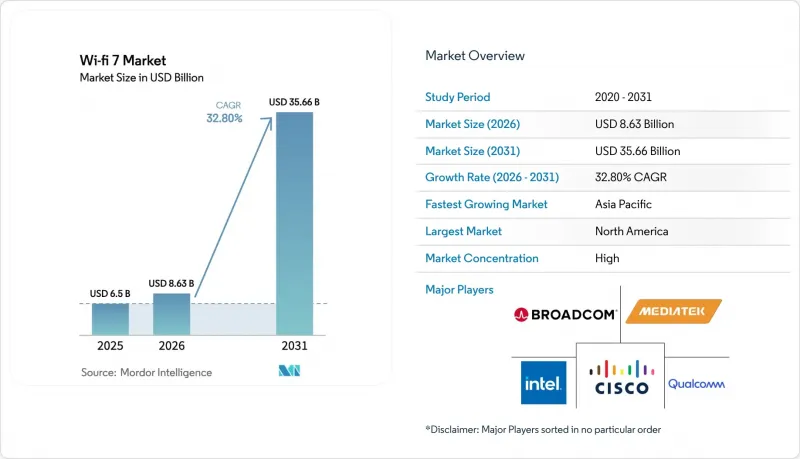
本報告按類型(硬體和服務)、應用(室內和室外)、最終用戶(住宅、企業、工業/製造業及其他)、頻段配置(雙頻 (2.4/5 GHz) 和三頻 (2.4/5/6 GHz))以及地區進行細分。市場預測以美元 (USD) 為單位。
全球Wi-Fi 7市場趨勢與洞察
提供捆綁式三頻 CPE 的一級 ISP 正在加速家庭升級週期。
一級網際網路服務供應商(ISP)捆綁銷售三頻用戶端設備(CPE)正在加速家庭網路升級週期。 Charter Communications 等服務供應商已於 2024 年下半年開始出貨先進的 Wi-Fi 7 路由器,縮短了傳統的四年用戶設備更換週期,並確保昂貴的光纖線路能夠為家庭用戶提供最高網路速度。 Lumen Technologies 也緊隨其後,推出了自主設計的 Wi-Fi 7 閘道器,並證明營運商補貼可以抵消用戶的初始硬體成本。這項策略將有助於提高高階寬頻方案的用戶留存率,增加每位用戶平均收入,並推動數百萬台三頻設備的普及,從而促進整個 Wi-Fi 7 市場的發展。
Wi-Fi 聯盟的「Wi-Fi CERTIFIED 7」認證標籤可降低企業的互通性風險。
Wi-Fi聯盟的「Wi-Fi CERTIFIED 7」認證標籤降低了企業的互通性風險。該認證計畫於2024年1月啟動,透過廠商中立的流程檢驗320 MHz頻道、多連結操作和4K QAM功能,從而消除了買家的疑慮。思科於2024年12月發布的智慧網路基地台正是基於此計畫設計,並配備了人工智慧驅動的自動化設定功能,可大幅縮短部署時間。大型企業現在將Wi-Fi 7設備視為符合標準,從而可以開展先前等候核准擱置的多站點部署。
與入門級智慧型手機中的 Wi-Fi 6E 相比,額外的組件成本更高。
入門級智慧型手機的物料成本(BOM)相比Wi-Fi 6E顯著增加。支援320 MHz頻道和4096-QAM調變需要先進的射頻前端設計。 Qorvo等廠商提供的多天線模組會使終端成本上漲15%至25%,令低成本智慧型手機製造商難以負擔。這種成本差異意味著,在組件價格下降之前,Wi-Fi 7的早期應用將僅限於旗艦機型,從而延緩其在大眾市場的量產。
細分市場分析
到2025年,硬體部分將佔總營收的81.35%,凸顯了新型射頻架構的資本密集特性,因為該架構無法進行改造升級。雖然大部分支出用於網路基地台、閘道器和晶片組,但軟體分析和託管服務正以40.2%的複合年成長率成長,這得益於現有部署基礎設施的完善。 Wi-Fi 7硬體市場預計將從2025年的52.9億美元成長到2031年的290.2億美元,主要得益於供應商對晶片、天線和前端模組的專注。服務領域仍然是Wi-Fi 7產業中成長最快的部分,因為網路服務供應商(ISP)將雲端入口網站、設備即服務(DaaS)方案和自動化最佳化工具捆綁在一起。
由於企業設備更新換代週期和高密度設施對三頻設計的需求,網路基地台仍然是最大的硬體細分市場。閘道器緊隨其後,這得益於政府對三頻CPE的補貼。晶片組是推動創新步伐的主要力量,博通的BCM 6765和聯發科的Filogic平台就是針對特定部署環境最佳化的專用晶片的典型代表。
到2025年,室內應用場景將佔總銷售額的66.20%,這主要得益於辦公室、大學和高層公寓大樓等場所對無需佈線即可實現多Gigabit覆蓋的需求。該領域的主導地位歸功於Wi-Fi 7的許多特性,例如多鏈路操作(Multi-Link Operation),這些特性能夠有效降低高密度環境中的干擾。室外應用,包括體育場館、市政Wi-Fi和智慧城市走廊,雖然在絕對數量上落後於室內應用,但預計到2031年將以39.4%的複合年成長率成長。
Extreme Networks 在 2024 年 Zwarte Cross 音樂節上展示了一款支援 Wi-Fi 7 的三頻存取點,可為數萬名同時上線用戶提供穩定的頻寬。此類演示凸顯了戶外性能,並為服務供應商卸載流量和城市級回程傳輸升級鋪平了道路。隨著監管機構對 AFC 的限制逐步解除,戶外部署將為 Wi-Fi 7 市場開啟新的收入來源。
區域分析
隨著中國主要電信業者將光纖到府 (FTTR) 作為事實上的標準,預計到 2025 年,亞太地區將佔全球收入的 40.60%。光是中國電信一家就已將其寬頻網路擴展至 1.93 億條線路,Gigabit普及率達到 27.3%,這使得中國需要以遠低於歐美地區的周期進行全國範圍的閘道器升級。供應鏈的近距離部署推動了產品的快速改進,使得供應商能夠在數月內陸續向契約製造廠商提供 Wi-Fi 7 參考設計。
北美仍然是領先的早期採用者地區。雖然美國聯邦通訊委員會 (FCC) 已批准在 5945 MHz 以上的標準功率水平下運行,從而實現了戶外部署,但美國聯邦通訊委員會 (AFC)資料庫的限制仍然存在。 Charter 和 Lumen 等服務供應商正將三頻閘道定位為在競爭激烈的Gigabit頻寬中的差異化優勢。隨著思科、HPE 阿魯巴共和國和 CommScope 等公司推出認證設備,企業設備的升級週期也正在加速。
在歐洲,Wi-Fi 7 的普及正透過監管統一逐步推進。歐盟委員會於 2024 年統一了 6 GHz 頻段的低頻頻寬監管規定,允許網路服務供應商和企業無需重新認證即可跨境部署 6 GHz 頻道。沃達豐英國公司已於 2024 年完成其 Wi-Fi 7 路由器的測試,並宣布將於 2025 年開始商業化。
預計到2031年,中東地區將迎來顯著成長。各國政府正將Wi-Fi 7納入智慧城市建設競標,該方案將採用人工智慧驅動的影像監控、連網交通和身臨其境型旅遊體驗等技術。在杜拜進行的公開展示中,原型機的下行速度達到了3.7 Gbps,證實了Wi-Fi 7在開闊的城市環境中具有良好的無線電波傳播性能。南美洲正受惠於巴西積極釋放頻段,而非洲市場則在等待區域監管機構遵循國際電信聯盟(ITU)的指導方針。
其他好處:
- Excel格式的市場預測(ME)表
- 3個月的分析師支持
目錄
第1章:引言
- 研究假設和市場定義
- 調查範圍
第2章:調查方法
第3章執行摘要
第4章 市場狀況
- 市場概覽
- 市場促進因素
- 由一級網路服務供應商提供的三頻CPE套餐正在加速家庭設備的升級換代。
- Wi-Fi 聯盟的「Wi-Fi CERTIFIED 7」認證標誌降低了與企業級互通性相關的風險。
- 歐盟和巴西強制分配 6 GHz 頻段將釋放出一個新的 1.2 GHz 頻段。
- OEM廠商競相將吞吐量超過5Gbps限制的AI-PC和XR頭顯推向市場。
- 在中國,「光纖到府 (FTTR)」的部署使得閘道器升級的間隔不到 18 個月。
- 汽車區域架構中車載串流採用 802.11be 標準
- 市場限制因素
- 與入門級智慧型手機中的 Wi-Fi 6E 相比,額外的組件成本較高。
- 美國和 EMEA 地區戶外 AP 的 AFC 相關認證出現延誤。
- 電池容量有限的物聯網感測器功耗會增加(30% 或更多)。
- 印度和俄羅斯未經許可佔用6GHz頻道相關的合規風險
- 產業價值鏈分析
- 監理情勢
- 技術展望
- 波特五力分析
第5章 市場規模與成長預測
- 按類型
- 硬體
- 網路基地台
- 閘道
- 路由器和擴展器
- 晶片組/模組
- 服務
- 硬體
- 透過使用
- 室內的
- 戶外的
- 最終用戶
- 住宅
- 公司
- 工業和製造業
- 服務供應商/智慧城市
- 頻寬配置
- 雙頻(2.4/5 GHz)
- 三頻(2.4/5/6 GHz)
- 按地區
- 北美洲
- 南美洲
- 歐洲
- 亞太地區
- 中東和非洲
第6章 競爭情勢
- 市場集中度
- 策略趨勢
- 市佔率分析
- 公司簡介
- Broadcom Inc.
- Qualcomm Technologies, Inc.
- Intel Corporation
- MediaTek Inc.
- Cisco Systems, Inc.
- TP-Link Technologies Co., Ltd.
- Huawei Technologies Co., Ltd.
- Netgear, Inc.
- Cambium Networks
- Synaptics
- CommScope
- AsusTek Computer Inc.
- Extreme Networks
- Sercomm Corporation
第7章 市場機會與未來展望
According to Mordor Intelligence, the Wi-Fi 7 market size was valued at USD 6.5 billion in 2025 and estimated to grow from USD 8.63 billion in 2026 to reach USD 35.66 billion by 2031, at a CAGR of 32.8% during the forecast period (2026-2031).
This report is Segmented by Type (Hardware and Services), Application (Indoor and Outdoor), End User (Residential, Enterprise, Industrial and Manufacturing, and More), Frequency Band Configuration (Dual-Band (2. 4/5 GHz) and Tri-Band (2. 4/5/6 GHz)), and Geography. The Market Forecasts are Provided in Terms of Value (USD).
Global Wi-fi 7 Market Trends and Insights
Tri-band CPE Bundling by Tier-1 ISPs Accelerates Household Upgrade Cycles
Tri-band CPE bundling by tier-1 ISPs accelerates household upgrade cycles. Service providers such as Charter Communications began shipping Advanced Wi-Fi 7 routers in late 2024, bypassing the usual four-year consumer replacement cadence and ensuring that expensive fiber lines deliver full in-home speeds. Lumen Technologies followed with an internally designed Wi-Fi 7 gateway, proving how operator subsidies can erase upfront hardware costs for subscribers. The strategy locks customers into premium broadband tiers, widens average revenue per user, and seeds millions of tri-band endpoints that lift the entire Wi-Fi 7 market.
Wi-Fi Alliance "Wi-Fi CERTIFIED 7" Labeling Lowers Enterprise Interoperability Risk
Wi-Fi Alliance "Wi-Fi CERTIFIED 7" labeling reduces enterprise interoperability risk. The January 2024 certification launch ended buyer hesitation by validating 320 MHz channels, Multi-Link Operation, and 4K QAM features in a vendor-neutral process. Cisco's intelligent access points released in December 2024 are built around the program, adding AI-driven self-configuration that slashes deployment times. Large organizations now treat Wi-Fi 7 gear as standards-compliant, enabling multi-site purchases that were on hold for ratification.
High Incremental BoM Versus Wi-Fi 6E in Entry-Level Smartphones
High incremental BoM cost versus Wi-Fi 6E in entry-level smartphones. Support for 320 MHz channels and 4,096-QAM requires advanced RF front-end designs; vendors such as Qorvo supply multi-antenna modules that raise handset costs by 15-25%, which budget-phone makers cannot absorb. The gap confines early Wi-Fi 7 adoption to flagship models until component prices fall, delaying volume scale in the mass market.
Other drivers and restraints analyzed in the detailed report include:
- 6 GHz Spectrum Release Mandates In The EU and Brazil Open 1.2 GHz of New Airwaves
- OEMs Race to Ship AI-PCs and XR Headsets That Exceed 5 GBPS Throughput
- AFC-related Certification Delay for Outdoor APs in the US and EMEA
For complete list of drivers and restraints, kindly check the Table Of Contents.
Segment Analysis
The hardware segment generated 81.35% of overall revenue in 2025, underscoring the capital intensity linked to new RF architectures that cannot be retrofitted. Access points, gateways, and chipsets account for the bulk of this spending, while software analytics and managed services sit on top of the installed base and are growing at a 40.2% CAGR. The Wi-Fi 7 market size for hardware is projected to stretch from USD 5.29 billion in 2025 to USD 29.02 billion in 2031, validating supplier focus on silicon, antennas, and front-end modules. Services still represent the fastest-climbing slice of the Wi-Fi 7 industry as ISPs bundle cloud portals, device-as-a-service plans, and automated optimization tools.
Access points remain the largest hardware sub-segment thanks to enterprise refresh cycles and high-density venues that demand tri-radio designs. Gateways follow closely, propelled by tri-band CPE subsidies. Chipsets set the pace for innovation: Broadcom's BCM 6765 and MediaTek's Filogic platforms exemplify purpose-built silicon tuned to specific deployment environments.
Indoor use cases captured 66.20% of 2025 revenue as offices, universities, and high-rise apartments needed multi-gigabit coverage without recabling. This segment leads because Wi-Fi 7 features, such as Multi-Link Operation, excel at mitigating interference in dense device clusters. Outdoor applications, including stadiums, municipal Wi-Fi, and smart-city corridors, trail in absolute value but are forecast to grow at 39.4% CAGR through 2031.
Extreme Networks showcased Wi-Fi 7 tri-radio APs at the Zwarte Cross 2024 festival, delivering consistent bandwidth to tens of thousands of concurrent users. Such proof points validate outdoor performance, setting the stage for service-provider offload and city-wide backhaul upgrades. As regulatory AFC hurdles clear, outdoor roll-outs will underpin incremental revenue streams for the Wi-Fi 7 market.
Complete Report Scope:
- By Type
- Hardware
- Access Points
- Gateways
- Routers and Extenders
- Chipsets / Modules
- Services
- Hardware
- By Application
- Indoor
- Outdoor
- By End User
- Residential
- Enterprise
- Industrial and Manufacturing
- Service Providers / Smart-City
- By Frequency Band Configuration
- Dual-band (2.4/5 GHz)
- Tri-band (2.4/5/6 GHz)
- By Geography
- North America
- South America
- Europe
- Asia-Pacific
- Middle East and Africa
Geography Analysis
Asia-Pacific commanded 40.60% of 2025 revenue as Chinese operators turned fiber-to-the-room into a de-facto baseline. China Telecom alone grew to 193 million broadband lines with 27.3% gigabit penetration, which forces a nation-wide gateway upgrade cadence far shorter than Western norms. Supply-chain proximity aids quick iterations, allowing vendors to push successive Wi-Fi 7 reference designs into contract manufacturers within months.
North America remains a premium early adopter region. The FCC's approval of standard-power operation above 5,945 MHz unlocks outdoor deployments, even though the AFC database still imposes friction on. Service providers such as Charter and Lumen position tri-band gateways as a differentiator in crowded gigabit tiers. Enterprise refresh cycles pick up as Cisco, HPE Aruba, and CommScope ship certified gear.
Europe approaches adoption through regulatory cohesion. The European Commission harmonized the lower 6 GHz band in 2024, allowing ISPs and enterprises to roll out 6 GHz channels across national borders without re-certification. Vodafone UK completed Wi-Fi 7 router testing in 2024, flagging a 2025 commercial debut.
The Middle East shows a signficjant growth through 2031. Governments bundle Wi-Fi 7 into smart-city tenders that feature AI video surveillance, connected transit, and immersive tourist experiences. A public demonstration in Dubai logged 3.7 Gbps downlink on pre-production equipment, underscoring favorable propagation in open urban layouts. South America benefits from Brazil's proactive spectrum release, while African markets wait for regional regulators to echo ITU guidelines.
- Broadcom Inc.
- Qualcomm Technologies, Inc.
- Intel Corporation
- MediaTek Inc.
- Cisco Systems, Inc.
- TP-Link Technologies Co., Ltd.
- Huawei Technologies Co., Ltd.
- Netgear, Inc.
- Cambium Networks
- Synaptics
- CommScope
- AsusTek Computer Inc.
- Extreme Networks
- Sercomm Corporation
Additional Benefits:
- The market estimate (ME) sheet in Excel format
- 3 months of analyst support
TABLE OF CONTENTS
1 INTRODUCTION
- 1.1 Study Assumptions and Market Definition
- 1.2 Scope of the Study
2 RESEARCH METHODOLOGY
3 EXECUTIVE SUMMARY
4 MARKET LANDSCAPE
- 4.1 Market Overview
- 4.2 Market Drivers
- 4.2.1 Tri-band CPE bundling by Tier-1 ISPs accelerates household upgrade cycles
- 4.2.2 Wi-Fi Alliance "Wi-Fi CERTIFIED 7" labeling reduces enterprise-grade interoperability risk
- 4.2.3 6 GHz spectrum release mandates in EU and Brazil open 1.2 GHz of new air-waves
- 4.2.4 OEM race to ship AI-PCs and XR headsets that exceed 5 Gbps throughput ceiling
- 4.2.5 Fiber-to-the-room (FTTR) roll-outs in China driving gateway refresh every below 18 months
- 4.2.6 Automotive zonal-architecture adoption of 802.11be for in-cabin streaming
- 4.3 Market Restraints
- 4.3.1 High incremental BoM cost vs. Wi-Fi 6E in entry-level smartphones
- 4.3.2 AFC?related certification delay for outdoor APs in US and EMEA
- 4.3.3 Power-consumption penalty ( above 30 %) in battery-constrained IoT sensors
- 4.3.4 Channel-occupancy compliance risk in unlicensed 6 GHz in India and Russia
- 4.4 Industry Value Chain Analysis
- 4.5 Regulatory Landscape
- 4.6 Technological Outlook
- 4.7 Porter's Five Forces Analysis
- 4.7.1 Bargaining Power of Buyers
- 4.7.2 Bargaining Power of Suppliers
- 4.7.3 Threat of New Entrants
- 4.7.4 Threat of Substitutes
- 4.7.5 Intensity of Competitive Rivalry
5 MARKET SIZE AND GROWTH FORECASTS (VALUE)
- 5.1 By Type
- 5.1.1 Hardware
- 5.1.1.1 Access Points
- 5.1.1.2 Gateways
- 5.1.1.3 Routers and Extenders
- 5.1.1.4 Chipsets / Modules
- 5.1.2 Services
- 5.1.1 Hardware
- 5.2 By Application
- 5.2.1 Indoor
- 5.2.2 Outdoor
- 5.3 By End User
- 5.3.1 Residential
- 5.3.2 Enterprise
- 5.3.3 Industrial and Manufacturing
- 5.3.4 Service Providers / Smart-City
- 5.4 By Frequency Band Configuration
- 5.4.1 Dual-band (2.4/5 GHz)
- 5.4.2 Tri-band (2.4/5/6 GHz)
- 5.5 By Geography
- 5.5.1 North America
- 5.5.2 South America
- 5.5.3 Europe
- 5.5.4 Asia-Pacific
- 5.5.5 Middle East and Africa
6 COMPETITIVE LANDSCAPE
- 6.1 Market Concentration
- 6.2 Strategic Moves
- 6.3 Market Share Analysis
- 6.4 Company Profiles (includes Global-level Overview, Market-level overview, Core Segments, Financials as available, Strategic Information, Market Rank/Share for key companies, Products and Services, and Recent Developments)
- 6.4.1 Broadcom Inc.
- 6.4.2 Qualcomm Technologies, Inc.
- 6.4.3 Intel Corporation
- 6.4.4 MediaTek Inc.
- 6.4.5 Cisco Systems, Inc.
- 6.4.6 TP-Link Technologies Co., Ltd.
- 6.4.7 Huawei Technologies Co., Ltd.
- 6.4.8 Netgear, Inc.
- 6.4.9 Cambium Networks
- 6.4.10 Synaptics
- 6.4.11 CommScope
- 6.4.12 AsusTek Computer Inc.
- 6.4.13 Extreme Networks
- 6.4.14 Sercomm Corporation
7 MARKET OPPORTUNITIES AND FUTURE OUTLOOK
- 7.1 White-space and Unmet-need Assessment

 Wi-Fi 7 市場規模、佔有率和成長分析:按組件、應用、頻段、最終用戶和地區分類-2026-2033 年產業預測
 Wi-Fi 7 路由器:市場佔有率分析、產業趨勢與統計數據、成長預測(2026-2031 年)
 2026年Wi-Fi 7全球市場報告
 Wi-Fi 7 市場分析及至 2035 年預測:按類型、產品類型、服務、技術、組件、應用、部署類型、最終用戶、模組和功能分類
 全球及中國Wi-Fi 7市場報告及預測(2026-2032)
 Wi-Fi 7 市場 - 全球產業規模、佔有率、趨勢、機會及預測(按產品、地點、應用、地區和競爭)2020-2030F
 全球Wi-Fi 7市場(截至2030年)