


 |
市場調查報告書
商品編碼
2119744
批發語音業者:市場佔有率分析、產業趨勢與統計、成長預測(2026-2031 年)Wholesale Voice Carrier - Market Share Analysis, Industry Trends & Statistics, Growth Forecasts (2026 - 2031) |
||||||

※ 本網頁內容可能與最新版本有所差異。詳細情況請與我們聯繫。
根據 Mordor Intelligence 估計,到 2026 年,批發語音營運商市值將達到 445.3 億美元,高於 2025 年的 402.6 億美元,預計到 2031 年將達到 736.3 億美元。
預計從 2026 年到 2031 年,其複合年成長率將達到 10.58%。
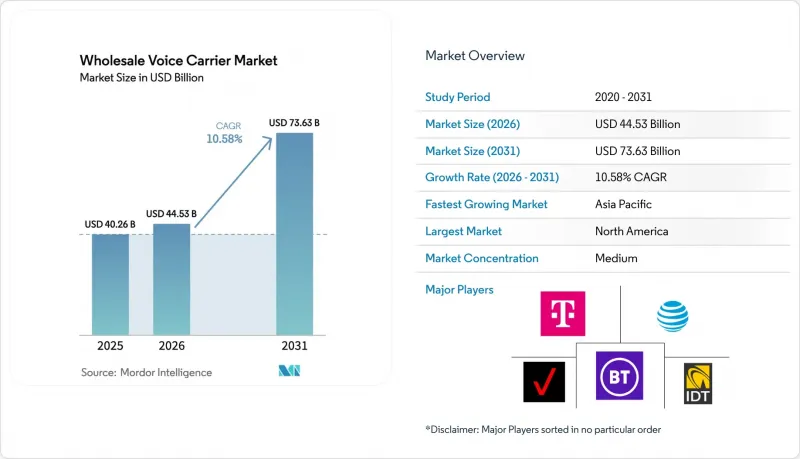
本報告按服務(語音終止、互聯收費、欺詐管理)、技術(VoIP 和傳統交換)、最終用戶(一級和二級運營商、OTT 和 CPaaS 提供者等)和地區進行分類。
全球批發語音業者市場趨勢及洞察
從TDM到SIP和VoIP中繼的快速過渡
隨著公共交換電話網路(PSTN)逐步退役的強制執行,包括英國通訊英國)制定的2027年服務終止計劃,電信業者被迫逐步淘汰傳統交換器並投資於IP核心網路。這項轉型將降低維護成本,實現靈活的容量擴展,並支援功能擴展,即使營運商暫時運行並行系統,從而增加營運成本(OPEX)。先行者透過降低延遲和支援高級轉碼器,在通話品質方面脫穎而出,而行動遲緩的業者則面臨監管處罰和客戶流失風險增加。
雲端通訊(UCaaS/CPaaS)的普及
隨著企業越來越傾向於整合雲端平台,批發需求正從固網轉向以API為中心的語音服務。電信業者透過白牌CPaaS服務提供可程式設計語音、錄音和分析功能,在維持流量的同時,也獲得了新的收入來源。 IntelePeer獲得1.1億美元成長投資等資金籌措表明,大量資金正湧入那些致力於將傳統終端服務與雲端原生編配相結合的供應商。
詐騙行為增加(來電顯示欺騙、語音自動電話)
日益猖獗的定序攻擊(預計2024年將造成12億美元的損失)正在削弱消費者信任,並促使電信業者更嚴格的合規要求。批發電信業者正大力投資於主導數據分析的詐欺偵測技術,但必須在保護成本和每分鐘微薄的利潤之間取得平衡。據估計,國際詐欺每年造成的損失高達170億美元,其手段包括「虛假回答監控」和「流量泵送」等,這些手段不僅嚴重損害盈利,還會損害品牌聲譽。
細分市場分析
預計到2025年,語音終端服務將佔總收入的45.78%,繼續在營運商間交易中發揮核心作用。然而,隨著企業對來電身分驗證的需求不斷成長,監管機構也開始強制推行語音自動電話措施,欺詐管理領域預計將成為成長最快的領域,到2031年複合年成長率將達到13.55%。高利潤的優質來電顯示產品憑藉其交付保證和來源檢驗,在性能上優於商品化的標準盡力而為流量。互聯收費市場分為兩類:一類是大型成熟業者偏好的可定製本地部署模組,另一類是尋求營運成本柔軟性的中小型業者採用的SaaS套件。隨著收入保證平台整合基於機器學習的模式識別技術來預測和阻止異常流量高峰,批發語音營運商市場也將從中受益。
欺詐管理的發展勢頭源自於北美地區的法規結構,例如STIR/SHAKEN,這些框架要求在接通來電前進行來電顯示認證。領先的供應商正在將即時分析儀表板整合到信令防火牆中,以標記可疑的回應率。隨著這些功能的成熟,小規模解決方案供應商面臨著准入門檻,而老牌巨頭則透過端到端的詐欺預防解決方案擴大了市場佔有率。對於營運商而言,採用高級詐欺預防服務可以提高每分鐘平均收入 (ARPM),從而在一定程度上抵消更廣泛的批發語音營運商市場的價格壓力。
區域分析
預計到2025年,歐洲將維持27.95%的市場佔有率,這得益於健全的跨境互聯互通法規和廣泛的光纖骨幹網路。隨著市場日趨成熟,效率和附加價值服務成為主流,德國電信2024年1158億歐元的營收和6.2%的EBITDA成長就充分證明了這一點。 Orange和Telefónica等主要老牌業者之間的整合談判凸顯了應對超大規模雲端服務和OTT服務帶來的市場變革的策略必要性。
亞太地區是全球成長最快的地區,預計到2031年將以13.72%的複合年成長率成長,這主要得益於5G用戶數量的激增、企業數位化進程的推進以及區域間貿易往來的活躍。 GSMA預測,到2024年,行動經濟的貢獻將達到8,800億美元,其中光是中國電信收入就將達到1.74兆元人民幣,預計雲端運算和巨量資料服務也將實現兩位數成長。隨著營運商部署需要全新互聯互通和漫遊框架的獨立5G核心網,這一成長動能正在擴大全部區域的批發語音營運商市場規模。
北美在技術上處於領先地位,但流量成長正在放緩。該地區受到嚴格的STIR/SHAKEN框架約束,迫使營運商在呼叫終止前投資於呼叫認證。 Verizon斥資200億美元收購Frontier Communications,正在將光纖網路擴展到25個州,並加速語音和寬頻資產的整合。拉丁美洲的策略則各不相同。西班牙電信(Telefónica)正在加速剝離其在阿根廷、智利和墨西哥的業務,以便將資本重新集中到利潤更高的歐洲市場,同時有選擇地保留在法規環境有利於盈利的地區的業務。
其他好處:
- Excel格式的市場預測(ME)表
- 3個月的分析師支持
目錄
第1章:引言
- 研究假設和市場定義
- 調查範圍
第2章:調查方法
第3章執行摘要
第4章 市場狀況
- 市場概覽
- 市場促進因素
- 從TDM到SIP和VoIP中繼的快速過渡
- 雲端通訊(UCaaS/CPaaS)的普及現狀
- 關於5G語音漫遊的新協議
- 人工智慧驅動的動態最低成本路徑規劃可提高利潤率。
- 基於區塊鏈的電信業者間結算將減少衝突。
- 市場限制因素
- 詐騙行為增加(來電顯示欺騙、語音自動電話)
- 由於OTT服務替代導致ARPU值下降
- 電信業者的STIR/SHAKEN合規成本
- eSIM 的普及導致國際漫遊通話時間減少。
- 價值鏈分析
- 監理情勢
- 技術展望
- 波特五力分析
第5章 市場規模與成長預測
- 按服務
- 音訊終止
- 高級版(含 CLI 保證)
- 標準(盡力而為)
- 互聯收費
- 本地部署解決方案
- 基於SaaS的解決方案
- 欺詐管理
- 收入保障與分析
- 基於信令的防火牆
- 音訊終止
- 透過技術
- VoIP
- SIP(IMS)
- H.323 和其他協議
- 傳統置換法(TDM)
- VoIP
- 最終用戶
- 一級和二級電信營運商
- 行動虛擬網路營運商(MVNO)
- OTT 和 CPaaS 供應商
- 企業和業務流程外包
- 按地區
- 北美洲
- 美國
- 加拿大
- 墨西哥
- 南美洲
- 巴西
- 阿根廷
- 其他南美國家
- 歐洲
- 德國
- 英國
- 法國
- 義大利
- 西班牙
- 俄羅斯
- 其他歐洲國家
- 亞太地區
- 中國
- 日本
- 韓國
- 印度
- 澳洲
- 其他亞太國家
- 中東和非洲
- 沙烏地阿拉伯
- 阿拉伯聯合大公國
- 南非
- 其他中東和非洲國家
- 北美洲
第6章 競爭情勢
- 市場集中度
- 策略趨勢
- 市佔率分析
- 公司簡介
- Verizon
- AT&T
- BT
- Deutsche Telekom
- Tata Communications
- Telefonica
- Lumen Technologies
- Orange
- Vodafone
- IDT Corporation
- BICS
- iBASIS
- Telia Carrier(Arelion)
- PCCW Global
- Sparkle
- China Telecom Global
- NTT Communications
- PLDT Global
- Telin
- Tofane Global
第7章 市場機會與未來展望
According to Mordor Intelligence, wholesale voice carrier market size in 2026 is estimated at USD 44.53 billion, growing from 2025 value of USD 40.26 billion with 2031 projections showing USD 73.63 billion, growing at 10.58% CAGR over 2026-2031.
This report is Segmented by Service (Voice Termination, Interconnect Billing, and Fraud Management), Technology (VoIP and Traditional Switching), End User (Tier-1 and Tier-2 Telcos, OTT and CPaaS Providers, and More), and Geography.
Global Wholesale Voice Carrier Market Trends and Insights
Rapid Migration from TDM to SIP and VoIP Trunking
Mandatory phase-outs of PSTN networks, such as the 2027 switch-off timetable set by Ofcom in the United Kingdom, compel operators to decommission legacy exchanges and invest in IP cores.The transition compresses maintenance costs, enables flexible capacity scaling, and supports feature expansion even as carriers temporarily operate parallel systems that elevate opex. Early adopters leverage improved latency and advanced codec support to differentiate on call quality, while lagging providers confront regulatory penalties and higher churn risk.
Cloud-based Communication (UCaaS / CPaaS) Uptake
Enterprise preference for unified cloud platforms shifts wholesale demand from fixed trunks to API-centric voice enablement. Operators that expose programmable voice, recording, and analytics capabilities through white-label CPaaS offerings gain new revenue while safeguarding traffic volumes. Funding milestones, such as IntelePeer's USD 110 million growth investment, signal heightened capital flow toward providers that bridge traditional termination with cloud-native orchestration.
Heightened Fraud (CLI Spoofing, Robocalls)
Escalating vishing attacks that generated USD 1.2 billion in losses during 2024 undermine consumer trust and trigger stricter compliance mandates. Wholesale carriers invest heavily in analytics-driven fraud detection, yet must balance protection costs against thin per-minute margins. International fraud, estimated at USD 17 billion annually, includes False Answer Supervision and Traffic Pumping schemes that erode profitability while damaging brand reputation.
Other drivers and restraints analyzed in the detailed report include:
- Emerging Voice-over-5G Roaming Agreements
- AI-enabled Dynamic Least-cost Routing Boosts Margins
- Declining Voice ARPU due to OTT Substitution
For complete list of drivers and restraints, kindly check the Table Of Contents.
Segment Analysis
Voice Termination accounted for 45.78% of revenue in 2025, maintaining its role as the cornerstone of inter-carrier exchange. However, Fraud Management delivers the swiftest expansion at 13.55% CAGR to 2031 as enterprises demand authenticated caller identities and regulators mandate robocall mitigation. Higher-margin Premium CLI products outperform commoditized Standard Best-Effort traffic thanks to guaranteed delivery and origin validation. Interconnect Billing splits between customizable on-premise modules preferred by large incumbents and SaaS suites adopted by smaller operators seeking opex flexibility. The wholesale voice carrier market benefits when revenue-assurance platforms integrate machine-learning pattern recognition, enabling predictive blocking of anomalous traffic bursts.
Fraud Management momentum stems from regulatory frameworks such as STIR/SHAKEN in North America, compelling carriers to certify calling party numbers before termination. Leading vendors package signaling firewalls with real-time analytics dashboards that flag suspicious answer-seizure ratios. As these capabilities mature, smaller solution providers encounter entry barriers while established players consolidate share through end-to-end fraud stacks. For carriers, premium anti-fraud service uptake supports average-revenue-per-minute lift that partially offsets unit price compression in the wider wholesale voice carrier market.
Complete Report Scope:
- By Service
- Voice Termination
- Premium (CLI Guaranteed)
- Standard (Best-Effort)
- Interconnect Billing
- On-premise Solutions
- SaaS-based Solutions
- Fraud Management
- Revenue-Assurance and Analytics
- Signalling-Based Firewalls
- Voice Termination
- By Technology
- VoIP
- SIP (IMS)
- H.323 and Other Protocols
- Traditional Switching (TDM)
- VoIP
- By End User
- Tier-1 and Tier-2 Telcos
- Mobile Virtual Network Operators (MVNO)
- OTT and CPaaS Providers
- Enterprises and BPOs
- By Geography
- North America
- United States
- Canada
- Mexico
- South America
- Brazil
- Argentina
- Rest of South America
- Europe
- Germany
- United Kingdom
- France
- Italy
- Spain
- Russia
- Rest of Europe
- Asia Pacific
- China
- Japan
- South Korea
- India
- Australia
- Rest of Asia Pacific
- Middle East and Africa
- Saudi Arabia
- United Arab Emirates
- South Africa
- Rest of Middle East and Africa
- North America
Geography Analysis
Europe maintained a 27.95% revenue share in 2025, underpinned by robust cross-border interconnection regulations and widespread fiber backbones. Market maturity prompts a pivot toward efficiency and value-added services, illustrated by Deutsche Telekom's EUR 115.8 billion revenue and 6.2% EBITDA uplift in 2024.Consolidation discussions between major incumbents such as Orange and Telefonica underline a strategic need to counter hyperscale cloud rivals and OTT disruptors.
Asia Pacific delivers the fastest regional trajectory at 13.72% CAGR through 2031, propelled by soaring 5G subscriptions, rising enterprise digitization, and inter-regional trade flows. The GSMA values the mobile economy contribution at USD 880 billion in 2024, with China alone recording RMB 1.74 trillion telecommunications revenue and double-digit growth in cloud and big-data services. Such momentum enlarges the wholesale voice carrier market size across the region as operators deploy standalone 5G cores that require new interconnect and roaming frameworks.
North America exhibits technological leadership but slower traffic growth. The region enforces stringent STIR/SHAKEN frameworks, compelling carriers to invest in call authentication before termination. Verizon's USD 20 billion purchase of Frontier Communications extends fiber reach across 25 states and consolidates voice and broadband assets. Latin America presents divergent strategies: Telefonica accelerates divestments in Argentina, Chile, and Mexico to refocus capital on higher-return European markets while maintaining selective presence where regulatory conditions support profitability.
- Verizon
- AT&T
- BT
- Deutsche Telekom
- Tata Communications
- Telefonica
- Lumen Technologies
- Orange
- Vodafone
- IDT Corporation
- BICS
- iBASIS
- Telia Carrier (Arelion)
- PCCW Global
- Sparkle
- China Telecom Global
- NTT Communications
- PLDT Global
- Telin
- Tofane Global
Additional Benefits:
- The market estimate (ME) sheet in Excel format
- 3 months of analyst support
TABLE OF CONTENTS
1 INTRODUCTION
- 1.1 Study Assumptions and Market Definition
- 1.2 Scope of the Study
2 RESEARCH METHODOLOGY
3 EXECUTIVE SUMMARY
4 MARKET LANDSCAPE
- 4.1 Market Overview
- 4.2 Market Drivers
- 4.2.1 Rapid migration from TDM to SIP and VoIP trunking
- 4.2.2 Cloud-based communication (UCaaS / CPaaS) uptake
- 4.2.3 Emerging voice-over-5G roaming agreements
- 4.2.4 AI-enabled dynamic least-cost routing boosts margins
- 4.2.5 Blockchain-based inter-carrier settlements reduce disputes
- 4.3 Market Restraints
- 4.3.1 Heightened fraud (CLI spoofing, robocalls)
- 4.3.2 Declining voice ARPU due to OTT substitution
- 4.3.3 STIR/SHAKEN compliance costs for carriers
- 4.3.4 eSIM driven fall in international roaming minutes
- 4.4 Value Chain Analysis
- 4.5 Regulatory Landscape
- 4.6 Technological Outlook
- 4.7 Porter's Five Forces Analysis
- 4.7.1 Threat of New Entrants
- 4.7.2 Bargaining Power of Buyers
- 4.7.3 Bargaining Power of Suppliers
- 4.7.4 Threat of Substitutes
- 4.7.5 Intensity of Competitive Rivalry
5 MARKET SIZE AND GROWTH FORECASTS (VALUE)
- 5.1 By Service
- 5.1.1 Voice Termination
- 5.1.1.1 Premium (CLI Guaranteed)
- 5.1.1.2 Standard (Best-Effort)
- 5.1.2 Interconnect Billing
- 5.1.2.1 On-premise Solutions
- 5.1.2.2 SaaS-based Solutions
- 5.1.3 Fraud Management
- 5.1.3.1 Revenue-Assurance and Analytics
- 5.1.3.2 Signalling-Based Firewalls
- 5.1.1 Voice Termination
- 5.2 By Technology
- 5.2.1 VoIP
- 5.2.1.1 SIP (IMS)
- 5.2.1.2 H.323 and Other Protocols
- 5.2.2 Traditional Switching (TDM)
- 5.2.1 VoIP
- 5.3 By End User
- 5.3.1 Tier-1 and Tier-2 Telcos
- 5.3.2 Mobile Virtual Network Operators (MVNO)
- 5.3.3 OTT and CPaaS Providers
- 5.3.4 Enterprises and BPOs
- 5.4 By Geography
- 5.4.1 North America
- 5.4.1.1 United States
- 5.4.1.2 Canada
- 5.4.1.3 Mexico
- 5.4.2 South America
- 5.4.2.1 Brazil
- 5.4.2.2 Argentina
- 5.4.2.3 Rest of South America
- 5.4.3 Europe
- 5.4.3.1 Germany
- 5.4.3.2 United Kingdom
- 5.4.3.3 France
- 5.4.3.4 Italy
- 5.4.3.5 Spain
- 5.4.3.6 Russia
- 5.4.3.7 Rest of Europe
- 5.4.4 Asia Pacific
- 5.4.4.1 China
- 5.4.4.2 Japan
- 5.4.4.3 South Korea
- 5.4.4.4 India
- 5.4.4.5 Australia
- 5.4.4.6 Rest of Asia Pacific
- 5.4.5 Middle East and Africa
- 5.4.5.1 Saudi Arabia
- 5.4.5.2 United Arab Emirates
- 5.4.5.3 South Africa
- 5.4.5.4 Rest of Middle East and Africa
- 5.4.1 North America
6 COMPETITIVE LANDSCAPE
- 6.1 Market Concentration
- 6.2 Strategic Moves
- 6.3 Market Share Analysis
- 6.4 Company Profiles (includes Global level Overview, Market level overview, Core Segments, Financials as available, Strategic Information, Market Rank/Share for key companies, Products and Services, and Recent Developments)
- 6.4.1 Verizon
- 6.4.2 AT&T
- 6.4.3 BT
- 6.4.4 Deutsche Telekom
- 6.4.5 Tata Communications
- 6.4.6 Telefonica
- 6.4.7 Lumen Technologies
- 6.4.8 Orange
- 6.4.9 Vodafone
- 6.4.10 IDT Corporation
- 6.4.11 BICS
- 6.4.12 iBASIS
- 6.4.13 Telia Carrier (Arelion)
- 6.4.14 PCCW Global
- 6.4.15 Sparkle
- 6.4.16 China Telecom Global
- 6.4.17 NTT Communications
- 6.4.18 PLDT Global
- 6.4.19 Telin
- 6.4.20 Tofane Global
7 MARKET OPPORTUNITIES AND FUTURE OUTLOOK
- 7.1 White-space and Unmet-need Assessment

 2034 年網際網路語音協定 (VoIP) 市場預測-按組件、部署模式、呼叫模式、接取模式、企業規模、最終用戶和地區分類的全球分析
 基於雲端的 VoIP 服務市場:按部署模式、服務類型、最終用戶、產業、國家和地區分類-全球產業分析、市場規模、市場佔有率及 2026 年至 2033 年預測智慧運營商基礎設施管理市場預測至2034年-按基礎設施類型、部署模式、技術、應用、最終用戶和地區分類的全球分析語音技術(VoIP AI)市場預測至2034年:按組件、部署模式、應用、最終用戶和地區分類的全球分析
 2026年VVoIP(基於IP的語音和視訊)全球市場報告
 全球 VoWLAN(無線區域網路語音)市場
 營運商級 VoIP 平台和會話邊界控制器 (SBC) 基礎設施2026年全球虛擬PBX(專用交換機)系統市場報告2026年網際網路協定(IP)安全尋呼全球市場報告2026年全球會話邊界控制器市場報告