


 |
市場調查報告書
商品編碼
2119712
下一代計算:市場佔有率分析、行業趨勢與統計數據以及成長預測(2026-2031 年)Next-generation Computing - Market Share Analysis, Industry Trends & Statistics, Growth Forecasts (2026 - 2031) |
||||||

※ 本網頁內容可能與最新版本有所差異。詳細情況請與我們聯繫。
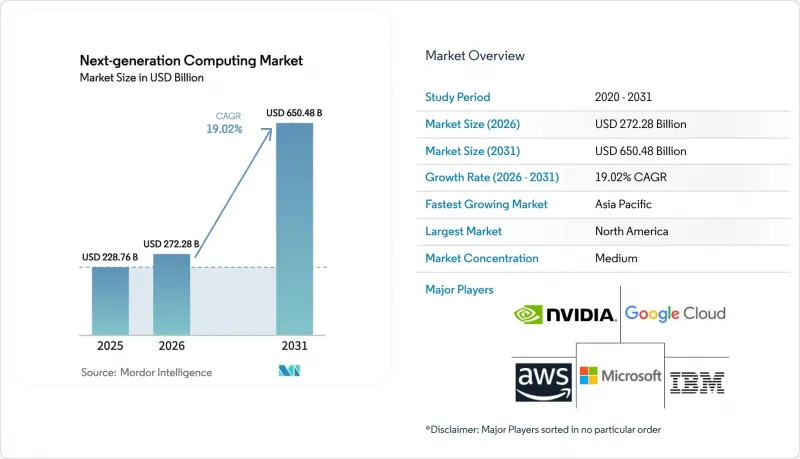
根據 Mordor Intelligence 預測,下一代運算市場規模將從 2025 年的 2,287.6 億美元成長到 2026 年的 2,722.8 億美元,然後在 2031 年達到 6,504.8 億美元,2026 年至 2031 年的複合年成長率為 19.02%。
本報告按組件(硬體、軟體、服務)、運算範式(高效能運算 (HPC)、量子運算、光學/光子運算、神經形態運算、邊緣/近邊緣運算等)、部署模式(雲端、本地、混合)、最終用戶產業(銀行、金融服務和保險、醫療保健和生命科學、汽車和運輸、能源和公共產業、其他)以及地區進行分類。
全球下一代運算市場趨勢與洞察
生成式人工智慧運算擴展需求激增
預計2025會計年度主要GPU廠商的資料中心營收將年增超過一倍,證實了大規模語言模式(LLM)和影像產生工具目前是半導體需求的主要驅動力。 Blackwell級處理器整合了2080億個電晶體,能夠以遠低於上一代產品的功耗實現兆參數推理。為此,雲端服務供應商推出了專用AI實例,並捆綁了低延遲網路和共享的高頻寬內存,使即使是中型企業也能按需獲得百億億百萬兆級運算能力。系統整合商透過重新設計板級供電和部署可最佳化數千個GPU調度的軟體堆疊,降低了進入門檻。這些努力共同加速了下一代運算市場的資本流入,並強化了硬體更新周期。
政府大力資助量子技術中心
2025年1月,美國能源局撥款6.25億美元用於量子研究的新津貼。同樣,英國撥款1.21億英鎊(約1.6434億美元)用於支援國內測試平台和商業加速器。這些資金叢集將大學、國家實驗室和私人供應商聯繫起來,建立長期夥伴關係關係,共同承擔原型開發的風險,並透過獎學金計畫培養人才。同時,日本和印度增加了量子技術的國家預算,以增強稀釋製冷機、光電和控制電子裝置等相關供應鏈的韌性。這些舉措刺激了量子位元連接技術、低溫封裝和誤差緩解演算法等領域的專利申請,為下一代運算市場注入了持續的動力。
量子技術專家短缺
2025 年一項針對量子科技相關人員的調查顯示,45% 的受訪者認為人才短缺是量子科技普及應用的主要障礙。設計量子演算法需要融合物理學、數學和電腦科學,但普通教育課程很少涵蓋這三個領域。企業曾嘗試透過內部培訓和與大學共同開設課程來彌補這一差距,但人才培養所需的時間往往超過了計畫截止日期。儘管政府獎學金增加了博士生的數量,但短期人才供應仍然緊張,這延緩了密碼學、最佳化和材料科學等領域的量子技術應用,並減緩了下一代計算市場的整體擴張。
細分市場分析
受GPU、張量處理單元和光子互連技術普及的推動,下一代運算硬體市場規模在2025年達到1,065.9億美元。百萬兆級主機板整合了六個HBM記憶體堆疊,頻寬頻寬,模型訓練批次規模擴大了十倍。記憶體製造商承諾擴大產能並確保組件供應,以滿足到2035年高效能運算(HPC)和人工智慧(AI)領域HBM需求成長15倍的預測。主流伺服器主機板也採用了節能型光鏈路,將加速器模組之間的延遲降低到微秒。
服務部門雖然規模較小,但憑藉其架構設計、安全部署和生命週期管理等業務,實現了更快速的成長。託管量子工作負載、AI管道最佳化和主動冷卻分析等服務成為新的收入來源。雲端服務供應商將專業服務時間打包到平台訂閱中,從而產生類似退休金的收入。這種混合收入結構增強了下一代運算市場的韌性,即使在硬體供應波動的情況下也能保持穩定,並有助於客戶鎖定在專用工具鏈上。
由於天氣建模、流體動態和金融風險網格等領域成熟的採購週期,高效能運算(HPC)在2024年繼續佔據了相當大的收入佔有率。廠商推出了百萬兆級系統,將x86或Arm CPU與基於乙太網路的NVLink架構上的下一代GPU結合,實現了超過7百億億次浮點運算的單精度吞吐量。即使其他運算範式日趨成熟,這些突破也保持了下一代運算市場的強勁勢頭。
量子計算展現出最強勁的成長動能。 D-Wave公司發布了一款擁有超過5000個量子位元的退火器,用於組合最佳化;同時,離子阱和中性原子量子系統的供應商也已籌集創業投資資金,用於開發具備糾錯能力的原型機。早期的混合先導計畫已證實,量子核心能夠加速金融風險模型中蒙特卡羅模擬的收斂性。預計量子運算將以34.05%的複合年成長率成長,逐步蠶食傳統運算的預算,從而鞏固其在下一代運算市場中的地位。
區域分析
預計到2025年,北美將佔下一代計算市場收入的40.80%。僅美國一國就將佔據該地區約四分之三的支出,這得益於公共資金、充裕的創業投資以及雲端領域領先成熟企業的存在。國家實驗室透過運作整合中性原子陣列和百萬兆級超級電腦的開創性量子測試平台,鞏固了其領先地位。跨產業聯盟開發了節能資料中心的創新技術,體現了以永續性為導向的政策。
亞太地區預計將以22.45%的複合年成長率實現最高成長。中國、日本和印度擴大了對半導體園區的激勵措施,並為量子研究獎學金提供津貼。超大規模業者承諾將新加坡、雪梨和孟買的託管閒置頻段擴大一倍,以滿足人工智慧的需求。 5G-Advanced的平行部署催生了新的邊緣運算節點,深化了工作負載本地化,並鞏固了該地區在下一代運算市場中的重要性。澳洲和韓國加入了量子標準多邊聯盟,為該地區帶來了技術多樣性。
歐洲堅持統一的產業戰略,將數位主權與環境管理結合。德國弗勞恩霍夫研究所推進了旨在實現亞瓦級推理的神經形態原型機的研發,而法國一家研究所則開展了基於光電的量子路由器的演示實驗。歐盟的「Fit for 55」氣候方案鼓勵資料中心營運商簽訂長期可再生能源購買協議,在監管合規與投資者壓力之間取得平衡。這些舉措進一步鞏固了歐洲在下一代運算市場永續性領域的先鋒地位。
其他好處:
- Excel格式的市場預測(ME)表
- 3個月的分析師支持
目錄
第1章:引言
- 研究假設和市場定義
- 調查範圍
第2章:調查方法
第3章執行摘要
第4章 市場狀況
- 市場概覽
- 市場促進因素
- 生成式人工智慧對更高運算能力的需求激增
- 政府大力資助量子技術中心
- 實現超低延遲物聯網的邊緣到雲端融合
- 利用雲端積分和開放IP晶片降低GPU總擁有成本
- 液冷技術的突破性進步使得高密度高性能電腦架成為可能。
- 二手人工智慧加速器市場
- 市場限制因素
- 量子技術專家短缺
- 高額資本支出(CAPEX)和異質叢集中的整合風險
- 超大規模資料中心的電網連接和授權瓶頸
- 對先進HBM和GPU出口管制限制
- 價值鏈分析
- 監理情勢
- 技術展望
- 波特五力模型
- 宏觀經濟因素的影響
- 投資分析
第5章 市場規模與成長預測
- 按組件
- 硬體
- 處理器和加速器
- 記憶體和儲存
- 互連與網路
- 熱能和電源解決方案
- 軟體
- 服務
- 硬體
- 計算範式
- 高效能運算(HPC)
- 量子計算
- 光學/光子計算
- 神經形態計算
- 邊緣/近邊緣運算
- 雲端原生加速運算
- 混合技術和其他新興技術
- 部署模式
- 雲
- 現場
- 混合
- 按最終用戶行業分類
- BFSI
- 醫療保健和生命科學
- 汽車和運輸業
- 能源公用事業
- 航太/國防
- 媒體與娛樂
- 資訊科技/通訊
- 零售與電子商務
- 製造業和工業
- 政府/公共部門
- 其他終端用戶產業
- 按地區
- 北美洲
- 美國
- 加拿大
- 墨西哥
- 南美洲
- 巴西
- 阿根廷
- 其他南美國家
- 歐洲
- 德國
- 英國
- 法國
- 義大利
- 俄羅斯
- 其他歐洲國家
- 亞太地區
- 中國
- 日本
- 韓國
- 印度
- ASEAN
- 其他亞太國家
- 中東和非洲
- 中東
- 沙烏地阿拉伯
- UAE
- 土耳其
- 其他中東國家
- 非洲
- 南非
- 奈及利亞
- 其他非洲國家
- 中東
- 北美洲
第6章 競爭情勢
- 市場集中度
- 策略趨勢
- 市佔率分析
- 公司簡介
- Alibaba Group Holding Ltd.
- Amazon Web Services Inc.
- Alphabet Inc.(Google Cloud)
- Microsoft Corp.
- IBM Corp.
- NVIDIA Corp.
- Intel Corp.
- Advanced Micro Devices Inc.
- Cisco Systems Inc.
- Oracle Corp.
- NEC Corp.
- Hewlett Packard Enterprise
- Dell Technologies
- Fujitsu Ltd.
- Graphcore Ltd.
- D-Wave Quantum Inc.
- IonQ Inc.
- Rigetti Computing Inc.
- ARM Ltd.
- PsiQuantum Corp.
- Cerebras Systems Inc.
- Tencent Holdings(Tencent Cloud)
- Baidu Inc.
- Huawei Technologies Co. Ltd.
- Samsung Electronics Co. Ltd.
- Graphcore Ltd.
- Cerebras Systems Inc.
第7章 市場機會與未來展望
According to Mordor Intelligence, the next-generation computing market size is expected to grow from USD 228.76 billion in 2025 to USD 272.28 billion in 2026 and is forecast to reach USD 650.48 billion by 2031 at 19.02% CAGR over 2026-2031.
This report is Segmented by Component (Hardware, Software, Services), Computing Paradigm (High-Performance Computing (HPC), Quantum Computing, Optical/Photonic Computing, Neuromorphic Computing, Edge/Near-Edge Computing, and More), Deployment Mode (Cloud, On-Premise, Hybrid), End-User Industry (BFSI, Healthcare and Life Sciences, Automotive and Transportation, Energy and Utilities, and More), and Geography.
Global Next-generation Computing Market Trends and Insights
Demand surge for generative-AI compute scaling
Fiscal-2025 datacenter revenue at a leading GPU vendor more than doubled year-over-year, confirming that large language models (LLMs) and image generators now dominate silicon demand. Blackwell-class processors integrated 208 billion transistors, enabling trillion-parameter inference with a fraction of prior-generation energy draw. Cloud providers responded by releasing dedicated AI instances that bundle low-latency networking and pooled high-bandwidth memory, allowing medium-sized firms to access exa-scale capacity on demand. System integrators simultaneously re-engineered board-level power delivery and introduced software stacks that finesse scheduling across thousands of GPUs, flattening barriers to entry. These steps combined to accelerate capital flows into the next-generation computing market and to reinforce hardware refresh cycles.
Government funding waves for quantum-tech hubs
The United States Department of Energy opened USD 625 million in fresh awards for quantum research in January 2025. Similar UK allocations of GBP 121 million (USD 164.34 million) supported national testbeds and business accelerators. Funding clusters anchor universities, national labs, and private suppliers into long-term partnerships, share prototyping risk, and catalyse workforce development through fellowship programmes. In parallel, Japan and India enlarged their sovereign quantum budgets to build supply-chain resilience around dilution refrigerators, photonics, and control electronics. These initiatives triggered patent filings in qubit connectivity, cryogenic packaging, and error-mitigation algorithms, adding durable momentum to the next-generation computing market.
Quantum-skilled talent shortage
A 2025 survey of quantum-technology stakeholders showed 45% citing workforce scarcity as their primary adoption barrier. Quantum algorithm design blends physics, mathematics, and computer science, yet mainstream curricula rarely cover all three. Enterprises attempted to close gaps via internal boot camps and joint university chairs, but ramp-up time often exceeded project deadlines. While government scholarships expanded PhD enrolment, near-term supply remained tight, delaying planned roll-outs in cryptography, optimisation, and material-science workloads and moderating overall expansion of the next-generation computing market.
Other drivers and restraints analyzed in the detailed report include:
- Edge-to-cloud convergence for ultra-low-latency IoT
- Falling GPU TCO via cloud credits and open-IP chiplets
- Grid-power and permitting bottlenecks for hyperscale DCs
For complete list of drivers and restraints, kindly check the Table Of Contents.
Segment Analysis
The next-generation computing market size tied to hardware reached USD 106.59 billion in 2025, powered by the adoption of GPUs, tensor processing units, and photonic interconnects. Exascale-class boards integrated six HBM stacks, doubling bandwidth and allowing 10X larger model training batches. Memory producers committed capacity expansions to meet a projected fifteen-fold increase in HBM demand for HPC and AI by 2035, safeguarding component supply. Power-efficient optical links also entered mainstream server boards, cutting latency between accelerator pods to microsecond levels.
Services, although smaller, grew faster by handling architecture design, secure deployment, and life-cycle management. Managed quantum workloads, AI-pipeline optimisation, and proactive cooling analytics formed new fee lines. Cloud providers bundled professional services hours into platform subscriptions, creating annuity-style revenue. This hybrid revenue mix improved resilience in the next-generation computing market during hardware supply oscillations and cultivated customer lock-in around specialised toolchains.
HPC still delivered the bulk of 2024 revenue, thanks to well-established procurement cycles in weather modelling, fluid dynamics, and financial risk grids. Vendors launched exascale systems that combined x86 or Arm CPUs with next-generation GPUs on NVLink-over-Ethernet fabrics, offering single-precision throughput beyond seven exaflops. Such leaps sustained the next-generation computing market even as alternative paradigms matured.
Quantum computing exhibited the steepest growth curve. D-Wave released a 5,000-plus-qubit annealer geared for combinatorial optimisation, while trapped-ion and neutral-atom providers attracted venture funding for error-corrected prototypes. Early hybrid pilots saw quantum kernels accelerate Monte Carlo simulation convergence in high-finance risk models. Given its 34.05% CAGR outlook, quantum will progressively erode classical-only budgets, solidifying its role in the overall next-generation computing market.
Complete Report Scope:
- By Component
- Hardware
- Processors and Accelerators
- Memory and Storage
- Interconnect and Networking
- Thermal and Power Solutions
- Software
- Services
- Hardware
- By Computing Paradigm
- High-Performance Computing (HPC)
- Quantum Computing
- Optical/Photonic Computing
- Neuromorphic Computing
- Edge / Near-Edge Computing
- Cloud-Native Accelerated Computing
- Hybrid and Other Emerging
- By Deployment Mode
- Cloud
- On-Premise
- Hybrid
- By End-user Industry
- BFSI
- Healthcare and Life Sciences
- Automotive and Transportation
- Energy and Utilities
- Aerospace and Defense
- Media and Entertainment
- IT and Telecom
- Retail and e-Commerce
- Manufacturing and Industrial
- Government and Public Sector
- Other End-user Industries
- By Geography
- North America
- United States
- Canada
- Mexico
- South America
- Brazil
- Argentina
- Rest of South America
- Europe
- Germany
- United Kingdom
- France
- Italy
- Russia
- Rest of Europe
- Asia Pacific
- China
- Japan
- South Korea
- India
- ASEAN
- Rest of Asia Pacific
- Middle East and Africa
- Middle East
- Saudi Arabia
- UAE
- Turkey
- Rest of Middle East
- Africa
- South Africa
- Nigeria
- Rest of Africa
- Middle East
- North America
Geography Analysis
North America generated 40.80% of 2025 revenue in the next-generation computing market. The United States alone accounted for roughly three-quarters of regional spend, buoyed by public financing, deep venture capital, and dominant cloud incumbents. National laboratories operated pathfinder quantum testbeds that integrate neutral-atom arrays with exascale supercomputers, cementing leadership. Energy-efficient data-centre innovations emerged from cross-industry consortia, reflecting policy focus on sustainability.
Asia-Pacific will post the fastest 22.45% CAGR. China, Japan, and India expanded semiconductor park incentives and subsidised quantum-research fellowships. Hyperscale operators pledged to double colocation white-space in Singapore, Sydney, and Mumbai to meet AI demand. Parallel 5G-Advanced roll-outs created new edge-computing nodes, deepening workload localisation and strengthening regional relevance of the next-generation computing market. Australia and South Korea joined multilateral alliances on quantum standards, adding technical pluralism to the region.
Europe preserved a unified industrial strategy combining digital sovereignty and environmental stewardship. Germany's Fraunhofer institutes advanced neuromorphic prototypes targeting sub-watt inference, while French labs piloted photonic-based quantum routers. The EU's fit-for-55 climate package spurred data-centre operators to sign long-term renewable-energy purchase agreements, aligning regulatory compliance with investor pressure. These initiatives elevated Europe's role as a sustainability vanguard within the next-generation computing market.
- Alibaba Group Holding Ltd.
- Amazon Web Services Inc.
- Alphabet Inc. (Google Cloud)
- Microsoft Corp.
- IBM Corp.
- NVIDIA Corp.
- Intel Corp.
- Advanced Micro Devices Inc.
- Cisco Systems Inc.
- Oracle Corp.
- NEC Corp.
- Hewlett Packard Enterprise
- Dell Technologies
- Fujitsu Ltd.
- Graphcore Ltd.
- D-Wave Quantum Inc.
- IonQ Inc.
- Rigetti Computing Inc.
- ARM Ltd.
- PsiQuantum Corp.
- Cerebras Systems Inc.
- Tencent Holdings (Tencent Cloud)
- Baidu Inc.
- Huawei Technologies Co. Ltd.
- Samsung Electronics Co. Ltd.
- Graphcore Ltd.
- Cerebras Systems Inc.
Additional Benefits:
- The market estimate (ME) sheet in Excel format
- 3 months of analyst support
TABLE OF CONTENTS
1 INTRODUCTION
- 1.1 Study Assumptions and Market Definition
- 1.2 Scope of the Study
2 RESEARCH METHODOLOGY
3 EXECUTIVE SUMMARY
4 MARKET LANDSCAPE
- 4.1 Market Overview
- 4.2 Market Drivers
- 4.2.1 Demand surge for generative-AI compute scaling
- 4.2.2 Government funding waves for quantum-tech hubs
- 4.2.3 Edge-to-cloud convergence for ultra-low-latency IoT
- 4.2.4 Falling GPU TCO via cloud credits and open-IP chiplets
- 4.2.5 Liquid-cooling breakthroughs enabling dense HPC racks
- 4.2.6 Secondary market for de-commissioned AI accelerators
- 4.3 Market Restraints
- 4.3.1 Quantum-skilled talent shortage
- 4.3.2 High CAPEX and integration risk for heterogeneous clusters
- 4.3.3 Grid-power and permitting bottlenecks for hyperscale DCs
- 4.3.4 Export-control limits on advanced HBM and GPU shipments
- 4.4 Value Chain Analysis
- 4.5 Regulatory Landscape
- 4.6 Technological Outlook
- 4.7 Porter's Five Forces
- 4.7.1 Bargaining Power of Suppliers
- 4.7.2 Bargaining Power of Buyers
- 4.7.3 Threat of New Entrants
- 4.7.4 Threat of Substitutes
- 4.7.5 Intensity of Competitive Rivalry
- 4.8 Impact of Macroeconomic Factors
- 4.9 Investment Analysis
5 MARKET SIZE AND GROWTH FORECASTS (VALUE)
- 5.1 By Component
- 5.1.1 Hardware
- 5.1.1.1 Processors and Accelerators
- 5.1.1.2 Memory and Storage
- 5.1.1.3 Interconnect and Networking
- 5.1.1.4 Thermal and Power Solutions
- 5.1.2 Software
- 5.1.3 Services
- 5.1.1 Hardware
- 5.2 By Computing Paradigm
- 5.2.1 High-Performance Computing (HPC)
- 5.2.2 Quantum Computing
- 5.2.3 Optical/Photonic Computing
- 5.2.4 Neuromorphic Computing
- 5.2.5 Edge / Near-Edge Computing
- 5.2.6 Cloud-Native Accelerated Computing
- 5.2.7 Hybrid and Other Emerging
- 5.3 By Deployment Mode
- 5.3.1 Cloud
- 5.3.2 On-Premise
- 5.3.3 Hybrid
- 5.4 By End-user Industry
- 5.4.1 BFSI
- 5.4.2 Healthcare and Life Sciences
- 5.4.3 Automotive and Transportation
- 5.4.4 Energy and Utilities
- 5.4.5 Aerospace and Defense
- 5.4.6 Media and Entertainment
- 5.4.7 IT and Telecom
- 5.4.8 Retail and e-Commerce
- 5.4.9 Manufacturing and Industrial
- 5.4.10 Government and Public Sector
- 5.4.11 Other End-user Industries
- 5.5 By Geography
- 5.5.1 North America
- 5.5.1.1 United States
- 5.5.1.2 Canada
- 5.5.1.3 Mexico
- 5.5.2 South America
- 5.5.2.1 Brazil
- 5.5.2.2 Argentina
- 5.5.2.3 Rest of South America
- 5.5.3 Europe
- 5.5.3.1 Germany
- 5.5.3.2 United Kingdom
- 5.5.3.3 France
- 5.5.3.4 Italy
- 5.5.3.5 Russia
- 5.5.3.6 Rest of Europe
- 5.5.4 Asia Pacific
- 5.5.4.1 China
- 5.5.4.2 Japan
- 5.5.4.3 South Korea
- 5.5.4.4 India
- 5.5.4.5 ASEAN
- 5.5.4.6 Rest of Asia Pacific
- 5.5.5 Middle East and Africa
- 5.5.5.1 Middle East
- 5.5.5.1.1 Saudi Arabia
- 5.5.5.1.2 UAE
- 5.5.5.1.3 Turkey
- 5.5.5.1.4 Rest of Middle East
- 5.5.5.2 Africa
- 5.5.5.2.1 South Africa
- 5.5.5.2.2 Nigeria
- 5.5.5.2.3 Rest of Africa
- 5.5.5.1 Middle East
- 5.5.1 North America
6 COMPETITIVE LANDSCAPE
- 6.1 Market Concentration
- 6.2 Strategic Moves
- 6.3 Market Share Analysis
- 6.4 Company Profiles (includes Global-level Overview, Market-level Overview, Core Segments, Financials, Strategic Information, Market Rank/Share, Products and Services, Recent Developments)
- 6.4.1 Alibaba Group Holding Ltd.
- 6.4.2 Amazon Web Services Inc.
- 6.4.3 Alphabet Inc. (Google Cloud)
- 6.4.4 Microsoft Corp.
- 6.4.5 IBM Corp.
- 6.4.6 NVIDIA Corp.
- 6.4.7 Intel Corp.
- 6.4.8 Advanced Micro Devices Inc.
- 6.4.9 Cisco Systems Inc.
- 6.4.10 Oracle Corp.
- 6.4.11 NEC Corp.
- 6.4.12 Hewlett Packard Enterprise
- 6.4.13 Dell Technologies
- 6.4.14 Fujitsu Ltd.
- 6.4.15 Graphcore Ltd.
- 6.4.16 D-Wave Quantum Inc.
- 6.4.17 IonQ Inc.
- 6.4.18 Rigetti Computing Inc.
- 6.4.19 ARM Ltd.
- 6.4.20 PsiQuantum Corp.
- 6.4.21 Cerebras Systems Inc.
- 6.4.22 Tencent Holdings (Tencent Cloud)
- 6.4.23 Baidu Inc.
- 6.4.24 Huawei Technologies Co. Ltd.
- 6.4.25 Samsung Electronics Co. Ltd.
- 6.4.26 Graphcore Ltd.
- 6.4.27 Cerebras Systems Inc.
7 MARKET OPPORTUNITIES AND FUTURE OUTLOOK
- 7.1 White-space and Unmet-need Assessment

 下一代運算市場預測——按組件、類型、交付方式、企業規模、最終用戶和地區分類的全球分析——2034 年
 下一代技術研究與展望:2025
 下一代運算市場:按技術、應用、最終用戶和地區分類
 下一代運算市場規模、佔有率、成長和全球產業分析:按類型、應用和地區分類的洞察,2026-2034 年預測
 2026年全球下一代運算市場報告下一代計算全球市場規模、佔有率、趨勢和成長分析報告(2026-2034)
 下一代運算市場規模、佔有率和成長分析(按組件、類型、部署類型、組織規模、最終用途和地區分類)-2026-2033年產業預測
 下一代運算的全球市場
 下一代運算市場:生物運算、腦機介面、高效能運算、奈米運算、神經形態運算、無伺服器運算、群體運算和量子運算(2025-2030 年)
 下一代運算市場機會、成長動力、產業趨勢分析和 2025 - 2034 年預測