


 |
市場調查報告書
商品編碼
2119674
醫用複合材料:市場佔有率分析、產業趨勢與統計、成長預測(2026-2031)Medical Composites - Market Share Analysis, Industry Trends & Statistics, Growth Forecasts (2026 - 2031) |
||||||

※ 本網頁內容可能與最新版本有所差異。詳細情況請與我們聯繫。
據 Mordor Intelligence 稱,醫療複合材料市場預計到 2026 年價值 16.8 億美元,高於 2025 年的 15.1 億美元,預計到 2031 年將達到 28.3 億美元。
預計 2026 年至 2031 年的複合年成長率為 11.03%。
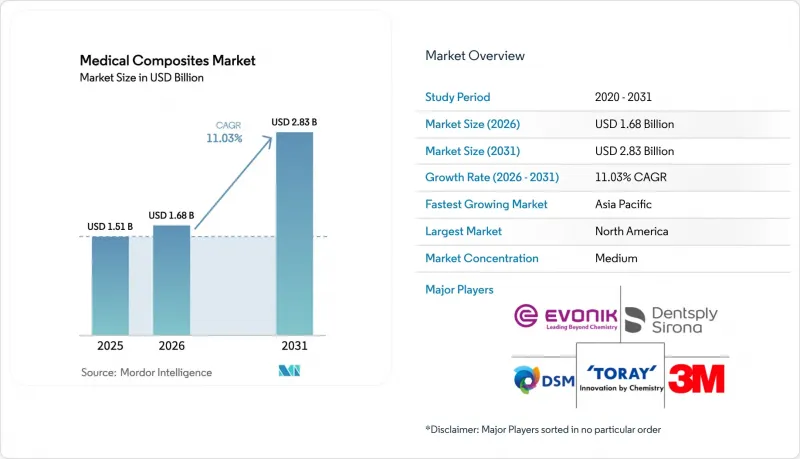
本報告按材料類型(例如,碳纖維增強聚合物、玻璃纖維增強聚合物)、聚合物基體(例如,PEEK、聚丙烯)、纖維類型(例如,碳纖維)、應用(例如,外科器械)和地區(北美、歐洲、亞太、中東和非洲、南美)進行細分。市場預測以美元計價。
全球醫用複合材料市場趨勢與洞察
慢性病負擔迅速加重和人口老化。
由於碳纖維的抗疲勞性能優於鈦,骨科醫生越來越傾向於使用複合材料植入,從而降低了老年患者的再次手術率。人口結構的變化鞏固了長期需求前景,促使供應商擴大產能並擴大適應症範圍。組織工程支架也受益於此,因為臨床醫生開始採用可生物吸收的支架,從而避免了二次取出手術。複合材料製造商正透過調整分解特性和表面化學性質來促進骨整合,以應對這一需求。保險公司在降低再次手術成本的壓力下,進一步強調了複合材料解決方案的有效性,並縮小了醫院的處方範圍,專注於使用經過驗證的耐用材料。因此,即使在整體經濟低迷時期,醫用複合材料市場也能維持穩定的供應。
對輕巧、相容核磁共振成像的設備的需求日益成長
滲透性的複合材料可消除影像偽影,使外科醫生能夠在螢光、CT和MRI檢查室中即時監測植入的位置。較輕的器械可減輕術中疲勞,縮短手術時間,並改善患者預後。醫院正在標準化複合材料成像台和定位系統,以確保不同成像方式的品質一致性。機器人供應商正在採用碳纖維關節來提高運動學精度,同時保持精密驅動單元的負載能力。隨著醫療報銷模式越來越注重效率,醫療機構擴大指定使用與MRI相容的複合材料組件,從而促進了此類組件的部署,並確保了定期更換銷售。
高昂的製造成本和有限的供應鏈深度
醫用級碳纖維價格高昂,因為只有少數製造商能夠滿足 ISO 13485 的文件和純度標準。高壓釜和雷射加工設備的巨額資本投資,為新進業者設定了很高的進入門檻。由於航太需求激增,預浸料供應中斷正在影響整個植入產品線,預計到 2024 年前置作業時間將超過 24 週。原始設備製造商 (OEM) 正在透過纖維來源多元化和投資自建預浸料生產線來應對,但成本持續上漲,阻礙了價格敏感型新興市場的採用。
細分市場分析
到2025年,碳纖維增強複合材料(CFRP)將佔據醫用複合材料市場35.05%的佔有率,鞏固其作為影像床、整形外科鋼板和機械臂組件核心材料的地位。該領域受益於其極高的比強度以及在不影響承載能力的情況下進行減薄的特性。影像設備原始設備製造商(OEM)正在利用CFRP的滲透性來實現無偽影掃描,從而擴大其在醫療保健領域的應用。同時,陶瓷基質複合材料的醫用複合材料市場預計將以11.73%的複合年成長率成長,這主要得益於其促進骨整合的生物活性。研發計畫正在提供將羥磷石灰陶瓷與可吸收聚合物結合的混合結構,這些結構能夠逐漸與宿主組織融合。隨著無壓燒結和微波燒結等製程縮短生產週期,生產成本曲線呈現下降趨勢。雖然混合型和生物基複合材料仍處於早期臨床試驗階段,但其某些特性,例如抗菌效果,已引起臨床關注。
碳纖維增強複合材料(CFRP)供應商正採用自動化纖維鋪放技術來降低廢品率,並確保不同批次產品機械性能的一致性。醫院讚賞CFRP化學惰性帶來的感染風險降低,保險公司也注意到術後審計中再次手術率的下降。陶瓷基質領域的創新者正利用積層製造技術,打造出與每位患者缺損形狀相符的晶格結構,進而縮短手術時間。隨著手術機器人朝向小型化、門診手術系統發展,輕質陶瓷-碳複合材料能夠滿足外科醫生對剛性的需求。這種不斷發展的材料組合,為醫療複合材料市場帶來了強勁的創新動力。
預計到2025年,PEEK將佔41.22%的市場佔有率,其彈性模量與皮質骨相近,因此可減輕植入後的應力遮蔽現象。外科醫師傾向於在脊椎融合手術中使用PEEK椎間融合器,因為術後影像清楚顯示了植入周圍的骨生長。包括PMMA和丙烯酸材料在內的醫用複合材料市場規模預計將以12.95%的複合年成長率成長,這主要得益於牙科和椎體成形術的需求,這些領域對低成本和液體固化性能的要求較高。含銀離子的抗菌PMMA骨水泥正逐步應用於臨床,有助於控制感染。聚丙烯繼續在一些特定應用領域使用,例如導管組件,這些應用需要低成本和耐化學腐蝕性。
基於擠出成型的3D列印技術的進步拓寬了PEEK植入的形狀選擇範圍,使其能夠製造出有利於組織穿透的多孔結構。複合基質材料的研發者正將奈米碳管與PEEK混合以提高導熱性,加速射頻消融探針的生產。創新PMMA研發者們正在探索利用生物活性玻璃微球來實現滲透性和治療性離子的可控釋放。監管機構要求提供關於釋放物的可靠數據,這迫使聚合物化合物製造商仔細改進其添加劑配方。正是由於這種競爭,醫用複合材料市場在不影響安全性的前提下,不斷豐富基質產品種類。
區域分析
預計到2025年,北美將佔據醫療複合材料市場41.10%的佔有率。這得歸功於其健全的保險報銷體係以及3M和史賽克等主要廠商持續的研發投入。美國佔據了該市場的大部分佔有率,這主要歸功於其對技術的早期應用以及擁有標準化複合材料器械托盤的大規模醫院網路。加拿大正利用其單一支付方醫療體系,並投資採購先進的核磁共振相容手術台,以縮短患者的等待時間。墨西哥的加工出口走廊正吸引著尋求成本最佳化且能維持與美國法律規範接近性的醫療設備原始設備製造商(OEM)。聯邦政府對整形外科研究的資助,正推動相關研發項目的持續發展,並鞏固北美在該市場的領先地位。
預計到2031年,亞太地區將以11.98%的複合年成長率實現最高成長,這主要得益於醫療保險覆蓋範圍的擴大、中產階級的崛起以及中印兩國協調一致的產業政策。中國複合材料製造商正受惠於國家對原料進口關稅的優惠政策,不斷提升國內供給能力。日本透過將複合材料應用於外科手術機器人出口,提升了該地區的高科技形象。印度的「2025年國家醫療設備政策」鼓勵碳纖維植入的在地化生產,旨在降低進口依賴。東南亞國家正在投資建造放射治療中心,該地區對碳環氧樹脂患者治療床的指定使用,進一步擴大了該地區對醫用複合材料的需求。
歐洲雖然發展成熟,但仍保持創新活力。嚴格的醫療設備法規(MDR)指導供應商開發具有可追溯性的高品質複合材料產品線。德國在應用工程領域處於領先地位,將智慧感測器整合到脊椎棒中,用於術後監測。英國的「彈射器」(Catapult)網路支援中小企業測試符合英國國家醫療服務系統(NHS)碳足跡要求的可回收熱塑性複合材料。法國正在試驗一項醫院一次性複合材料醫療設備回收計劃,收集對未來放鬆管制至關重要的生命週期數據。義大利Lombardia的叢集正在擴大其高壓釜產能,並向歐盟出口整形外科鋼板。透過這些合作努力,即使在經濟成長放緩的情況下,歐洲仍然在技術進步中發揮著至關重要的作用。
其他好處:
- Excel格式的市場預測(ME)表
- 3個月的分析師支持
目錄
第1章:引言
- 研究假設和市場定義
- 調查範圍
第2章:調查方法
第3章執行摘要
第4章 市場狀況
- 市場概覽
- 市場促進因素
- 慢性病負擔迅速加重和人口老化。
- 對輕巧、相容核磁共振成像的工具的需求日益成長
- 微創手術和機器人手術設備的進步
- 機器人輔助多設備的快速普及
- 碳纖維PEEK植入獲得監管部門快速批准
- 診斷影像基礎設施的擴建
- 市場限制因素
- 生產成本高且供應鏈深度不足
- 獲得多個地區嚴格監管機構的批准
- 複合材料裝置報廢階段的回收挑戰
- 加工和滅菌的複雜性
- 波特五力分析
第5章 市場規模與成長預測
- 材料類型
- 碳纖維增強塑膠(CFRP)
- 玻璃纖維增強塑膠(GFRP)
- 陶瓷基質複合材料
- 其他材料
- 通過聚合物基質
- PEEK
- 聚丙烯(PP)
- PMMA和丙烯酸酯類
- 其他
- 依纖維類型
- 碳纖維
- 玻璃纖維
- 芳香聚醯胺和其他高性能纖維
- 透過使用
- 手術器械
- 診斷影像組件
- 整形外科植入
- 牙科植體
- 組織工程支架
- 其他用途
- 按地區
- 北美洲
- 美國
- 加拿大
- 墨西哥
- 歐洲
- 德國
- 英國
- 法國
- 義大利
- 西班牙
- 其他歐洲國家
- 亞太地區
- 中國
- 日本
- 印度
- 澳洲
- 韓國
- 其他亞太國家
- 中東和非洲
- GCC
- 南非
- 其他中東和非洲國家
- 南美洲
- 巴西
- 阿根廷
- 其他南美國家
- 北美洲
第6章 競爭情勢
- 市場集中度
- 市佔率分析
- 公司簡介
- 3M
- Toray Industries Inc.
- Victrex plc(Invibio)
- DSM-Firmenich
- CeramTec GmbH
- SGL Carbon
- Evonik Industries AG
- Dentsply Sirona
- Solvay
- Kulzer GmbH
- Composiflex
- Mitsubishi Chemical Group(MCAM)
- Icotec AG
- Rochling Group
- Zeus Industrial Products
- Trelleborg AB
- Ensinger GmbH
- Hexcel Corporation
- Arkema SA
- Avient Corporation
- LANXESS AG
第7章 市場機會與未來展望
According to Mordor Intelligence, medical composites market size in 2026 is estimated at USD 1.68 billion, growing from 2025 value of USD 1.51 billion with 2031 projections showing USD 2.83 billion, growing at 11.03% CAGR over 2026-2031.
This report is Segmented by Material Type (Carbon Fiber Reinforced Polymer, Glass Fiber Reinforced Polymer, and More), Polymer Matrix (PEEK, Polypropylene, and More), Fibre Type (Carbon Fibre, and More), Application (Surgical Instruments, and More), and Geography (North America, Europe, Asia-Pacific, Middle East & Africa, South America). The Market Forecasts are Provided in Terms of Value (USD).
Global Medical Composites Market Trends and Insights
Surging Chronic Disease Burden & Aging Population
Orthopedic surgeons increasingly prefer composite implants because carbon fiber's fatigue resistance outperforms titanium, lowering revision rates for elderly patients. The demographic surge strengthens long-term demand visibility, encouraging suppliers to scale capacity and pursue wider indications. Tissue engineering scaffolds benefit as clinicians adopt bio-resorbable lattices that obviate secondary removal surgeries. Composite producers respond by tailoring degradation profiles and surface chemistries that promote osteointegration. Insurance payors, under pressure to cut re-operation costs, further validate composite solutions, tightening hospital formularies around proven, durable materials. Consequently, the medical composites market registers steady procurement even during broader economic slowdowns.
Growing Demand for Lightweight, MRI-Compatible Tools
Radiolucent composites remove image artifacts, letting surgeons monitor implant placement in real time across fluoroscopy, CT, and MRI suites. Lower instrument weight reduces intra-operative fatigue, trimming procedure times and enhancing patient outcomes. Hospitals standardize composite imaging tables and positioning systems to guarantee uniform quality across modalities. Robotics vendors adopt carbon-fiber joints to sharpen kinematic accuracy while keeping payloads manageable for precision drive units. As reimbursement models reward efficiency, healthcare providers increasingly specify MRI-compatible composite sets, widening the installed base and locking in recurring replacement sales.
High Production Costs & Limited Supply Chain Depth
Medical-grade carbon fiber commands a premium because only a handful of producers meet ISO 13485 documentation and purity thresholds. Autoclave and laser-machining assets involve high capital outlays, raising entry barriers for new entrants. Disruptions in precursor supply ripple across implant lines, with lead times stretching past 24 weeks during 2024 aerospace demand spikes. OEMs mitigate by dual-sourcing fibers and investing in in-house prepreg lines, yet cost pass-throughs persist, restraining adoption in price-sensitive emerging markets.
Other drivers and restraints analyzed in the detailed report include:
- Advancements in Minimally Invasive & Robotic Surgery Devices
- Rapid Adoption of Robot-Assisted Composite Instruments
- Stringent Multi-Region Regulatory Approvals
For complete list of drivers and restraints, kindly check the Table Of Contents.
Segment Analysis
CFRP commanded 35.05% of the medical composites market in 2025, substantiating its role as the backbone of imaging tables, orthopedic plates, and robotic arm components. The segment benefits from unmatched strength-to-weight ratios that allow thinner profiles without sacrificing load tolerance. Imaging OEMs capitalize on CFRP's radiolucency to achieve artifact-free scans, widening its institutional footprint. Meanwhile, the medical composites market size for ceramic matrix composites is projected to advance at a 11.73% CAGR, propelled by bioactivity that accelerates osteointegration. Development programs pair hydroxyapatite-infused ceramics with resorbable polymers, offering hybrid constructs that knit gradually with host tissue. Production cost curves trend downward as pressureless sintering and microwave sintering reduce cycle times. Hybrid and bio-based composites linger in early-stage trials, yet targeted properties such as antimicrobial efficacy attract clinical attention.
CFRP suppliers deploy automated fiber placement to curtail scrap rates and drive consistent mechanical performance batch-to-batch. Hospitals value the reduced infection risk linked to CFRP's chemical inertness, while insurers flag lower re-operation incidence in postoperative audits. Ceramic matrix innovators leverage additive manufacturing to print lattice structures that match patient-specific defect geometries, shortening operating room time. As surgical robotics shifts toward smaller, outpatient-compatible systems, lightweight ceramic-carbon hybrids offer the stiffness surgeons expect. This evolving material mix ensures the medical composites market retains a robust innovation funnel.
PEEK held 41.22% share in 2025, its elastic modulus mirroring cortical bone and thereby mitigating stress-shielding after implantation. Surgeons prefer PEEK cages for spinal fusion because post-operative imaging clearly distinguishes bone growth around the implant. The medical composites market size expansion for PMMA & acrylics, set for 12.95% CAGR, rests on dental and vertebroplasty demand where low cost and flowable curing matter. Antimicrobial PMMA bone cements containing silver ions are clearing clinical pathways, aiding infection control. Polypropylene retains niche use in catheter components needing chemical resistance at low budgets.
Advances in extrusion-based 3D printing broaden PEEK implant geometries, supporting porous architectures that invite tissue in-growth. Composite matrix developers now blend PEEK with carbon nanotubes to elevate thermal conductivity, facilitating RF ablation probes. PMMA innovators experiment with bioactive glass microspheres to couple radiopacity with controlled elution of therapeutic ions. Regulatory bodies call for robust leachables data, pushing polymer formulators to refine additive packages carefully. The resulting competition ensures that the medical composites market continues to diversify matrix offerings without compromising safety.
Complete Report Scope:
- By Material Type
- Carbon Fiber Reinforced Polymer (CFRP)
- Glass Fiber Reinforced Polymer (GFRP)
- Ceramic Matrix Composites
- Other Materials
- By Polymer Matrix
- PEEK
- Polypropylene (PP)
- PMMA & Acrylics
- Others
- By Fibre Type
- Carbon Fibre
- Glass Fibre
- Aramid & Other High-Performance Fibres
- By Application
- Surgical Instruments
- Diagnostic Imaging Components
- Orthopedic Implants
- Dental Implants
- Tissue Engineering Scaffolds
- Other Applications
- By Geography
- North America
- United States
- Canada
- Mexico
- Europe
- Germany
- United Kingdom
- France
- Italy
- Spain
- Rest of Europe
- Asia-Pacific
- China
- Japan
- India
- Australia
- South Korea
- Rest of Asia-Pacific
- Middle East & Africa
- GCC
- South Africa
- Rest of Middle East & Africa
- South America
- Brazil
- Argentina
- Rest of South America
- North America
Geography Analysis
North America secured 41.10% of the medical composites market in 2025, underpinned by a robust reimbursement ecosystem and continuous R&D investments from players such as 3M and Stryker. The United States accounts for the lion's share, coupling early technology adoption with large-scale hospital networks that standardize composite instrument trays. Canada, leveraging its single-payer system, funds procurement of advanced MRI-compatible tables to cut wait times. Mexico's maquiladora corridor attracts device OEMs seeking cost-optimized composite component production while remaining proximate to US regulatory oversight. Federal funding for orthopedic research sustains pipeline momentum, preserving North American leadership.
Asia-Pacific registers the fastest 11.98% CAGR through 2031, a testament to expanded health insurance coverage, burgeoning middle-class demand, and concerted industrial policies in China and India. Chinese composite producers benefit from state incentives that lower precursor import tariffs, boosting domestic supply capacity. Japan integrates composites into surgical robotic exports, reinforcing the region's high-tech image. India's National Medical Devices Policy 2025 encourages local manufacture of carbon-fiber implants, targeting reduced import dependencies. Southeast Asian nations invest in radiotherapy centers, each specifying carbon-epoxy patient couches, further swelling regional uptake across the medical composites market.
Europe retains a mature yet innovative profile, with stringent MDR rules nudging suppliers toward traceable, high-quality composite lines. Germany spearheads application engineering, embedding smart sensors into spinal rods for postoperative monitoring. The United Kingdom's Catapult network supports SME trials of recyclable thermoplastic composites, aligning with National Health Service carbon-footprint mandates. France pilots hospital take-back programs for single-use composite devices, collecting lifecycle data critical to future regulatory relief. Italy's Lombardy cluster ramps autoclave capacity, exporting orthopedic plates across the EU. Such coordinated initiatives keep Europe integral to technological progress even as growth moderates.
- 3M
- Toray Industries
- Victrex plc (Invibio)
- DSM-Firmenich
- CeramTec GmbH
- SGL Carbon
- Evonik Industries
- Dentsply Sirona
- Solvay
- Kulzer
- Composiflex
- Mitsubishi Chemical Group (MCAM)
- Icotec AG
- Rochling Group
- Zeus Industrial Products
- Trelleborg AB
- Ensinger GmbH
- Hexcel Corporation
- Arkema SA
- Avient Corporation
- LANXESS AG
Additional Benefits:
- The market estimate (ME) sheet in Excel format
- 3 months of analyst support
TABLE OF CONTENTS
1 Introduction
- 1.1 Study Assumptions & Market Definition
- 1.2 Scope of the Study
2 Research Methodology
3 Executive Summary
4 Market Landscape
- 4.1 Market Overview
- 4.2 Market Drivers
- 4.2.1 Surging Chronic Disease Burden & Aging Population
- 4.2.2 Growing Demand for Lightweight, MRI-Compatible Tools
- 4.2.3 Advancements in Minimally-Invasive & Robotic Surgery Devices
- 4.2.4 Rapid Adoption of Robot-Assisted Composite Instruments
- 4.2.5 Regulatory Fast-Track for Carbon-Fiber PEEK Implants
- 4.2.6 Expansion of Diagnostic Imaging Infrastructure
- 4.3 Market Restraints
- 4.3.1 High Production Costs & Limited Supply Chain Depth
- 4.3.2 Stringent Multi-Region Regulatory Approvals
- 4.3.3 End-of-Life Recycling Challenges for Composite Devices
- 4.3.4 Machining & Sterilization Complexity
- 4.4 Porter's Five Forces Analysis
- 4.4.1 Threat of New Entrants
- 4.4.2 Bargaining Power of Buyers
- 4.4.3 Bargaining Power of Suppliers
- 4.4.4 Threat of Substitutes
- 4.4.5 Intensity of Competitive Rivalry
5 Market Size & Growth Forecasts (Value in USD)
- 5.1 By Material Type
- 5.1.1 Carbon Fiber Reinforced Polymer (CFRP)
- 5.1.2 Glass Fiber Reinforced Polymer (GFRP)
- 5.1.3 Ceramic Matrix Composites
- 5.1.4 Other Materials
- 5.2 By Polymer Matrix
- 5.2.1 PEEK
- 5.2.2 Polypropylene (PP)
- 5.2.3 PMMA & Acrylics
- 5.2.4 Others
- 5.3 By Fibre Type
- 5.3.1 Carbon Fibre
- 5.3.2 Glass Fibre
- 5.3.3 Aramid & Other High-Performance Fibres
- 5.4 By Application
- 5.4.1 Surgical Instruments
- 5.4.2 Diagnostic Imaging Components
- 5.4.3 Orthopedic Implants
- 5.4.4 Dental Implants
- 5.4.5 Tissue Engineering Scaffolds
- 5.4.6 Other Applications
- 5.5 By Geography
- 5.5.1 North America
- 5.5.1.1 United States
- 5.5.1.2 Canada
- 5.5.1.3 Mexico
- 5.5.2 Europe
- 5.5.2.1 Germany
- 5.5.2.2 United Kingdom
- 5.5.2.3 France
- 5.5.2.4 Italy
- 5.5.2.5 Spain
- 5.5.2.6 Rest of Europe
- 5.5.3 Asia-Pacific
- 5.5.3.1 China
- 5.5.3.2 Japan
- 5.5.3.3 India
- 5.5.3.4 Australia
- 5.5.3.5 South Korea
- 5.5.3.6 Rest of Asia-Pacific
- 5.5.4 Middle East & Africa
- 5.5.4.1 GCC
- 5.5.4.2 South Africa
- 5.5.4.3 Rest of Middle East & Africa
- 5.5.5 South America
- 5.5.5.1 Brazil
- 5.5.5.2 Argentina
- 5.5.5.3 Rest of South America
- 5.5.1 North America
6 Competitive Landscape
- 6.1 Market Concentration
- 6.2 Market Share Analysis
- 6.3 Company Profiles (includes Global level Overview, Market level overview, Core Segments, Financials as available, Strategic Information, Market Rank/Share for key companies, Products & Services, and Recent Developments)
- 6.3.1 3M
- 6.3.2 Toray Industries Inc.
- 6.3.3 Victrex plc (Invibio)
- 6.3.4 DSM-Firmenich
- 6.3.5 CeramTec GmbH
- 6.3.6 SGL Carbon
- 6.3.7 Evonik Industries AG
- 6.3.8 Dentsply Sirona
- 6.3.9 Solvay
- 6.3.10 Kulzer GmbH
- 6.3.11 Composiflex
- 6.3.12 Mitsubishi Chemical Group (MCAM)
- 6.3.13 Icotec AG
- 6.3.14 Rochling Group
- 6.3.15 Zeus Industrial Products
- 6.3.16 Trelleborg AB
- 6.3.17 Ensinger GmbH
- 6.3.18 Hexcel Corporation
- 6.3.19 Arkema SA
- 6.3.20 Avient Corporation
- 6.3.21 LANXESS AG
7 Market Opportunities & Future Outlook
- 7.1 White-space & Unmet-Need Assessment

 人工生物材料:在醫療領域的潛力:市場與技術(2027-2047)
 醫用複合材料市場-2026-2032年全球市場預測醫療工程材料市場-全球市場預測(2026-2032年)
 醫用複合材料市場:按類型、應用和地區分類(2026-2034 年)
 醫用工程材料市場:按產品類型、應用、最終用戶和地區分類醫用複合材料市場:依纖維類型、應用和地區分類
 自修復醫用材料:市場與技術(2026-2046)
 2026年全球醫用工程材料市場報告2026年全球醫用複合材料市場報告
 全球醫用複合材料市場規模、佔有率、趨勢和成長分析報告(2026-2034年)