


 |
市場調查報告書
商品編碼
2119628
住宅暖通空調:市場佔有率分析、產業趨勢與統計、成長預測(2026-2031)Residential HVAC - Market Share Analysis, Industry Trends & Statistics, Growth Forecasts (2026 - 2031) |
||||||

※ 本網頁內容可能與最新版本有所差異。詳細情況請與我們聯繫。
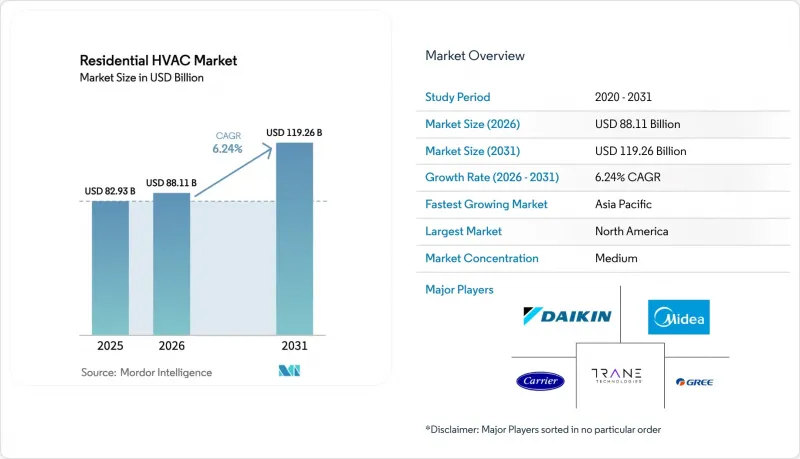
根據 Mordor Intelligence 預測,住宅HVAC 市場規模將從 2025 年的 829.3 億美元成長到 2026 年的 881.1 億美元,然後在 2031 年達到 1192.6 億美元,2026 年至 2031 年的複合年成長率為 6.24%。
本報告按設備(冷媒和通風設備、暖氣設備)、技術(傳統冷媒、低全球暖化潛勢冷媒等)、安裝類型(新建、維修/更換)、住宅類型(獨棟住宅、多用戶住宅/公寓大樓)和地區進行分類。市場預測以美元計價。
全球住宅暖通空調市場趨勢及洞察
強制性脫碳將加速電熱泵的普及。
聯邦稅收優惠和州級建築規範正推動熱泵走向主流住宅應用。加州2024年第24號法規的要求以及華盛頓州14,000美元的補貼顯著縮短了消費者的投資回收期,而《通貨膨脹控制法案》提供的30%稅額扣抵則可抵消高達60%的初始成本。技術進步使得熱泵能夠在低至-20°F(約-29°C)的溫度下運作,從而得以在以往傳統燃氣暖氣爐佔據主導地位的北方市場推廣。跨州採購聯盟正在整合需求,降低單位成本。聯邦、州和公用事業項目的結合,建構了一個多層次的獎勵體系,使得熱泵在生命週期成本方面能夠與燃氣暖氣爐相媲美,即使在天然氣價格仍然較低的地區也是如此。製造商正在擴大寒冷氣候壓縮機的生產規模,以掌握不斷成長的住宅暖通空調市場機會。
過渡到變頻驅動變速壓縮機
變頻壓縮機正從利基產品走向主流產品,為住宅暖通空調市場下一輪能源效率提升奠定了基礎。大金和科普蘭的合資企業正瞄準北美地區的熱泵應用市場,而倫諾克斯的SL22KLV憑藉其寬範圍的容量調節功能,實現了21.1 SEER²的能源效率比。 25%至100%的輸出調節範圍可減少循環損耗,改善濕度控制,並與單級機組相比,降低20%至30%的能耗。中國供應全球95%以上的壓縮機產量,這使得OEM製造商能夠透過早期採用該技術獲得成本優勢。電力公司重視能夠即時調節需求的設備,這有助於透過新興的需量反應市場提高住宅的收益。
冷媒法規的變化和分階段減量計劃
美國環保署(EPA)的技術過渡計畫要求原始設備製造商(OEM)和承包商同時管理兩種冷媒的庫存,並遵守A2L安全協議。歐盟F-gas法規的差異增加了複雜性,根據AHRI認證流程,產品上市可能會延遲長達12個月。改用R-32或R-454B冷媒會產生500至1000美元的單機合規成本,其中包括洩漏檢測設備和技術人員訓練費用。過渡期的不確定性推高了消費價格,加劇了供應鏈緊張,並抑制了初期需求。
細分市場分析
2025年,空調和通風設備產業佔總銷售額的60.12%。新興經濟體的快速都市化、氣候變遷趨勢以及中產階級收入的成長正在推動空調普及率的持續上升。隨著變冷劑流量(VRF)和無管道迷你分離式空調系統在獨戶房屋住宅住宅和多用戶住宅項目中的普及,預計到2031年,住宅暖通空調(HVAC)市場中空調設備的市場規模將以6.98%的複合年成長率成長。屋頂式和整體式空調系統仍然是小眾市場,但由於集中維護具有成本優勢,它們正被應用於預製房屋和低層多用戶住宅。在強制性脫碳政策的推動下,暖氣設備的需求正在結構性轉變,轉向電熱泵。寒冷氣候型號現在能夠應對零度以下的溫度,這縮小了傳統燃氣加熱器的目標市場。在天然氣基礎設施完善的地區,燃氣加熱器仍然主導著替換市場。然而,結合熱泵和燃氣加熱器的混合系統正在成為一種過渡性解決方案,既能保持耐用性,又能滿足能源效率標準。
暖氣設備產業的快速轉型與協同電氣化政策直接相關。聯邦補貼使中檔熱泵和燃氣熱水器的初始投資成本趨於一致,加速了住宅暖通空調市場佔有率的轉移。原始設備製造商預計五年內成本將趨於一致,並正將研發資源從冷凝式燃氣技術重新分配到變頻驅動熱泵平台。下一代水循環式和強制送風式熱泵整合的併網功能進一步提升了這些產品的差異化優勢,透過需求調節計劃創造永續的收入來源,並在初始設備利潤之外創造附加價值。
傳統的R410A和較老的R22冷凍機組仍佔已安裝總量的69.85%,但由於監管限制了生產和進口,供應日益緊張,服務成本不斷上升。由此導致的供不應求加速了老舊系統的提前更換,而更換需求正轉向全球暖化潛勢(GWP)更低的替代冷媒。 R32的GWP值比R22低68%,製造商只需對現有生產線進行少量硬體改動即可使用,從而實現更平穩的過渡並降低材料清單(BOM)成本。 R454B雖然需要額外的處理要求,但其GWP值較低,更符合住宅暖通空調市場的長期合規要求。
預計到2031年,低全球暖化潛勢(GWP)冷媒系統的複合年成長率將達到7.32%。原始設備製造商(OEM)透過將這些冷媒與變頻驅動裝置、智慧診斷和雲端連接控制系統結合,提高了單機收入。改進的密封技術和更小的充注量正在降低易燃性風險。隨著恆速壓縮機的減少,變速壓縮機的普及提高了平均售價,同時降低了整體生命週期運行成本,既滿足了監管要求,也符合住宅的經濟需求。
區域分析
預計到2025年,北美將佔全球銷售額的37.55%。受《通貨膨脹控制法案》的聯邦獎勵以及各州補貼的影響,截至2024年11月,美國熱泵銷量成長了15%。加拿大的聯邦計畫為每台安裝設備提供高達5,000加元(約3,700美元)的補貼,加上各州的額外補貼,補貼總額可能會翻倍。預計到2024年,墨西哥的暖通空調出口額將達到76億美元,凸顯了該地區供應鏈的整合程度。儘管單戶住宅的更換需求仍然強勁,但由於建築性能標準的日益嚴格,多用戶住宅的電氣化進程正在加速。
亞太地區是成長最快的地區,預計到2031年複合年成長率將達到6.82%。中國約佔全球熱泵裝置量的30%,並控制超過95%的壓縮機產能,使其能夠採取更具競爭力的價格策略並快速改進產品。在印度,中產階級的崛起和日益嚴重的都市區熱島效應正在推動空調貨量的成長,而政府能源效率局的相關法規也正在加速新型變頻器的普及應用。在日本,隨著疫情造成的訂單停滯得到控制,預計到2024年底,更換市場將恢復到5%的成長率。
歐洲正經歷短期動盪。天然氣價格低迷和建築業放緩導致2024年上半年德國熱泵銷售量下降50%。然而,隨著REPowerEU計劃在2027年新增1,000萬住宅熱泵,並提供3,000至15,000歐元的津貼,預計從2025年起,熱泵銷量將恢復兩位數成長。該地區的維修潛力依然巨大,因為近四分之三的建築是在現代能源效率標準訂定之前建造的。
在中東和非洲,空調需求旺盛,但電費補貼政策減緩了高效率節能空調的普及。然而,海灣合作理事會(GCC)成員國的電力公司正在試點針對高能效比(SEER)產品的補貼計劃,以減輕高峰期電網負荷,這表明高階空調產品在住宅暖通空調(HVAC)市場具有未來成長潛力。
其他好處:
- Excel格式的市場預測(ME)表
- 3個月的分析師支持
目錄
第1章:引言
- 研究假設和市場定義
- 調查範圍
第2章:調查方法
第3章執行摘要
第4章 市場狀況
- 市場概覽
- 市場促進因素
- 強制性脫碳政策正在加速電熱泵的普及應用。
- 過渡到變頻驅動變速壓縮機
- 疫情後住宅維修整修週期激增
- 智慧恆溫器和物聯網暖通空調控制設備的廣泛應用
- 電力公司對併網高效節能建築(GEB)的獎勵
- 家庭電氣化資金籌措模式(PACE,建築內電氣化)正變得越來越普遍。
- 市場限制因素
- 冷媒法規的變化和分階段減量計劃
- 高效率設備的初始成本溢價
- 缺乏技術純熟勞工進行正確的安裝和試運行。
- 對現有住宅存量電氣設備維修的限制
- 產業價值鏈分析
- 監理情勢
- 技術展望
- 波特五力分析
- 宏觀經濟因素的影響
- 投資分析
第5章 市場規模與成長預測
- 透過裝置
- 冷凍和通風設備
- 風管分離系統
- 無管道分離式空調系統
- VRF系統
- 空調機組
- 屋頂空調和風機盤管機組
- 加熱設備
- 熱風加熱器和鍋爐
- 熱泵
- 冷凍和通風設備
- 透過技術
- 傳統型(R410A/R22)
- 低全球暖化潛勢冷媒(R32、R454B、二氧化碳、丙烷)
- 恆速型
- 變頻/變速
- 智慧/互聯
- 按安裝類型
- 新建工程
- 維修/更換
- 按住宅類型
- 獨立式住宅
- 多用戶住宅和公寓
- 按地區
- 北美洲
- 美國
- 加拿大
- 墨西哥
- 南美洲
- 巴西
- 阿根廷
- 其他南美國家
- 歐洲
- 英國
- 德國
- 法國
- 義大利
- 西班牙
- 北歐的
- 比荷盧經濟聯盟
- 東歐
- 俄羅斯
- 其他歐洲國家
- 亞太地區
- 中國
- 日本
- 印度
- 韓國
- 澳洲和紐西蘭
- ASEAN
- 其他亞太國家
- 中東和非洲
- 中東
- 沙烏地阿拉伯
- 阿拉伯聯合大公國
- 土耳其
- 其他中東國家
- 非洲
- 南非
- 奈及利亞
- 其他非洲國家
- 中東
- 北美洲
第6章 競爭情勢
- 市場集中度
- 策略趨勢
- 市佔率分析
- 公司簡介
- Daikin Industries, Ltd.
- Carrier Global Corporation
- Trane Technologies plc
- Lennox International Inc.
- Johnson Controls International plc
- Robert Bosch GmbH
- Mitsubishi Electric Corporation
- Systemair AB
- TROX GmbH
- Hitachi, Ltd.
- Blue Star Limited
- Swegon AB
- Ariston Holding NV
- Danfoss A/S
- Alfa Laval AB
- Vaillant GmbH
- Rheem Manufacturing Company
- Samsung Electronics Co., Ltd.
- LG Electronics Inc.
- Panasonic Holdings Corporation
- Fujitsu General Limited
- Gree Electric Appliances, Inc.
- Midea Group Co., Ltd.
- Nortek Global HVAC, LLC
- Viessmann Climate Solutions SE
- Glen Dimplex Group
第7章 市場機會與未來展望
According to Mordor Intelligence, the residential HVAC market size is expected to grow from USD 82.93 billion in 2025 to USD 88.11 billion in 2026 and is forecast to reach USD 119.26 billion by 2031 at 6.24% CAGR over 2026-2031.
This report is Segmented by Equipment (Cooling and Ventilation Equipment and Heating Equipment), Technology (Conventional, Low-GWP Refrigerants, and More), Installation Type (New Construction and Retrofit and Replacement), Housing Type (Single-Family Homes and Multi-Family Apartments and Condominiums), and Geography. The Market Forecasts are Provided in Terms of Value (USD).
Global Residential HVAC Market Trends and Insights
Decarbonization Mandates Accelerating Electric-Heat-Pump Adoption
Federal tax incentives and state-level building codes are pushing heat pumps into mainstream residential applications. California's 2024 Title 24 requirements and Washington's USD 14,000 rebates have slashed consumer payback periods, while the Inflation Reduction Act's 30% credit offsets up-front costs by as much as 60%. Technology enhancements now enable operation down to -20 °F, allowing deployment in historically furnace-dominant northern markets. Multi-state procurement coalitions aggregate demand, reducing per-unit manufacturing costs. Combined federal, state, and utility programs create a layered incentive stack that positions heat pumps as lifecycle-cost-competitive with gas furnaces even where natural-gas tariffs remain low. Manufacturers are scaling cold-climate compressors to capture this expanding residential HVAC market opportunity.
Shift Toward Inverter-Driven Variable-Speed Compressors
Variable-speed compressors have migrated from premium to mainstream status, underpinning the next wave of efficiency gains in the residential HVAC market. Daikin's joint venture with Copeland targets North American heat-pump applications, while Lennox's SL22KLV achieves a 21.1 SEER2 rating through wide-range capacity modulation. Modulation between 25-100% reduces cycling losses, improves humidity control, and cuts energy use by 20-30% compared with single-stage units. China supplies more than 95% of global compressor output, granting OEMs early-access cost advantages. Utilities value equipment that can throttle demand in real time, enhancing homeowner earnings via emerging demand-response markets.
Volatility in Refrigerant Regulations and Phasedown Schedules
EPA Technology Transition timelines require OEMs and contractors to juggle dual refrigerant inventories while navigating A2L safety protocols. Divergent EU F-Gas rules amplify complexity, delaying product launches by up to 12 months under AHRI certification processes. The switch to R 32 or R 454B drives unit-level compliance costs of USD 500-1,000 for leak-detection hardware and technician training. Transitional uncertainty inflates consumer prices and strains supply chains, slowing early-cycle demand.
Other drivers and restraints analyzed in the detailed report include:
- Surge in Home-Improvement and Retrofit Cycles Post-Pandemic
- Growing Penetration of Smart Thermostats and IoT-Enabled HVAC Controls
- Up-Front Cost Premium of High-Efficiency Equipment
For complete list of drivers and restraints, kindly check the Table Of Contents.
Segment Analysis
Cooling and ventilation captured 60.12% of 2025 revenue. Strong urbanization, warmer climate trends, and rising middle-class incomes in emerging economies continue to lift air-conditioning adoption. The residential HVAC market size for cooling equipment is projected to expand at a 6.98% CAGR through 2031 as variable-refrigerant flow and ductless mini-split platforms penetrate single-family retrofits and multi-family projects. Rooftop and packaged systems remain niche but serve manufactured housing and low-rise multi-family complexes where centralized maintenance offers cost advantages. Heating-equipment demand is undergoing a structural shift toward electric heat pumps, reinforced by decarbonization mandates. Cold-climate models now handle sub-zero temperatures, shrinking the addressable market for legacy gas furnaces. Furnaces still dominate replacement sales in regions with entrenched natural-gas infrastructure, but hybrid heat-pump/furnace installations are emerging as transitional solutions to meet efficiency codes while maintaining resilience.
The heating segment's rapid transformation is directly tied to electrification policy stacking. Federal rebates equalize capital outlays between mid-tier heat pumps and gas furnaces, accelerating the share shift within the residential HVAC market. OEMs are reallocating R&D resources from condensing gas technology toward inverter-driven heat-pump platforms, anticipating cost parity within five years. Grid-interactive capabilities embedded in next-generation hydronic and forced-air heat pumps further differentiate these products, opening recurring revenue streams via demand-flexibility programs and extending value beyond upfront equipment margins.
Conventional R 410A and legacy R 22 units still represent 69.85% of the installed base, yet regulatory caps on production and imports are tightening supply and inflating service costs. The resulting scarcity is propelling accelerated retirement of aging systems, shifting replacement demand toward low-GWP alternatives. R 32's 68% lower global-warming potential allows manufacturers to leverage existing production lines with minimal hardware changes, supporting smoother transitions and lighter bill-of-materials. R 454B introduces additional handling requirements but offers even lower GWP, aligning long-term compliance paths in the residential HVAC market.
Low-GWP refrigerant systems are forecast to post a 7.32% CAGR through 2031. OEMs are bundling these refrigerants with inverter drives, smart diagnostics, and cloud-integrated controls, elevating per-unit revenue. Enhanced sealing technology and lower charge volumes mitigate flammability concerns. As fixed-speed compressors decline, variable-speed adoption lifts average selling prices yet reduces lifecycle operational costs, dovetailing with both regulatory and homeowner economic priorities.
Complete Report Scope:
- By Equipment
- Cooling and Ventilation Equipment
- Ducted Split Systems
- Ductless Split Systems
- VRF Systems
- Air-Handling Units
- Rooftops and Fan-Coils
- Heating Equipment
- Furnaces and Boilers
- Heat Pumps
- Cooling and Ventilation Equipment
- By Technology
- Conventional (R410A/R22)
- Low-GWP Refrigerants (R32, R454B, CO2, Propane)
- Fixed-speed
- Inverter / Variable-speed
- Smart / Connected
- By Installation Type
- New Construction
- Retrofit / Replacement
- By Housing Type
- Single-family Homes
- Multi-family Apartments and Condominiums
- By Geography
- North America
- United States
- Canada
- Mexico
- South America
- Brazil
- Argentina
- Rest of South America
- Europe
- United Kingdom
- Germany
- France
- Italy
- Spain
- Nordics
- Benelux
- Eastern Europe
- Russia
- Rest of Europe
- Asia Pacific
- China
- Japan
- India
- South Korea
- Australia and New Zealand
- ASEAN
- Rest of Asia Pacific
- Middle East and Africa
- Middle East
- Saudi Arabia
- United Arab Emirates
- Turkey
- Rest of Middle East
- Africa
- South Africa
- Nigeria
- Rest of Africa
- Middle East
- North America
Geography Analysis
North America represented 37.55% of 2025 global revenue. Federal incentives under the Inflation Reduction Act, combined with state rebates, drove a 15% surge in U.S. heat-pump sales by November 2024. Canadian federal programs provide up to CAD 5,000 (USD 3,700) per installation, while provincial add-ons can double total rebate values. Mexico's HVAC export output reached USD 7.6 billion in 2024, underscoring the region's supply-chain integration. Single-family replacement demand remains vigorous, but multi-family electrification is accelerating as building performance standards tighten.
Asia Pacific is the fastest-growing region with a 6.82% CAGR through 2031. China accounts for roughly 30% of global heat-pump installations and controls more than 95% of compressor production capacity, enabling aggressive pricing and rapid product iterations. India's rising middle-class and blistering urban heat islands propel air-conditioning shipments, while governmental Bureau of Energy Efficiency regulations drive new inverter adoption. Japan's 2024 replacement market returned to 5% growth by year-end as pandemic backlogs cleared.
Europe faces near-term turbulence. Low natural-gas prices and construction slowdowns slashed first-half 2024 heat-pump sales by 50% in Germany. Yet REPowerEU's target of 10 million additional residential heat pumps by 2027, supported by grants of EUR 3,000-15,000, is poised to restore double-digit growth from 2025 onward. The region's retrofit potential remains vast as nearly three-quarters of building stock predates modern efficiency codes.
The Middle East and Africa exhibit cooling-dominant demand yet slower penetration of high-efficiency models due to subsidized electricity tariffs. Nevertheless, Gulf Cooperation Council utilities are piloting high-SEER rebate schemes to curb peak-season grid stress, signaling future upside for premium cooling products in the residential HVAC market.
- Daikin Industries, Ltd.
- Carrier Global Corporation
- Trane Technologies plc
- Lennox International Inc.
- Johnson Controls International plc
- Robert Bosch GmbH
- Mitsubishi Electric Corporation
- Systemair AB
- TROX GmbH
- Hitachi, Ltd.
- Blue Star Limited
- Swegon AB
- Ariston Holding NV
- Danfoss A/S
- Alfa Laval AB
- Vaillant GmbH
- Rheem Manufacturing Company
- Samsung Electronics Co., Ltd.
- LG Electronics Inc.
- Panasonic Holdings Corporation
- Fujitsu General Limited
- Gree Electric Appliances, Inc.
- Midea Group Co., Ltd.
- Nortek Global HVAC, LLC
- Viessmann Climate Solutions SE
- Glen Dimplex Group
Additional Benefits:
- The market estimate (ME) sheet in Excel format
- 3 months of analyst support
TABLE OF CONTENTS
1 INTRODUCTION
- 1.1 Study Assumptions and Market Definition
- 1.2 Scope of the Study
2 RESEARCH METHODOLOGY
3 EXECUTIVE SUMMARY
4 MARKET LANDSCAPE
- 4.1 Market Overview
- 4.2 Market Drivers
- 4.2.1 Decarbonisation mandates accelerating electric-heat-pump adoption
- 4.2.2 Shift toward inverter-driven variable-speed compressors
- 4.2.3 Surge in home-improvement and retrofit cycles post-pandemic
- 4.2.4 Growing penetration of smart thermostats and IoT-enabled HVAC controls
- 4.2.5 Grid-interactive efficient buildings (GEB) incentives from utilities
- 4.2.6 Home electrification financing models (PACE, on-bill) gaining traction
- 4.3 Market Restraints
- 4.3.1 Volatility in refrigerant regulations and phasedown schedules
- 4.3.2 Up-front cost premium of high-efficiency equipment
- 4.3.3 Skilled-labour shortage for proper installation and commissioning
- 4.3.4 Electrical-service upgrade constraints in legacy housing stock
- 4.4 Industry Value Chain Analysis
- 4.5 Regulatory Landscape
- 4.6 Technological Outlook
- 4.7 Porter's Five Forces Analysis
- 4.7.1 Bargaining Power of Suppliers
- 4.7.2 Bargaining Power of Buyers
- 4.7.3 Threat of New Entrants
- 4.7.4 Threat of Substitute Products
- 4.7.5 Intensity of Competitive Rivalry
- 4.8 Impact of Macroeconomic Factors
- 4.9 Investment Analysis
5 MARKET SIZE AND GROWTH FORECASTS (VALUE)
- 5.1 By Equipment
- 5.1.1 Cooling and Ventilation Equipment
- 5.1.1.1 Ducted Split Systems
- 5.1.1.2 Ductless Split Systems
- 5.1.1.3 VRF Systems
- 5.1.1.4 Air-Handling Units
- 5.1.1.5 Rooftops and Fan-Coils
- 5.1.2 Heating Equipment
- 5.1.2.1 Furnaces and Boilers
- 5.1.2.2 Heat Pumps
- 5.1.1 Cooling and Ventilation Equipment
- 5.2 By Technology
- 5.2.1 Conventional (R410A/R22)
- 5.2.2 Low-GWP Refrigerants (R32, R454B, CO2, Propane)
- 5.2.3 Fixed-speed
- 5.2.4 Inverter / Variable-speed
- 5.2.5 Smart / Connected
- 5.3 By Installation Type
- 5.3.1 New Construction
- 5.3.2 Retrofit / Replacement
- 5.4 By Housing Type
- 5.4.1 Single-family Homes
- 5.4.2 Multi-family Apartments and Condominiums
- 5.5 By Geography
- 5.5.1 North America
- 5.5.1.1 United States
- 5.5.1.2 Canada
- 5.5.1.3 Mexico
- 5.5.2 South America
- 5.5.2.1 Brazil
- 5.5.2.2 Argentina
- 5.5.2.3 Rest of South America
- 5.5.3 Europe
- 5.5.3.1 United Kingdom
- 5.5.3.2 Germany
- 5.5.3.3 France
- 5.5.3.4 Italy
- 5.5.3.5 Spain
- 5.5.3.6 Nordics
- 5.5.3.7 Benelux
- 5.5.3.8 Eastern Europe
- 5.5.3.9 Russia
- 5.5.3.10 Rest of Europe
- 5.5.4 Asia Pacific
- 5.5.4.1 China
- 5.5.4.2 Japan
- 5.5.4.3 India
- 5.5.4.4 South Korea
- 5.5.4.5 Australia and New Zealand
- 5.5.4.6 ASEAN
- 5.5.4.7 Rest of Asia Pacific
- 5.5.5 Middle East and Africa
- 5.5.5.1 Middle East
- 5.5.5.1.1 Saudi Arabia
- 5.5.5.1.2 United Arab Emirates
- 5.5.5.1.3 Turkey
- 5.5.5.1.4 Rest of Middle East
- 5.5.5.2 Africa
- 5.5.5.2.1 South Africa
- 5.5.5.2.2 Nigeria
- 5.5.5.2.3 Rest of Africa
- 5.5.5.1 Middle East
- 5.5.1 North America
6 COMPETITIVE LANDSCAPE
- 6.1 Market Concentration
- 6.2 Strategic Moves
- 6.3 Market Share Analysis
- 6.4 Company Profiles (includes Global level Overview, Market level overview, Core Segments, Financials as available, Strategic Information, Market Rank/Share for key companies, Products and Services, and Recent Developments)
- 6.4.1 Daikin Industries, Ltd.
- 6.4.2 Carrier Global Corporation
- 6.4.3 Trane Technologies plc
- 6.4.4 Lennox International Inc.
- 6.4.5 Johnson Controls International plc
- 6.4.6 Robert Bosch GmbH
- 6.4.7 Mitsubishi Electric Corporation
- 6.4.8 Systemair AB
- 6.4.9 TROX GmbH
- 6.4.10 Hitachi, Ltd.
- 6.4.11 Blue Star Limited
- 6.4.12 Swegon AB
- 6.4.13 Ariston Holding NV
- 6.4.14 Danfoss A/S
- 6.4.15 Alfa Laval AB
- 6.4.16 Vaillant GmbH
- 6.4.17 Rheem Manufacturing Company
- 6.4.18 Samsung Electronics Co., Ltd.
- 6.4.19 LG Electronics Inc.
- 6.4.20 Panasonic Holdings Corporation
- 6.4.21 Fujitsu General Limited
- 6.4.22 Gree Electric Appliances, Inc.
- 6.4.23 Midea Group Co., Ltd.
- 6.4.24 Nortek Global HVAC, LLC
- 6.4.25 Viessmann Climate Solutions SE
- 6.4.26 Glen Dimplex Group
7 MARKET OPPORTUNITIES AND FUTURE OUTLOOK
- 7.1 White-space and Unmet-Need Assessment


