


 |
市場調查報告書
商品編碼
2119616
中國積體電路(IC):市場佔有率分析、產業趨勢與統計及成長預測(2026-2031)China Integrated Circuit (IC) - Market Share Analysis, Industry Trends & Statistics, Growth Forecasts (2026 - 2031) |
||||||

※ 本網頁內容可能與最新版本有所差異。詳細情況請與我們聯繫。
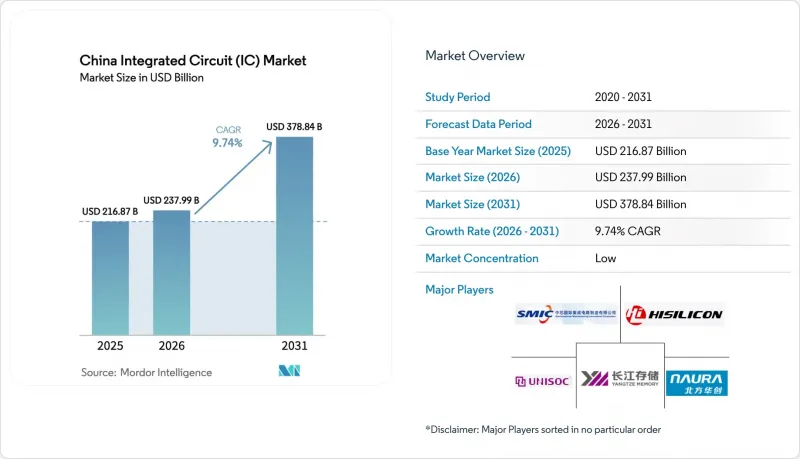
根據 Mordor Intelligence 預測,中國積體電路 (IC) 市場規模預計將從 2025 年的 2168.7 億美元成長到 2026 年的 2379.9 億美元,然後從 2026 年到 2031 年以 9.74% 的複合年成長率成長,達到 2031 年到 2031 年以 9.74% 的複合年成長率成長,達到 2031.4 億美元。
本報告依類型(類比IC[通用積體電路、專用積體電路]等)、晶圓尺寸(200毫米、300毫米、450毫米(試體))、製程節點(65奈米(傳統)、45/40奈米等)、設計所有權模式(無晶圓廠、IDM、專業代工廠)、45/40奈米等)、設計所有權模式(無晶圓廠、IDM、專業代工廠)、應用領域(消費性汽車等領域。市場預測以美元計價。
中國積體電路(IC)市場趨勢及洞察。
透過國家半導體基金第三階段擴大晶圓廠產能
規模達475億美元的第三期「大基金」直接投資於高頻寬記憶體和先進DRAM專案。財政部持有17.44%的股份,透過嚴格監管確保其與國家科技發展目標一致。長江儲存已實現每月50萬片3D NAND晶圓的產能,鞏固了中國在高階儲存裝置領域的地位。優先資金用於擴大成熟製程節點,以支援汽車和工業晶片的研發,彌補進口限制造成的短期供不應求。該計劃將里程碑式的資金投入與產能目標掛鉤,縮小了與海外主要廠商的差距,並振興了國內設備製造商。這些舉措共同加速了國內晶圓廠的擴張,並鞏固了中國積體電路市場的長期供應穩定性。
電動車和新能源汽車政策的推廣將提振對汽車積體電路(IC)的需求。
預計到2024年,中國電動車銷量將達到1,100萬輛,約佔全國汽車總銷量的一半。積極的購車補貼和雙抵政策推動了電源管理IC、碳化矽模組和汽車微控制器訂單的激增。比亞迪半導體將碳化矽(SiC)和IGBT生產線垂直整合到其電動車產品組合中,使其在2023年功率模組市場佔有率達到28.9%。預計到2025年,汽車IC市場規模將達到230億美元,本土晶圓代工廠正在最佳化28nm和16nm工藝,以滿足功能安全標準。隨著汽車製造商與晶片設計公司合作的不斷深化,認證週期也在加速,這正在中國積體電路市場培育一個能夠支援未來行動電子產品發展的生態系統。
對極微影術設備的使用限制
出口限制使得中國晶圓廠無法購買ASML的EUV光刻設備,阻礙了7nm及更小過程的量產經濟可行性。中芯國際已採用多模式DUV技術複製了7nm邏輯晶片,但掩模數量的增加推高了成本並降低了良率。荷蘭和日本將於2025年4月生效的更嚴格的許可法規加劇了這一瓶頸。這些限制促使國內研發轉向自主微影術技術,但與全面採用EUV技術的競爭對手之間的成本差距正在擴大。因此,在高效能運算領域,儘管政策制定者正在協商部分豁免,但企業仍依賴先進的封裝和晶片技術來彌補效能上的不足。
細分市場分析
預計到2025年,儲存裝置將佔中國積體電路市場佔有率的35.02%,這主要得益於長江儲存3D NAND快閃記憶體量產的擴大以及長江儲存DDR5的上市。隨著大型基金對高頻寬記憶體生產線投入數十億美元,中國與記憶體相關的積體電路市場規模預計將穩定成長。同時,隨著人工智慧推理、自動駕駛和邊緣運算等領域對高效能SoC的需求不斷成長,邏輯積體電路預計將以9.55%的複合年成長率成長。
混合訊號領域呈現穩定成長態勢。這是因為整合類比和數位訊號的架構在汽車感測器和工業控制系統中至關重要。類比IC在需要高可靠性的領域仍然不可或缺,採用180nm和90nm製程的國內晶圓廠預計將持續保持強勁的需求。隨著物聯網的普及,對微型積體電路的需求正在加速成長。在該領域,龍芯電子等國內CPU製造商正在提供ARM的替代方案,並進一步推進技術堆疊的在地化。
至2025年,隨著中芯國際、華宏半導體以及多家合資晶圓廠產能的全面提升,300mm規格晶片預計將佔國內市場銷售額的71.45%。這些生產線構成了支撐尖端邏輯、記憶體和射頻產品出貨的基礎,為中國積體電路市場的擴張提供了成本保障。而正在蓬勃發展的450mm先導計畫,預計將以13.22%的複合年成長率成長,體現了中國克服國際阻礙、確保長期製造優勢的決心。
採用200毫米以下晶圓尺寸的老舊晶圓廠主要生產小眾的類比、電源和顯示驅動器。政府獎勵支持對200毫米設備進行選擇性現代化改造,以確保國內專用節點的供應。這種多層晶圓尺寸配置提供了柔軟性,使製造商能夠在平衡資本投資風險的同時,支援差異化的產品系列。
其他好處:
- Excel格式的市場預測(ME)表
- 3個月的分析師支持
目錄
第1章:引言
- 研究假設和市場定義
- 調查範圍
第2章:調查方法
第3章執行摘要
第4章 市場狀況
- 市場概覽
- 市場促進因素
- 國家半導體基金第三階段將加速晶圓廠產能的擴張。
- 電動車和新能源汽車相關政策的推廣將擴大對汽車積體電路的需求。
- 超大規模人工智慧/雲端基礎設施的擴展正在創造對客製化加速器的需求。
- 將中國製造的物聯網引入數位車間式製造
- 由於制裁,成熟節點的整個供應鏈需要進行本地化。
- 日本 5G 基地台建設激增,導致射頻和功率積體電路的訂單增加。
- 市場限制因素
- 對EUV微影術設備的使用限制
- 高級積體電路設計和製程工程師嚴重短缺
- 由於 28nm 及更高製程產能過剩,價格下降。
- 智慧財產權和專利訴訟的持續風險
- 產業生態系分析
- 技術展望
- 波特五力分析
- 投資分析
第5章 市場規模與成長預測
- 按類型
- 類比IC
- 通用積體電路
- 專用積體電路
- 邏輯積體電路
- TTL
- CMOS
- 混合訊號積體電路
- 記憶
- DRAM
- NAND/NOR快閃記憶體
- 其他(SRAM、EEPROM)
- 微型積體電路
- 微處理器(MPU)
- 微控制器(MCU)
- 數位訊號處理器
- 類比IC
- 按晶圓尺寸
- 200 mm
- 300 mm
- 450 毫米(導引頭)
- 按行程節點
- 65奈米(傳統製程)
- 45/40 nm
- 28 nm
- 16/14 nm
- 10/7 nm
- 依設計所有權類型
- 無晶圓廠
- IDM
- 專業鑄造廠
- 透過使用
- 消費性電子產品
- 車
- IT/通訊
- 工業自動化
- 其他
- 按地區
- 華東地區(上海、江蘇、浙江)
- 中國中部和南部(廣東、湖南和湖北三省)
- 中國北方(北京、天津、河北)
- 中國東北地區(遼寧省、吉林省、黑龍江省)
- 中國西南地區(四川省、重慶市、雲南省)
- 西北地區(陝西、甘肅、新疆)
第6章 競爭情勢
- 市場集中度
- 策略趨勢
- 市佔率分析
- 公司簡介
- Semiconductor Manufacturing International Corp.(SMIC)
- Hua Hong Semiconductor
- Yangtze Memory Technologies Co.(YMTC)
- ChangXin Memory Tech(CXMT)
- HiSilicon(Huawei)
- UNISOC
- Nexperia(Wingtech)
- GigaDevice Semiconductor
- Loongson Technology
- Allwinner Technology
- SG Micro Corp.
- JCET Group
- TongFu Micro-electronics
- Tianshui Huatian Technology
- Naura Technology Group(Equipment)
- Advanced Micro-Fabrication Equipment(AMEC)
- Sino IC Leasing
- ASR Microelectronics
- Rockchip Electronics
- Empyrean Technology(EDA)
第7章 市場機會與未來展望
According to Mordor Intelligence, the China integrated circuit market size is expected to grow from USD 216.87 billion in 2025 to USD 237.99 billion in 2026 and is forecast to reach USD 378.84 billion by 2031 at 9.74% CAGR over 2026-2031.
This report is Segmented by Type (Analog IC [General-Purpose IC, Application-Specific IC], and More), Wafer Size (= 200 Mm, 300 Mm, 450 Mm), Process Node (= 65 Nm (Legacy), 45/40 Nm, and More), Design Ownership (Fabless, IDM, Pure-Play Foundry), Application (Consumer Electronics, Automotive, and More), and Geography. The Market Forecasts are Provided in Terms of Value (USD).
China Integrated Circuit (IC) Market Trends and Insights
National Semiconductor Fund Phase III Driving Fab Capacity Expansion
The USD 47.5 billion third-phase Big Fund channels capital directly into high-bandwidth memory and advanced DRAM projects. With the Ministry of Finance holding 17.44%, close oversight ensures alignment with national technology goals. YMTC has already lifted output to 500,000 3D NAND wafers per month, fortifying China's position in premium storage devices. Mature-node expansions that underpin automotive and industrial chips receive priority funding, bridging immediate shortfalls caused by import restrictions. The program's structure ties milestone financing to capacity targets, narrowing gaps with leading overseas manufacturers and stimulating local toolmakers. Collectively, these initiatives quicken the scale-up of domestic fabs and firm long-term supply security across the China integrated circuit market.
EV and NEV Policy Push Boosting Demand for Automotive-grade ICs
China sold 11 million electric vehicles in 2024, equal to nearly half of national car sales. Aggressive purchase subsidies and dual-credit mandates translate into surging orders for power management ICs, SiC modules, and automotive microcontrollers. BYD Semiconductor's power module share hit 28.9% in 2023 as the company vertically integrated silicon carbide and IGBT lines into its EV stack. With the automotive IC pool forecast at USD 23 billion in 2025, local foundries are tailoring 28 nm and 16 nm processes for functional safety compliance. Partnerships between carmakers and chip designers deepen, accelerating qualification cycles and fostering an ecosystem that anchors future mobility electronics inside the China integrated circuit market.
Restricted Access to EUV Lithography Tools
Export controls bar Chinese fabs from purchasing ASML's EUV scanners, stalling mass-production economics below 7 nm. SMIC has replicated 7 nm logic using multi-patterned DUV, yet higher mask counts raise cost and reduce yield. Stricter Dutch and Japanese licensing rules, effective April 2025, deepen the bottleneck. This restraint pushes domestic R&D toward indigenous lithography but widens the cost gap with rivals leveraging full EUV. High-performance computing segments therefore, lean on advanced packaging and chiplet approaches to bridge performance shortfalls while policymakers negotiate for partial exemption
Other drivers and restraints analyzed in the detailed report include:
- Hyperscale AI/Cloud Build-outs Creating Custom Accelerator Demand
- Made-in-China IoT Deployments in "Digital Workshop" Manufacturing
- Acute Shortage of Senior IC Design and Process Engineers
For complete list of drivers and restraints, kindly check the Table Of Contents.
Segment Analysis
Memory devices accounted for 35.02% of China integrated circuit market share in 2025 on the back of YMTC's 3D NAND ramp-up and CXMT's DDR5 debut. The China integrated circuit market size tied to memory is set to expand steadily as the Big Fund channels billions into high-bandwidth memory lines. Logic ICs, however, are poised for a 9.55% CAGR as AI inference, autonomous driving domains, and edge computing broaden demand for performance-dense SoCs.
The mixed-signal subset posts healthy gains because converged analog-digital architectures are critical for automotive sensors and industrial controls. Analog ICs remain indispensable in high-reliability sectors, giving local fabs with 180 nm and 90 nm assets enduring relevance. Micro IC demand accelerates alongside IoT proliferation, where domestic CPU players such as Loongson offer non-ARM alternatives that further localize the stack.
The 300 mm format generated 71.45% of national revenue in 2025 as SMIC, Hua Hong, and several JV fabs maxed out capacity. These lines underpin most advanced logic, memory, and RF shipments and provide the cost base from which the China integrated circuit market scales. A nascent 450 mm pilot, projected to grow 13.22% CAGR, demonstrates China's willingness to leapfrog international hesitation and secure long-term manufacturing edge.
Older <=200 mm fabs sustain niche analog, power, and display-driver production. Government incentives permit selective modernization of 200 mm equipment to safeguard domestic supply of specialty nodes. This tiered wafer-size landscape creates flexibility, allowing manufacturers to balance capex risk while meeting differentiated product portfolios.
Complete Report Scope:
- By Type
- Analog IC
- General-purpose IC
- Application-specific IC
- Logic IC
- TTL
- CMOS
- Mixed-Signal IC
- Memory IC
- DRAM
- NAND/NOR Flash
- Other Memories (SRAM, EEPROM)
- Micro IC
- Microprocessors (MPU)
- Microcontrollers (MCU)
- Digital Signal Processors
- Analog IC
- By Wafer Size
- = 200 mm
- 300 mm
- 450 mm (Pilot)
- By Process Node
- = 65 nm (Legacy)
- 45/40 nm
- 28 nm
- 16/14 nm
- 10/7 nm
- By Design Ownership
- Fabless
- IDM
- Pure-play Foundry
- By Application
- Consumer Electronics
- Automotive
- IT and Telecommunications
- Industrial and Automation
- Other Applications
- By Geography
- East China (Shanghai, Jiangsu, Zhejiang)
- South-Central China (Guangdong, Hunan, Hubei)
- North China (Beijing, Tianjin, Hebei)
- Northeast China (Liaoning, Jilin, Heilongjiang)
- Southwest China (Sichuan, Chongqing, Yunnan)
- Northwest China (Shaanxi, Gansu, Xinjiang)
List of Companies Covered in this Report:
- Semiconductor Manufacturing International Corp. (SMIC)
- Hua Hong Semiconductor
- Yangtze Memory Technologies Co. (YMTC)
- ChangXin Memory Tech (CXMT)
- HiSilicon (Huawei)
- UNISOC
- Nexperia (Wingtech)
- GigaDevice Semiconductor
- Loongson Technology
- Allwinner Technology
- SG Micro Corp.
- JCET Group
- TongFu Micro-electronics
- Tianshui Huatian Technology
- Naura Technology Group (Equipment)
- Advanced Micro-Fabrication Equipment (AMEC)
- Sino IC Leasing
- ASR Microelectronics
- Rockchip Electronics
- Empyrean Technology (EDA)
Additional Benefits:
- The market estimate (ME) sheet in Excel format
- 3 months of analyst support
TABLE OF CONTENTS
1 INTRODUCTION
- 1.1 Study Assumptions and Market Definition
- 1.2 Scope of the Study
2 RESEARCH METHODOLOGY
3 EXECUTIVE SUMMARY
4 MARKET LANDSCAPE
- 4.1 Market Overview
- 4.2 Market Drivers
- 4.2.1 National Semiconductor Fund Phase III Driving Fab capacity Expansion
- 4.2.2 EV and NEV Policy Push Boosting Demand for Automotive-grade ICs
- 4.2.3 Hyperscale AI/Cloud Build-outs Creating Custom Accelerator Demand
- 4.2.4 Made-in-China IoT Deployments in "Digital Workshop" Manufacturing
- 4.2.5 Sanctions-Driven Localization Across Mature-Node Supply Chain
- 4.2.6 Surge in Domestic 5G Base-Station Build Raising RF and Power IC Orders
- 4.3 Market Restraints
- 4.3.1 Restricted Access to EUV Lithography Tools
- 4.3.2 Acute Shortage of Senior IC Design and Process Engineers
- 4.3.3 Price Erosion from Over-capacity at 28 nm and Above
- 4.3.4 Persistent IP and Patent-Litigation Risks
- 4.4 Industry Ecosystem Analysis
- 4.5 Technological Outlook
- 4.6 Porter's Five Forces Analysis
- 4.6.1 Bargaining Power of Suppliers
- 4.6.2 Bargaining Power of Buyers
- 4.6.3 Threat of New Entrants
- 4.6.4 Intensity of Competitive Rivalry
- 4.6.5 Threat of Substitutes
- 4.7 Investment Analysis
5 MARKET SIZE AND GROWTH FORECASTS (VALUE)
- 5.1 By Type
- 5.1.1 Analog IC
- 5.1.1.1 General-purpose IC
- 5.1.1.2 Application-specific IC
- 5.1.2 Logic IC
- 5.1.2.1 TTL
- 5.1.2.2 CMOS
- 5.1.2.3 Mixed-Signal IC
- 5.1.3 Memory IC
- 5.1.3.1 DRAM
- 5.1.3.2 NAND/NOR Flash
- 5.1.3.3 Other Memories (SRAM, EEPROM)
- 5.1.4 Micro IC
- 5.1.4.1 Microprocessors (MPU)
- 5.1.4.2 Microcontrollers (MCU)
- 5.1.4.3 Digital Signal Processors
- 5.1.1 Analog IC
- 5.2 By Wafer Size
- 5.2.1 = 200 mm
- 5.2.2 300 mm
- 5.2.3 450 mm (Pilot)
- 5.3 By Process Node
- 5.3.1 = 65 nm (Legacy)
- 5.3.2 45/40 nm
- 5.3.3 28 nm
- 5.3.4 16/14 nm
- 5.3.5 10/7 nm
- 5.4 By Design Ownership
- 5.4.1 Fabless
- 5.4.2 IDM
- 5.4.3 Pure-play Foundry
- 5.5 By Application
- 5.5.1 Consumer Electronics
- 5.5.2 Automotive
- 5.5.3 IT and Telecommunications
- 5.5.4 Industrial and Automation
- 5.5.5 Other Applications
- 5.6 By Geography
- 5.6.1 East China (Shanghai, Jiangsu, Zhejiang)
- 5.6.2 South-Central China (Guangdong, Hunan, Hubei)
- 5.6.3 North China (Beijing, Tianjin, Hebei)
- 5.6.4 Northeast China (Liaoning, Jilin, Heilongjiang)
- 5.6.5 Southwest China (Sichuan, Chongqing, Yunnan)
- 5.6.6 Northwest China (Shaanxi, Gansu, Xinjiang)
6 COMPETITIVE LANDSCAPE
- 6.1 Market Concentration
- 6.2 Strategic Moves
- 6.3 Market Share Analysis
- 6.4 Company Profiles (includes Global level Overview, Market level overview, Core Segments, Financials as available, Strategic Information, Market Rank/Share for key companies, Products and Services, and Recent Developments)
- 6.4.1 Semiconductor Manufacturing International Corp. (SMIC)
- 6.4.2 Hua Hong Semiconductor
- 6.4.3 Yangtze Memory Technologies Co. (YMTC)
- 6.4.4 ChangXin Memory Tech (CXMT)
- 6.4.5 HiSilicon (Huawei)
- 6.4.6 UNISOC
- 6.4.7 Nexperia (Wingtech)
- 6.4.8 GigaDevice Semiconductor
- 6.4.9 Loongson Technology
- 6.4.10 Allwinner Technology
- 6.4.11 SG Micro Corp.
- 6.4.12 JCET Group
- 6.4.13 TongFu Micro-electronics
- 6.4.14 Tianshui Huatian Technology
- 6.4.15 Naura Technology Group (Equipment)
- 6.4.16 Advanced Micro-Fabrication Equipment (AMEC)
- 6.4.17 Sino IC Leasing
- 6.4.18 ASR Microelectronics
- 6.4.19 Rockchip Electronics
- 6.4.20 Empyrean Technology (EDA)
7 MARKET OPPORTUNITIES AND FUTURE OUTLOOK
- 7.1 White-space and Unmet-need Assessment

 2026-2030年全球毫米波雷達市場
 2026 年至 2035 年低溫 CMOS 量子控制電子元件的市場機會、成長要素、產業趨勢分析與預測。
 全球電子材料和化學品市場規模、佔有率、趨勢和成長分析報告(2026-2034年)
 鋰電池電量指示器IC市場分析及至2035年預測:類型、產品、技術、組件、應用、裝置、最終用戶、功能、安裝、解決方案
 毫米波雷達積體電路市場報告:趨勢、預測與競爭分析(至2035年)毫米波雷達市場分析及至2035年預測:類型、技術、組件、應用、最終用戶、安裝配置、雷達類型、偵測範圍
 積體電路(IC)市場規模、佔有率和成長分析:按產品類型、組件、技術、晶圓尺寸、最終用途產業和地區分類-2026-2033年產業預測
 2026-2030年全球積體電路市場
 2026-2030年全球穩健型積體電路(IC)市場
 積體電路市場-全球產業規模、佔有率、趨勢、機會、預測:按產品類型、按類型、按應用、按行業垂直領域、按地區和競爭對手分類,2021-2031年